Co Selling Partnership: How B2B Teams Actually Close Deals Together
Most co selling partnership programs die in the account-mapping stage. Here's how the ones that work are structured, staffed, and measured — plus the metrics that prove it.
A co selling partnership only works when both sides bring live accounts, live contacts, and a written revenue split. Most never get that far. Here is what the programs that source real pipeline do differently.
TL;DR
A co selling partnership is two companies working the same account with a shared plan, shared data, and a written revenue split. It is not two AEs on a Zoom call agreeing to "keep each other posted."
The failure point is almost never strategy. It is account mapping and contact data. Partners trade spreadsheets, find that 60% of the overlap is stale, and the momentum dies in week three.
Co-sell deals close roughly 25–45% faster than solo outbound in most partner-led programs. You inherit trust instead of building it. That only holds where the account overlap is real.
The three models — referral, co-sell, and full co-marketing — need different comp plans, different CRM plumbing, and different headcount. Mixing them is why partner teams get defunded.
Before you pitch a partner, know your side of the overlap cold: which accounts, which champions, and which contacts are still reachable.
What is a co selling partnership?#
A co selling partnership is an agreement where two vendors sell into the same account at the same time. They coordinate the motion so the buyer hears one story instead of two pitches.
Think of two contractors bidding on the same kitchen. A referral partnership is one contractor handing the homeowner a plumber's card. A co selling partnership is both of them showing up to the walkthrough together — one quote, one timeline, and a clear answer to "who do I call when the sink leaks."
That distinction matters. Most companies say "co-sell" when they mean "referral," then wonder why nobody is paid correctly.
The mechanics are unglamorous. You identify shared accounts. You agree on who leads. You agree on how revenue and credit get split. You give each other enough visibility to avoid embarrassing yourselves in front of the customer. The QBRs, the enablement decks, the Slack Connect channel — all of it is scaffolding around those four things.
Here is what makes it worth the operational drag: you are not cold. Your partner's AE already has a champion, a budget conversation in motion, and a reason to be on the call. You inherit that. According to HubSpot's research on partner ecosystems, companies with mature partner programs report shorter sales cycles and bigger deals than direct-only teams. The credibility transfer is the whole product.
How is co-selling different from referral or channel partnerships?#
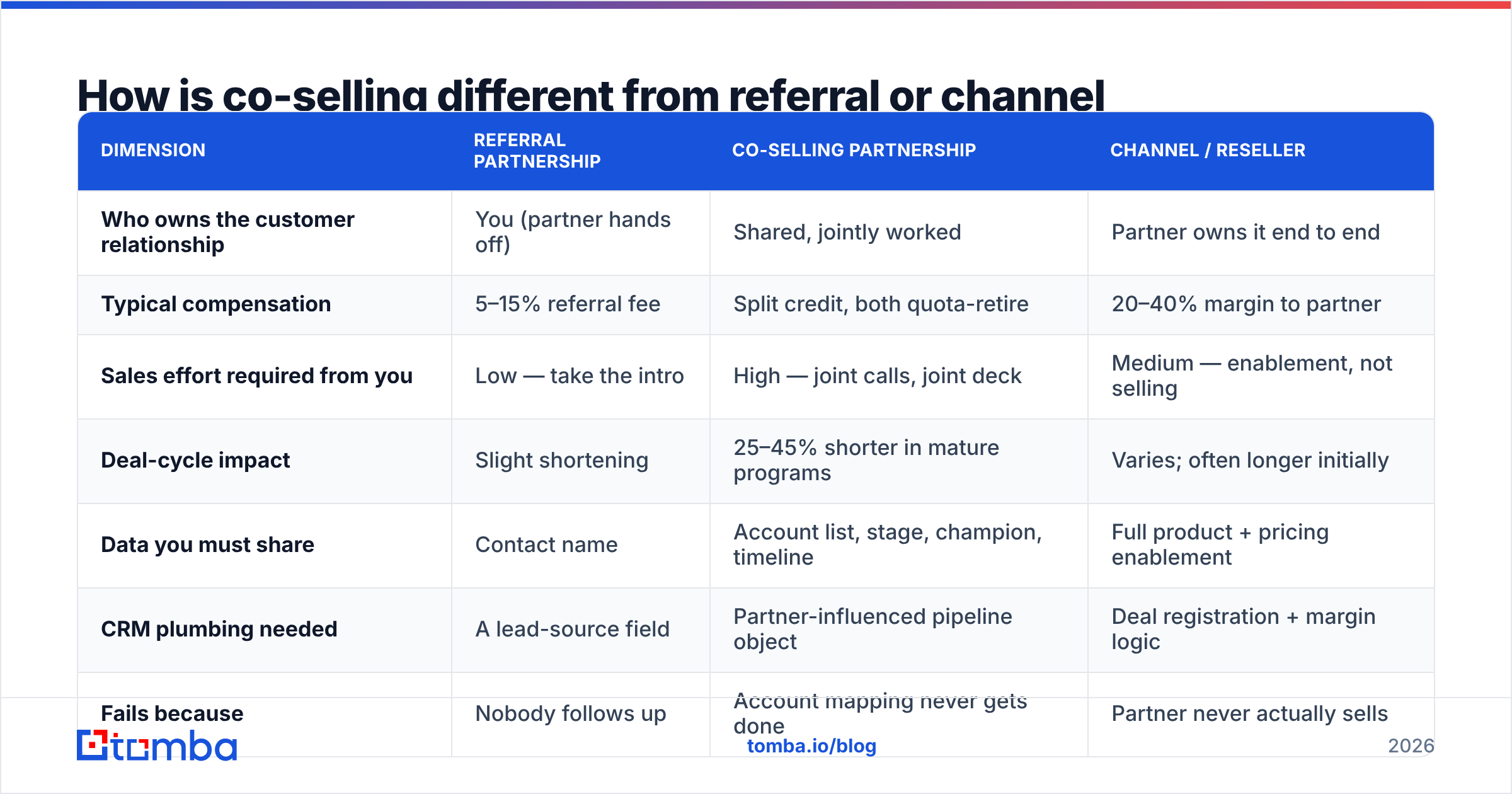
Three models get lumped together, and they are not the same. Here is the honest breakdown:
| Dimension | Referral partnership | Co-selling partnership | Channel / reseller |
|---|---|---|---|
| Who owns the customer relationship | You (partner hands off) | Shared, jointly worked | Partner owns it end to end |
| Typical compensation | 5–15% referral fee | Split credit, both quota-retire | 20–40% margin to partner |
| Sales effort required from you | Low — take the intro | High — joint calls, joint deck | Medium — enablement, not selling |
| Deal-cycle impact | Slight shortening | 25–45% shorter in mature programs | Varies; often longer initially |
| Data you must share | Contact name | Account list, stage, champion, timeline | Full product + pricing enablement |
| CRM plumbing needed | A lead-source field | Partner-influenced pipeline object | Deal registration + margin logic |
| Fails because | Nobody follows up | Account mapping never gets done | Partner never actually sells |
| Realistic time to first dollar | 2–6 weeks | 3–6 months | 6–12 months |
The pattern is clear. Co-selling sits in the awkward middle. It costs more than a referral program and pays back faster than a channel program — but only if you do the joint work. Half-built co-sell motions produce referral-tier results at channel-tier cost. That is the trap.
One more honest read: co-selling only makes sense when your products are adjacent, not overlapping. An email-finding platform and a sequencing tool co-sell beautifully. Two email-finding platforms never will, no matter how friendly the founders are.
Why do most co-selling partnerships fail before the first joint call?#
Account mapping. Almost always account mapping.
Here is the sequence, and it plays out the same way at nearly every company:
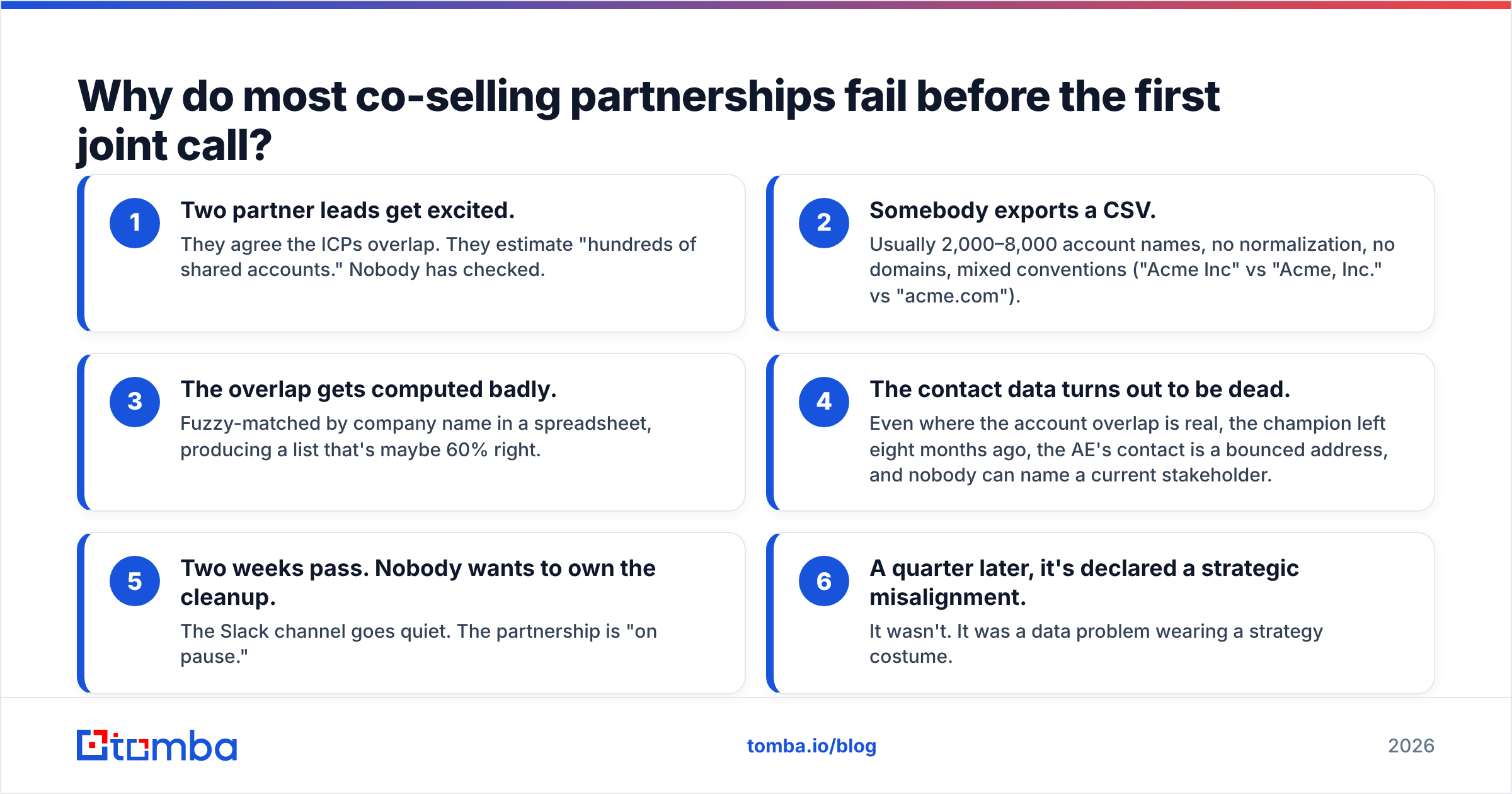
- Two partner leads get excited. They agree the ICPs overlap. They estimate "hundreds of shared accounts." Nobody has checked.
- Somebody exports a CSV. Usually 2,000–8,000 account names, no domains, mixed conventions ("Acme Inc" vs "Acme, Inc." vs "acme.com").
- The overlap gets computed badly. Fuzzy-matched by company name in a spreadsheet, producing a list that is maybe 60% right.
- The contact data turns out to be dead. Even where the account overlap is real, the champion left eight months ago and the AE's contact bounces.
- Two weeks pass. Nobody wants to own the cleanup. The Slack channel goes quiet. The partnership is "on pause."
- A quarter later, it is declared a strategic misalignment. It was not. It was a data problem wearing a strategy costume.
The fix is boring and it works: normalize on domain, not company name. Every account row gets a canonical domain before anyone compares anything. Then re-verify the contacts on both sides for the accounts that survive. A co-sell motion built on a list where a third of the emails bounce will burn your sender reputation and your partner's patience in the same week.
This is where a domain search pass earns its keep. Point it at the shared-account domain list and pull the current people in the relevant roles. You walk into the first joint call with live names instead of a graveyard. Run the survivors through an email verifier before anyone sends under a joint banner.
What does a co-selling partnership actually require operationally?#
Six things. If you cannot check all six, you have a referral partnership with extra meetings.
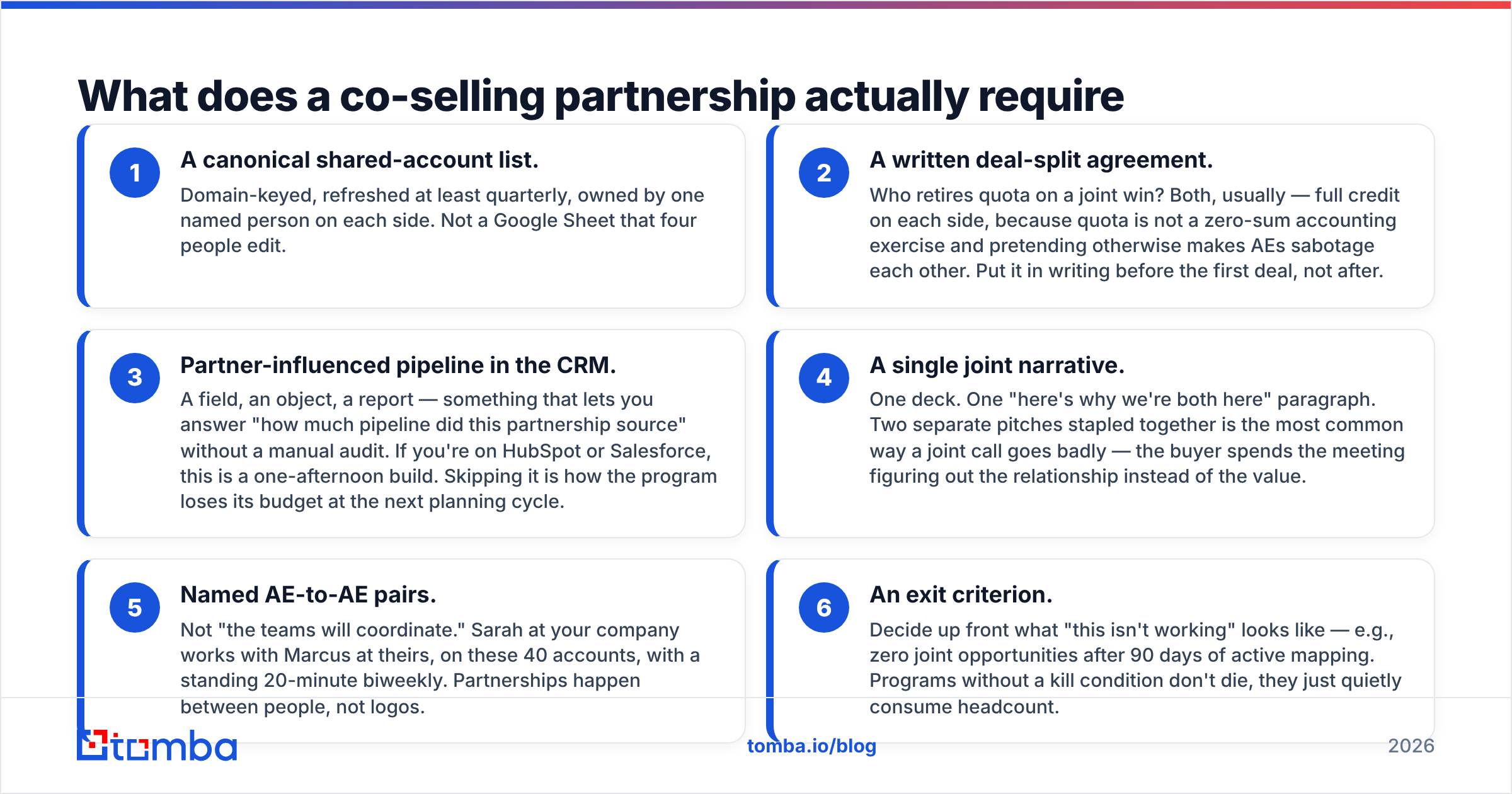
A canonical shared-account list. Domain-keyed, refreshed quarterly, owned by one named person on each side. Not a Google Sheet that four people edit.
A written deal-split agreement. Who retires quota on a joint win? Both sides, usually. Quota is not a zero-sum accounting exercise, and pretending otherwise makes AEs sabotage each other. Put it in writing before the first deal.
Partner-influenced pipeline in the CRM. A field, an object, a report — something that answers "how much pipeline did this partnership source" without a manual audit. On HubSpot or Salesforce, this is a one-afternoon build. Skip it and the program loses its budget at the next planning cycle.
A single joint narrative. One deck. One "here is why we are both here" paragraph. Two pitches stapled together is the most common way a joint call goes badly. The buyer spends the meeting decoding your relationship instead of the value.
Named AE-to-AE pairs. Not "the teams will coordinate." Sarah works with Marcus, on these 40 accounts, with a standing 20-minute biweekly. Partnerships happen between people, not logos.
An exit criterion. Decide up front what "this is not working" looks like — say, zero joint opportunities after 90 days of active mapping. Programs without a kill condition do not die. They quietly consume headcount.
Four of the six are data or process problems, not relationship problems. That ratio is about right for how co-selling actually fails.
How do you find the right co-selling partner?#
Start with the accounts, not the logo. Most partner strategies get built backwards. Someone wants a marquee name for the website, and the account overlap gets reverse-engineered to justify it.
The better sequence:
Look at your closed-won deals. What else did those customers buy in the same six-month window? Ask them. Your best co-sell partner is usually already in your customers' stack.
Check the tech overlap directly. If a target account runs your partner's product, the overlap is a fact, not a hypothesis. A website tech stack check across your target list gives you a real signal instead of a guess.
Filter for complementary, not adjacent-sounding. The question is not "do we both sell to RevOps?" It is "does buying us make buying them easier, and the reverse?" If the answer is no, you have a co-marketing partner.
Weigh their motion, not just their market. A partner with a self-serve PLG motion and no AEs cannot co-sell with you, however well the ICPs line up. There has to be a human on the other end of the joint call.
Size the overlap before you commit. Forty genuinely shared accounts with active champions beats 900 name-matched rows. Run the mapping before the announcement, not after.
Worth noting: the co-sell landscape includes peers you would normally call competitors. Data providers like BookYourData and Tomba serve overlapping buyers, yet they often complement each other in a stack. One is strong on pre-built list depth, the other on real-time verification and API-driven lookup. Adjacent-but-not-identical is exactly the shape a co-sell motion needs. Partnering only with tools in far-off categories leaves a lot of pipeline on the table.
For a sanity check on who is actually adjacent in your category, G2's category maps are a faster read than most analyst reports.
What metrics prove a co selling partnership is working?#
Four numbers, tracked from day one. Everything else is a vanity metric with a nice chart.
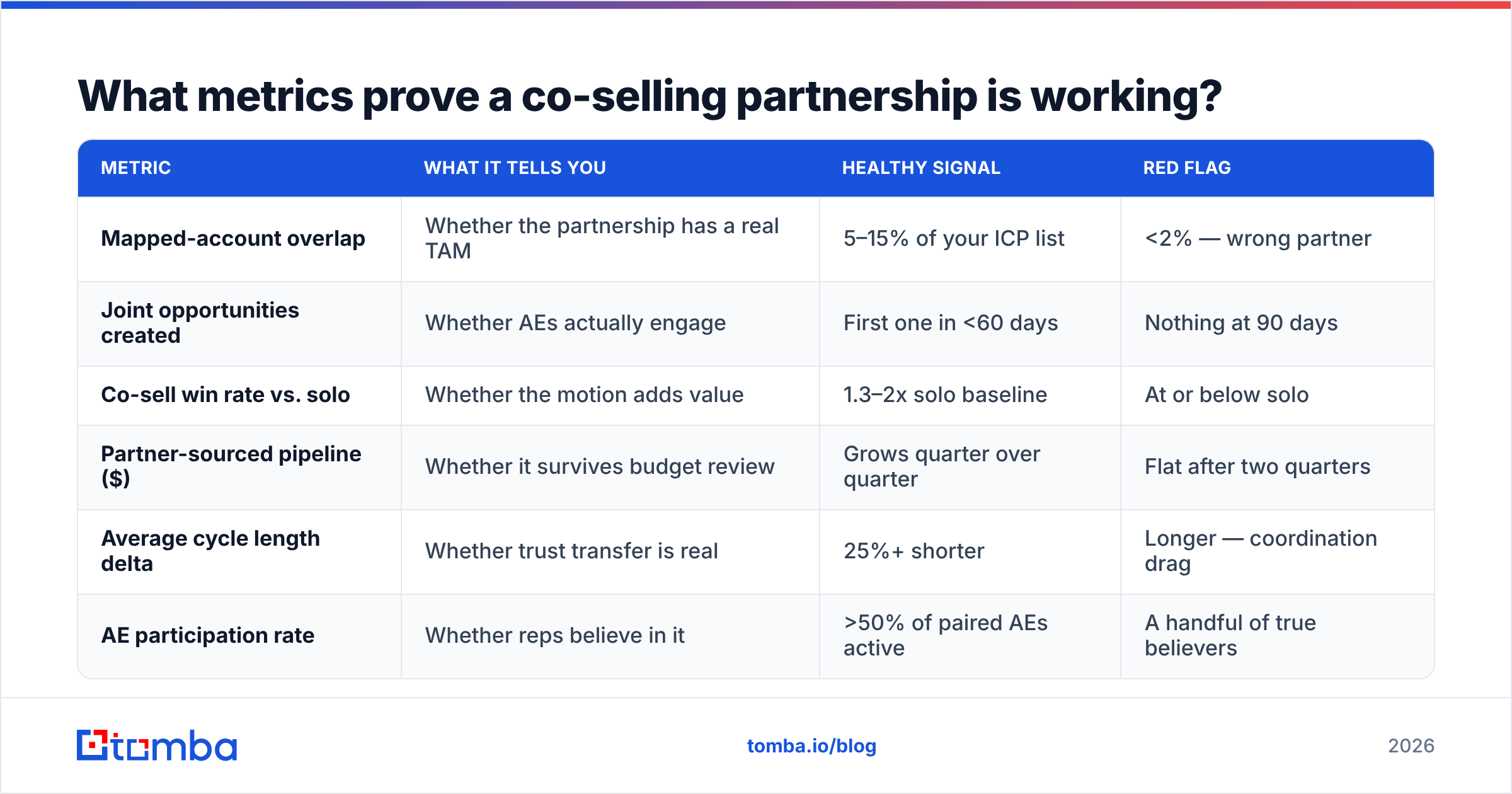
| Metric | What it tells you | Healthy signal | Red flag |
|---|---|---|---|
| Mapped-account overlap | Whether the partnership has a real TAM | 5–15% of your ICP list | <2% — wrong partner |
| Joint opportunities created | Whether AEs actually engage | First one in <60 days | Nothing at 90 days |
| Co-sell win rate vs. solo | Whether the motion adds value | 1.3–2x solo baseline | At or below solo |
| Partner-sourced pipeline ($) | Whether it survives budget review | Grows quarter over quarter | Flat after two quarters |
| Average cycle length delta | Whether trust transfer is real | 25%+ shorter | Longer — coordination drag |
| AE participation rate | Whether reps believe in it | >50% of paired AEs active | A handful of true believers |
The one people skip: AE participation rate. A program where three enthusiastic reps produce all the pipeline is not a program. It is three people who like each other, and it will not survive either of them changing jobs. Track how many paired AEs logged a joint activity this quarter. That number predicts survival better than revenue does.
On measurement, Forrester's work on partner ecosystems makes the point well. Partner programs get killed not because they underperform, but because they cannot prove they performed. Instrument first.
How do you launch a co-selling motion in 30 days?#
Week 1 — Map. Export both account lists. Normalize to domains. Compute the overlap. If the real overlap is under 2% of your ICP, stop here and save everyone six months. This week is a filter, not a formality.
Week 2 — Enrich and verify. Identify current stakeholders on both sides for every account in the overlap. Titles change and people leave. A joint outreach built on last year's contacts is worse than none — it tells the buyer that neither of you is paying attention. Run data enrichment across the overlap and verify before anyone sends.
Week 3 — Pair and arm. Assign named AE pairs. Build one joint deck with one narrative. Write the deal-split rule down. Stand up the partner-influenced field in the CRM. Set the exit criterion.
Week 4 — Run five deals. Not fifty. Five. Pick the five accounts with the strongest overlap and the warmest champion. Run the joint motion end to end, then debrief hard on all five. What you learn there decides whether the next hundred work.
The mistake here is scale-first. Teams announce the partnership, blast a joint campaign at 900 mapped accounts, get a 4% reply rate and a pile of bounces, and conclude co-selling does not work. It works. Sequencing it wrong does not.
Is a co selling partnership worth it for your team?#
It comes down to one thing: whether you have the discipline to maintain a shared account list.
If you do, co-selling is one of the highest-leverage motions in B2B. You get shorter cycles, higher win rates, and warm entry into accounts your outbound could not crack. All of it costs a fraction of buying that access through paid channels.
If you do not — if your CRM is a mess, your contact data is 18 months stale, and nobody owns the account list — a co selling partnership will expose all of it, in front of a partner, at speed. That is not a reason to skip it. It is a reason to fix the data first.
Here is the unglamorous conclusion most partner content avoids. The bottleneck in your co selling partnership is not your partner. It is whether you can take a list of 400 shared account domains and produce the current, verified, reachable humans behind them within a week.
Start there. Use Tomba's Email Finder to turn your shared-account domain list into verified contacts before the first joint call. The free tier gives you 25 searches to test the overlap, and Starter is $49/mo. The Tomba API will map the whole list programmatically once you scale past five deals. See full Tomba pricing for team plans.
The partnership strategy is the easy part. Showing up with people who still work there is the part that closes.
Related guides#
Ready to find emails that actually work?
Join 150,000+ professionals who stopped guessing and started sending. Free credits on signup — no credit card required.
Get the Tomba newsletter
Practical outbound tactics and product updates — once every two weeks.
About the author