Coachability in Sales: Why It Predicts Rep Success in 2026
Coachability in sales often beats raw talent at predicting who hits quota. Here's how to spot it, measure it, and build it into your team culture.
Hiring managers keep chasing the "natural closer." Then they watch that hire flatline in month four while a quieter, less polished rep passes quota and keeps climbing. The difference usually is not talent. It is coachability.
TL;DR#
- Coachability in sales is a rep's willingness and ability to absorb feedback, change behavior, and improve — and it predicts long-term performance better than raw charisma or early ramp speed.
- It is observable and measurable. You can score it in interviews, in ride-alongs, and in how reps respond to call reviews.
- Uncoachable top performers create a hidden tax: they cap their own growth, resist process, and quietly teach the team that feedback is optional.
- Coachability is partly a trait and partly an environment. Weak coaching cadences make even open reps look closed.
- Build it with a repeatable feedback loop, psychological safety, and manager consistency — not with one-off "development chats."
What Is Coachability in Sales?#
Coachability is the loop of hearing feedback, actually changing what you do, and getting measurably better because of it. Think of it like a GPS recalculating: a coachable rep hears "you missed the turn," reroutes without arguing with the map, and arrives faster next time. An uncoachable rep insists the map is wrong and keeps driving.
In sales specifically, coachability shows up across three behaviors:
- Receiving — the rep listens to feedback without getting defensive, asks clarifying questions, and treats criticism as data instead of an attack.
- Applying — they change the actual behavior on the next call, email, or demo, not just nod in the 1:1.
- Sustaining — the change sticks, compounds, and shows up in metrics like win rate and response rate over a quarter, not just for a day.
That last part matters. Plenty of reps can perform a change once to please a manager. Coachability is when the new behavior becomes the default.
Why Does Coachability Predict Success Better Than Talent?#
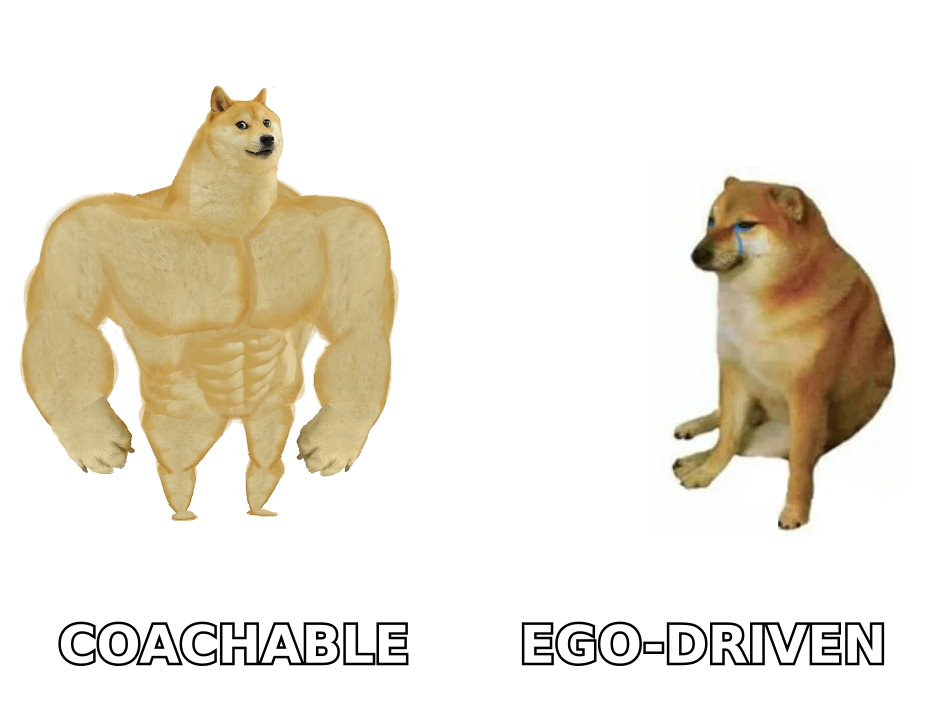
Talent is a starting position. Coachability is a slope. Over a two-year window, slope wins almost every time.
A talented but closed rep improves slowly because every piece of feedback bounces off. A moderately talented but open rep compounds — small weekly adjustments to discovery questions, objection handling, and follow-up cadence stack into a dramatically better seller by month twelve. Research and field data from sales orgs consistently show that ramp speed and first-quarter numbers are weak predictors of year-two performance, while responsiveness to coaching is a strong one.
There is also a compounding organizational effect. According to Gartner research on sales enablement, reps who consistently apply manager coaching outperform peers who do not, and the gap widens as the sales motion gets more complex. When your product, buyer, or CRM process changes — and it always does — coachable reps adapt in weeks. Uncoachable reps treat every change as a threat.
The uncomfortable truth: your uncoachable top performer is often your most expensive employee. Not because of salary, but because of the ceiling they hit and the culture they model.
What Are the Signs of a Coachable (vs. Uncoachable) Rep?#
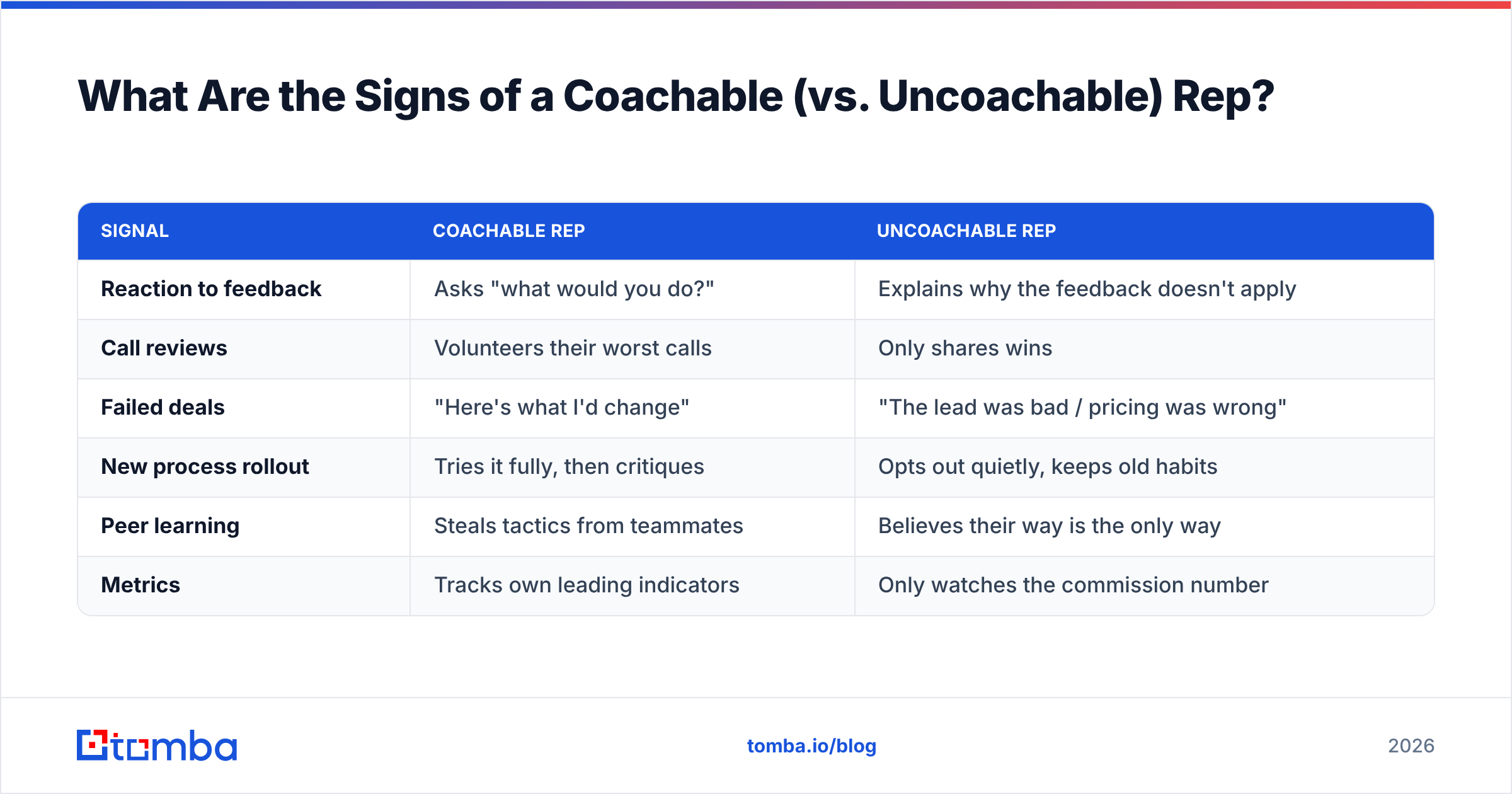
You do not need a personality test. Coachability leaks out in everyday behavior. Here is a practical signal table you can use in interviews, ride-alongs, and 1:1s.
| Signal | Coachable rep | Uncoachable rep |
|---|---|---|
| Reaction to feedback | Asks "what would you do?" | Explains why the feedback doesn't apply |
| Call reviews | Volunteers their worst calls | Only shares wins |
| Failed deals | "Here's what I'd change" | "The lead was bad / pricing was wrong" |
| New process rollout | Tries it fully, then critiques | Opts out quietly, keeps old habits |
| Peer learning | Steals tactics from teammates | Believes their way is the only way |
| Metrics | Tracks own leading indicators | Only watches the commission number |
One row does not define a rep. The pattern across rows does. A rep who consistently sits in the right column is not a coaching problem you will solve with encouragement — they are a hiring and accountability decision.
The interview test#
Ask any candidate: "Tell me about a piece of feedback that changed how you sell." Coachable candidates have a specific story with a before and after. Uncoachable candidates give a vague answer or, worse, describe feedback they received and rejected because they "knew better." Then push once: give them a small piece of live feedback on their answer and watch how they take it. That thirty-second reaction tells you more than the resume.
How Do You Measure Coachability?#
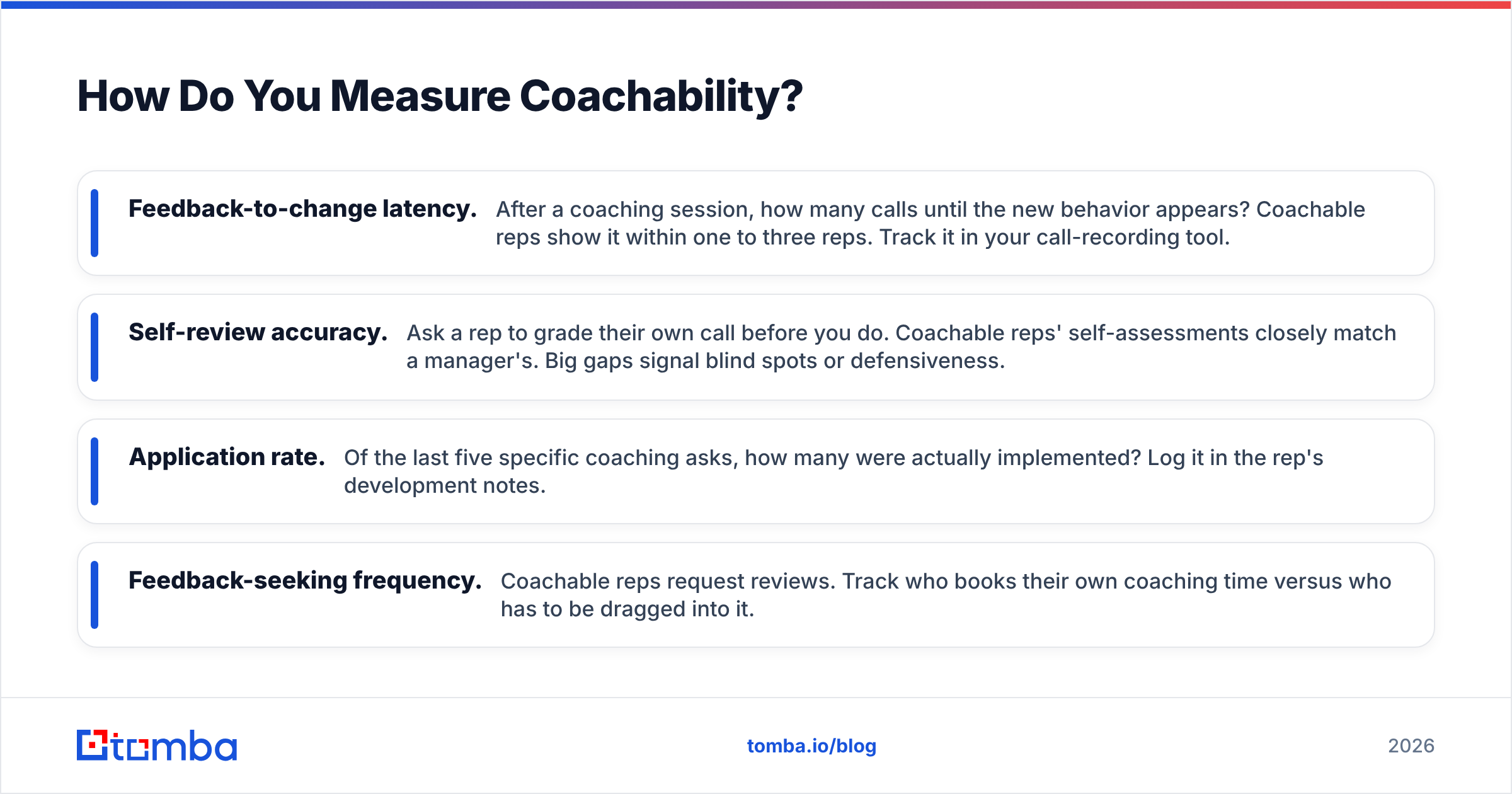
You measure it the way you measure any behavior: define it, observe it repeatedly, and score it against a rubric instead of a gut feeling.
- Feedback-to-change latency. After a coaching session, how many calls until the new behavior appears? Coachable reps show it within one to three reps. Track it in your call-recording tool.
- Self-review accuracy. Ask a rep to grade their own call before you do. Coachable reps' self-assessments closely match a manager's. Big gaps signal blind spots or defensiveness.
- Application rate. Of the last five specific coaching asks, how many were actually implemented? Log it in the rep's development notes.
- Feedback-seeking frequency. Coachable reps request reviews. Track who books their own coaching time versus who has to be dragged into it.
Keep the scoring lightweight — a 1-to-5 rating per dimension in your sales enablement notes is enough. The goal is trend visibility, not a bureaucratic scorecard. When you can see coachability declining for a normally open rep, that is usually a burnout or trust signal, not a character flaw.
Is Coachability a Trait or Can You Build It?#
Both — and treating it as fixed is the most common management mistake. Some reps arrive more open than others, but the environment sets the ceiling. A defensive rep in a psychologically safe, consistent-coaching team will open up. A naturally open rep under a manager who only gives feedback after a bad quarter will armor up fast.
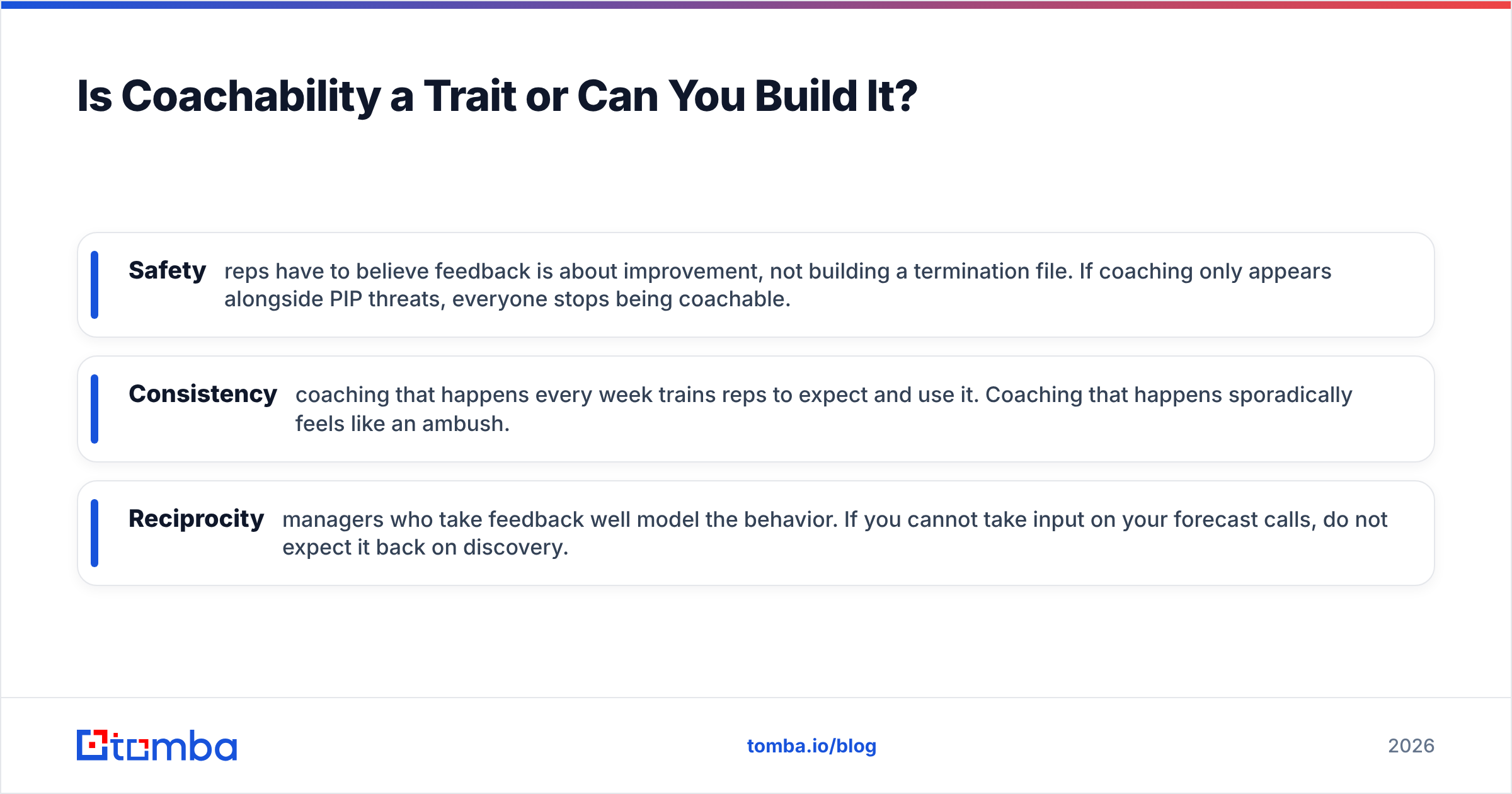
Three environmental factors decide whether coachability grows or dies on your team:
- Safety — reps have to believe feedback is about improvement, not building a termination file. If coaching only appears alongside PIP threats, everyone stops being coachable.
- Consistency — coaching that happens every week trains reps to expect and use it. Coaching that happens sporadically feels like an ambush.
- Reciprocity — managers who take feedback well model the behavior. If you cannot take input on your forecast calls, do not expect it back on discovery.
How Do You Build a Coaching Culture That Actually Sticks?#
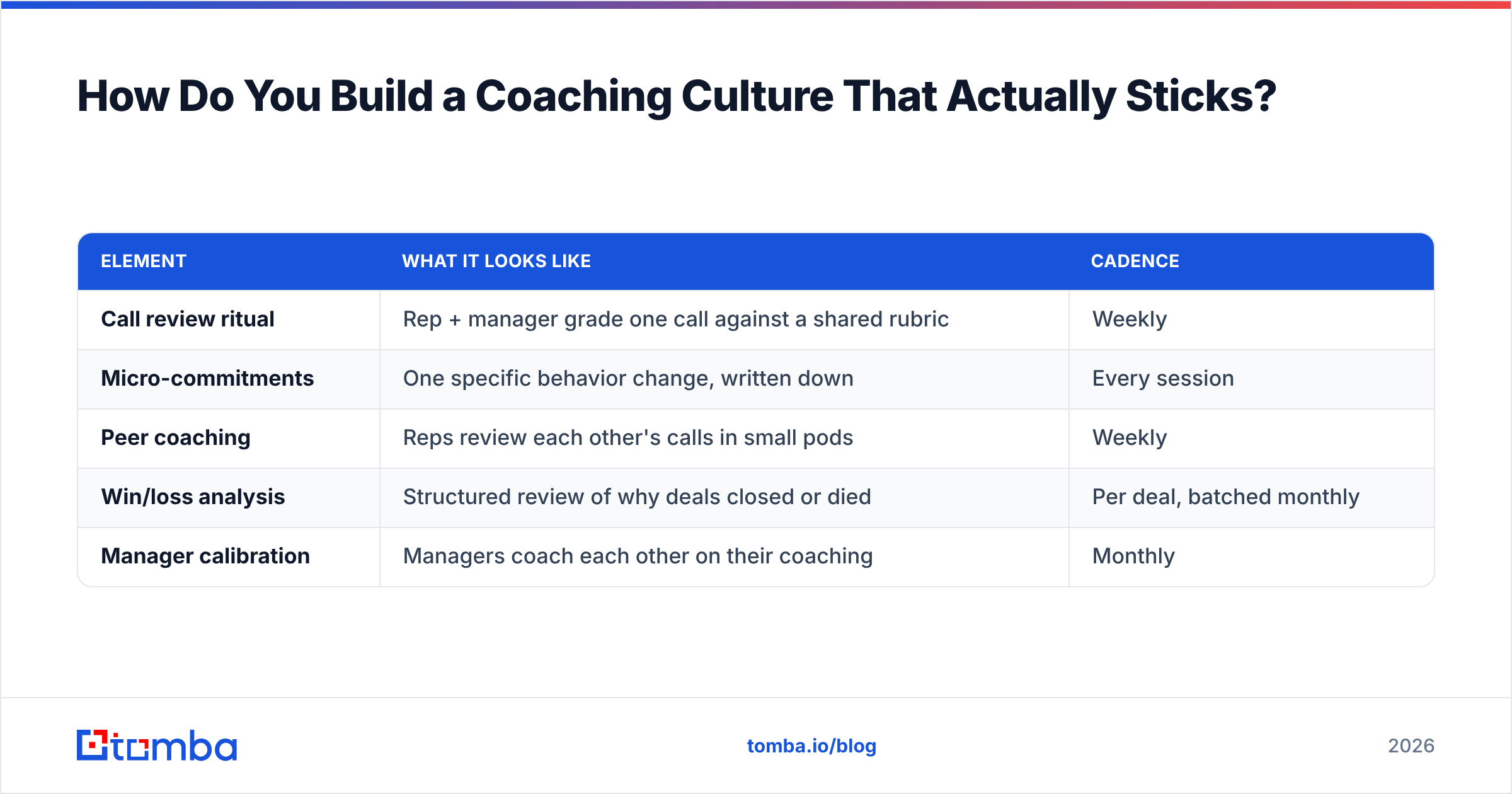
Stop running "development conversations" and start running a loop. A culture of coachability is a system, not a vibe. Here is a framework that scales from a three-rep team to a hundred.
| Element | What it looks like | Cadence |
|---|---|---|
| Call review ritual | Rep + manager grade one call against a shared rubric | Weekly |
| Micro-commitments | One specific behavior change, written down | Every session |
| Peer coaching | Reps review each other's calls in small pods | Weekly |
| Win/loss analysis | Structured review of why deals closed or died | Per deal, batched monthly |
| Manager calibration | Managers coach each other on their coaching | Monthly |
A few principles make or break it:
- One thing at a time. Coaching a rep on six weaknesses guarantees zero improvement. Pick the single highest-leverage behavior and stay on it until it sticks.
- Behavior, not personality. "You were defensive on that call" is unactionable. "You interrupted the buyer twice before they finished the pain statement" is coachable.
- Follow the rep, not the deal. Deal reviews optimize the pipeline. Rep coaching optimizes the seller. You need both, but do not confuse them — a pure deal desk teaches reps nothing durable.
- Make feedback bidirectional. End sessions with "what should I do differently as your manager?" It builds the reciprocity that keeps reps open.
Companies like HubSpot and Salesforce publicly credit structured, high-frequency coaching cadences — not just hiring "A-players" — for durable rep performance. The pattern is consistent across high-performing orgs: the coaching system matters more than the raw talent pool it operates on.
Where Does Coachability Fit Alongside the Rest of the Sales Stack?#
Coachability determines whether your other investments pay off. You can buy the best sequences, the cleanest data, and the sharpest playbook, but an uncoachable team will underuse all of it. The reps who actually adopt new tools, new B2B data sources, and new messaging are — unsurprisingly — the coachable ones.
That is why smart managers screen for coachability before investing in enablement. Handing a polished prospecting workflow to a rep who won't change their habits is like installing a world-class kitchen for someone who refuses to cook. The tools reward the reps who are willing to learn them.
It also changes how you think about tenure. A three-year veteran who stopped being coachable in year two is often a bigger risk than a coachable six-month hire, because the veteran's habits are cemented and their influence on newer reps is larger.
Common Mistakes Managers Make Around Coachability#
- Confusing agreeableness with coachability. A rep who nods at everything and changes nothing is not coachable — they are conflict-avoidant. Real coachability includes pushback plus behavior change.
- Only coaching the strugglers. Your top reps have the most upside from coaching and get the least. Coach the middle and the top, not just the bottom.
- Coaching outcomes instead of behaviors. "Close more" is a wish. "Ask the budget question before the demo" is coaching.
- Giving up after one attempt. Behavior change takes repetition. If a rep did not change after one session, that is the normal timeline, not proof they are uncoachable.
- Ignoring your own coachability. The fastest way to kill a feedback culture is a manager who dishes it out and never takes it.
Frequently Asked Questions#
Can you hire for coachability? Yes. Use behavioral interview questions with a before/after structure, give live micro-feedback in the interview, and check references specifically on how the candidate handled criticism. Weight these signals as heavily as you weight quota history.
Should you fire an uncoachable top performer? Not automatically — but do not ignore it. Set clear behavioral expectations, coach explicitly on the resistance itself, and measure the culture cost. If they cap the team's growth and reject every process, the math often favors moving on.
How long does it take to build coachability on a team? With a consistent weekly cadence, most managers see measurable change in application rates within a quarter. Culture-level change — where reps coach each other unprompted — usually takes two to three quarters.
Is coachability different from being teachable? Slightly. Teachable is about acquiring knowledge; coachable is about changing behavior under real-world pressure. A rep can know the playbook cold and still be uncoachable in a live deal.
The Bottom Line#
Coachability in sales is the highest-leverage trait you can screen for and the most underrated one you can build. Talent gets a rep to their first quota. Coachability is what carries them to their tenth. Score it, coach it, and protect the environment that lets it grow — and your team compounds instead of plateaus.
And once your reps are coachable enough to actually adopt better workflows, give them prospecting data worth acting on. Tomba's Email Finder helps coachable teams turn improved outreach habits into real pipeline — accurate, verified contacts so every refined message lands in front of the right person. Start free with 25 searches, then scale on a Tomba plan that fits your team as it grows.
Related guides#
// get started
Find, verify and enrich your first contacts today
Start on the free plan with 25 searches a month, then scale when your team is ready.
Free plan · No credit card required · GDPR & CCPA
// about the author