Cognism vs Prosperfleet Valgen: A 2026 B2B Data Comparison
Cognism and Prosperfleet Valgen both promise clean B2B contact data, but they price, cover, and verify very differently. Here's an honest breakdown of which fits your outbound motion in 2026.
Choosing a B2B data provider is really a bet on two things: how many of your target contacts the tool actually has, and how many of those records are still true when your rep hits send. Cognism and Prosperfleet Valgen sit on opposite ends of that trade-off, and the right pick depends on whether you're buying a full sales-intelligence suite or a leaner, pay-for-what-you-use data layer.
This is a neutral, hands-on comparison — not a pitch for either vendor. We'll look at coverage, accuracy, pricing structure, compliance, and the workflows each one is built for, then show where a focused tool like Tomba fits when you don't need the whole platform.
TL;DR — Cognism vs Prosperfleet Valgen at a glance#
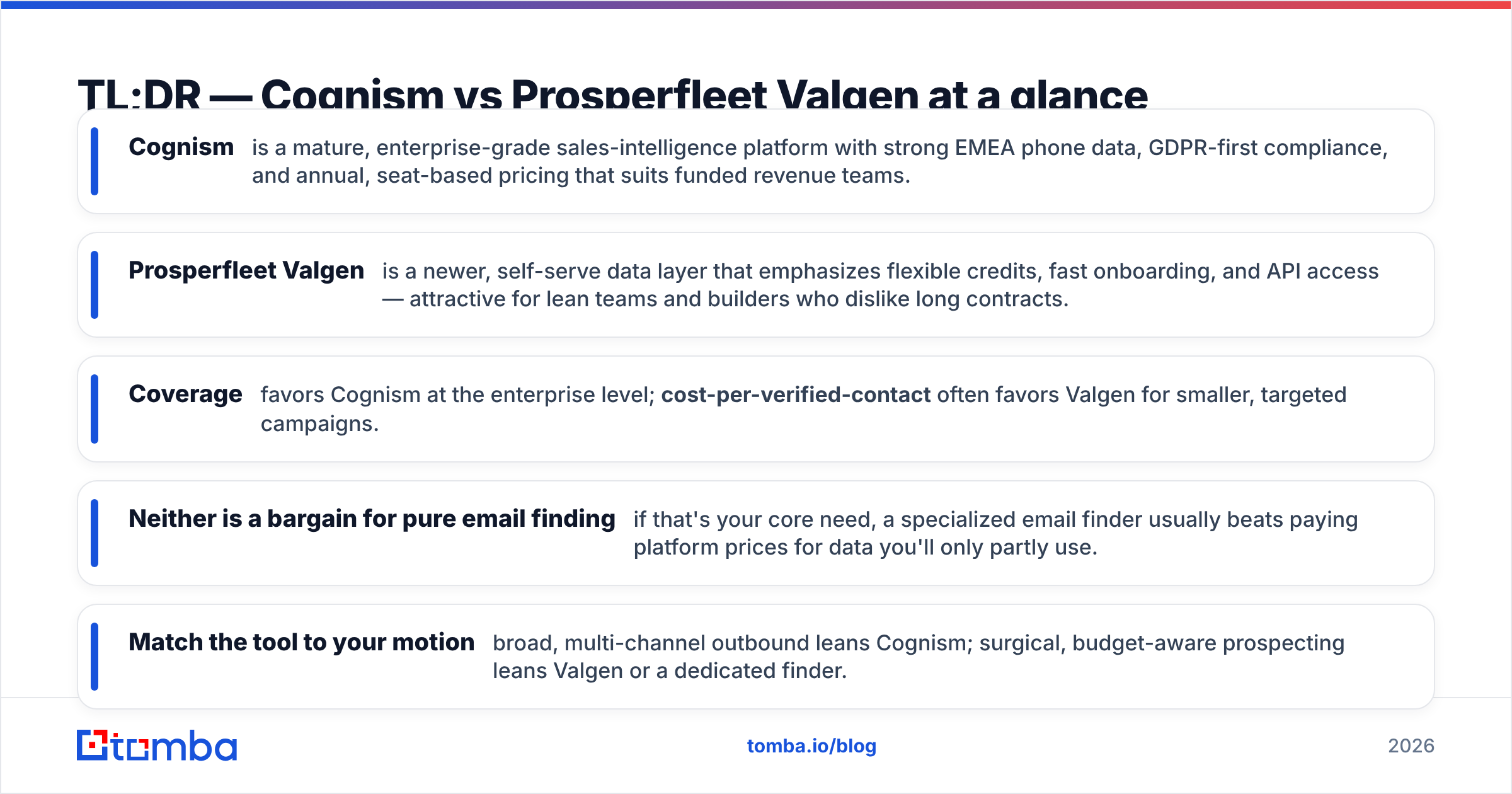
- Cognism is a mature, enterprise-grade sales-intelligence platform with strong EMEA phone data, GDPR-first compliance, and annual, seat-based pricing that suits funded revenue teams.
- Prosperfleet Valgen is a newer, self-serve data layer that emphasizes flexible credits, fast onboarding, and API access — attractive for lean teams and builders who dislike long contracts.
- Coverage favors Cognism at the enterprise level; cost-per-verified-contact often favors Valgen for smaller, targeted campaigns.
- Neither is a bargain for pure email finding — if that's your core need, a specialized email finder usually beats paying platform prices for data you'll only partly use.
- Match the tool to your motion: broad, multi-channel outbound leans Cognism; surgical, budget-aware prospecting leans Valgen or a dedicated finder.
What is Cognism?#
Cognism is a well-established sales-intelligence company that sells access to a global B2B contact and company database, layered with intent data, mobile-verified phone numbers (its "Diamond Data" tier), and integrations into CRMs like Salesforce and HubSpot. It's positioned as an all-in-one prospecting platform for mid-market and enterprise revenue teams, and it consistently earns high marks on peer-review sites like G2.
Its two headline strengths are compliance and phone coverage. Cognism built its brand on GDPR- and CCPA-aware data processing, including notified-contact checks against do-not-call lists in Europe — a genuine differentiator if your outbound touches EMEA. The manually verified mobile numbers are the other draw; teams that live on the phone tend to rate that connect rate highly.
The trade-off is commercial. Cognism is sold on annual contracts with per-seat licensing and, historically, usage limits on how many records you can view or export. That model rewards teams that use it every day and penalizes light or seasonal users.
What is Prosperfleet Valgen?#
Prosperfleet Valgen is a newer entrant pitched as a flexible, self-serve B2B data layer. Instead of leading with a heavy platform and seats, Valgen emphasizes credit-based access, quick sign-up, and an API-first posture aimed at growth teams, agencies, and technical builders who want to pull contact and company data on demand.
Its positioning is essentially the anti-enterprise argument: skip the annual commitment, buy the data volume you need, and wire it into your own stack. For teams that were burned by shelf-ware seats on a bigger suite, that resonates.
Because it's younger, Valgen's database depth and brand track record are harder to benchmark than an incumbent's. Coverage in North America tends to be solid; niche EMEA segments and verified mobile depth are where you'll want to run your own test list before committing. Treat any single-vendor accuracy claim — from either side — as a hypothesis to verify, not a fact.

How do Cognism and Prosperfleet Valgen compare on features and price?#
Here's the side-by-side. Prices and limits shift, so treat these as directional and confirm current terms with each vendor before you sign.
| Attribute | Cognism | Prosperfleet Valgen |
|---|---|---|
| Best for | Mid-market & enterprise revenue teams | Lean teams, agencies, builders |
| Pricing model | Annual, per-seat + data package | Credit-based, monthly or usage |
| Contract | Typically 12-month | Flexible / month-to-month |
| Phone data | Strong (verified mobiles) | Moderate; verify by region |
| EMEA / GDPR posture | Category-leading | Present, less established |
| API access | Available (higher tiers) | Core selling point |
| Onboarding speed | Sales-led, slower | Self-serve, fast |
| Ideal team size | 10+ seats | 1–10 seats |
The pattern is clear: Cognism trades flexibility for depth and compliance rigor, while Valgen trades track record for speed and pay-as-you-go economics. Neither is "better" in the abstract — they're tuned for different buyers.
A quick decision guide:
- You sell into EMEA and dial a lot — Cognism's compliance and mobile data justify the contract.
- You want to start this week without procurement — Valgen's self-serve model wins.
- Your volume is spiky or seasonal — credit-based pricing (Valgen) avoids paying for idle seats.
- You need CRM-native intent signals at scale — Cognism's suite is the more complete fit.
- You mostly just need verified emails — neither platform is the cost-efficient choice; a dedicated finder is.
Which is more accurate — and how would you know?#
Accuracy is the number that actually decides ROI, because every bad record burns sender reputation and rep time. The honest answer is that you can't take a vendor's marketing figure at face value — you have to test both on your ICP.

Run the same 200-contact sample list through both tools and measure three things: match rate (how many contacts they had at all), verified-email bounce rate (send to a seed segment or use an email verifier), and phone connect rate if you dial. Cognism usually wins raw coverage and mobile depth; Valgen frequently wins cost-per-verified record, which is the metric that matters once you strip out contacts you'd never actually use.
One caveat that trips up buyers: catch-all domains. Both platforms will return addresses on catch-all servers that accept everything at the SMTP layer, and neither a big suite nor a lean data layer fully solves this. If your list skews toward larger enterprises, plan to run results through a catch-all verifier before you trust them in a sequence.
When should you skip both and use a dedicated email finder?#
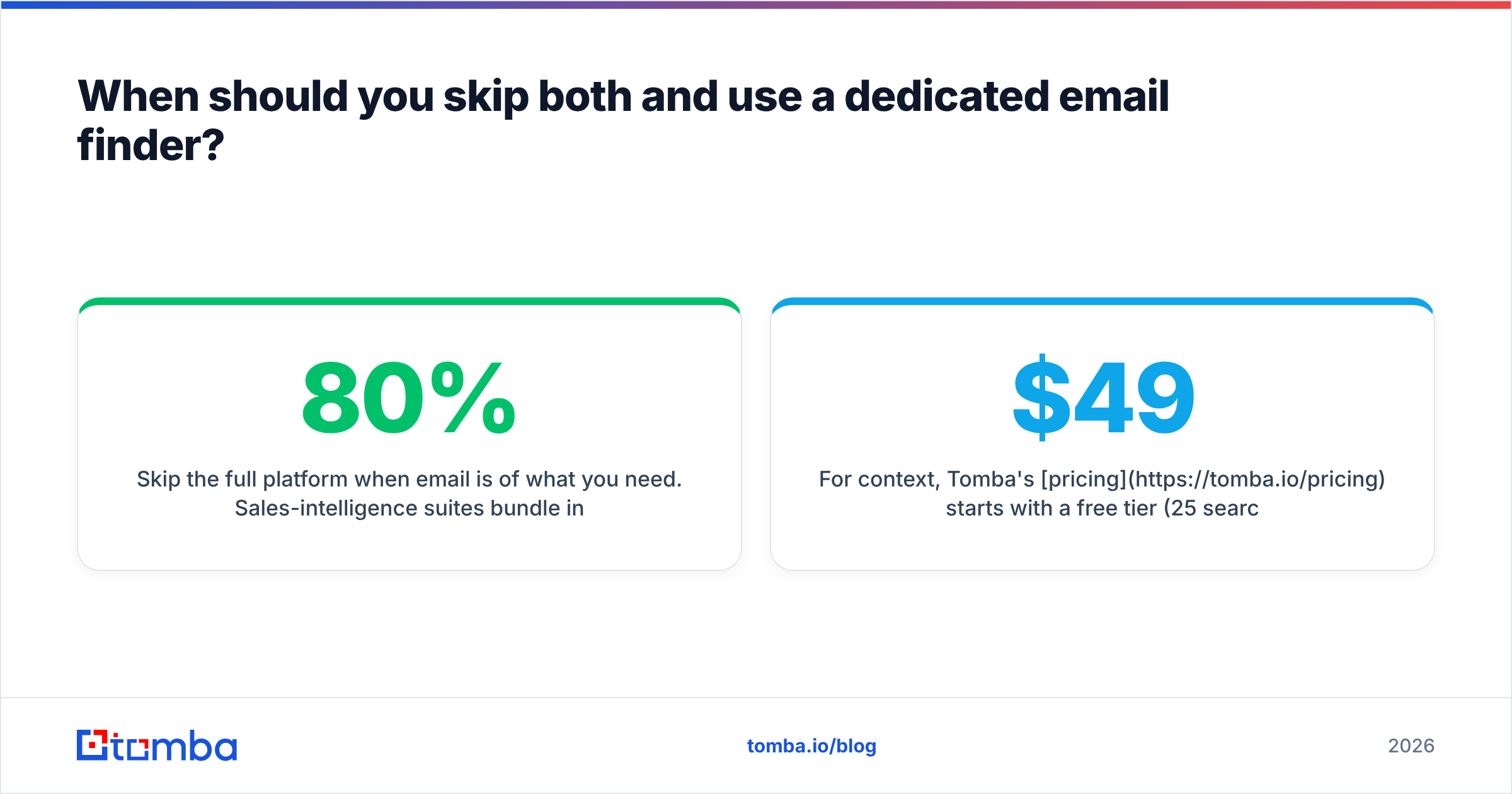
Skip the full platform when email is 80% of what you need. Sales-intelligence suites bundle intent data, dialers, sequencing, and enrichment — powerful if you use all of it, expensive if you're really just after a verified work email by name and domain.
If your workflow is "I have a list of companies and target roles, and I need reliable emails," a focused tool is faster and dramatically cheaper per contact. That's the gap Tomba fills. You can run a domain search to pull every discoverable address at a company, use the bulk email finder for list-scale jobs, and push everything through verification in the same flow — without an annual seat commitment.

For context, Tomba's pricing starts with a free tier (25 searches/month), then Starter at $49/mo, Growth at $99/mo, and Pro at $249/mo — a very different economic model from seat-plus-package enterprise contracts. For a builder, the Tomba API gives programmatic finding and verification the same way Valgen pitches its API layer, but scoped to the email problem specifically.
That's not an argument that Cognism or Valgen are overpriced — for a team using the whole suite, they're reasonable. It's an argument about fit. Buying a sales-intelligence platform to do email finding is like buying a delivery van to commute to work alone: it does the job, but you're paying for eight seats you'll never fill.
How to choose in five steps#
Analysts like Gartner will tell you the same thing in more words: buy for your workflow, not the feature list. Here's the compressed version.
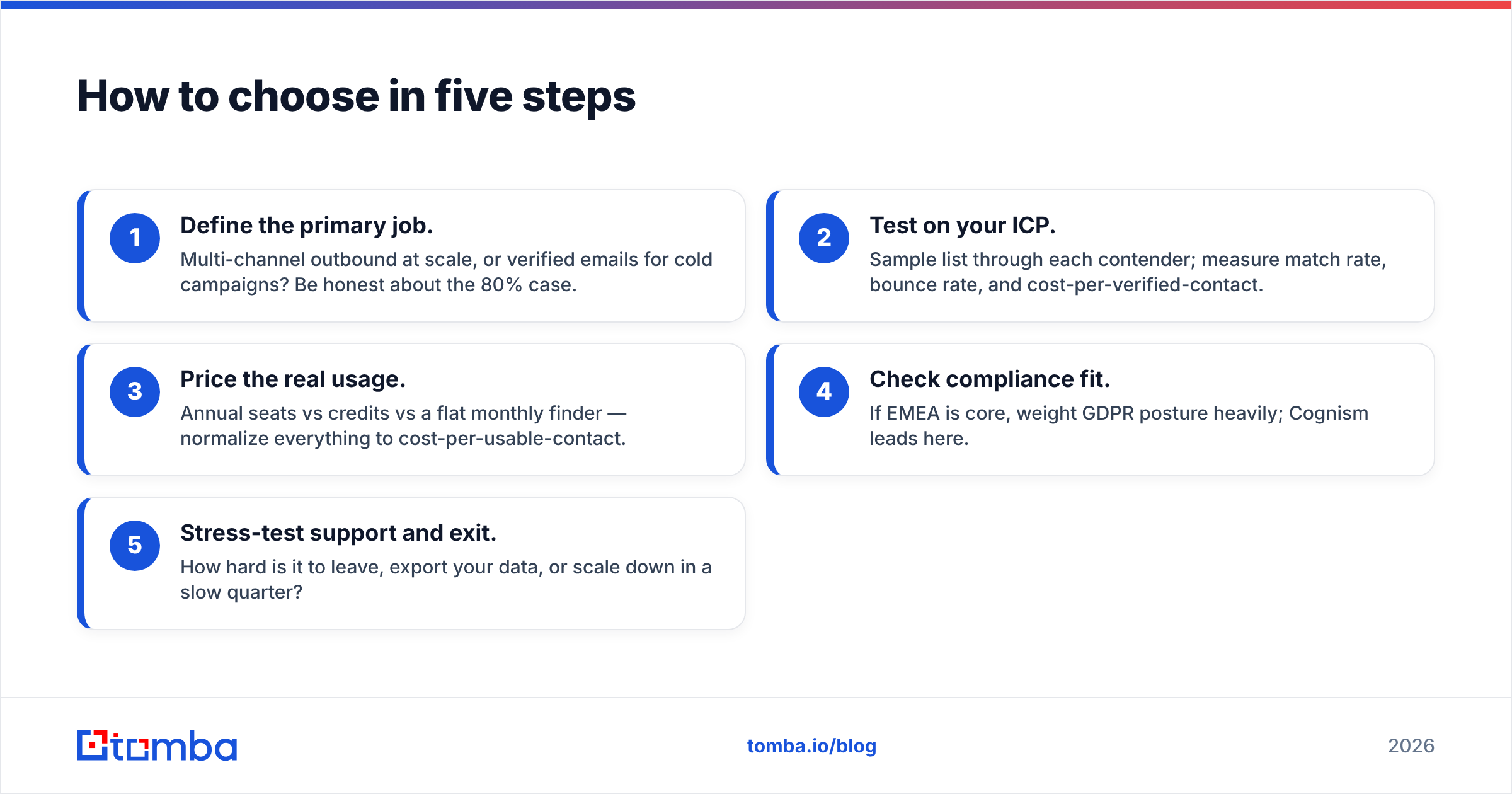
- Define the primary job. Multi-channel outbound at scale, or verified emails for cold campaigns? Be honest about the 80% case.
- Test on your ICP. Sample list through each contender; measure match rate, bounce rate, and cost-per-verified-contact.
- Price the real usage. Annual seats vs credits vs a flat monthly finder — normalize everything to cost-per-usable-contact.
- Check compliance fit. If EMEA is core, weight GDPR posture heavily; Cognism leads here.
- Stress-test support and exit. How hard is it to leave, export your data, or scale down in a slow quarter?
Do those five and the "Cognism vs Prosperfleet Valgen" question usually answers itself — often with the surprising conclusion that a leaner, email-specific tool covers most of what you actually needed.
The verdict#
Cognism is the safer enterprise pick: deep coverage, best-in-class EMEA compliance, verified mobiles, and a mature platform — as long as you'll use the whole thing and can live with annual, seat-based pricing. Prosperfleet Valgen is the flexible challenger: fast to start, credit-based, API-friendly, and a better cost story for lean or spiky usage, with the usual caveat that you should verify its coverage on your own segments first.
But if you zoom out, a lot of teams evaluating either one are really just trying to get verified emails into a sequence without lighting money on fire. If that's you, don't buy a platform to solve a point problem.
Start with the Tomba Email Finder. Find professional emails by name, domain, or company, verify them in the same workflow, and scale from a free tier to paid plans only when your volume justifies it — no annual lock-in, no seats you won't use. Test it against your ICP alongside Cognism and Valgen, and let the cost-per-verified-contact make the decision for you.
Related guides#
Ready to find emails that actually work?
Join 150,000+ professionals who stopped guessing and started sending. Free credits on signup — no credit card required.
Get the Tomba newsletter
Practical outbound tactics and product updates — once every two weeks.
About the author