Cold Call Guide 2026: Scripts, Data, and What Actually Works
Cold calling isn't dead — but the lazy version is. Here's a data-backed 2026 playbook: when to call, what to say, and how to build a dial list that connects.
TL;DR
- The cold call is not dead in 2026 — but spray-and-pray dialing is. Connect rates now hinge on list quality, timing, and a tight opener, not call volume alone.
- Expect roughly 2–5% of dials to turn into a real conversation, and 1–3% of conversations to book a meeting. Small percentages compound fast when your data is clean.
- A repeatable structure — permission-based opener, one sharp reason for the call, a single question, then a clear ask — beats a memorized 12-line script every time.
- Bad phone data quietly kills good reps. Wrong numbers, disconnected lines, and gatekeeper dead-ends waste the two hours a day that actually move pipeline.
- Pair verified direct-dial numbers with email and LinkedIn touches. Phone-only is fragile; multi-channel sequences are what convert in 2026.
What is a cold call, really?#
A cold call is a phone conversation with a prospect who did not ask to hear from you. That is the whole definition — no prior relationship, no inbound request, just you, a number, and a reason to interrupt someone's day.
Think of it like knocking on a stranger's door versus ringing a doorbell you were invited to press. Warm calls (referrals, inbound leads, event follow-ups) are the invited doorbell. Cold calls are the unexpected knock — which means the first ten seconds decide whether the door stays open or slams.
That framing matters because most "cold calling doesn't work" complaints are really "my knock was terrible" complaints. The channel is fine. The execution — and the list behind it — usually isn't.
Is cold calling dead in 2026?#
Short answer: no, but the easy version of it is.
Buyers screen calls harder than ever. Mobile carriers flag unknown numbers as "Spam Likely." Gatekeepers route unfamiliar callers to voicemail by reflex. Against that backdrop, a rep who dials 200 random numbers from a stale list will conclude the phone is useless — and they'll be right, for them.
Meanwhile, teams that treat the cold call as a precision instrument still book meetings that email alone never would. A live human voice cuts through an inbox of 60 unread cold emails. It creates a two-way conversation in real time, surfaces objections you'd never see in a reply, and builds rapport faster than any cold email sequence.
The honest 2026 verdict: the phone is one of the highest-conversion channels per touch and one of the lowest-conversion channels per hour. It rewards preparation and punishes laziness. If you can only do one thing well, make it your list.
Does cold calling still work? The numbers#
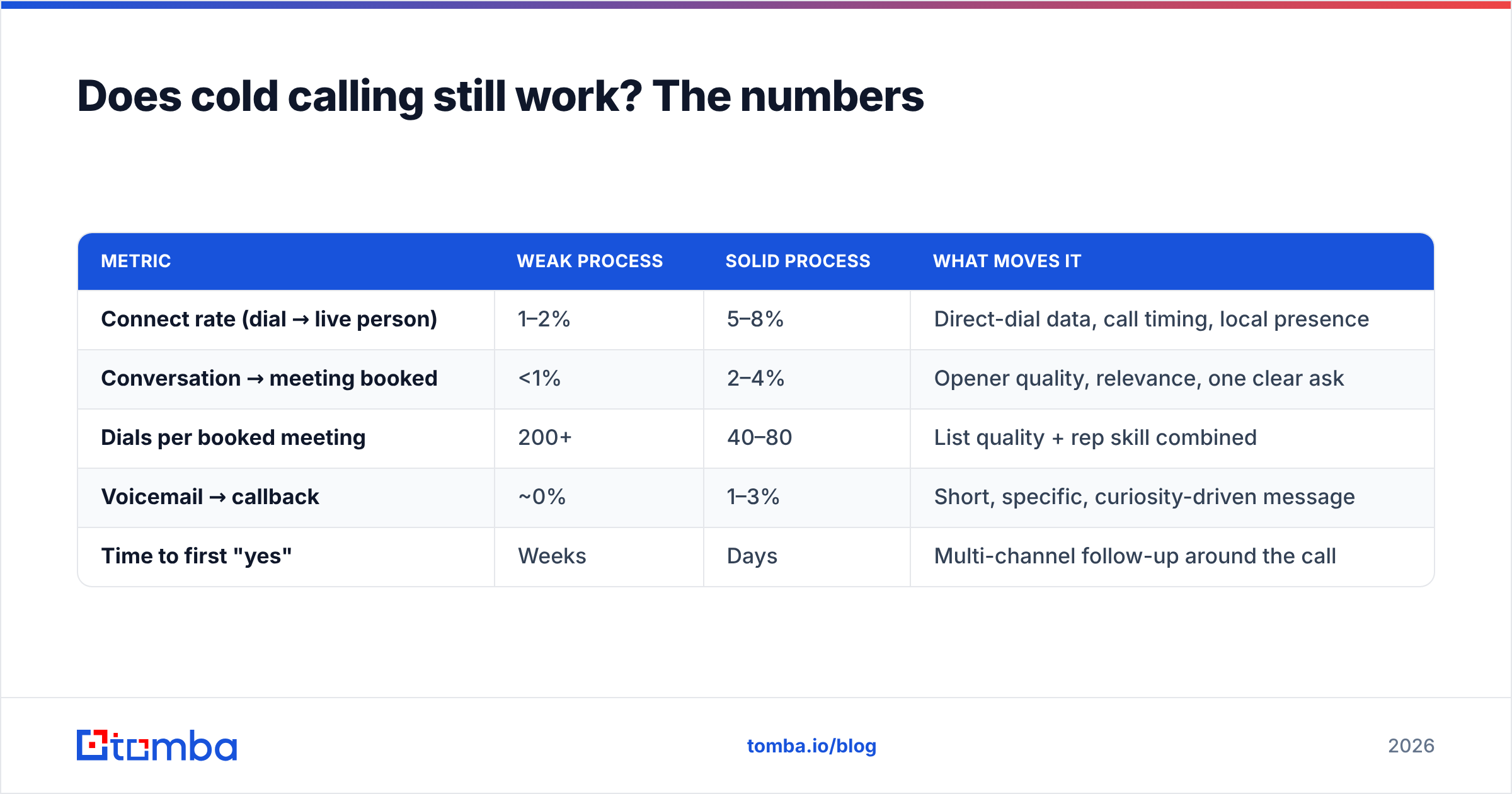
Benchmarks vary by industry, seniority, and offer, but here are realistic ranges for outbound B2B in 2026:
| Metric | Weak process | Solid process | What moves it |
|---|---|---|---|
| Connect rate (dial → live person) | 1–2% | 5–8% | Direct-dial data, call timing, local presence |
| Conversation → meeting booked | <1% | 2–4% | Opener quality, relevance, one clear ask |
| Dials per booked meeting | 200+ | 40–80 | List quality + rep skill combined |
| Voicemail → callback | ~0% | 1–3% | Short, specific, curiosity-driven message |
| Time to first "yes" | Weeks | Days | Multi-channel follow-up around the call |
Two takeaways. First, the gap between a weak and a solid process is enormous — often 3–4x fewer dials per meeting. Second, most of that gap is data and timing, not charisma. A confident rep working a garbage list still loses to an average rep working verified direct dials.
If your dials-per-meeting number looks closer to the "weak" column, don't rewrite your script first. Audit where the numbers came from.
What makes a great cold call script?#
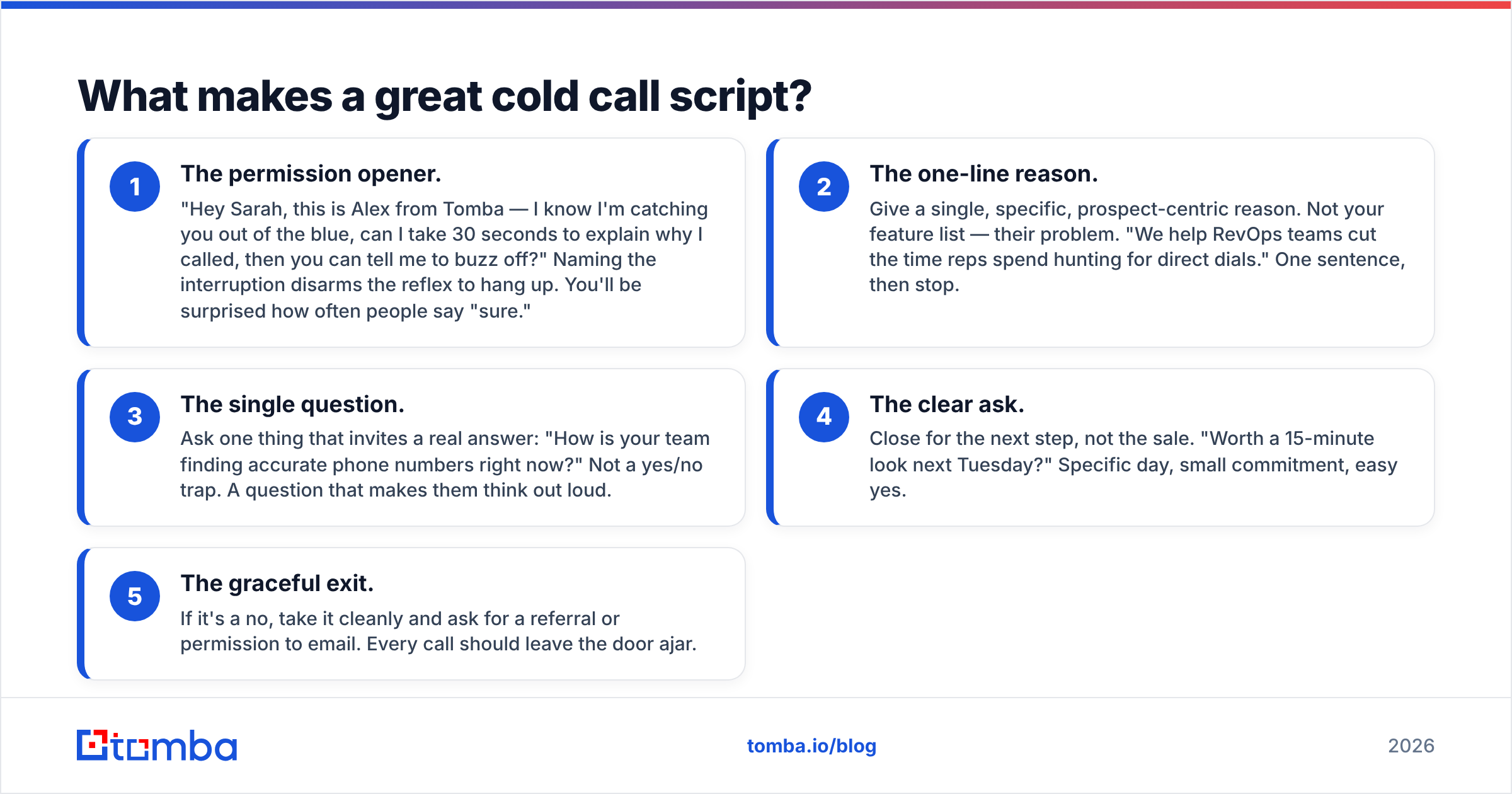
A great script is a skeleton, not a cage. It gives you structure so you can listen instead of panic. Here is the anatomy that consistently works:
- The permission opener. "Hey Sarah, this is Alex from Tomba — I know I'm catching you out of the blue, can I take 30 seconds to explain why I called, then you can tell me to buzz off?" Naming the interruption disarms the reflex to hang up. You'll be surprised how often people say "sure."
- The one-line reason. Give a single, specific, prospect-centric reason. Not your feature list — their problem. "We help RevOps teams cut the time reps spend hunting for direct dials." One sentence, then stop.
- The single question. Ask one thing that invites a real answer: "How is your team finding accurate phone numbers right now?" Not a yes/no trap. A question that makes them think out loud.
- The clear ask. Close for the next step, not the sale. "Worth a 15-minute look next Tuesday?" Specific day, small commitment, easy yes.
- The graceful exit. If it's a no, take it cleanly and ask for a referral or permission to email. Every call should leave the door ajar.
Notice what's missing: a monologue. The best cold callers talk less than 40% of the time. Your script exists to start a conversation, then get out of the way. For subject-line and messaging inspiration you can reuse across channels, tools like a subject line generator help you test the same hook in the inbox that worked on the phone.
How do you build a cold-call list that actually connects?#
This is the part reps skip and then blame the channel. Your connect rate is capped by your data before you dial a single number.
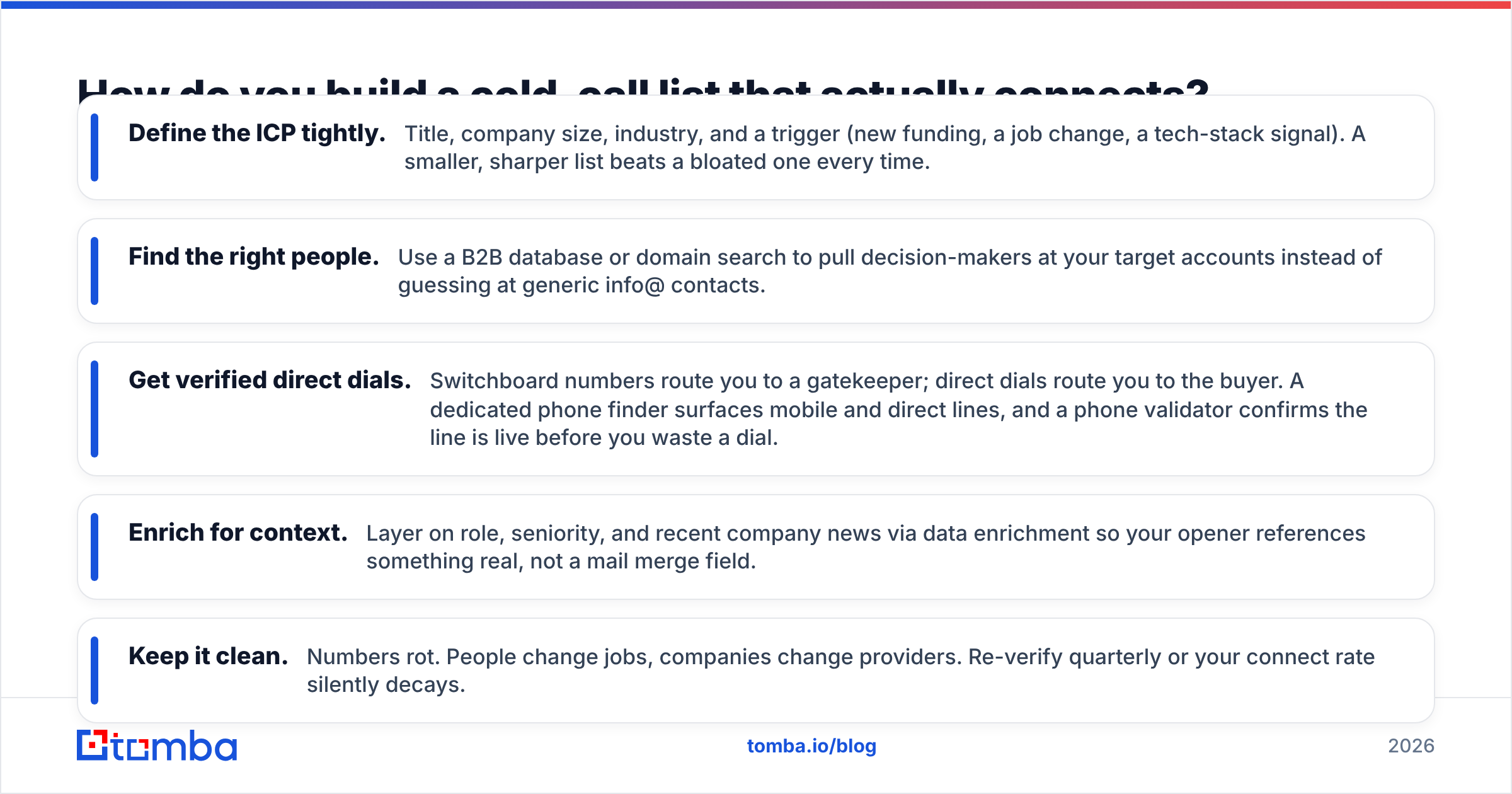
A dependable list-building flow looks like this:
- Define the ICP tightly. Title, company size, industry, and a trigger (new funding, a job change, a tech-stack signal). A smaller, sharper list beats a bloated one every time.
- Find the right people. Use a B2B database or domain search to pull decision-makers at your target accounts instead of guessing at generic info@ contacts.
- Get verified direct dials. Switchboard numbers route you to a gatekeeper; direct dials route you to the buyer. A dedicated phone finder surfaces mobile and direct lines, and a phone validator confirms the line is live before you waste a dial.
- Enrich for context. Layer on role, seniority, and recent company news via data enrichment so your opener references something real, not a mail merge field.
- Keep it clean. Numbers rot. People change jobs, companies change providers. Re-verify quarterly or your connect rate silently decays.
The reps who hit the "solid process" column above aren't superhuman. They just never dial a number they haven't confirmed is real and attached to the right human.
Cold calling vs. cold email vs. LinkedIn: which wins?#
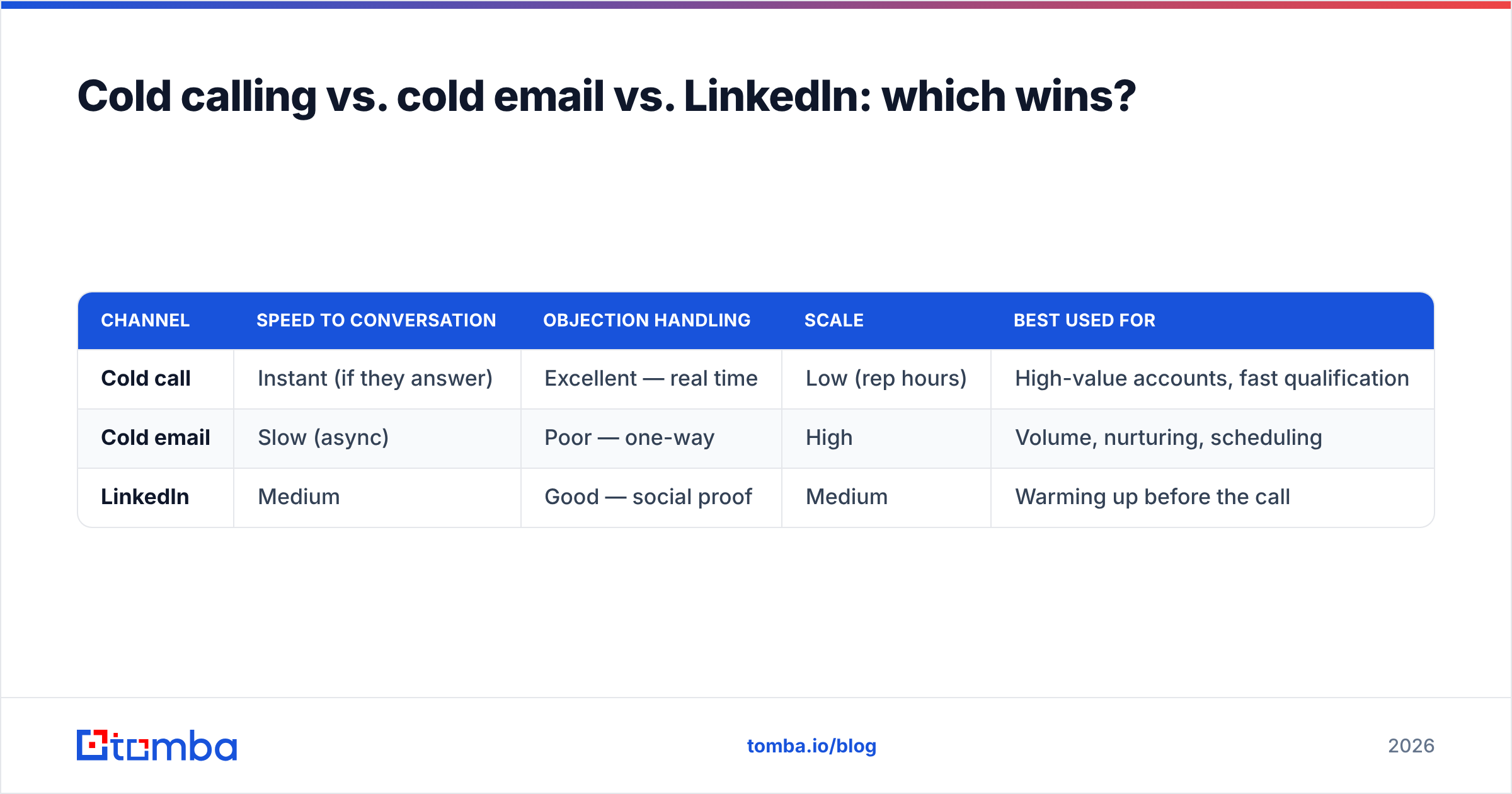
Wrong question. The winning teams don't pick one — they sequence all three around the same prospect. Here's how the channels actually stack up:
| Channel | Speed to conversation | Objection handling | Scale | Best used for |
|---|---|---|---|---|
| Cold call | Instant (if they answer) | Excellent — real time | Low (rep hours) | High-value accounts, fast qualification |
| Cold email | Slow (async) | Poor — one-way | High | Volume, nurturing, scheduling |
| Medium | Good — social proof | Medium | Warming up before the call |
The practical play: warm the prospect on LinkedIn, reference that touch in your call opener, and follow every call — connected or not — with an email that recaps and offers a time. A voicemail plus a same-day email lifts callback rates far more than either alone. If you want the mechanics of the written side, the team's guide to response rate benchmarks is a useful companion read.
Phone-only outreach is fragile because it depends entirely on someone picking up. Multi-channel outreach compounds: each touch makes the next one warmer. The call does the converting; email and LinkedIn do the setting up.
How do you handle gatekeepers and objections?#
Gatekeepers aren't obstacles — they're information. Treat them like colleagues, not walls.
With gatekeepers: Be transparent and confident. "Hi, I'm hoping you can help me — I'm trying to reach whoever owns sales data at your company, is that Sarah?" People help when you ask for help and skip the fake authority act. Having a verified direct dial in the first place means you often bypass this step entirely.
With objections, use the acknowledge-then-pivot pattern:
- "I'm busy right now." → "Totally fair — that's exactly why I kept this to 30 seconds. Is later today or tomorrow better for a quick call?"
- "We already use a tool for that." → "Makes sense, most teams I talk to do. Quick question — how happy is your team with the accuracy of the data it pulls?"
- "Just send me an email." → "Happy to. So I send the right thing — is data accuracy or coverage the bigger pain for you right now?"
Every objection is a door, not a wall. Acknowledge it honestly, ask one question, and keep the conversation moving. The goal on a cold call is never to win the argument — it's to earn the next five minutes.
What tools does a modern cold caller need in 2026?#
You don't need a bloated tech stack. You need three things working together:
- A power/parallel dialer to eliminate manual dialing and squeeze more conversations into your two peak calling hours (mid-morning and late afternoon in the prospect's timezone tend to win).
- A CRM to log every touch and trigger follow-ups — see the CRM fundamentals if you're setting one up.
- A verified data source feeding both. This is the foundation everything else sits on, and it's where most stacks are weakest.
A quick cost-of-bad-data reality check. If a rep makes 100 dials a day and 20% of the numbers are wrong, that's 20 dials — roughly 30–40 minutes — burned on dead lines every single day. Across a five-person team, that's a full workweek of wasted selling time every month. Clean phone data isn't a nice-to-have; it's the highest-ROI fix on this list. For a deeper look at where the numbers come from, Tomba documents its data sources openly.
For broader context on how buyers evaluate sales tech, independent review sites like G2 and Capterra are worth a scan before you commit budget, and HubSpot's sales statistics roundup is a solid, regularly updated benchmark source.
A simple daily cold-calling routine that works#
Consistency beats intensity. A rep who does this every day out-books the hero who binge-dials once a week:
- Prep (15 min): Review your list, confirm numbers are validated, note one personalization hook per account.
- Power hour #1 (60 min): Dial your best-fit accounts during their mid-morning window. No email checking, no distractions.
- Follow-up (30 min): Email and LinkedIn-touch everyone you called — connected or not.
- Power hour #2 (60 min): Second calling window, second timezone if you sell nationally.
- Log and learn (15 min): Update the CRM, note which openers landed, adjust tomorrow's list.
That's about three focused hours. Protect them, and the pipeline follows.
The bottom line on cold calling in 2026#
The cold call rewards two things: a sharp, human conversation and a list of real people at real numbers. You can control the first with practice. The second you build with the right data — and it's the lever most teams ignore.
If your reps are burning peak calling hours on disconnected lines and wrong contacts, no script rewrite will save the quarter. Start where the leverage is. Tomba's phone finder and Email Finder pull verified direct dials and professional emails for your exact ICP, so every dial has a real chance of connecting and every call has an email to back it up. Try it free with 25 searches a month, and scale up on the Starter plan at $49/mo once the meetings start landing. Build the list first — the conversations get a lot easier when the person on the other end actually picks up.
Related guides#
Ready to find emails that actually work?
Join 150,000+ professionals who stopped guessing and started sending. Free credits on signup — no credit card required.
Get the Tomba newsletter
Practical outbound tactics and product updates — once every two weeks.
About the author