Cold Call Meeting Request Email: Templates That Book Meetings
A cold call meeting request email turns a missed dial or voicemail into a booked slot. Here are the templates, structure, and timing that actually get replies in 2026.
You dialed. They didn't pick up. Now what? The rep who shrugs and moves on loses the deal to the rep who sends a sharp, well-timed cold call meeting request email within the hour. The email isn't a consolation prize for a missed call — it's the highest-leverage touch in the whole sequence, because it lands in an inbox the prospect actually controls and reads on their own schedule.
This guide breaks down exactly how to write that email: the structure, the subject lines, the timing relative to the call, and seven templates you can adapt today. No fluff, no "circling back."
TL;DR#
- A cold call meeting request email is the written follow-up (or lead-in) to a phone attempt whose only job is to book one specific meeting.
- Send it within 60 minutes of a missed call or voicemail while your name is still fresh — timing beats cleverness.
- Keep it to 50–125 words, one clear ask, and one proposed time. Every extra option lowers your reply rate.
- Reference the call ("I just tried you at 2:15") to earn context, then lead with the prospect's problem, not your product.
- Reaching the right inbox matters more than the copy. Verify the address first with an email verifier so your perfect email doesn't bounce into a spam trap.
What is a cold call meeting request email?#
A cold call meeting request email is a short outbound message sent alongside a cold call — usually right after an unanswered dial or voicemail — asking the prospect to commit to a specific meeting. Think of it like leaving a business card taped to the door after you knock: the knock (the call) creates a moment of attention, and the card (the email) gives them a frictionless way to respond when they're ready.
It is not a generic cold email. The defining feature is that it leverages a phone touch. That reference — "I just left you a voicemail" — does two things: it signals you're a real person putting in real effort, and it primes the pattern-recognition part of the brain that already half-registered your name on the caller ID.
The email and the call are one motion, not two separate campaigns. Top sequences pair them deliberately: call, then email 30–60 minutes later, then a second call the next morning. Companies like Gong have published analysis showing multi-channel touches consistently outperform single-channel ones, and the phone-plus-email combo is the most durable pairing in B2B.
Why do most cold call follow-up emails get ignored?#
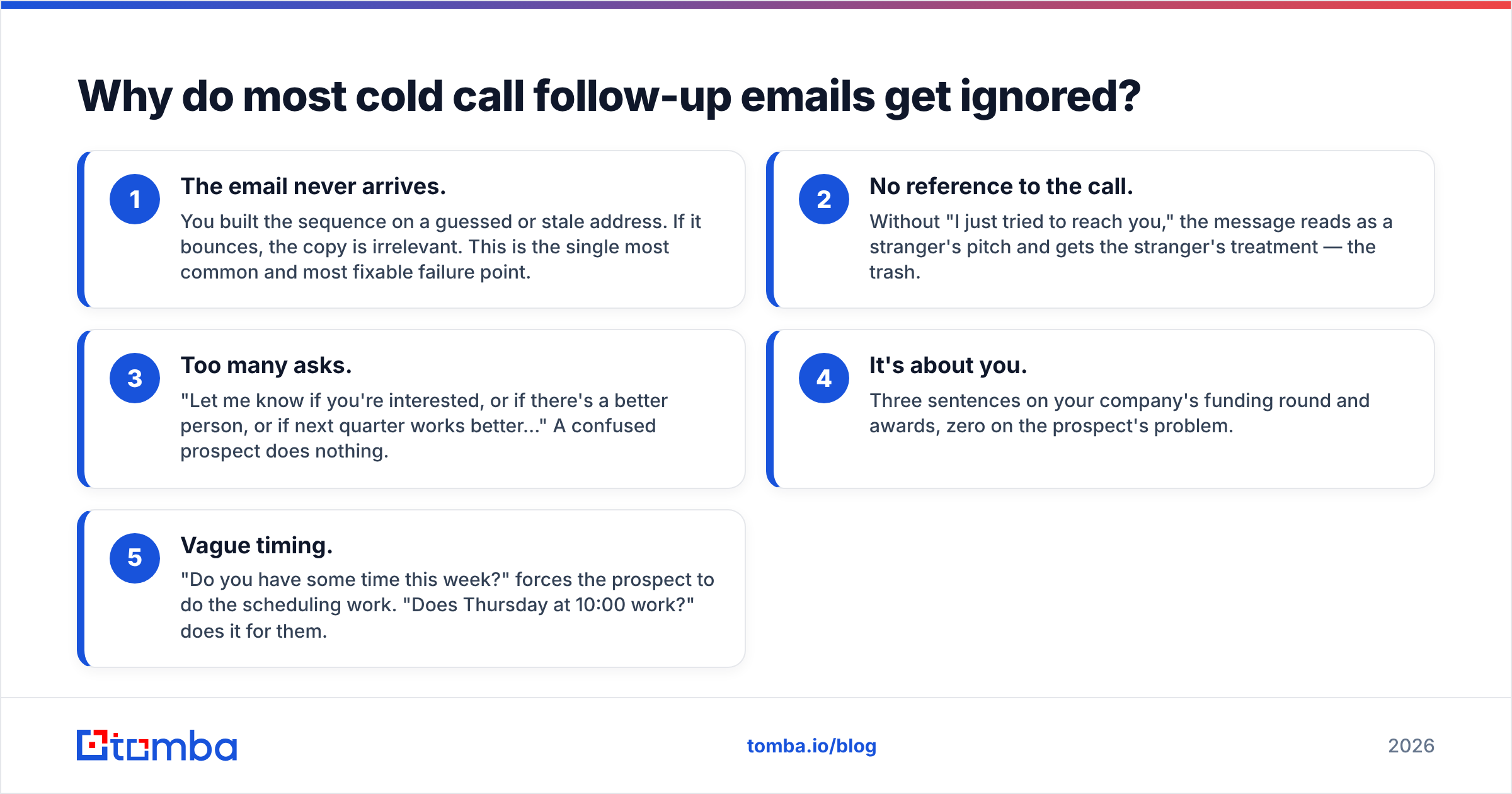
Most of these emails die for reasons that have nothing to do with the offer. Here are the usual killers, ranked by how often they sink an otherwise-good message:
- The email never arrives. You built the sequence on a guessed or stale address. If it bounces, the copy is irrelevant. This is the single most common and most fixable failure point.
- No reference to the call. Without "I just tried to reach you," the message reads as a stranger's pitch and gets the stranger's treatment — the trash.
- Too many asks. "Let me know if you're interested, or if there's a better person, or if next quarter works better…" A confused prospect does nothing.
- It's about you. Three sentences on your company's funding round and awards, zero on the prospect's problem.
- Vague timing. "Do you have some time this week?" forces the prospect to do the scheduling work. "Does Thursday at 10:00 work?" does it for them.
Fix the deliverability problem first, because it's binary. You can A/B test subject lines forever, but if half your list bounces you're optimizing a leak. Run your list through a bulk check and confirm the format with a company email pattern tool before you ever hit send.
What structure should a cold call meeting request email follow?#
Every high-performing version of this email uses roughly the same skeleton. Fill each line with specifics and cut anything that doesn't move the reader toward "yes."
- Subject line — short, lowercase, human. "quick question re: [company]" or "tried calling — 15 min?"
- Call reference — one line: "I just tried you at 2:15 and left a quick voicemail."
- Relevance hook — one line tying you to their world: a trigger event, a peer result, a specific pain.
- The ask — one meeting, one proposed time, one fallback. "Does Thursday at 10:00 ET work? If not, I'll grab a slot Friday."
- Frictionless exit — a soft out that paradoxically increases replies: "If you're not the right person, just point me to who is."
- Signature — name, title, phone. Nothing else.
That's it. No image-heavy signature, no five-link footer, no "P.S. check out our webinar." One ask, one motion.
Comparison: which follow-up channel books more meetings?#
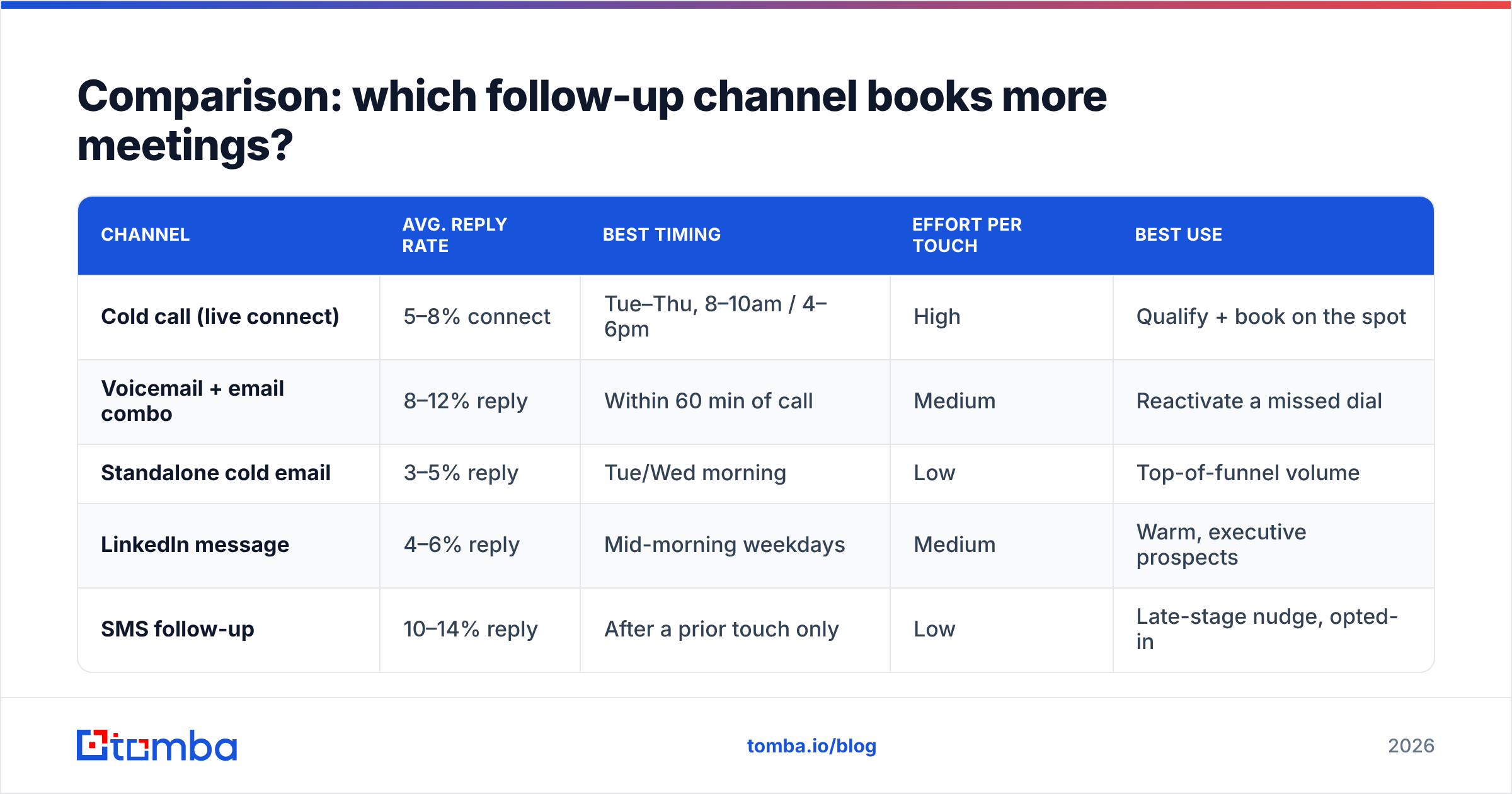
The email doesn't operate in a vacuum. Here's how the main follow-up channels stack up so you know where the meeting-request email fits and where to spend the rest of your energy.
| Channel | Avg. reply rate | Best timing | Effort per touch | Best use |
|---|---|---|---|---|
| Cold call (live connect) | 5–8% connect | Tue–Thu, 8–10am / 4–6pm | High | Qualify + book on the spot |
| Voicemail + email combo | 8–12% reply | Within 60 min of call | Medium | Reactivate a missed dial |
| Standalone cold email | 3–5% reply | Tue/Wed morning | Low | Top-of-funnel volume |
| LinkedIn message | 4–6% reply | Mid-morning weekdays | Medium | Warm, executive prospects |
| SMS follow-up | 10–14% reply | After a prior touch only | Low | Late-stage nudge, opted-in |
The takeaway: the voicemail-plus-email combo has the highest reply rate of any cold channel because it stacks two touches into one memory. The email carries the message; the call makes the email feel earned. If you only automate one thing, automate the 60-minute email after every unanswered dial.
What are the best cold call meeting request email templates?#
Here are seven templates covering the situations you'll actually hit. Swap the brackets, keep them short, and never send more than one variable ask.
1. The classic post-voicemail
Subject: tried calling — 15 min?
Hi [First name], I just left you a quick voicemail. I'm reaching out because [peer company] cut their [metric] by [X%] after fixing [specific problem] — and from the outside it looks like your team might be wrestling with the same thing. Worth a 15-minute call Thursday at 10:00 ET to see if it's relevant? If Thursday's bad, I'll grab a Friday slot. — [Name]
2. The trigger-event opener
Subject: congrats on [funding / hire / launch]
Hi [First name], saw the news about [trigger event] — congratulations. Timing like this is usually when [problem] starts to bite, so I tried you by phone a few minutes ago. Could we spend 15 minutes Wednesday afternoon on how teams your size handle it? — [Name]
3. The "wrong person" net
Subject: quick question re: [company]
Hi [First name], I left you a voicemail about [outcome]. If owning [area] isn't in your lane, no problem at all — could you point me to whoever does? Happy to keep this off your plate. — [Name]
4. The one-metric hook
Subject: [metric] at [company]
Hi [First name], tried you at [time]. One number: teams like yours typically leave [X] on the table with [problem]. I have a specific idea for [company]. 15 minutes Thursday? — [Name]
5. The break-up (last touch)
Subject: closing your file
Hi [First name], I've tried a couple of times and don't want to be a pest. I'll assume the timing's off and close things out — unless a quick call this week would actually help. Either reply works. — [Name]
6. The referral-warmed request
Subject: [mutual contact] suggested I reach out
Hi [First name], [mutual contact] mentioned you're the person thinking about [area]. I tried you by phone just now. Could we find 15 minutes Tuesday morning? — [Name]
7. The value-first, no-meeting ask
Subject: sending this over instead
Hi [First name], couldn't reach you by phone, so here's the short version: [one-sentence insight]. If it's useful, I'll send the full breakdown — or we grab 15 minutes Thursday, your call. — [Name]
For a deeper library you can plug into your sequencer, browse a full set of cold email templates and adapt the framing to your ICP.
How soon after the call should you send the email?#
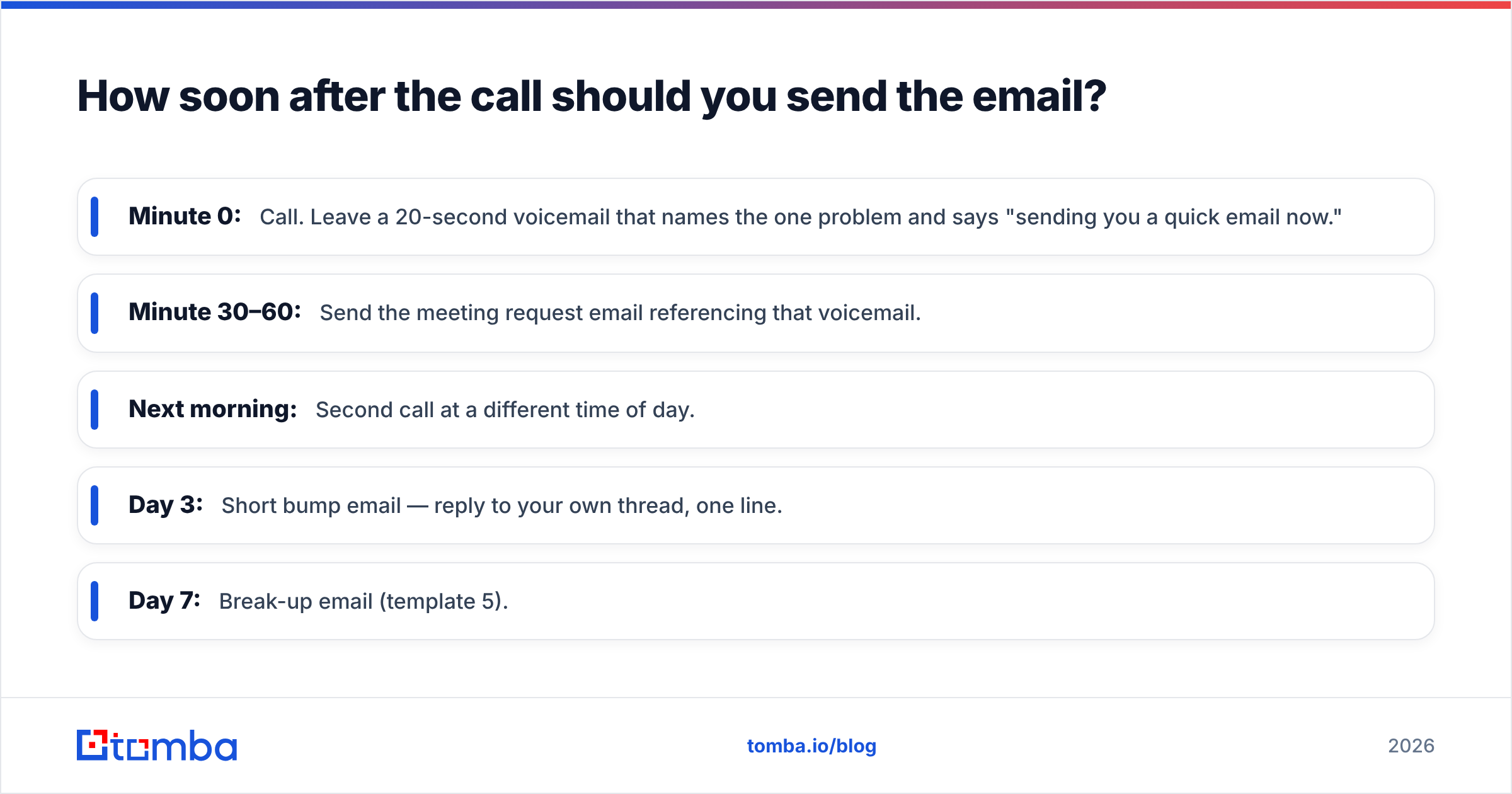
Send it within 60 minutes — sooner if you can. The "recency window" is real: when your caller ID and voicemail are still fresh, the email lands as continuation rather than cold contact, and continuation gets far more benefit of the doubt.
A practical cadence that respects the prospect's time without going quiet:
- Minute 0: Call. Leave a 20-second voicemail that names the one problem and says "sending you a quick email now."
- Minute 30–60: Send the meeting request email referencing that voicemail.
- Next morning: Second call at a different time of day.
- Day 3: Short bump email — reply to your own thread, one line.
- Day 7: Break-up email (template 5).
Keep the whole sequence inside two weeks. Dragging a cold sequence across a month trains the prospect to ignore you. Research summarized by teams at HubSpot consistently shows the majority of positive replies come within the first few touches, so front-load your effort. If you're tracking performance, watch your response rate by template and cut whatever underperforms after 50 sends.
How do you make sure the email actually reaches the prospect?#
This is where most sequences quietly bleed. Your copy can be flawless, but if the address is wrong or the domain is a catch-all, the meeting never happens. Three safeguards:
- Find the real address, not a guess. Use an email finder to resolve a verified professional address from a name and company domain instead of permutating and praying.
- Verify before you send. A quick verification pass catches typos, role accounts, and dead mailboxes so your bounce rate stays low and your sender reputation intact.
- Add a phone fallback. The whole premise here is call-plus-email, so make sure you actually have a dialable number. A phone finder closes that gap when the CRM only has an email.
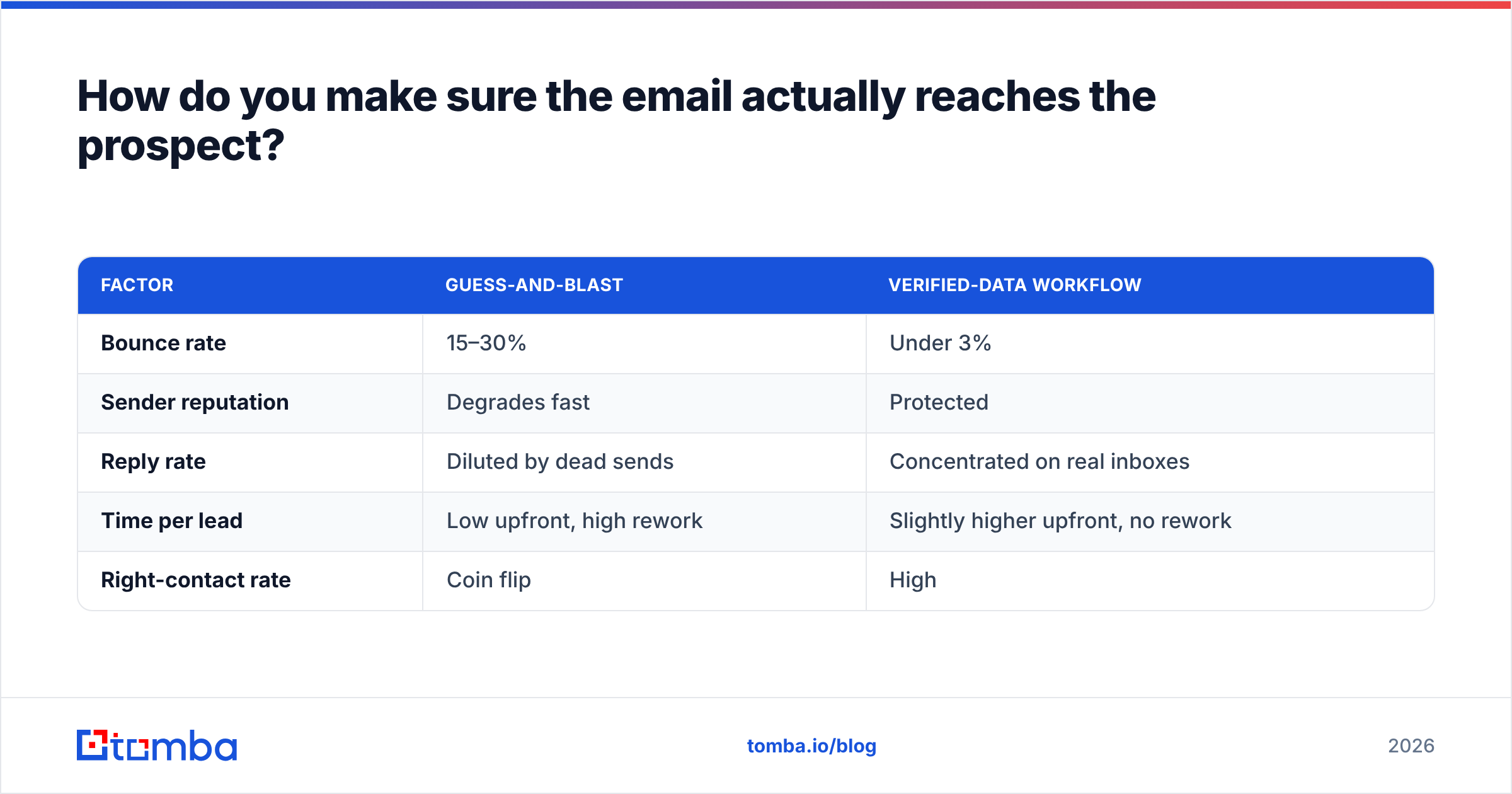
Here's how the "guess and blast" approach compares with a verified-data workflow:
| Factor | Guess-and-blast | Verified-data workflow |
|---|---|---|
| Bounce rate | 15–30% | Under 3% |
| Sender reputation | Degrades fast | Protected |
| Reply rate | Diluted by dead sends | Concentrated on real inboxes |
| Time per lead | Low upfront, high rework | Slightly higher upfront, no rework |
| Right-contact rate | Coin flip | High |
The verified workflow wins on every metric that matters after the first week. Tomba's plans scale with volume — the Free tier gives you 25 searches a month to test the workflow, and paid Tomba pricing starts at $49/mo for Starter when you're ready to run real campaigns.
What subject lines get cold call follow-up emails opened?#
Short, specific, and lowercase beats clever. Your subject line's only job is to earn the open, and the reference to your call does most of the heavy lifting. Proven patterns:
- "tried calling — 15 min?"
- "quick question re: [company]"
- "[first name] — missed you just now"
- "[metric] at [company]"
- "[mutual contact] suggested I reach out"
Avoid anything that screams mass mail: no ALL CAPS, no "🚀", no "Re:" fakery, no "Following up" (the most ignored two words in B2B). Test one variable at a time and let the data pick the winner.
Common mistakes to avoid#
- Writing a paragraph when a sentence works. If the prospect has to scroll, you've lost.
- Pitching features instead of outcomes. Nobody books a meeting to hear about your product; they book to solve their problem.
- Offering five time slots. Propose one, offer one fallback. Decision fatigue kills replies.
- Forgetting the call reference. Without it, you've thrown away your only advantage.
- Skipping verification. A bounced email doesn't just fail — it damages your domain for the next prospect too.
Book more meetings with verified data#
The best cold call meeting request email in the world does nothing if it lands in a dead inbox. Get the fundamentals right — one clear ask, one proposed time, sent within the hour, referencing your call — and then remove the single biggest variable working against you by making sure every address is real before you send.
Start with the Tomba Email Finder: pull verified professional emails by name and domain, confirm them in the same workflow, and hand your reps a list where every send is a real shot at a booked meeting. Combine it with a phone number for the call half of the combo, and you've built the exact call-plus-email motion that outperforms every single channel on its own. Your copy is ready — now make sure it arrives.
Related guides#
Ready to find emails that actually work?
Join 150,000+ professionals who stopped guessing and started sending. Free credits on signup — no credit card required.
Get the Tomba newsletter
Practical outbound tactics and product updates — once every two weeks.
About the author