The Cold Call Pitch Script That Actually Books Meetings in 2026
A cold call pitch script isn't a robotic monologue — it's a flexible framework. Here's the exact structure top reps use to open strong, handle objections, and book the meeting.
Most cold calls die in the first ten seconds. Not because the product is weak or the prospect is hostile — but because the rep opens with a script that screams "I am reading a script." A good cold call pitch script fixes that. It gives you a spine to lean on when your heart is pounding, without turning you into a robot the prospect wants to hang up on.
This guide gives you the full framework, word-for-word lines you can steal, an objection-handling cheat sheet, and the metrics that tell you whether your script is working. No fluff, no "just be confident" advice.
TL;DR#
- A cold call pitch script is a flexible framework — opener, reason for calling, value hook, discovery, and a clear ask — not a monologue to recite.
- The first 10 seconds decide the call. Lead with a permission-based opener and a specific reason, never "How are you today?"
- Objections are signals, not walls. Prepare 3–4 rebuttals for the objections you hear most (price, timing, "send me an email").
- Your close is a calendar ask, not a pitch. Book the next step; don't try to sell the whole deal on call one.
- Scripts only work on good data. A perfect pitch to a wrong number or a gatekeeper is wasted — clean contact data is half the battle.
What Is a Cold Call Pitch Script?#
A cold call pitch script is a repeatable conversation map — think of it like jazz sheet music. The chords are fixed (opener, hook, discovery, close), but you improvise the melody based on how the prospect responds. Rookies read every note. Pros internalize the structure and riff.
The goal of a cold call is almost never to close a sale on the spot. In B2B, the goal is to earn the next step: a discovery meeting, a demo, or a warm follow-up. So your script's job is to survive the first 10 seconds, create enough curiosity to keep the prospect on the line, and land a specific ask.
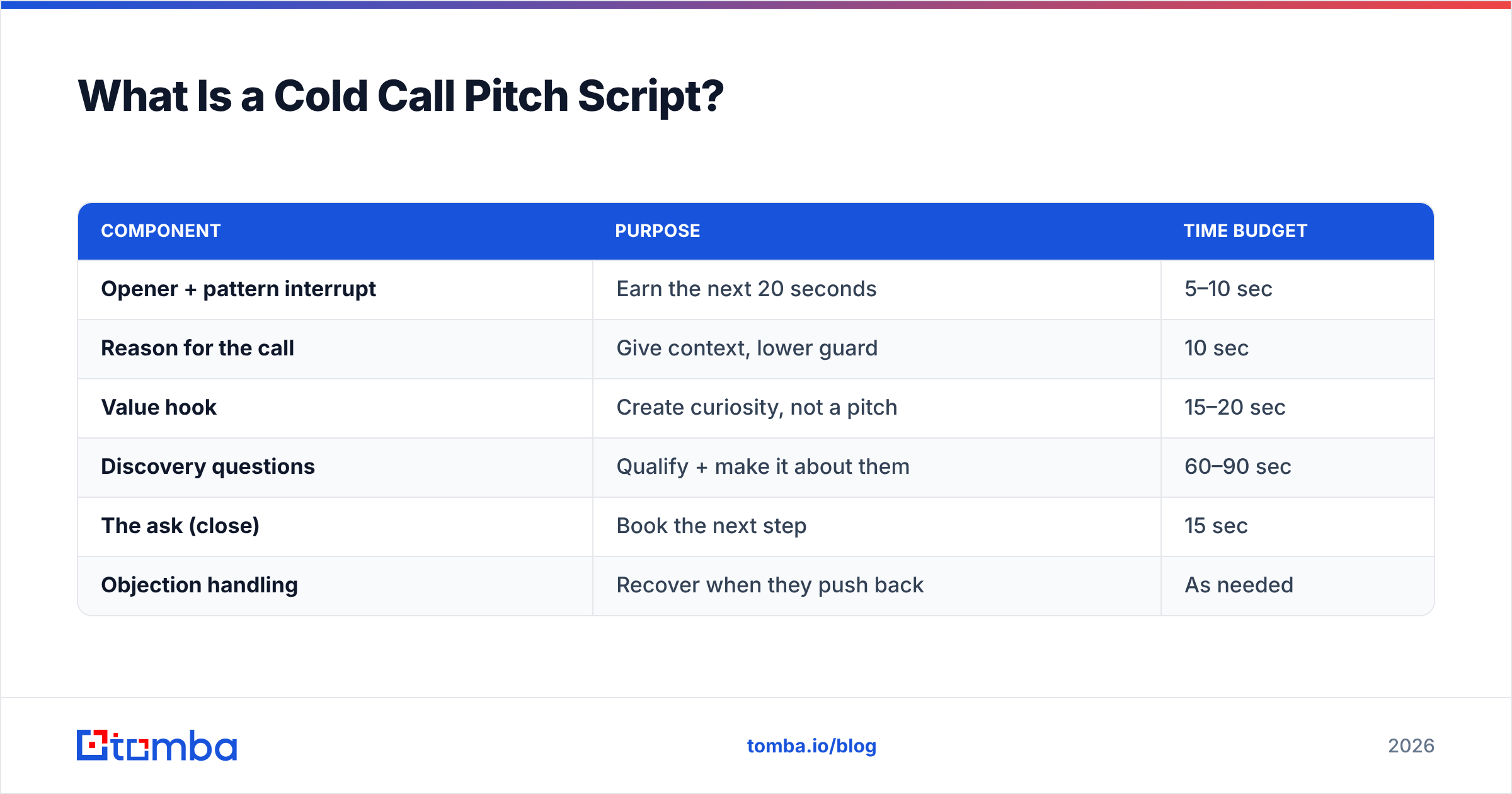
Here's the anatomy of a script that does that:
| Component | Purpose | Time budget |
|---|---|---|
| Opener + pattern interrupt | Earn the next 20 seconds | 5–10 sec |
| Reason for the call | Give context, lower guard | 10 sec |
| Value hook | Create curiosity, not a pitch | 15–20 sec |
| Discovery questions | Qualify + make it about them | 60–90 sec |
| The ask (close) | Book the next step | 15 sec |
| Objection handling | Recover when they push back | As needed |
Notice how little time is spent "pitching." The bulk of a strong call is discovery — the prospect talking, not you.
How Do You Open a Cold Call Without Getting Hung Up On?#
Your opener is 80% of the outcome. Lead with respect for their time and a specific reason to be calling. The two openers below outperform the tired "How are you doing today?" that instantly flags you as a telemarketer.
The permission-based opener:
"Hi [Name], this is [You] from [Company]. I know I'm an interruption — can I have 27 seconds to tell you why I called, and then you can decide if it's worth continuing?"
The oddly specific "27 seconds" is a pattern interrupt. It's disarming, slightly funny, and signals you respect their time. Most people say yes out of curiosity.
The reason-first opener:
"Hi [Name], it's [You] with [Company]. I'll be honest — this is a cold call. The reason I'm reaching out is that we just helped [similar company] cut their onboarding time by 40%, and I wanted to see if that's relevant to you."
Naming that it's a cold call is a trust move. Prospects respect the honesty, and it separates you from reps pretending to be a returning contact.
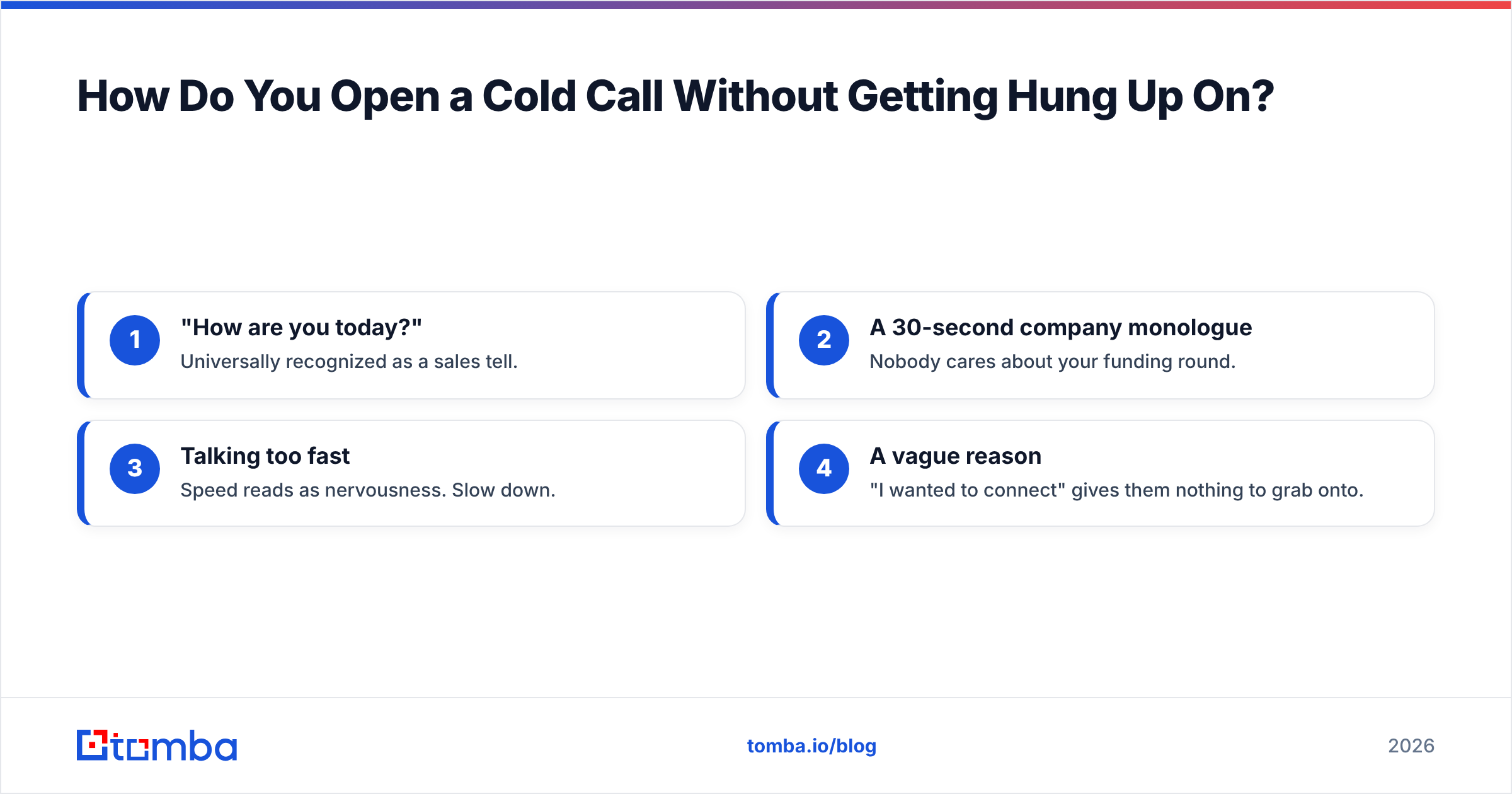
Whatever you do, kill these opener habits:
- "How are you today?" — Universally recognized as a sales tell.
- A 30-second company monologue — Nobody cares about your funding round.
- Talking too fast — Speed reads as nervousness. Slow down.
- A vague reason — "I wanted to connect" gives them nothing to grab onto.
What Goes in the Body of the Script?#
Once you've earned the next 20 seconds, deliver a value hook — one crisp sentence about an outcome, framed around a problem they likely have. Then flip immediately into discovery.
The mistake most reps make is treating the body as a feature dump. Instead, use it to ask sharp questions. A framework like this keeps you honest:
The 4-question discovery flow:
- Situation — "How are you handling [problem area] right now?"
- Problem — "What's the most frustrating part of that today?"
- Impact — "What does that cost you — in time, revenue, or headcount?"
- Priority — "Is fixing that on the roadmap this quarter, or is it more of a someday thing?"
If you've seen SPIN Selling from Huthwaite/Neil Rackham, this will look familiar — it's a proven structure that shifts a call from "me pitching" to "us diagnosing." When the prospect answers question 3, they're selling themselves.
Only after discovery do you connect your product to what they just told you: "Based on what you said about [their words], the reason [similar company] worked with us was exactly that."
A Full Cold Call Pitch Script (Copy-Paste Ready)#
Here's the whole thing assembled. Adapt the brackets, keep the rhythm.
Opener: "Hi [Name], this is [You] from [Company]. I know I caught you out of the blue — can I take 30 seconds to explain why I called, and you tell me if it's worth continuing?"
(Wait for yes.)
Reason + hook: "Thanks. We work with [role] at companies like [example], and the pattern we keep seeing is [specific problem]. We just helped one team [specific outcome]. I'm not sure if that's a problem for you — is it?"
(Let them talk.)
Discovery: "Got it. How are you handling [problem area] today? … And what's the most painful part of that? … What's that costing you?"
The ask: "This sounds like it might be worth a deeper look. I'm not going to pitch you on a cold call — how about 20 minutes Thursday at 10, and I'll show you exactly how [example] solved this. Fair?"
That's it. Under two minutes if the prospect is engaged. The close is a calendar ask with a specific time, not "Can I send you some info?" — which is where deals go to die.
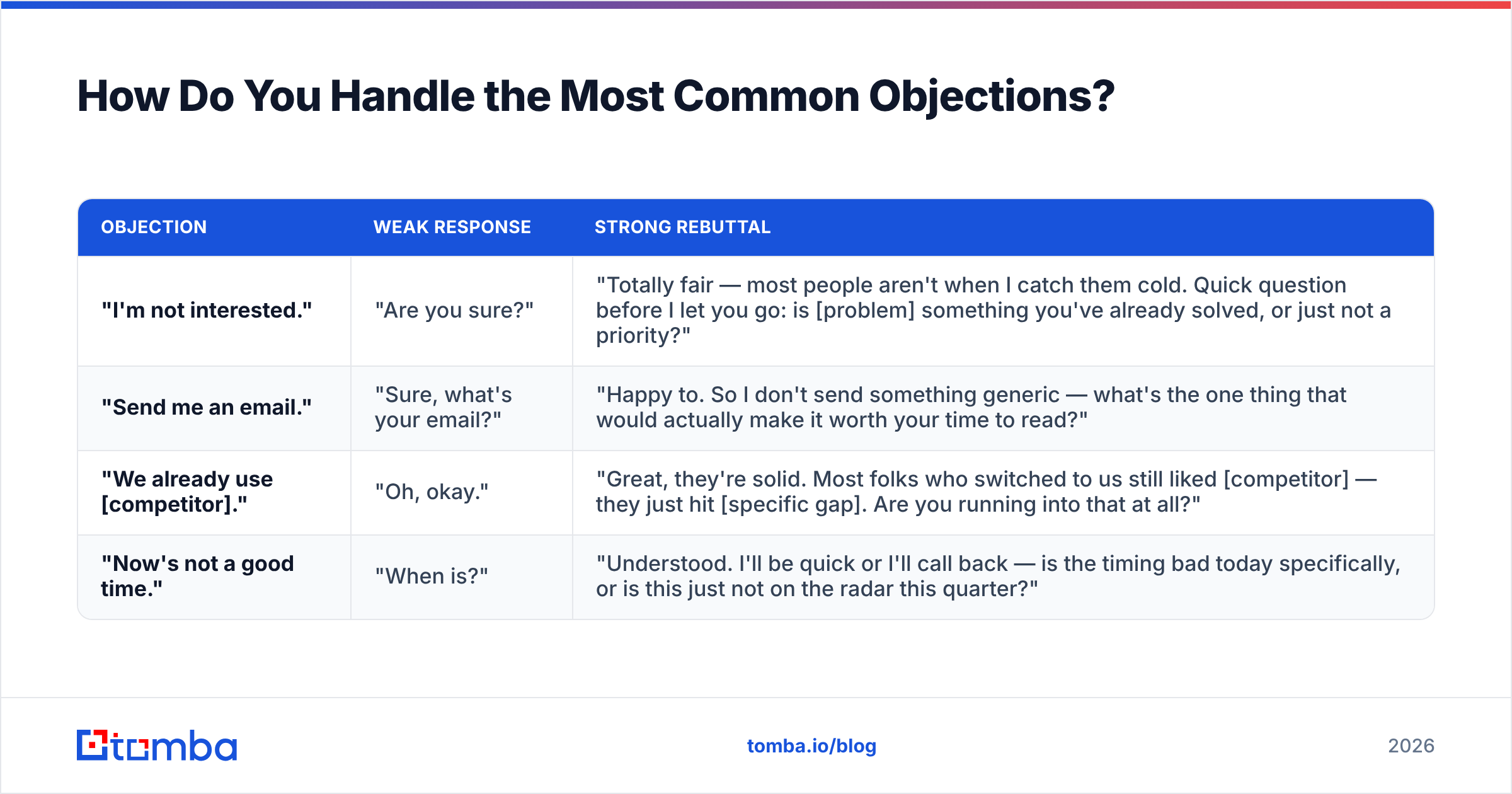
How Do You Handle the Most Common Objections?#
Objections mean the prospect is still on the line and engaged enough to push back. Pre-write your rebuttals so you never freeze. Here are the four you'll hear most:
| Objection | Weak response | Strong rebuttal |
|---|---|---|
| "I'm not interested." | "Are you sure?" | "Totally fair — most people aren't when I catch them cold. Quick question before I let you go: is [problem] something you've already solved, or just not a priority?" |
| "Send me an email." | "Sure, what's your email?" | "Happy to. So I don't send something generic — what's the one thing that would actually make it worth your time to read?" |
| "We already use [competitor]." | "Oh, okay." | "Great, they're solid. Most folks who switched to us still liked [competitor] — they just hit [specific gap]. Are you running into that at all?" |
| "Now's not a good time." | "When is?" | "Understood. I'll be quick or I'll call back — is the timing bad today specifically, or is this just not on the radar this quarter?" |
The through-line: never argue. Acknowledge, then ask a question that keeps the conversation alive. Every rebuttal ends with a question mark, handing the ball back to them.
Why Do Great Scripts Still Fail?#
A flawless script fails when it's pointed at the wrong person. You can nail every line and still lose if the number routes to a disconnected desk, a gatekeeper, or someone who left the company eight months ago. Cold calling has a garbage-in problem: the script is only as good as the contact list underneath it.
This is where prep beats improvisation. Before you dial, you want the right person's direct line, a verified point of contact, and enough firmographic context to personalize the opener. Reps who "spray and pray" through a bad list burn morale and hit rate; reps who dial pre-qualified, accurate contacts book meetings with the same script.
Two data problems sink cold-call campaigns most often:
- Wrong or shared numbers — you reach a switchboard, not the decision-maker. A dedicated phone finder surfaces direct dials, and a phone validator confirms the line is live before you waste a dial.
- Stale contact records — the title, company, or ownership changed. Pairing calls with fresh data enrichment keeps your list current so your opener references the right role at the right company.
Many teams also run a call-and-email one-two punch. If you can't reach someone by phone, a verified work email lets you follow up the same day — which is why keeping an accurate email finder in the workflow multiplies the value of every dial. For a benchmark on how teams price these workflows, G2's software category pages are a decent neutral starting point.
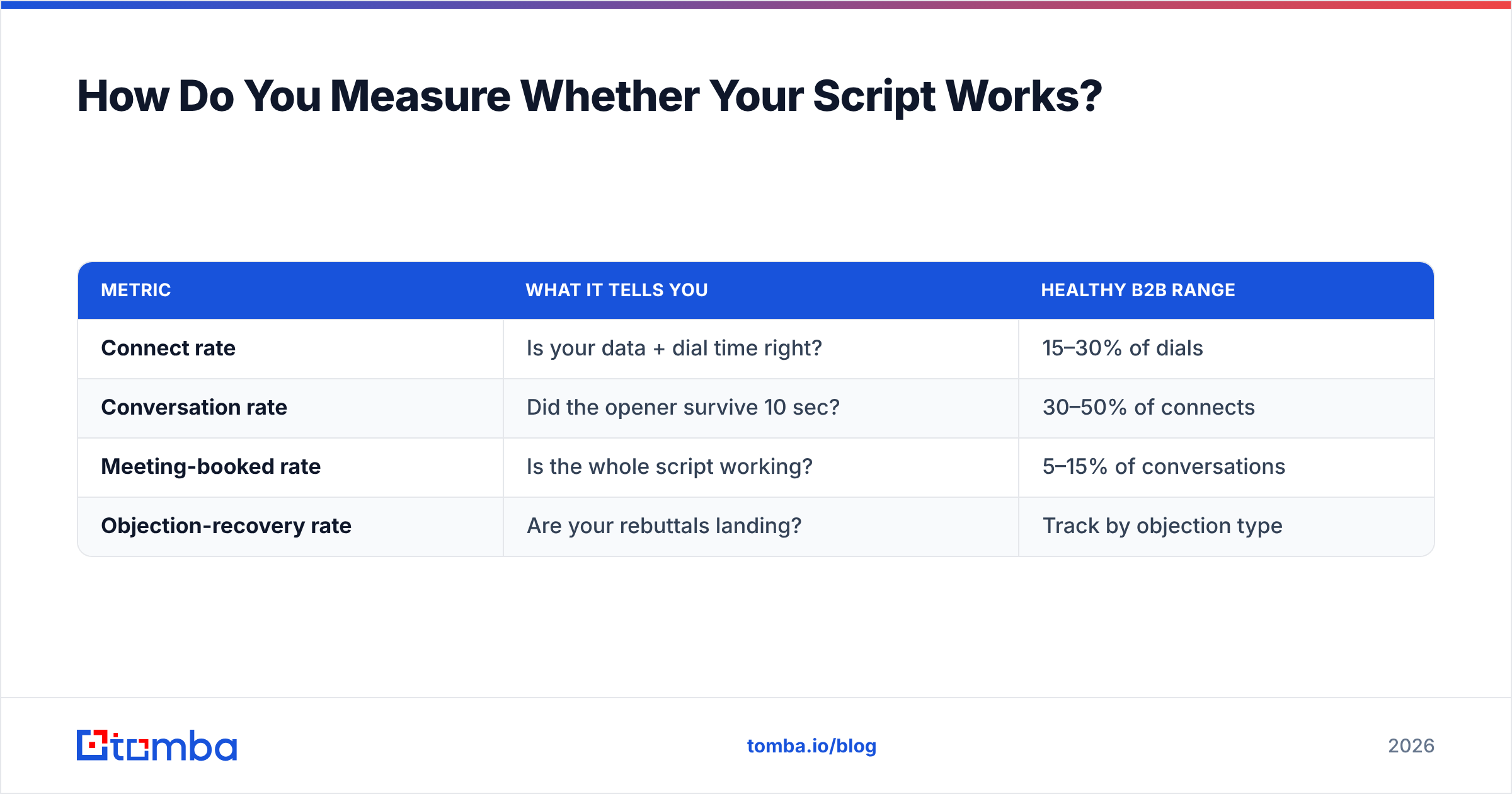
How Do You Measure Whether Your Script Works?#
Don't guess. Track a small set of numbers per script version and let the data pick the winner. If you A/B two openers, keep everything else constant.
| Metric | What it tells you | Healthy B2B range |
|---|---|---|
| Connect rate | Is your data + dial time right? | 15–30% of dials |
| Conversation rate | Did the opener survive 10 sec? | 30–50% of connects |
| Meeting-booked rate | Is the whole script working? | 5–15% of conversations |
| Objection-recovery rate | Are your rebuttals landing? | Track by objection type |
If your connect rate is low, that's a data problem, not a script problem — fix the list before you rewrite a single line. If connects are healthy but conversations tank, your opener is the culprit. If conversations are strong but meetings don't book, your close is too soft. Diagnose before you rewrite.
For a deeper benchmark on cold-calling conversion norms, sales orgs like HubSpot publish annual sales-stat roundups worth pressure-testing against your own numbers.
Cold Call Pitch Script: Quick FAQ#
How long should a cold call script be? Short enough to sound human. Aim for a 2-minute call when things go well — most of that should be the prospect talking, not you reciting.
Should I read the script word-for-word? No. Internalize the structure and the key lines (opener, hook, close), then improvise the discovery. Reading verbatim is the fastest way to sound like a telemarketer.
What's the single biggest mistake in cold call scripts? Pitching too early. Earn permission, ask questions, and only connect your product to a problem the prospect has already admitted out loud.
How many objections should I prepare for? Three to four — the ones you actually hear. Don't script for hypotheticals; script for the pushback in your last 50 calls.
Start With Better Data, Then Run the Script#
The best cold call pitch script in the world can't fix a bad list. Before you refine another opener, make sure every dial reaches a real, current decision-maker — and that you have a verified email ready for the inevitable "just send me something."
Tomba's Email Finder helps you build accurate, verified contact lists by domain, name, or company, so your reps spend their energy on the conversation instead of chasing dead numbers. Pair it with the phone finder and enrichment tools, start free with 25 searches a month, and check the Tomba pricing tiers ($49/mo Starter up to Pro and Enterprise) when you're ready to scale the outbound engine. Fix the data, run the script, book the meeting.
Related guides#
Ready to find emails that actually work?
Join 150,000+ professionals who stopped guessing and started sending. Free credits on signup — no credit card required.
Get the Tomba newsletter
Practical outbound tactics and product updates — once every two weeks.
About the author