Cold Call Qualifying Questions: 15 Scripts to Qualify Faster in 2026
Stop pitching prospects who will never buy. These 15 cold call qualifying questions separate real buyers from time-wasters—complete with scripts, a BANT vs MEDDIC breakdown, and a repeatable framework for 2026.
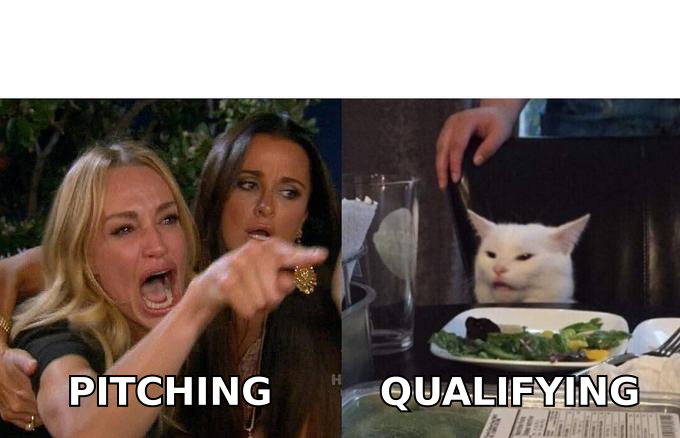
Most cold calls die for one reason: the rep spends 90 seconds pitching a product before finding out the person on the other end has no budget, no authority, and no problem worth solving. Qualifying questions flip that. They turn a monologue into a diagnosis, and a diagnosis is what actually moves a deal forward.
This guide gives you 15 cold call qualifying questions that work in 2026, the exact wording to use, and a framework to sequence them so you never sound like you're reading from a clipboard.
TL;DR#
- Qualify before you pitch. The goal of a cold call isn't to close—it's to confirm the prospect has a real problem, a budget, and the authority to act.
- Use open questions to diagnose, closed questions to confirm. "What's driving that?" surfaces pain; "Are you the person who signs off on this?" locks down a fact.
- Frameworks are scaffolding, not scripts. BANT is fast for high-volume outbound; MEDDIC fits complex, multi-stakeholder deals.
- The best questions feel like a conversation, not an interrogation. Layer them into natural dialogue and always tie back to the prospect's words.
- Bad data wastes good questions. Reaching the right person with an accurate direct line does more for qualification than any clever script.
Why do qualifying questions matter on a cold call?#
Qualifying questions matter because your calendar is finite and most prospects are not a fit. Think of a cold call like a doctor's first appointment. A bad doctor prescribes medication before you've described the symptom. A good one asks where it hurts, how long it's been happening, and what you've already tried—then recommends treatment. Qualifying questions are you asking where it hurts.
The payoff is measurable. Reps who qualify early book fewer meetings but close a far higher percentage of them, which lifts your win rate without adding a single dial. According to HubSpot's sales research, the average successful cold call in recent years runs noticeably longer than an unsuccessful one—because the rep is asking questions and listening, not pitching into a void.
Skip qualification and you get the opposite: long, drifting calls that end in "send me some info" and a follow-up thread that never replies.
What makes a good cold call qualifying question?#
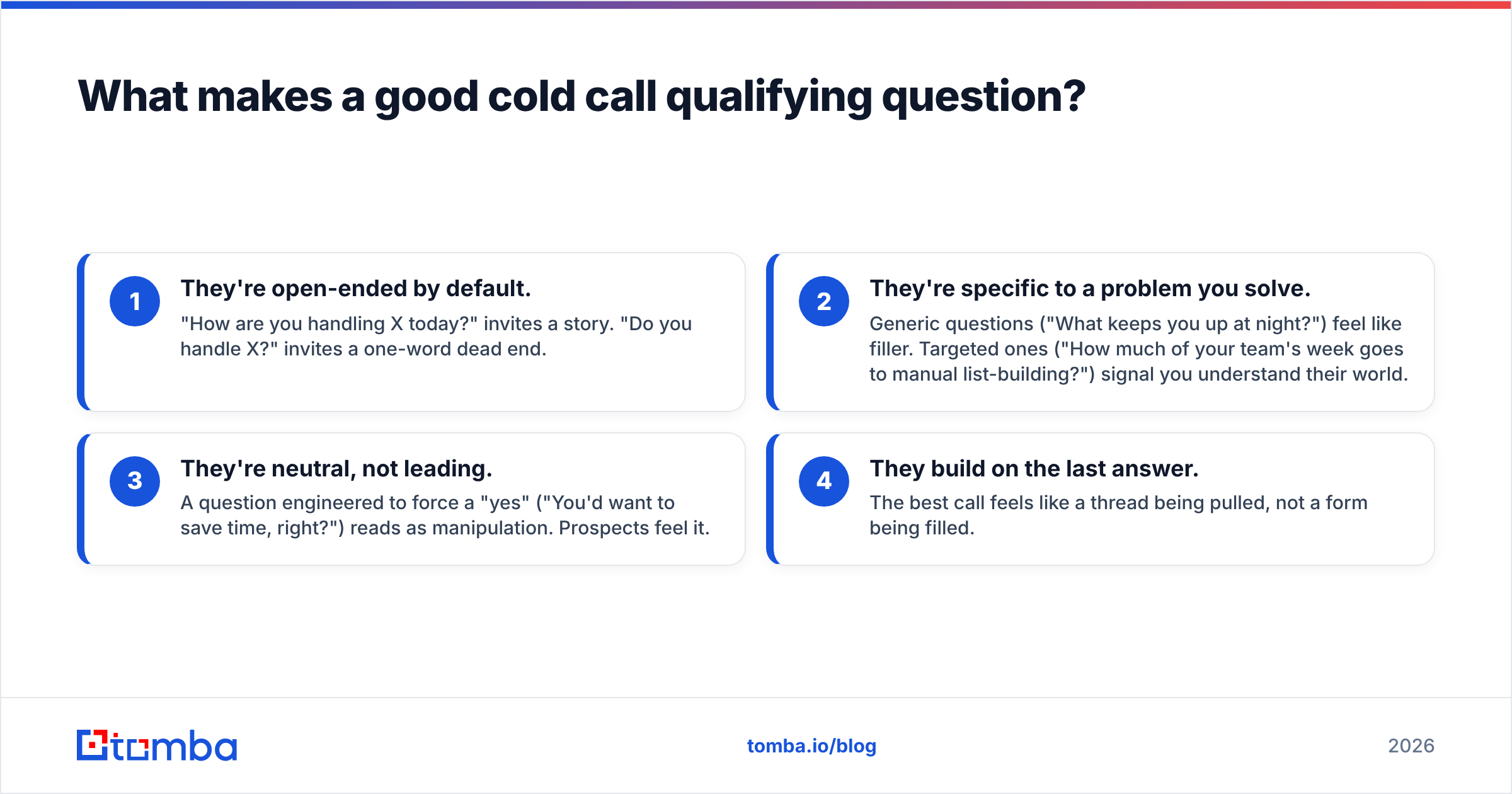
A good qualifying question does three things at once: it surfaces information you need, it keeps the prospect talking, and it earns you the right to ask the next one. The strongest questions share a few traits.
- They're open-ended by default. "How are you handling X today?" invites a story. "Do you handle X?" invites a one-word dead end.
- They're specific to a problem you solve. Generic questions ("What keeps you up at night?") feel like filler. Targeted ones ("How much of your team's week goes to manual list-building?") signal you understand their world.
- They're neutral, not leading. A question engineered to force a "yes" ("You'd want to save time, right?") reads as manipulation. Prospects feel it.
- They build on the last answer. The best call feels like a thread being pulled, not a form being filled.
Get those right and qualification stops feeling like a checkpoint and starts feeling like help.
The 15 best cold call qualifying questions for 2026#
Below are 15 questions grouped by what they uncover. You won't ask all 15 on one call—pick four to six that fit the conversation and let the prospect's answers steer you.
Questions that uncover the problem (pain)#
- "What does your process for [relevant task] look like right now?" — Establishes the status quo before you challenge it.
- "Where does that process tend to break down or slow you down?" — Surfaces the pain without naming it for them.
- "How long has that been a problem, and what's changed recently?" — A problem with a trigger event is a problem with urgency.
- "What have you already tried to fix it?" — Tells you who you're competing against—including "doing nothing."
Questions that uncover budget and cost of inaction#
- "Roughly what is that inefficiency costing you in hours or revenue?" — Converts a vague pain into a number you can sell against.
- "Is there budget allocated to solving this, or is this something you'd need to make a case for?" — Distinguishes a buyer from a browser.
- "How are you funding tools like this today?" — Reveals the buying process without an awkward price interrogation.
Questions that uncover authority and process#
- "Besides yourself, who else would weigh in on a decision like this?" — Maps the buying committee early.
- "What does a decision like this usually look like at your company?" — Uncovers procurement, security review, and timelines.
- "If this made sense, are you the person who'd move it forward?" — A direct authority check, framed hypothetically so it lands softly.
Questions that uncover timing and next steps#
- "Is fixing this a priority for this quarter, or more of a someday thing?" — Separates hot from lukewarm.
- "What would need to be true for you to act on this in the next 30 days?" — Turns interest into concrete conditions.
- "If you did nothing about this for another six months, what happens?" — The cost-of-inaction question that creates urgency without pressure.
- "Who else on your team feels this pain the most?" — Finds your internal champion.
- "What's the best next step from your side?" — Hands the prospect the pen and confirms genuine intent.
BANT vs MEDDIC: which qualifying framework should you use?#
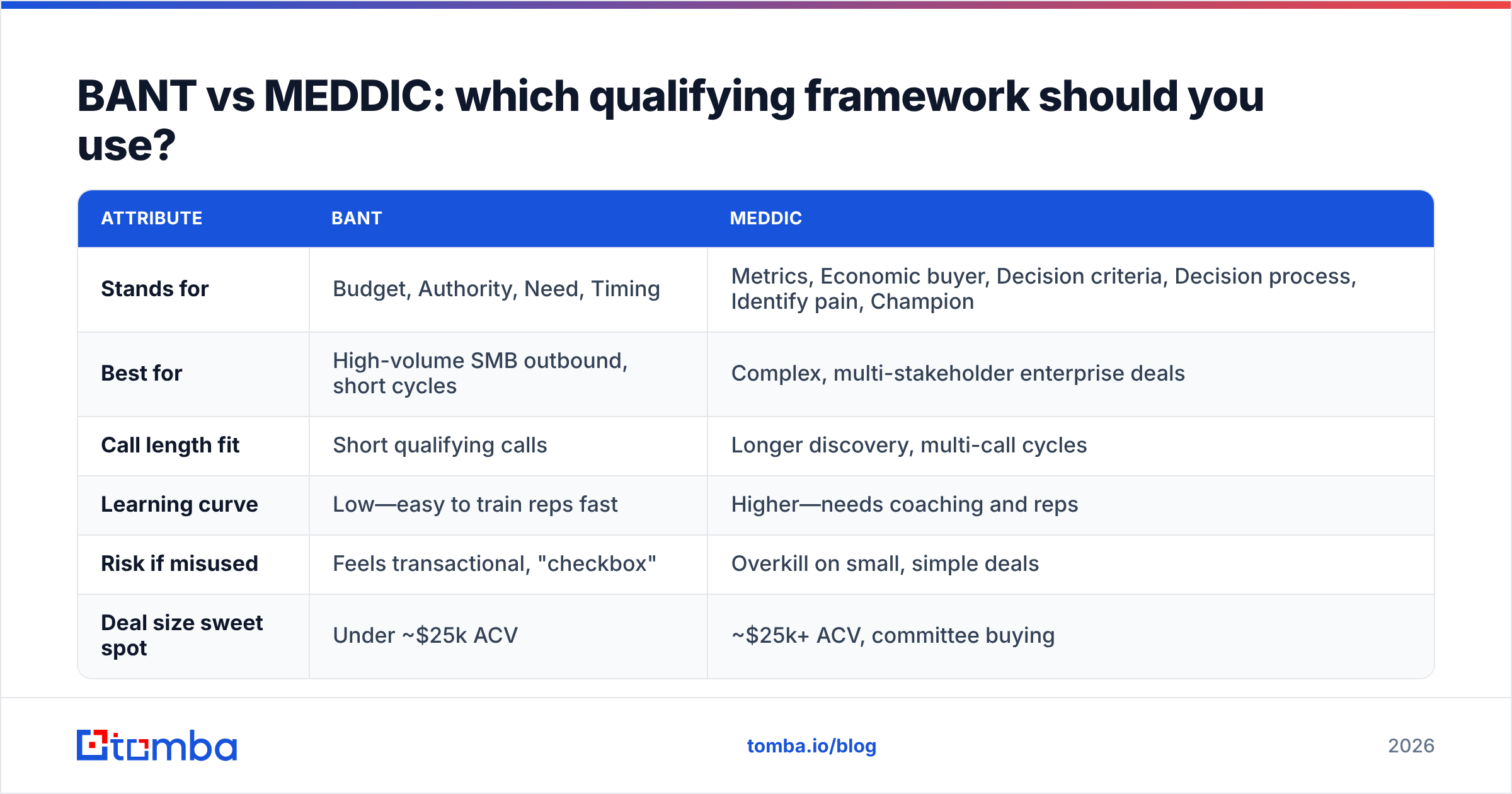
Frameworks help you decide which questions to prioritize. The two you'll hear most are BANT and MEDDIC. BANT is older and faster; MEDDIC is more thorough and built for complex enterprise deals. Neither is a script—they're checklists you convert into natural questions.
| Attribute | BANT | MEDDIC |
|---|---|---|
| Stands for | Budget, Authority, Need, Timing | Metrics, Economic buyer, Decision criteria, Decision process, Identify pain, Champion |
| Best for | High-volume SMB outbound, short cycles | Complex, multi-stakeholder enterprise deals |
| Call length fit | Short qualifying calls | Longer discovery, multi-call cycles |
| Learning curve | Low—easy to train reps fast | Higher—needs coaching and reps |
| Risk if misused | Feels transactional, "checkbox" | Overkill on small, simple deals |
| Deal size sweet spot | Under ~$25k ACV | ~$25k+ ACV, committee buying |
For most SDR and cold-calling motions, start with BANT because it's fast and forgiving. As deals get larger and more people enter the room, layer in MEDDIC's emphasis on the economic buyer and a named champion. Sales-tech vendors like Gong have published call-analysis data showing that deals with a clearly identified champion and documented decision process close at materially higher rates—which is exactly what MEDDIC forces you to capture.
How do you sequence qualifying questions without sounding like a robot?#
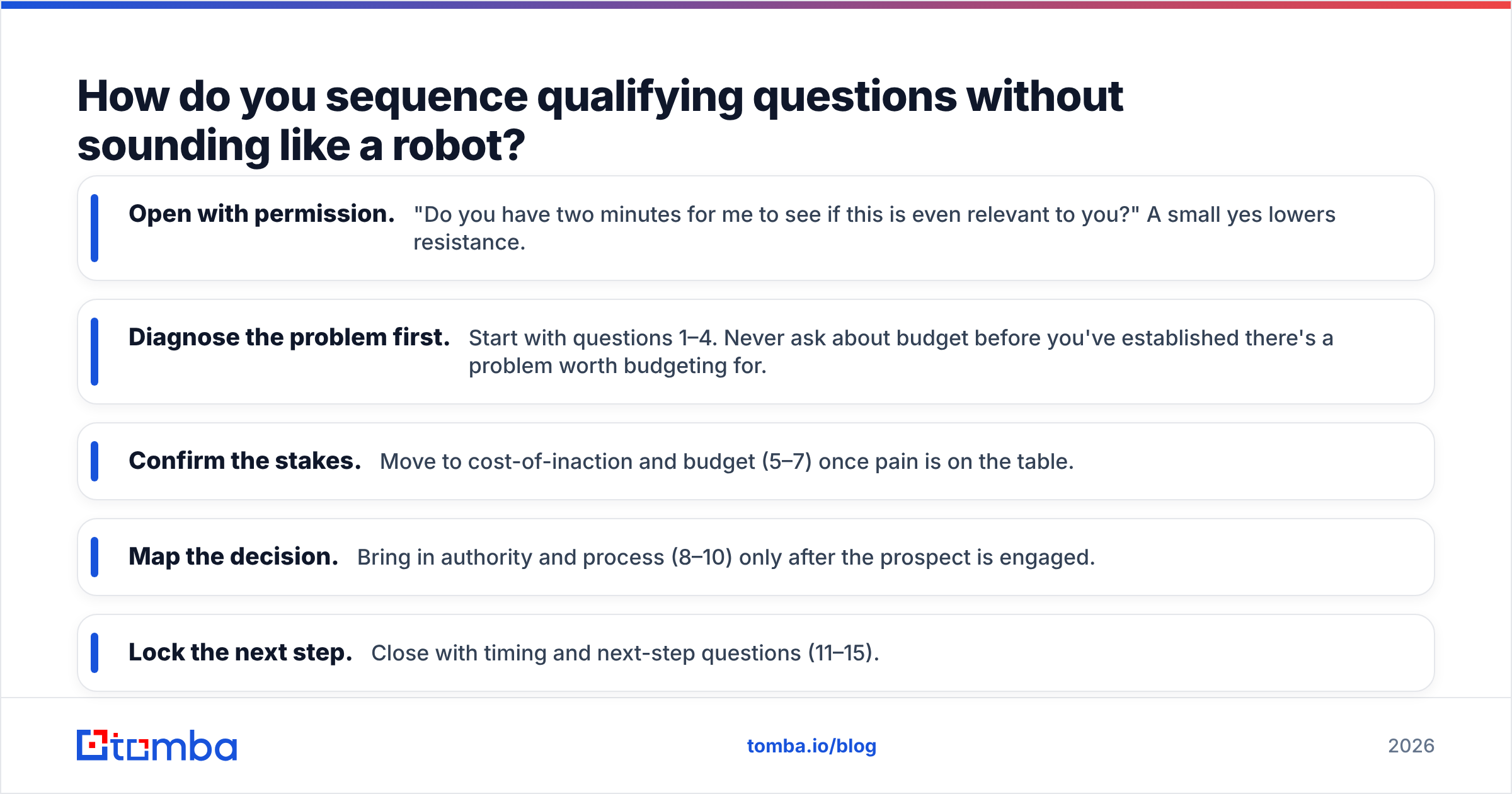
Sequence questions from broad to specific, and always bridge with the prospect's own words. The rhythm looks like this:
- Open with permission. "Do you have two minutes for me to see if this is even relevant to you?" A small yes lowers resistance.
- Diagnose the problem first. Start with questions 1–4. Never ask about budget before you've established there's a problem worth budgeting for.
- Confirm the stakes. Move to cost-of-inaction and budget (5–7) once pain is on the table.
- Map the decision. Bring in authority and process (8–10) only after the prospect is engaged.
- Lock the next step. Close with timing and next-step questions (11–15).
The bridge is what makes it feel human. When a prospect says "list-building eats half our week," you don't jump to your next scripted line—you reflect it back: "Half your week—so if that dropped to an hour, what would the team do with the other twenty?" That's a qualifying question disguised as genuine curiosity.

What are the biggest cold call qualifying mistakes to avoid?#
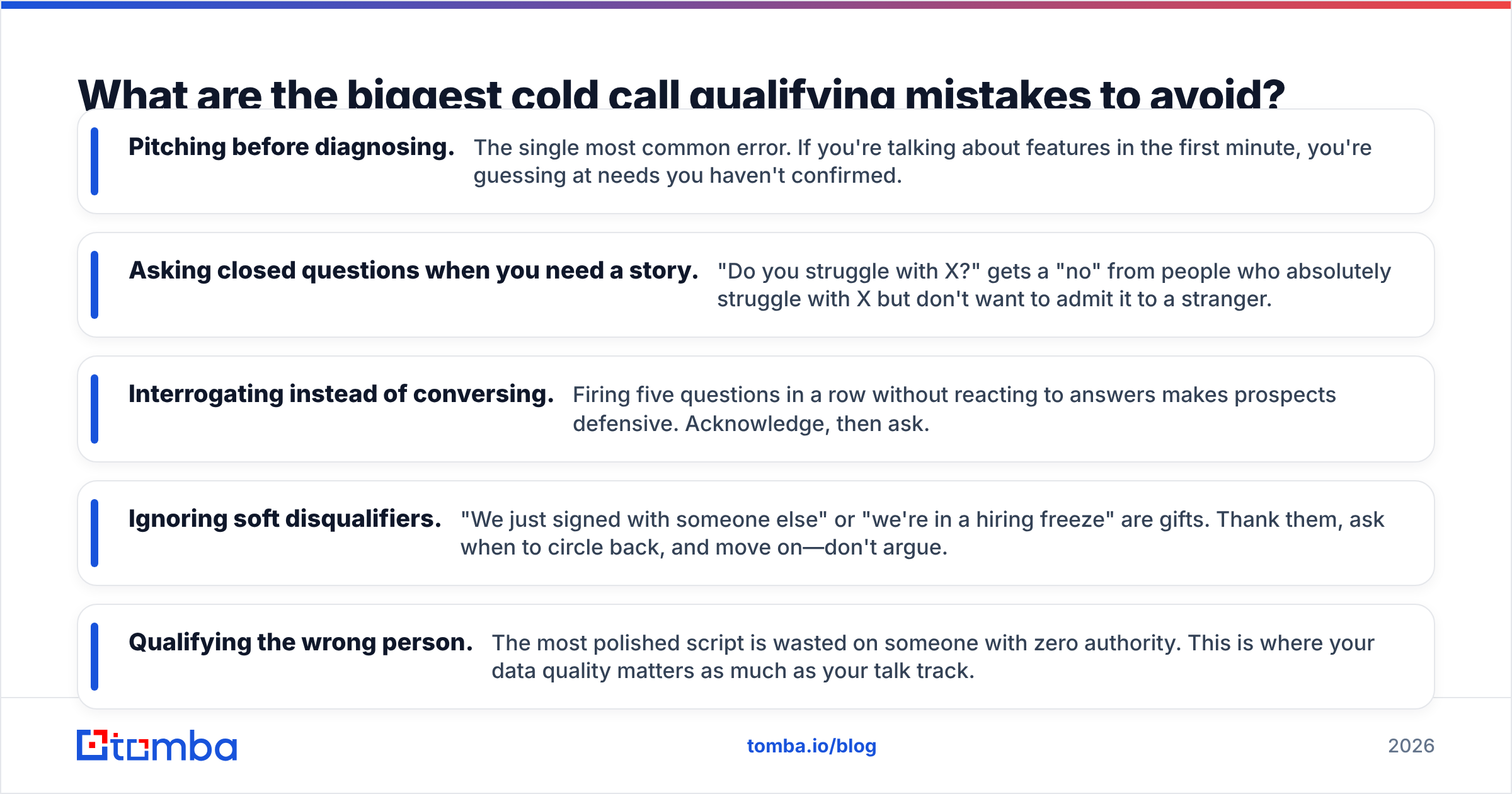
Even with great questions, a few habits will sink your calls.
- Pitching before diagnosing. The single most common error. If you're talking about features in the first minute, you're guessing at needs you haven't confirmed.
- Asking closed questions when you need a story. "Do you struggle with X?" gets a "no" from people who absolutely struggle with X but don't want to admit it to a stranger.
- Interrogating instead of conversing. Firing five questions in a row without reacting to answers makes prospects defensive. Acknowledge, then ask.
- Ignoring soft disqualifiers. "We just signed with someone else" or "we're in a hiring freeze" are gifts. Thank them, ask when to circle back, and move on—don't argue.
- Qualifying the wrong person. The most polished script is wasted on someone with zero authority. This is where your data quality matters as much as your talk track.
That last point is worth dwelling on. You can't qualify a decision-maker you never reach. If your list is full of gatekeepers, generic info@ lines, or dead direct dials, your connect rate collapses before a single question gets asked.
How does better contact data improve qualification?#
Better data improves qualification by putting you in front of the right person, on the right number, on the first attempt. Qualification and prospecting aren't separate steps—clean data is the foundation the whole call sits on.
Two things make the difference:
- Accurate direct dials. Reaching a decision-maker's actual line instead of a switchboard means your qualifying questions land on someone who can answer them. A phone finder that returns verified B2B numbers turns a 5% connect rate into something worth dialing for.
- Pre-call enrichment. Knowing a prospect's role, company size, and tech stack before you dial lets you skip generic questions and open with a relevant one. Data enrichment that appends firmographics to your list means every call starts warmer.
When your contact record already tells you the person is a VP of Sales at a 200-person company using a competing tool, questions 1 and 8 practically write themselves. You spend the call confirming and deepening, not fishing for basics. That's the difference between a qualifying call and a discovery expedition—and it directly lifts your response rate on the follow-up too.
Frequently asked questions#
How many qualifying questions should I ask on one cold call? Aim for four to six. Fewer and you risk pitching to an unqualified prospect; more and it feels like an interview. Let the prospect's answers decide which of the 15 you actually use.
Should I qualify for budget on the very first call? Not first. Establish that a real, costly problem exists before you ask about budget. Budget questions land far better once the prospect has already described the pain in their own words.
Is BANT outdated in 2026? No—it's just narrower than it used to be. BANT is excellent for fast, high-volume outbound and short sales cycles. For complex, committee-driven enterprise deals, layer MEDDIC on top rather than replacing BANT entirely.
What's the best qualifying question if I only get to ask one? "What have you already tried to fix this?" It reveals the problem, the urgency, your competition, and whether "doing nothing" is your real rival—all in one answer.
Start every call with the right person#
Great qualifying questions can't fix a bad list. Before you refine another script, make sure you're dialing decision-makers on numbers that actually connect. Tomba's Email Finder and phone tools help you build accurate, enriched contact lists so your reps spend their time qualifying real buyers instead of chasing dead dials. Check the Tomba pricing plans—starting free with 25 searches a month and scaling to Starter at $49/mo—and give your team a list worth calling.
Related guides#
Ready to find emails that actually work?
Join 150,000+ professionals who stopped guessing and started sending. Free credits on signup — no credit card required.
Get the Tomba newsletter
Practical outbound tactics and product updates — once every two weeks.
About the author