Cold Call Subject Lines That Get Opened: A 2026 Guide
A cold call rarely happens in a vacuum — the email around it decides whether your prospect ever picks up. Here are the subject lines that get those emails opened, why they work, and how to write your own.
Cold calling almost never stands alone anymore. The call is one touch in a sequence, and the email wrapped around it — the pre-call heads-up, the "sorry I missed you," the voicemail follow-up — lives or dies on one line of text. Get the cold call subject line wrong and your prospect never opens the message, never sees the context, and treats your next call as a cold interruption instead of a warm reconnect.
This guide breaks down what a cold call subject line actually is, why it decides your connect rate, the formulas that work in 2026, and 12 lines you can steal today.
TL;DR#
- A cold call subject line is the subject on the emails that surround your calls — the pre-call note, the missed-call follow-up, and the voicemail recap. It sets context so your call lands warm.
- Short wins. Subject lines under 40 characters consistently out-open long ones on mobile, where most reps' emails are first seen.
- Specificity beats cleverness. A referenced trigger ("Your Q3 hiring spike") outperforms hype ("Game-changing offer inside").
- Pair the subject line with a real, verified email address — a great line sent to a bounced address is worthless. Clean data is half the battle.
- Steal the 12 templates below, then test them with a subject line tester before you send at scale.
What is a cold call subject line, exactly?#
Think of it like the label on a package left at someone's door. The prospect decides — in under a second — whether it's worth picking up based only on that label. A cold call subject line is the label on every email that touches your calling motion.
There are three moments where it matters most:
- The pre-call email. Sent hours before you dial, so your name isn't a total stranger when the phone rings.
- The missed-call follow-up. Sent minutes after they don't answer, referencing the attempt.
- The voicemail recap. Sent right after you leave a voicemail, so the message has a written twin in their inbox.
In all three, the subject line does the same job: earn the open, deliver context, and make the next call feel expected instead of intrusive. According to HubSpot's sales research, it often takes multiple touches to reach a prospect — and every touch that gets ignored resets the counter. The subject line is where most of that ignoring happens.
Why does the subject line decide your connect rate?#
Because the email gets seen before the call gets answered. A prospect who has opened your "Quick question re: your SDR team" email at 9:02 a.m. is far more likely to pick up your 11:00 a.m. call than someone who has never seen your name. The subject line is the cheapest warm-up you have.
Three mechanics are working under the hood:
- Recognition. A name they've already read once reads as familiar on the caller ID, even subconsciously.
- Priming. The email plants the reason for the call, so the first 10 seconds of the conversation aren't spent explaining who you are.
- Permission. An opened email that wasn't deleted is a soft signal the topic is relevant — you're no longer purely cold.
Miss on the subject line and none of that happens. You're back to a true cold dial, which anyone who has done outbound knows is the hardest version of the job. Understanding cold calling as a sequence — not a single event — is the mindset shift that makes subject lines matter.
What makes a cold call subject line actually work?#
Four traits show up in nearly every high-open subject line. Use them as a checklist before you hit send.
- Length under 40 characters. Mobile inboxes truncate hard. If the payload isn't in the first few words, it's gone. Aim for 3–6 words.
- A specific trigger or reference. Mention their company, a recent event, a mutual connection, or the call itself. Specificity signals you did homework.
- Zero hype words. "Free," "guaranteed," "exclusive," and "act now" are spam-filter magnets and trust-killers. Write like a colleague, not a billboard.
- A reason tied to them, not you. "Cutting your onboarding time" beats "Introducing our platform." The subject line is about their world.
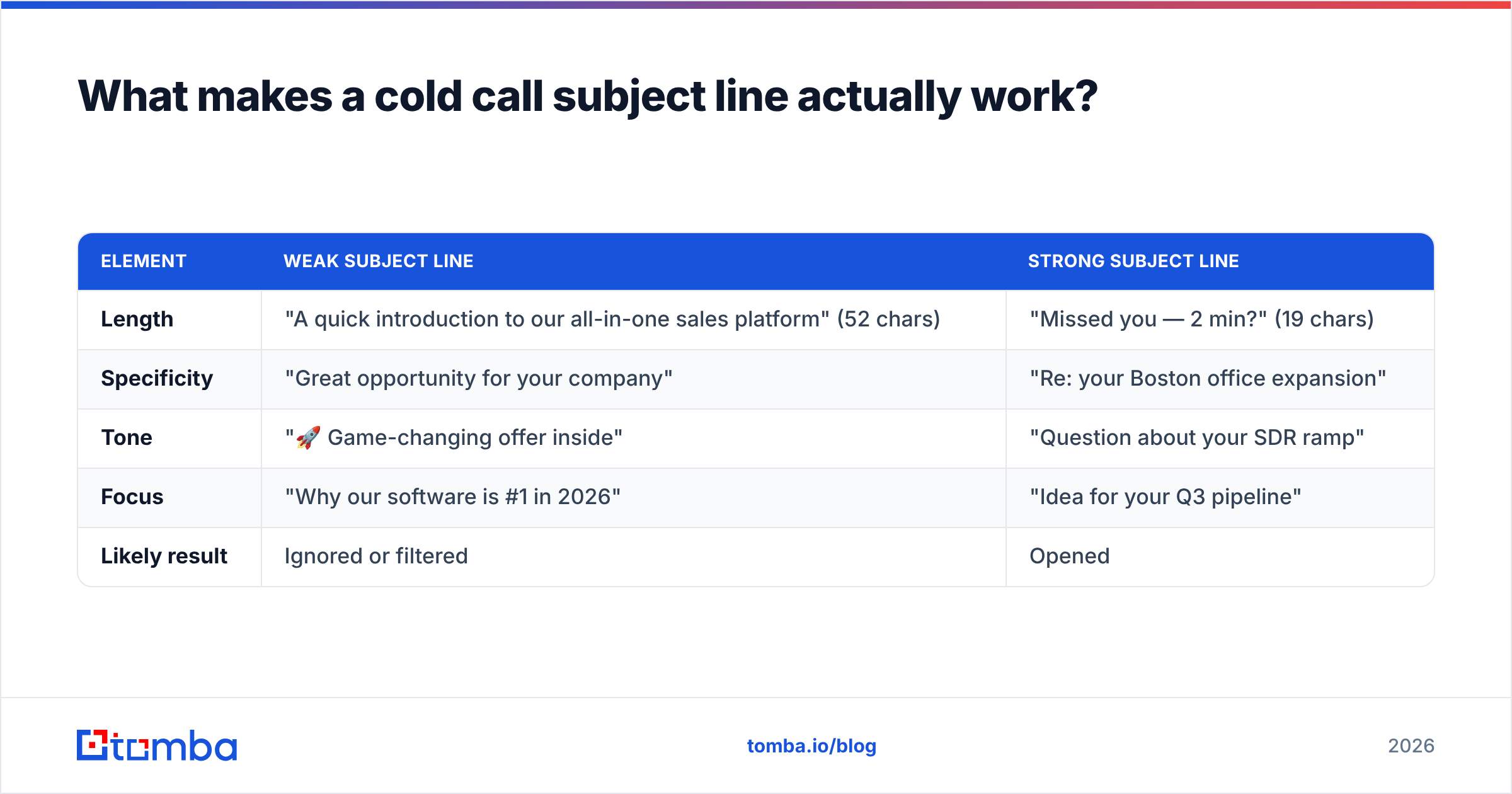
Here's the difference in practice:
| Element | Weak subject line | Strong subject line |
|---|---|---|
| Length | "A quick introduction to our all-in-one sales platform" (52 chars) | "Missed you — 2 min?" (19 chars) |
| Specificity | "Great opportunity for your company" | "Re: your Boston office expansion" |
| Tone | "🚀 Game-changing offer inside" | "Question about your SDR ramp" |
| Focus | "Why our software is #1 in 2026" | "Idea for your Q3 pipeline" |
| Likely result | Ignored or filtered | Opened |
The pattern is obvious once you see it side by side: short, specific, human, prospect-centered. Everything else is noise that trains the reader to swipe left.
Which cold call subject line formulas convert in 2026?#
Below are the reliable formulas, grouped by the moment in your sequence. Swap the brackets for real details — a generic template sent verbatim is almost as bad as no email at all.
Pre-call (sent before you dial):
Quick question re: [their initiative][Mutual connection] suggested I reach outIdea for [their team/department]
Missed-call follow-up (sent minutes after no answer):
Sorry I missed you, [First name]Called about [specific topic]Bad timing? 2-min recap inside
Voicemail recap (sent right after a voicemail):
Left you a voicemail — here's the short versionRe: my call about [pain point]
Re-engagement (after a few unanswered attempts):
Should I close your file?Last note on [topic]Worth a 10-min call next week?[First name], quick yes/no
The "Should I close your file?" and "quick yes/no" lines work because they lower the cost of replying — the prospect can respond in one word. That's a psychological trick worth keeping in your kit. If you want a starting library, Tomba's cold email templates give you full-body copy to pair with these subject lines, and the subject line generator can spin variants when you're stuck.
How do you write your own instead of copying templates?#
Templates get you started; personalization gets you opened. Use this quick process for any account:
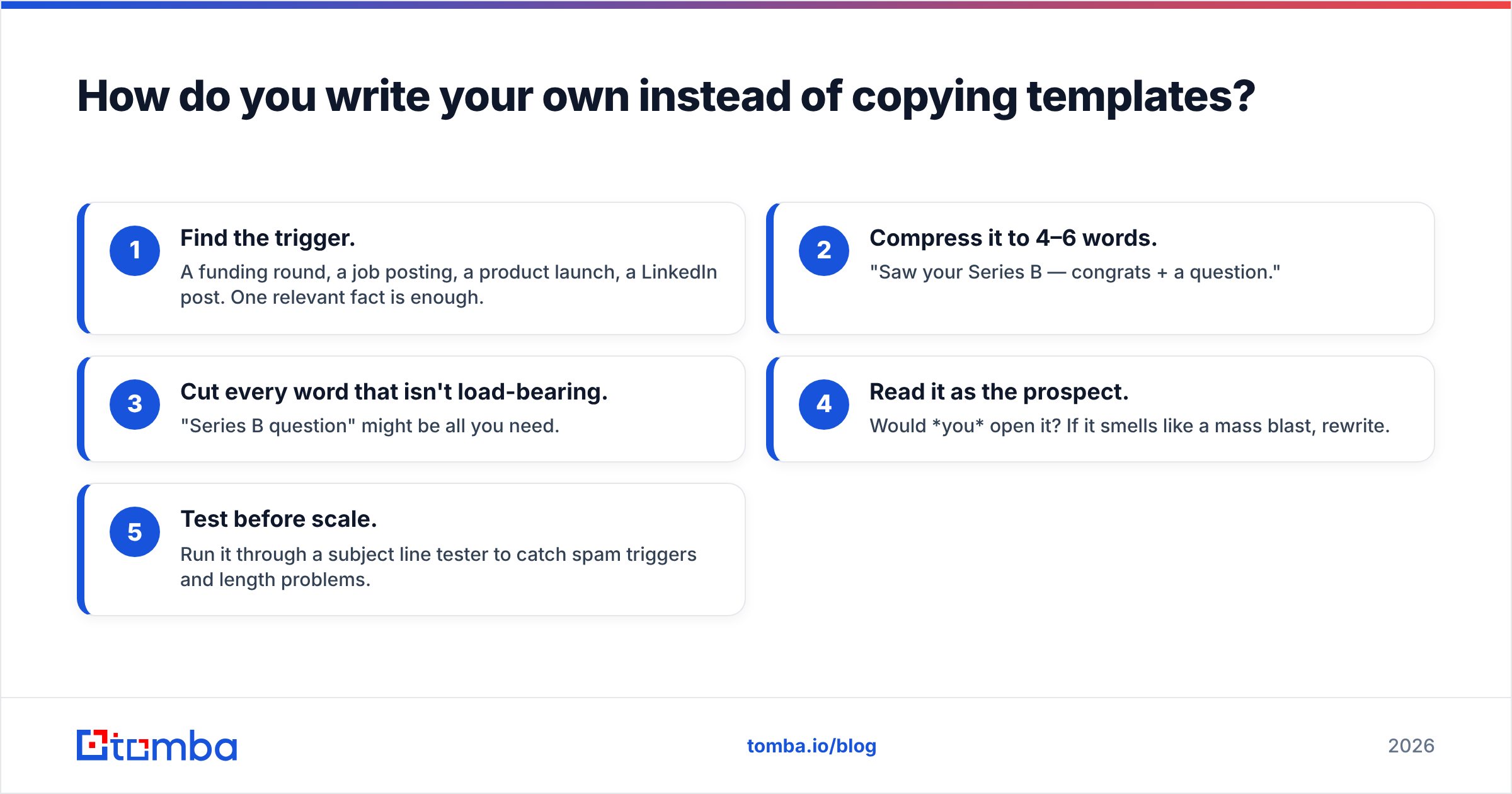
- Find the trigger. A funding round, a job posting, a product launch, a LinkedIn post. One relevant fact is enough.
- Compress it to 4–6 words. "Saw your Series B — congrats + a question."
- Cut every word that isn't load-bearing. "Series B question" might be all you need.
- Read it as the prospect. Would you open it? If it smells like a mass blast, rewrite.
- Test before scale. Run it through a subject line tester to catch spam triggers and length problems.
The goal isn't cleverness — it's the feeling that a real person who knows something about their business is reaching out. That feeling is what earns the open, and the open is what warms the call.
What mistakes tank your open rate?#
Most bad subject lines fail the same handful of ways. Avoid these and you're ahead of the majority of reps.
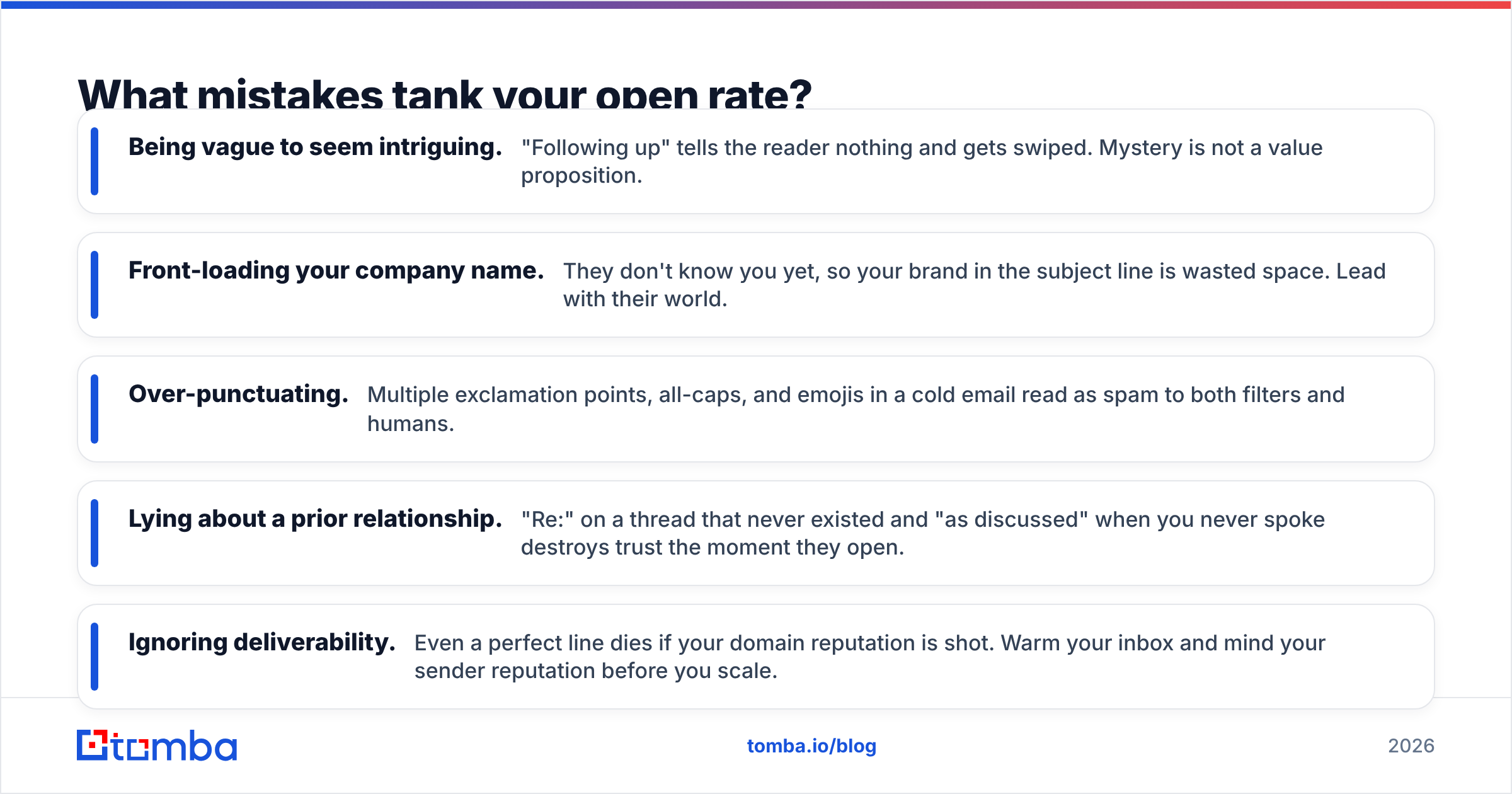
- Being vague to seem intriguing. "Following up" tells the reader nothing and gets swiped. Mystery is not a value proposition.
- Front-loading your company name. They don't know you yet, so your brand in the subject line is wasted space. Lead with their world.
- Over-punctuating. Multiple exclamation points, all-caps, and emojis in a cold email read as spam to both filters and humans.
- Lying about a prior relationship. "Re:" on a thread that never existed and "as discussed" when you never spoke destroys trust the moment they open.
- Ignoring deliverability. Even a perfect line dies if your domain reputation is shot. Warm your inbox and mind your sender reputation before you scale.
That last point is the silent killer. You can obsess over wording for an hour, but if your emails are landing in spam, the subject line never gets a vote. Deliverability and copy are a package deal.
How does clean data multiply your results?#
Here's the part most subject-line guides skip: the best line in the world is worthless if it's sent to jsmith@company.com when the prospect is actually john.smith@company.com. Bounces hurt your response rate twice — the message never arrives, and repeated bounces drag down your sender reputation, which then hurts every other email you send.
That's where verified contact data pays for itself. Before a single subject line goes out, you want:
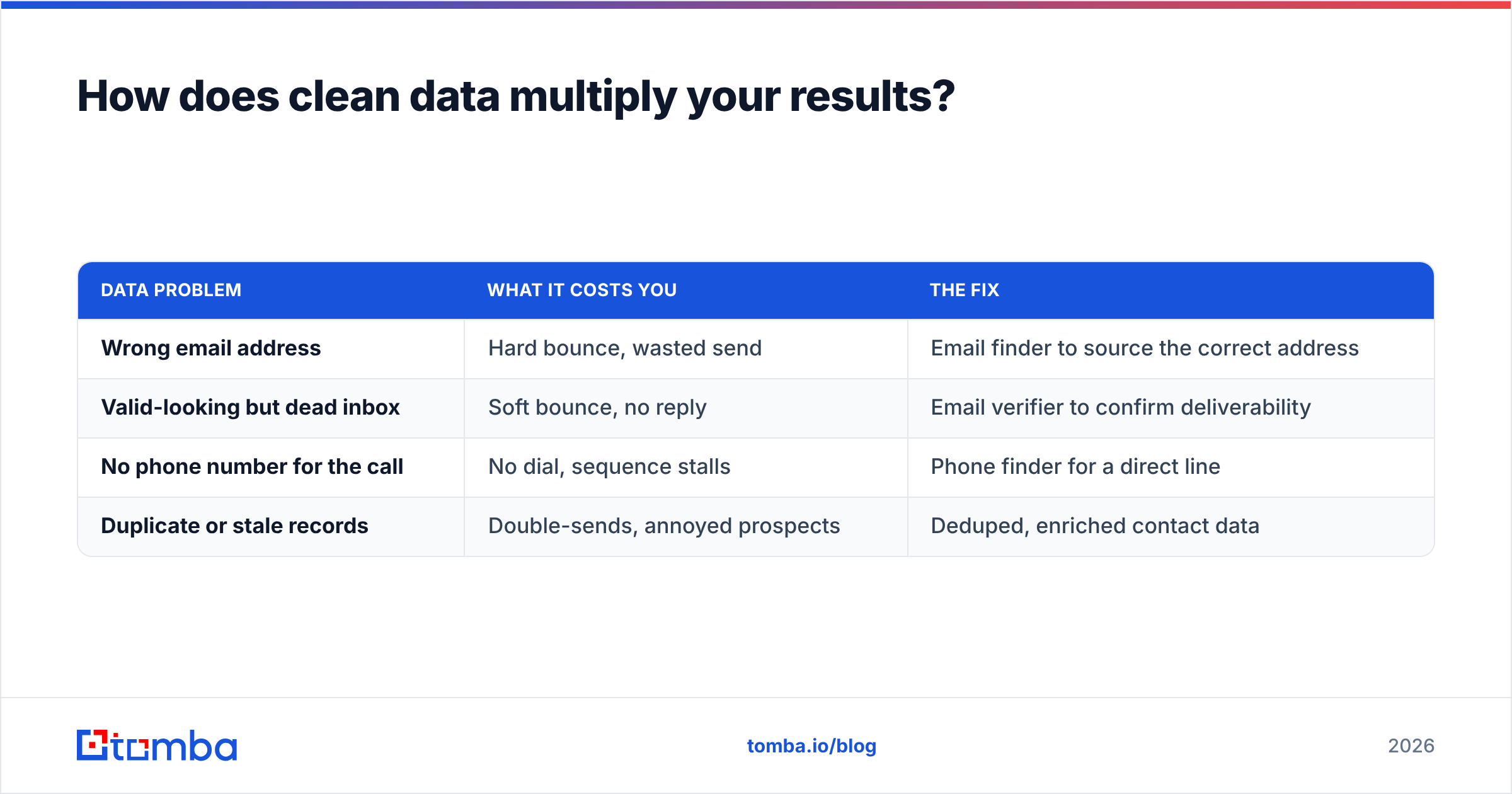
| Data problem | What it costs you | The fix |
|---|---|---|
| Wrong email address | Hard bounce, wasted send | Email finder to source the correct address |
| Valid-looking but dead inbox | Soft bounce, no reply | Email verifier to confirm deliverability |
| No phone number for the call | No dial, sequence stalls | Phone finder for a direct line |
| Duplicate or stale records | Double-sends, annoyed prospects | Deduped, enriched contact data |
A cold call subject line is the last mile of a chain that starts with accurate data. Nail the data, and every subject line you write gets a real shot at an open — and every call you place reaches a real, reachable person.
Cold call subject line quick-reference#
Keep this scannable list on hand when you're building a sequence:
- Keep it under 40 characters. Mobile-first, always.
- One specific reference per line. Company, trigger, or the call itself.
- No hype, no emojis, no fake "Re:". Write like a peer.
- Match the subject to the moment. Pre-call, missed-call, and voicemail recaps each need their own angle.
- Verify the address first. No open rate survives a bounce.
- Test, then scale. A 30-second check beats a burned domain.
Do these six things and you'll out-open the reps still blasting "Touching base" to unverified lists. The bar in outbound is lower than most people think — consistency on the fundamentals is the whole game.
Start with contacts that actually exist#
The sharpest subject line can't rescue a bad address. Before you write another word of copy, make sure every prospect in your sequence has a real, verified email and a working direct line. That's the foundation the whole calling motion sits on.
Use the Tomba Email Finder to source accurate professional emails by name, company, or domain — then verify them, enrich them, and load them into your sequence with confidence. When your data is right, your subject lines get the open they deserve, and your cold calls stop being cold. Check Tomba pricing to find the plan that fits your outbound volume, starting free with 25 searches a month. Write the line, but win the data first.
Related guides#
Ready to find emails that actually work?
Join 150,000+ professionals who stopped guessing and started sending. Free credits on signup — no credit card required.
Get the Tomba newsletter
Practical outbound tactics and product updates — once every two weeks.
About the author