The Cold Call Template That Books Meetings in 2026 (7 Scripts)
A cold call template gives you a repeatable opening, discovery, and close so reps stop freezing on the phone. Steal these 7 scripts, an objection table, and a voicemail formula.
Most cold calls die in the first 10 seconds — not because the product is wrong, but because the rep has no structure. A good cold call template fixes that. It gives you a repeatable opener, a discovery path, and a close you can run half-asleep, so your brain is free to actually listen to the prospect instead of scrambling for the next line.
This guide gives you 7 cold call templates you can copy today, plus an objection-handling table, a voicemail formula, and the metrics that tell you whether your script is working.
TL;DR#
- A cold call template is a flexible script skeleton — opener, permission, value hook, discovery, close — not a word-for-word robot monologue.
- The best-performing structure in 2026 is the permission-based opener: name the person, admit it's a cold call, ask for 30 seconds.
- Templates only work on accurate contact data — a perfect script dialed to a wrong number still fails.
- Use the objection table below to keep the conversation alive past the first "not interested."
- Track connect rate, conversation rate, and meetings booked per 100 dials to know which template to keep.
What is a cold call template?#
A cold call template is a reusable framework that maps out the flow of a call before you ever pick up the phone. Think of it like a jazz chart, not a classical score: it fixes the key sections — the intro, the hook, the questions, the ask — but leaves room to improvise based on what the prospect actually says.
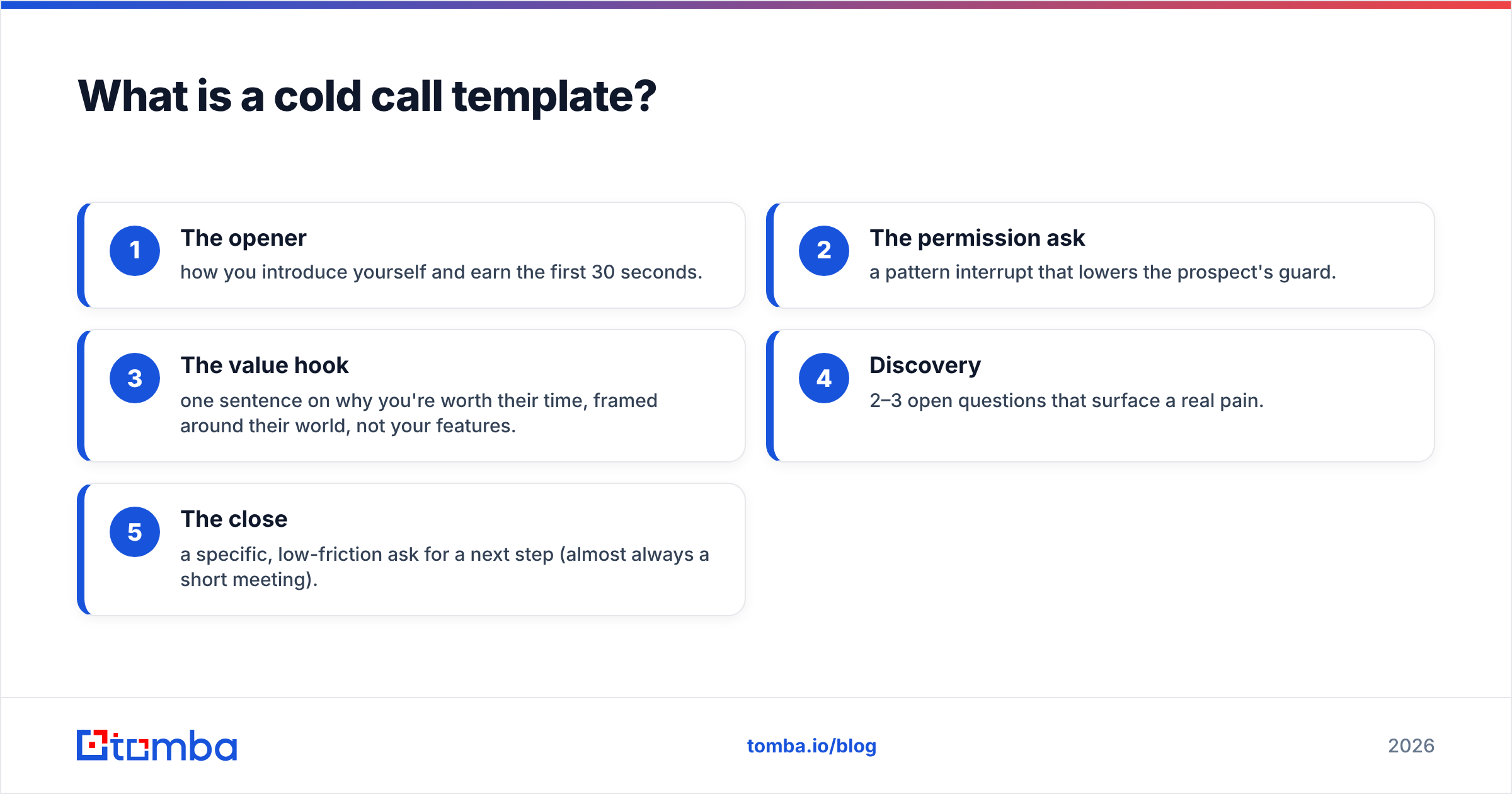
A complete template has five moving parts:
- The opener — how you introduce yourself and earn the first 30 seconds.
- The permission ask — a pattern interrupt that lowers the prospect's guard.
- The value hook — one sentence on why you're worth their time, framed around their world, not your features.
- Discovery — 2–3 open questions that surface a real pain.
- The close — a specific, low-friction ask for a next step (almost always a short meeting).
The reps who sound the most natural on the phone are usually the ones running the tightest template. Structure buys you the freedom to listen.
Why do most cold call scripts fail?#
They fail for three reasons, and only one of them is the script.
The script sounds like a script. If your opener is "How are you doing today?" the prospect's brain files you under "telemarketer" before you finish the sentence. Generic pleasantries trigger the brush-off reflex.
The data is wrong. You can have a flawless template and still miss if the number is stale, the person changed roles, or you're dialing the wrong decision-maker. Before you optimize the words, fix the list. Pairing verified direct dials from a phone finder with confirmed contact details means your reps spend time talking, not chasing disconnected lines.
No feedback loop. Teams that never record, score, or A/B their scripts keep repeating the same weak opener. A template is a hypothesis; your call metrics are the experiment.
The 7 cold call templates#
Below are seven templates for the most common B2B scenarios. Swap the bracketed variables for your specifics and read them out loud a few times before you dial — the goal is to internalize the shape, not memorize the words.
1. The permission-based opener#
"Hi [Name], it's [You] from [Company]. I'll be honest — this is a cold call. Do you want to hang up, or can I have 30 seconds to tell you why I called?"
Admitting the call is cold disarms the prospect and the honesty earns you a hearing. Most people say "go ahead" out of surprise.
2. The referral / trigger-event opener#
"Hi [Name], I saw [Company] just [hired 5 SDRs / raised a Series B / opened a new office]. We help teams in that exact moment [outcome]. Is now a terrible time for a quick question?"
Tying the call to a specific, recent event proves you did homework and aren't spray-dialing a list.
3. The problem-first opener#
"Hi [Name], most [job title]s I talk to are fighting [specific pain] this quarter. Is that on your radar, or have you already got it handled?"
You lead with their problem, not your product. If it lands, they lean in; if not, they tell you fast and you save everyone time.
4. The straight-shooter opener#
"Hi [Name], I know you didn't expect my call, so I'll be quick. We [one-line outcome] for companies like [peer]. Worth 15 minutes next week, or should I get out of your hair?"
Respecting their time explicitly is itself a differentiator on a channel built on interruption.
5. The voicemail template#
"Hi [Name], [You] from [Company]. I called about [specific outcome/trigger] — I'll send a two-line email so you have it in writing. If it's not relevant, just reply 'no' and I won't chase you. Talk soon."
Give a reason for the follow-up email and a graceful exit. Reference your voicemail in the email subject line for a one-two punch.
6. The gatekeeper template#
"Hi, I'm hoping you can help me — I'm trying to reach whoever owns [function]. Who would that be, and is there a good time to catch them?"
Treat the gatekeeper as an ally, not an obstacle. Asking for help beats trying to bluff past them.
7. The re-engagement template#
"Hi [Name], we spoke back in [month] about [topic] and the timing wasn't right. A few things have changed on our end — mind if I take two minutes to catch you up?"
Warm-ish leads deserve a script that acknowledges the history instead of restarting from zero.
Which cold call template should you use?#
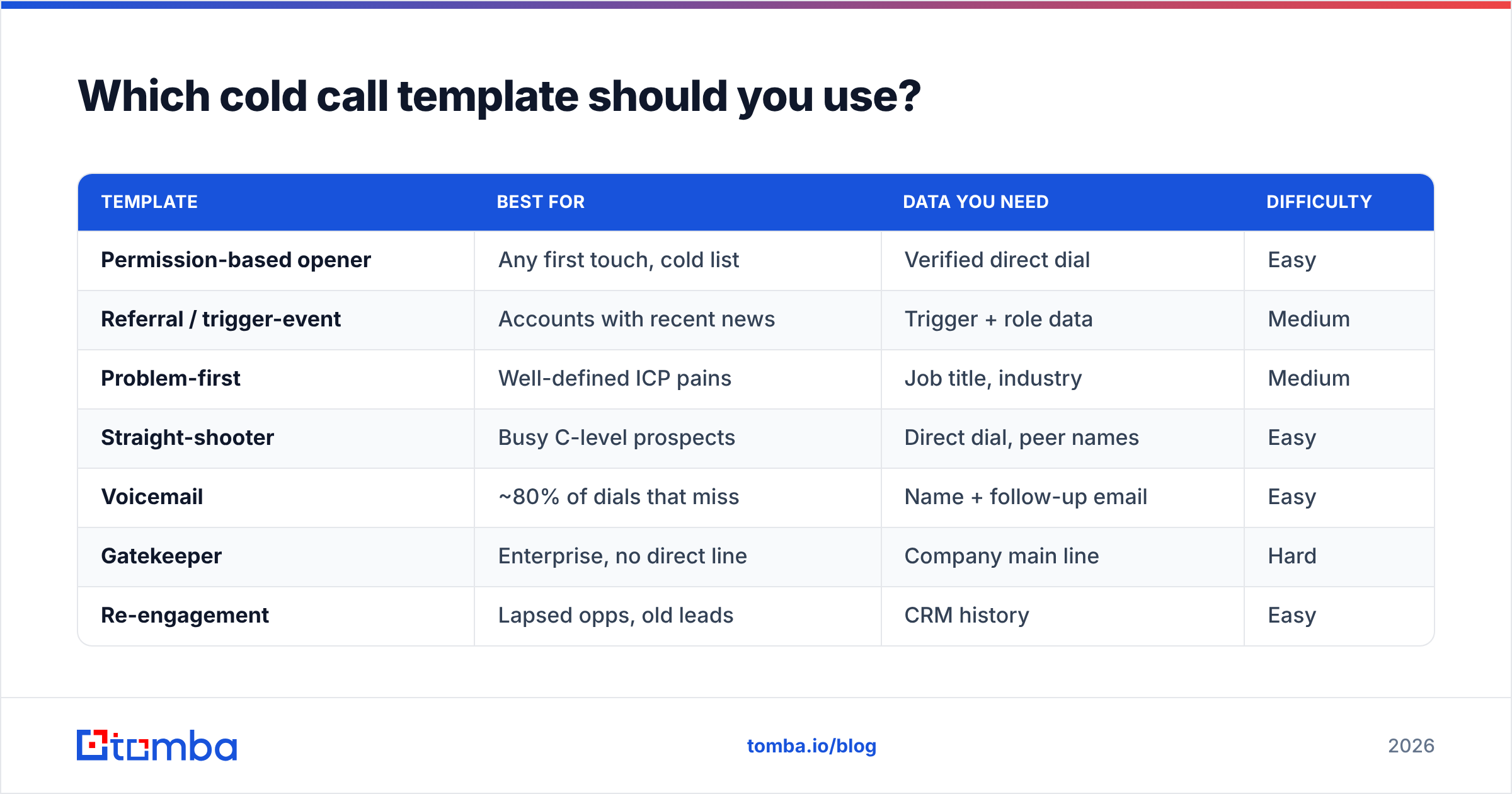
Match the template to the scenario, the data you have, and the buyer's seniority. Here's a quick decision table.
| Template | Best for | Data you need | Difficulty |
|---|---|---|---|
| Permission-based opener | Any first touch, cold list | Verified direct dial | Easy |
| Referral / trigger-event | Accounts with recent news | Trigger + role data | Medium |
| Problem-first | Well-defined ICP pains | Job title, industry | Medium |
| Straight-shooter | Busy C-level prospects | Direct dial, peer names | Easy |
| Voicemail | ~80% of dials that miss | Name + follow-up email | Easy |
| Gatekeeper | Enterprise, no direct line | Company main line | Hard |
| Re-engagement | Lapsed opps, old leads | CRM history | Easy |
If you only master two, start with the permission-based opener and the voicemail template — together they cover the overwhelming majority of what actually happens on a dial session.
How do you handle cold call objections?#
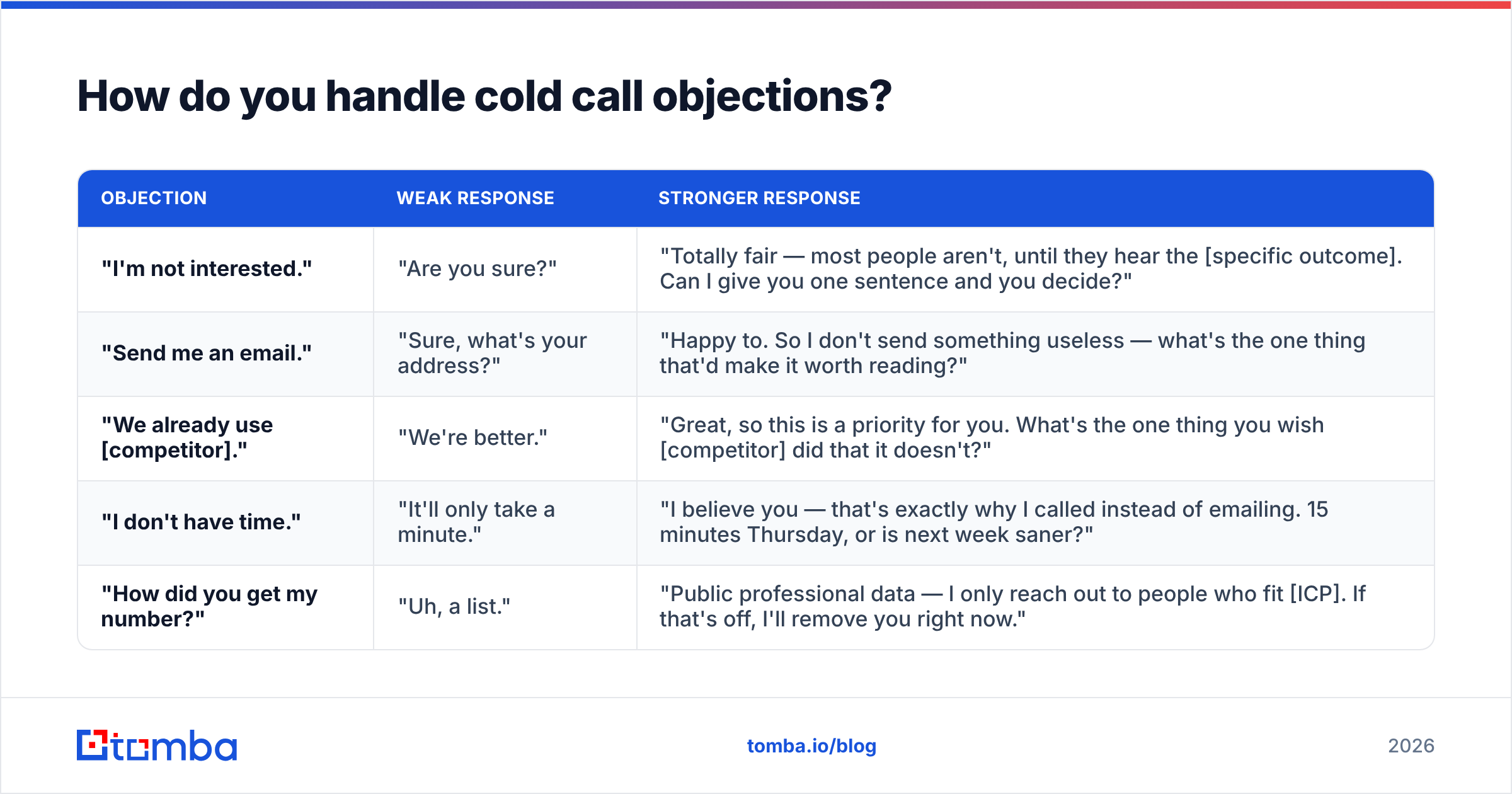
Objections aren't rejections; they're requests for a reason to keep talking. The move is to acknowledge, reframe, and ask a question that reopens the conversation. Keep this table by your desk.
| Objection | Weak response | Stronger response |
|---|---|---|
| "I'm not interested." | "Are you sure?" | "Totally fair — most people aren't, until they hear the [specific outcome]. Can I give you one sentence and you decide?" |
| "Send me an email." | "Sure, what's your address?" | "Happy to. So I don't send something useless — what's the one thing that'd make it worth reading?" |
| "We already use [competitor]." | "We're better." | "Great, so this is a priority for you. What's the one thing you wish [competitor] did that it doesn't?" |
| "I don't have time." | "It'll only take a minute." | "I believe you — that's exactly why I called instead of emailing. 15 minutes Thursday, or is next week saner?" |
| "How did you get my number?" | "Uh, a list." | "Public professional data — I only reach out to people who fit [ICP]. If that's off, I'll remove you right now." |
The pattern is always the same: agree with the emotion, redirect to value, end on a question. Never argue.
Do cold call scripts still work in 2026?#
Yes — but only when they're built on good data and paired with other channels. The phone is one of the few channels where you get a real-time human reaction, which is exactly why it still converts when done well. Industry research from teams like Gong consistently shows that structured openers and talk-listen ratios move connect-to-meeting rates more than raw dial volume.
What's changed is the surrounding motion. In 2026, the top performers run the phone alongside email and LinkedIn in a coordinated sequence, not in isolation. A cold call after a well-timed email lands warmer than a cold call into silence. If you're building that multichannel motion, our guide to LinkedIn outreach and a tight set of cold email templates will compound with your calling.
Frameworks like HubSpot's sales cadence research reinforce the same point: a script is a tool inside a system, not a magic incantation.
How do you know if your template is working?#
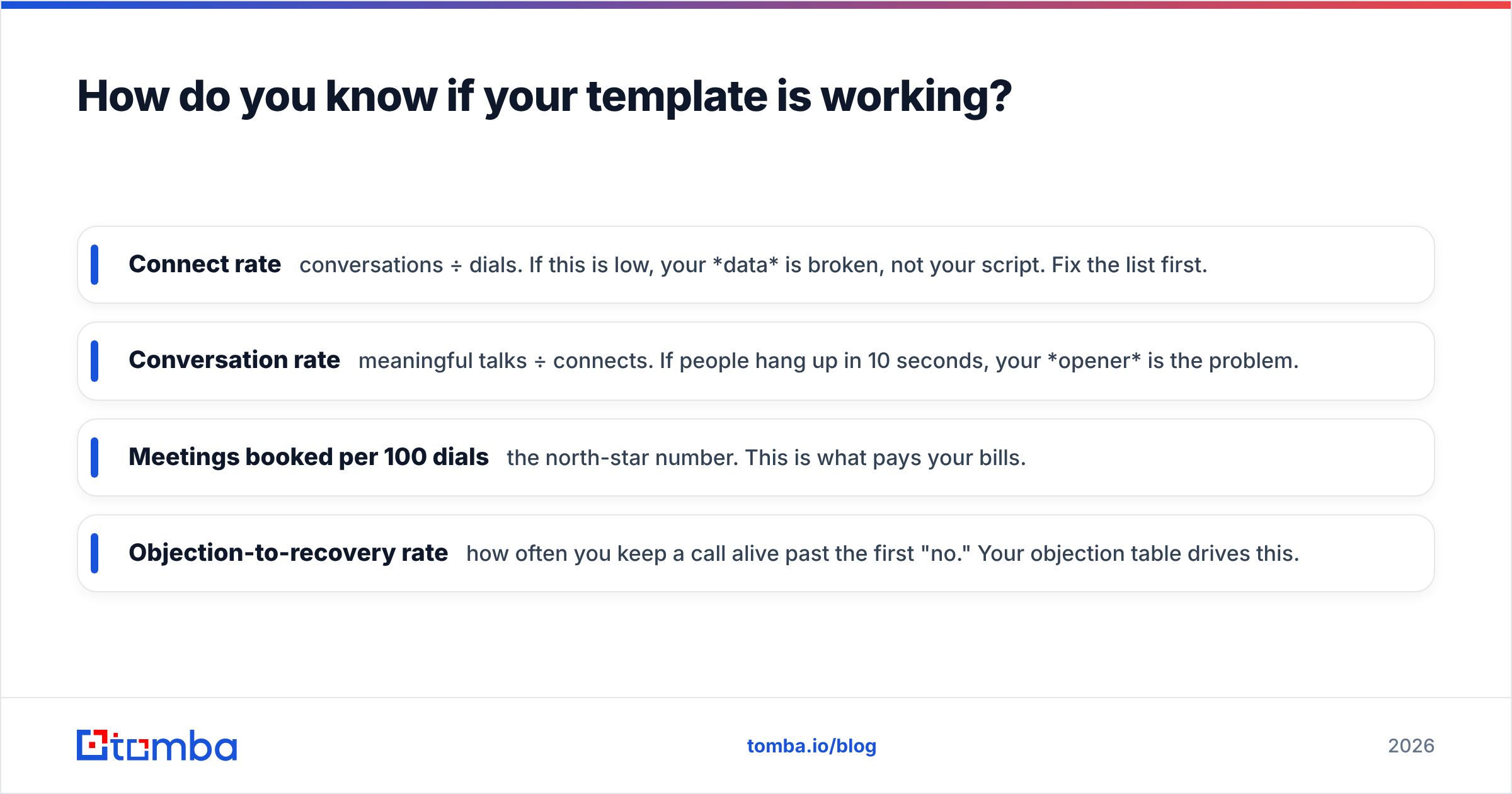
Track three numbers and let them tell you which script to keep. Vanity metrics like "dials made" feel productive but hide what matters.
- Connect rate — conversations ÷ dials. If this is low, your data is broken, not your script. Fix the list first.
- Conversation rate — meaningful talks ÷ connects. If people hang up in 10 seconds, your opener is the problem.
- Meetings booked per 100 dials — the north-star number. This is what pays your bills.
- Objection-to-recovery rate — how often you keep a call alive past the first "no." Your objection table drives this.
Run one template for a week, log the numbers, then swap a single variable — usually the opener — and compare. Treat it like an experiment, not a personality test.
A quick reality check on the data side: if your connect rate is stuck below 15–20%, no script rewrite will save you. That's a signal to audit where your numbers come from and to verify contacts before the dial session, not during it. Reps who load a clean, verified list into the dialer simply get more at-bats per hour.
Common mistakes to avoid#
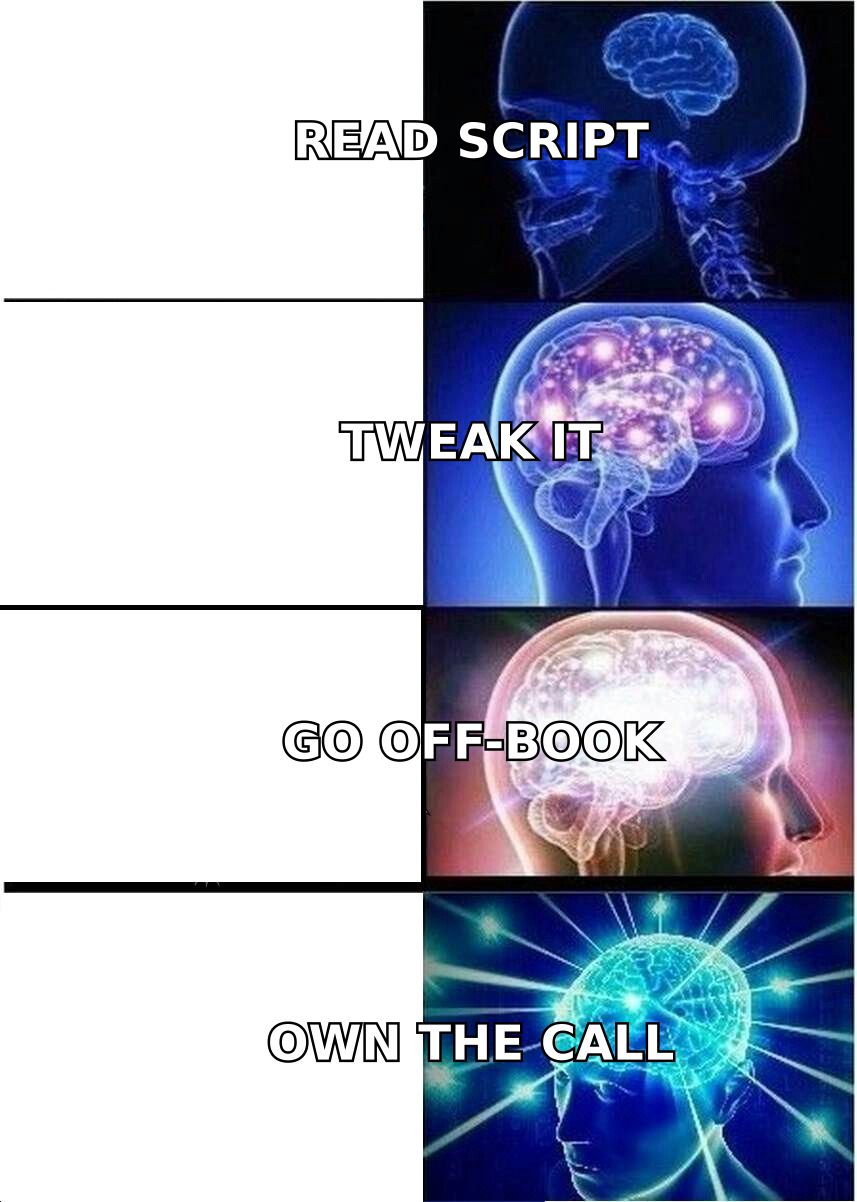
- Reading, not talking. If it sounds read, it is read. Internalize the shape and speak like a human.
- Talking too much. Aim for the prospect speaking at least 40% of the time. Your questions do the selling.
- No clear ask. "I'll follow up" isn't a close. Offer two specific time slots.
- Skipping the voicemail. ~80% of dials won't connect on the first try. A scripted voicemail plus a referencing email is free pipeline.
- Never updating the script. A template that worked in Q1 can go stale by Q3. Revisit it monthly against your metrics.
Put your cold call template to work#
A great script is only half the equation — the other half is dialing the right person at a number that actually rings. Before your next call block, build a verified list of decision-makers with correct direct dials and emails so every template above gets a fair shot. Tomba's Email Finder helps you find and confirm the professional contacts behind your target accounts, and pairs with the phone finder so your reps spend the day in conversations, not chasing dead numbers. Start free with 25 searches, then scale on a plan that fits your team — see Tomba pricing for details. Fix the data, run the template, track the three numbers, and watch your meetings-per-100-dials climb.
Related guides#
Ready to find emails that actually work?
Join 150,000+ professionals who stopped guessing and started sending. Free credits on signup — no credit card required.
Get the Tomba newsletter
Practical outbound tactics and product updates — once every two weeks.
About the author