Cold Call Tonality: How to Sound Confident on Every Call
Your script matters less than how you say it. Learn the cold call tonality techniques—pace, pitch, and pauses—that keep prospects on the line and booking meetings.
You dialed the right number. You reached a real decision-maker. You even had a solid opener. And they still hung up in eight seconds. The problem usually isn't your list or your script — it's your tonality. The way you sound in the first few seconds tells a prospect whether to keep listening or reach for the "not interested" button.
Cold call tonality is the single most underrated variable in phone-based selling. Two reps can read the exact same word-for-word script and get wildly different results, because one sounds like a confident peer and the other sounds like a nervous telemarketer. This guide breaks down what tonality actually is, why it beats the script, and the specific vocal patterns you can drill this week.
TL;DR#
- Tonality is how you say it, not what you say. Pace, pitch, volume, and pauses carry more meaning on a cold call than the words themselves.
- Downward inflection signals confidence. End statements going down, not up — upward inflection makes you sound like you're asking permission.
- Slow down and use pauses. Talking fast reads as desperation; a two-second pause after your opener earns attention.
- Match and lead the prospect's energy. Mirror their pace first, then guide them toward calm confidence.
- Record and score your calls. You cannot fix a tonality problem you have never heard. Weekly self-review is the fastest lever.
What is cold call tonality?#
Cold call tonality is the emotional and vocal quality of your speech — pace, pitch, volume, inflection, and pauses — independent of the actual words you use. Researchers call this "paralanguage": everything a listener hears besides the dictionary meaning of your sentences.
Think of it like a song. The lyrics are your script, but the melody is your tonality. You can sing "I'm calling about your sales process" as a bright, curious question or as a flat, apologetic mumble — same lyrics, completely different song. Prospects decide how to feel about you based on the melody long before they process the lyrics.
On a cold call, the stakes are higher than in a normal conversation because the listener has zero visual cues. No handshake, no eye contact, no confident posture. Your voice has to carry 100% of the trust signal. That's why a great script delivered with weak tonality flops, and a mediocre script delivered with strong tonality books meetings.
Why does tonality matter more than the script?#
Because humans are wired to judge intent from sound. According to widely-cited communication research popularized on the HubSpot sales blog, a large share of how a message lands comes from vocal quality and delivery rather than the literal words — especially when someone is deciding whether to trust a stranger. Cold calling is the purest test of that principle.
Conversation-intelligence data backs this up. Analysis of hundreds of thousands of sales calls by Gong consistently shows that how top reps speak — their pacing, their willingness to pause, their tone during objections — separates them from average performers far more reliably than the specific talk tracks they memorize.
Here's the practical takeaway: a prospect can't consciously evaluate your value proposition in the first five seconds. What they can do instantly is decide whether you sound like a confident expert worth two minutes, or a scripted rep they need to escape. Tonality wins or loses that snap judgment. The word "paralanguage" on Wikipedia covers the underlying science if you want the deep version.
What are the core elements of cold call tonality?#
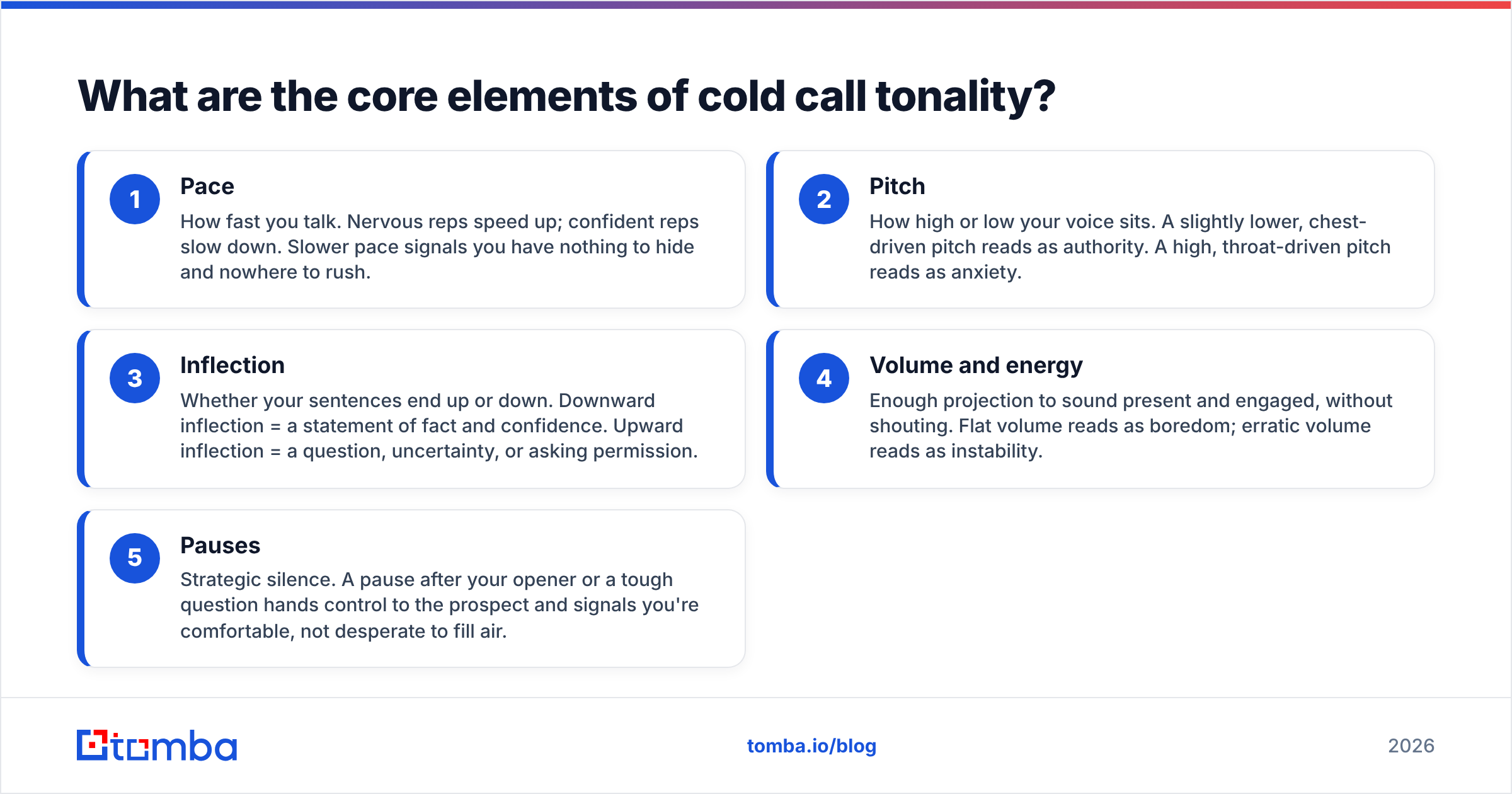
There are five levers you can pull. Master these and you control the emotional read of every call.
- Pace — How fast you talk. Nervous reps speed up; confident reps slow down. Slower pace signals you have nothing to hide and nowhere to rush.
- Pitch — How high or low your voice sits. A slightly lower, chest-driven pitch reads as authority. A high, throat-driven pitch reads as anxiety.
- Inflection — Whether your sentences end up or down. Downward inflection = a statement of fact and confidence. Upward inflection = a question, uncertainty, or asking permission.
- Volume and energy — Enough projection to sound present and engaged, without shouting. Flat volume reads as boredom; erratic volume reads as instability.
- Pauses — Strategic silence. A pause after your opener or a tough question hands control to the prospect and signals you're comfortable, not desperate to fill air.
The magic is in combining them. "Confident but warm" is a slow pace, a grounded pitch, downward inflection, moderate energy, and deliberate pauses working together.
Which tonality types should you actually use?#
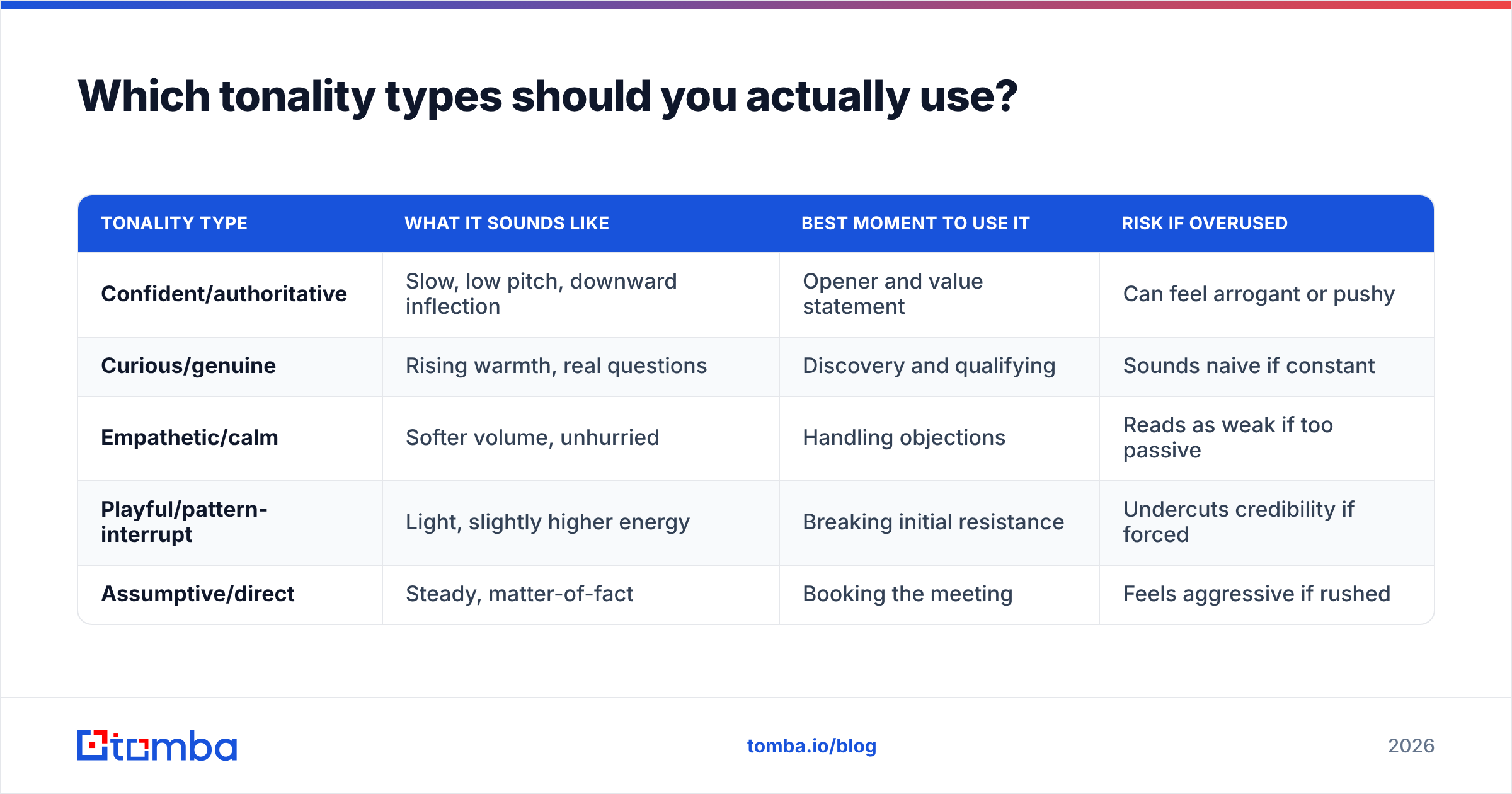
Not every moment of a call calls for the same tone. Elite reps switch between a small set of deliberate tonalities depending on where they are in the conversation. Here's how the most useful ones compare.
| Tonality type | What it sounds like | Best moment to use it | Risk if overused |
|---|---|---|---|
| Confident/authoritative | Slow, low pitch, downward inflection | Opener and value statement | Can feel arrogant or pushy |
| Curious/genuine | Rising warmth, real questions | Discovery and qualifying | Sounds naive if constant |
| Empathetic/calm | Softer volume, unhurried | Handling objections | Reads as weak if too passive |
| Playful/pattern-interrupt | Light, slightly higher energy | Breaking initial resistance | Undercuts credibility if forced |
| Assumptive/direct | Steady, matter-of-fact | Booking the meeting | Feels aggressive if rushed |
The pattern most top performers follow: open with confident, shift to curious during discovery, go empathetic when an objection lands, and close assumptive when asking for the meeting. You're not acting — you're matching your vocal delivery to the emotional job of each stage.
How do you fix a monotone or nervous voice?#
Start by diagnosing the specific failure. Most struggling reps have one of three problems: they talk too fast, they end statements with upward inflection, or they never pause. Each has a targeted fix.
If you talk too fast, force a hard pause after your opener. Say your first line, then count "one-Mississippi, two-Mississippi" silently before continuing. It feels agonizing to you and completely normal to the prospect. Slowing your open by even 20% can transform how competent you sound.
If you end statements like questions, record yourself and listen for the "uptalk." Practice ending key sentences by physically dropping your chin slightly — it naturally lowers your pitch and inflection. "I'm calling because I noticed something about your outbound process." Down, not up.
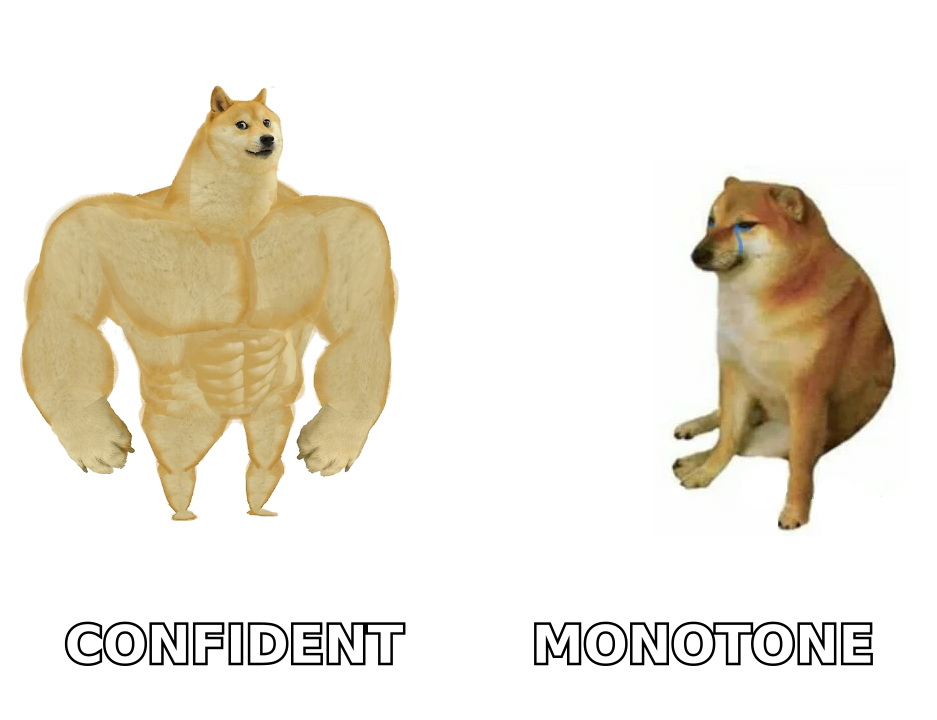
If you're monotone, the issue is usually energy, not range. Stand up. Smile. Gesture with your free hand. Your voice follows your body — a rep slumped in a chair sounds slumped, and a rep on their feet sounds alive. It's the audio version of good posture.

The fastest accelerant is recording. Pull three of your own calls this week and score each on pace, inflection, and pauses. You'll hear things in ten minutes of playback that a manager couldn't coach out of you in a month. If your dialer doesn't record, a conversation-intelligence tool or even a phone-side recorder works.
How does tonality change when you handle objections?#
This is where most reps' tonality collapses. A prospect says "we already have a vendor" and the rep either gets defensive (pitch spikes, pace accelerates) or deflates (volume drops, energy dies). Both telegraph that the objection rattled you.
The move is to lower your energy slightly and slow down on objections — the opposite of your instinct. A calm, unhurried "totally fair, most people I talk to already have something in place" signals that the objection is routine and expected. You've heard it a hundred times. That composure is more persuasive than any clever rebuttal, because it reframes you from "desperate seller" to "experienced peer."
Match the prospect's emotional state first, then lead them somewhere calmer. If they're irritated, don't meet irritation with forced cheerfulness — that reads as tone-deaf. Acknowledge with matching seriousness, then gently guide the temperature down. This mirror-then-lead pattern is the heart of advanced tonality, and it directly lifts your response rate on follow-up touches too.
Does tonality matter if you're leaving a voicemail?#
Yes — arguably more, because voicemail is tonality with zero feedback loop. You can't adjust based on their reactions, so your delivery has to be right the first time. Keep it under 20 seconds, use downward inflection on your name and company, and speak slightly slower than feels natural so your callback number is actually legible.
The best voicemails sound like a busy peer leaving a quick note, not a rep reading a script. Warmth plus brevity plus a clear reason to call back. And when you pair voicemails with a well-timed email, delivery still matters — an AI cold email writer can help you match the same confident, concise voice in text that you're using on the phone.
What tools and workflows support better tonality?#
Tonality is a skill, but the right workflow makes it easier to practice and easier to get in front of the right people so your reps aren't wasting good delivery on bad numbers.
- Accurate phone data. Great tonality is wasted on wrong numbers and dead lines. A reliable phone finder gets you to real decision-makers, and a phone validator filters out disconnected lines before you dial so every call is a real rep.
- Call recording and review. Any dialer or conversation-intelligence layer that records calls so you can score pace, inflection, and pauses weekly.
- Warm intros over pure cold. When you enrich a contact before dialing, you can open with something specific, which naturally relaxes your tonality because you actually have context.
- Multichannel follow-up. Pair calls with email so a prospect who wasn't ready by phone still hears from you in a channel they prefer.
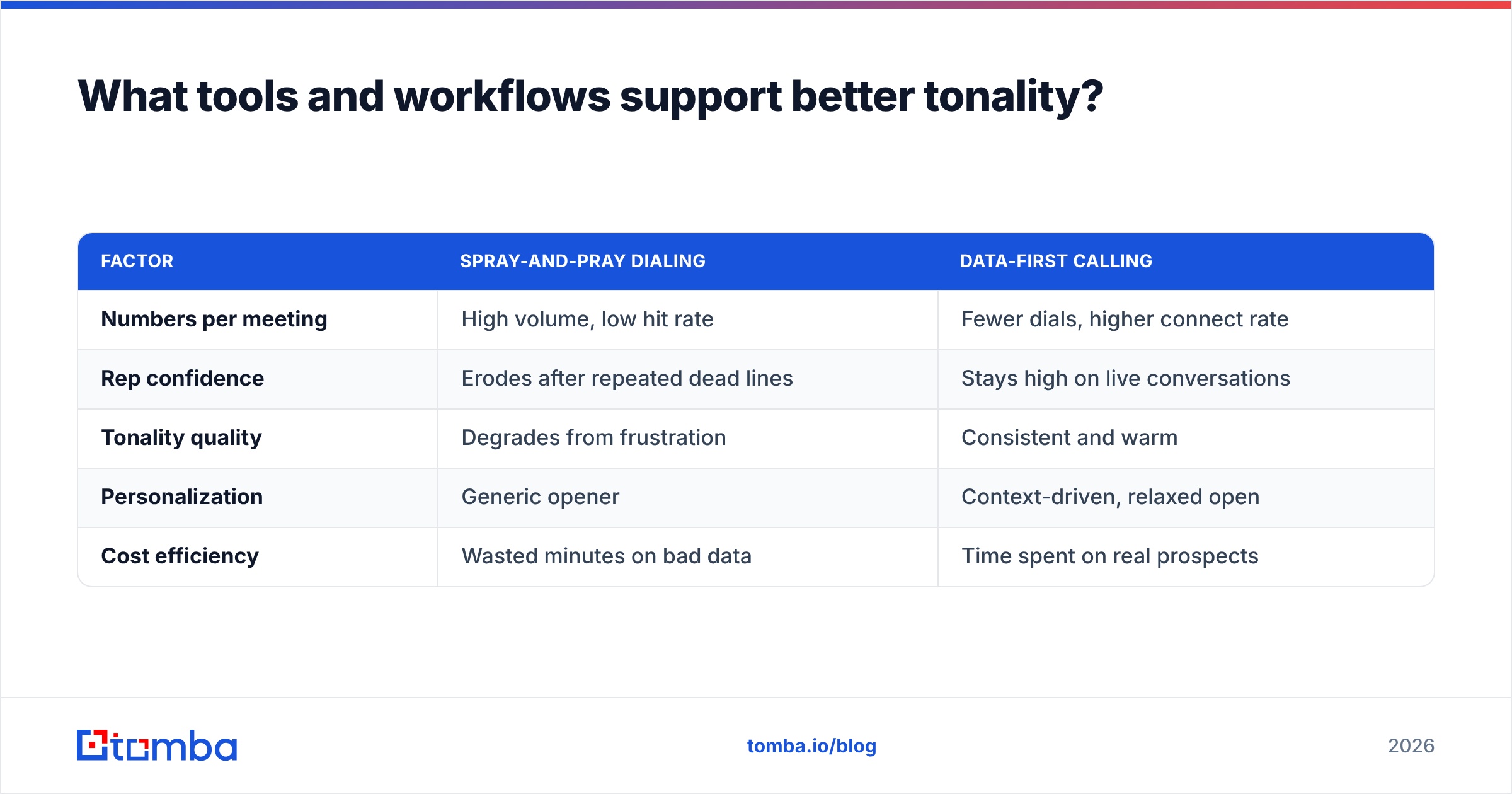
Here's how a data-first calling workflow compares to spray-and-pray dialing.
| Factor | Spray-and-pray dialing | Data-first calling |
|---|---|---|
| Numbers per meeting | High volume, low hit rate | Fewer dials, higher connect rate |
| Rep confidence | Erodes after repeated dead lines | Stays high on live conversations |
| Tonality quality | Degrades from frustration | Consistent and warm |
| Personalization | Generic opener | Context-driven, relaxed open |
| Cost efficiency | Wasted minutes on bad data | Time spent on real prospects |
The through-line: clean data protects your tonality. Reps who spend the morning hitting disconnected numbers sound defeated by call ten. Reps hitting live, correct contacts stay energized and warm.
How do you practice tonality until it's automatic?#
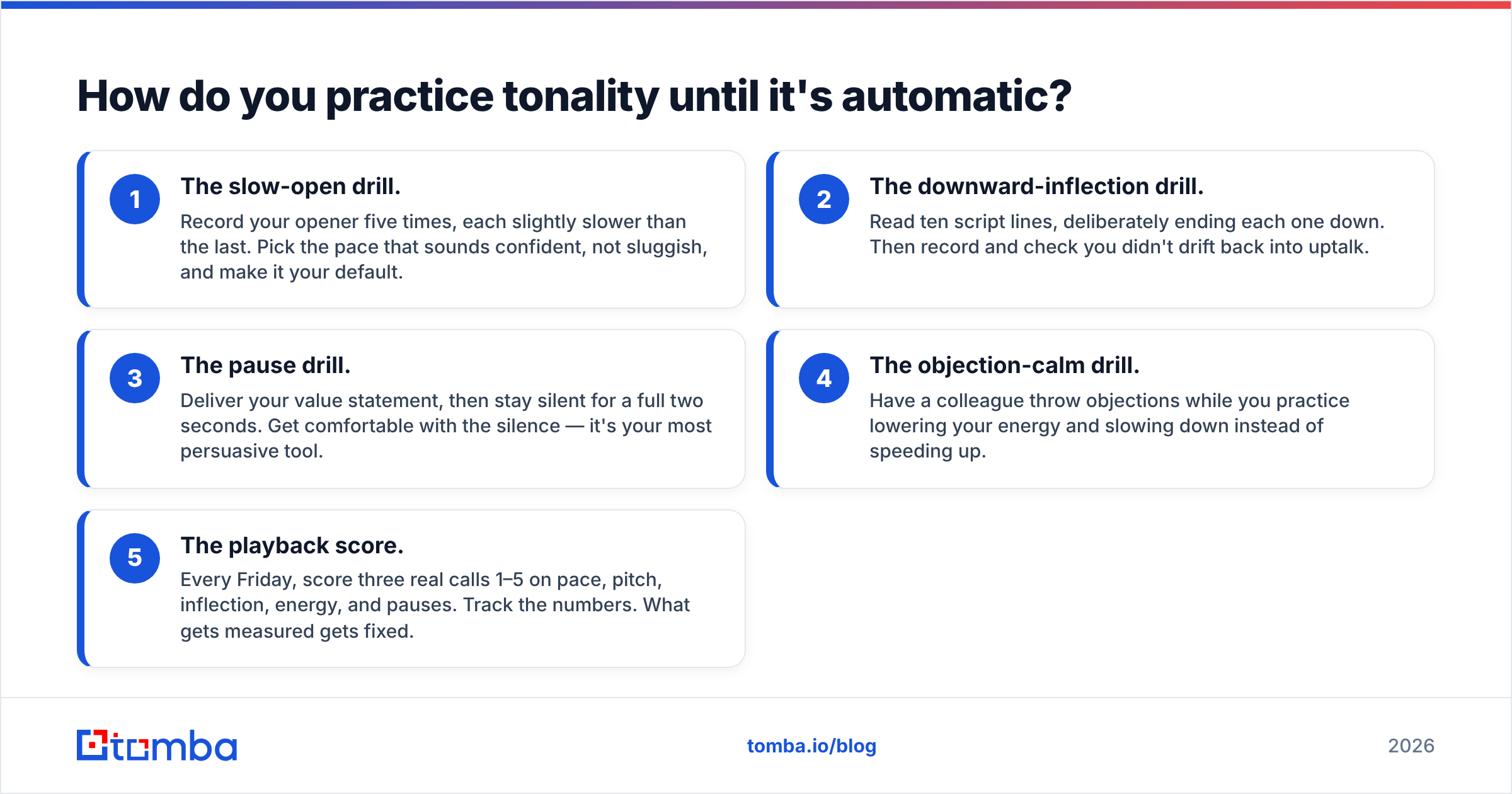
Drilling beats reading about it. Use these five reps-tested exercises.
- The slow-open drill. Record your opener five times, each slightly slower than the last. Pick the pace that sounds confident, not sluggish, and make it your default.
- The downward-inflection drill. Read ten script lines, deliberately ending each one down. Then record and check you didn't drift back into uptalk.
- The pause drill. Deliver your value statement, then stay silent for a full two seconds. Get comfortable with the silence — it's your most persuasive tool.
- The objection-calm drill. Have a colleague throw objections while you practice lowering your energy and slowing down instead of speeding up.
- The playback score. Every Friday, score three real calls 1–5 on pace, pitch, inflection, energy, and pauses. Track the numbers. What gets measured gets fixed.
Two weeks of daily reps and the mechanics move from conscious effort to automatic habit. That's the goal — you shouldn't be thinking about your inflection mid-call, any more than a driver thinks about the clutch.
The bottom line on cold call tonality#
Your prospects decide whether to trust you in the first few seconds, and they decide it based on how you sound, not what you say. Slow down, drop your inflection, use pauses, match-then-lead the prospect's energy, and record yourself relentlessly. Those five habits will do more for your connect-to-meeting rate than any new script.
But even flawless tonality can't fix bad data. If your reps are burning their best voices on disconnected numbers and gatekeepers, start upstream. Use Tomba's Email Finder and phone-finding tools to put verified, decision-maker contact details in front of every rep — so the confident, warm delivery you've trained lands on the people who can actually say yes. Check the Tomba plans to see which tier fits your outbound team, starting free with 25 searches a month.
Related guides#
Ready to find emails that actually work?
Join 150,000+ professionals who stopped guessing and started sending. Free credits on signup — no credit card required.
Get the Tomba newsletter
Practical outbound tactics and product updates — once every two weeks.
About the author