Cold Calling Best Practices: The 2026 Playbook That Books Meetings
Cold calling still books meetings in 2026 — if you skip the spray-and-pray. Here are the research-backed best practices, scripts, and metrics that turn dials into pipeline.
Cold calling was declared dead every year for the last decade, and every year reps who do it well keep hitting quota. The gap between the two camps has almost nothing to do with talent and almost everything to do with process: who you call, when you call, what you say in the first ten seconds, and whether you actually track the numbers.
This is a practical, no-fluff guide to cold calling best practices for 2026 — the openers, timing windows, scripts, and metrics that separate reps who book meetings from reps who get hung up on.
TL;DR — The Short Version#
- Accurate data beats volume. Dialing bad numbers is the fastest way to kill your connect rate. Clean, verified phone data is the single biggest lever most teams ignore.
- The first 10 seconds decide the call. A permission-based opener that names the reason you called outperforms "How are you today?" every time.
- Timing is real. Mid-morning and late-afternoon on Wednesdays and Thursdays consistently beat Monday-morning and Friday-afternoon dials.
- Talk less, ask more. Top reps let the prospect speak for roughly half the call and handle objections with curiosity, not rebuttals.
- Track leading metrics. Connect rate, conversation rate, and meetings booked per 100 dials tell you what to fix — total dials alone tells you nothing.
Is Cold Calling Still Worth It in 2026?#
Yes — but only as one channel in a coordinated outbound motion. The phone is no longer a standalone strategy; it's the highest-intent touch inside a sequence that also includes email and LinkedIn.
Here's the honest framing. Email scales but gets ignored. LinkedIn builds familiarity but rarely closes on its own. A live phone conversation is the only channel where you get real-time objection handling, tone, and a same-day yes. According to HubSpot's sales research, a large share of buyers still accept calls from vendors when the timing and relevance are right — the problem is almost never the channel, it's the execution.
The reps who quit cold calling usually quit for the wrong reason: they were calling stale lists with generic pitches and blamed the phone. Fix the inputs and the phone still works.
What Are the Core Cold Calling Best Practices?#
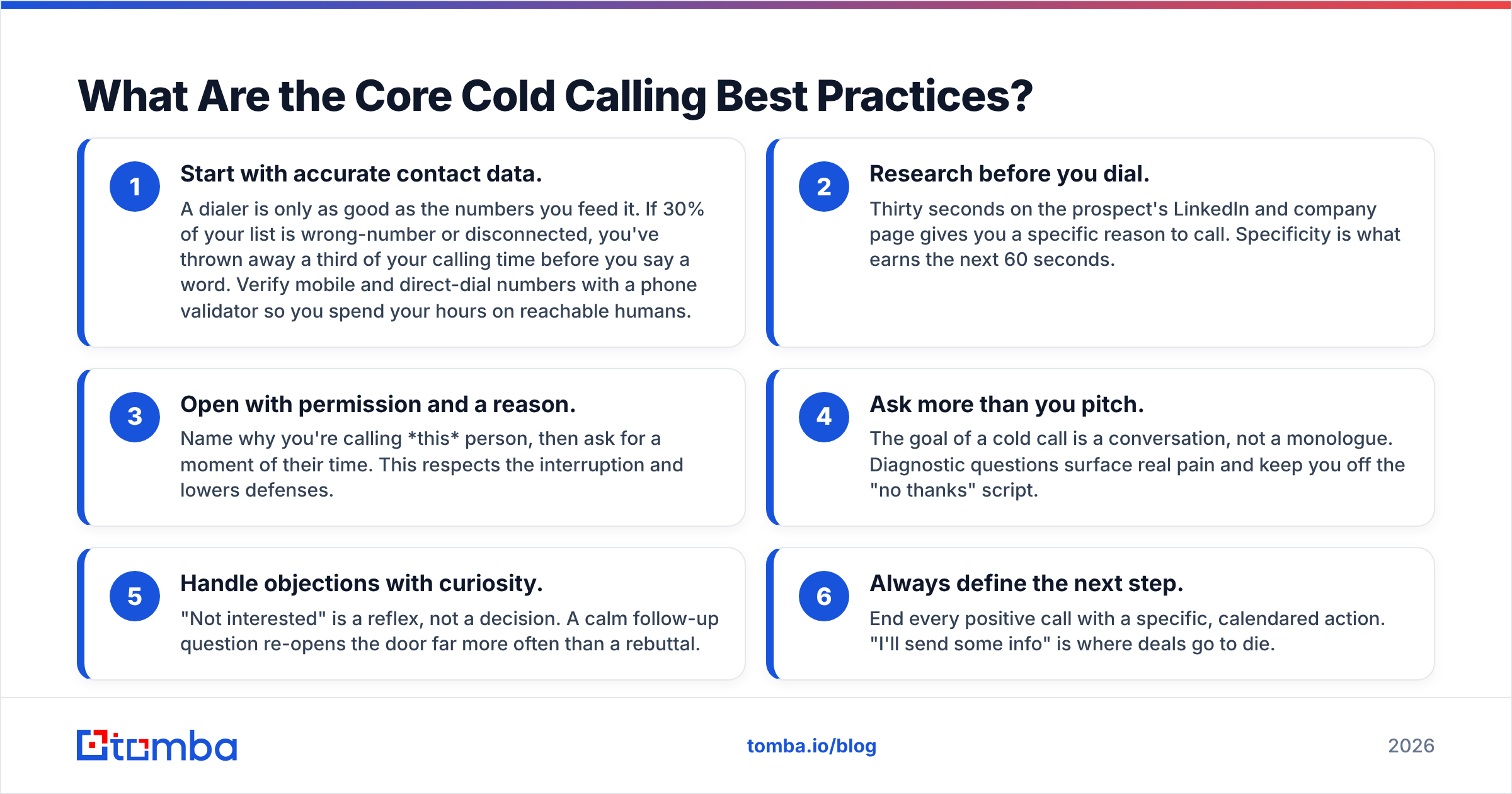
Every high-performing calling motion comes back to the same fundamentals. Master these before you worry about clever tactics.
- Start with accurate contact data. A dialer is only as good as the numbers you feed it. If 30% of your list is wrong-number or disconnected, you've thrown away a third of your calling time before you say a word. Verify mobile and direct-dial numbers with a phone validator so you spend your hours on reachable humans.
- Research before you dial. Thirty seconds on the prospect's LinkedIn and company page gives you a specific reason to call. Specificity is what earns the next 60 seconds.
- Open with permission and a reason. Name why you're calling this person, then ask for a moment of their time. This respects the interruption and lowers defenses.
- Ask more than you pitch. The goal of a cold call is a conversation, not a monologue. Diagnostic questions surface real pain and keep you off the "no thanks" script.
- Handle objections with curiosity. "Not interested" is a reflex, not a decision. A calm follow-up question re-opens the door far more often than a rebuttal.
- Always define the next step. End every positive call with a specific, calendared action. "I'll send some info" is where deals go to die.
What Should Your Cold Call Opener Sound Like?#
Your opener has one job: buy you the next 30 seconds. It should never sound like a script being read at a stranger.
Weak opener: "Hi, is this John? Great! How are you doing today?" — This triggers the sales-call reflex instantly. Prospects have heard it a thousand times.
Strong opener: "Hi John, this is Sara from Tomba. I know I'm calling out of the blue — do you have 27 seconds for me to tell you why, and you can decide if it's worth continuing?"
The permission-based opener works for three reasons. It's honest about the interruption, it's specific about a small time ask, and it hands control to the prospect, which paradoxically keeps them on the line. Research from conversation-intelligence platform Gong consistently finds that openers acknowledging the cold nature of the call outperform the ones that pretend it's a warm chat.
Then follow the permission with a reason tied to them: "I noticed your team just posted three SDR roles — teams scaling outbound that fast usually hit a data-quality wall around now. That's what I wanted to ask you about."
When Is the Best Time to Cold Call?#
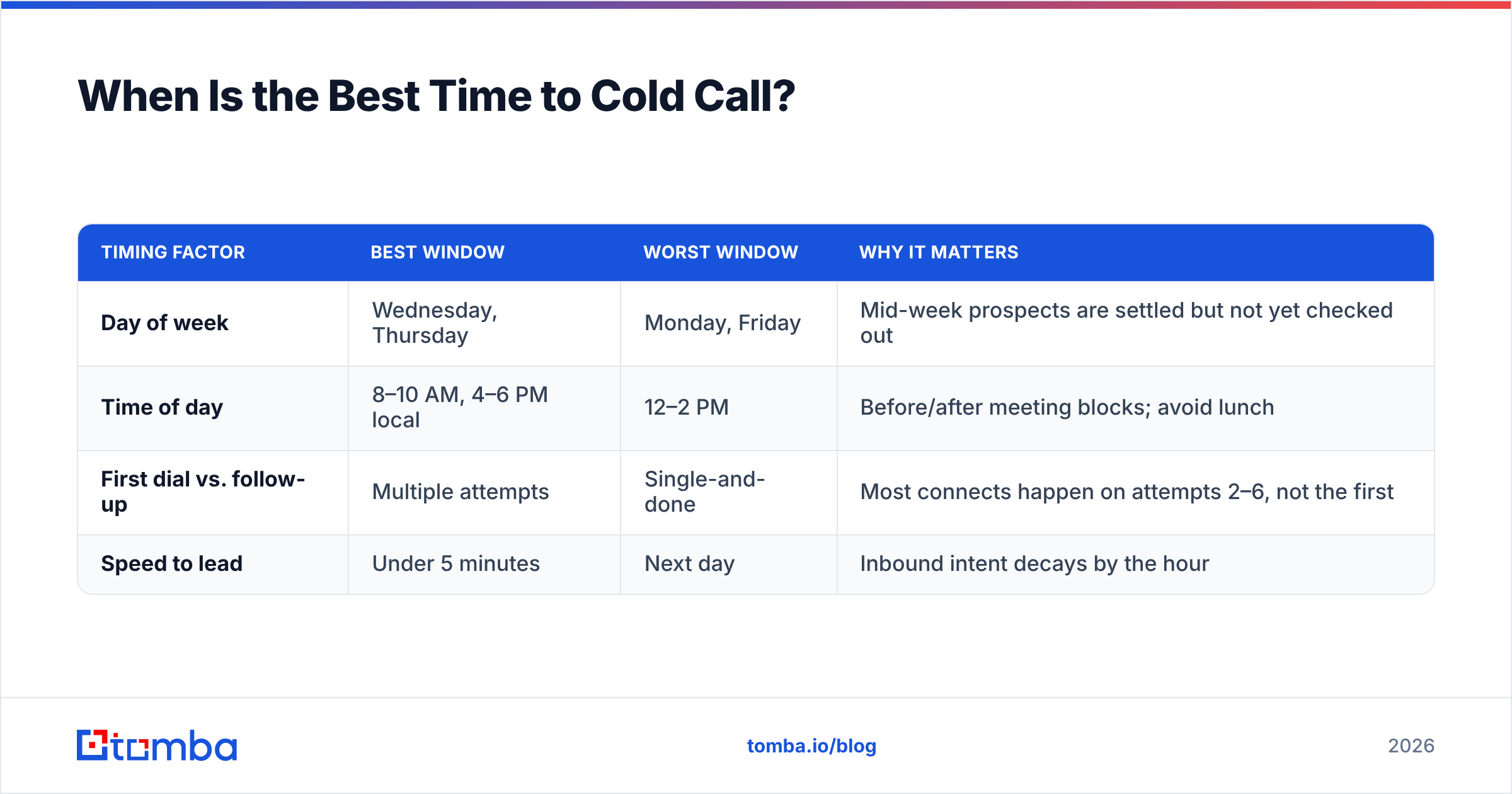
Timing won't fix a bad pitch, but calling at the wrong time wastes even a great one. The patterns below hold across most B2B calling data — treat them as a starting hypothesis, then test against your own connect rates.
| Timing factor | Best window | Worst window | Why it matters |
|---|---|---|---|
| Day of week | Wednesday, Thursday | Monday, Friday | Mid-week prospects are settled but not yet checked out |
| Time of day | 8–10 AM, 4–6 PM local | 12–2 PM | Before/after meeting blocks; avoid lunch |
| First dial vs. follow-up | Multiple attempts | Single-and-done | Most connects happen on attempts 2–6, not the first |
| Speed to lead | Under 5 minutes | Next day | Inbound intent decays by the hour |
Two rules matter more than the grid. First, call in the prospect's time zone, not yours — a 9 AM dial from New York lands at 6 AM in California. Second, speed to lead beats perfect timing. If someone downloaded your content an hour ago, call now; a slightly-worse time window with fresh intent beats a perfect window on a cold contact.
How Do You Handle Cold Call Objections?#
Objections are not rejections — they're the actual conversation starting. The mistake most reps make is treating every objection as a wall to argue through instead of a signal to explore.
"I'm not interested." Don't pitch harder. Ask: "Totally fair — out of curiosity, is that because the timing's off, or because you've already got this handled?" You'll learn whether it's a real no or a reflex.
"We already use [competitor]." Great, they've admitted they have budget and the problem. "That makes sense — a lot of the teams I talk to use them too. What made you look at them originally, and is it fully delivering on that?"
"Send me some info." This is usually a soft brush-off. Counter with: "Happy to — so I send the right thing and not a generic deck, can I ask two quick questions?" If they say yes, you've saved the call.
"I don't have time right now." Believe them and book the follow-up: "No problem — would tomorrow at 10 or Thursday at 2 work better for a 15-minute call?"
The thread through all of these is calm curiosity. You're not defeating an objection; you're finding out if there's a fit worth pursuing.
Why Does Your Call List Quality Matter More Than Volume?#
Because you can't out-dial a bad list. This is the best practice everyone nods along to and almost nobody actually fixes.
Do the math. A rep making 60 dials a day on a list where 35% of numbers are wrong or disconnected is effectively making 39 real attempts. Multiply that waste across a five-person team over a quarter and you've burned hundreds of selling hours dialing dead numbers. No script, cadence, or objection framework recovers that time — the only fix is better data going in.
This is where a lot of teams over-invest in dialer software and under-invest in the contact data feeding it. Before you buy another calling tool, ask a harder question: how accurate are the direct-dial and mobile numbers on my list right now?
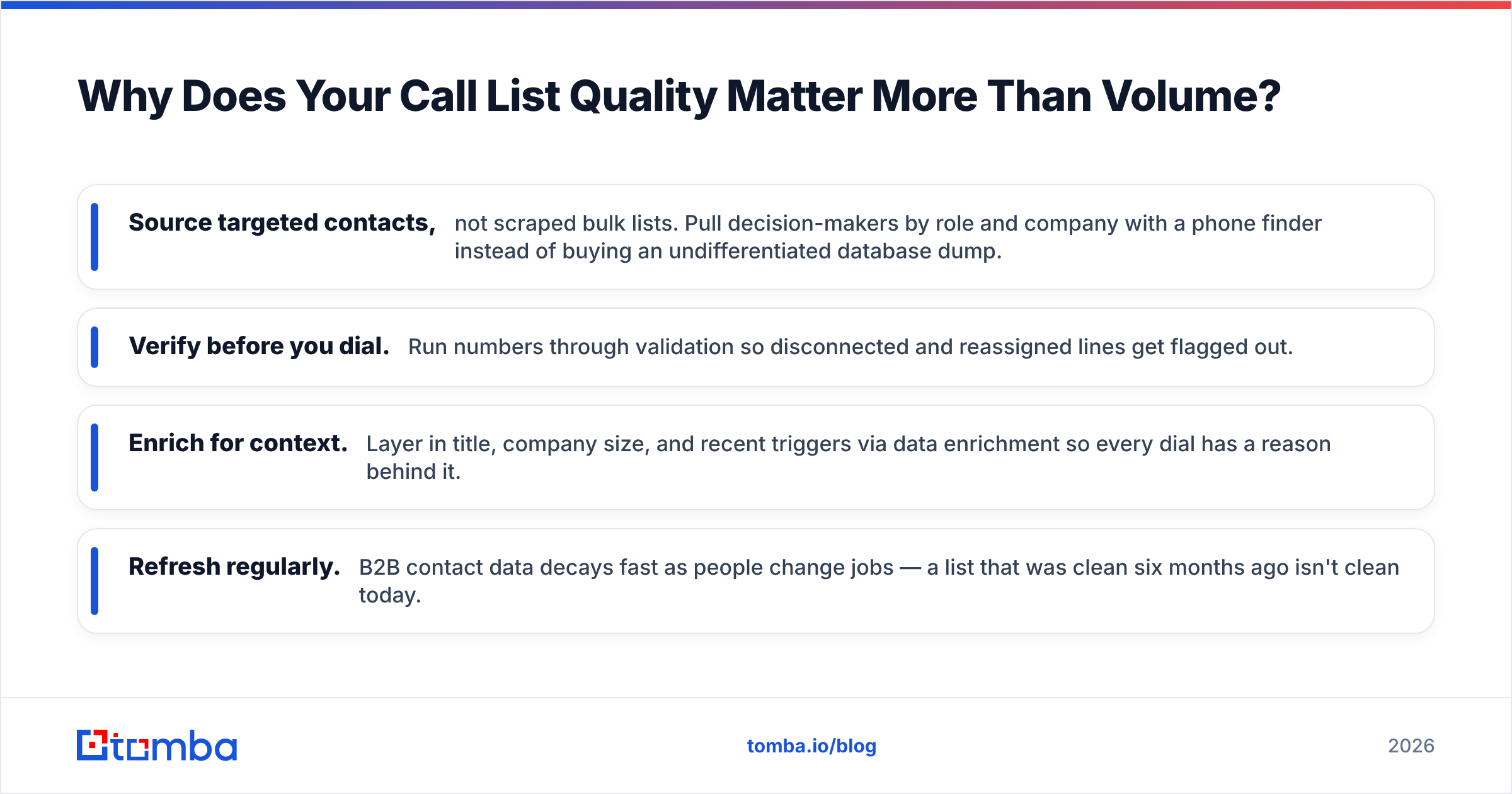
A clean calling motion looks like this:
- Source targeted contacts, not scraped bulk lists. Pull decision-makers by role and company with a phone finder instead of buying an undifferentiated database dump.
- Verify before you dial. Run numbers through validation so disconnected and reassigned lines get flagged out.
- Enrich for context. Layer in title, company size, and recent triggers via data enrichment so every dial has a reason behind it.
- Refresh regularly. B2B contact data decays fast as people change jobs — a list that was clean six months ago isn't clean today.
For teams that need scale, a maintained B2B database beats manual list-building, but the principle is identical: accuracy first, volume second.
How Should You Structure a Cold Call Script?#
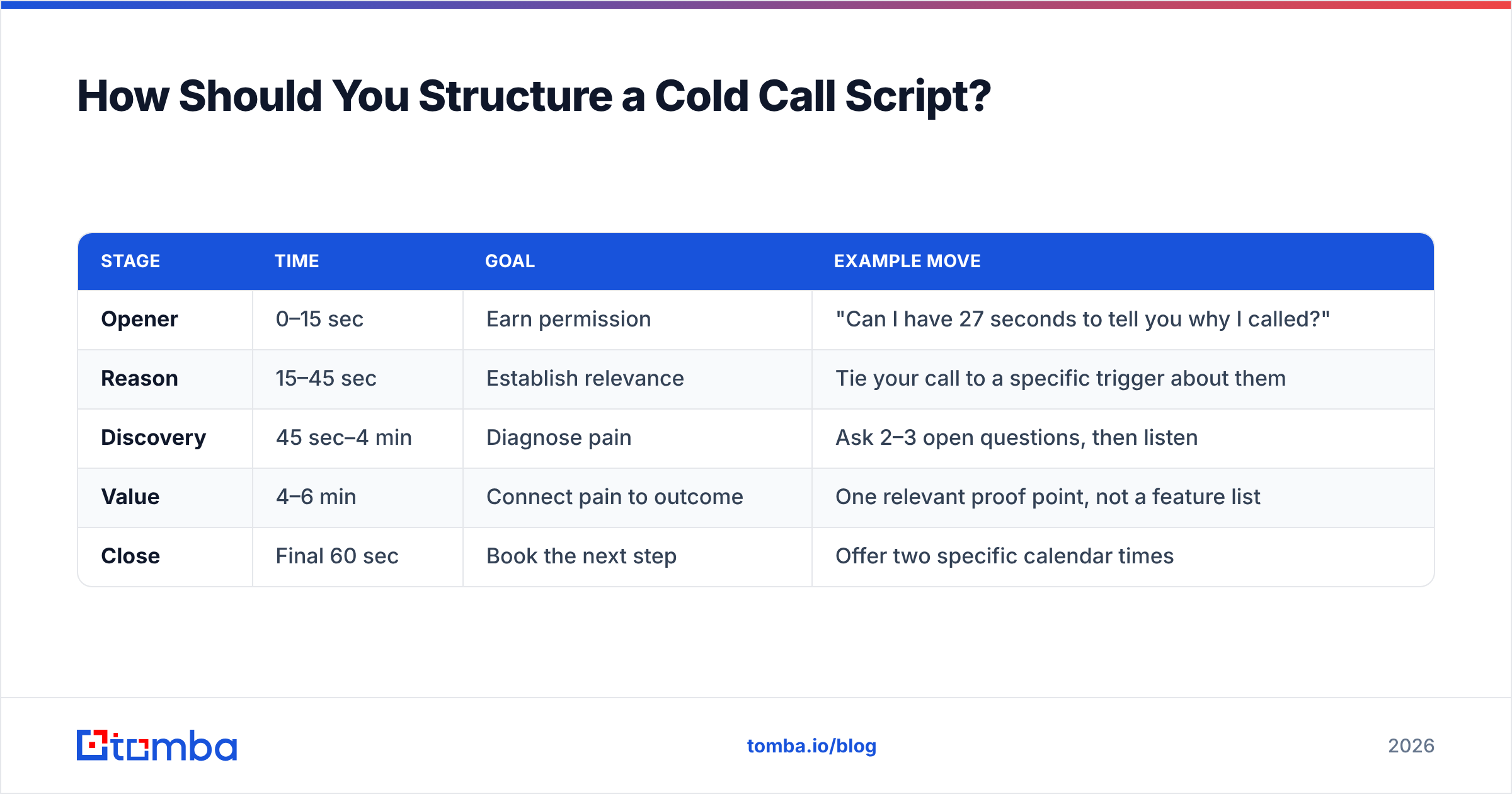
A script isn't a word-for-word cage — it's a map that keeps you from getting lost. The best reps internalize the structure and improvise the words.
| Stage | Time | Goal | Example move |
|---|---|---|---|
| Opener | 0–15 sec | Earn permission | "Can I have 27 seconds to tell you why I called?" |
| Reason | 15–45 sec | Establish relevance | Tie your call to a specific trigger about them |
| Discovery | 45 sec–4 min | Diagnose pain | Ask 2–3 open questions, then listen |
| Value | 4–6 min | Connect pain to outcome | One relevant proof point, not a feature list |
| Close | Final 60 sec | Book the next step | Offer two specific calendar times |
Notice the balance. The prospect should be talking for a big chunk of the discovery stage. If you're delivering a five-minute monologue, you've written a voicemail, not a conversation. Keep your talk-track lean and let their answers steer where you go next.
Print your script, then throw it away after a week of live calls. The words that actually work are the ones you discover in real conversations — the sheet is just training wheels.
What Metrics Should You Track?#
You can't improve what you don't measure, and "number of dials" is the vanity metric that hides every real problem. Track the funnel, not the activity.
- Connect rate = live conversations ÷ dials. If this is low, your problem is data quality or timing, not your pitch.
- Conversation rate = meaningful conversations ÷ connects. If this is low, your opener is losing people in the first 15 seconds.
- Meeting rate = meetings booked ÷ conversations. If this is low, your discovery or close needs work.
- Meetings per 100 dials = your single north-star efficiency number for comparing reps and weeks.
The power of this breakdown is that each metric points to a different fix. A rep with a great meeting rate but low connect rate doesn't need coaching on their pitch — they need a cleaner list. Diagnosing the right stage saves you from "just make more calls," which is almost never the answer.
Pair these with call recording and review. Listening back to your own calls — or having a manager review a sample weekly — surfaces the habits no dashboard can, like talking over prospects or rushing the close. Platforms like Salesforce and dedicated conversation-intelligence tools make this reviewable at scale, but even a manual weekly listen-back beats flying blind.
Cold Calling Best Practices: Quick Do's and Don'ts#
| Do | Don't |
|---|---|
| Verify numbers before dialing | Trust a list you didn't clean |
| Open with permission and a reason | Ask "How are you today?" |
| Call in the prospect's time zone | Batch-dial on your clock only |
| Let the prospect talk ~50% | Deliver a scripted monologue |
| Book a specific next step | Settle for "I'll send info" |
| Track connect and meeting rates | Report on total dials |
| Attempt 4–6 times per contact | Give up after one voicemail |
Turn Better Data Into Better Conversations#
Every best practice in this guide sits on top of one foundation: you have to be calling the right people at reachable numbers. The most polished opener in the world is worthless dialed into a disconnected line.
That's the part Tomba is built to fix. Use the Phone Finder to pull accurate B2B direct-dial and mobile numbers for the decision-makers you actually want to reach, validate them before your reps burn time on dead lines, and enrich each contact with the context that makes an opener land. Clean inputs, better connect rates, more conversations — the flywheel every calling team wants.
Start free with 25 searches a month, and if the numbers add up, scale into a paid plan — Tomba pricing starts at $49/mo for Starter. Feed your dialer better data, and let the phone do what it's always done best: book the meeting.
Related guides#
Ready to find emails that actually work?
Join 150,000+ professionals who stopped guessing and started sending. Free credits on signup — no credit card required.
Get the Tomba newsletter
Practical outbound tactics and product updates — once every two weeks.
About the author