Cold Calling Businesses in 2026: The No-Fluff Playbook
Cold calling businesses still books meetings in 2026 — if your list is clean and your first line earns the next 20 seconds. Here's the data-backed playbook.
Cold calling businesses is not dead — but the spray-and-pray version of it is. In 2026, the reps who still book meetings on the phone treat every dial as a targeted play backed by clean data, sharp timing, and a script built for interruption, not monologue. This guide breaks down exactly how to do that.
TL;DR#
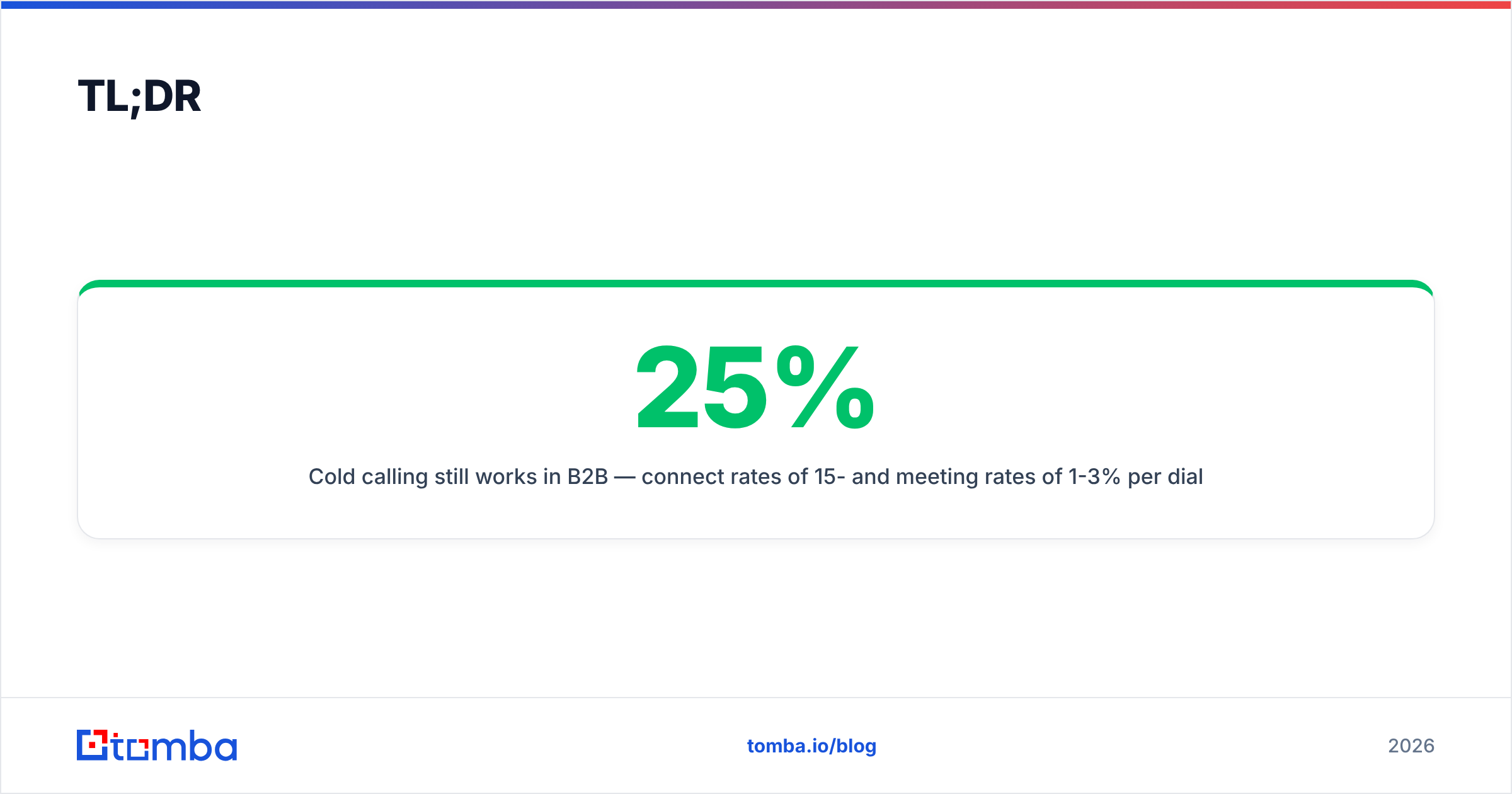
- Cold calling still works in B2B — connect rates of 15-25% and meeting rates of 1-3% per dial are realistic when your list and timing are right.
- The list beats the script. Dialing verified direct numbers of the right personas is the single biggest lever; a great script on a bad list still fails.
- Best windows are mid-morning and late afternoon, Tuesday through Thursday, in the prospect's local time zone.
- Openers that name a trigger ("I saw you just opened a second location") beat generic "How are you today?" openers by a wide margin.
- Pair phone with email and LinkedIn. Multi-channel sequences convert 2-3x better than phone alone. Use a phone finder and email finder to build the same contact record for both.
Is cold calling businesses still worth it in 2026?#
Yes — for the right motion. Cold calling remains one of the fastest ways to reach a decision-maker directly, especially in mid-market and enterprise deals where the buyer is not filling out demo forms. The catch is that the bar has risen. Buyers screen unknown numbers, gatekeepers are sharper, and a bad opener gets you hung up on in five seconds.
The reps who win treat cold calling as a precision instrument. They call a tight list of qualified accounts, they know why they're calling that person today, and they lead with relevance. The reps who lose still buy a 50,000-row list, dial from the top, and read the same script to a CFO and an intern.
According to HubSpot's sales research, phone outreach still influences a large share of booked meetings, but only when it's part of a coordinated sequence. The phone alone, disconnected from email and social touches, underperforms.
What makes a cold call actually connect?#
Three things decide whether a dial turns into a conversation: the number, the timing, and the first ten seconds.
- The number is a real direct line. Main switchboards route you to a gatekeeper. Direct dials and verified mobile numbers put you in front of the buyer. This is where a phone validator earns its keep — dialing dead numbers burns your day.
- The timing matches the buyer's rhythm. Executives answer between meetings, not during them. Mid-morning and late-afternoon windows in the prospect's own time zone consistently outperform lunchtime and Monday mornings.
- The opener earns the next 20 seconds. You are interrupting someone. Acknowledge it, give a reason grounded in their world, and ask permission to continue. Generic pleasantries signal "salesperson" and trigger the reflex hang-up.
Notice that two of the three levers are about data and preparation, not delivery. That's why list quality is the theme this whole guide keeps returning to.
How do you build a cold-call list that converts?#
Start with the account, not the contact. Define the firmographic profile that fits your best customers — industry, size, region, tech stack — then find the two or three people inside each account who own the problem you solve.
Then enrich each of those people with a verified direct phone number and a verified work email, so the same contact record powers both your dials and your follow-up. A phone number with no email, or an email with no phone, cuts your channels in half.
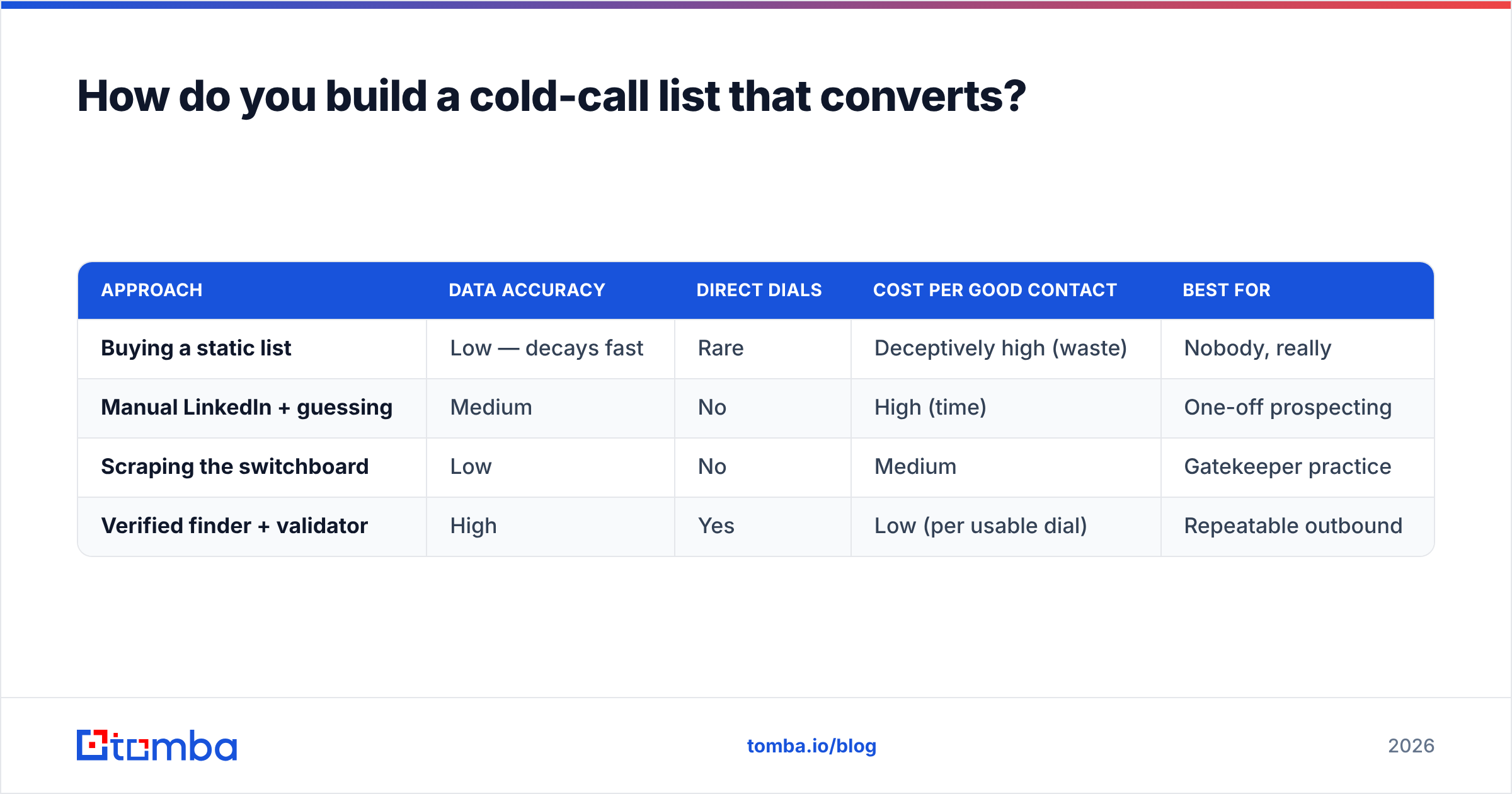
Here's how the common list-building approaches compare:
| Approach | Data accuracy | Direct dials | Cost per good contact | Best for |
|---|---|---|---|---|
| Buying a static list | Low — decays fast | Rare | Deceptively high (waste) | Nobody, really |
| Manual LinkedIn + guessing | Medium | No | High (time) | One-off prospecting |
| Scraping the switchboard | Low | No | Medium | Gatekeeper practice |
| Verified finder + validator | High | Yes | Low (per usable dial) | Repeatable outbound |
The bottom row is where modern outbound teams live. You pull the contact, confirm the number is live with a phone validator, confirm the email deliverable with an email verifier, and only then does the record enter your dialer. Everything upstream of a clean record is wasted effort downstream.
If you run outbound at volume, do this in batches rather than one contact at a time — a bulk email finder and enrichment pass builds a full campaign list in one sweep instead of a hundred manual lookups.
What should you actually say on a B2B cold call?#
Lead with a pattern interrupt and a reason. Here's a framework that respects the buyer's time:
- Opener (5 sec): "Hi Sarah, it's Marcus from Tomba. I know I'm calling out of the blue — can I take 30 seconds to tell you why, and you can decide if it's worth continuing?" The permission ask lowers defenses.
- Reason (15 sec): Anchor to a trigger. "I noticed your team posted three SDR roles this month — usually that means you're scaling outbound, and the number-one thing that breaks at that stage is data quality."
- Question (10 sec): Hand them the floor. "How are you sourcing contact data for the new hires right now?"
- Advance (10 sec): Book the next step, not the deal. "Makes sense. Worth a 15-minute look next Tuesday?"
The whole thing is under a minute if they're busy. The trigger-based reason is what separates a relevant call from an interruption — and triggers come from research and enrichment, not from the script.
For handling objections, the rule is acknowledge-then-redirect, never argue. "We already have a tool" becomes "Totally — most teams I call do. The reason people still take a look is the direct-dial coverage. Worth a quick compare?" You're not fighting; you're offering a low-cost next step.
When is the best time to cold call a business?#
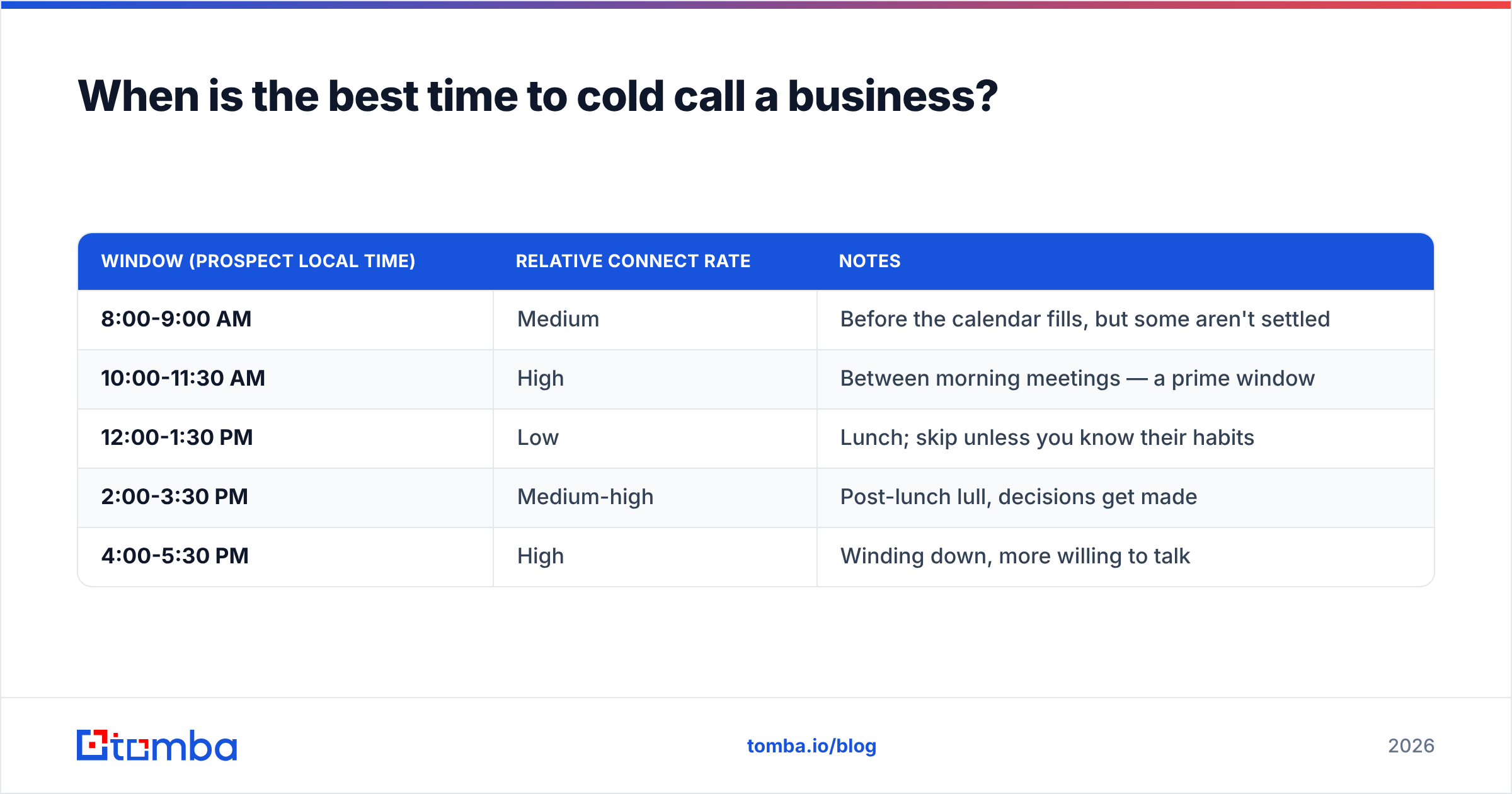
Timing is a multiplier on everything else. Based on aggregated B2B dialing data, the pattern is consistent:
| Window (prospect local time) | Relative connect rate | Notes |
|---|---|---|
| 8:00-9:00 AM | Medium | Before the calendar fills, but some aren't settled |
| 10:00-11:30 AM | High | Between morning meetings — a prime window |
| 12:00-1:30 PM | Low | Lunch; skip unless you know their habits |
| 2:00-3:30 PM | Medium-high | Post-lunch lull, decisions get made |
| 4:00-5:30 PM | High | Winding down, more willing to talk |
Day of week matters too: Tuesday through Thursday outperform Monday (catching up) and Friday (checking out). The single most common mistake is ignoring time zones — calling an East Coast prospect at 9 AM Pacific means you're dialing at lunch. Sort your list by the prospect's local time, not yours.
How does cold calling compare to email and LinkedIn?#
They're not rivals — they're a sequence. Each channel covers the others' blind spots.
- Phone gets you a live conversation and instant qualification, but it's time-intensive and easy to miss.
- Email scales, documents, and lets the buyer respond on their schedule — but it's easy to ignore. Good email deliverability determines whether it even lands.
- LinkedIn builds familiarity so your call and email aren't fully cold. A LinkedIn outreach touch before a dial noticeably lifts pickup rates.
The winning play is a coordinated cadence: connect on LinkedIn, send a short email, then call referencing both. By the time you dial, you're a warm-ish name, not an unknown number. This is why the same enriched contact record — email plus phone plus profile — is the foundation. According to G2's reviews of sales engagement tools, multi-channel sequencing is now the default expectation for outbound teams, not a nice-to-have.
What tools do you need for a modern cold-calling motion?#
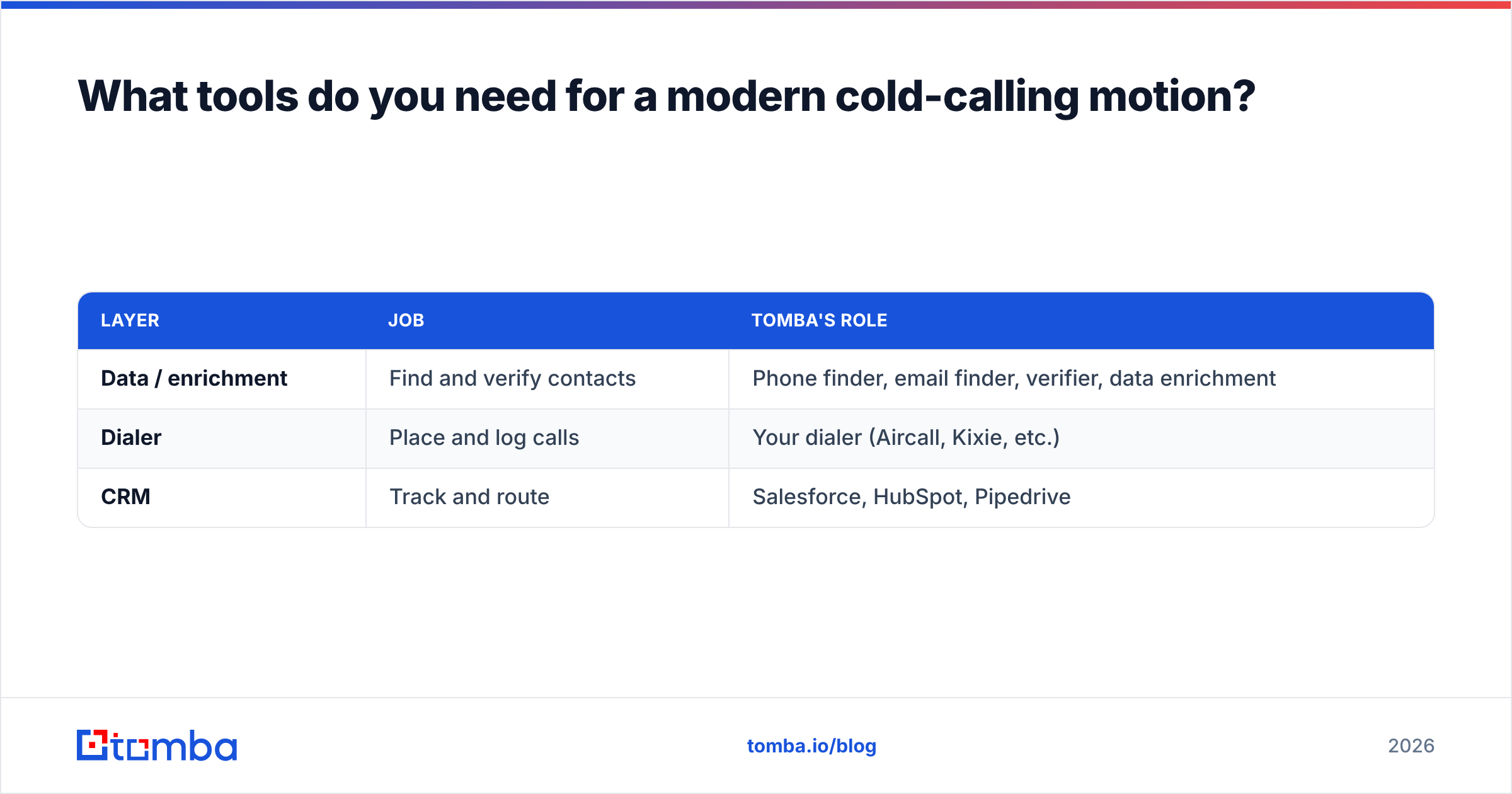
You need three layers: data, dialer, and CRM. The dialer and CRM you likely already have. The data layer is where most teams under-invest and where cold calling quietly dies.
| Layer | Job | Tomba's role |
|---|---|---|
| Data / enrichment | Find and verify contacts | Phone finder, email finder, verifier, data enrichment |
| Dialer | Place and log calls | Your dialer (Aircall, Kixie, etc.) |
| CRM | Track and route | Salesforce, HubSpot, Pipedrive |
Tomba sits at the data layer. You feed it a domain or a name and it returns the verified work email, and via the phone finder, a direct number — then pushes both into your CRM through the integrations. Compared to buying static lists (which decay 25-30% per year, per Salesforce's data-management guidance), a real-time verified finder keeps your list live.
Tomba's pricing scales with volume: a Free tier gives you 25 searches a month to test, Starter is $49/mo, Growth is $99/mo, and Pro is $249/mo — see the full Tomba pricing breakdown. For most SDR teams, the Growth plan covers a healthy monthly prospecting cadence.
What metrics prove your cold calling is working?#
Track the funnel, not just the vanity numbers. If you only measure "calls made," you'll optimize for dialing fast instead of dialing well.
- Connect rate (conversations ÷ dials): 15-25% is healthy with clean direct dials. Under 10% usually means bad numbers.
- Conversation-to-meeting rate: 10-20% of real conversations should advance. Below that, fix the opener.
- Meetings per 100 dials: 1-3 is a solid benchmark for cold B2B.
- Show rate: meetings that actually happen. Confirm by email — another reason to have the verified address on file.
If your connect rate is low, the fix is almost never "call harder." It's the list. Bad numbers, wrong personas, or wrong time zones — all data problems, all fixable before you pick up the phone.
Common cold-calling mistakes to avoid#
- Dialing unverified numbers. Every dead line is wasted time and a hit to morale. Validate first.
- One-size-fits-all scripts. A message that speaks to everyone speaks to no one. Segment by persona.
- Ignoring time zones. The fastest way to tank connect rates.
- Phone-only outreach. Without email and social support, you're leaving conversions on the table.
- No follow-up system. Most meetings come from the second or third touch, not the first. Log everything in the CRM.
The bottom line#
Cold calling businesses in 2026 works when it's precise: the right person, a verified direct line, the right hour, and an opener grounded in their reality. The reps who struggle blame the channel; the reps who win fix the list. Data quality is the difference between an interruption and a conversation.
That's where your prep pays off. Before you touch the dialer, build a list of the right personas with verified emails and direct numbers using the Tomba Email Finder and phone finder, verify each record, and push it straight into your CRM. Start free with 25 searches, and turn your next dialing session from spray-and-pray into a targeted, meeting-booking machine.
Related guides#
Ready to find emails that actually work?
Join 150,000+ professionals who stopped guessing and started sending. Free credits on signup — no credit card required.
Get the Tomba newsletter
Practical outbound tactics and product updates — once every two weeks.
About the author