Cold Calling C-Level Executives: The 2026 Playbook
Cold calling C-level executives fails when you pitch. It works when you earn 30 seconds of respect. Here's the research, scripts, and timing that actually book meetings with the C-suite in 2026.
Cold calling a CEO is not a bigger version of cold calling a manager. It is a different sport, with different rules, a shorter clock, and a much smaller margin for error. The good news: fewer reps are willing to do it well, which means the executives who pick up hear far less noise than their inboxes suggest.
This guide covers what actually books meetings with the C-suite in 2026 — the prep, the timing, the opening ten seconds, and the follow-through that separates a booked call from a polite brush-off.
TL;DR#
- The dial is not the hard part — the first 10 seconds are. Executives decide whether to stay on the line before you finish your second sentence.
- Research beats volume. One call backed by a specific, relevant reason to phone outperforms fifty generic dials to the same title.
- Call early or late. C-level executives are most reachable before 8:30 a.m. and after 5:30 p.m., when gatekeepers and back-to-back meetings are gone.
- Lead with a problem, not your product. The C-suite buys outcomes and risk reduction, not features.
- Accurate direct-dial data is the multiplier. A perfect script dialed to the wrong number books nothing. Verified B2B phone numbers are the foundation the whole play sits on.
Why is cold calling C-level executives so different?#
Think of a front-line manager as a store clerk and a C-level executive as the store owner. The clerk can tell you where things are; the owner decides whether the store changes at all. When you call the owner, you are not asking for information — you are asking for a slice of the scarcest resource in the building: their attention.
Three things make the C-suite a distinct target:
- Time is rationed in minutes, not hours. A VP might give you five minutes to be curious. A CFO gives you thirty seconds to be relevant, then hangs up mentally even if the call continues.
- They think in outcomes and risk. Executives rarely care how your product works. They care what it does to revenue, cost, risk, or speed — and whether trusting you is a mistake they'll have to explain later.
- They have heard every pitch. The average C-level executive has been sold to for fifteen-plus years. Generic openers are pattern-matched and dismissed in real time.
None of this means the C-suite is unreachable. It means the bar for a good call is simply higher — and most of your competitors won't clear it.
What research do you need before you dial?#
Conclusion first: if you cannot state, in one sentence, a specific reason this executive should care today, you are not ready to call. Executives can smell a spray-and-pray dial instantly, and it costs you the only shot you get.
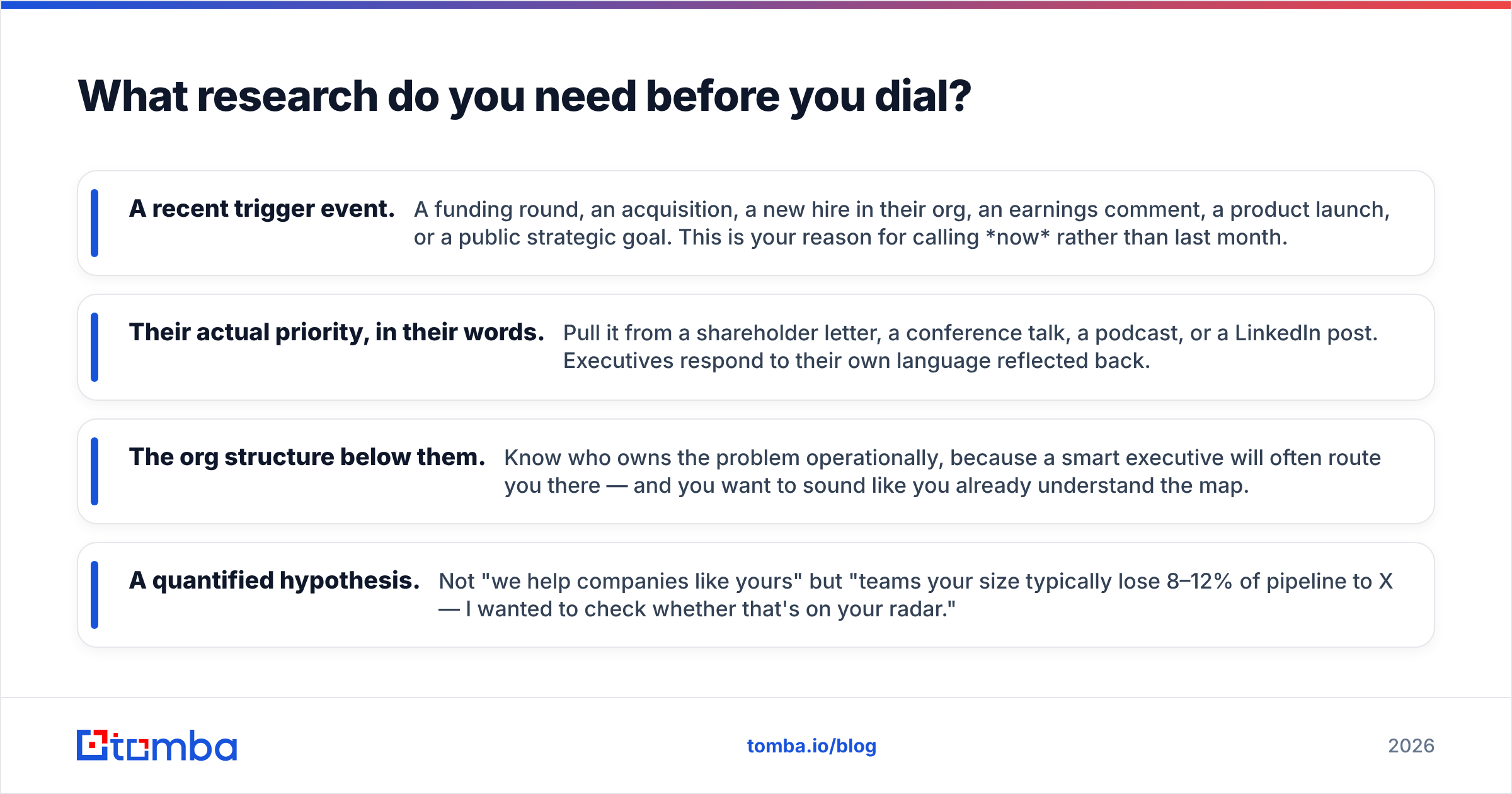
Before you pick up the phone, you should know:
- A recent trigger event. A funding round, an acquisition, a new hire in their org, an earnings comment, a product launch, or a public strategic goal. This is your reason for calling now rather than last month.
- Their actual priority, in their words. Pull it from a shareholder letter, a conference talk, a podcast, or a LinkedIn post. Executives respond to their own language reflected back.
- The org structure below them. Know who owns the problem operationally, because a smart executive will often route you there — and you want to sound like you already understand the map.
- A quantified hypothesis. Not "we help companies like yours" but "teams your size typically lose 8–12% of pipeline to X — I wanted to check whether that's on your radar."
This is where data quality quietly decides the outcome. You need the right name, the right title, and a direct dial that actually reaches a mobile — not a routed switchboard. Building that list by hand is slow; a bulk lead generation workflow lets you enrich a target account list with verified contacts and direct numbers before you ever start dialing. According to Gartner, B2B buyers spend the majority of their journey researching independently, so the executive you reach has likely already formed opinions — your research has to be sharp enough to add something they don't already know.
When is the best time to cold call executives?#
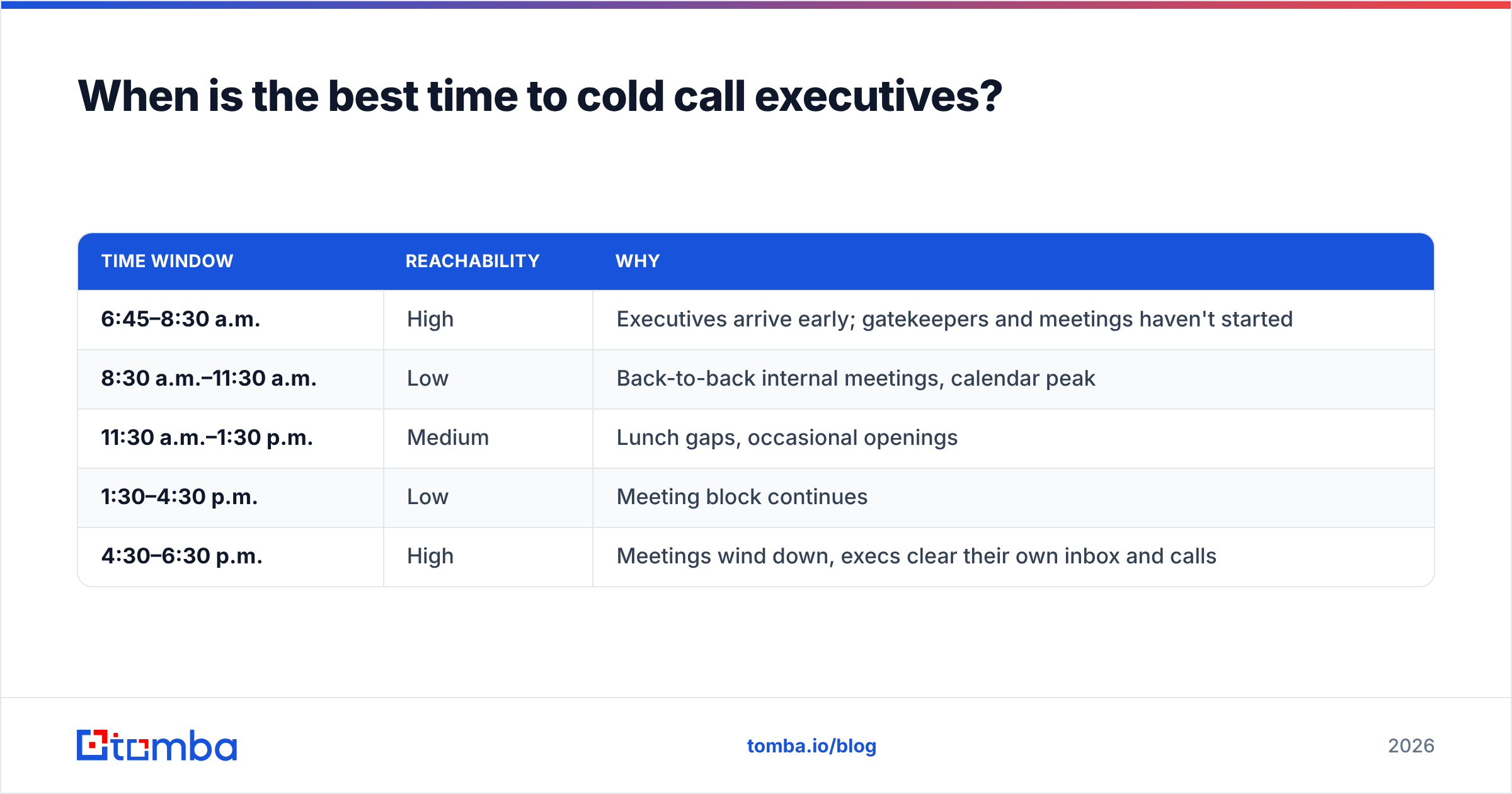
The best times to reach C-level executives are the edges of the day — before the calendar fills and after it empties.
| Time window | Reachability | Why |
|---|---|---|
| 6:45–8:30 a.m. | High | Executives arrive early; gatekeepers and meetings haven't started |
| 8:30 a.m.–11:30 a.m. | Low | Back-to-back internal meetings, calendar peak |
| 11:30 a.m.–1:30 p.m. | Medium | Lunch gaps, occasional openings |
| 1:30–4:30 p.m. | Low | Meeting block continues |
| 4:30–6:30 p.m. | High | Meetings wind down, execs clear their own inbox and calls |
The pattern is simple: assistants and packed calendars work 9-to-5, but ambitious executives don't. The half hour before the workday officially starts is the single most underused window in cold calling. A direct mobile dial at 7:15 a.m. often rings straight through to the person, because the wall of gatekeeping hasn't been built yet for the day.
Two more timing notes:
- Tuesday through Thursday remain the strongest days; Monday is triage and Friday is wind-down.
- Mid-month beats the last week of a quarter, when executives are heads-down on numbers and have zero tolerance for interruption.
How do you open a cold call to the C-suite?#
Your opener has one job: buy the next thirty seconds. It does that by sounding like a peer with a reason, not a vendor with a script.
A structure that works:
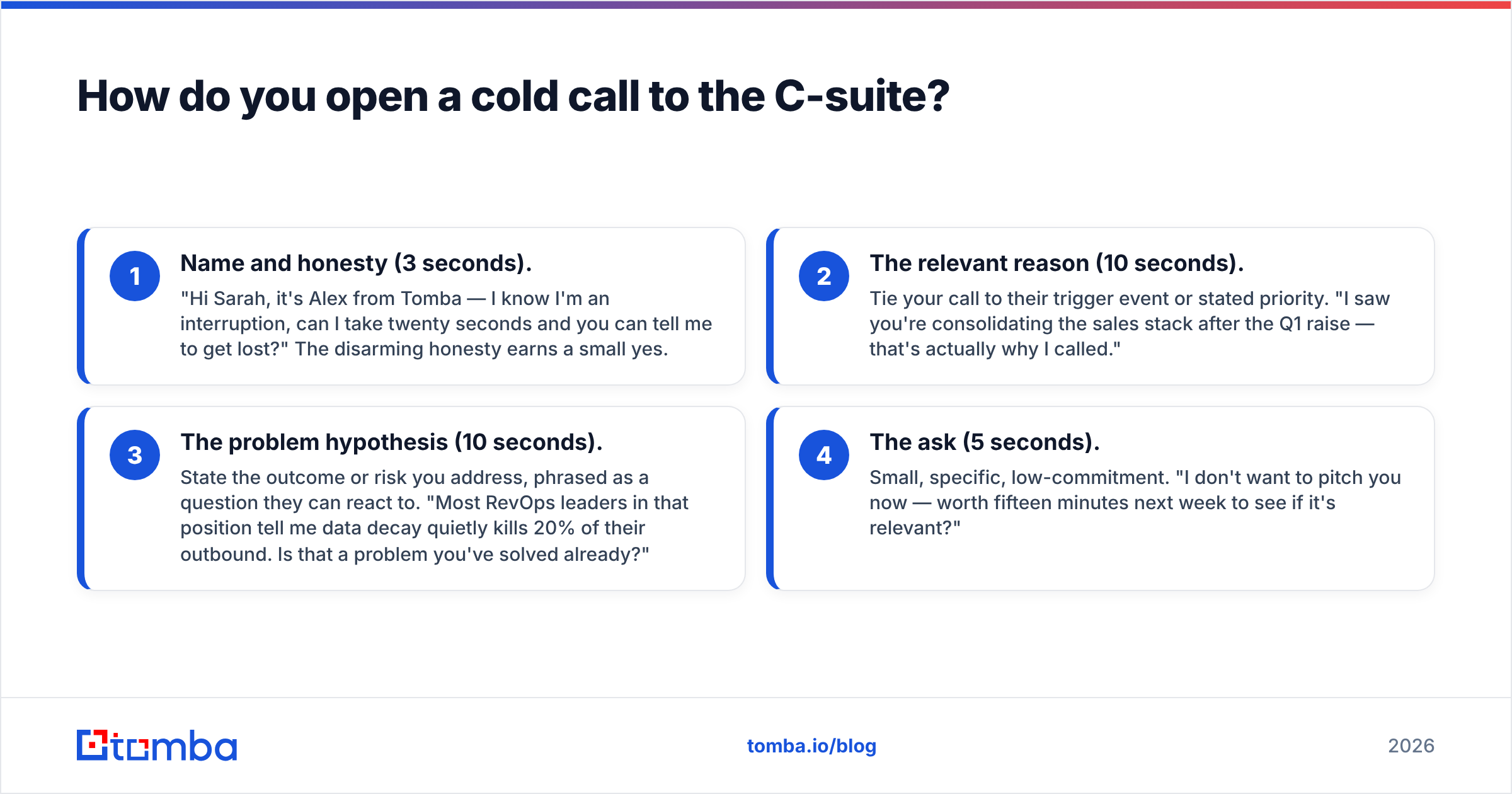
- Name and honesty (3 seconds). "Hi Sarah, it's Alex from Tomba — I know I'm an interruption, can I take twenty seconds and you can tell me to get lost?" The disarming honesty earns a small yes.
- The relevant reason (10 seconds). Tie your call to their trigger event or stated priority. "I saw you're consolidating the sales stack after the Q1 raise — that's actually why I called."
- The problem hypothesis (10 seconds). State the outcome or risk you address, phrased as a question they can react to. "Most RevOps leaders in that position tell me data decay quietly kills 20% of their outbound. Is that a problem you've solved already?"
- The ask (5 seconds). Small, specific, low-commitment. "I don't want to pitch you now — worth fifteen minutes next week to see if it's relevant?"
Notice what's missing: no company history, no feature list, no "how are you today." Every second is spent on them. The executive should feel the call is about their problem, not your quota.
What script gets past the gatekeeper?#
The gatekeeper is not your enemy; they're a filter protecting a busy person from noise. The way past is to not be noise.
Two approaches, depending on the situation:
- The direct route (preferred): Skip the gatekeeper entirely with a verified direct dial. This is the strongest argument for investing in accurate contact data — you dial the mobile and the whole gatekeeping problem disappears. A phone finder that returns validated direct numbers turns a three-call obstacle into a single ring.
- The respectful route (when you must go through reception): Be confident, brief, and specific. "Hi, could you help me reach Sarah Chen? I'm following up on the stack consolidation she mentioned — she may not be expecting my call, but she'll know the context." You give the gatekeeper a real reason and treat them as a colleague, not a hurdle.
Never lie to a gatekeeper about knowing the executive. If it gets back to the C-suite that you fibbed your way in, the meeting is dead before it starts. Executives value straight dealing more than cleverness.
Cold calling vs. cold emailing the C-suite#
Neither channel wins alone. The strongest outbound to executives is a coordinated sequence where each touch reinforces the others.
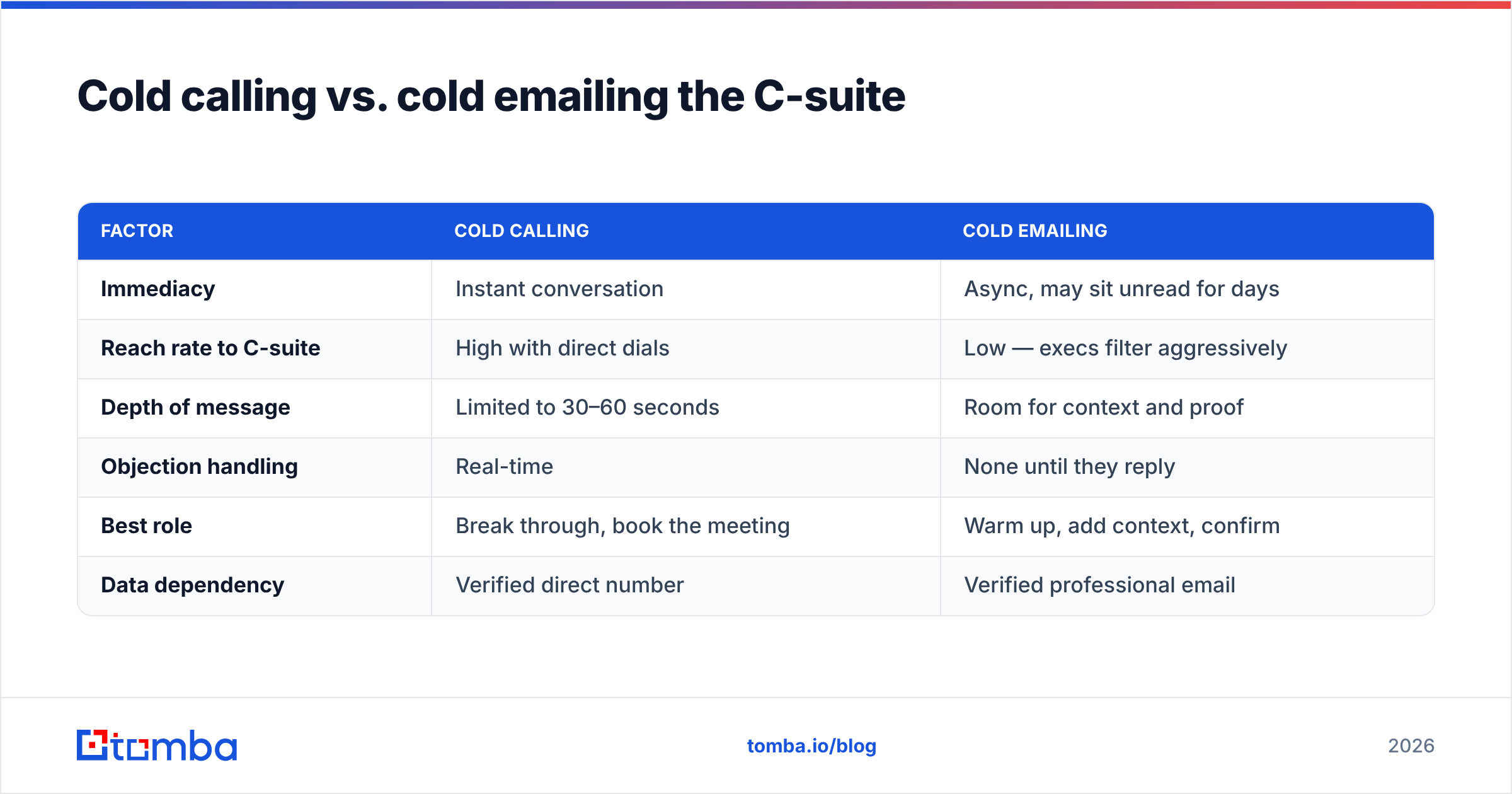
| Factor | Cold calling | Cold emailing |
|---|---|---|
| Immediacy | Instant conversation | Async, may sit unread for days |
| Reach rate to C-suite | High with direct dials | Low — execs filter aggressively |
| Depth of message | Limited to 30–60 seconds | Room for context and proof |
| Objection handling | Real-time | None until they reply |
| Best role | Break through, book the meeting | Warm up, add context, confirm |
| Data dependency | Verified direct number | Verified professional email |
The practical play: use email to introduce context and a specific reason to talk, then call to convert. Both depend on the same thing — accurate contact data. A great call to a dead number and a great email to a bounced address fail identically. Pairing verified emails from an email finder with validated direct dials gives every touch a real chance to land. For deliverability on the email side, HubSpot's sales research consistently shows multi-touch, multi-channel sequences outperform single-channel outreach.
How do you handle executive objections?#
Executive objections are usually shorthand for "you haven't earned my time yet." Answer the subtext, not just the words.
- "I'm not interested." They mean you haven't shown relevance. Respond: "Fair — most people aren't until they see the number. Teams like yours are losing X. If that's not you, I'll never call again." Then stop talking.
- "Send me some information." This is often a soft brush-off. Counter with specificity: "Happy to — so I send the right thing and not a brochure, is the priority reducing cost or speeding up the cycle?" A real answer means real interest.
- "Talk to my VP of Sales." This is a win, not a rejection. "Perfect — can I mention you pointed me their way? It'll save us both time." A warm intra-company referral is worth more than any cold dial.
- "We already use a competitor." Don't attack the incumbent. "Makes sense — most teams your size do. I'm not calling to rip it out, just to show one gap it usually leaves. Worth fifteen minutes?"
The unifying principle: stay calm, stay brief, and never argue. Executives respect composure. The moment you sound desperate, the call is over.
What tools make executive cold calling work?#
The reps who consistently book C-suite meetings aren't more charming — they're better equipped. The stack that matters:
- Verified direct-dial data — the single highest-leverage input. Wrong numbers waste your best scripts. A phone validator confirms a number is live before you spend a dial on it.
- Enriched account context — trigger events, org maps, and priorities pulled automatically rather than researched by hand. Data enrichment turns a bare name into a full picture before you call.
- CRM logging and cadence — so no executive falls through the cracks between touches.
- Email pairing — verified emails to reinforce every call in a coordinated sequence.
You can compare where Tomba fits and what each plan includes on the Tomba pricing page — the Free tier gives you 25 searches a month to test the data quality before committing, with Starter at $49/mo and Growth at $99/mo as you scale.
Put it together#
Cold calling C-level executives rewards preparation over persistence. The rep who researches one account deeply, dials the right direct number at 7:15 a.m., opens with the executive's own priority, and asks for fifteen honest minutes will out-book the rep who blasts a hundred generic dials into voicemail. The dial itself was never the bottleneck — the relevance behind it always was.
Everything downstream of that first ring depends on reaching the right person at the right number. Start with data you can trust: use the Tomba Email Finder and its companion phone and enrichment tools to build a verified, direct-dial list of the executives you actually want to reach — so every one of your best calls has a real person on the other end. Prep the reason, pick the window, and dial.
Related guides#
// get started
Find, verify and enrich your first contacts today
Start on the free plan with 25 searches a month, then scale when your team is ready.
Free plan · No credit card required · GDPR & CCPA
// about the author