Cold Calling Cadence: Build a Call Sequence That Books Meetings
A cold calling cadence isn't about dialing more — it's about timing, spacing, and channel mix. Here's how to build one that actually connects in 2026.
Most reps don't have a cold calling problem. They have a cadence problem. They dial once, get voicemail, mark the lead "no answer," and move on — leaving 80% of the deal on the table. A cold calling cadence fixes that by turning a single hopeful dial into a disciplined, multi-touch sequence that keeps you in front of a prospect until they either buy, book, or explicitly say no.
This guide breaks down exactly how to structure one for 2026: how many touches, how to space them, when to call, and how to weave in email and LinkedIn so calls actually land.
TL;DR#
- A cold calling cadence is a scheduled sequence of call attempts (usually blended with email and LinkedIn) spread over 2–4 weeks — not a one-and-done dial.
- Most connects happen on attempts 4–8, yet the average rep quits after 2. Persistence with structure is the entire game.
- Timing matters more than volume: mid-morning and late-afternoon on Tuesday–Thursday consistently outperform Monday mornings and Friday afternoons.
- The best cadences are multichannel — a call after an email is opened converts far better than a cold dial into silence.
- Data quality gates everything. A perfect cadence dialed against wrong numbers is wasted effort; verified contact data is the foundation.
What is a cold calling cadence?#
A cold calling cadence is a predefined schedule of outreach touches — calls first, supported by emails and social — that a rep runs against a prospect over a fixed window. Think of it like watering a plant: one heavy soak does nothing if you never come back, but a steady rhythm over two weeks gets results. The cadence tells you what to do, when, and through which channel, so you're never guessing or relying on motivation.
A cadence has three moving parts:
- Touches — the total number of contact attempts (calls + emails + social).
- Spacing — the number of days between each touch.
- Channel mix — which medium each touch uses and in what order.
The point of writing it down is consistency. Without a cadence, reps default to their comfort zone — usually one call and an email — and the follow-through that closes deals never happens.
Why does a cadence beat random dialing?#
Because buying attention is won on repetition, not luck. Industry call-analytics research from Gong and others repeatedly shows that connect and conversion rates climb sharply across the first several attempts, then plateau. One dial captures a tiny slice of that curve. A structured cadence captures the whole thing.
Random dialing fails for three predictable reasons:
- You quit too early. The prospect wasn't ignoring you — they were in a meeting on Tuesday and at lunch on Thursday. You just happened to catch the two worst moments.
- You have no channel leverage. A cold call into total silence is the hardest possible open. A call after the prospect has seen your name in their inbox is warm by comparison.
- You can't measure or improve. If every rep dials on a whim, you can't tell whether the script, the timing, or the list is the problem.
A cadence turns cold calling from a coin flip into a process you can test and tune.
How many touches should a cold calling cadence have?#
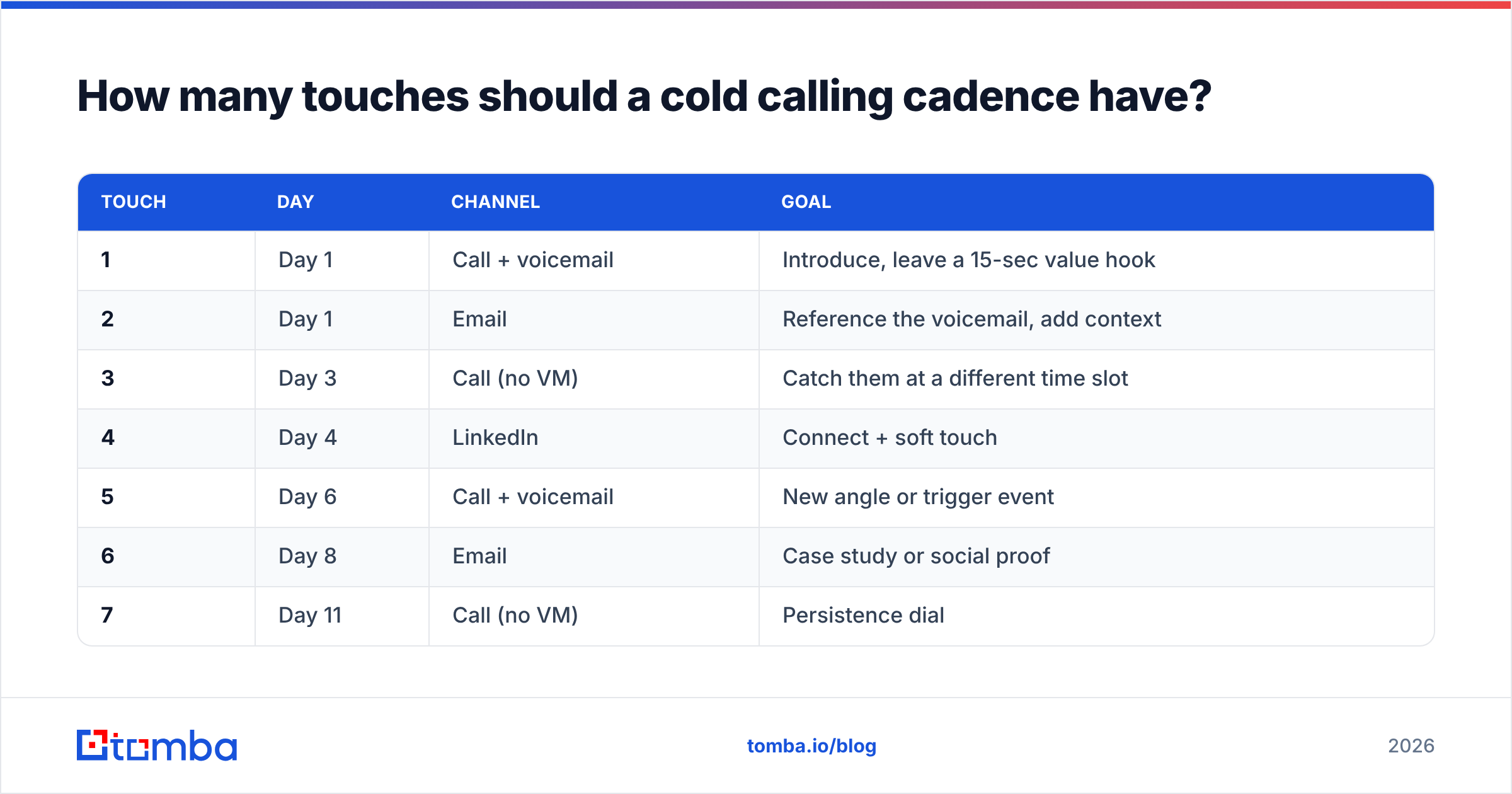
Aim for 8–12 total touches over 2–4 weeks, with calls making up 40–50% of them. That range balances persistence with respect: enough attempts to catch a busy prospect at a good moment, not so many that you become the reason they block your number.
Here's a proven distribution for a mid-market B2B cadence:
| Touch | Day | Channel | Goal |
|---|---|---|---|
| 1 | Day 1 | Call + voicemail | Introduce, leave a 15-sec value hook |
| 2 | Day 1 | Reference the voicemail, add context | |
| 3 | Day 3 | Call (no VM) | Catch them at a different time slot |
| 4 | Day 4 | Connect + soft touch | |
| 5 | Day 6 | Call + voicemail | New angle or trigger event |
| 6 | Day 8 | Case study or social proof | |
| 7 | Day 11 | Call (no VM) | Persistence dial |
| 8 | Day 14 | Break-up email, clear CTA |
Notice the calls are spread across different days and implied times — you're not dialing the same 9:05 a.m. slot eight times. Vary the hour on each attempt so you eventually hit a window when the prospect is actually at their desk.
When are the best times to cold call in 2026?#
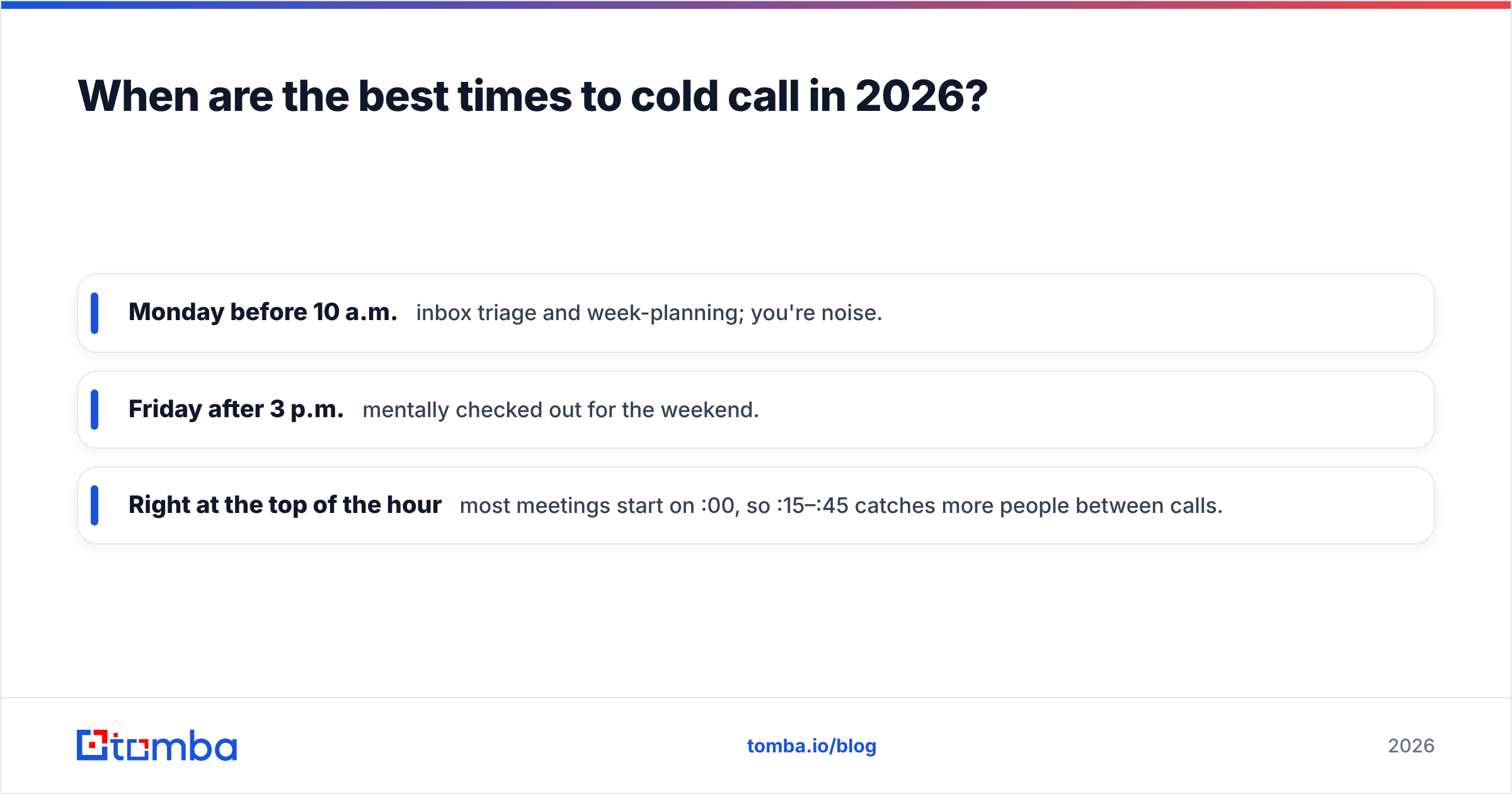
The best call windows are mid-to-late morning (10–11:30 a.m.) and late afternoon (4–5 p.m.), Tuesday through Thursday, in the prospect's local time zone. These are the natural gaps between meeting blocks when someone is at their desk but not heads-down.
Avoid the low-yield zones:
- Monday before 10 a.m. — inbox triage and week-planning; you're noise.
- Friday after 3 p.m. — mentally checked out for the weekend.
- Right at the top of the hour — most meetings start on :00, so :15–:45 catches more people between calls.
The single biggest timing mistake is ignoring time zones. If you're calling a West Coast prospect at what feels like a reasonable 9 a.m. for you on the East Coast, it's 6 a.m. for them. Segment your list by region and dial each within its local sweet spot. And always match the call to the prospect's data — a validated direct-dial beats a switchboard number every time, which is why teams run numbers through a phone validator before a cadence even starts.
How do you blend calls with email and LinkedIn?#
Sequence the channels so each one warms up the next. A call is your highest-intent, highest-friction touch — so earn attention on cheaper channels first, then cash it in on the dial.
The winning pattern is "trigger, then call." For example:
- Email lands at 8 a.m. referencing a specific trigger (a funding round, a new hire, a tech-stack signal).
- The prospect opens it mid-morning.
- You call within the hour — "Hey, I just sent you a note about your Series B, wanted to give you the 30-second version."
Now you're not a cold caller; you're the person from that email. Response rates on this pattern dwarf blind dialing. If you want the mechanics of measuring the lift, our breakdown of email response rate benchmarks pairs well with call-connect tracking.
LinkedIn plays a supporting role: a connection request or a thoughtful comment on the prospect's post makes your name familiar, so the call feels like a follow-up rather than an intrusion. For a deeper channel strategy, see how LinkedIn outreach fits into a multichannel motion.
What does a good cadence structure look like side by side?#
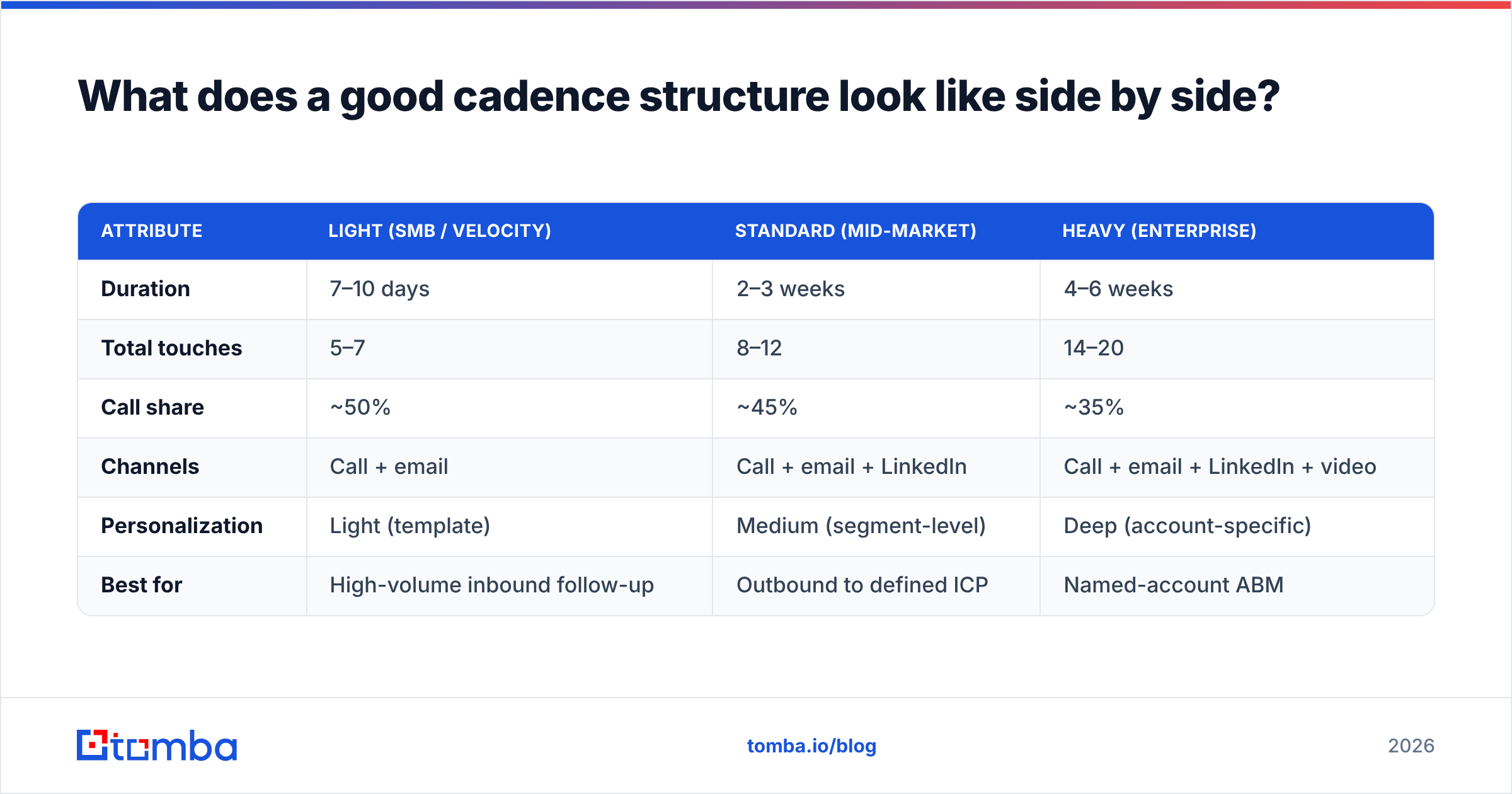
Not every deal needs the same intensity. Match cadence length and touch density to deal size and buyer seniority. A $500/month SMB tool doesn't warrant a six-week enterprise siege, and a $200K enterprise deal won't close on a three-touch sprint.
| Attribute | Light (SMB / velocity) | Standard (mid-market) | Heavy (enterprise) |
|---|---|---|---|
| Duration | 7–10 days | 2–3 weeks | 4–6 weeks |
| Total touches | 5–7 | 8–12 | 14–20 |
| Call share | ~50% | ~45% | ~35% |
| Channels | Call + email | Call + email + LinkedIn | Call + email + LinkedIn + video |
| Personalization | Light (template) | Medium (segment-level) | Deep (account-specific) |
| Best for | High-volume inbound follow-up | Outbound to defined ICP | Named-account ABM |
The heavier the cadence, the more personalization each touch demands — you can't blast 18 generic touches at a VP and expect anything but a block. Volume and relevance move in opposite directions.
How do you write voicemails and call openers for a cadence?#
Keep voicemails under 20 seconds and give a reason to expect your next touch. The goal of a cadence voicemail isn't a callback — it's recognition, so touch #3 lands warmer. A simple formula:
- Name + company (2 sec)
- One-line reason you're calling tied to their world (8 sec)
- A bridge to your next touch — "I'll follow up with a quick email" (5 sec)
For the live opener, lead with a pattern interrupt and a permission-based ask: "I know you weren't expecting my call — can I take 30 seconds to tell you why I dialed, and you can tell me to get lost?" It disarms the reflex hang-up and buys you a real conversation. HubSpot's sales call resources are a solid library if you want vetted scripts to adapt.
Rotate your angle across the cadence. If touch #1 led with a cost-saving hook and got nothing, touch #5 should try a competitive-pressure or peer-proof angle. Repeating the identical message eight times just confirms you're a script, not a person.
What metrics should you track to improve the cadence?#
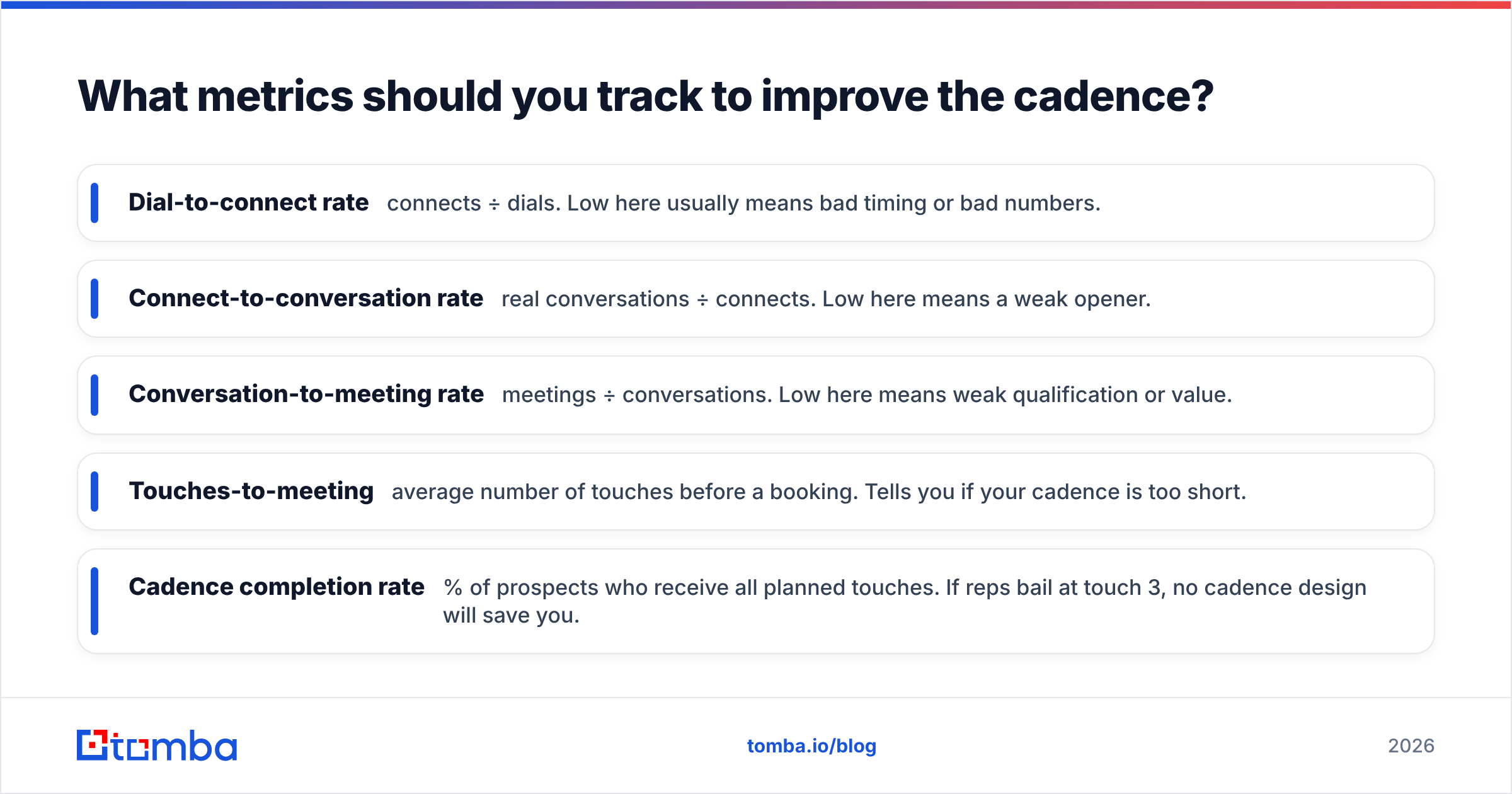
Track the funnel at every stage, not just meetings booked — otherwise you can't tell where the cadence leaks.
- Dial-to-connect rate — connects ÷ dials. Low here usually means bad timing or bad numbers.
- Connect-to-conversation rate — real conversations ÷ connects. Low here means a weak opener.
- Conversation-to-meeting rate — meetings ÷ conversations. Low here means weak qualification or value.
- Touches-to-meeting — average number of touches before a booking. Tells you if your cadence is too short.
- Cadence completion rate — % of prospects who receive all planned touches. If reps bail at touch 3, no cadence design will save you.
If your dial-to-connect rate is in the tank, the fix is almost never "call more." It's better data. Reps burn hours on disconnected lines and gatekeeper switchboards — clean, direct-dial numbers from a phone finder recover that time instantly. Salesforce's sales operations guidance has good frameworks for wiring these metrics into a repeatable review cadence.
Common cold calling cadence mistakes to avoid#
- Quitting at touch 2. The most expensive mistake in sales. Your competitor who dials a fourth time gets the meeting you gave up on.
- Same time, every time. Eight dials at 9 a.m. is one attempt repeated eight times, not eight attempts.
- No channel support. Cold dials into total silence are the hardest path. Warm the prospect first.
- Ignoring time zones. A great cadence in the wrong local window is a bad cadence.
- Dialing bad data. Wrong numbers inflate your "no answer" count and demoralize reps. Verify before you dial.
- No break-up touch. A clear final message ("last time you'll hear from me") often produces the reply nothing else did.
Build your cadence on data that actually connects#
A cold calling cadence is only as good as the contact data behind it. The smartest touch schedule in the world falls apart when half the numbers are disconnected and the email addresses bounce. Before you obsess over timing and scripts, make sure every prospect in the sequence has a verified email and a real direct dial.
That's where Tomba's Email Finder fits into your outbound stack — it surfaces accurate professional email addresses so your "trigger, then call" pattern actually has a working inbox to trigger against, and pairs with Tomba's phone and enrichment tools to keep your dials landing on live lines. Start on the free tier (25 searches a month), and if it earns a place in your workflow, plans scale from $49/month. Check the full Tomba pricing to match a tier to your volume.
Build the cadence, respect the timing, and feed it clean data — that's the combination that turns cold calls into booked meetings.
Related guides#
Ready to find emails that actually work?
Join 150,000+ professionals who stopped guessing and started sending. Free credits on signup — no credit card required.
Get the Tomba newsletter
Practical outbound tactics and product updates — once every two weeks.
About the author