Cold Calling Challenges in 2026: 9 Problems and Fixes
Cold calling still works in 2026 - if you solve the right problems. Here are the 9 biggest cold calling challenges reps face and the concrete fixes that beat each one.
Cold calling is not dead. Bad cold calling is dead. The reps still booking meetings in 2026 are not luckier or more charismatic - they have simply removed the friction that quietly tanks everyone else's numbers.
This guide breaks down the nine cold calling challenges that hurt connect rates and conversion the most right now, and gives you a concrete fix for each one. No motivational filler. Just the problems and what to do about them.
TL;DR#
- Bad phone data is the #1 killer - reps waste 30-50% of dials on wrong or dead numbers. Fix the list before you fix the pitch.
- Gatekeepers, voicemail, and spam-flagged caller IDs now block most first-attempt dials. These are process problems, not talent problems.
- The opener decides everything - you have about 8 seconds before a prospect mentally hangs up.
- Rejection and call reluctance are real, measurable productivity leaks. Structure beats willpower.
- Combine verified contact data with a tight script and disciplined cadence and cold calling still outperforms most channels for high-ACV deals.
Why is cold calling still so hard in 2026?#
The mechanics got harder, not easier. Buyers screen calls aggressively, carriers flag unknown numbers as "Spam Likely," and the average B2B decision-maker fields dozens of outreach attempts a week. According to HubSpot's sales research, it takes multiple touches to reach a prospect, and most reps quit long before they get there.
At the same time, the fundamentals still favor the phone for complex deals. A live conversation surfaces objections you would never see in an ignored email. The challenge is that a single cold call now depends on a chain of things going right - the number has to be correct, the caller ID has to look trustworthy, you have to get past a gatekeeper, and then you have about eight seconds to earn the next thirty. Break any link and the call is dead.
Let's go through the chain link by link.
What are the biggest cold calling challenges?#
Here are the nine problems that show up in almost every underperforming calling motion, ranked by how much damage they do.
1. Bad or outdated phone data#
This is the silent budget killer. If a third of your numbers are wrong, disconnected, or belong to someone who left the company two years ago, no script on earth saves you. You are paying reps to listen to dial tones.
The fix: Clean and enrich your list before anyone picks up a headset. Use a phone finder to source current direct-dial and mobile numbers tied to the actual person, then run them through a phone validator to strip dead lines. Pair that with data enrichment so the rep knows the title, company, and context before dialing. Verified data is the cheapest performance boost available - it costs pennies per record and instantly recovers wasted dial time.
2. Getting flagged as "Spam Likely"#
Carriers and call-screening apps now label unknown business numbers as spam. If your caller ID shows up red, connect rates collapse before the phone even rings.
The fix: Register your outbound numbers with the major carrier analytics providers, rotate a small pool of numbers instead of hammering one line, keep your dial-to-connect ratio human, and monitor your numbers' reputation monthly. Local presence dialing (matching area codes) still helps, but only if the underlying number is clean.
3. Gatekeepers#
Executive assistants and front-desk staff are trained to deflect. Treating them as obstacles is the fastest way to get blocked permanently.
The fix: Be direct, confident, and respectful. Ask for the person by first name as if you already know them, state a crisp reason, and never sound like you are reading a script. Better yet, skip the switchboard entirely - a verified direct dial or mobile number sidesteps the gatekeeper problem before it starts.
4. Voicemail black holes#
Most first dials go to voicemail, and most voicemails go unheard. Reps either leave rambling messages or none at all.
The fix: Decide your voicemail strategy in advance. A tight 15-second message referencing a specific trigger event, plus a follow-up email sent in the same minute, doubles the odds of a callback. Consistency matters more than perfection here.
5. The eight-second opener problem#
Prospects decide almost instantly whether to stay on the line. "Did I catch you at a bad time?" and other tired openers signal a cold call and trigger an immediate brush-off.
The fix: Lead with relevance, not permission. Reference something specific about their company, name the problem you solve for people in their role, and get to the point. Pattern interrupts work because they do not sound like every other rep.
6. Call reluctance and rejection fatigue#
Hearing "no" fifty times a day wears people down. Call reluctance - the quiet avoidance of dialing - is one of the least discussed but most expensive problems in any SDR team.
The fix: Make dialing mechanical and rejection impersonal. Block calling into focused sprints, track dials as an input metric separate from outcomes, and celebrate activity, not just booked meetings. When the list is pre-verified, reps get more live conversations per hour, which is the single best antidote to reluctance.
7. Weak or missing cadence#
One-and-done calling wastes every dial that did not connect. Yet most reps give up after one or two attempts.
The fix: Build a multi-touch cadence that mixes calls, emails, and social touches across two to three weeks. Persistence, sequenced properly, is what separates the reps who hit quota from the ones who blame the market.
8. No pre-call research#
Generic pitches get generic rejections. If you cannot name why you are calling this person, they can tell.
The fix: Spend 60 seconds per prospect on context - recent funding, a new hire, a product launch, a job posting. Enriched records surface most of this automatically, so research does not have to mean 20 minutes of manual LinkedIn digging.
9. Not measuring the right things#
Teams that only track booked meetings are flying blind. You cannot fix a funnel you do not measure.
The fix: Track connect rate, conversation-to-meeting rate, and dials-per-connect separately. Each number points to a different problem - a low connect rate is a data or caller-ID issue, while a low conversation-to-meeting rate is a script issue.
Which cold calling challenges hurt the most?#
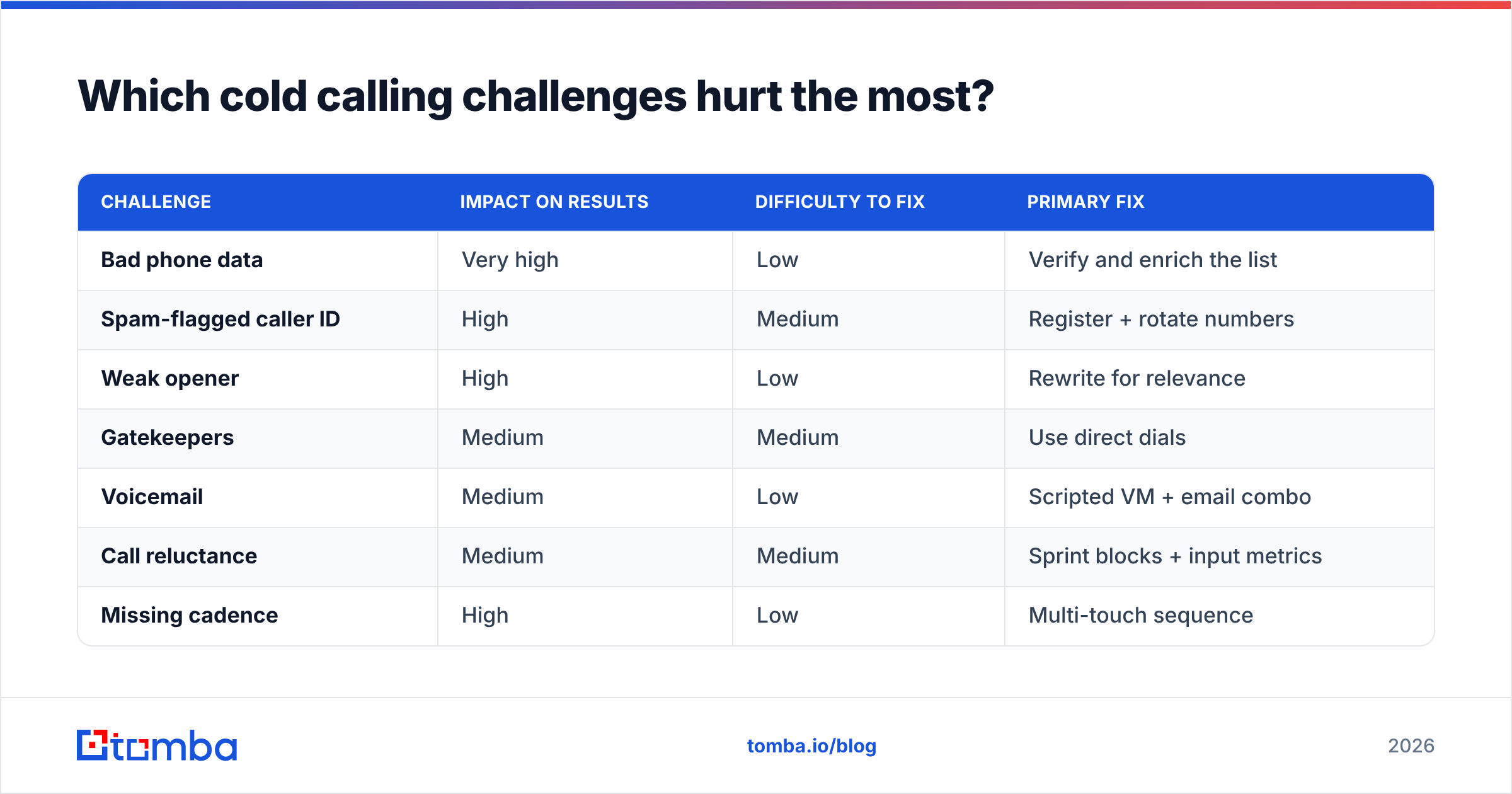
Not all problems cost the same. Here is how they stack up by impact and how hard they are to fix.
| Challenge | Impact on results | Difficulty to fix | Primary fix |
|---|---|---|---|
| Bad phone data | Very high | Low | Verify and enrich the list |
| Spam-flagged caller ID | High | Medium | Register + rotate numbers |
| Weak opener | High | Low | Rewrite for relevance |
| Gatekeepers | Medium | Medium | Use direct dials |
| Voicemail | Medium | Low | Scripted VM + email combo |
| Call reluctance | Medium | Medium | Sprint blocks + input metrics |
| Missing cadence | High | Low | Multi-touch sequence |
| No research | Medium | Low | 60-second enrichment |
| Poor measurement | High | Low | Track the three core rates |
The pattern is clear: the highest-impact, lowest-difficulty fixes are almost all about data quality and process, not raw talent. That is good news, because those are the cheapest and fastest things to change.
How do you fix bad phone data before it wrecks your dials?#
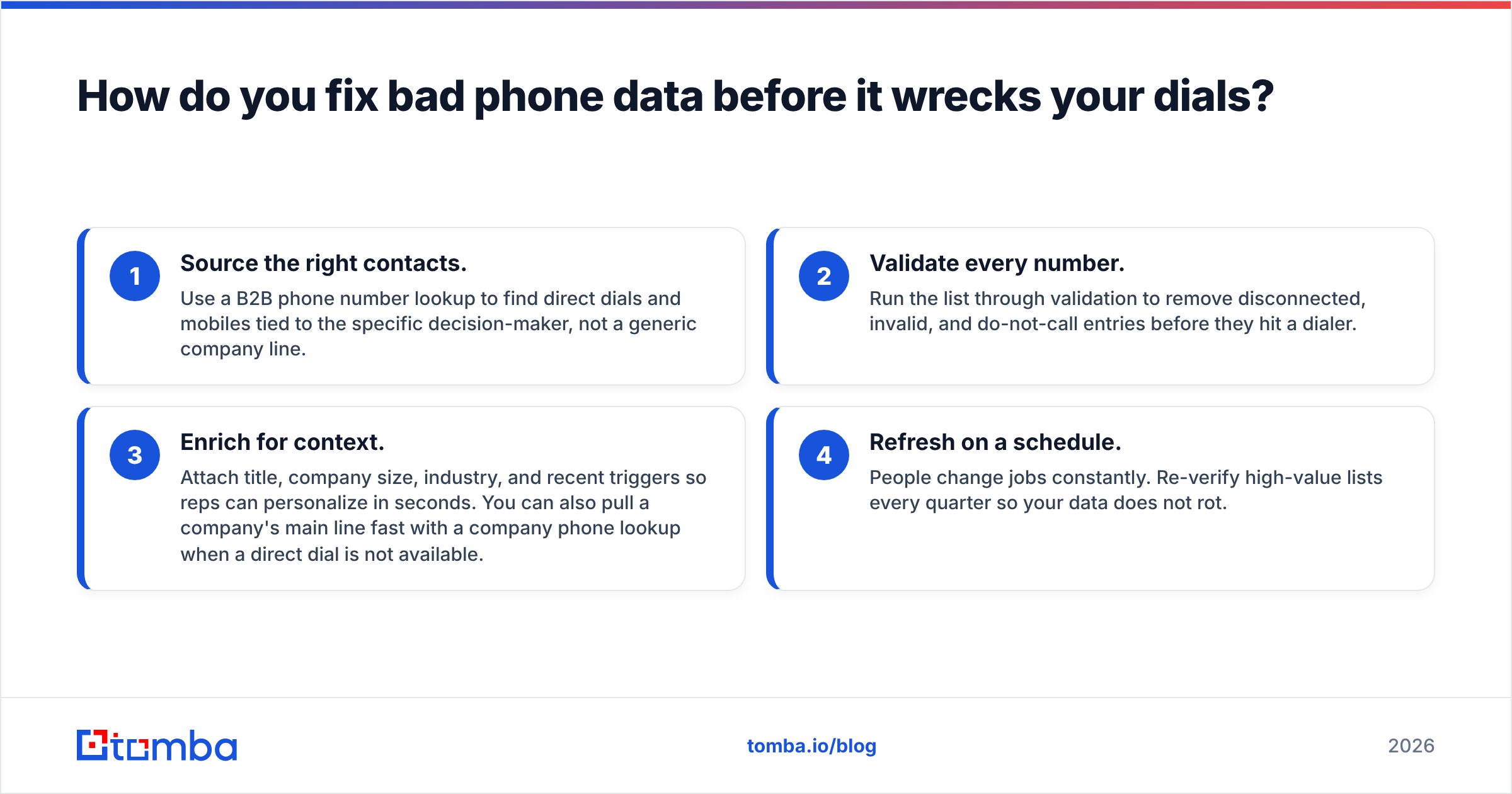
Start upstream. Most calling problems trace back to the list, so fixing the list fixes several challenges at once. A simple four-step workflow:
- Source the right contacts. Use a B2B phone number lookup to find direct dials and mobiles tied to the specific decision-maker, not a generic company line.
- Validate every number. Run the list through validation to remove disconnected, invalid, and do-not-call entries before they hit a dialer.
- Enrich for context. Attach title, company size, industry, and recent triggers so reps can personalize in seconds. You can also pull a company's main line fast with a company phone lookup when a direct dial is not available.
- Refresh on a schedule. People change jobs constantly. Re-verify high-value lists every quarter so your data does not rot.
This is the boring work that quietly doubles connect rates. Reps love a clean list because it means more conversations and less soul-crushing dead air.
Cold calling vs. cold email: which handles these challenges better?#
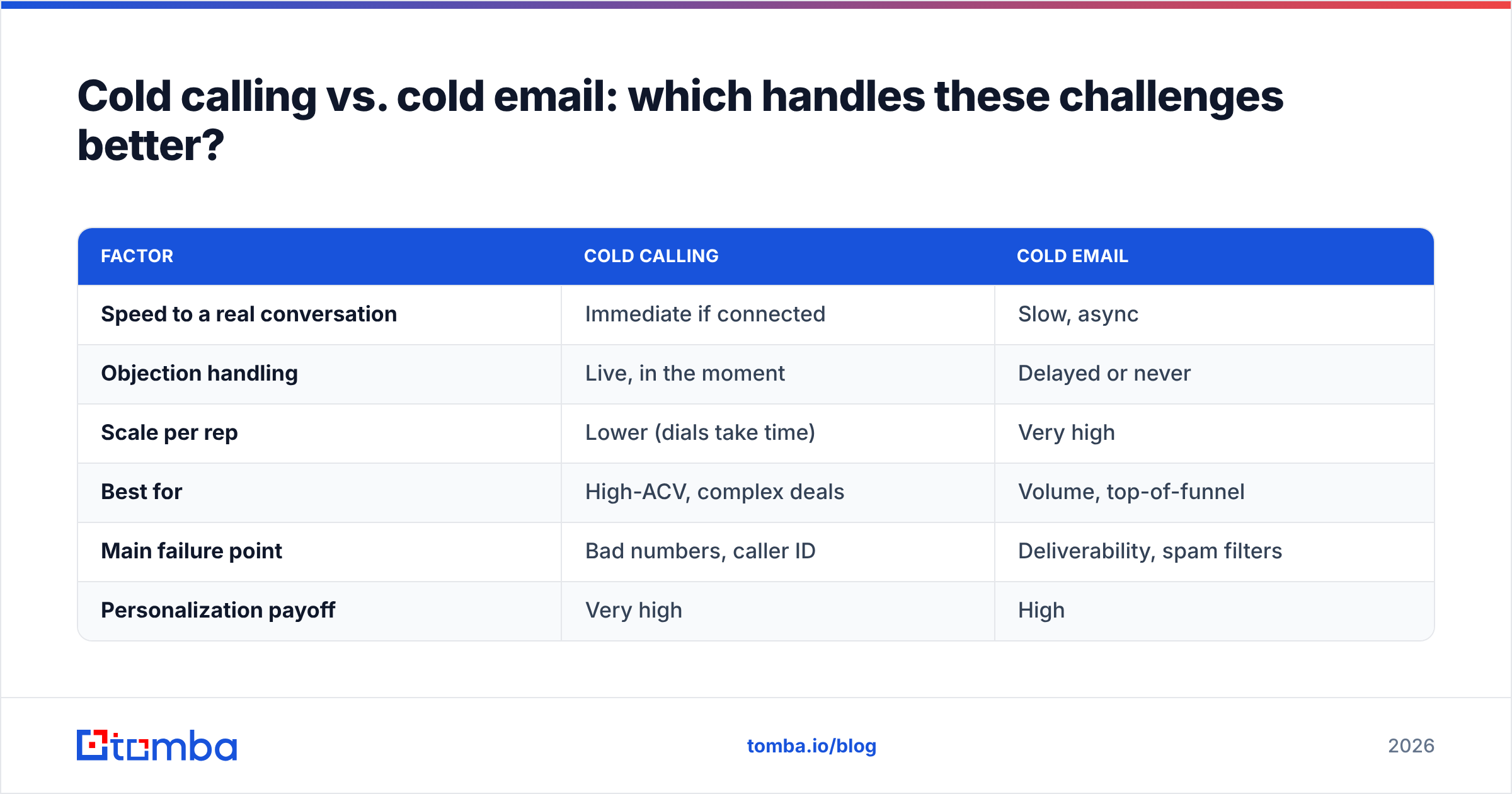
Reps often ask whether they should just abandon the phone for email. The honest answer: they solve different problems, and the best teams run both. Here is a straight comparison.
| Factor | Cold calling | Cold email |
|---|---|---|
| Speed to a real conversation | Immediate if connected | Slow, async |
| Objection handling | Live, in the moment | Delayed or never |
| Scale per rep | Lower (dials take time) | Very high |
| Best for | High-ACV, complex deals | Volume, top-of-funnel |
| Main failure point | Bad numbers, caller ID | Deliverability, spam filters |
| Personalization payoff | Very high | High |
Cold calling wins on depth; cold email wins on scale. For most B2B teams, the phone is where large deals get unstuck and email is how you stay top of mind between calls. If you are building the email side too, an accurate email finder feeds the same enriched contact record you use for dialing, so the two channels reinforce each other instead of running on separate, conflicting lists.
Industry review sites like G2 and analyst firms like Gartner consistently show that multi-channel outbound outperforms single-channel motions - the phone is a pillar of that mix, not a relic.
What does a high-performing cold call actually look like?#
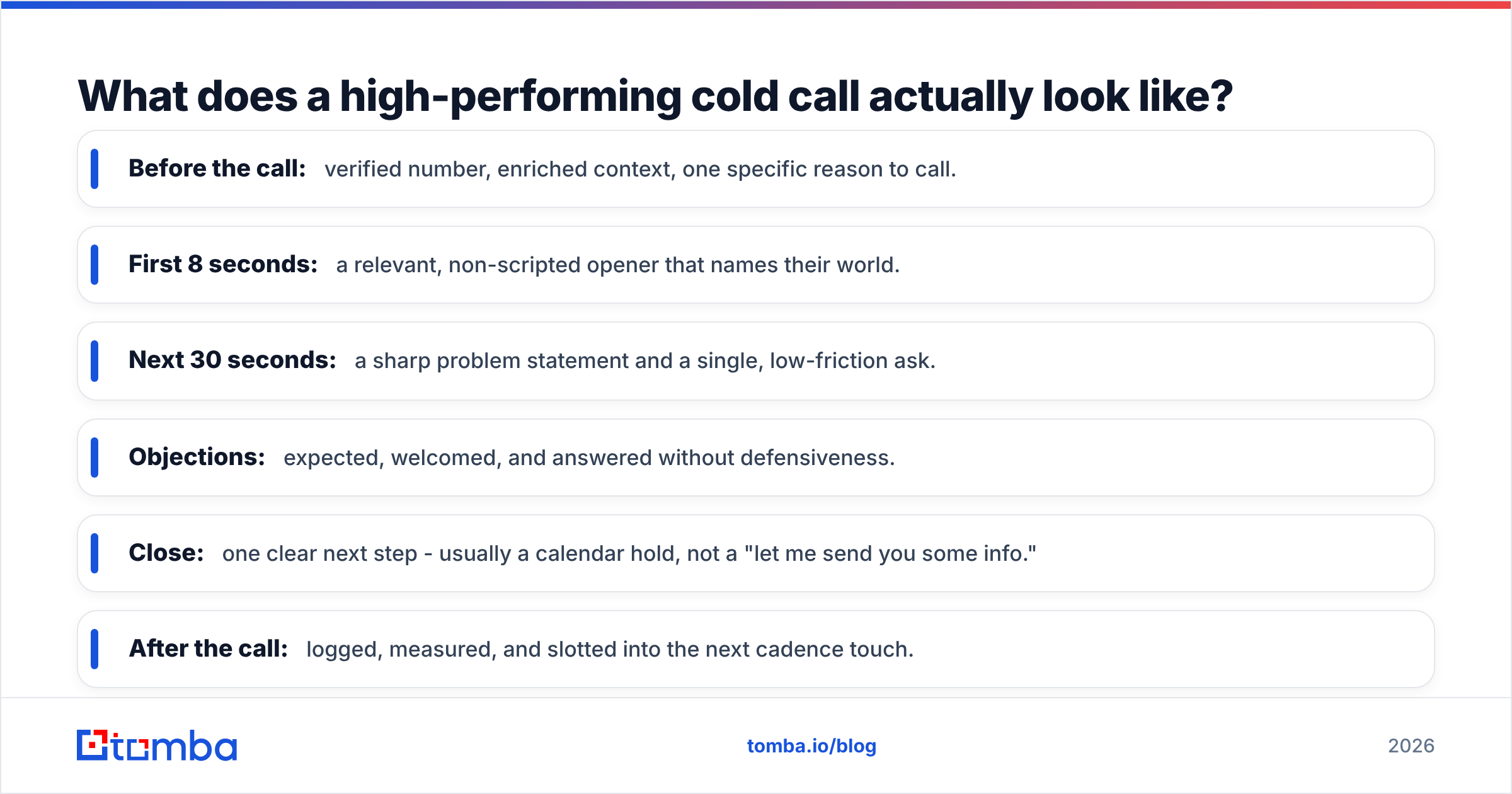
Put the fixes together and a good call has a repeatable shape:
- Before the call: verified number, enriched context, one specific reason to call.
- First 8 seconds: a relevant, non-scripted opener that names their world.
- Next 30 seconds: a sharp problem statement and a single, low-friction ask.
- Objections: expected, welcomed, and answered without defensiveness.
- Close: one clear next step - usually a calendar hold, not a "let me send you some info."
- After the call: logged, measured, and slotted into the next cadence touch.
None of this requires being a natural. It requires clean inputs and a disciplined process - both of which you control.
Frequently asked questions#
Is cold calling still effective in 2026? Yes, especially for high-value and complex deals where a live conversation surfaces objections email never would. It is less effective for pure volume plays, where email and social scale better.
What is the single biggest cold calling challenge? Bad phone data. Wrong and dead numbers waste 30-50% of dials, and no amount of coaching fixes a list problem. Verify and enrich before you dial.
How many dials does it take to book a meeting? It varies by segment, but connect rates of 5-10% and multiple touches per prospect are normal. Tracking dials-per-connect separately from conversation-to-meeting tells you which lever to pull.
How do I stop showing up as "Spam Likely"? Register your numbers with carrier analytics providers, rotate a small pool of clean numbers, keep dial pacing human, and monitor reputation monthly.
Fix the data, and cold calling starts working again#
Most cold calling challenges are not about grit or gift of gab - they are about the quality of what happens before the phone rings. Clean numbers, real context, and a disciplined cadence beat raw hustle every time.
That is exactly where Tomba's phone finder earns its place: source current direct dials and mobiles, validate them, and enrich every record so your reps spend their day in conversations instead of chasing dead lines. Start on the free tier and see how many more live connects a verified list buys you before you scale up. Your connect rate - and your reps' morale - will thank you.
Related guides#
Ready to find emails that actually work?
Join 150,000+ professionals who stopped guessing and started sending. Free credits on signup — no credit card required.
Get the Tomba newsletter
Practical outbound tactics and product updates — once every two weeks.
About the author