Cold Calling Companies in 2026: Costs, Pros, and Top Picks
Thinking about outsourcing your dials? Here's what cold calling companies actually cost, when they work, when they burn budget, and how to vet one before you sign.
Cold calling is not dead — but the way you buy it has changed. More teams now rent a dialing team than build one, and a whole industry of cold calling companies has grown up to meet that demand. The question is whether handing your pipeline to an outside vendor actually beats keeping the phones in-house.
This guide breaks down what these companies do, what they charge, where they help, and where they quietly waste your money — plus how to vet one so you don't sign a 12-month contract you regret by month three.
TL;DR#
- Cold calling companies sell outsourced dialing: they staff SDRs, load your target list, run scripts, and book meetings on your calendar — usually for a monthly retainer plus a per-meeting fee.
- Expect $3,000–$8,000/month for a managed program, or $5,000–$10,000 per dedicated rep. Pay-per-appointment deals run $150–$700 per booked meeting.
- They work best when you have product-market fit, a defined ICP, and no time to hire — and worst when your list is dirty or your offer is still unproven.
- The single biggest predictor of ROI is contact-data quality, not the vendor's script. Garbage numbers sink good callers.
- You can slash the cost by feeding vendors clean, verified direct-dial data yourself using a tool like Tomba's phone finder instead of paying them to source it.
What are cold calling companies?#
A cold calling company is an outsourced sales team you rent instead of hire. Think of it like a temp agency, but for the top of your funnel: instead of you recruiting, training, and managing sales development reps (SDRs), the vendor supplies trained callers who dial prospects on your behalf and hand you qualified meetings.
Most operate under one of a few labels — "appointment setting," "B2B lead generation," "outbound SDR-as-a-service," or "sales development outsourcing." The mechanics are similar. You give them an ideal customer profile (ICP) and an offer; they build or clean a call list, write scripts with you, and start dialing. Booked meetings drop onto your account executives' calendars.
The category exists because building an in-house outbound team is genuinely hard. According to HubSpot's sales research, ramp time for a new SDR routinely stretches past three months, and turnover in the role is among the highest in sales. Outsourcing trades that operational headache for a monthly invoice.
How do cold calling companies actually work?#
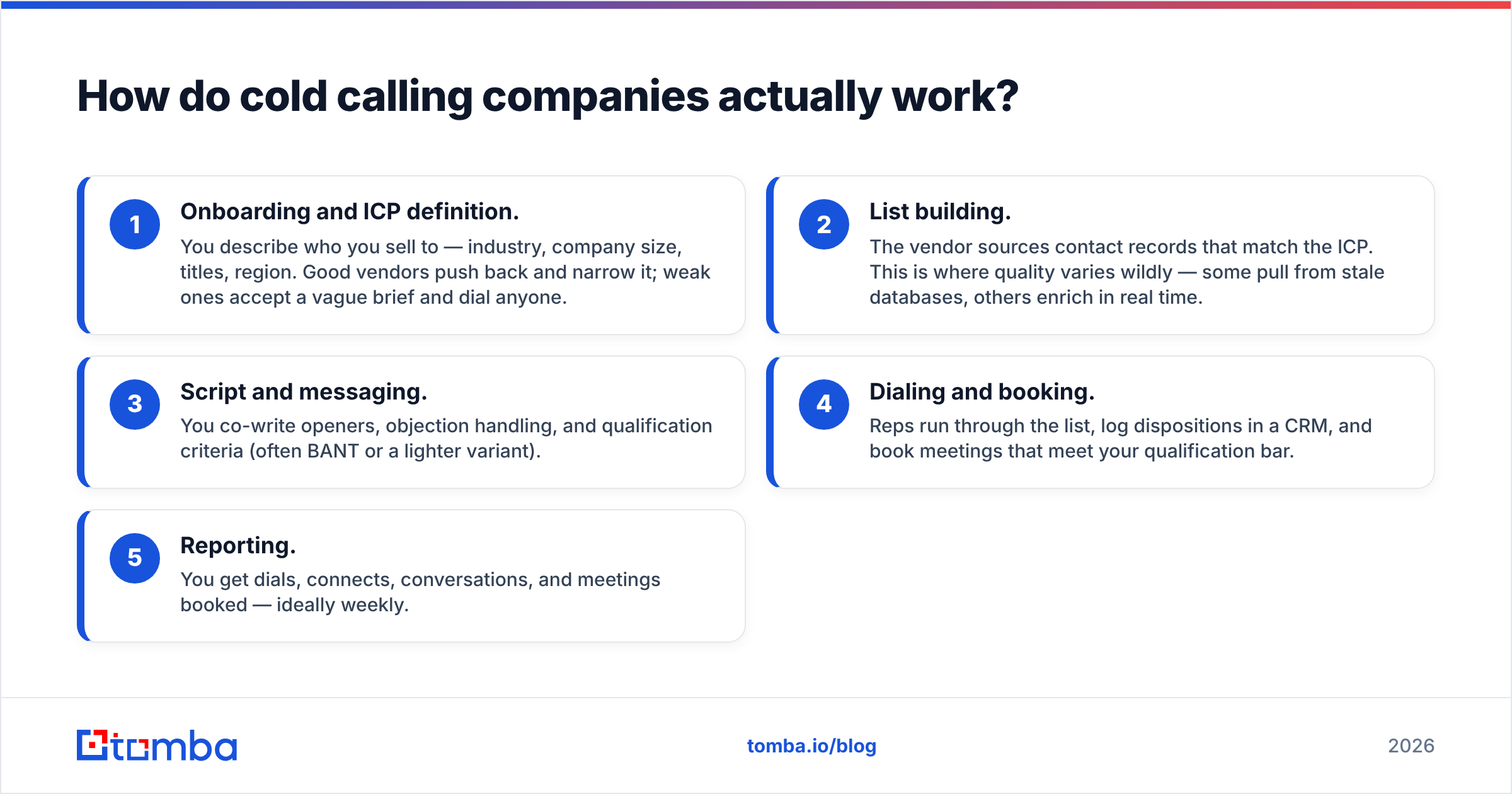
Most managed programs follow the same five steps:
- Onboarding and ICP definition. You describe who you sell to — industry, company size, titles, region. Good vendors push back and narrow it; weak ones accept a vague brief and dial anyone.
- List building. The vendor sources contact records that match the ICP. This is where quality varies wildly — some pull from stale databases, others enrich in real time.
- Script and messaging. You co-write openers, objection handling, and qualification criteria (often BANT or a lighter variant).
- Dialing and booking. Reps run through the list, log dispositions in a CRM, and book meetings that meet your qualification bar.
- Reporting. You get dials, connects, conversations, and meetings booked — ideally weekly.
The catch hidden in step two: if the phone numbers are wrong, everything downstream collapses. A rep who spends half their day hitting dead lines and wrong extensions books half the meetings — and you pay for the wasted hours either way.
How much do cold calling companies cost in 2026?#
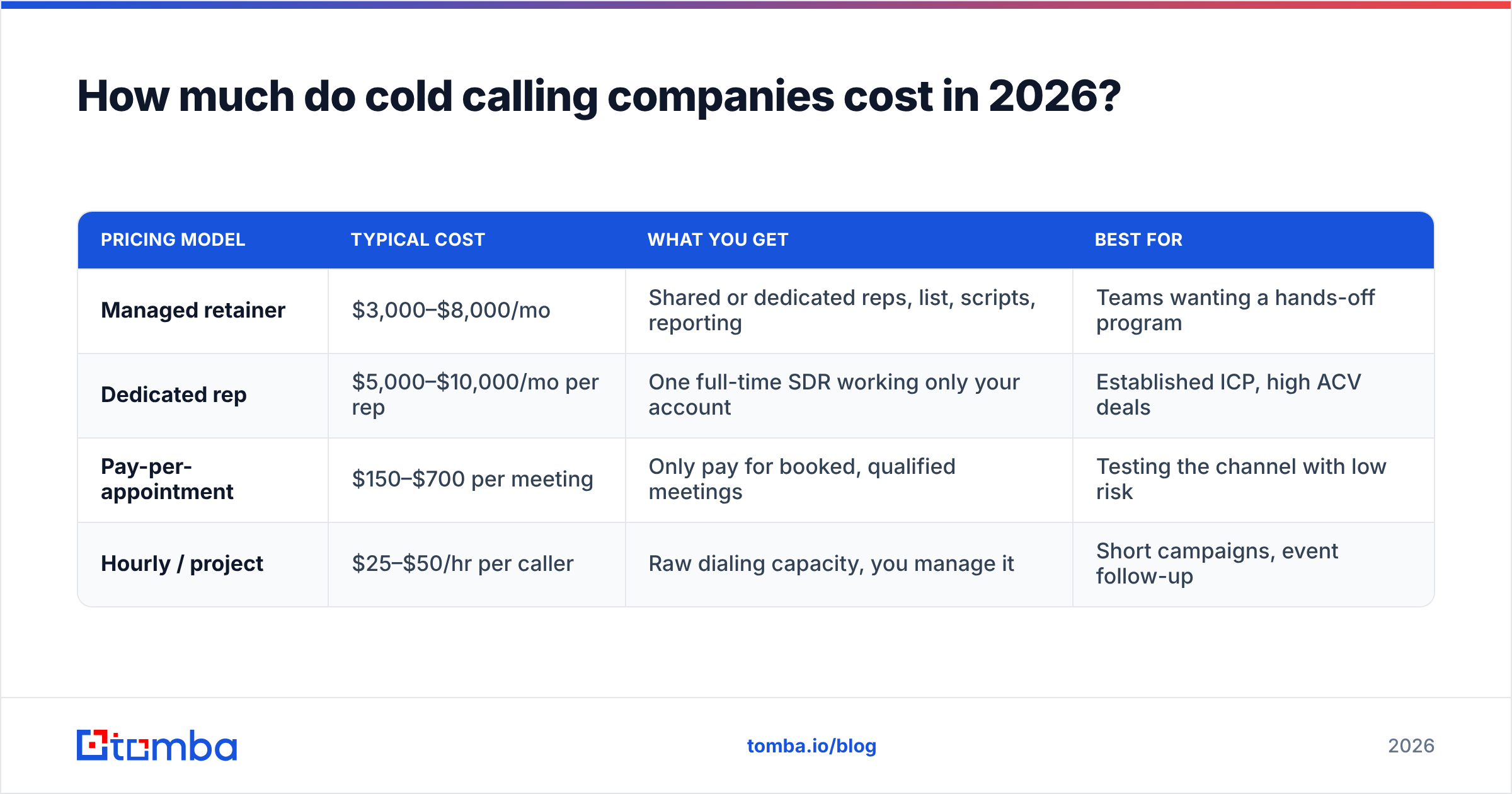
Pricing splits into three common models. Here's how they compare on a realistic mid-market program.
| Pricing model | Typical cost | What you get | Best for |
|---|---|---|---|
| Managed retainer | $3,000–$8,000/mo | Shared or dedicated reps, list, scripts, reporting | Teams wanting a hands-off program |
| Dedicated rep | $5,000–$10,000/mo per rep | One full-time SDR working only your account | Established ICP, high ACV deals |
| Pay-per-appointment | $150–$700 per meeting | Only pay for booked, qualified meetings | Testing the channel with low risk |
| Hourly / project | $25–$50/hr per caller | Raw dialing capacity, you manage it | Short campaigns, event follow-up |
A few things the sticker price hides:
- Ramp is not free. Most retainers charge full price during the 3–6 week ramp when meeting volume is near zero.
- List sourcing may be extra. Some vendors bundle data; others bill it separately or use low-grade lists to protect margin.
- Meeting quality varies. A cheap per-appointment deal that books unqualified meetings costs your AEs more in wasted time than a pricier program that books real ones.
For comparison, an in-house SDR runs roughly $60,000–$85,000 fully loaded per year in the US before tooling — so a single dedicated outsourced rep at $6,000/month is in the same ballpark, minus the hiring risk.
Are cold calling companies better than building an in-house team?#
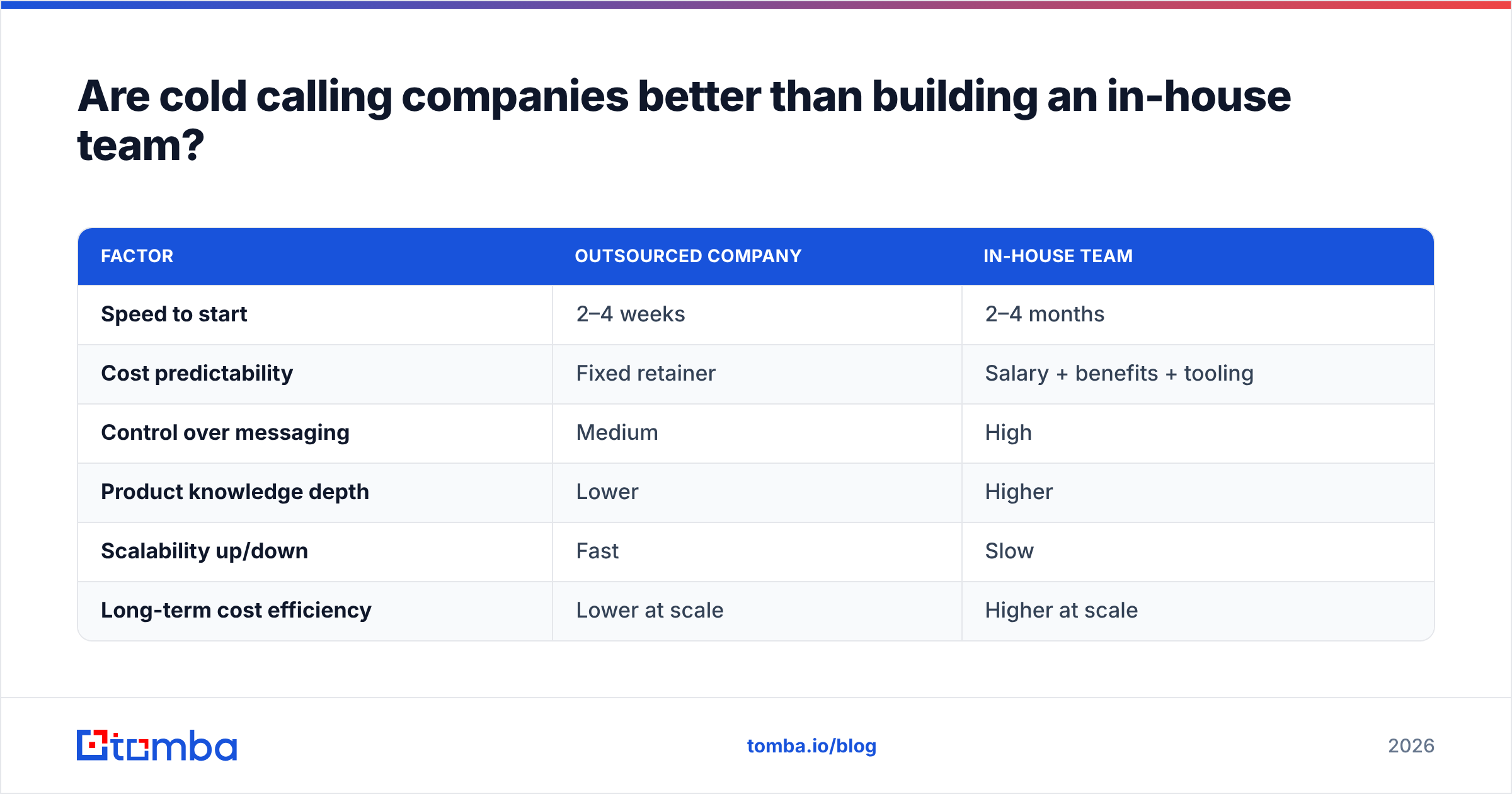
Neither wins universally — it depends on your stage and your data. Here's the honest split.
| Factor | Outsourced company | In-house team |
|---|---|---|
| Speed to start | 2–4 weeks | 2–4 months |
| Cost predictability | Fixed retainer | Salary + benefits + tooling |
| Control over messaging | Medium | High |
| Product knowledge depth | Lower | Higher |
| Scalability up/down | Fast | Slow |
| Long-term cost efficiency | Lower at scale | Higher at scale |
Outsource when you need pipeline now, your ICP is validated, and you'd rather not manage people. Build in-house when your sales motion is complex, your product needs deep explanation, or outbound is a permanent core function you want to own. Many teams do both: outsource to test a new segment, then bring the winners in-house.
One rule holds either way — the phone numbers and the person behind them have to be right. That's true whether an outsourced rep or your own SDR is dialing.
What separates a good cold calling company from a bad one?#
Score any vendor against these before you sign:
- Data transparency. Ask where they source contact data and how recently it was verified. If they can't answer, assume it's stale. Bad direct-dial data is the number one reason programs underperform.
- Dedicated vs shared reps. Shared reps juggle several clients and give you a fraction of their attention. Dedicated reps cost more but learn your product.
- Realistic meeting benchmarks. A vendor promising 40 meetings a month from a cold start on a niche ICP is selling fantasy. Credible ones talk in ranges and connect-rate math.
- Qualification discipline. Get their exact definition of a "qualified meeting" in writing. Loose definitions inflate their numbers and waste your AEs' calendars.
- Reporting cadence. Weekly dials, connects, conversations, and meetings — not a vague monthly summary.
- Ramp and contract terms. Look for month-to-month or a short pilot. Avoid 12-month lock-ins before you've seen results.
Check independent reviews on G2 and Capterra before trusting a vendor's own case studies — self-published wins are curated, third-party reviews are not.
Why does contact data quality decide the whole outcome?#
Because a cold calling company's output is capped by its input. The best script on earth can't fix a list where 30% of the direct dials are wrong. Phone and email data decays fast — people change jobs, companies restructure, numbers get reassigned. Industry estimates put B2B data decay at roughly 2–3% per month, which means a list built a year ago can be a third obsolete.
This is the lever most buyers ignore and the one that moves ROI the most. If you supply your own verified list instead of paying the vendor to source cheap records, you often get:
- Higher connect rates (fewer dead numbers)
- More conversations per hour of paid dialing
- Better meeting quality (you controlled the targeting)
- A lower blended cost per meeting
You can build that list yourself. Use Tomba's phone finder for direct dials, the email finder for multichannel follow-up, and data enrichment to fill in titles and company details before you hand anything to a caller. Feeding a vendor clean, accurate data turns their reps into a scalpel instead of a shotgun.
What are the alternatives to hiring a cold calling company?#
Outsourced dialing isn't the only path to booked meetings. Weigh these before committing budget:
- Build a lean in-house SDR pod. Two reps, a good CRM, and clean data can outperform a mediocre agency — and the product knowledge compounds.
- Multichannel outbound (calls + email + LinkedIn). Phone-only is a narrow bet. Pairing dials with cold email and social touches lifts response rates. Warm the sequence with a strong opening email, then call.
- Trigger-based outbound. Instead of cold-dialing a static list, dial prospects who just showed intent — a funding round, a new hire, a tech-stack change. Fewer calls, higher relevance.
- DIY calling with better tooling. Sometimes the gap isn't headcount; it's data and cadence. Give your existing reps verified numbers and a tighter list and the "we need to outsource" problem can disappear.
If your response rates are the real bottleneck, fixing targeting and data usually beats renting more dialing capacity. A vendor amplifies whatever list you give them — good or bad.
How do you vet a cold calling company before signing?#
Run this short due-diligence pass:
- Ask for a paid pilot, not a free trial and not a long contract. Thirty to sixty days is enough to see real connect and booking rates.
- Define "qualified meeting" in the contract in your words, with a clawback or replacement clause for meetings that don't meet the bar.
- Demand data provenance — where the list comes from and when it was last verified. Offer to supply your own list and see if the price drops (it should).
- Talk to a current client in a similar industry, not just a logo on their homepage.
- Confirm CRM access so you see dispositions in real time, not a filtered weekly deck.
- Start narrow. One segment, one offer, one clear metric. Expand only after the pilot proves out.
Vendors that welcome these terms are confident in their results. Ones that resist a pilot or a tight qualification definition are protecting numbers that won't survive scrutiny.
The bottom line#
Cold calling companies are a legitimate, fast way to add pipeline — when your offer is proven, your ICP is tight, and your data is clean. They're an expensive mistake when you use them to paper over a fuzzy target market or a low-quality list. Outsourcing amplifies your inputs; it doesn't fix them.
Whichever route you pick — an agency, an in-house pod, or your own reps with better tools — the deciding variable is the same: are you dialing the right people at the right numbers? Get that right first, and every downstream choice gets cheaper and easier.
Before you pay anyone per dial, build a verified list you control. Start with Tomba's Email Finder to source and validate contact data by domain, name, or company — pair it with the phone finder for direct dials — and hand your callers a list that actually connects. It's free to try (25 searches a month), with paid plans from $49/mo; see full Tomba pricing when you're ready to scale.
Related guides#
// get started
Find, verify and enrich your first contacts today
Start on the free plan with 25 searches a month, then scale when your team is ready.
Free plan · No credit card required · GDPR & CCPA
// about the author