Cold Calling Customers in 2026: Scripts, Timing, and Data
Cold calling customers still books meetings in 2026 - if your list is accurate, your timing is smart, and your opener earns the next 30 seconds. Here's the playbook.
Cold calling is not dead - bad cold calling is. The reps still hitting quota by phone in 2026 are not smiling-and-dialing off a stale spreadsheet. They are calling the right person, at a defensible number, at a moment that makes sense, with an opener built to survive the first eight seconds.
This guide breaks down how cold calling customers actually works today: the data behind it, the scripts that convert, the timing that gets pickups, and the tooling that keeps your list clean enough to be worth dialing.
TL;DR#
- Cold calling still works, but connect rates live and die on data quality - a wrong number burns the dial before you say a word.
- Timing beats volume. Mid-morning and late-afternoon windows on Tuesday through Thursday consistently out-connect Monday mornings and Friday afternoons.
- The first 8 seconds decide the call. Lead with a permission-based opener, not a pitch.
- Multichannel wins. A call backed by email and LinkedIn touches converts far better than a cold dial in isolation.
- Feed the phone with accurate contacts. Verified direct-dial and mobile numbers from a tool like Tomba's phone finder turn wasted dials into conversations.
Does cold calling customers still work in 2026?#
Yes - but the bar is higher. Buyers screen unknown numbers, gatekeepers are sharper, and mobile carriers now flag suspected spam automatically. The reps who complain that "cold calling is dead" are usually the ones dialing unverified landlines from a list they bought two years ago.
The data tells a more nuanced story. Industry research from HubSpot shows that a majority of buyers still take calls from vendors at some point in the buying cycle, and analyst firms like Gartner continue to list the phone among the highest-intent outbound channels when it is used to book a conversation rather than close on the spot.
What changed is the definition of a "cold" call. In 2026, the best calls are only lukewarm: the prospect fits your ICP, you have a real trigger (a funding round, a new hire, a tech-stack change), and you already touched them by email or LinkedIn. The phone becomes the channel that turns interest into a meeting - not the channel that generates interest from zero.
What makes a cold call actually connect?#
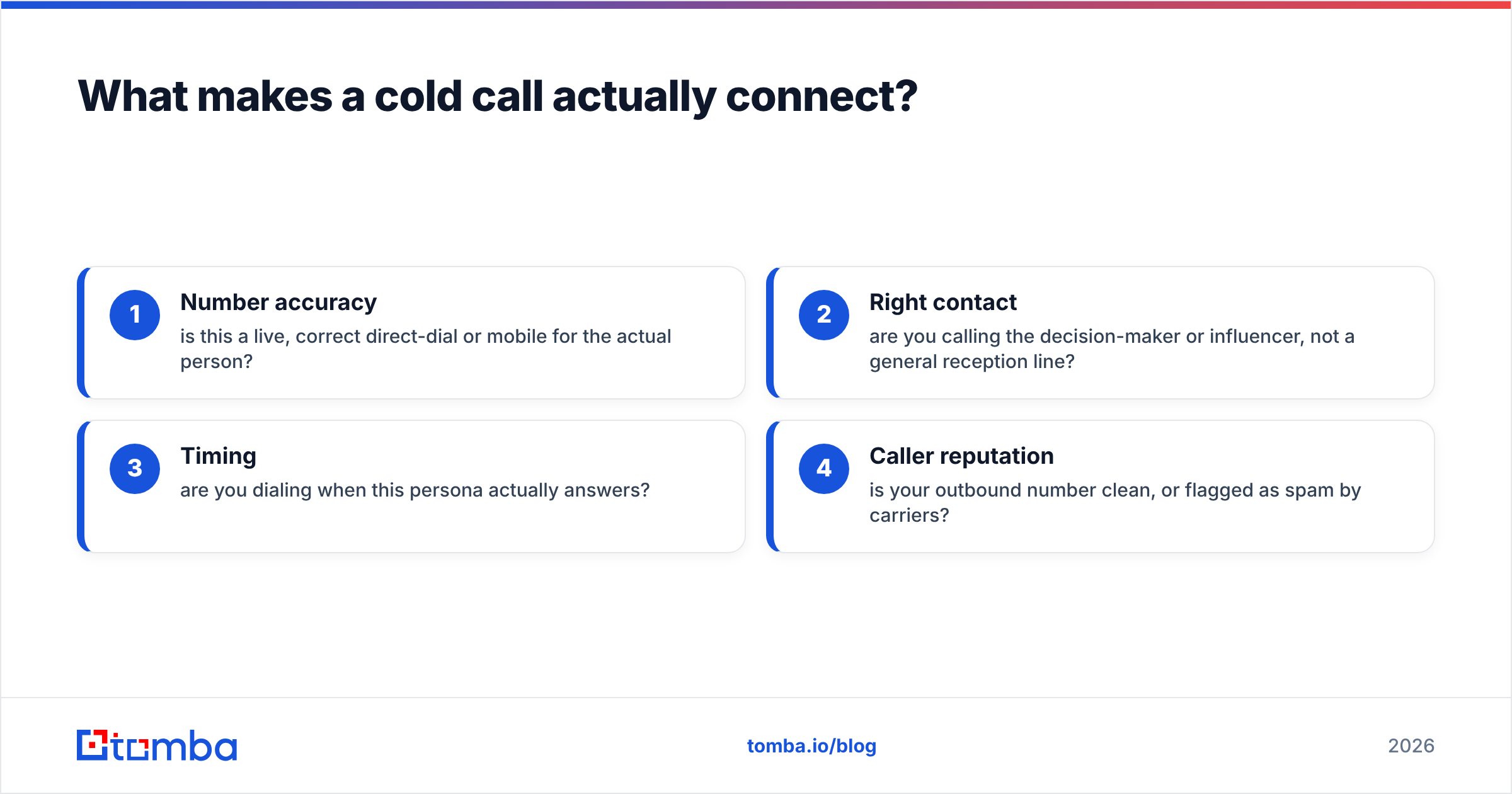
Before you obsess over your script, fix the inputs. A brilliant opener delivered to a disconnected number converts at exactly zero percent. Connect rate is a function of four things, roughly in this order of impact:
- Number accuracy - is this a live, correct direct-dial or mobile for the actual person?
- Right contact - are you calling the decision-maker or influencer, not a general reception line?
- Timing - are you dialing when this persona actually answers?
- Caller reputation - is your outbound number clean, or flagged as spam by carriers?
Most teams pour energy into item four's cousin - the pitch - while ignoring items one through three. That is backwards. Clean B2B phone numbers and correct targeting drive more lift than any clever line, because they change the denominator: how many dials even reach a human.
The connect-rate math#
Here is why data quality dominates. If your list is 60% accurate and you dial 100 numbers, 40 are dead on arrival before timing or script matter. Bump accuracy to 90% and you have effectively added 30 extra live conversations for the same effort - no new hires, no more hours.
When is the best time to cold call customers?#
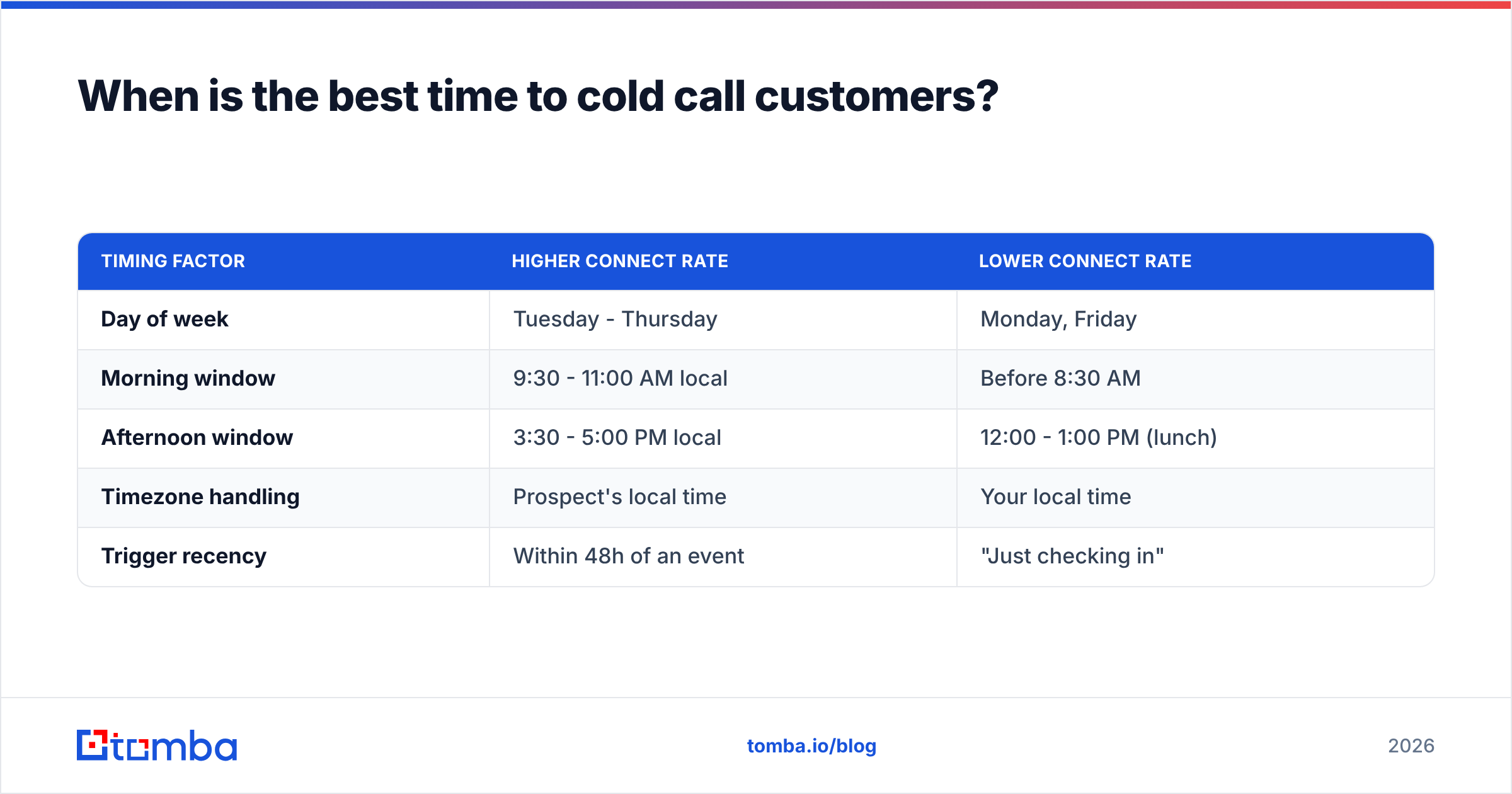
Timing is the cheapest lever you have, and most reps ignore it. Broad patterns hold across B2B datasets, though you should always validate against your own connect logs.
| Timing factor | Higher connect rate | Lower connect rate |
|---|---|---|
| Day of week | Tuesday - Thursday | Monday, Friday |
| Morning window | 9:30 - 11:00 AM local | Before 8:30 AM |
| Afternoon window | 3:30 - 5:00 PM local | 12:00 - 1:00 PM (lunch) |
| Timezone handling | Prospect's local time | Your local time |
| Trigger recency | Within 48h of an event | "Just checking in" |
Two rules matter most. First, always dial in the prospect's timezone, not yours - a 9 AM call from New York lands at 6 AM in California and torches your reputation. Second, call fast after a trigger. A congratulatory call within two days of a promotion or funding announcement is warm; the same call three weeks later is noise.
What does a good cold call script look like?#
A modern cold call script is not a monologue - it is a decision tree that earns permission at each step. Structure it in four beats:
- The opener (0 - 8 seconds). Say your name, your company in five words, and ask permission. Example: "Hi Sarah, this is Alex from Tomba. I know I'm an interruption - can I take 30 seconds to tell you why I called, and you can hang up if it's not relevant?" That pattern-interrupt honesty consistently out-performs the fake-familiar "How are you today?"
- The reason (8 - 30 seconds). Tie the call to a trigger or a specific pain. "I saw you just hired three SDRs - most teams at that stage struggle with list accuracy, and that's the exact problem we solve."
- The engagement (30 - 90 seconds). Ask one sharp diagnostic question and then shut up. Let them talk. You are qualifying, not closing.
- The close (the ask). Book a specific next step: "Does Thursday at 2 work for a 15-minute walkthrough?" Never end with "I'll send some info" - that is a soft no in disguise.
Keep the whole thing under two minutes on the first call. Your only goal is the meeting, not the sale.
Handling the three most common objections#
- "I'm busy right now." - "Totally fair. Are you the right person for [problem], and if so when's a better time - later today or tomorrow morning?" You get a callback slot and confirm you have the right contact.
- "Send me an email." - "Happy to. So I send something useful and not generic, what's the one thing that would make this worth 15 minutes?" You extract a pain point instead of getting filed under spam.
- "We already use [competitor]." - "Makes sense, they're solid. Most of the teams we talk to who switched did it because of [specific gap]. Worth a quick comparison?" You stay neutral and open a door.
How does cold calling compare to other outbound channels?#
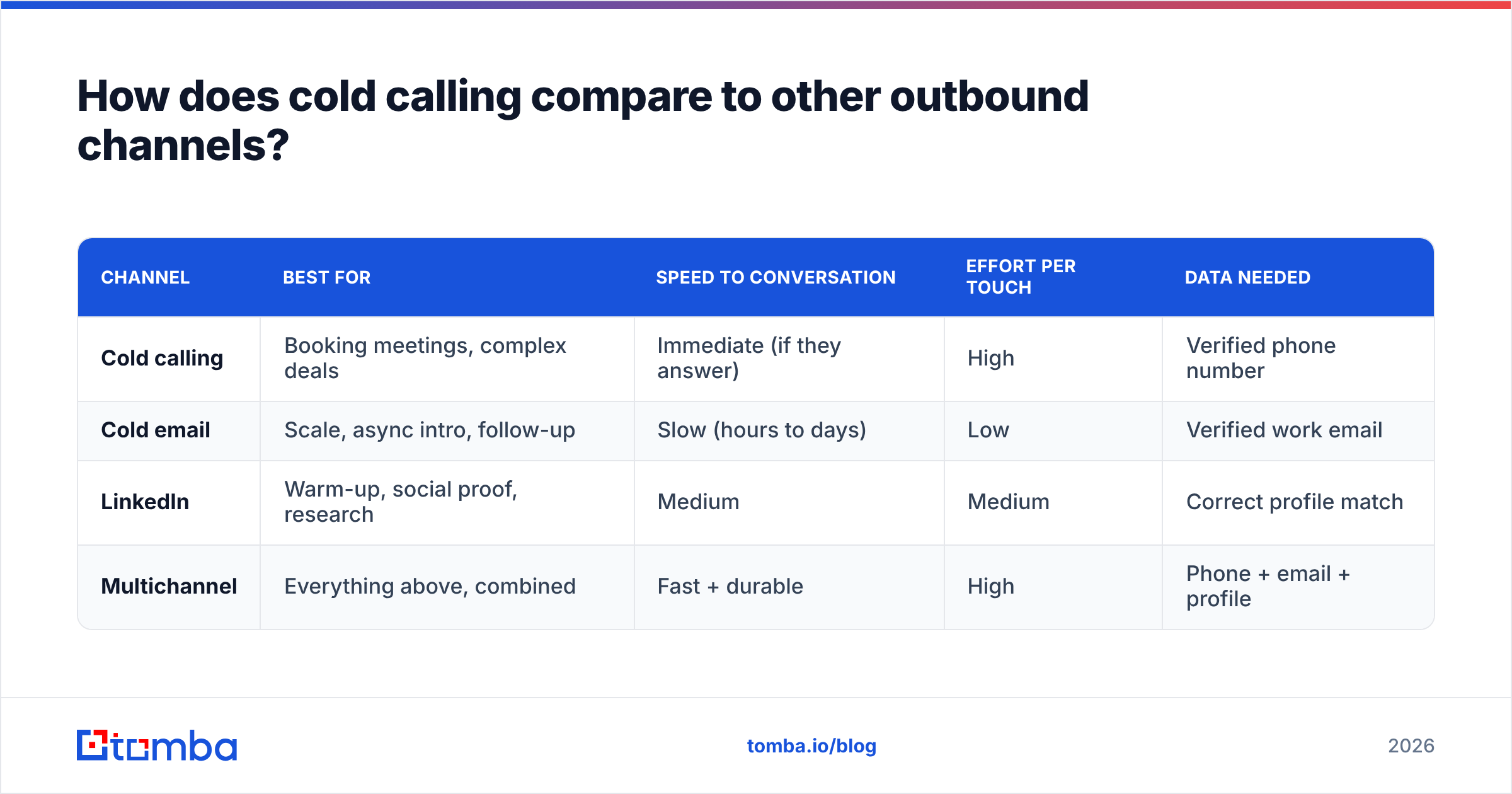
The phone is not competing with email and LinkedIn - it is compounding with them. But it helps to see the trade-offs clearly so you deploy each channel where it is strongest.
| Channel | Best for | Speed to conversation | Effort per touch | Data needed |
|---|---|---|---|---|
| Cold calling | Booking meetings, complex deals | Immediate (if they answer) | High | Verified phone number |
| Cold email | Scale, async intro, follow-up | Slow (hours to days) | Low | Verified work email |
| Warm-up, social proof, research | Medium | Medium | Correct profile match | |
| Multichannel | Everything above, combined | Fast + durable | High | Phone + email + profile |
The winning play in 2026 is a sequence, not a single channel. A typical cadence: connect on LinkedIn, send a short value email, then call while your name is still fresh, then follow up by email with the recap. Each touch raises the odds the phone gets answered because you are no longer a stranger. Track the payoff with a metric like response rate so you know which combinations actually move the needle.
What tools do you need for cold calling in 2026?#
You need three layers: a way to find and verify contacts, a way to dial efficiently, and a way to log what happened. Reviews on marketplaces like G2 can help you compare dialers and CRMs, but the layer teams most often underinvest in is the data layer - and it is the one that determines whether the other two are worth anything.
Here is how the stack breaks down and where accurate data feeds each part:
- Contact discovery - find the direct dial and mobile, not the switchboard. Tomba's phone finder surfaces B2B phone numbers tied to the right person, and its email finder covers the email leg of your multichannel cadence.
- Verification - confirm numbers and emails are live before you spend a rep's hour on them. Pairing phone data with a phone validator keeps your connect rate honest.
- Enrichment - fill in title, company size, and trigger context so your opener is specific. Tomba's data enrichment appends the fields your script relies on.
- Dialer + CRM - a power or parallel dialer to reduce idle time, and a CRM to log dispositions and callbacks.
Tomba pricing at a glance#
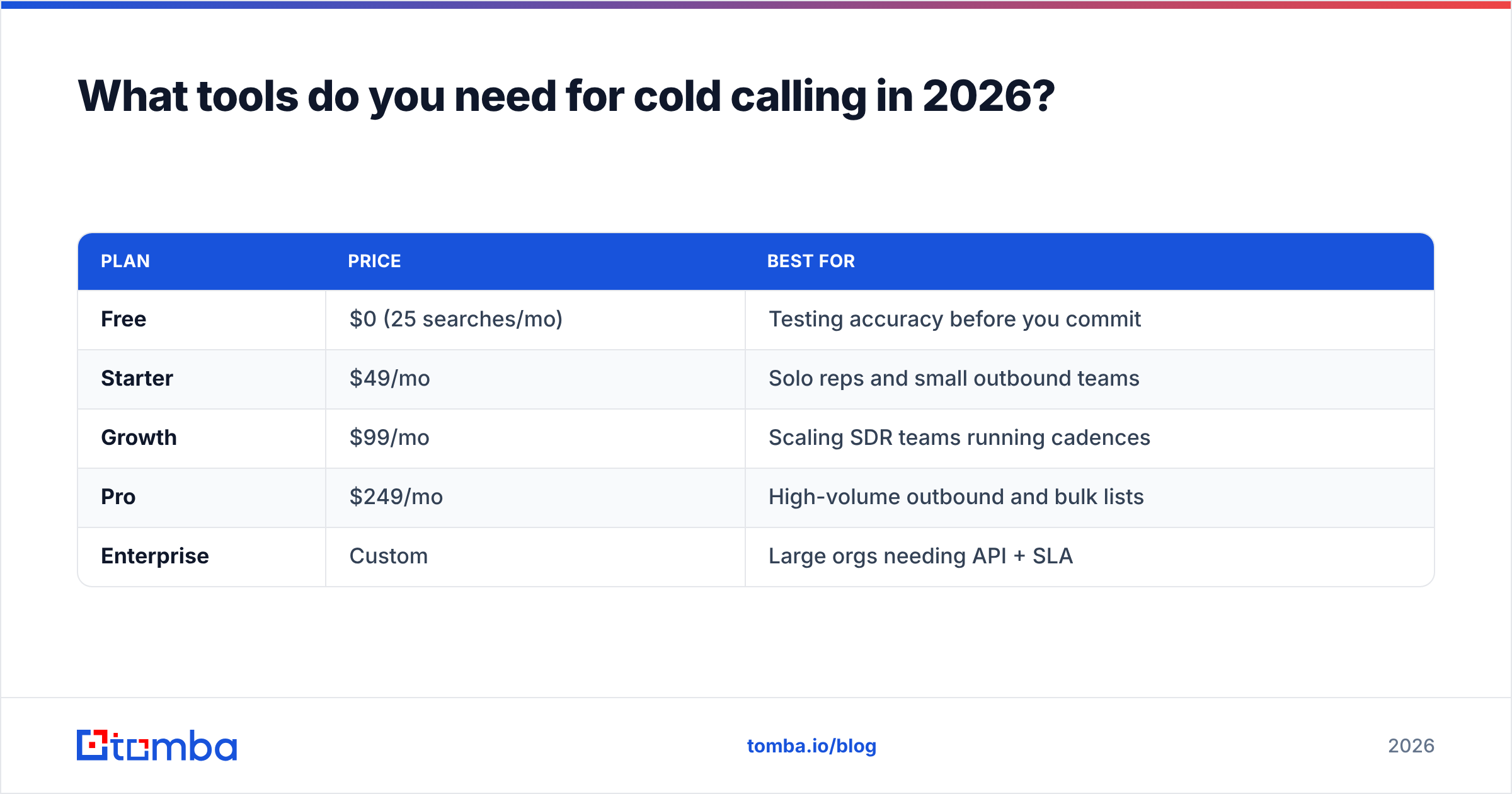
If the data layer is where you are choosing to invest, here is where Tomba sits so you can budget realistically. Full Tomba pricing is public, but the short version:
| Plan | Price | Best for |
|---|---|---|
| Free | $0 (25 searches/mo) | Testing accuracy before you commit |
| Starter | $49/mo | Solo reps and small outbound teams |
| Growth | $99/mo | Scaling SDR teams running cadences |
| Pro | $249/mo | High-volume outbound and bulk lists |
| Enterprise | Custom | Large orgs needing API + SLA |
The free tier matters more than it looks: it lets you check whether the phone and email data is accurate for your specific market before you pay a cent. Test on 25 of your real target accounts and measure the connect rate yourself.
How do you keep your cold calling list clean?#
A list decays about 2 - 3% every month as people change jobs, companies restructure, and numbers get reassigned. Left alone, a list that was 90% accurate in January is meaningfully worse by summer. Three habits keep it healthy:
- Re-verify before every campaign. Run numbers and emails through validation right before a push, not once a quarter.
- Enrich on a trigger, not a calendar. When a prospect changes roles, re-pull their new contact details instead of dialing the old dead line.
- Feed dispositions back into your data. Every "wrong number" or "no longer here" from a rep is a signal - log it and suppress it so nobody wastes a second dial.
Clean data is not a one-time purchase; it is a maintenance discipline. The teams that treat it that way keep their connect rates stable while everyone else watches theirs erode.
Cold calling customers: the honest verdict#
Cold calling in 2026 rewards precision, not volume. The rep who dials 40 verified, well-timed, well-researched numbers will out-book the rep who blasts 120 unverified ones - with less burnout and a cleaner reputation. Fix the data first, then the timing, then the script. In that order.
If you want your calls to land on live numbers held by the right people, start with the contact data. Tomba's phone finder and email finder give you verified direct dials, mobiles, and work emails so your cadence reaches humans instead of dead lines - and the free tier lets you test the accuracy on your own target list before you scale. Stop dialing into the void. Give your reps numbers worth calling.
Related guides#
Ready to find emails that actually work?
Join 150,000+ professionals who stopped guessing and started sending. Free credits on signup — no credit card required.
Get the Tomba newsletter
Practical outbound tactics and product updates — once every two weeks.
About the author