Cold Calling and Email: The 2026 Playbook to Book More Meetings
Cold calling and cold email each fail on their own. Here's how top reps in 2026 combine both into one sequence — with timing, scripts, and the data workflow that makes it work.
Cold calling is not dead, and cold email is not dead. What is dead is running either one in isolation and hoping volume covers for bad targeting. The reps hitting quota in 2026 stopped arguing about which channel wins and started stitching them into a single, coordinated sequence.
This guide shows you how a cold calling email motion actually works: when to dial, when to send, what to say in each, and the data workflow that keeps the whole thing from collapsing under bad phone numbers and bounced addresses.
TL;DR#
- Neither channel wins alone. Call-only reps burn hours on voicemail; email-only reps drown in the inbox. Combined sequences book more meetings than either does solo.
- Sequence beats spray. A structured call → email → call → email cadence over 12–15 business days outperforms random touches.
- Data quality is the real bottleneck. A perfect script fails against a wrong number or a bounced email. Verified contact data does more for connect rates than any tweak to your opener.
- The email references the call, and the call references the email. Cross-channel continuity is what makes prospects remember you.
- Tools matter. You need an accurate way to find and verify both emails and phone numbers before the sequence starts.
Why do cold calling and cold email work better together?#
Because they cover each other's weak spots. A cold call demands attention in real time but only connects 5–15% of the time. A cold email reaches the inbox nearly every time but is easy to ignore. Run them together and the email warms up the call, while the call gives the email a reason to exist.
Think of it like a restaurant reservation. The email is the online booking that puts you on the radar; the call is the host walking over to greet you by name. Neither replaces the other — together they make the experience feel intentional.
Data backs this up. Sales teams that coordinate multiple channels in one cadence consistently report higher reply and meeting rates than single-channel teams, a pattern documented across outbound research from vendors like Gong and HubSpot. The mechanism is simple: repetition across formats builds familiarity, and familiarity lowers the resistance that kills first-touch outreach.
What does a cold calling email sequence look like?#
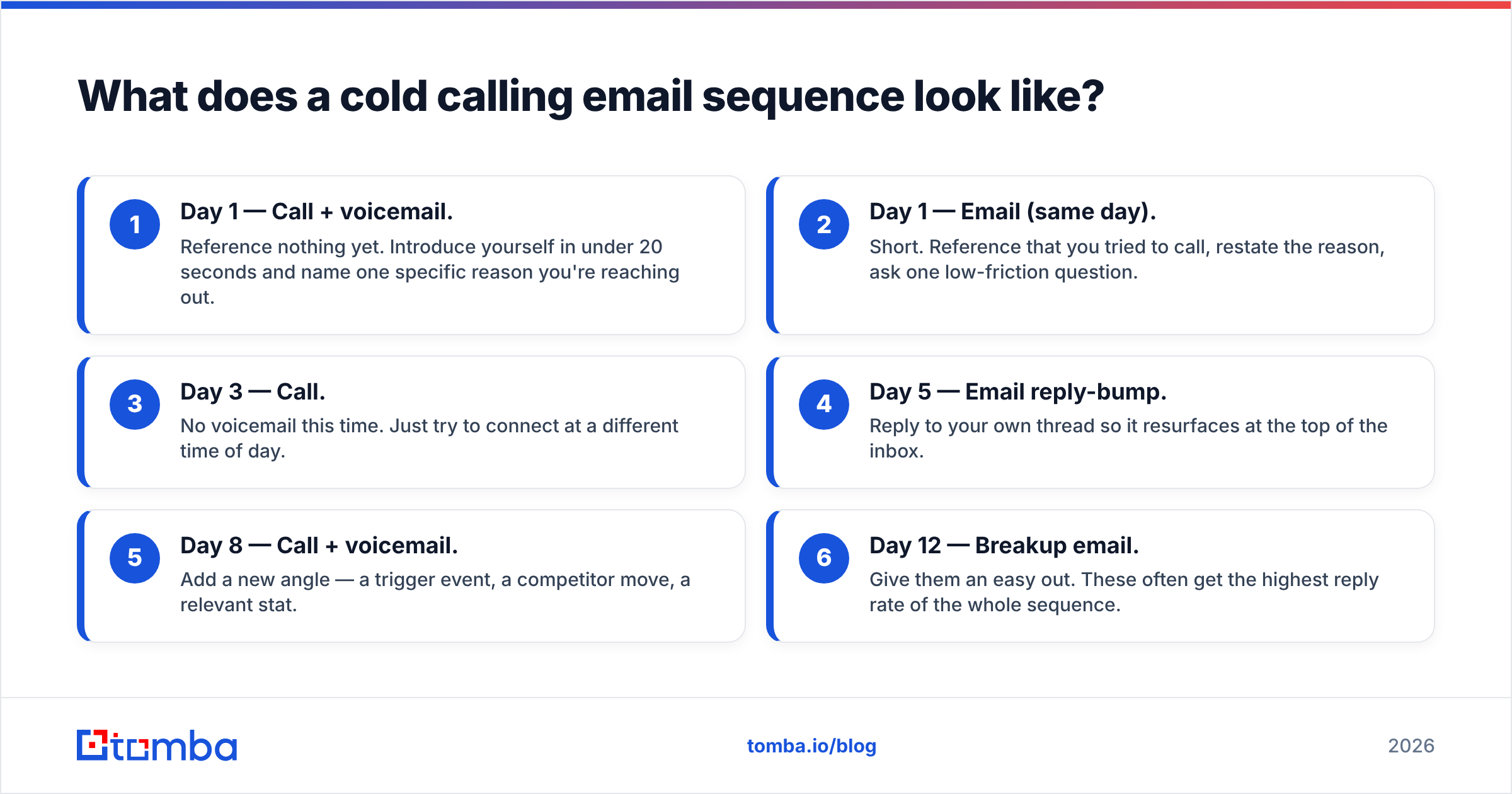
A good sequence is a fixed schedule of touches, not a pile of random attempts. Here is a proven 12-business-day shape you can adapt:
- Day 1 — Call + voicemail. Reference nothing yet. Introduce yourself in under 20 seconds and name one specific reason you're reaching out.
- Day 1 — Email (same day). Short. Reference that you tried to call, restate the reason, ask one low-friction question.
- Day 3 — Call. No voicemail this time. Just try to connect at a different time of day.
- Day 5 — Email reply-bump. Reply to your own thread so it resurfaces at the top of the inbox.
- Day 8 — Call + voicemail. Add a new angle — a trigger event, a competitor move, a relevant stat.
- Day 12 — Breakup email. Give them an easy out. These often get the highest reply rate of the whole sequence.
Notice that the call and the email are never strangers to each other. Each references the last touch. That continuity is the entire point of a cold calling email approach — the prospect should feel one coherent person is reaching out, not a machine firing at random.
Cold calling vs. cold email: which channel does what?#
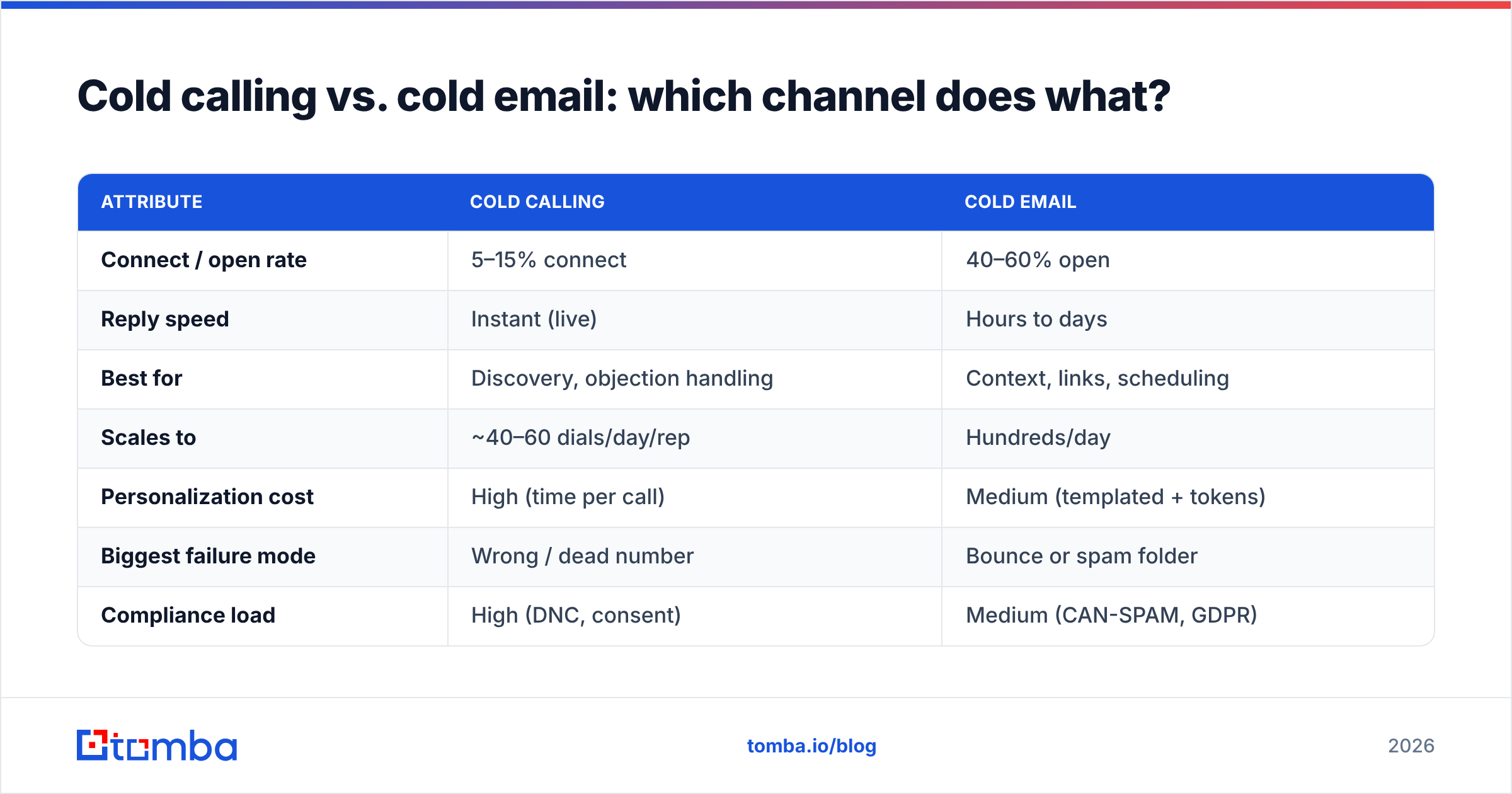
Neither is universally better; they carry different jobs inside the same sequence. Here's how they stack up.
| Attribute | Cold Calling | Cold Email |
|---|---|---|
| Connect / open rate | 5–15% connect | 40–60% open |
| Reply speed | Instant (live) | Hours to days |
| Best for | Discovery, objection handling | Context, links, scheduling |
| Scales to | ~40–60 dials/day/rep | Hundreds/day |
| Personalization cost | High (time per call) | Medium (templated + tokens) |
| Biggest failure mode | Wrong / dead number | Bounce or spam folder |
| Compliance load | High (DNC, consent) | Medium (CAN-SPAM, GDPR) |
The takeaway: use email to deliver context and calls-to-action at scale, and use calls to create the human moments where deals actually start. When one channel stalls, the other keeps the prospect warm.
How much does contact data quality actually matter?#
More than your script, your timing, or your subject line combined. You can run a flawless sequence and still get zero meetings if the phone numbers ring dead and the emails bounce.
Do the math. If 30% of your list has a wrong number and 20% of your emails bounce, you've quietly deleted a third to half of your pipeline before the first hello. Worse, high bounce rates tank your sender reputation, which drags down deliverability for the addresses that were valid. Bad data doesn't just waste the bad records — it poisons the good ones.
This is where the workflow, not the wording, decides your results:
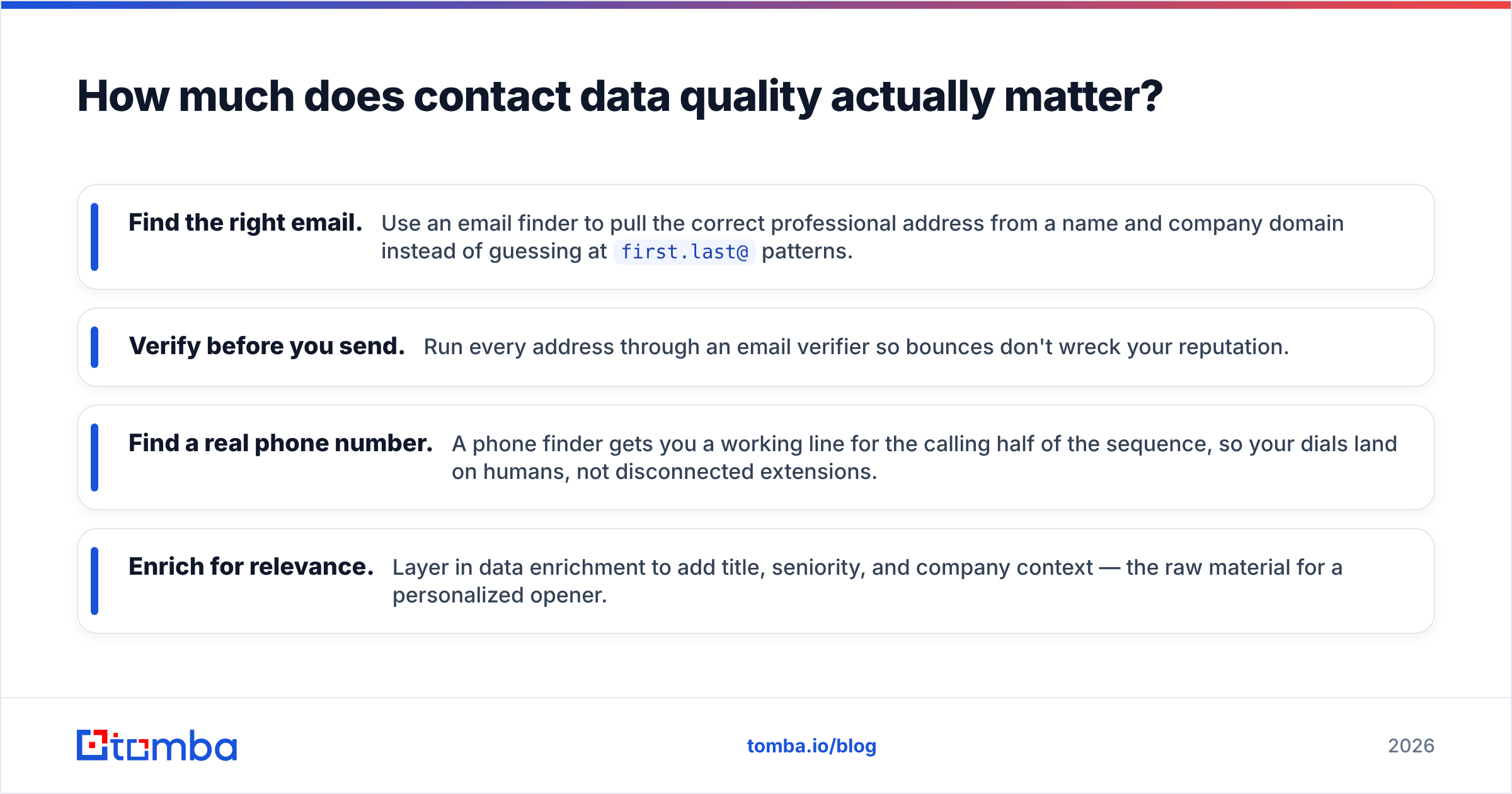
- Find the right email. Use an email finder to pull the correct professional address from a name and company domain instead of guessing at
first.last@patterns. - Verify before you send. Run every address through an email verifier so bounces don't wreck your reputation.
- Find a real phone number. A phone finder gets you a working line for the calling half of the sequence, so your dials land on humans, not disconnected extensions.
- Enrich for relevance. Layer in data enrichment to add title, seniority, and company context — the raw material for a personalized opener.
What should you actually say on the call and in the email?#
Keep both short and make them talk to each other. Here are lean templates you can lift.
Cold call opener (under 20 seconds):
"Hi [Name], it's [You] from [Company]. I'll be quick — I'm reaching out because [specific trigger, e.g. 'I saw you're hiring three SDRs this quarter']. Teams in that spot usually run into [problem]. Is that on your radar right now, or am I off base?"
The "am I off base?" gives them permission to say no, which paradoxically keeps more of them talking.
Same-day follow-up email:
Subject: tried calling — [company] + [problem]
Hi [Name],
Just left you a voicemail. Reaching out because [same trigger]. We help teams like yours [one-line outcome], and a 15-minute call is usually enough to know if it's relevant.
Worth a quick look next week?
[You]
Breakup email (Day 12):
Subject: closing the loop
Hi [Name], I haven't heard back, so I'll assume the timing's off — no problem. If [problem] becomes a priority later, just reply here and I'll pick it right back up. All the best.
Every message stays under 90 words, references the channel before it, and ends with exactly one ask. That discipline is what separates a sequence from noise. For more reusable frames, a library of cold email templates can save you from rewriting the same email twenty times.
How do you scale this without becoming a robot?#
Batch the mechanical work and reserve your energy for the human work. The finding, verifying, and enriching should be automated up front; the calls and the personalized first line should be yours.
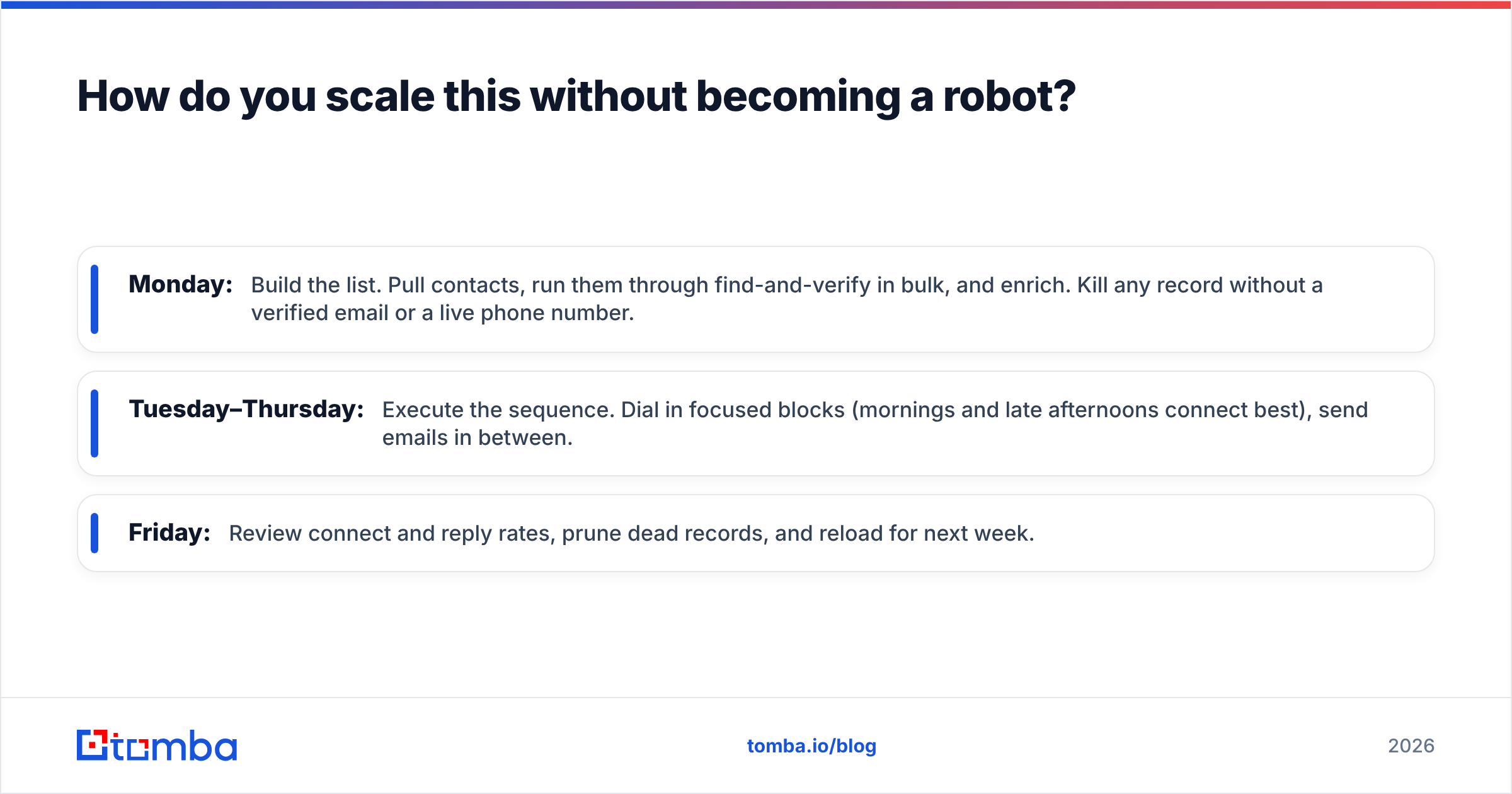
A practical weekly rhythm:
- Monday: Build the list. Pull contacts, run them through find-and-verify in bulk, and enrich. Kill any record without a verified email or a live phone number.
- Tuesday–Thursday: Execute the sequence. Dial in focused blocks (mornings and late afternoons connect best), send emails in between.
- Friday: Review connect and reply rates, prune dead records, and reload for next week.
The reps who sound human at scale are not writing every word from scratch — they're spending zero time on data hygiene because they front-loaded it. If you're deciding between tools, compare Tomba pricing against dedicated single-purpose finders and verifiers; a combined email-plus-phone platform usually beats stitching three subscriptions together. And if you already know the phone-heavy side of your motion is strong, doubling down on data quality is still the highest-leverage change you can make, a point echoed in Salesforce's own sales-productivity research.
What mistakes kill a cold calling email sequence?#
- Treating channels as separate campaigns. If your email never mentions the call, you've thrown away the compounding effect.
- Skipping verification. One in five unverified addresses bounces on average — send anyway and you're gambling your domain.
- Over-templating the opener. The body can be templated; the first sentence should prove you know who they are.
- Giving up too early. Most meetings come from touches 4 through 7, yet most reps quit at 2.
- Calling and emailing at random times. A schedule you can measure beats inspiration you can't.
Fix these five and your meeting rate climbs before you ever touch your script wording.
Frequently asked questions#
Is cold calling still effective in 2026? Yes, when it's paired with email and backed by accurate numbers. Call-only motions struggle, but calls inside a multi-touch sequence remain one of the fastest ways to reach a live human.
Should I call or email first? Call first, then email the same day referencing the call. The voicemail primes them; the email gives them a written record and an easy way to reply.
How many touches before I stop? Plan for 6–8 touches across 12–15 business days. Meetings cluster in the middle of the sequence, so quitting early is the most common self-inflicted wound.
How do I keep emails out of spam? Verify every address before sending, warm up your domain, and keep volume steady. Clean lists protect deliverability more than any single tactic.
Start with data, not with a script#
The fastest way to lift your meeting rate isn't a cleverer opener — it's a list where every email is verified and every phone number is live. Get that right and both channels start working the way they're supposed to.
Tomba's Email Finder gives you accurate professional emails by name, company, or domain, with verification built in — so your cold calling email sequence launches from clean data instead of guesses. Start on the free tier (25 searches a month), or step up to the Starter plan at $49/mo when you're ready to scale your outbound without scaling your bounce rate. Build the list once, run the sequence right, and let the calls and emails do what they each do best.
Related guides#
Ready to find emails that actually work?
Join 150,000+ professionals who stopped guessing and started sending. Free credits on signup — no credit card required.
Get the Tomba newsletter
Practical outbound tactics and product updates — once every two weeks.
About the author