Cold Calling Executives in 2026: The Complete Playbook
Executives still pick up the phone in 2026 — if you earn the first eight seconds. Here's the research-backed playbook for scripts, timing, gatekeepers, and the data that gets you a direct line to the C-suite.
Cold calling executives is not dead — it's just unforgiving. The margin for error when you dial a VP of Engineering or a CFO is measured in seconds, and most reps burn those seconds on a script the executive has heard a thousand times. This is a working playbook for getting senior decision-makers to stay on the line and book the next meeting.
TL;DR#
- Executives answer more than you think — roughly 57% of C-level buyers prefer a phone conversation early in the process, higher than directors or managers.
- The first 8 seconds decide everything. Lead with a permission-based opener and a reason that maps to their P&L, not your feature list.
- Timing beats volume. Early mornings, late afternoons, and the gaps around calendar blocks outperform the 10 a.m. call-blitz everyone runs.
- Bad data kills senior outreach. A wrong number or an outdated title torches your credibility before you speak. Verify the direct line first.
- Multichannel is the multiplier. Pair the call with a LinkedIn touch and a short email so the dial lands warm, not cold.
Does cold calling executives still work in 2026?#
Yes — but only for reps who treat it as a precision channel, not a numbers game. The data has been remarkably stable: senior buyers still take calls, and many prefer them for the first substantive conversation. According to HubSpot's sales research, a majority of buyers want to hear from vendors by phone, and that preference rises with seniority. Executives are time-poor, not phone-averse. A five-minute call that respects their time is often faster for them than a 12-email thread.
What has changed is the tolerance for waste. An executive will forgive a nervous rep with a sharp point of view. They will not forgive a rep who mispronounces their name, cites a competitor's product as their own, or dials a number that rings a former assistant's desk. The bar is a data bar as much as a skills bar.

The reps who still win with executive cold calls share three traits: they research before they dial, they open with relevance instead of rapport-faking, and they work from verified contact data so every dial reaches a real, current line.
Why is calling the C-suite different from calling a manager?#
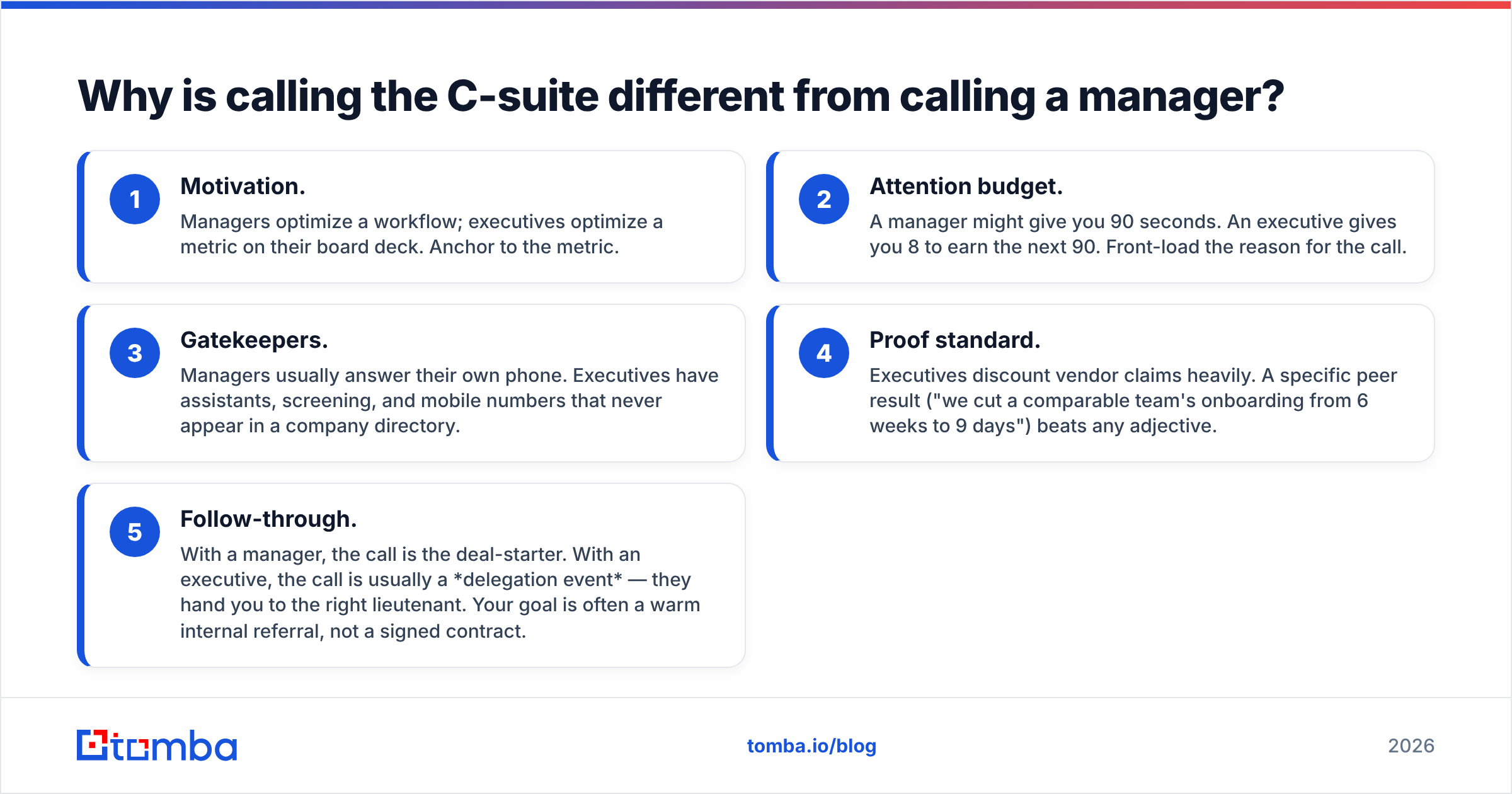
Because the stakes, the framing, and the gatekeepers are different. A manager buys a tool. An executive buys an outcome — revenue, risk reduction, headcount efficiency. If your opener talks about features, you've already signaled you're calling the wrong level.
Here's how the two motions actually diverge:
- Motivation. Managers optimize a workflow; executives optimize a metric on their board deck. Anchor to the metric.
- Attention budget. A manager might give you 90 seconds. An executive gives you 8 to earn the next 90. Front-load the reason for the call.
- Gatekeepers. Managers usually answer their own phone. Executives have assistants, screening, and mobile numbers that never appear in a company directory.
- Proof standard. Executives discount vendor claims heavily. A specific peer result ("we cut a comparable team's onboarding from 6 weeks to 9 days") beats any adjective.
- Follow-through. With a manager, the call is the deal-starter. With an executive, the call is usually a delegation event — they hand you to the right lieutenant. Your goal is often a warm internal referral, not a signed contract.
Once you internalize that an executive call is about earning a relevant next step, the whole script changes.
What does a strong executive cold call script look like?#
Permission-based, specific, and short. The classic structure that still converts:
1. The pattern-interrupt opener (0–8 sec). Skip "How are you today?" Executives know it's a script. Try: "Hi Dana, this is Alex with [Company] — I know I'm an interruption. Can I take 30 seconds to tell you why I called, and you can tell me to get lost?" The honesty and the explicit out lower their guard.
2. The relevance hook (8–30 sec). One sentence tying your reason to their world: "We work with three other CFOs in medical devices who were closing the books in 11 days and wanted it under 5." Notice: peer, industry, metric, no product name yet.
3. The permission question. "Is that a priority for you this year, or am I off base?" You want a real answer. If it's off base, you've saved you both time.
4. The single ask. Not a demo. A next step sized to their calendar: "Worth 15 minutes next week to compare notes?"
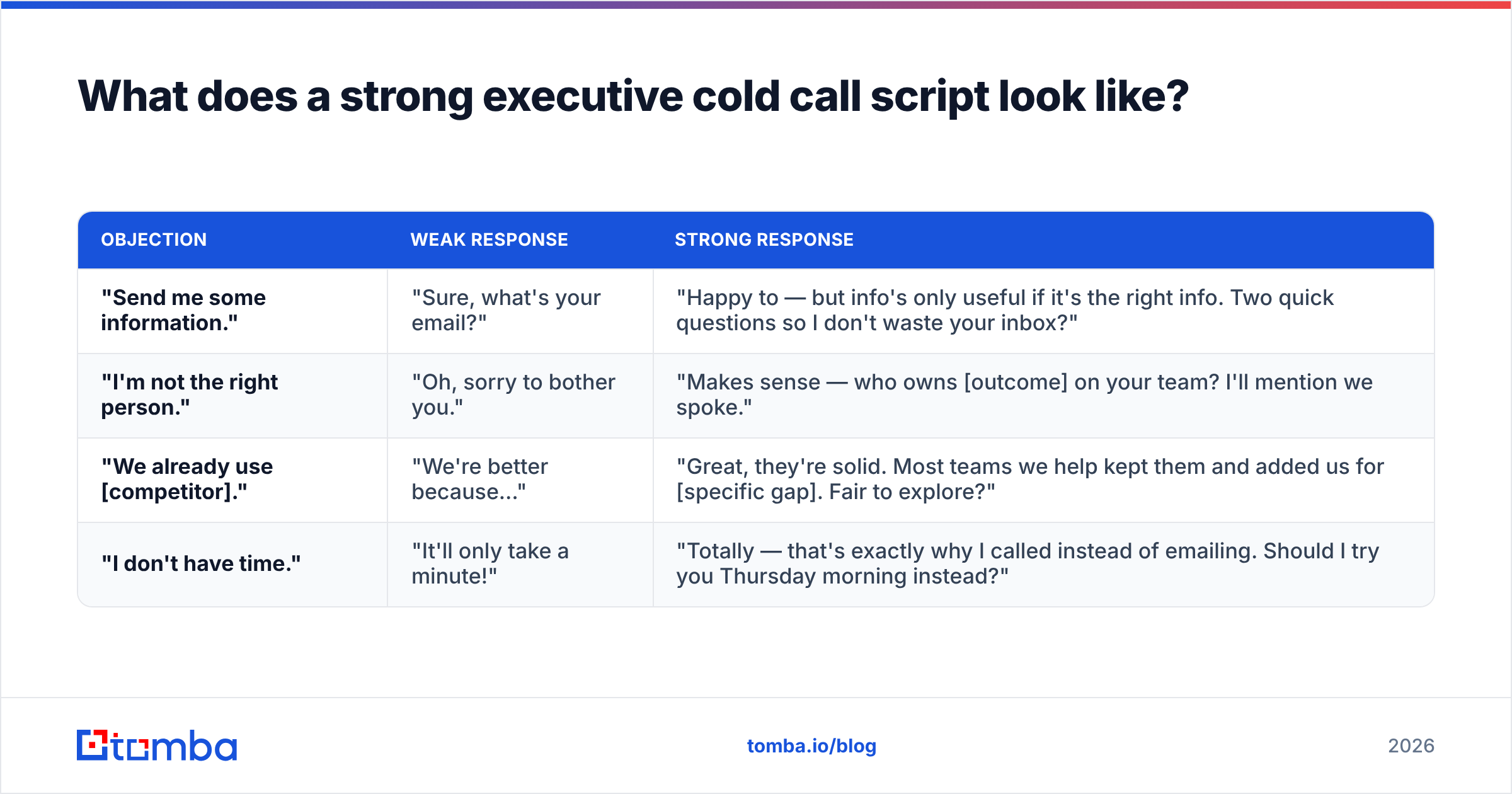
Keep a one-page objection map next to you. The three you'll hear most from executives:
| Objection | Weak response | Strong response |
|---|---|---|
| "Send me some information." | "Sure, what's your email?" | "Happy to — but info's only useful if it's the right info. Two quick questions so I don't waste your inbox?" |
| "I'm not the right person." | "Oh, sorry to bother you." | "Makes sense — who owns [outcome] on your team? I'll mention we spoke." |
| "We already use [competitor]." | "We're better because…" | "Great, they're solid. Most teams we help kept them and added us for [specific gap]. Fair to explore?" |
| "I don't have time." | "It'll only take a minute!" | "Totally — that's exactly why I called instead of emailing. Should I try you Thursday morning instead?" |
The pattern: never argue, always convert the objection into a next step or a referral.
When is the best time to cold call executives?#
Around the edges of their day, not the middle. Executives protect their mid-morning and mid-afternoon for meetings and deep work. The openings tend to be:
- 7:45–8:45 a.m. — before the first meeting block, often when they're at their desk with coffee and no assistant screening yet.
- 11:30 a.m.–12:15 p.m. — the pre-lunch gap.
- 4:30–6:00 p.m. — after the last meeting, when the day loosens and they answer their own phone.
Day of week matters less than most "best day to cold call" listicles claim, but mid-week (Tuesday–Thursday) remains the safe default. The bigger lever is cadence discipline: a study cited by Gartner shows buyers engage far more with sellers who deliver relevant, well-timed touches than with those who simply dial more. Volume without timing is noise.
One practical rule: call the mobile before the office line when you have it. A verified direct or mobile number bypasses the switchboard entirely — which is where most executive calls die.
How do you get past the gatekeeper?#
Treat the gatekeeper as an ally, not an obstacle. Executive assistants control access precisely because they filter out low-value noise. Give them a reason to pass you through.
- Be transparent. "Hi, I'm hoping you can help me — I'm trying to reach Dana about [outcome]. Is she the right person, or should I be talking to someone else?" Assistants respect directness and route you correctly.
- Use the name and the reason. Vague ("Is the CFO available?") gets screened. Specific and human gets a fair hearing.
- Ask for help, not access. "What's the best way to get 15 minutes on her calendar?" turns the gatekeeper into a scheduler.
- Never lie about knowing them. "She's expecting my call" when she isn't ends the relationship on contact.
But the most reliable way past the gatekeeper is not to go through the front desk at all. If you have the executive's verified direct line or mobile, you skip the filter. That's a data problem, and it's solvable.
Why does data quality make or break executive outreach?#
Because one bad dial with a senior buyer costs you the relationship, not just the call. Reach a CFO with the wrong name or a dead number and you've confirmed their suspicion that vendors are careless. Reach the right person on the right line with a relevant reason and you've earned a hearing.
Two data failures sink executive cold calls specifically:
- Stale titles. Executives move. The "VP of Sales" from your list left nine months ago; you're now pitching their replacement's predecessor's problem.
- Wrong numbers. Main switchboards, disconnected lines, and reassigned extensions waste dials and destroy your talk-time-to-connect ratio.
This is where verified B2B contact data earns its keep. A phone finder surfaces direct-dial and mobile numbers tied to the actual current decision-maker, and a phone validator confirms the line is live before you burn a dial on it. Layer in data enrichment to keep titles and roles current, and your list stops fighting you. Tools like this don't replace calling skill — they make sure your skill lands on a real person who's still in the seat.
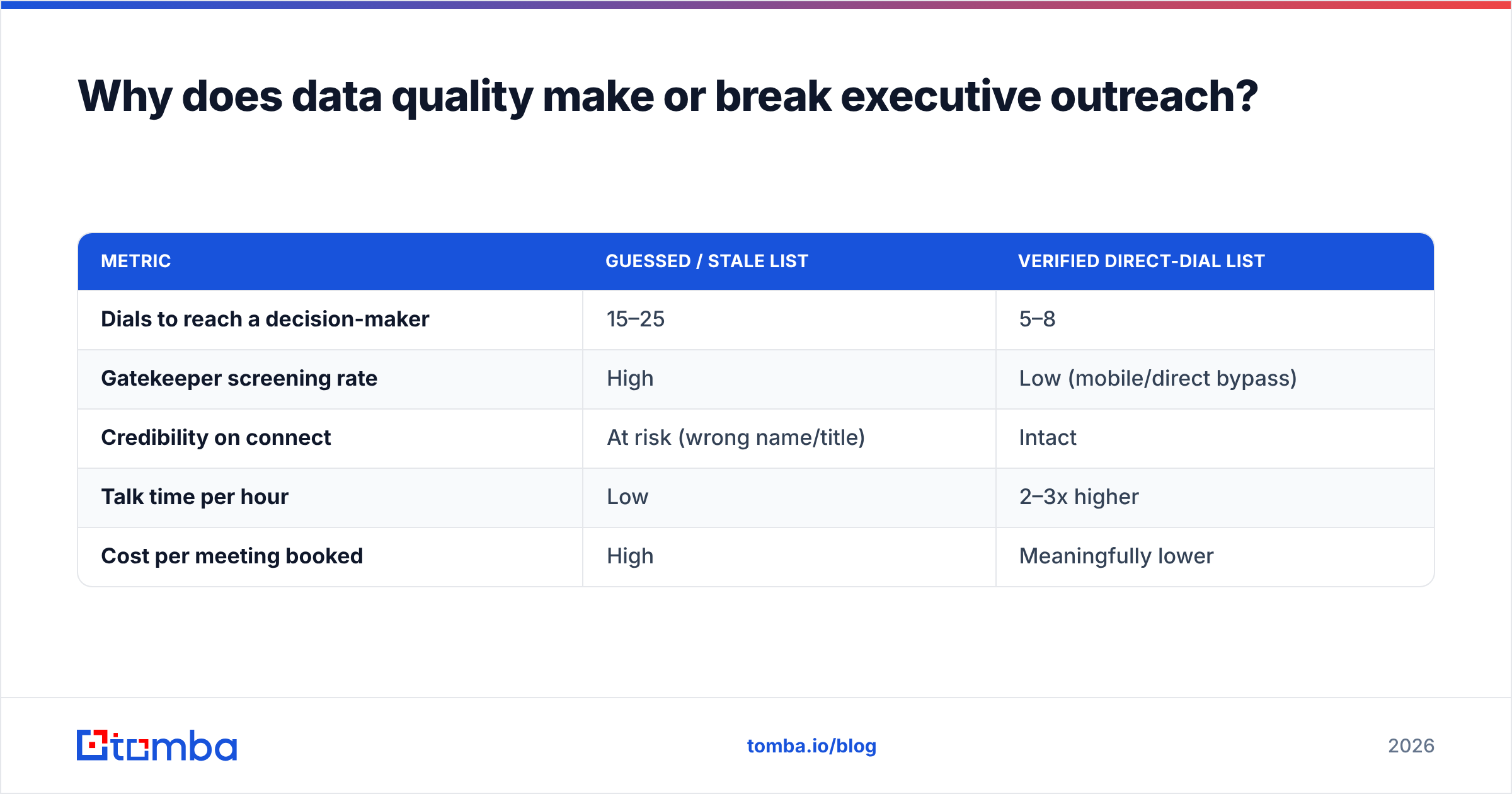
Here's how the connect economics compare when your data is clean versus guessed:
| Metric | Guessed / stale list | Verified direct-dial list |
|---|---|---|
| Dials to reach a decision-maker | 15–25 | 5–8 |
| Gatekeeper screening rate | High | Low (mobile/direct bypass) |
| Credibility on connect | At risk (wrong name/title) | Intact |
| Talk time per hour | Low | 2–3x higher |
| Cost per meeting booked | High | Meaningfully lower |
The math is simple: fewer dials to a real person means more conversations per hour, and executive selling is entirely a function of quality conversations.
Should you pair cold calls with other channels?#
Always. A cold call that lands after a light LinkedIn touch and a two-line email connects at a far higher rate than a truly cold dial. The executive has seen your name; the call now has context.
A clean three-touch sequence over a week:
- Day 1 — LinkedIn. A short, no-pitch connection note referencing a specific trigger (funding, hire, product launch). See our primer on LinkedIn outreach for framing that doesn't read as automated spam.
- Day 3 — Email. Three sentences: the peer result, the relevance question, one soft ask.
- Day 5 — Call. Now the opener changes: "Dana, I sent a note earlier this week about [outcome] — figured a quick call beat another email."
The call is no longer cold. It's the third impression, and third impressions convert. Multichannel also respects the reality that executives process information differently — some read, some talk, some skim LinkedIn between meetings. Cover the channels and let them choose.
What tools actually help you call executives?#
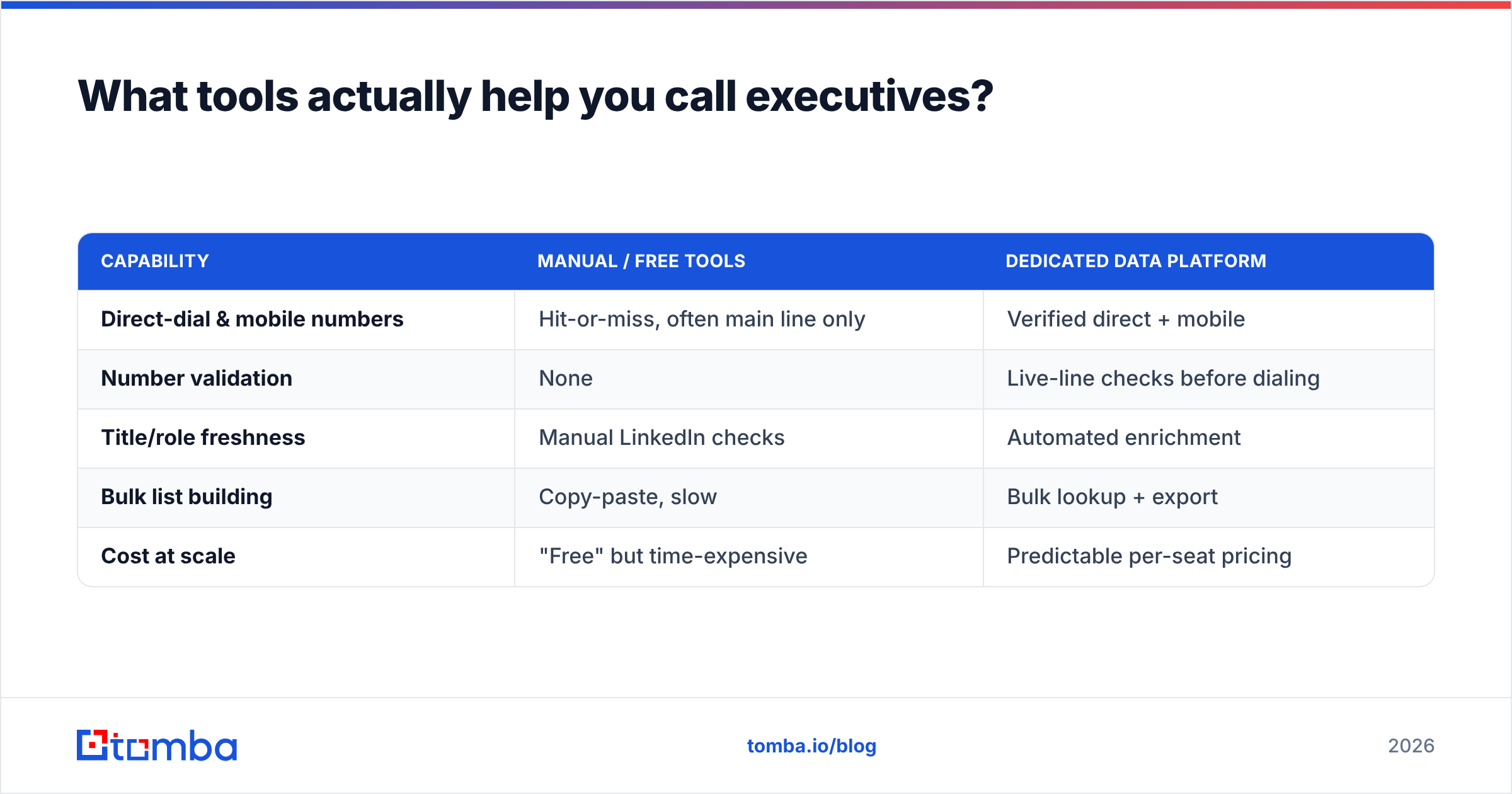
You need three capabilities: find the right person, verify the line, and stay organized. You can stitch these from point tools or run them from one contact-data layer. Compare the practical options:
| Capability | Manual / free tools | Dedicated data platform |
|---|---|---|
| Direct-dial & mobile numbers | Hit-or-miss, often main line only | Verified direct + mobile |
| Number validation | None | Live-line checks before dialing |
| Title/role freshness | Manual LinkedIn checks | Automated enrichment |
| Bulk list building | Copy-paste, slow | Bulk lookup + export |
| Cost at scale | "Free" but time-expensive | Predictable per-seat pricing |
For most teams, the tradeoff tips toward a platform the moment calling becomes a real motion rather than an occasional experiment. Tomba's contact stack — phone finder, phone validation, and data enrichment — is built to feed a dialer with current, verified executive contacts, and you can review Tomba pricing to size it against your call volume. If you want to compare approaches broadly, G2's sales intelligence category is a fair, vendor-neutral starting point.
What mistakes get executives to hang up?#
The fast ways to lose a senior buyer, ranked by how often reps commit them:
- Fake rapport. "How's your day going?" from a stranger reads as a script. Skip it.
- Pitching features before relevance. They don't care what it does until they believe it's for them.
- No clear ask. Rambling without a next step forces them to end the call for you.
- Reading a script robotically. Executives can hear a teleprompter. Internalize the structure, then talk like a human.
- Bad data tells. Mispronouncing the name or citing a wrong company detail signals you didn't do the work.
- Not qualifying out. Chasing an executive who told you it's not a priority wastes both of you and burns future goodwill.
Avoid those six and you're already ahead of most of the reps dialing the same list.
The bottom line#
Cold calling executives works in 2026 for reps who earn the first eight seconds, lead with relevance, respect the gatekeeper, and — critically — dial verified numbers tied to the person who actually holds the budget. The skill and the data are inseparable: the best script in the world fails on a dead line, and a perfect direct-dial is wasted on a rep with nothing relevant to say.
Fix the data half first, because it's the fastest win. Start by building a clean, verified list of the executives you actually want to reach with the Tomba Email Finder and its companion phone and enrichment tools — so every dial reaches a real decision-maker on a live line, with a current title and a reason to keep listening. Then go make the call worth their eight seconds.
Related guides#
// get started
Find, verify and enrich your first contacts today
Start on the free plan with 25 searches a month, then scale when your team is ready.
Free plan · No credit card required · GDPR & CCPA
// about the author