Cold Calling Gatekeeper: How to Get Past Them in 2026
The gatekeeper isn't your enemy — they're a filter. Here's how to earn respect, get transferred, and stop wasting dials on dead ends in 2026.
Cold Calling Gatekeeper: How to Get Past Them in 2026
TL;DR
- A cold calling gatekeeper — receptionist, EA, or IVR menu — exists to protect your prospect's time, not to ruin your day. Treat them as an ally and your transfer rate climbs.
- The reps who "get past" gatekeepers rarely trick them. They sound like a peer, ask for help, and give a crisp reason to connect.
- Scripts matter, but the bigger lever is calling the right number. A verified direct dial skips the gate entirely.
- Manipulation tactics (fake urgency, pretending you already know the exec) burn trust and get you flagged. They don't scale.
- Pair a respectful phone approach with accurate contact data so you spend dials on real, reachable decision-makers.
Cold calling is not dead, but the wall in front of your prospect has gotten smarter. In 2026, a gatekeeper might be a human receptionist, an executive assistant screening on behalf of three VPs, or an automated menu that loops you back to "press 0." Getting through consistently is less about a magic line and more about a repeatable system. This guide covers both the human psychology and the data mechanics that decide whether you get transferred or dismissed.
What is a cold calling gatekeeper?#
A cold calling gatekeeper is any person or system that stands between you and the decision-maker you want to reach. Their job is to filter interruptions so the person behind them can focus. Think of the gatekeeper as the bouncer at a members' club: they are not personally against you, but they will absolutely stop anyone who can't quickly show they belong inside.
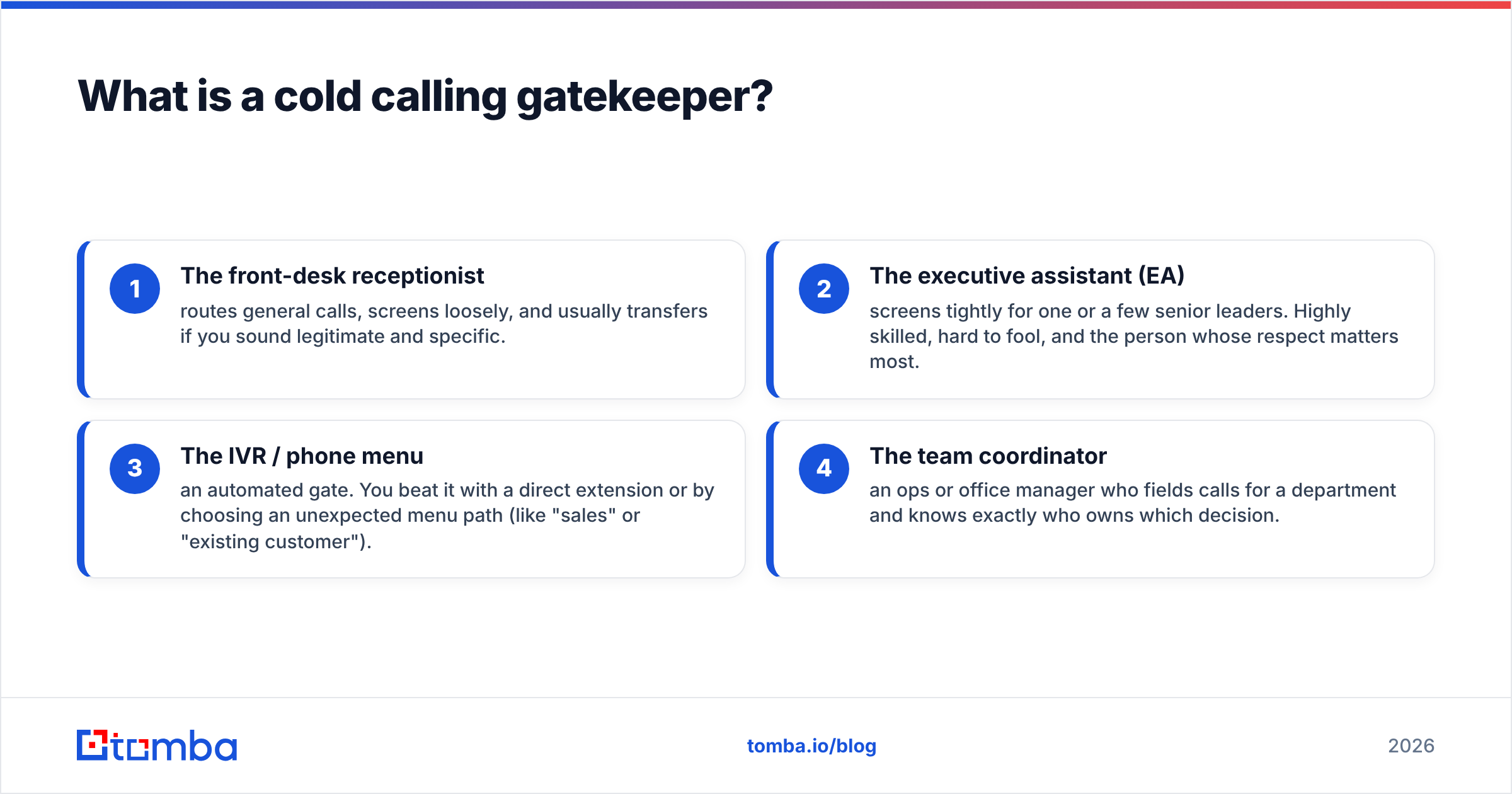
Gatekeepers come in a few common forms:
- The front-desk receptionist — routes general calls, screens loosely, and usually transfers if you sound legitimate and specific.
- The executive assistant (EA) — screens tightly for one or a few senior leaders. Highly skilled, hard to fool, and the person whose respect matters most.
- The IVR / phone menu — an automated gate. You beat it with a direct extension or by choosing an unexpected menu path (like "sales" or "existing customer").
- The team coordinator — an ops or office manager who fields calls for a department and knows exactly who owns which decision.
Understanding which type you're facing changes your approach. You don't talk to a seasoned EA the way you talk to a temp covering the front desk. Misreading the gate is the most common reason a good pitch never reaches a human who can say yes.
Why do so many reps fail at the gatekeeper?#
Most reps fail because they signal "salesperson" in the first three seconds. Gatekeepers screen dozens of pitches a week, and they pattern-match fast. The tell-tale signals — an over-friendly "Hi, how are you today?", a fumbled company name, or asking "Who handles your marketing?" — trigger an instant block.
The other failure mode is treating the gatekeeper as an obstacle to defeat rather than a person to work with. Adversarial energy is contagious. If you sound like you're trying to sneak past, they dig in. According to sales research aggregated on G2, connect rates on cold calls have declined as buyers and their teams get better at filtering, which means the margin for sounding "off" is thinner than ever.
Here's the honest reframe: the gatekeeper is doing exactly what a good employee should. Your task isn't to beat them. It's to give them enough confidence that transferring you is the right call.
How do you get past a cold calling gatekeeper?#
You get past by sounding like someone who is supposed to be calling. Below are the tactics that consistently outperform, roughly in order of impact.
1. Lead with calm confidence and a name. Use the decision-maker's first name as if you already have a reason to reach them: "Hi, can you connect me with Sarah?" Familiarity implies legitimacy. Fumbling for a title ("um, whoever runs sales?") signals a cold pitch.
2. Give a specific, honest reason. You don't have to hide that you're selling — you have to make it relevant. "I'm following up on a note I sent Sarah about her team's outbound reporting" is transparent and specific.
3. Ask for help, sincerely. "I'm hoping you can point me in the right direction" invites the gatekeeper to problem-solve with you. People who feel respected help more.
4. Match their pace and tone. Slow, warm, and unhurried beats rushed and slick. You are a peer, not a telemarketer racing through a script.
5. Call at off-peak times. Early morning (7:45–8:30) and after 5 PM often route directly to the decision-maker because the gate has gone home.
6. Use the direct dial. The single most reliable way past a gatekeeper is to not meet one. A verified mobile or direct line puts you straight through.
The respectful script that works#
You: "Hi, this is Alex. Could you connect me with Jordan Reyes?"
Gatekeeper: "What's this regarding?"
You: "Sure — I work with a few RevOps teams on cleaning up their outbound data, and I had a specific question for Jordan about how their team sources contacts. Is he the right person, or should I be speaking with someone else?"
Notice what this does: it uses a name, states an honest reason, keeps it short, and hands the gatekeeper an easy off-ramp to redirect you. No tricks, no fake urgency, no pretending you're old friends.
What gatekeeper tactics should you avoid?#
Some widely shared "hacks" work once and poison the well after. Avoid these:
- Faking familiarity ("Jordan's expecting my call") when he isn't. EAs verify, and you'll be permanently flagged.
- Manufactured urgency ("It's time-sensitive") with no real basis. It reads as manipulation.
- Being rude or dismissive to the gatekeeper. They talk to your prospect daily and can quietly bury you.
- The "I'll just email then" guilt trip. It's transparent and petty.
Trust is the currency of phone sales. Every shortcut that spends trust for one transfer costs you the relationship — and gatekeepers have long memories. The reps who win the long game are the ones EAs remember as respectful and easy to deal with.
Human gatekeeper vs. direct dial: which should you target?#
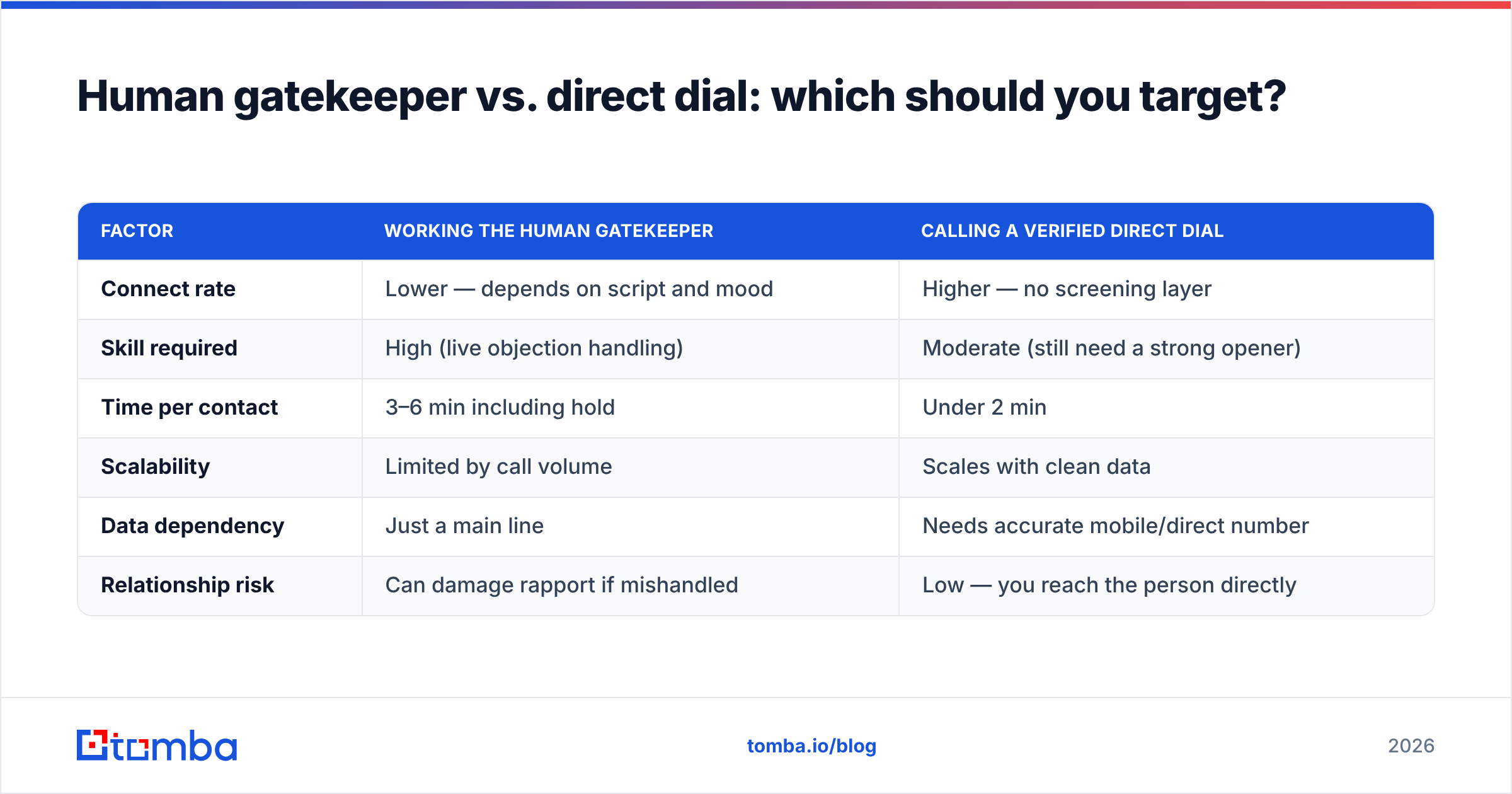
The fastest path is often to skip the gate. Here's how the two approaches compare in practice.
| Factor | Working the human gatekeeper | Calling a verified direct dial |
|---|---|---|
| Connect rate | Lower — depends on script and mood | Higher — no screening layer |
| Skill required | High (live objection handling) | Moderate (still need a strong opener) |
| Time per contact | 3–6 min including hold | Under 2 min |
| Scalability | Limited by call volume | Scales with clean data |
| Data dependency | Just a main line | Needs accurate mobile/direct number |
| Relationship risk | Can damage rapport if mishandled | Low — you reach the person directly |
Neither approach is "cheating." Working the gatekeeper is a real skill worth keeping sharp — some numbers you'll only ever have are main lines. But when you can start from a verified direct dial, your team spends its energy on the conversation that matters instead of the negotiation to get there.
That's where your data workflow becomes a competitive edge. If you're building call lists, a phone finder that surfaces direct B2B numbers means more of your dials land on a decision-maker rather than a switchboard. Pair it with a phone validator so you're not burning time on dead or reassigned lines.
How does data quality change the gatekeeper game?#
Data quality decides how many gates you have to face at all. You can be the best cold caller in your org and still lose the month if your list is full of main lines, outdated titles, and wrong-department contacts.
Consider the math. If half your list routes through a gatekeeper and you convert one in five of those to a transfer, you're losing a large share of dials before you say a word to a buyer. Shift even a third of that list to verified direct dials and your daily conversations with actual decision-makers can double — without making a single extra call.
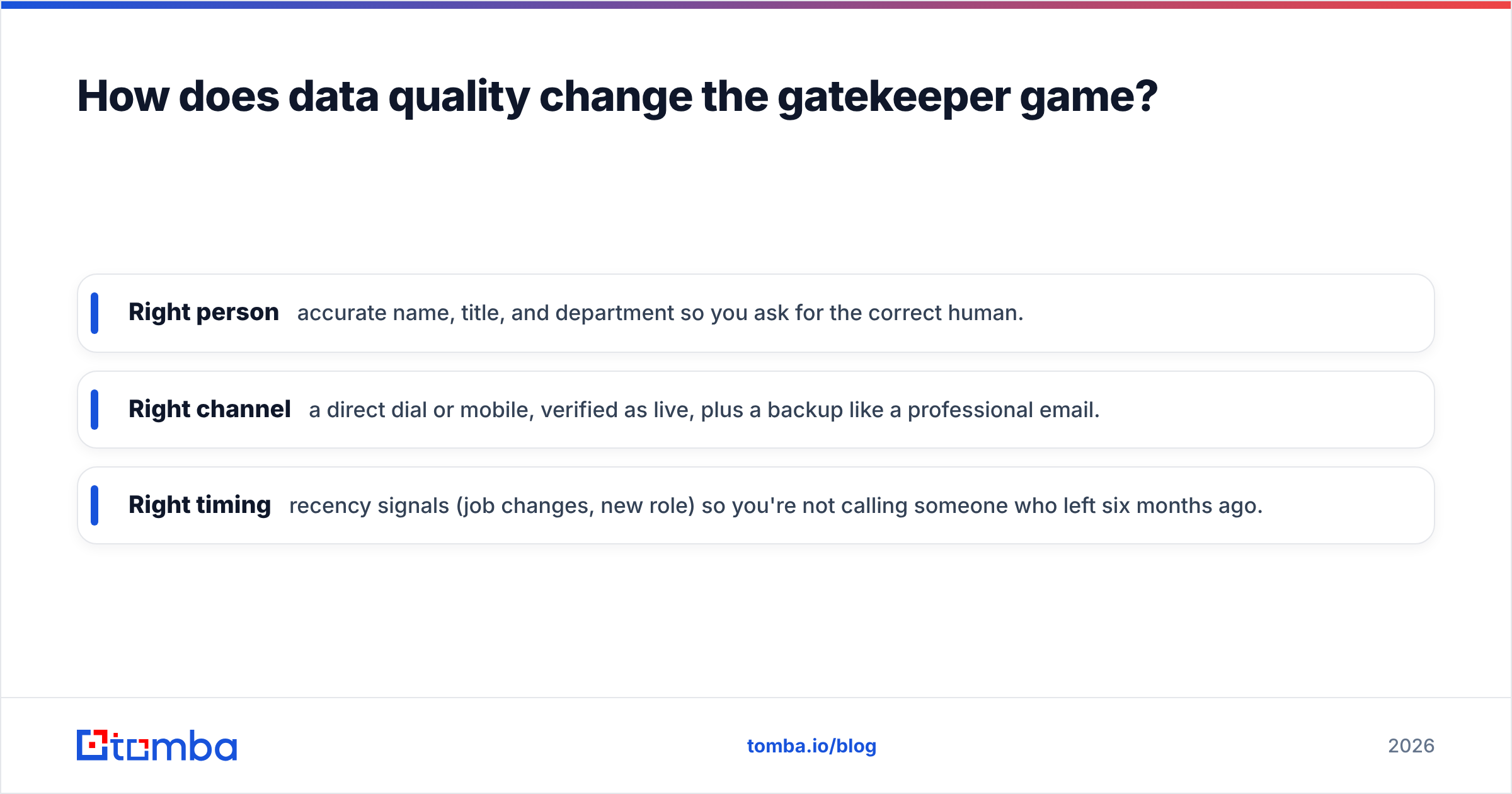
Modern prospecting stacks combine three data layers:
- Right person — accurate name, title, and department so you ask for the correct human.
- Right channel — a direct dial or mobile, verified as live, plus a backup like a professional email.
- Right timing — recency signals (job changes, new role) so you're not calling someone who left six months ago.
When you know the exact person and have a live direct line, the gatekeeper conversation becomes a fallback, not your default. And for the calls where you still hit a gate, a confident, specific ask backed by real research ("I'm trying to reach Jordan Reyes in RevOps") lands far better than a vague fishing expedition. Vendors like HubSpot and call-analytics platforms have documented for years that call preparation and list accuracy correlate directly with connect and conversion rates.
Cold calling also rarely lives alone in 2026. The strongest reps sequence a call with a relevant email and a light-touch LinkedIn outreach message, so by the time they dial, the name isn't fully cold. If you're finding those contacts, a reliable email finder rounds out the multi-channel play and gives the gatekeeper's boss a reason to recognize your name.
What should a full gatekeeper playbook look like?#
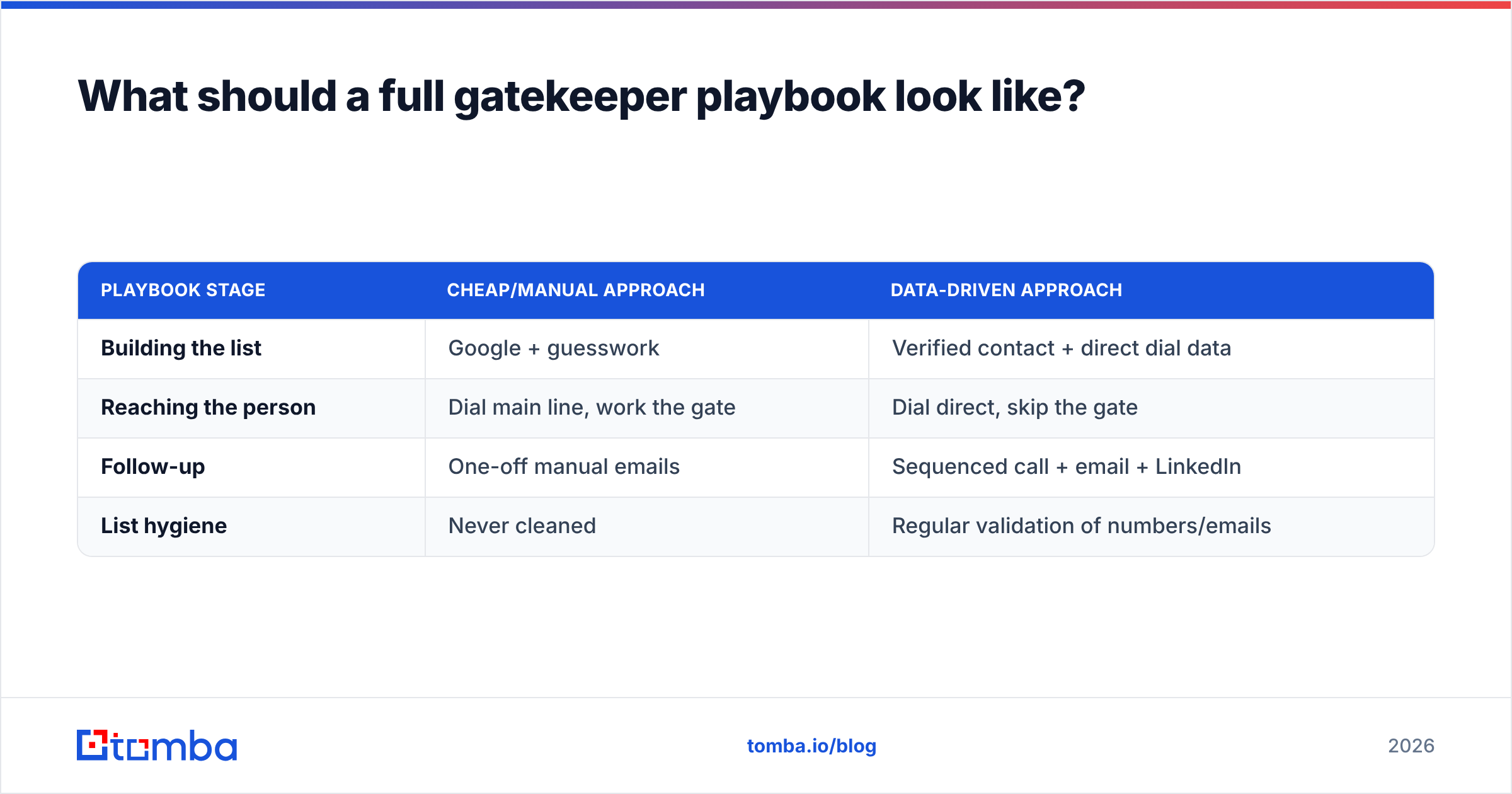
Put the pieces together into a repeatable sequence you can coach across a team:
- Research first. Confirm the decision-maker's name, title, and department before dialing. Never call to ask "who handles X?"
- Prefer the direct dial. Start with verified direct numbers; reserve main lines for when no direct dial exists.
- Open with a name and a reason. Calm, specific, honest. No small talk fishing.
- Enlist the gatekeeper. Ask for help, respect their screening, give an easy redirect.
- Log everything. Note who screens for whom, their name, and their preferences. Gatekeepers reward reps who remember them.
- Sequence across channels. Follow calls with email and LinkedIn so future dials feel warm.
| Playbook stage | Cheap/manual approach | Data-driven approach |
|---|---|---|
| Building the list | Google + guesswork | Verified contact + direct dial data |
| Reaching the person | Dial main line, work the gate | Dial direct, skip the gate |
| Follow-up | One-off manual emails | Sequenced call + email + LinkedIn |
| List hygiene | Never cleaned | Regular validation of numbers/emails |
The teams that win aren't the ones with the slickest gatekeeper trick. They're the ones who show up prepared, respectful, and armed with accurate contact data — so most calls never need a trick at all.
Get more calls straight to the decision-maker#
The best way to beat a cold calling gatekeeper is to reach the right person on a number that actually rings their desk. Start by building cleaner, more accurate call lists: Tomba's Email Finder helps you identify the exact decision-maker and their professional contact details by domain, name, or company — so your reps open with a name, not a guess, and spend their energy on conversations instead of switchboards. Explore the full toolkit and Tomba pricing, including a free tier to test it on your next list, and turn more dials into real conversations.
Related guides#
Ready to find emails that actually work?
Join 150,000+ professionals who stopped guessing and started sending. Free credits on signup — no credit card required.
Get the Tomba newsletter
Practical outbound tactics and product updates — once every two weeks.
About the author