Cold Calling Introduction Script: 2026 Openers That Work
A cold calling introduction script buys you the first 15 seconds. Here are the openers, frameworks, and word-for-word lines that keep reps out of the hang-up pile in 2026.
Cold Calling Introduction Script: 2026 Openers That Work
You have about 15 seconds. That is the honest span between "hello" and the moment a prospect decides whether you are a peer worth listening to or a robocall worth hanging up on. A cold calling introduction script is the tool that makes those 15 seconds repeatable instead of a coin flip.
This guide gives you the exact openers, the framework behind them, and the lines most reps should stop using in 2026.
TL;DR#
- The intro is not the pitch. Its only job is to earn the next 30 seconds — nothing more.
- Name, reason, permission is the three-beat structure that outperforms the old "How are you today?" opener.
- A script is a floor, not a cage. Read it enough to internalize it, then talk like a human.
- Pattern interrupts still work, but only when paired with genuine relevance to the prospect's role.
- Data quality decides everything. The best script on earth fails against a wrong number or the wrong contact.
Why Do You Even Need a Cold Calling Introduction Script?#
Because improvisation punishes you at exactly the wrong moment. The opening is the highest-pressure, lowest-information part of the call, and that is where reps freeze, over-talk, or apologize for existing.
Think of a script like a pilot's takeoff checklist. Pilots do not read it because they forgot how to fly — they read it because takeoff is where small mistakes compound fastest. Your intro is takeoff.
A written cold calling introduction script does three things:
- Removes decision fatigue in the first seconds so your brain is free to listen.
- Standardizes what works so your best line becomes everyone's line.
- Creates a control so you can test one variable at a time and actually learn.
According to Gong's conversation research, the strongest cold calls are shaped in the first 30–60 seconds — the opener sets the tone the rest of the call inherits.
What Are the Core Parts of a Cold Call Opener?#
Every effective opener has the same skeleton, no matter the industry. Get these four beats right and the words in between barely matter.
- The name anchor — State your first and last name and your company clearly. Mumbling your company name signals you are hiding something.
- The permission ask — A short, honest request for a few seconds. It disarms the reflex to hang up.
- The relevance hook — One sentence that proves you called this person for a reason, not a list.
- The soft handoff — A question that hands the floor back to them within 20 seconds.
Notice what is missing: your product, your feature list, and "How are you doing today?" None of that belongs in the opener.
What Does a Cold Calling Introduction Script Actually Look Like?#
Here is a word-for-word template you can adapt. The bracketed parts are yours to fill in.
"Hi [First Name], this is [Your Name] from [Company]. I know I'm calling out of the blue — do you have 27 seconds for me to tell you why, and then you can decide if it's worth continuing?"
Then, after they agree (most do, because 27 seconds is oddly specific and non-threatening):
"I work with [role] at companies like [reference customer], and the thing I keep hearing is [specific problem]. I had a hunch that might be on your radar too — is that fair, or am I way off?"
That final "am I way off?" is the pressure-release valve. It gives the prospect an easy exit, which paradoxically makes them stay.
The Permission-Based Opener (recommended default)#
Best for cold, senior, or skeptical prospects. It trades a tiny bit of momentum for a large amount of trust. This is the version most modern SDR teams standardize on.
The Pattern-Interrupt Opener#
"Hi [Name] — I'll be honest, this is a cold call. You can hang up, or you can give me 20 seconds. Your call."
Radical candor gets attention because almost nobody does it. Use sparingly and only when your data is airtight.
The Referral-Bridge Opener#
"Hi [Name], [Mutual Contact] mentioned you're the person who owns [area] — is now a terrible time?"
The "is now a terrible time?" phrasing is a proven negotiation move: a "no" (it's not terrible) moves you forward.
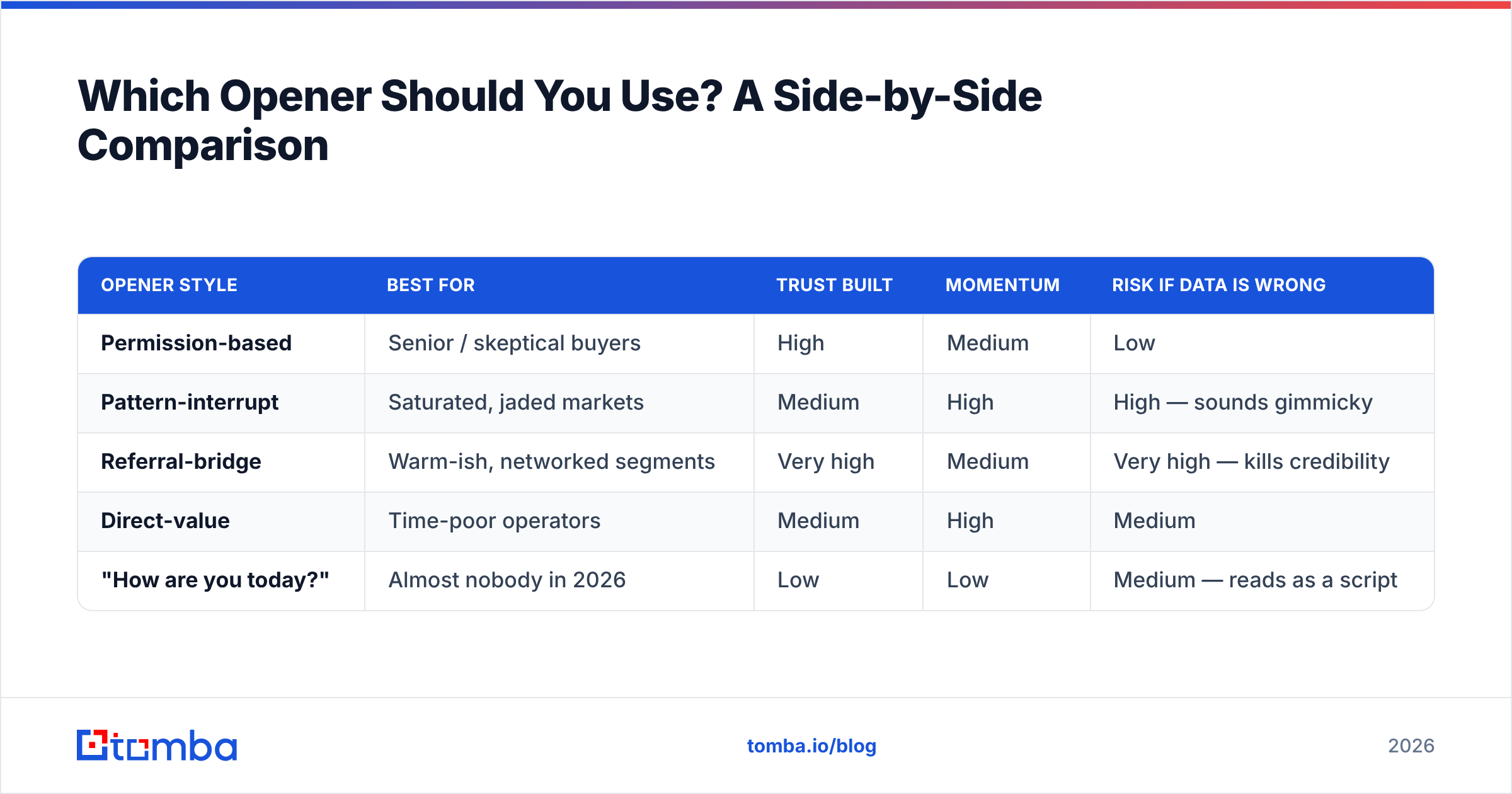
Which Opener Should You Use? A Side-by-Side Comparison#
Different prospects, different openers. Use this table to match the script to the situation.
| Opener style | Best for | Trust built | Momentum | Risk if data is wrong |
|---|---|---|---|---|
| Permission-based | Senior / skeptical buyers | High | Medium | Low |
| Pattern-interrupt | Saturated, jaded markets | Medium | High | High — sounds gimmicky |
| Referral-bridge | Warm-ish, networked segments | Very high | Medium | Very high — kills credibility |
| Direct-value | Time-poor operators | Medium | High | Medium |
| "How are you today?" | Almost nobody in 2026 | Low | Low | Medium — reads as a script |
The pattern is clear: the more your opener leans on specifics (a name, a referral, a role), the more damage a bad record does. A referral-bridge opener aimed at the wrong department does not just fizzle — it burns credibility.
How Do You Get Past the Gatekeeper?#
The gatekeeper is not your enemy; they are a filter doing their job. Treat them as a colleague, not an obstacle.
- Be transparent, briefly. "Hi, this is [Name] from [Company] — could you point me to whoever owns [area]?"
- Use the decision-maker's name when you have it. "Could you connect me with [First Name]?" signals you belong.
- Never pitch the gatekeeper. They can't buy, but they can block. Respect the boundary.
- Ask for help, not a favor. "I'm hoping you can help me — am I even calling the right team?"
The through-line: none of this works if you're guessing the name. Walking in with the correct decision-maker and a verified direct line changes the entire dynamic — which is a data problem before it is a script problem.
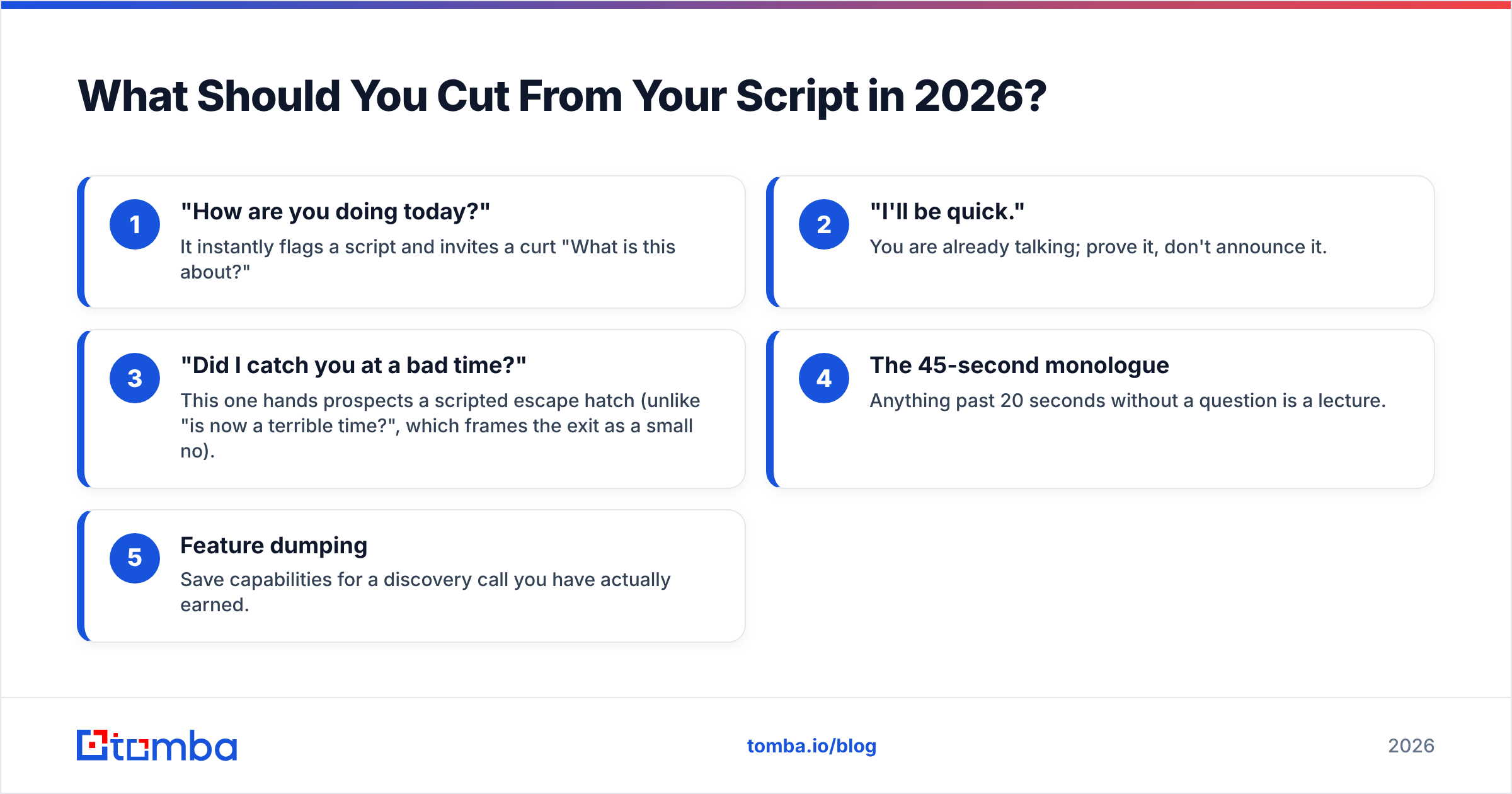
What Should You Cut From Your Script in 2026?#
Some lines have aged badly. Retire these:
- "How are you doing today?" — It instantly flags a script and invites a curt "What is this about?"
- "I'll be quick." — You are already talking; prove it, don't announce it.
- "Did I catch you at a bad time?" — This one hands prospects a scripted escape hatch (unlike "is now a terrible time?", which frames the exit as a small no).
- The 45-second monologue — Anything past 20 seconds without a question is a lecture.
- Feature dumping — Save capabilities for a discovery call you have actually earned.
How Do You Practice a Script Without Sounding Robotic?#
The paradox of scripts: you read them until you no longer need to read them. A script you cling to word-for-word sounds worse than no script at all.
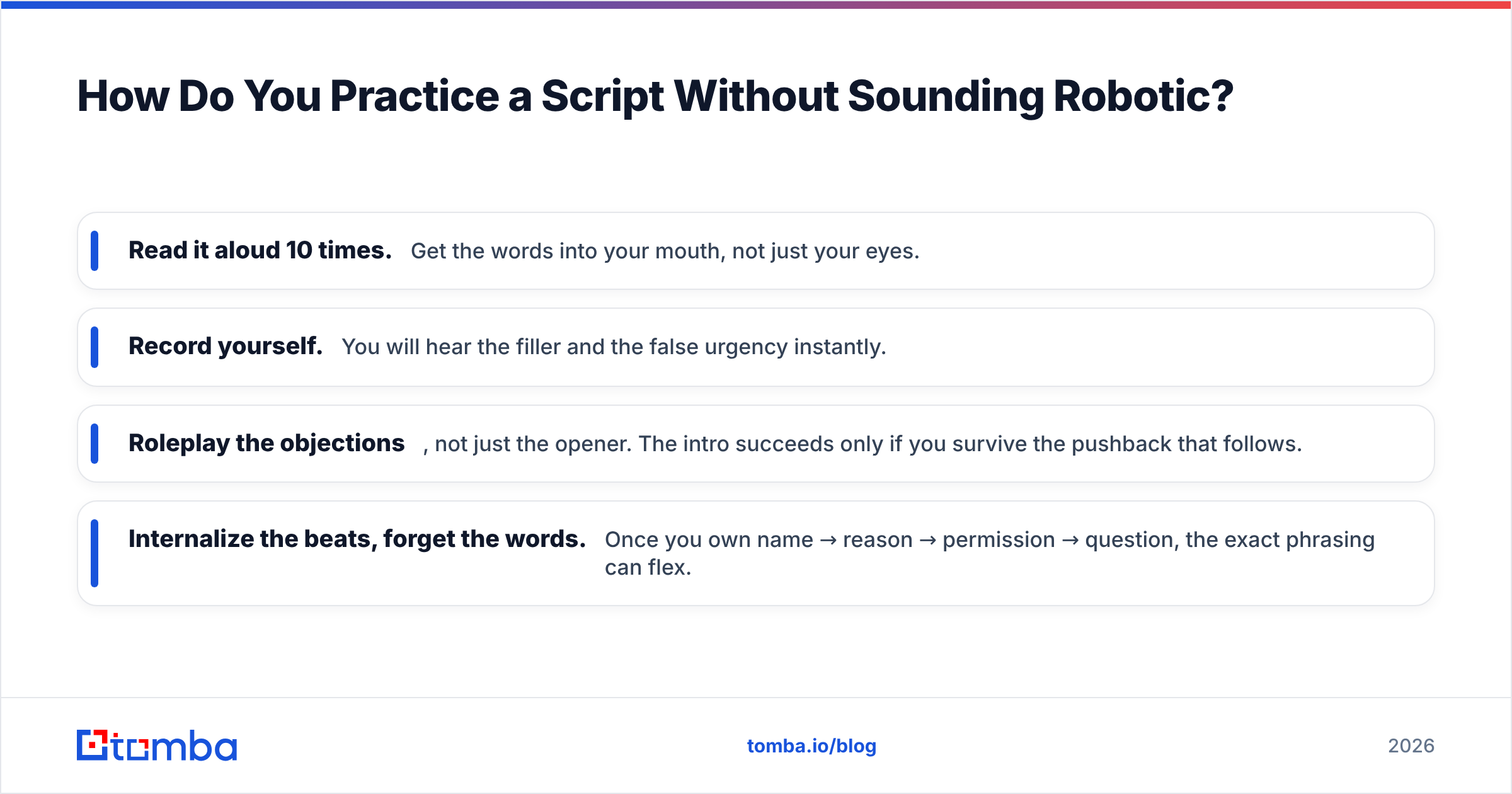
Here's the progression that works:
- Read it aloud 10 times. Get the words into your mouth, not just your eyes.
- Record yourself. You will hear the filler and the false urgency instantly.
- Roleplay the objections, not just the opener. The intro succeeds only if you survive the pushback that follows.
- Internalize the beats, forget the words. Once you own name → reason → permission → question, the exact phrasing can flex.
Think of it like learning a song on guitar. First you stare at the chords. Eventually your hands know them and you can improvise around the melody. The chords never change; your delivery does.
Why Does Data Quality Beat Script Quality?#
Because a perfect script delivered to the wrong person is a perfect waste. The single biggest lever on cold-call results is not word choice — it's calling the right person, at the right number, at a company that fits.
This is where your pre-call workflow matters more than your opener. If you're dialing numbers scraped from a stale list, your connect rate craters before your script gets a chance. Reps routinely lose half their calling hours to disconnected lines and wrong departments.
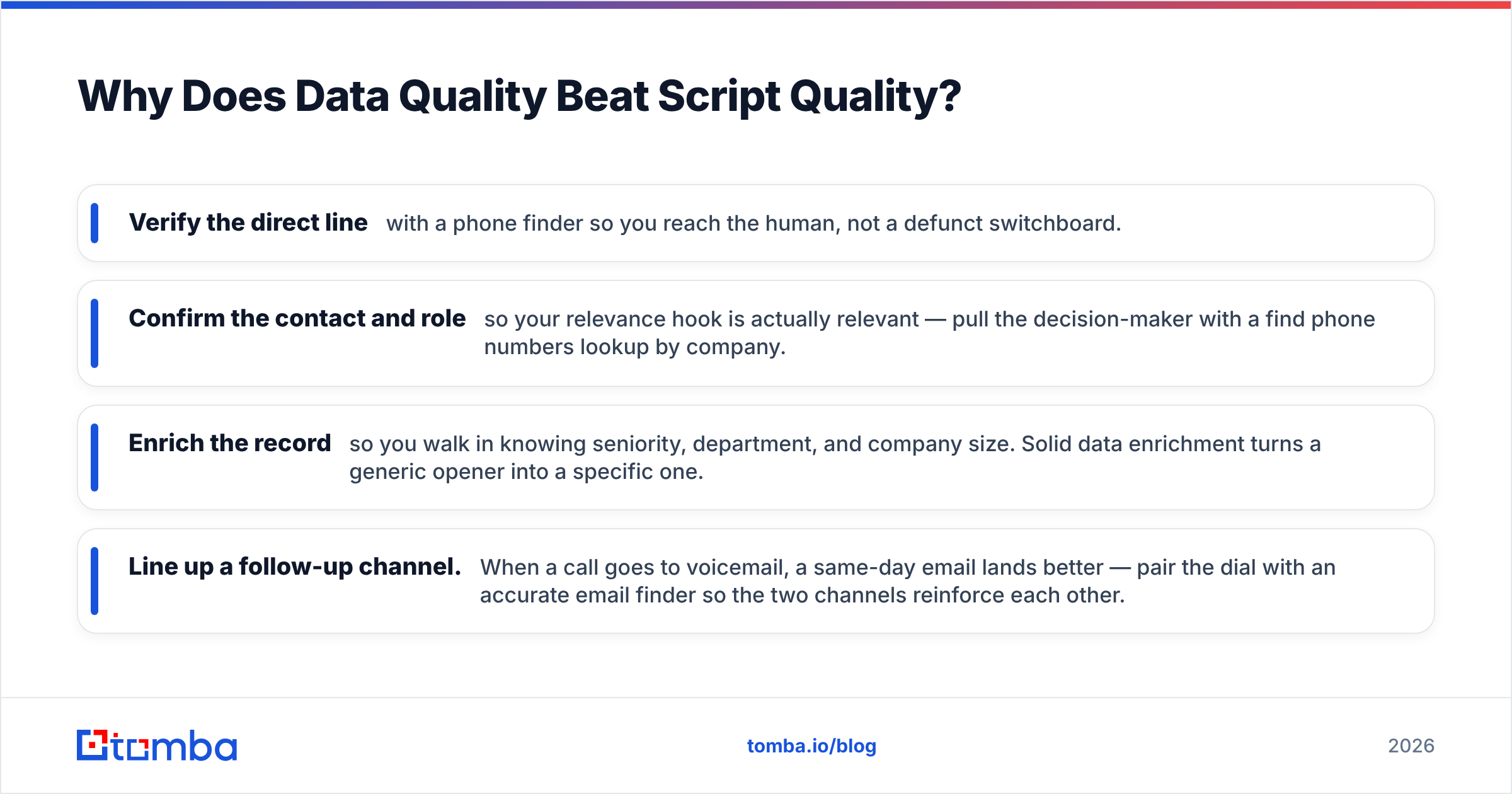
A tighter pre-call stack looks like this:
- Verify the direct line with a phone finder so you reach the human, not a defunct switchboard.
- Confirm the contact and role so your relevance hook is actually relevant — pull the decision-maker with a find phone numbers lookup by company.
- Enrich the record so you walk in knowing seniority, department, and company size. Solid data enrichment turns a generic opener into a specific one.
- Line up a follow-up channel. When a call goes to voicemail, a same-day email lands better — pair the dial with an accurate email finder so the two channels reinforce each other.
HubSpot's sales research has long shown that multi-touch, multi-channel sequences outperform single-channel outreach — the call and the email are teammates, not rivals.
A Complete Sample Call Flow#
Putting it together, here's how the first 30 seconds should sound end to end:
You: "Hi Dana, this is Marcus from Northwind. I know I'm calling out of the blue — got 27 seconds for me to explain why, then you decide if it's worth more?"
Dana: "...Sure, go ahead."
You: "I work with RevOps leads at mid-market SaaS companies, and the recurring headache I hear is reps burning half their day on dead phone numbers. I had a hunch that might sound familiar — or am I way off?"
Dana: "No, that's real, actually."
You: "Figured. Can I ask two quick questions to see if it's even worth a longer conversation?"
You've now earned discovery — which was the entire point of the intro.
Common Questions#
How long should a cold call introduction be? Under 20 seconds before you hand the floor back with a question. The intro earns the conversation; it is not the conversation.
Should I mention the price in the opener? No. Price without context reads as a pitch and triggers the reflex to end the call.
What connect rate is realistic? It varies wildly by industry, but data quality moves it more than script wording. Clean, verified numbers can meaningfully lift the percentage of dials that reach a live human.
Is cold calling dead in 2026? No — but spray-and-pray calling is. Targeted calls to verified contacts with a relevant hook still convert.
The Bottom Line#
A cold calling introduction script wins the first 15 seconds by doing less, not more: name yourself clearly, ask permission, prove relevance, and hand the floor back with a question. Everything past that is discovery you earned.
But the script is only half the equation. The other half is walking into the call with the right person and a number that actually rings. Before you dial your next list, run it through the Tomba Email Finder and pair it with verified direct lines so your carefully-crafted opener reaches a human who fits. Start free with 25 searches a month, and check the full Tomba pricing when you're ready to scale your outbound. The best opener in the world can't fix a wrong number — so fix the data first, then let the script do its job.
Related guides#
Ready to find emails that actually work?
Join 150,000+ professionals who stopped guessing and started sending. Free credits on signup — no credit card required.
Get the Tomba newsletter
Practical outbound tactics and product updates — once every two weeks.
About the author