Cold Calling KPIs: The 12 Metrics That Actually Drive Revenue
Most teams track cold calling KPIs that look busy but predict nothing. Here are the 12 metrics that actually forecast pipeline — and the vanity numbers to drop.
Cold calling is not dead, but the way most teams measure it is. Reps log a wall of numbers every day — dials, talk time, hours on the phone — and almost none of it tells a manager whether next quarter's pipeline is safe. This guide cuts the cold calling KPIs down to the ones that forecast revenue, shows you how to benchmark each, and names the vanity metrics quietly wasting your team's attention.
TL;DR#
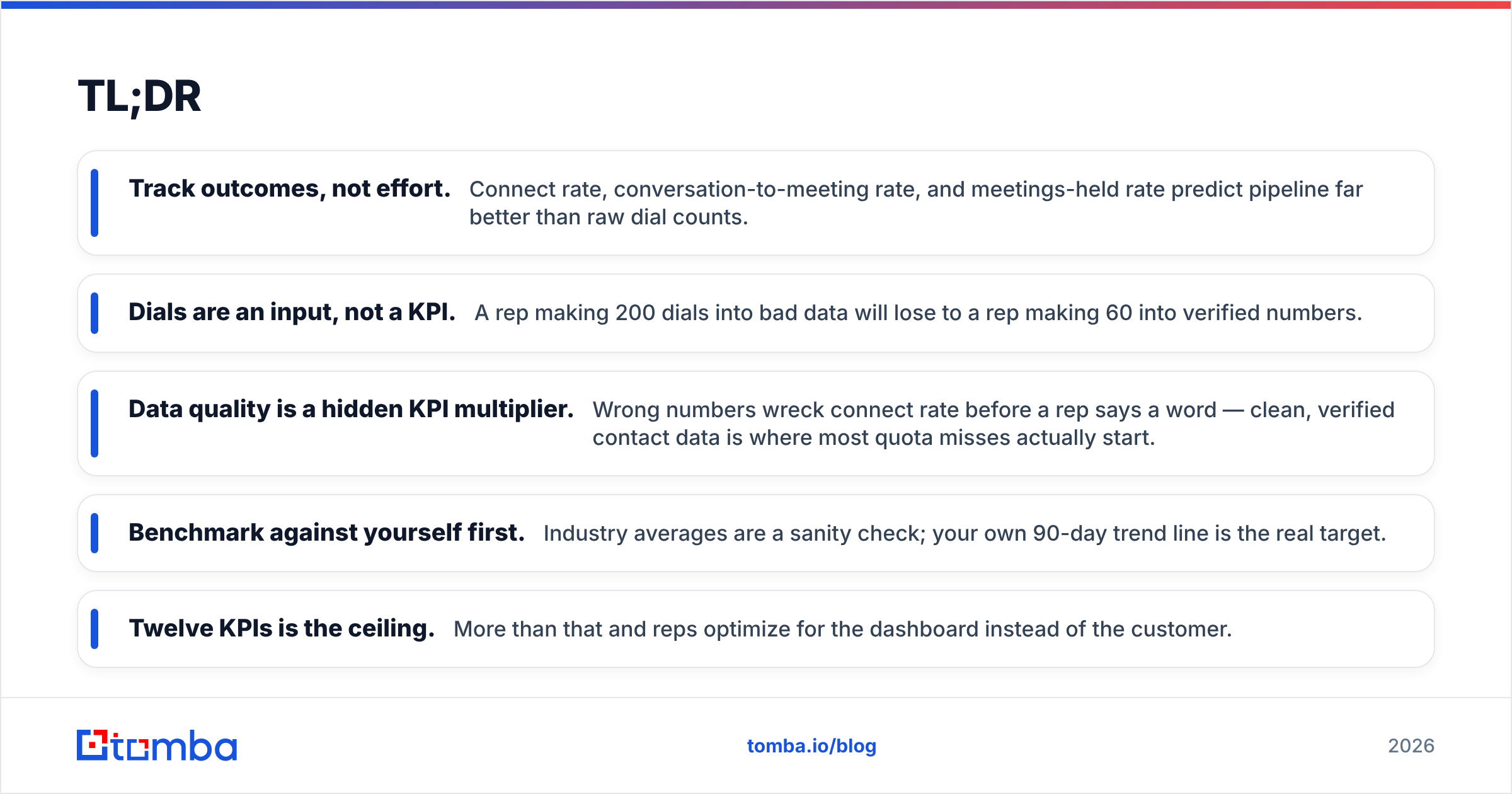
- Track outcomes, not effort. Connect rate, conversation-to-meeting rate, and meetings-held rate predict pipeline far better than raw dial counts.
- Dials are an input, not a KPI. A rep making 200 dials into bad data will lose to a rep making 60 into verified numbers.
- Data quality is a hidden KPI multiplier. Wrong numbers wreck connect rate before a rep says a word — clean, verified contact data is where most quota misses actually start.
- Benchmark against yourself first. Industry averages are a sanity check; your own 90-day trend line is the real target.
- Twelve KPIs is the ceiling. More than that and reps optimize for the dashboard instead of the customer.
What are cold calling KPIs?#
Cold calling KPIs are the quantifiable measures that tell you whether your outbound calling motion is working — from the first dial to a booked, held meeting. Think of them like a car dashboard: dials are the RPM gauge (activity), but connect rate, meeting rate, and pipeline created are the speedometer and fuel gauge (are you actually getting somewhere, and can you keep going).
The trap most teams fall into is measuring effort because effort is easy to count. A dialer logs every attempt automatically. But a KPI is only useful if it changes a decision. "We made 4,000 dials" changes nothing. "Our connect rate dropped from 18% to 9% after we imported that list" tells you exactly where to look.
Good cold calling KPIs share three traits:
- They map to an outcome — a conversation, a meeting, or revenue, not just an action.
- They isolate a fixable cause — when the number moves, you know which lever to pull (data, list, script, or rep skill).
- They survive scrutiny — you can defend the number to a VP without hand-waving about "quality of conversations."

Which cold calling KPIs actually matter?#
Here are the twelve worth your dashboard, grouped by where they sit in the funnel. Everything else is context, not a KPI.
Activity metrics (inputs — necessary, not sufficient)#
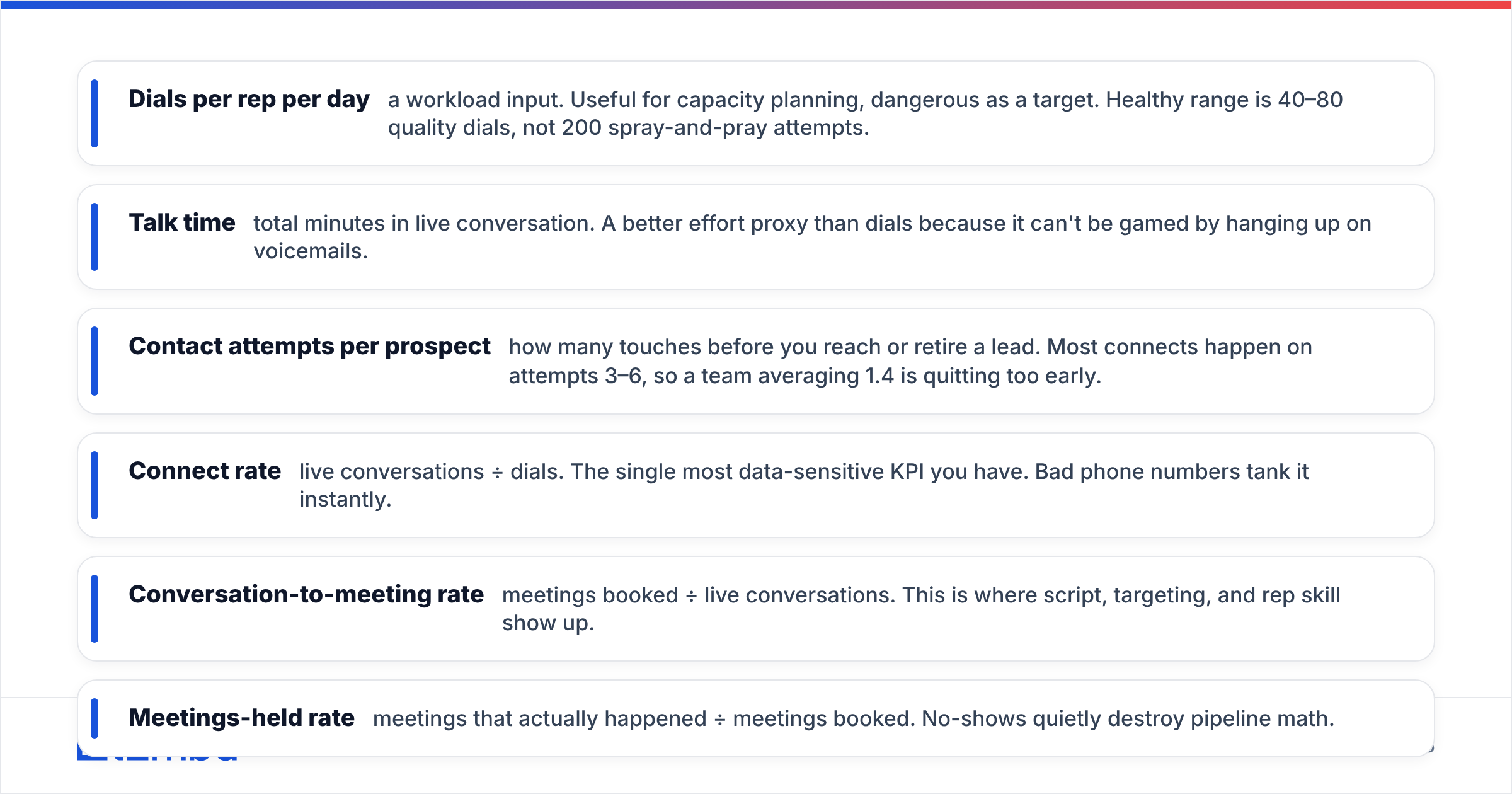
- Dials per rep per day — a workload input. Useful for capacity planning, dangerous as a target. Healthy range is 40–80 quality dials, not 200 spray-and-pray attempts.
- Talk time — total minutes in live conversation. A better effort proxy than dials because it can't be gamed by hanging up on voicemails.
- Contact attempts per prospect — how many touches before you reach or retire a lead. Most connects happen on attempts 3–6, so a team averaging 1.4 is quitting too early.
Efficiency metrics (the real leading indicators)#
- Connect rate — live conversations ÷ dials. The single most data-sensitive KPI you have. Bad phone numbers tank it instantly.
- Conversation-to-meeting rate — meetings booked ÷ live conversations. This is where script, targeting, and rep skill show up.
- Meetings-held rate — meetings that actually happened ÷ meetings booked. No-shows quietly destroy pipeline math.
Outcome metrics (what leadership cares about)#
- Pipeline created ($) — qualified opportunity value sourced from cold calls.
- Cost per meeting — fully-loaded rep cost ÷ meetings held. The number that decides whether the channel scales.
- Cold-call-sourced win rate — deals won that originated from a cold call, divided by opportunities from the same source. Ties the whole motion to closed revenue. If you want a precise definition, here's a clean primer on win rate.
Quality and consistency metrics#
- Callback / follow-up rate — how reliably reps do the second touch. Weak follow-through is the most common silent leak.
- Average deal size from cold calls — spots whether the channel brings in strategic accounts or only small-logo noise.
- Ramp-to-productivity time — days for a new rep to hit target connect and meeting rates. A management KPI, but a critical one.
Cold calling KPI benchmarks: what "good" looks like in 2026#
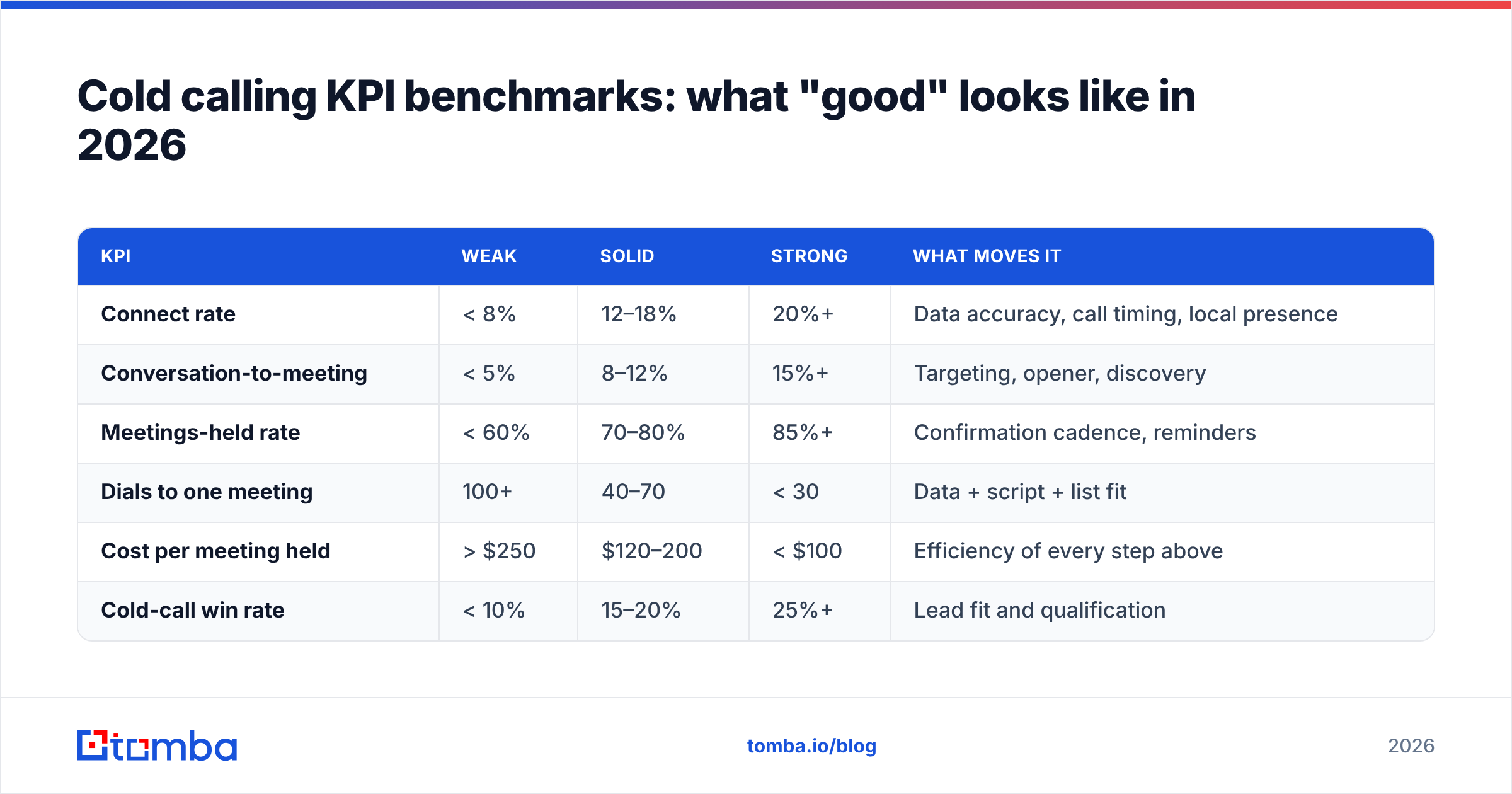
Benchmarks vary wildly by industry, list quality, and whether you're calling SMB or enterprise. Use the table below as a starting sanity check, then replace it with your own 90-day baseline as fast as you can.
| KPI | Weak | Solid | Strong | What moves it |
|---|---|---|---|---|
| Connect rate | < 8% | 12–18% | 20%+ | Data accuracy, call timing, local presence |
| Conversation-to-meeting | < 5% | 8–12% | 15%+ | Targeting, opener, discovery |
| Meetings-held rate | < 60% | 70–80% | 85%+ | Confirmation cadence, reminders |
| Dials to one meeting | 100+ | 40–70 | < 30 | Data + script + list fit |
| Cost per meeting held | > $250 | $120–200 | < $100 | Efficiency of every step above |
| Cold-call win rate | < 10% | 15–20% | 25%+ | Lead fit and qualification |
Two things to notice. First, every efficiency KPI improves when the data underneath improves — connect rate and dials-to-meeting are downstream of whether the number even rings the right person. Second, "strong" columns are not reached by dialing harder; they're reached by dialing smarter at better contacts. The G2 sales analytics category is a good place to see how vendors frame these same numbers if you want outside reference points.
Why do so many cold calling KPIs mislead teams?#
Because activity is easy to measure and outcomes are hard, dashboards drift toward vanity metrics. Three patterns cause the most damage.
The dial-count death spiral. Managers set a dials-per-day quota, reps hit it by burning through low-quality numbers, connect rate craters, and everyone concludes "cold calling doesn't work." The channel was fine; the data and the incentive were broken.
The talk-time illusion. Long calls feel productive, but a rep who spends 20 minutes with an unqualified prospect scores well on talk time and poorly on pipeline. Never let a soft KPI override a hard one.
The no-show blind spot. Teams celebrate "meetings booked" and never reconcile it against meetings held. A 40% no-show rate turns an impressive booking number into a mediocre pipeline number.
The fix is discipline: pick the twelve KPIs above, make efficiency and outcome metrics the ones tied to comp, and demote activity metrics to coaching context only.
How does data quality change your cold calling KPIs?#
Data quality is the multiplier sitting underneath every efficiency KPI you track. It's the foundation of the house — you can repaint the walls (better scripts) all day, but if the foundation is cracked (wrong numbers, dead contacts), nothing holds.
Here's the mechanism. Connect rate is live conversations divided by dials. If 30% of your phone numbers are wrong, disconnected, or belong to someone who left the company, you've capped your connect rate before the rep opens their mouth. No script fixes a number that doesn't ring the right person. That single input cascades into dials-to-meeting, cost per meeting, and ultimately win rate.
This is why teams serious about cold calling KPIs invest in verified contact data instead of scraped lists. A few practical moves:
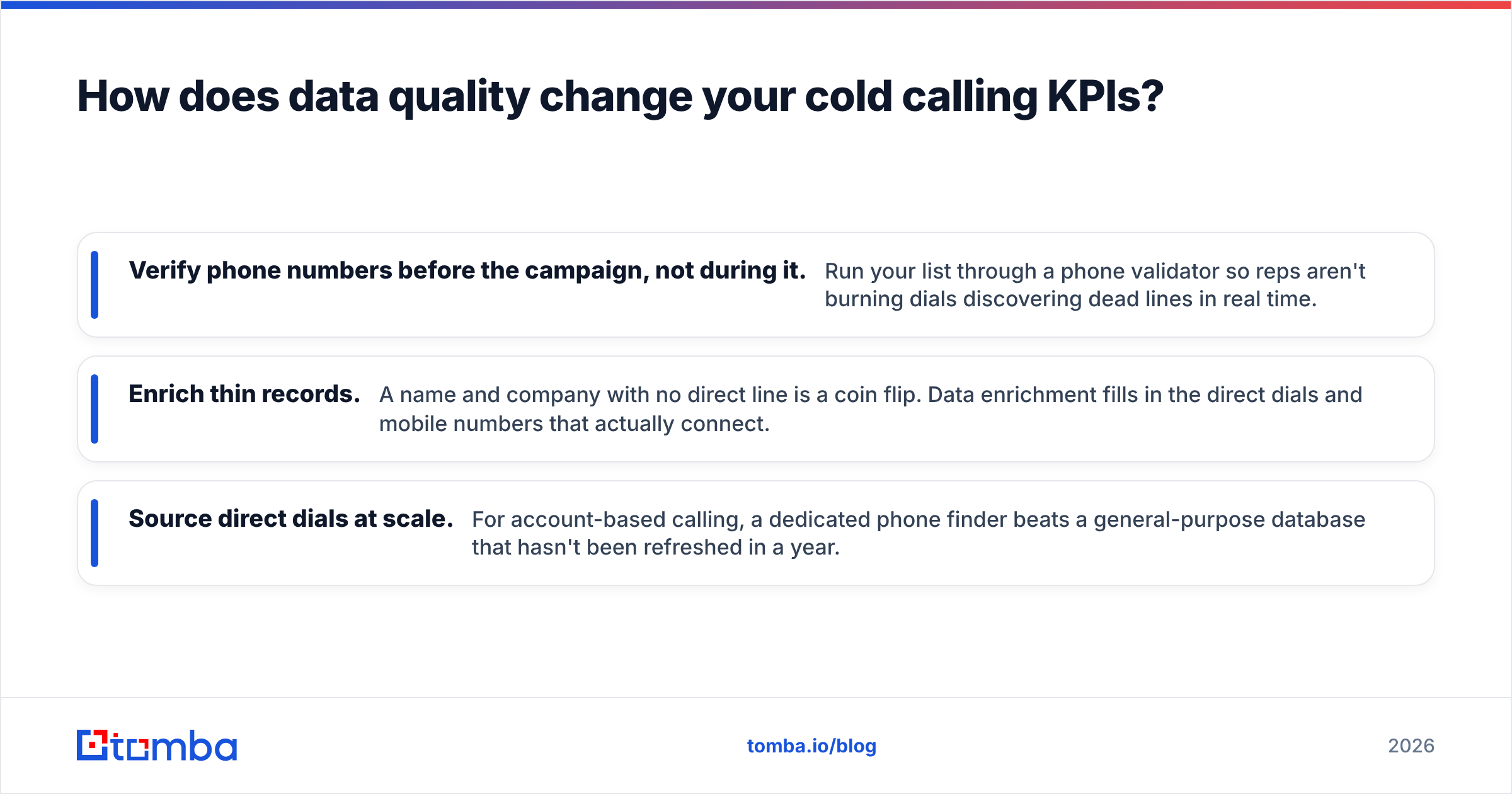
- Verify phone numbers before the campaign, not during it. Run your list through a phone validator so reps aren't burning dials discovering dead lines in real time.
- Enrich thin records. A name and company with no direct line is a coin flip. Data enrichment fills in the direct dials and mobile numbers that actually connect.
- Source direct dials at scale. For account-based calling, a dedicated phone finder beats a general-purpose database that hasn't been refreshed in a year.
The payoff is measurable: cleaner data typically lifts connect rate several points, which compounds through every downstream KPI. You're not working harder — you're deleting the wasted dials from the top of the funnel.
How to build a cold calling KPI dashboard reps will actually use#
A dashboard nobody opens is worse than no dashboard, because it creates false confidence. Keep it ruthlessly simple.
Show three tiers, not thirty numbers. Top row: outcome KPIs (pipeline created, meetings held, cost per meeting). Middle row: efficiency KPIs (connect rate, conversation-to-meeting, held rate). Bottom row: activity, collapsed and de-emphasized. Reps should see outcomes first so effort stays in service of results.
Trend, don't snapshot. A single day's connect rate is noise. A 14-day rolling average is signal. Every KPI should show its own trend line so a drop is obvious the day it starts, not the week it's already hurt pipeline.
Attribute every number to a lever. Next to each efficiency KPI, note what fixes it: connect rate → data + timing; conversation-to-meeting → script + targeting; held rate → confirmation cadence. This turns a report into a playbook.
Review weekly, coach individually. Team averages hide the story. One rep with a 6% connect rate on the same list where everyone else hits 15% has a skill or process problem — or got handed the worst data. You can only see that at the rep level.
If you want to wire these numbers into the tools your team already lives in, Tomba's HubSpot integration and Salesforce integration let you push verified contact data straight into the CRM where your KPI reporting already runs — so the data feeding your dials and the data feeding your dashboard are the same. HubSpot's own sales metrics guide is a solid companion read on structuring the reporting layer itself.
Which cold calling KPIs should you drop?#
Cutting metrics is as important as adding them. Retire these:
- Raw dials as a target. Keep it as a capacity input; never comp on it.
- Hours logged in the dialer. Measures presence, not productivity.
- Emails sent alongside calls, counted as "touches." Bundling channels hides which one actually books meetings.
- Voicemails left. A near-zero-conversion action dressed up as activity.
- Leaderboard rank on activity. It rewards volume over outcome and teaches exactly the wrong behavior.
Every metric you remove is attention returned to the six or seven KPIs that predict revenue. Less dashboard, more focus.
Frequently asked questions#
What is the most important cold calling KPI? Connect rate, because it's the earliest efficiency signal and the most sensitive to data quality. If it's low, nothing downstream can recover. Fix connect rate before you touch scripts.
How many cold calls should a rep make per day? There's no universal number — 40–80 quality dials is a healthy range for most B2B teams. Chasing 150+ almost always means the data or list is thin and reps are compensating with volume. Optimize dials-to-meeting instead of dials alone.
How do I improve connect rate specifically? Three levers, in order: verify your phone data, call during connect-friendly windows (early morning and late afternoon in the prospect's timezone), and use local presence dialing. Data is first because it's the biggest and most fixable.
Are cold calling KPIs different for SMB vs enterprise? Yes. SMB calling tolerates higher volume and lower deal size; enterprise calling accepts far fewer dials per meeting but demands better data and higher average deal size. Benchmark each segment separately or your averages will lie to you.
Start with the data your KPIs depend on#
Every cold calling KPI in this guide traces back to one question: are you dialing the right, reachable person? Better scripts and coaching help — but they only pay off once your list actually connects. That's the foundation.
Tomba's phone finder and contact data enrichment give your reps verified direct dials instead of stale, scraped numbers — the single fastest way to lift connect rate and, with it, every efficiency and outcome KPI downstream. Pair it with the email finder for multi-channel follow-up, start on the free tier of Tomba pricing, and let your dashboard show what a clean list does to the numbers that actually forecast revenue.
Related guides#
Ready to find emails that actually work?
Join 150,000+ professionals who stopped guessing and started sending. Free credits on signup — no credit card required.
Get the Tomba newsletter
Practical outbound tactics and product updates — once every two weeks.
About the author