Cold Calling Leads in 2026: How to Find, Qualify, and Close
Most cold calls fail before the first ring—bad numbers, wrong contacts, no research. Here's how to build a cold calling leads list that converts, plus the workflow top reps use to book more meetings.
Cold calling still works in 2026. What has changed is the margin for error. Buyers screen calls harder, mobile carriers flag spam faster, and a list of stale numbers will burn your connect rate before you say a word. The reps who win are not dialing more—they are dialing better leads.
This guide breaks down how to source, qualify, and work cold calling leads that actually pick up, and the data workflow that separates a booked-meeting machine from a rep grinding through dead numbers.
TL;DR#
- Cold calling leads are only as good as the data behind them. Bad numbers and wrong titles kill connect rates faster than any script.
- Source from multiple channels—CRM, intent data, LinkedIn, and enriched contact databases—then verify every phone number before you dial.
- Qualify before you call. A 90-second research pass on fit and trigger events doubles the odds a conversation goes somewhere.
- Track connect rate, conversation rate, and meetings booked—not just dials—so you know which lead sources are worth your time.
- Use a tool like Tomba's phone finder to pull B2B numbers and enrich contacts, so your list is accurate before it hits the dialer.
What are cold calling leads?#
Cold calling leads are prospects you contact by phone who have not previously engaged with your company. Unlike a warm lead who downloaded a whitepaper or replied to an email, a cold lead has no relationship with you yet—so the call has to earn attention in the first ten seconds.
Think of it like fishing. Warm leads are fish already circling your boat. Cold calling leads are the open water: bigger, but you need the right spot, the right bait, and accurate coordinates. Dial the wrong coordinates—an outdated number or a contact who left the company—and it does not matter how good your pitch is.
A usable cold calling lead has three things:
- A correct, reachable phone number (ideally a direct dial or mobile, not a gatekept switchboard).
- The right person—a role that owns or influences the problem you solve.
- A reason to call now—a trigger event, a fit signal, or a relevant pain point you can name.
Miss any one of those and you are not cold calling. You are cold guessing.
Where do the best cold calling leads come from?#
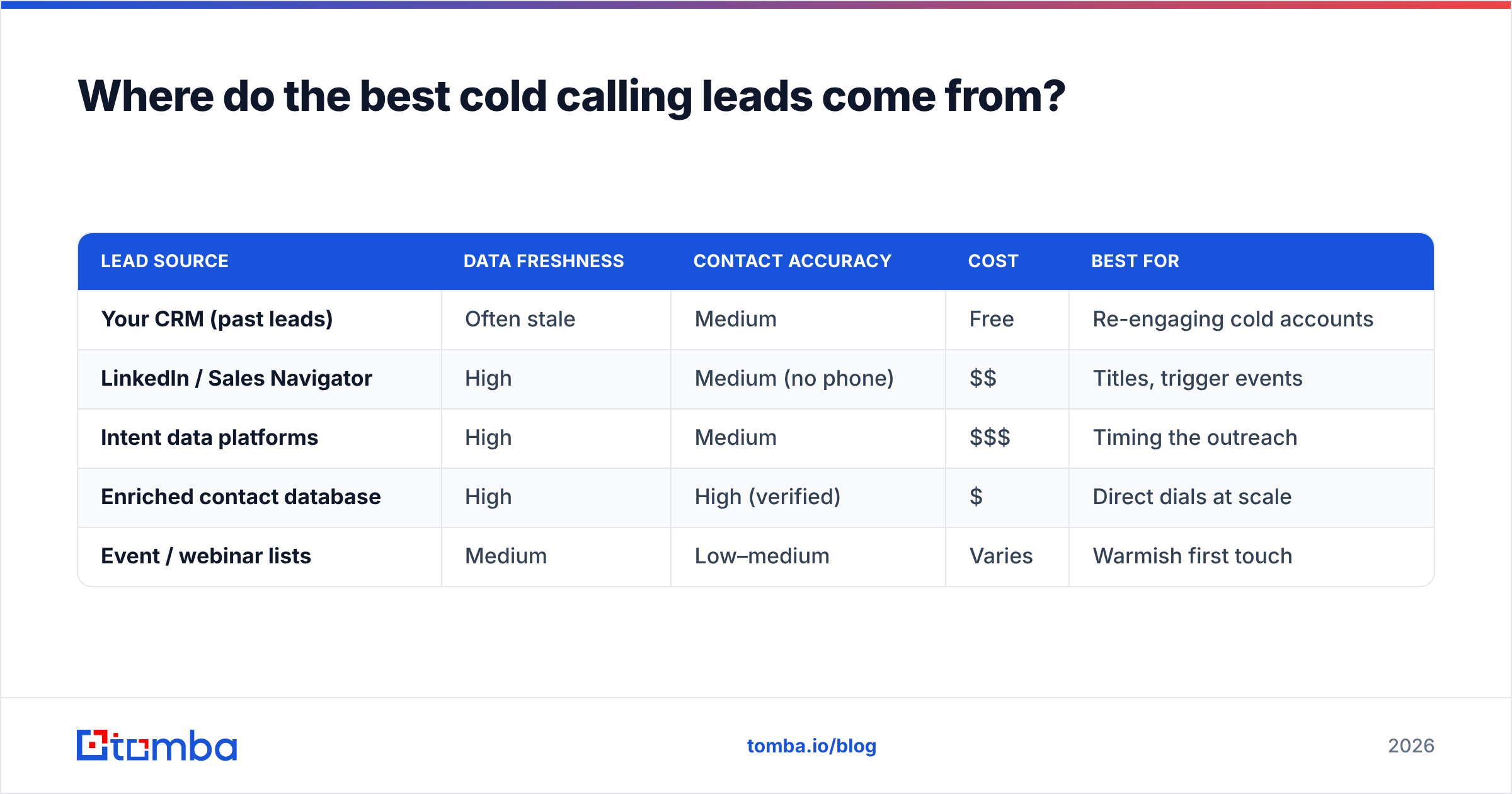
There is no single best source—strong pipelines blend several. Each channel trades off volume, freshness, and cost. Here is how the main options stack up.
| Lead source | Data freshness | Contact accuracy | Cost | Best for |
|---|---|---|---|---|
| Your CRM (past leads) | Often stale | Medium | Free | Re-engaging cold accounts |
| LinkedIn / Sales Navigator | High | Medium (no phone) | $$ | Titles, trigger events |
| Intent data platforms | High | Medium | $$$ | Timing the outreach |
| Enriched contact database | High | High (verified) | $ | Direct dials at scale |
| Event / webinar lists | Medium | Low–medium | Varies | Warmish first touch |
Notice that LinkedIn and intent tools are great for who and when, but they rarely hand you a phone number. That gap is where most cold calling programs leak. You identify a perfect-fit VP of Operations, then spend fifteen minutes hunting for a direct dial that may be wrong anyway.
The efficient move is to layer sources: find the account and the person with intent or LinkedIn signals, then pull an accurate number through a dedicated tool. Tomba's phone finder and data enrichment close that loop by turning a name and company into a verified B2B contact record, so you are not stitching together five browser tabs per lead.
How do you qualify cold calling leads before you dial?#
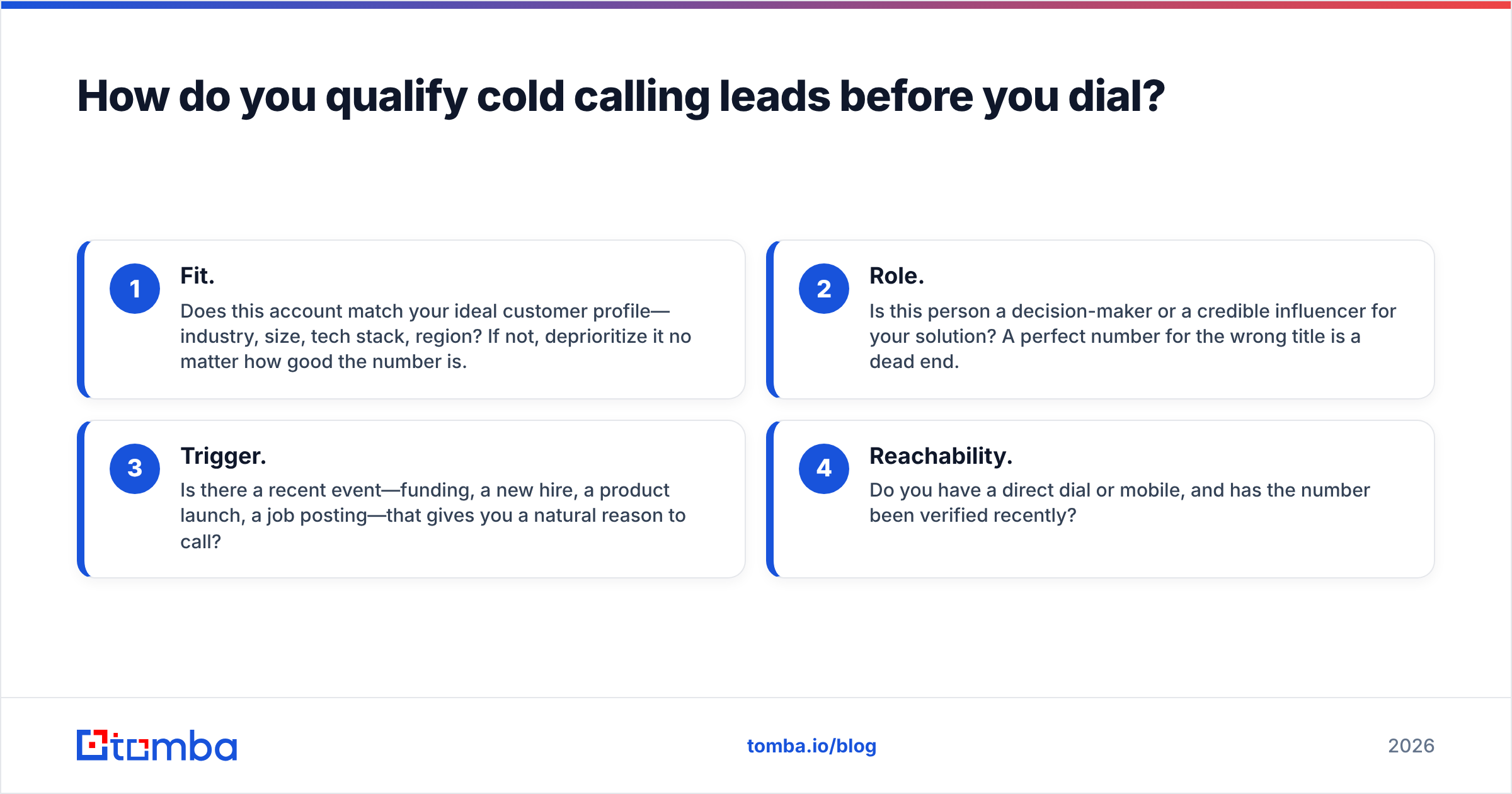
Qualify on fit and timing first, contact quality second—both matter, and skipping either wastes dials. A quick framework:
- Fit. Does this account match your ideal customer profile—industry, size, tech stack, region? If not, deprioritize it no matter how good the number is.
- Role. Is this person a decision-maker or a credible influencer for your solution? A perfect number for the wrong title is a dead end.
- Trigger. Is there a recent event—funding, a new hire, a product launch, a job posting—that gives you a natural reason to call?
- Reachability. Do you have a direct dial or mobile, and has the number been verified recently?
Run these four in under two minutes per lead. The goal is not a research essay; it is a single sentence you can open the call with: "I saw you just hired three new SDRs—usually that means onboarding is about to get painful, which is exactly what we help with." That beats "How are you today?" every time.
For the reachability check, don't trust a number just because a database returned it. Numbers change constantly as people switch jobs. Run them through a phone validator so you are not paying in wasted dials and a damaged caller reputation. Carriers increasingly flag numbers that repeatedly hit dead lines, and once your outbound number is marked "Spam Likely," even your good leads stop answering.
Why does data hygiene decide your connect rate?#
Because you cannot out-script bad data. A rep with a mediocre pitch and clean, verified numbers will out-book a great talker working a rotten list—every time.
Here is the math most teams ignore. Say you have 500 cold calling leads and a nominal 5% connect rate. On paper that is 25 conversations. But if 30% of the numbers are wrong, disconnected, or route to a switchboard, your effective list is 350, and your real connects drop to roughly 17. You just lost a third of your day's conversations to data rot, not to objections.
According to HubSpot's sales research, it can take multiple attempts to reach a prospect—so every wasted dial on a dead number compounds. Clean data is the cheapest performance boost available to a caller. It requires no new script, no coaching, and no charisma.
This is also why bulk verification beats one-at-a-time checking for teams. Before a calling blitz, run the whole list through verification and enrichment in one pass. Tomba's bulk lead generation tools let you validate and enrich hundreds of records at once, so your reps open the dialer to a list that is accurate on day one—not one they clean while they call.
What does a modern cold calling workflow look like?#
The best-run teams treat cold calling as a pipeline with distinct stages, not a single "pick up the phone" action. A repeatable flow looks like this:
- Build the list. Pull target accounts from your ICP filters, intent tools, or a B2B database. Aim for a focused list of well-matched accounts over a giant, generic one.
- Enrich and verify. Append direct dials, mobiles, and current titles; validate every number. Drop anything that fails.
- Research the trigger. Add one relevant, recent reason-to-call per lead. Store it in a note field the dialer surfaces.
- Prioritize. Sort by fit score and trigger strength so your first hour hits the highest-probability leads.
- Call in blocks. Batch dials into focused power hours; energy and rhythm matter more than spreading calls across the day.
- Log and route. Capture the outcome, and for connects that aren't ready, drop them into a nurture or callback sequence.
Notice that only one of those six steps is the actual call. That is the point—most of a great cold calling program is the prep. Automating the enrich-and-verify steps is where a tool pays for itself, because it is the least fun and most error-prone part when done by hand.
Cold calling leads vs. cold email leads: which should you prioritize?#
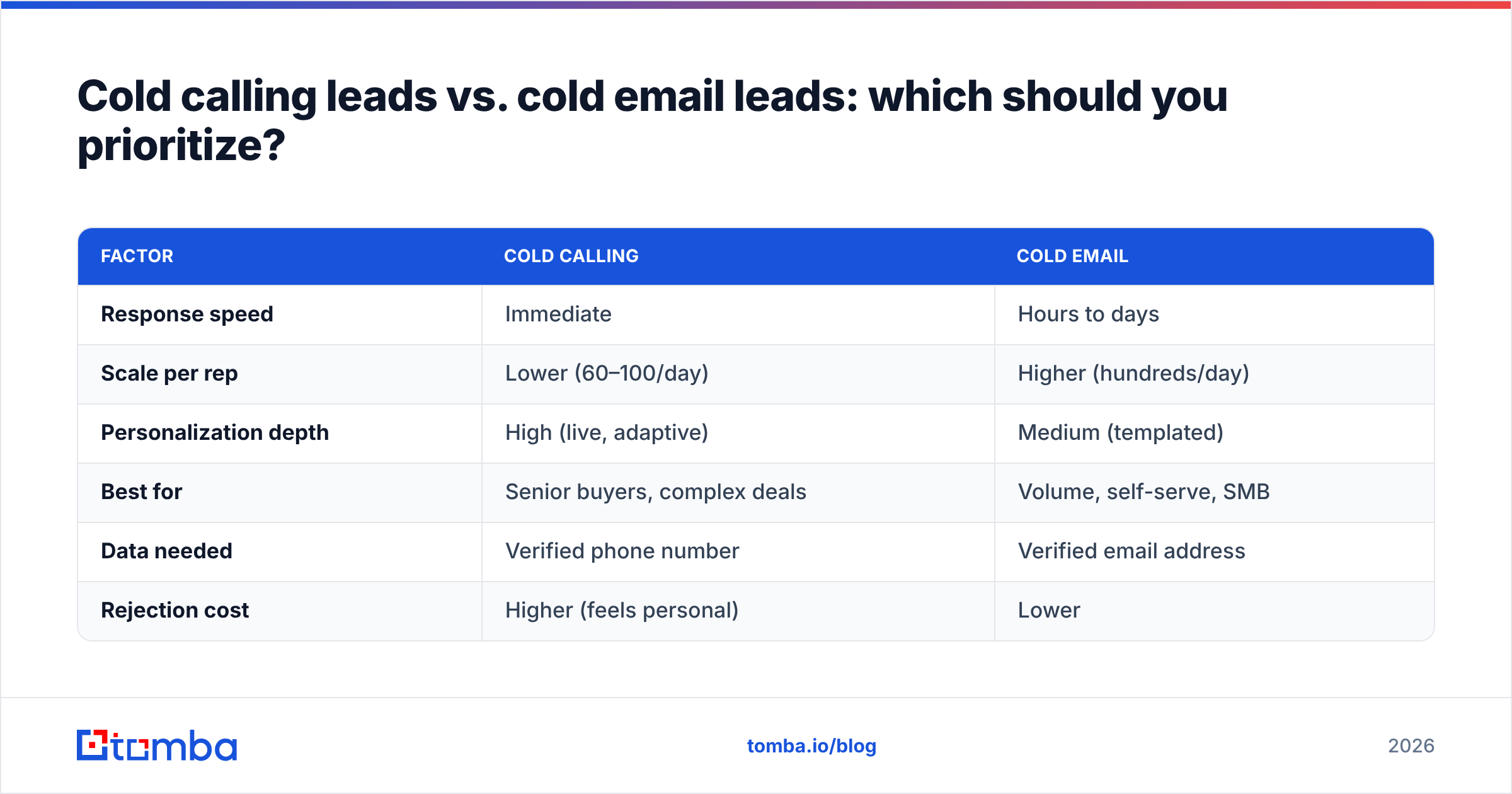
Use both, but choose your opener by role and urgency—phone wins for senior, time-sensitive plays; email wins for scale and self-serve buyers. They are not competitors; they are a one-two punch.
| Factor | Cold calling | Cold email |
|---|---|---|
| Response speed | Immediate | Hours to days |
| Scale per rep | Lower (60–100/day) | Higher (hundreds/day) |
| Personalization depth | High (live, adaptive) | Medium (templated) |
| Best for | Senior buyers, complex deals | Volume, self-serve, SMB |
| Data needed | Verified phone number | Verified email address |
| Rejection cost | Higher (feels personal) | Lower |
A common, effective play: warm the lead with a short email or LinkedIn touch, then call within a day or two referencing it. The prospect half-recognizes your name, and your connect-to-conversation rate climbs. For that combo you need both a clean number and a clean email—so many teams enrich both at once using an email finder alongside phone data, keeping every channel accurate from the same source record.
If you are weighing tools, compare capabilities and Tomba pricing against your channel mix. A team that lives on the phone needs deep phone coverage; a hybrid team wants email, phone, and enrichment in one place so the data stays consistent across sequences.
How do you measure whether your cold calling leads are working?#
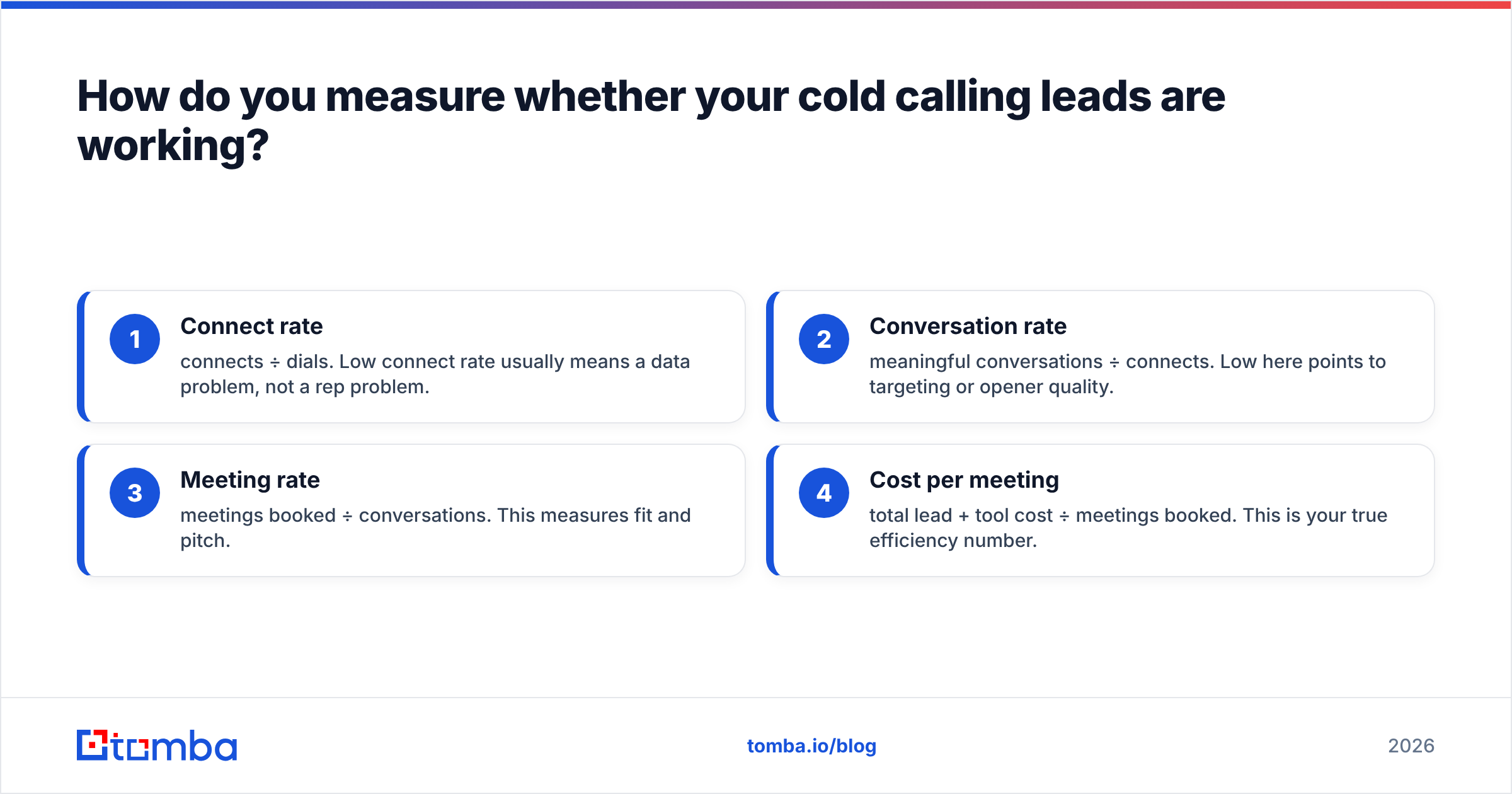
Track the funnel, not just the effort. Dials alone tell you nothing about lead quality. Watch these four metrics per lead source:
- Connect rate — connects ÷ dials. Low connect rate usually means a data problem, not a rep problem.
- Conversation rate — meaningful conversations ÷ connects. Low here points to targeting or opener quality.
- Meeting rate — meetings booked ÷ conversations. This measures fit and pitch.
- Cost per meeting — total lead + tool cost ÷ meetings booked. This is your true efficiency number.
Segment every metric by lead source. You will often find one channel produces cheap dials but almost no meetings, while another costs more per lead but converts far better. Kill or fix the weak sources and reinvest in the strong ones. This is basic, but most teams never do it because they measure activity instead of outcomes.
According to peer reviews on G2, the tools that rate highest for prospecting teams are the ones that combine accurate contact data with easy list-building—because that is what actually moves the connect and meeting rates that matter.
Common cold calling leads mistakes to avoid#
- Dialing an unverified list. The single most expensive habit. Verify first.
- Chasing volume over fit. 200 bad-fit leads is worse than 40 great ones.
- No trigger, no reason. "Just checking in" calls get hung up on. Lead with relevance.
- Ignoring "Spam Likely" flags. If your number gets flagged, rotate it and slow your pace—reputation is a real asset.
- Never enriching the CRM. Old records rot. Re-enrich cold accounts before you rework them instead of dialing three-year-old numbers.
Each of these traces back to one root cause: treating the list as fixed and the call as the only variable. Flip it. Obsess over the quality of who you are calling, and the calls get easier.
The bottom line#
Cold calling leads convert when the data is right, the target fits, and you have a real reason to call. Everything else—scripts, tone, objection handling—is a multiplier on top of that foundation. Start with accurate, verified, well-targeted leads and even an average rep books meetings.
If your list is the weak link, fix that first. Tomba's phone finder pulls verified B2B numbers, its phone validator keeps your dials landing on live lines, and its enrichment tools keep the rest of the record—title, company, email—current so every channel works from clean data. Start free with 25 searches a month, and stop letting bad numbers eat your pipeline. Build the list right, and the calls take care of themselves.
Related guides#
Ready to find emails that actually work?
Join 150,000+ professionals who stopped guessing and started sending. Free credits on signup — no credit card required.
Get the Tomba newsletter
Practical outbound tactics and product updates — once every two weeks.
About the author