Cold Calling Objection Handling: The 2026 Field Playbook
Most reps lose the deal in the first 8 seconds of pushback. Here's a repeatable framework for cold calling objection handling that turns "not interested" into a booked meeting.
Cold Calling Objection Handling: The 2026 Field Playbook
You don't lose cold calls at the pitch. You lose them in the two seconds after the prospect pushes back — and how you handle that moment separates reps who book meetings from reps who get hung up on.
Objections aren't rejection. They're the actual conversation starting. The goal of cold calling objection handling isn't to "win" the argument; it's to stay on the line long enough to earn a next step. This playbook gives you the framework, the exact language, and a cheat sheet you can tape to your monitor.
TL;DR#
- An objection is a reflex, not a decision. "Not interested" usually means "you interrupted me and haven't earned 10 seconds yet." Treat it as a signal to slow down, not speed up.
- Use a 4-step loop: Pause → Acknowledge → Reframe → Ask. Skipping the acknowledge step is the single most common reason rebuttals fail.
- Most objections fall into 6 buckets. Learn one clean response per bucket and you'll handle ~90% of what you hear.
- Data quality beats script quality. Calling the wrong person with a perfect rebuttal still fails — accurate numbers and titles are half the battle.
- Track objection types, not just call counts. The pattern in your "no" is the roadmap to your next quota.
Why do prospects object on cold calls?#
Because you interrupted them. That's the honest answer.
Think of a cold call like knocking on someone's door during dinner. The reflexive "no thanks" isn't a considered evaluation of your offer — it's a pattern-matched response to being interrupted. Neuroscience calls it the amygdala's threat response; sales calls it the brush-off. Either way, the prospect who says "not interested" three seconds in hasn't heard enough to actually be uninterested.
That reframe changes everything. If the first objection is a reflex, your job is to defuse the reflex, not defeat a logical argument. You can't logic someone out of a feeling they arrived at automatically.
According to Gong's analysis of sales conversations, successful reps talk less right after an objection and ask more questions. The instinct to pile on features is exactly backwards.
What is the core objection-handling framework?#
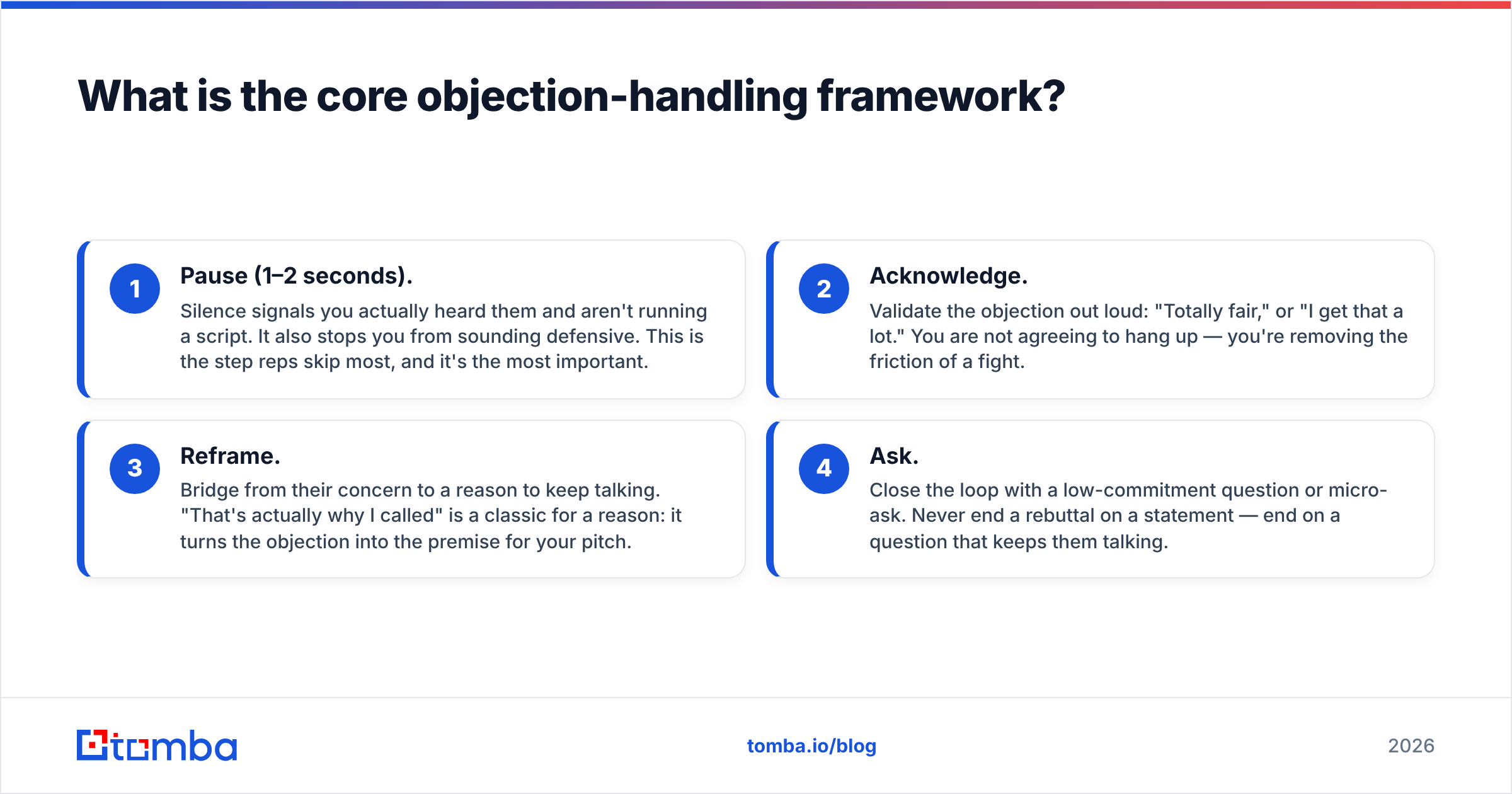
Run every objection through the same 4-step loop: Pause, Acknowledge, Reframe, Ask. It works because it's psychological before it's tactical — you lower the prospect's guard before you make your case.
- Pause (1–2 seconds). Silence signals you actually heard them and aren't running a script. It also stops you from sounding defensive. This is the step reps skip most, and it's the most important.
- Acknowledge. Validate the objection out loud: "Totally fair," or "I get that a lot." You are not agreeing to hang up — you're removing the friction of a fight.
- Reframe. Bridge from their concern to a reason to keep talking. "That's actually why I called" is a classic for a reason: it turns the objection into the premise for your pitch.
- Ask. Close the loop with a low-commitment question or micro-ask. Never end a rebuttal on a statement — end on a question that keeps them talking.
Here's the loop in action against "We already use a competitor":
Prospect: "We already use [Competitor]."
You: (pause) "Makes sense — most teams I call already have something in place. (acknowledge) A lot of them keep it and just plug us in for the accounts [Competitor] can't reach. (reframe) Out of curiosity, where does your current setup fall short today?" (ask)
Notice you never trashed the competitor. You acknowledged reality, reframed to a gap, and handed them an open question. That's the whole game.
What are the most common cold call objections (and how do you respond)?#
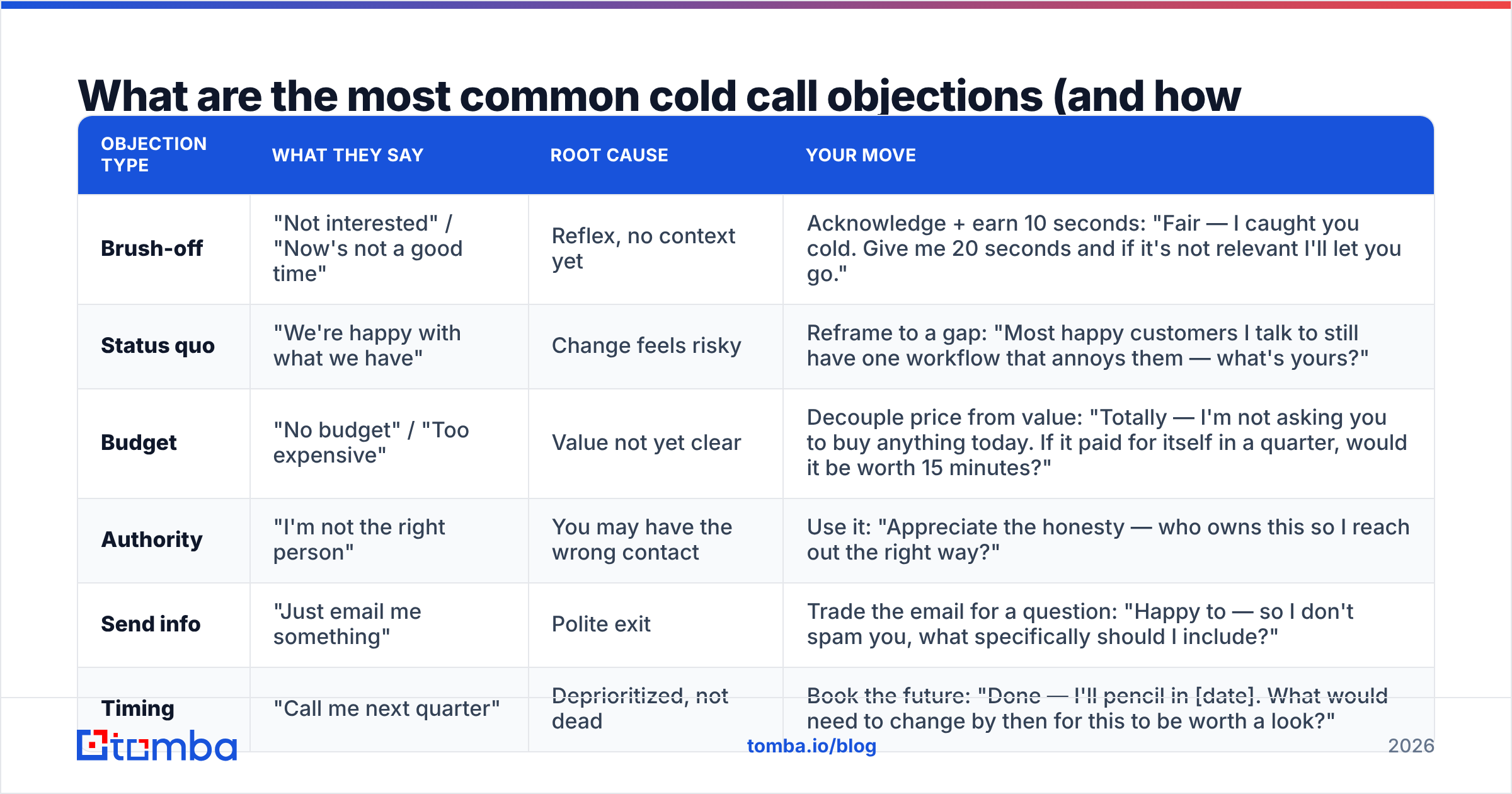
Nearly everything you'll hear collapses into six buckets. Master one response per bucket and improvise the rest.
| Objection type | What they say | Root cause | Your move |
|---|---|---|---|
| Brush-off | "Not interested" / "Now's not a good time" | Reflex, no context yet | Acknowledge + earn 10 seconds: "Fair — I caught you cold. Give me 20 seconds and if it's not relevant I'll let you go." |
| Status quo | "We're happy with what we have" | Change feels risky | Reframe to a gap: "Most happy customers I talk to still have one workflow that annoys them — what's yours?" |
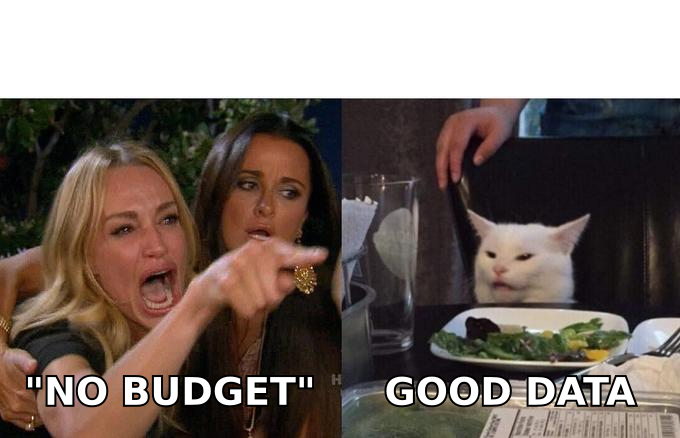
| Budget | "No budget" / "Too expensive" | Value not yet clear | Decouple price from value: "Totally — I'm not asking you to buy anything today. If it paid for itself in a quarter, would it be worth 15 minutes?" |
| Authority | "I'm not the right person" | You may have the wrong contact | Use it: "Appreciate the honesty — who owns this so I reach out the right way?" |
| Send info | "Just email me something" | Polite exit | Trade the email for a question: "Happy to — so I don't spam you, what specifically should I include?" |
| Timing | "Call me next quarter" | Deprioritized, not dead | Book the future: "Done — I'll pencil in [date]. What would need to change by then for this to be worth a look?" |
The "send me info" objection is a trap because it feels like progress. It usually isn't. Ninety percent of "just email me" requests are a soft hang-up. The counter is to make them define what they want — a prospect who tells you what to put in the email is a prospect who's still engaged.
Is handling budget objections different from the rest?#
Yes — budget objections are the one bucket where you must separate price from value before you respond.
When someone says "too expensive" early in a cold call, they can't mean it literally. They haven't seen a quote. What they're really saying is "I don't yet believe this is worth the disruption." So resist the urge to discount. Discounting on a cold call teaches the prospect your price was fake.
Instead, do three things:
- Isolate the objection. "Is it purely the budget, or is there something else too?" This surfaces the real blocker, which is often status quo wearing a budget mask.
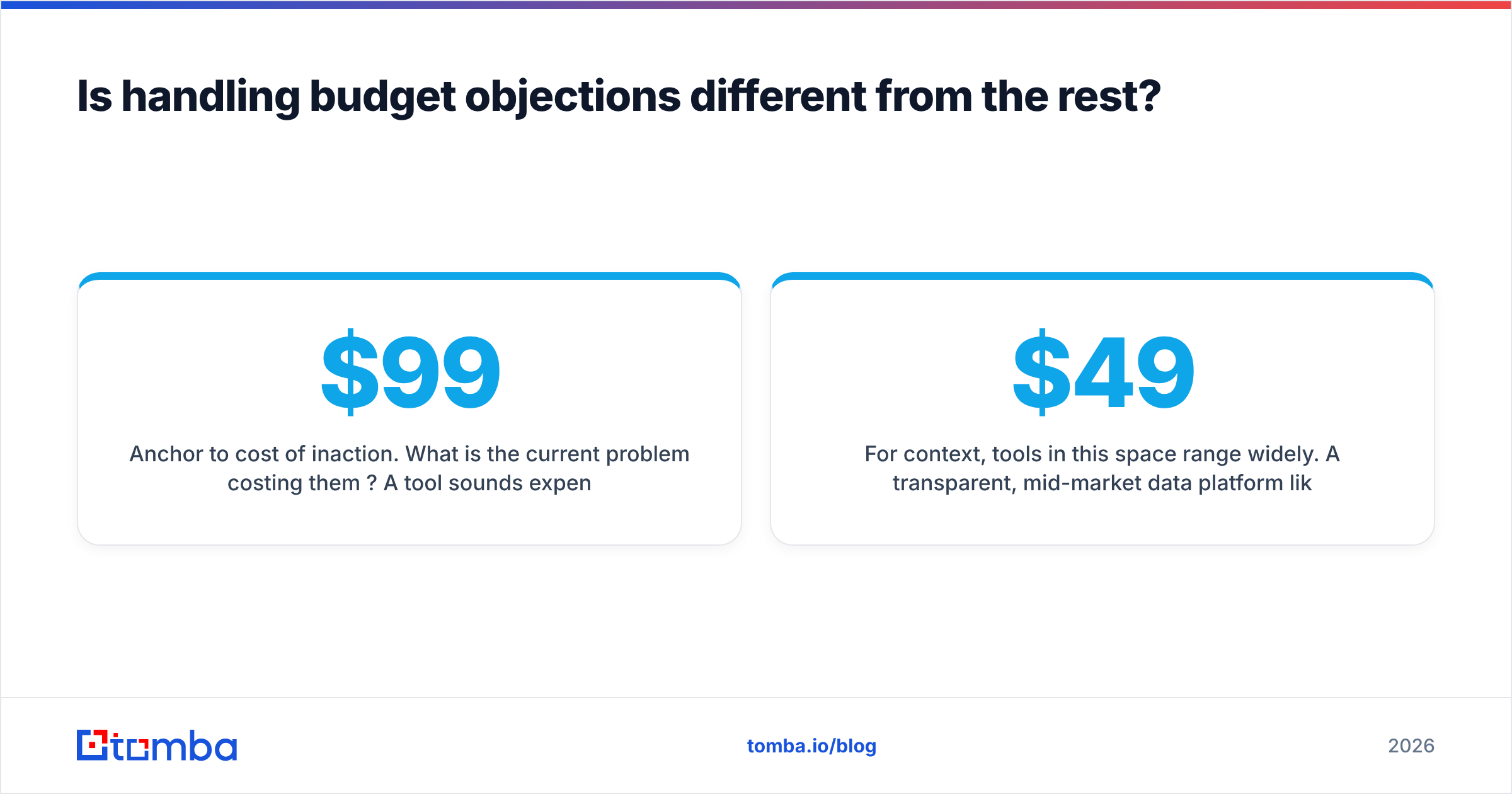
- Anchor to cost of inaction. What is the current problem costing them per month? A $99/mo tool sounds expensive until it's framed against $8,000 in wasted rep hours.
- Shrink the ask. You're not selling the contract on the call — you're selling the next 15-minute meeting. Keep the commitment tiny.
For context, tools in this space range widely. A transparent, mid-market data platform like Tomba runs a Free tier at 25 searches/mo and a Starter plan at $49/mo, which makes the "no budget" objection easy to neutralize when you're building the call list itself — you're not asking them to bet the farm to start.
How do you handle the "we already have a vendor" objection?#
Never attack the incumbent. The moment you say "oh, they're terrible," you've insulted the prospect's past decision — and people defend their decisions harder than they defend their vendors.
Play it as coexistence, then dig for the gap:
"That's great — [Competitor] is solid. Most folks I work with actually run both: they keep [Competitor] for X and use us for the accounts it can't cover. What's the one thing you wish yours did that it doesn't?"
That last question does the heavy lifting. Every tool has a gap. Your job is to find it and make your call about that, not about a rip-and-replace. This is also where knowing your prospect's stack in advance pays off — enrichment that tells you what they already use lets you skip the guessing.

Why does data quality decide the call before you dial?#
Because the smoothest rebuttal in the world fails against the wrong human.
Half of what reps label "objections" are actually data failures in disguise. "I'm not the right person" isn't a real objection — it's a symptom of dialing the wrong contact. "How did you get this number?" happens when your list is scraped and stale. You can't script your way out of bad targeting.
Two data problems quietly wreck cold call connect rates:
- Wrong number. Disconnected lines, personal cells that go to voicemail, and reception gatekeepers all burn your dial budget. Validating numbers before a campaign — with a phone validator — keeps your dial time on live, reachable prospects.
- Wrong title. Calling an IC when a director owns the budget guarantees an authority objection. Enriching your list with accurate roles means you're pitching the person who can actually say yes.
This is where your prospecting stack matters more than your talk track. Building call lists with verified direct dials via a phone finder, and layering on data enrichment for title and company context, means you spend your energy on rebuttals — not on discovering, three minutes in, that you're talking to the wrong department. Pulling from a clean B2B database instead of a scraped CSV changes the character of every conversation.
Put bluntly: a great script on bad data loses to a decent script on good data, every time.
What's a repeatable practice routine to get better?#
Objection handling is a muscle. You build it with reps, not with reading. Here's a weekly routine that compounds:
- Record and review. Pull three calls that died on an objection. Where in the 4-step loop did you skip a step? Almost always it's the pause or the acknowledge.
- Build a rebuttal bank. For each of the six buckets, write your best two responses and rehearse them until they sound like you, not a teleprompter.
- Role-play the hard ones. Have a teammate throw the objection you fear most, ten times in a row, until it stops rattling you.
- Track objection types. Tag every "no" by bucket in your CRM. If 40% of your calls die on "wrong person," your problem isn't your rebuttal — it's your list.
- A/B your openers. The best objection handling is preventing the objection. A stronger first 10 seconds means fewer reflexive brush-offs to handle at all.
Vendors like HubSpot and Salesforce publish call-tracking features that make this tagging trivial — the point is to turn your objections into a dataset, not a bad memory.
Cold call objection handling: the one-page cheat sheet#
If you internalize nothing else, internalize this:
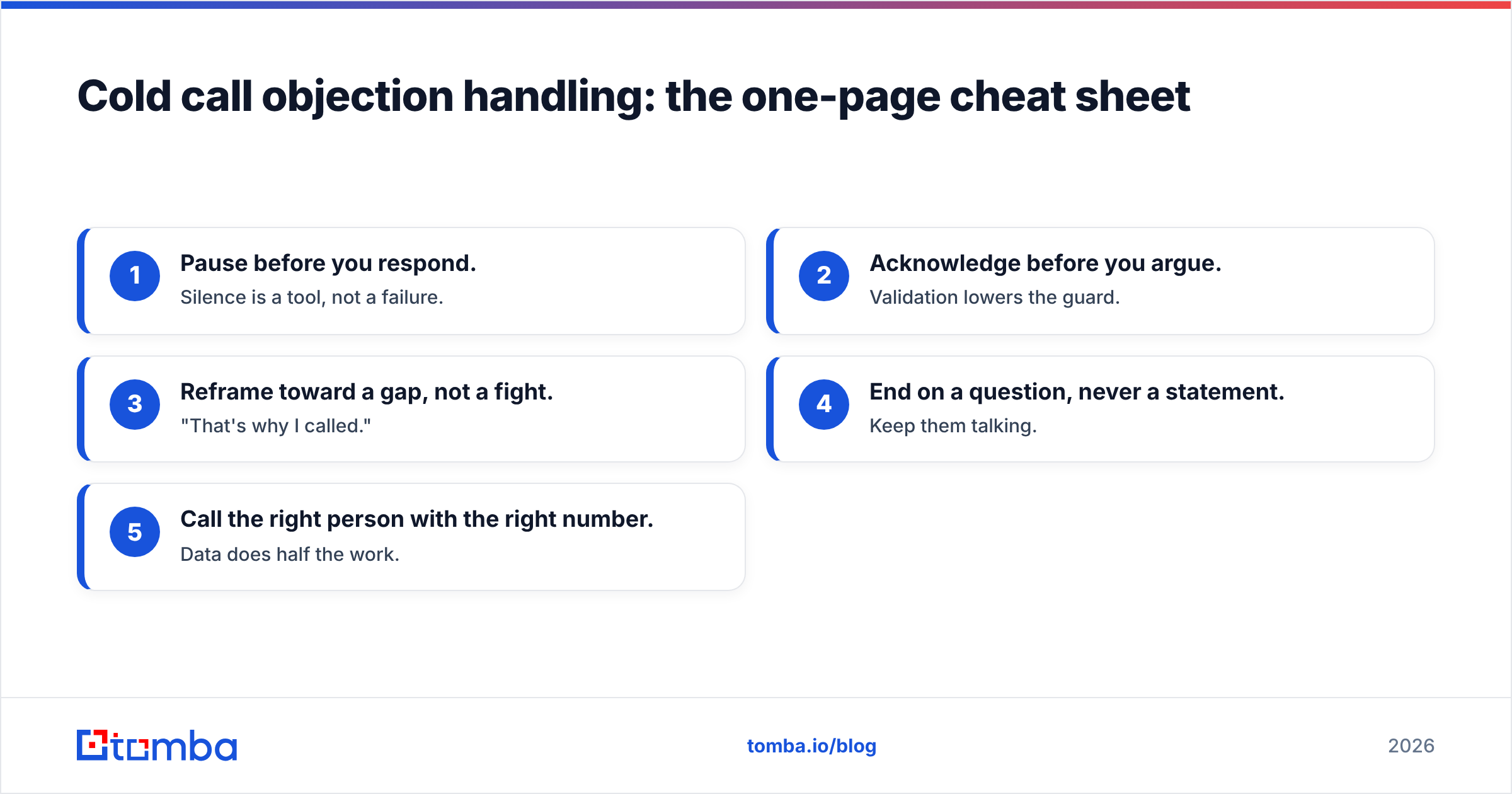
- Pause before you respond. Silence is a tool, not a failure.
- Acknowledge before you argue. Validation lowers the guard.
- Reframe toward a gap, not a fight. "That's why I called."
- End on a question, never a statement. Keep them talking.
- Call the right person with the right number. Data does half the work.
The reps who hit quota aren't the ones with magic words. They're the ones who stay calm through the first "no," ask one more question, and dial a list that was clean before they ever picked up the phone.
Build a call list worth dialing#
Great objection handling starts before the call connects. If your list is full of wrong numbers and mistargeted contacts, you're spending your best rebuttals on the wrong people.
Use the Tomba Email Finder to pull accurate, verified contact data for the accounts you're targeting, then layer on the phone finder to reach decision-makers directly instead of fighting gatekeepers. Start on the free tier, load a clean list, and let your reps do what they do best — hold the line through the first objection and book the meeting. Explore the plans on Tomba pricing and give your team data that makes every rebuttal land on the right ear.
Related guides#
Ready to find emails that actually work?
Join 150,000+ professionals who stopped guessing and started sending. Free credits on signup — no credit card required.
Get the Tomba newsletter
Practical outbound tactics and product updates — once every two weeks.
About the author