Cold Calling Objections: How to Handle the 15 Most Common
The 15 cold calling objections that end most calls early — and word-for-word rebuttals, a framework, and a cheat-sheet table you can keep beside the phone.
Cold calling objections are not rejections — they are reflexes. When a prospect says "I'm not interested" three seconds into your call, they are not evaluating your offer. They are protecting their time from yet another interruption. Once you understand that, the whole game changes: your job is not to "overcome" the reflex with a slicker line, it is to earn five more seconds of attention until the real conversation can start.
This guide breaks down the 15 objections you will hear most, gives you word-for-word rebuttals you can actually say out loud, and hands you a repeatable framework so you are never caught flat-footed again.
TL;DR#
- Most cold calling objections are reflexive brush-offs, not informed decisions — treat them as a request for relevance, not a "no."
- Use the Acknowledge → Isolate → Reframe → Ask framework so every objection gets the same calm, structured response.
- The five deadliest openers — "not interested," "send me an email," "we already use someone," "no budget," and "I'm busy" — each have a specific counter.
- A rebuttal is only as good as your list: dialing accurate direct numbers beats a perfect script aimed at the wrong person.
- Log every objection so you can spot which ones cost you the most meetings and fix the pitch upstream.
Why do prospects object on cold calls?#
Prospects object because a cold call is an interruption, and interruptions trigger a defensive script that runs before the brain fully engages. "I'm not interested" is the human equivalent of an email spam filter — it fires on pattern, not content.
That means the words a prospect uses rarely reflect the actual reason they are hesitating. "Send me an email" can mean "I'm curious but busy," "I want you off the phone," or "prove you're worth my time." Your first task is diagnosis, not persuasion.
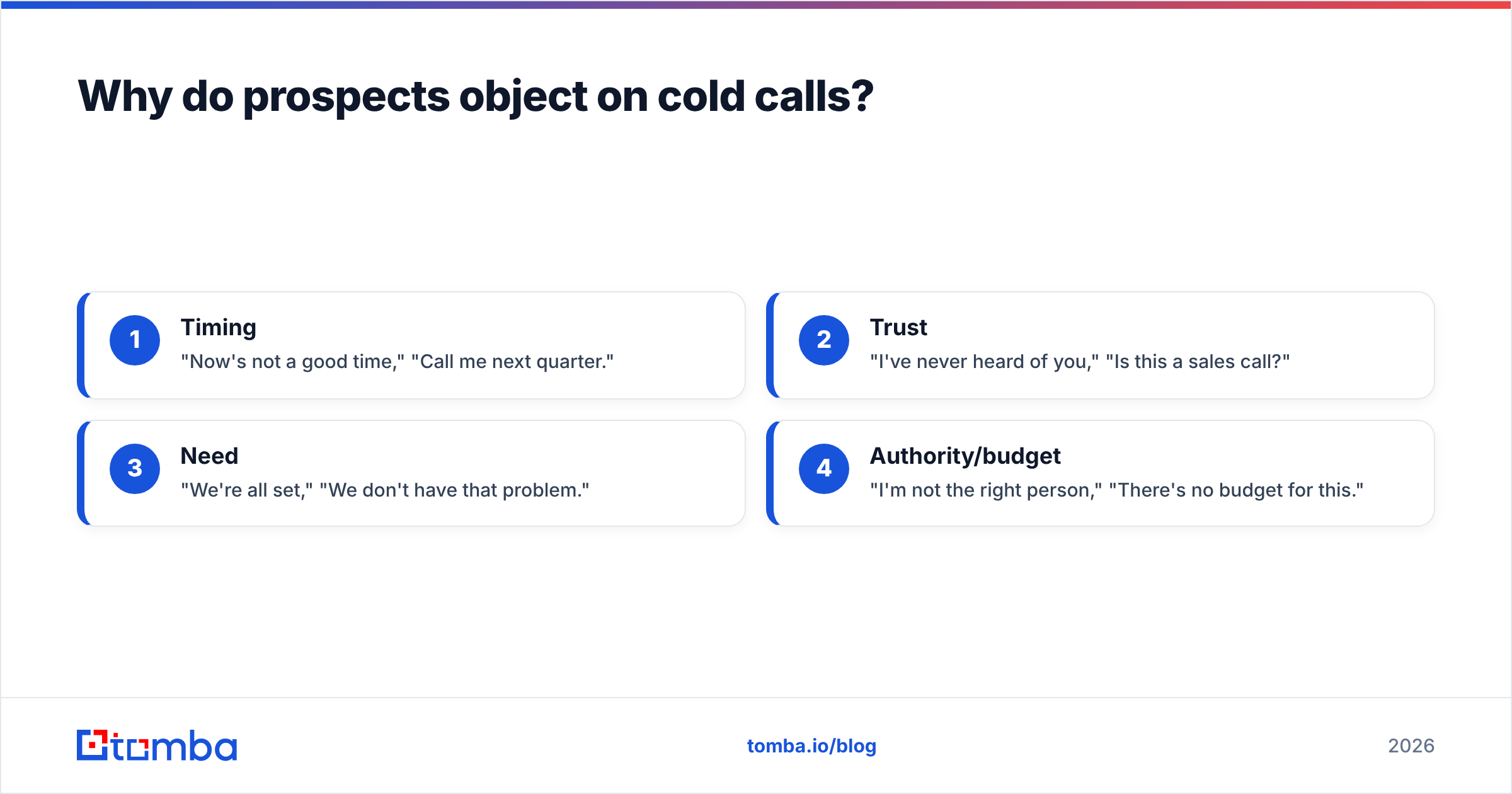
There are really only four families of objection:
- Timing — "Now's not a good time," "Call me next quarter."
- Trust — "I've never heard of you," "Is this a sales call?"
- Need — "We're all set," "We don't have that problem."
- Authority/budget — "I'm not the right person," "There's no budget for this."
When you can instantly file an objection into one of these four buckets, you stop reacting emotionally and start responding tactically. Every rebuttal below maps back to one of them.

What framework should you use to handle any objection?#
Use a four-step loop — Acknowledge → Isolate → Reframe → Ask — for every objection, no matter how it is phrased. It keeps your tone even and buys you the seconds you need.
- Acknowledge. Show you heard them. "Totally fair," or "I get that a lot." This lowers the defensive wall before you say anything else.
- Isolate. Find the real objection. "Is it the timing, or is it that this isn't a priority right now?" You cannot solve an objection you have not diagnosed.
- Reframe. Give one sharp reason the call is still worth 20 seconds — tied to their world, not your pitch.
- Ask. Always end on a question that moves forward. A statement invites a "no"; a question keeps the dialogue open.
The magic is that the framework is objection-agnostic. You memorize one loop, not fifty scripts. Under pressure, a single reliable pattern beats a library of clever one-liners you will never recall mid-dial.
What are the 15 most common cold calling objections (and how do you respond)?#
Below are the objections that end most calls early, sorted by how often they show up. Say the rebuttals in your own voice — memorized-sounding scripts trigger the exact reflex you are trying to defuse.
1. "I'm not interested."#
Acknowledge and isolate. "Fair enough — you can't be interested in something you haven't heard yet. Can I take 20 seconds, and if it's not relevant you hang up on me, no hard feelings?" You are trading a tiny, defined commitment for the chance to be relevant.
2. "Send me an email."#
"Happy to. So I don't send you something you'll delete — what's the one thing that would actually make this worth a look?" You get intel and a reason to follow up with a real subject line instead of a generic deck.
3. "We already use [competitor]."#
"That's great — most of the teams I talk to do. I'm not calling to rip that out. Folks usually take my call because [specific gap the competitor has]. Worth a five-minute compare?"
4. "Now's not a good time."#
"I figured — I'm interrupting your day. Are you the right person for [topic], and if so, when's genuinely better: later today or tomorrow morning?" You confirm fit before you spend a callback.
5. "We don't have the budget."#
"Understood, and I'm not asking you to spend anything today. Most people find budget when the cost of not fixing this is clear. Can I show you that number in five minutes?"
6. "I'm not the right person."#
"No problem — who on your team owns [area]? And would you mind if I mentioned you pointed me their way?" A warm internal referral outperforms a cold restart every time.
7. "How did you get my number?"#
Be transparent. "You're listed as the [role] at [company], so you came up when I was researching who owns this. Did I get that right?" Honesty defuses suspicion faster than a dodge.
8. "Is this a sales call?"#
"It is — I'll be quick and I won't be weird about it. Thirty seconds to tell you why I called, then you decide?" Naming it disarms it.
9. "Just call me back next quarter."#
"Happy to. So next quarter isn't another brush-off — what changes then that makes this a priority?" You separate a real timing objection from a polite exit.
10. "We tried something like this and it didn't work."#
"That's exactly why I called. What went wrong last time? Usually it's [common failure], and that's the part we do differently."
11. "We're happy with what we have."#
"Love hearing that. Quick gut check — if there were one thing you'd improve about it, what would it be?" Even happy buyers have a wish list.
12. "I don't have time for this."#
"Ten seconds, then you tell me to go away or keep going. Deal?" A radically small ask is hard to refuse.
13. "Email me your pricing."#
"I can, but pricing depends on [variable], so a number without context is useless. Two questions and I'll send you a real figure — sound fair?"
14. "We're in a contract."#
"Makes sense — I'm not asking you to break it. When's it up for renewal? I'd rather be the call you're glad you took before you re-sign."
15. "Take me off your list."#
Respect it immediately. "Done — I'll remove you now. Sorry to have caught you at a bad time." Never argue with a hard no; your reputation and your deliverability both depend on it.
Which objections cost the most meetings?#
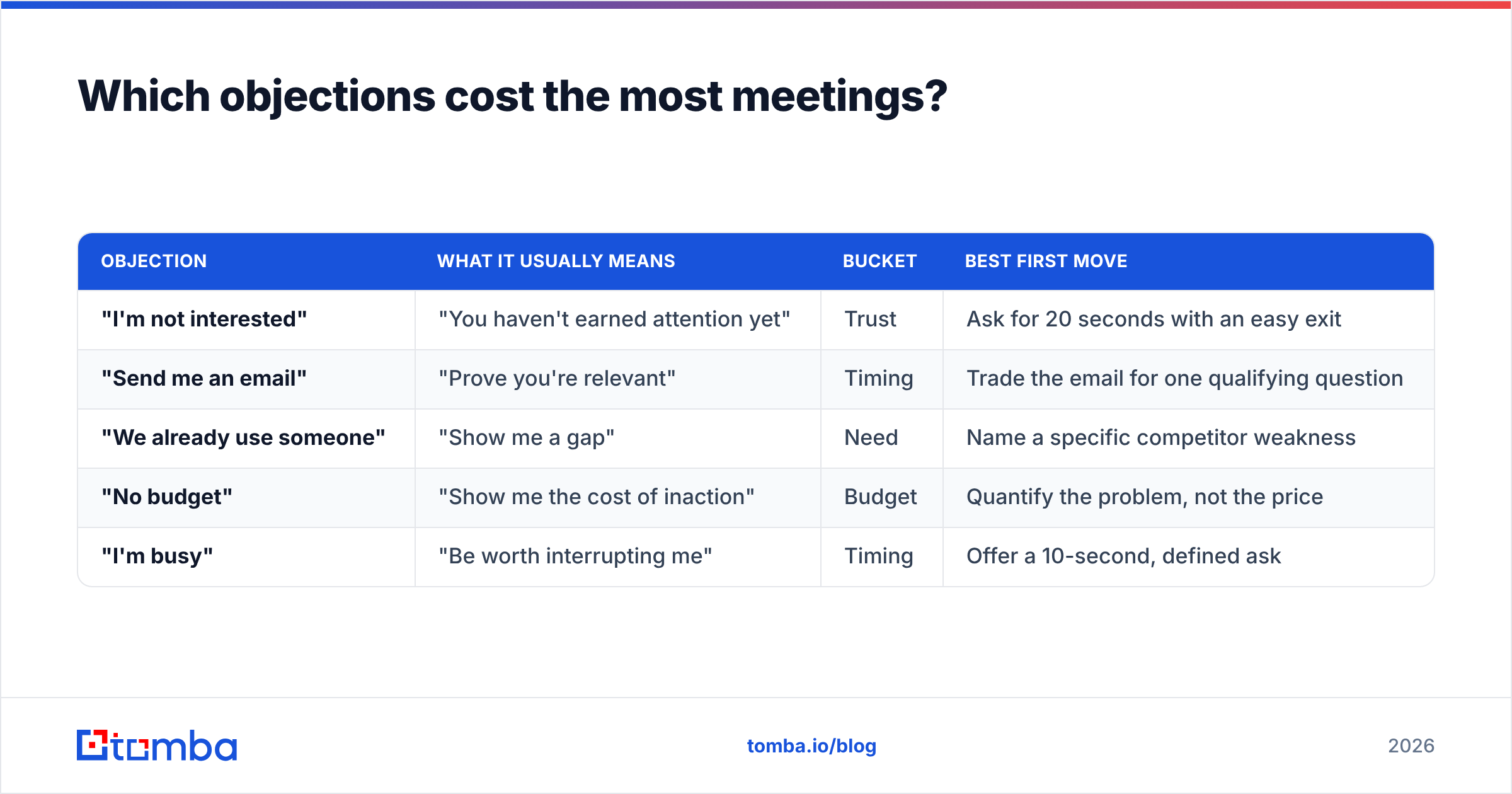
The five reflexive openers cost the most because they arrive before your value ever lands — and most reps fold on them instantly. The table below shows what is really being said and the single highest-leverage move for each.
| Objection | What it usually means | Bucket | Best first move |
|---|---|---|---|
| "I'm not interested" | "You haven't earned attention yet" | Trust | Ask for 20 seconds with an easy exit |
| "Send me an email" | "Prove you're relevant" | Timing | Trade the email for one qualifying question |
| "We already use someone" | "Show me a gap" | Need | Name a specific competitor weakness |
| "No budget" | "Show me the cost of inaction" | Budget | Quantify the problem, not the price |
| "I'm busy" | "Be worth interrupting me" | Timing | Offer a 10-second, defined ask |
Notice that none of the "best first moves" is a hard sell. Each one lowers the stakes of staying on the phone. That is the entire art of handling cold calling objections: make continuing the conversation feel smaller than ending it.
How do you keep your composure when objections stack up?#
Slow down and let silence do the work. New reps rush to fill every pause, which reads as desperation. A confident two-second beat after an objection signals you have heard it before and you are not rattled.
Think of objections like waves at the beach. If you brace stiff against every one, you get knocked over. If you let them pass and stay planted, they lose their force. Technically: pause, breathe, run the framework, and remember that your prospect's tone says more about their day than about your offer.
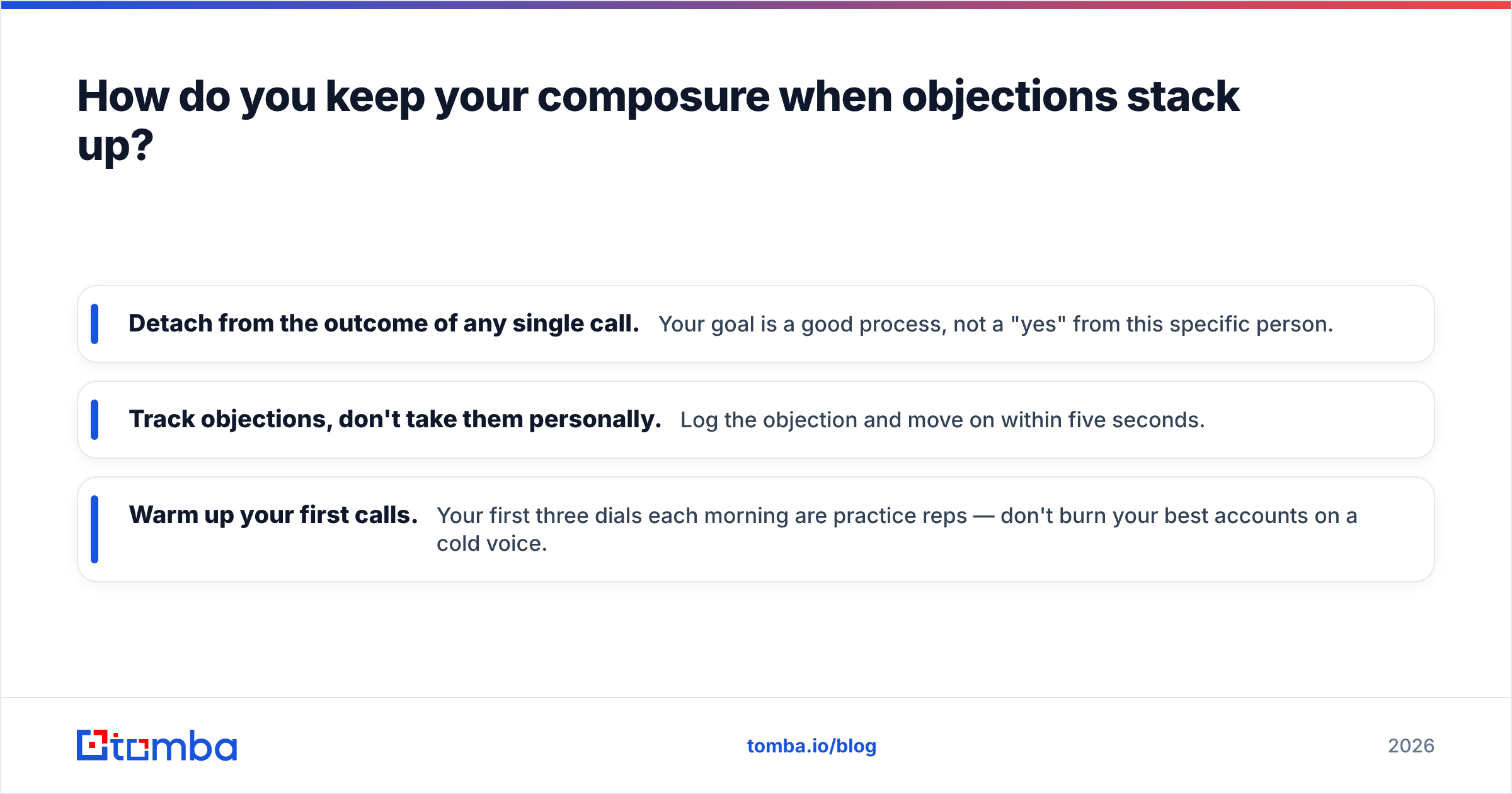
Three habits that protect your composure over a long dial session:
- Detach from the outcome of any single call. Your goal is a good process, not a "yes" from this specific person.
- Track objections, don't take them personally. Log the objection and move on within five seconds.
- Warm up your first calls. Your first three dials each morning are practice reps — don't burn your best accounts on a cold voice.

Do better lists beat better rebuttals?#
Yes — the best rebuttal in the world fails if you are dialing the wrong number or the wrong person. Objection handling is downstream of list quality. Reps who blame their "closing skills" for a bad connect rate are usually fighting a data problem in disguise.
Two data issues silently inflate your objection count:
- Wrong contact. Half of "I'm not the right person" objections vanish when you dial the actual decision-maker's direct line instead of a shared switchboard.
- Stale numbers. Disconnected lines and gatekeeper dead-ends look like objections in your metrics but are really list rot.
This is where prospecting tooling earns its keep. Pulling verified B2B phone numbers for the right title means more of your dials reach a human who can actually say yes. Pairing that with an email finder gives you a second channel for the "send me an email" crowd, so a deferral becomes a follow-up instead of a dead end. And when you track your response rate by segment, you can see whether a slump is a script problem or a list problem.
For teams that want to move faster on the follow-up, a tool like Tomba's cold email AI turns the note you promised on the call into a relevant message in seconds — so "email me" actually converts.
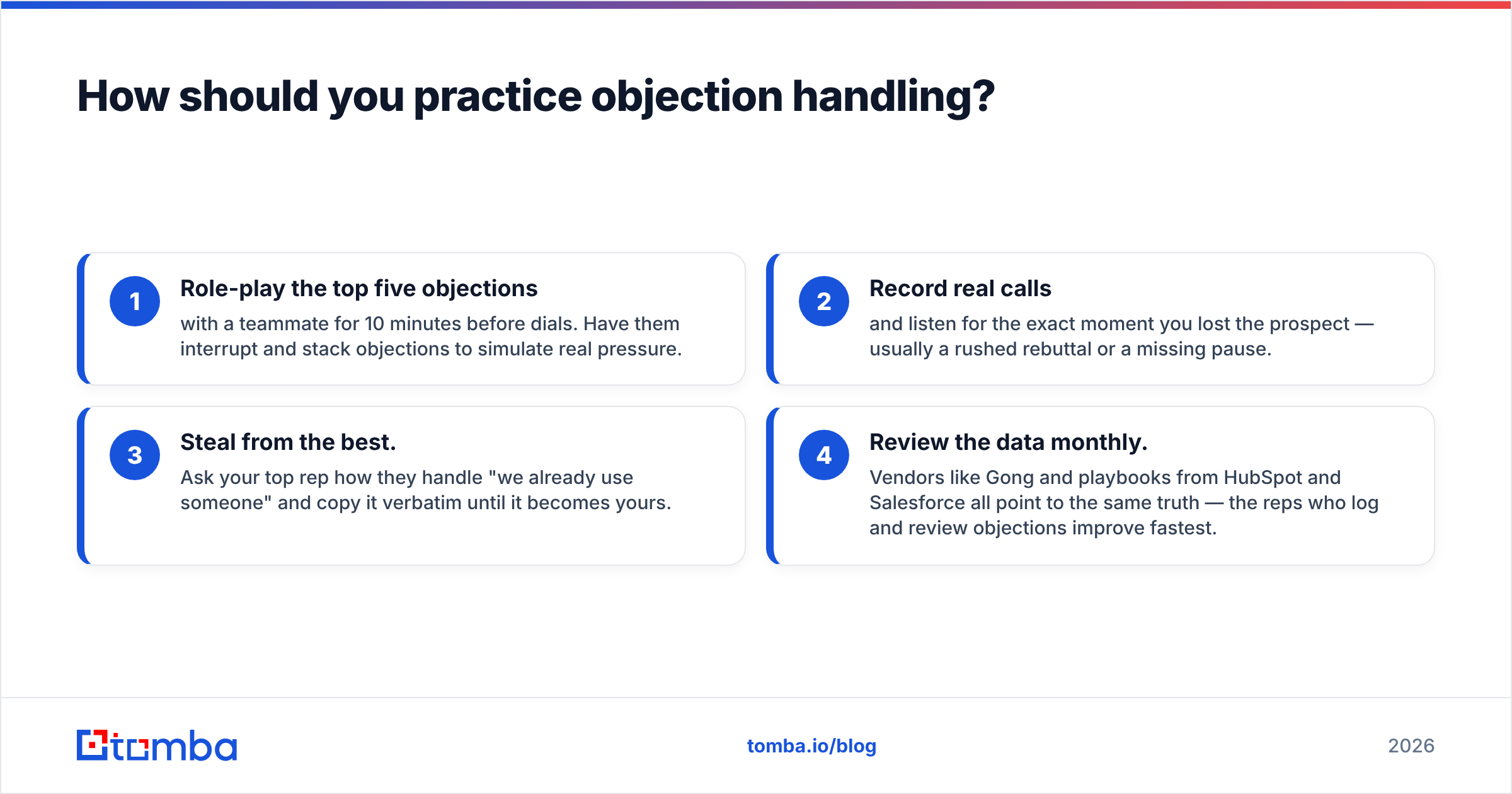
How should you practice objection handling?#
Practice with live role-play and recorded review, not by re-reading scripts. Objections are muscle memory; you cannot build muscle by watching.
A simple weekly cadence works:
- Role-play the top five objections with a teammate for 10 minutes before dials. Have them interrupt and stack objections to simulate real pressure.
- Record real calls and listen for the exact moment you lost the prospect — usually a rushed rebuttal or a missing pause.
- Steal from the best. Ask your top rep how they handle "we already use someone" and copy it verbatim until it becomes yours.
- Review the data monthly. Vendors like Gong and playbooks from HubSpot and Salesforce all point to the same truth — the reps who log and review objections improve fastest.
The point is not to sound scripted. It is to be so comfortable with the framework that you can be fully present with the person on the other end, because you are no longer scrambling for what to say.
The bottom line#
Cold calling objections are not the wall at the end of the call — they are the door into it. Acknowledge the reflex, isolate the real issue, reframe it around the prospect's world, and always end on a question. Then back that skill with clean data so your rebuttals land on the right person, at the right number, at the right time.
Start with the list. If your reps are dialing wrong or dead numbers, no script will save the call. Use Tomba's Email Finder to build accurate, verified contact lists — and pair it with the phone finder so every objection you handle is one worth handling. See Tomba pricing to find the plan that fits your team, starting free with 25 searches a month.
Related guides#
Ready to find emails that actually work?
Join 150,000+ professionals who stopped guessing and started sending. Free credits on signup — no credit card required.
Get the Tomba newsletter
Practical outbound tactics and product updates — once every two weeks.
About the author