Cold Calling on Weekends in 2026: Does It Actually Work?
Weekend cold calling sounds like a shortcut to empty voicemail boxes and gatekeeper-free lines. Here's what the connect-rate data actually says, and when Saturday dials beat a Monday blitz.
Cold calling on weekends is one of those tactics reps whisper about: fewer gatekeepers, quieter phone lines, and decision-makers who might actually pick up. But does it survive contact with real connect-rate data, or is it just a way to burn a Saturday for two conversations?
Short answer: weekends can work, but only for specific segments, specific hours, and only if your list and compliance are airtight. Here's the full breakdown.
TL;DR#
- Weekends aren't a magic bullet. Saturday morning can beat a crowded Tuesday afternoon for some B2B and most B2C-adjacent segments, but Sunday is almost always a waste.
- Timing beats volume. Saturday 10 a.m.–12 p.m. is the sweet spot; avoid early mornings, dinner hours, and anything on Sunday before noon.
- Founders, owners, and small-business buyers answer weekends. Enterprise VPs behind an EA usually do not.
- Compliance still applies. TCPA calling-window rules and Do-Not-Call lists don't take the weekend off — a mistake here is expensive.
- Bad numbers kill weekend campaigns fastest. Verified direct-dial data is the difference between 30 conversations and 30 disconnected tones.
Does cold calling on weekends actually work?#
It depends less on the day and more on who you're calling. The old sales-floor logic is real: on a weekend, the person who screens calls Monday through Friday is off. If your buyer is a founder, an owner-operator, a solo practitioner, or anyone who is their own gatekeeper, the weekend strips away the biggest obstacle in outbound — the layer between you and the decision.
But that same logic collapses for enterprise. A VP of Engineering at a 4,000-person company isn't sitting by their desk phone on Saturday, and their cell is on Do Not Disturb. You'll hit voicemail, and worse, you may annoy a high-value prospect enough to poison a future weekday touch.
So the honest framing isn't "do weekends work?" It's "does my segment answer on weekends?" For a huge slice of SMB and prosumer B2B selling, the answer is yes — often at a higher rate than a saturated weekday window where every other SDR in your category is dialing the same list.
What does the connect-rate data say about weekend calls?#
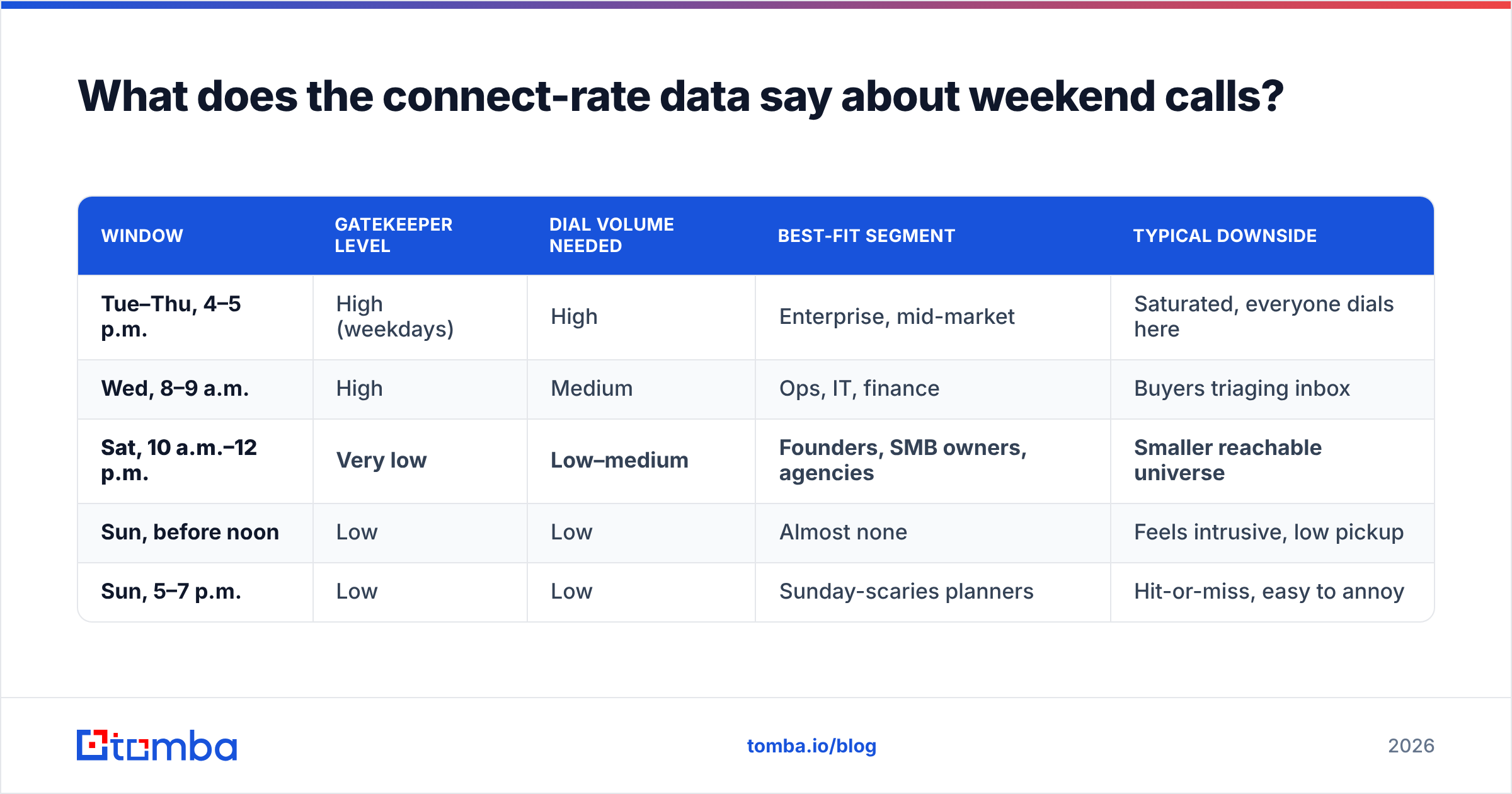
Published cold-call benchmarks consistently show mid-week (Tuesday–Thursday) as the highest-volume connect window, and that's true. But volume and rate aren't the same thing. Weekday afternoons carry the most connects mostly because that's when the most calls are placed — the airwaves are crowded.
The interesting signal is per-dial efficiency. When far fewer reps are dialing (weekends), a smaller number of calls can convert at a comparable or better rate for the right segment, because you're not the fifth interruption of the buyer's morning. Industry roundups from teams like Gong and general benchmarks aggregated on G2 reinforce the same theme: connect rate is driven by relevance and timing, not the calendar square alone.
Here's a realistic way to think about the trade-off:
| Window | Gatekeeper level | Dial volume needed | Best-fit segment | Typical downside |
|---|---|---|---|---|
| Tue–Thu, 4–5 p.m. | High (weekdays) | High | Enterprise, mid-market | Saturated, everyone dials here |
| Wed, 8–9 a.m. | High | Medium | Ops, IT, finance | Buyers triaging inbox |
| Sat, 10 a.m.–12 p.m. | Very low | Low–medium | Founders, SMB owners, agencies | Smaller reachable universe |
| Sun, before noon | Low | Low | Almost none | Feels intrusive, low pickup |
| Sun, 5–7 p.m. | Low | Low | Sunday-scaries planners | Hit-or-miss, easy to annoy |
The pattern: Saturday late morning is the weekend window worth testing. Sunday is mostly noise, with a narrow "planning for the week" pocket on Sunday evening for specific buyers.
Who should you actually call on a weekend?#
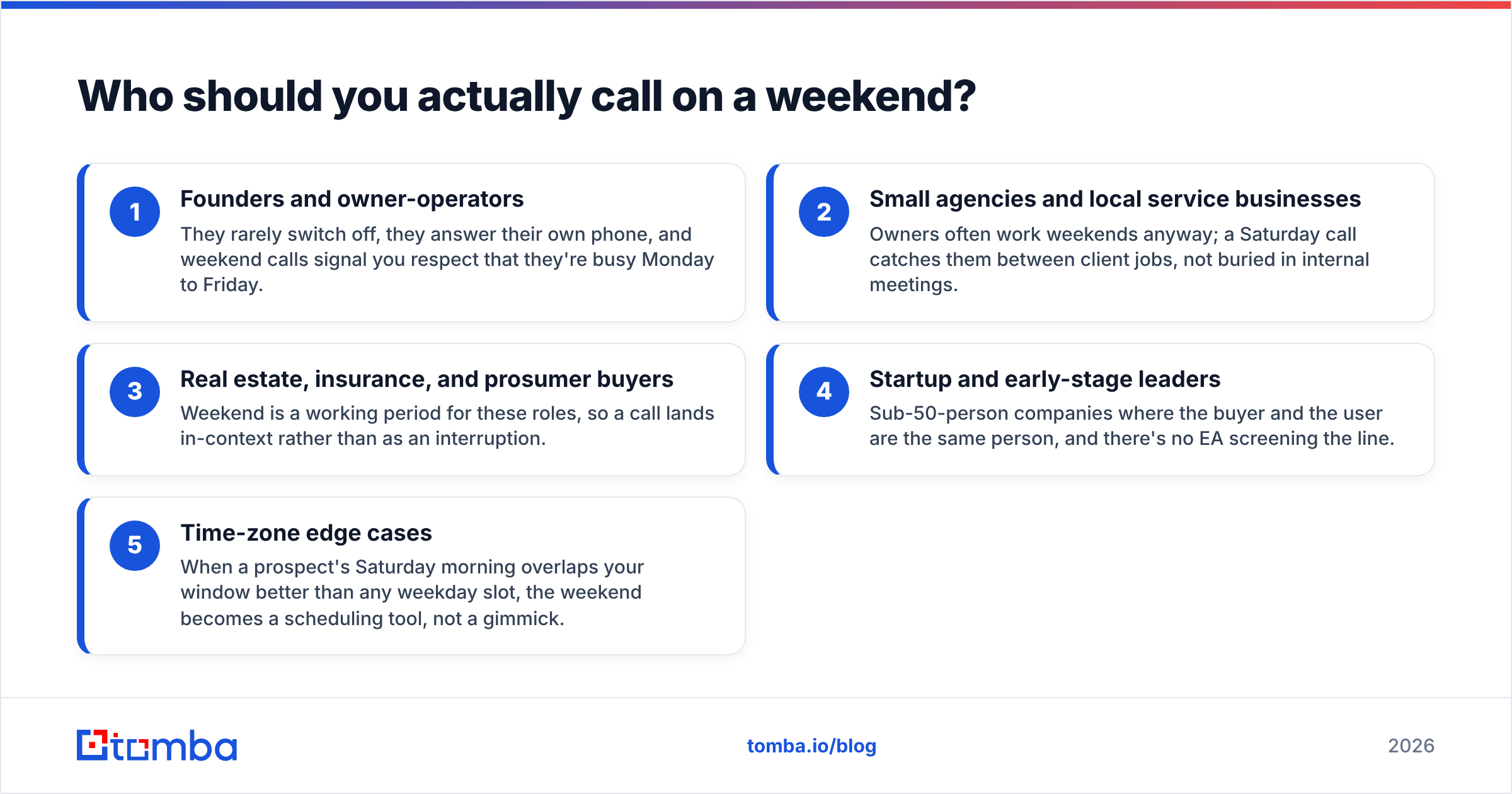
Use this as a quick qualification filter before you build a weekend list:
- Founders and owner-operators — They rarely switch off, they answer their own phone, and weekend calls signal you respect that they're busy Monday to Friday.
- Small agencies and local service businesses — Owners often work weekends anyway; a Saturday call catches them between client jobs, not buried in internal meetings.
- Real estate, insurance, and prosumer buyers — Weekend is a working period for these roles, so a call lands in-context rather than as an interruption.
- Startup and early-stage leaders — Sub-50-person companies where the buyer and the user are the same person, and there's no EA screening the line.
- Time-zone edge cases — When a prospect's Saturday morning overlaps your window better than any weekday slot, the weekend becomes a scheduling tool, not a gimmick.
Who to skip: enterprise VPs and C-suite behind assistants, anyone in a heavily regulated schedule, and any contact you only have a main office line for (nobody's in the office Saturday).
When on the weekend should you call?#
Timing on weekends is even more sensitive than on weekdays, because you're calling someone during their personal time. Get the hour wrong and you don't just miss — you damage the relationship.
- Best: Saturday 10 a.m. to 12 p.m. The buyer is awake, caffeinated, not yet deep into family plans, and mentally still half in work mode.
- Decent: Saturday 4 p.m. to 6 p.m. A quieter second window before evening plans start.
- Narrow: Sunday 5 p.m. to 7 p.m. The "prepping for Monday" mindset opens a small door for planning-oriented buyers.
- Avoid: Before 9 a.m., during lunch (12–2 p.m.), dinner (6–8 p.m.), and all of Sunday morning.
Whatever window you choose, keep the opener explicitly weekend-aware: "I know it's Saturday, so I'll be quick." Acknowledging the day lowers the buyer's defenses and buys you the first 20 seconds.
Is weekend cold calling legal?#
Yes — with the same rules that govern any cold call, and they do not relax on weekends. In the U.S., the TCPA restricts telemarketing calls to between 8 a.m. and 9 p.m. in the called party's local time zone, and requires you to honor the National Do-Not-Call Registry for applicable calls. That 8 a.m.–9 p.m. window applies Saturday and Sunday too.
Practical guardrails:
- Scrub against DNC lists before every weekend push, not just quarterly.
- Respect the local time zone of the number, not your own — a 10 a.m. call for you might be 7 a.m. for them.
- Keep records of consent and call times; weekend campaigns get scrutinized the same way weekday ones do.
- B2B has some carve-outs, but "it's a business number" is not a blanket exemption — verify before you assume.
When in doubt, treat weekend rules as identical to weekday rules and you'll stay clean. The upside of a Saturday connect is never worth a compliance violation.
Why does list quality matter even more on weekends?#
Because weekends give you a smaller reachable universe, every dial has to count — and a bad number is a wasted shot you can't afford. On a weekday you might power through 120 dials and shrug off the disconnects. On a Saturday with a 40-dial plan, 12 dead numbers means you've lost 30% of your entire session before you said a word.
Two things wreck weekend efficiency:
- Office landlines instead of direct dials. Nobody's at the main office Saturday. You need mobile or direct numbers.
- Stale or unverified data. Job changes, ported numbers, and dead lines turn a tight window into a dialing-the-void exercise.
This is where your data provider does the heavy lifting. Pulling accurate direct-dial numbers and confirming they're live before the weekend means your session is 40 real conversations, not 40 attempts. Tomba's phone finder surfaces B2B phone numbers tied to verified contacts, and running the list through a phone validator filters out dead lines before you dial. If you're building the contact list from scratch, pairing an email finder with phone data lets you follow up across channels when a Saturday call goes to voicemail.
How do weekend calls compare to weekday calls and other channels?#
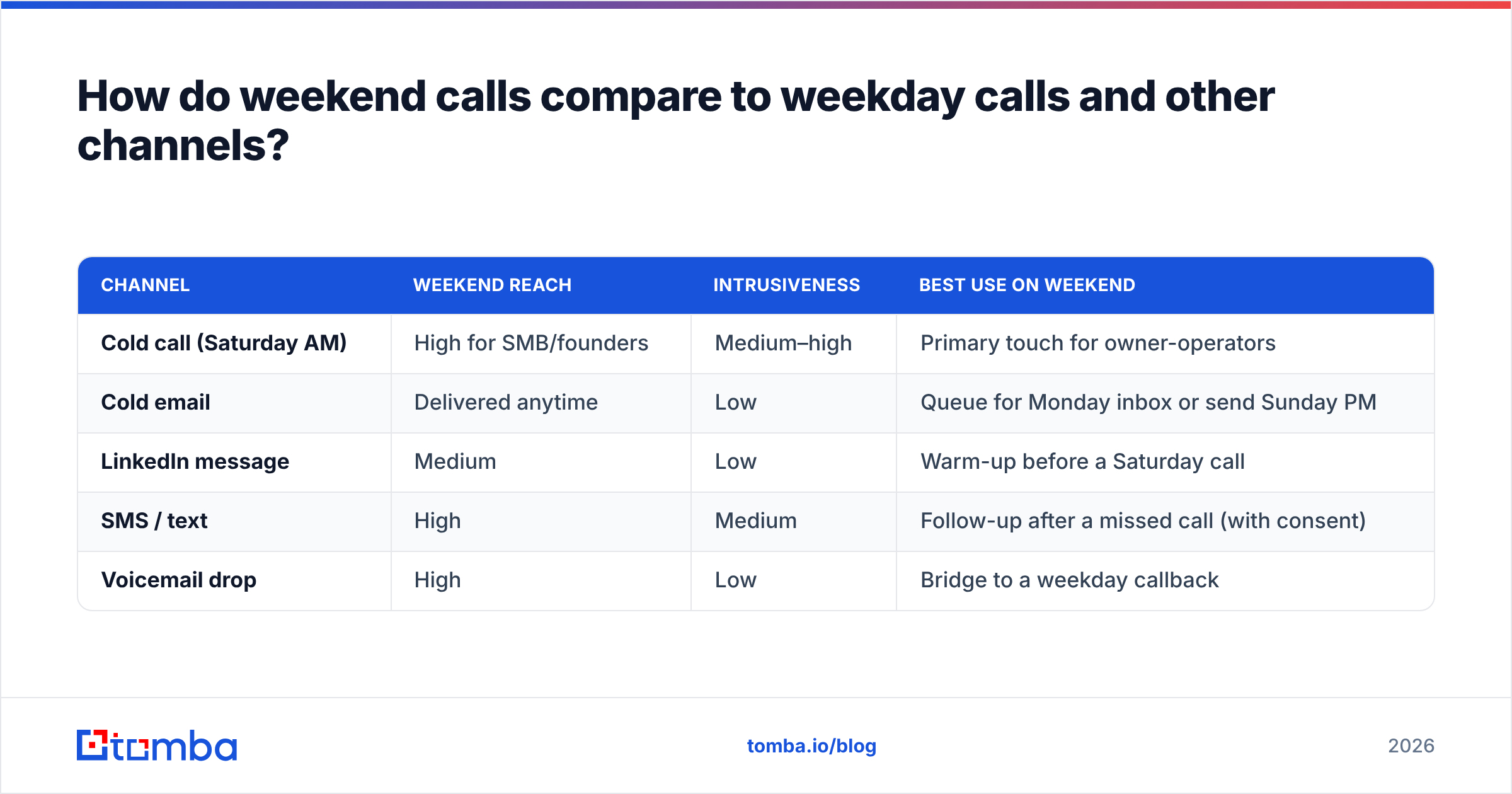
Cold calling isn't the only weekend-reachable channel, and the smartest outbound motions blend them. Here's how the main options stack up for weekend outreach:
| Channel | Weekend reach | Intrusiveness | Best use on weekend |
|---|---|---|---|
| Cold call (Saturday AM) | High for SMB/founders | Medium–high | Primary touch for owner-operators |
| Cold email | Delivered anytime | Low | Queue for Monday inbox or send Sunday PM |
| LinkedIn message | Medium | Low | Warm-up before a Saturday call |
| SMS / text | High | Medium | Follow-up after a missed call (with consent) |
| Voicemail drop | High | Low | Bridge to a weekday callback |
The winning play is rarely "weekend calls instead of everything else." It's sequencing: a Saturday morning dial, an immediate follow-up email if it goes to voicemail, and a LinkedIn touch to keep the thread warm into the week. A tool like LinkedIn finder helps you line up those parallel channels against the same verified contact, so a missed call doesn't mean a lost lead.
For the email side of that sequence, verifying addresses with an email verifier before you send protects your sender reputation — a bounced weekend blast can quietly wreck your Monday deliverability.
What does a weekend calling session look like in practice?#
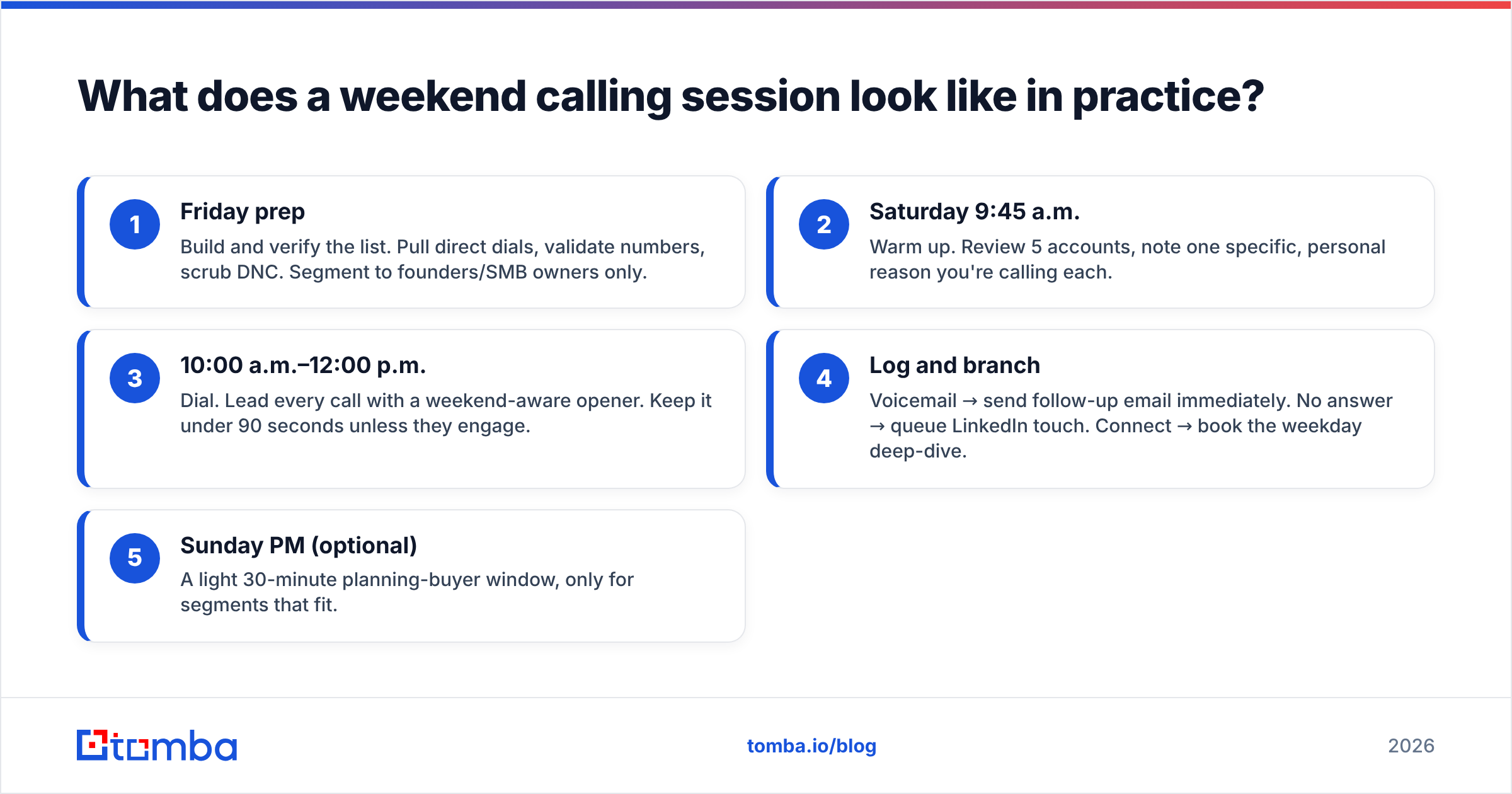
A repeatable Saturday session:
- Friday prep — Build and verify the list. Pull direct dials, validate numbers, scrub DNC. Segment to founders/SMB owners only.
- Saturday 9:45 a.m. — Warm up. Review 5 accounts, note one specific, personal reason you're calling each.
- 10:00 a.m.–12:00 p.m. — Dial. Lead every call with a weekend-aware opener. Keep it under 90 seconds unless they engage.
- Log and branch — Voicemail → send follow-up email immediately. No answer → queue LinkedIn touch. Connect → book the weekday deep-dive.
- Sunday PM (optional) — A light 30-minute planning-buyer window, only for segments that fit.
Two hours, a tight verified list, and disciplined branching will out-produce a scattershot four-hour Saturday marathon on a stale list every time.
The verdict on cold calling on weekends#
Weekend cold calling works when three things line up: the right segment (founders and SMB owners, not gated enterprise), the right hour (Saturday 10 a.m.–noon), and the right data (verified direct dials, scrubbed for compliance). Miss any one and you're burning a weekend for two conversations and a stack of disconnected tones.
Treat it as a precision tool, not a volume hack. Test one Saturday session against your best weekday window, measure connect rate rather than raw connects, and let the data tell you whether your segment picks up on weekends.
Before you dial a single number this Saturday, make sure the numbers are real. Start with Tomba's Email Finder to build verified, enriched contact lists — then layer in phone data so every weekend dial reaches a live line instead of a dead one. Check the Tomba pricing tiers (a free tier to test, Starter at $49/mo when you scale) and give your weekend outbound the accurate data it needs to convert.
Related guides#
Ready to find emails that actually work?
Join 150,000+ professionals who stopped guessing and started sending. Free credits on signup — no credit card required.
Get the Tomba newsletter
Practical outbound tactics and product updates — once every two weeks.
About the author