Cold Calling Outsourcing in 2026: A Complete, Honest Guide
Should you outsource cold calling or build in-house? A neutral breakdown of costs, models, risks, and the data quality that decides whether outsourced dialing actually books meetings.
Cold calling outsourcing sounds like a shortcut: pay a vendor, get booked meetings, skip the hiring headache. Sometimes that is exactly what happens. Just as often, teams sign a three-month contract, hand over a stale list, and get back a spreadsheet of "conversations" that never convert. The difference is rarely the vendor's script — it is the setup around it.
This guide walks through when outsourcing cold calling makes sense, what it actually costs, the models available, and the one variable that quietly decides the outcome: the quality of the data your dialers are working from.
TL;DR#
- Cold calling outsourcing means paying a third party — a BPO, an agency, or offshore SDRs — to make outbound calls on your behalf, usually to book meetings or qualify leads.
- It works best when your offer is proven and your bottleneck is dialing volume, not messaging. It fails when you outsource strategy you have not figured out yourself.
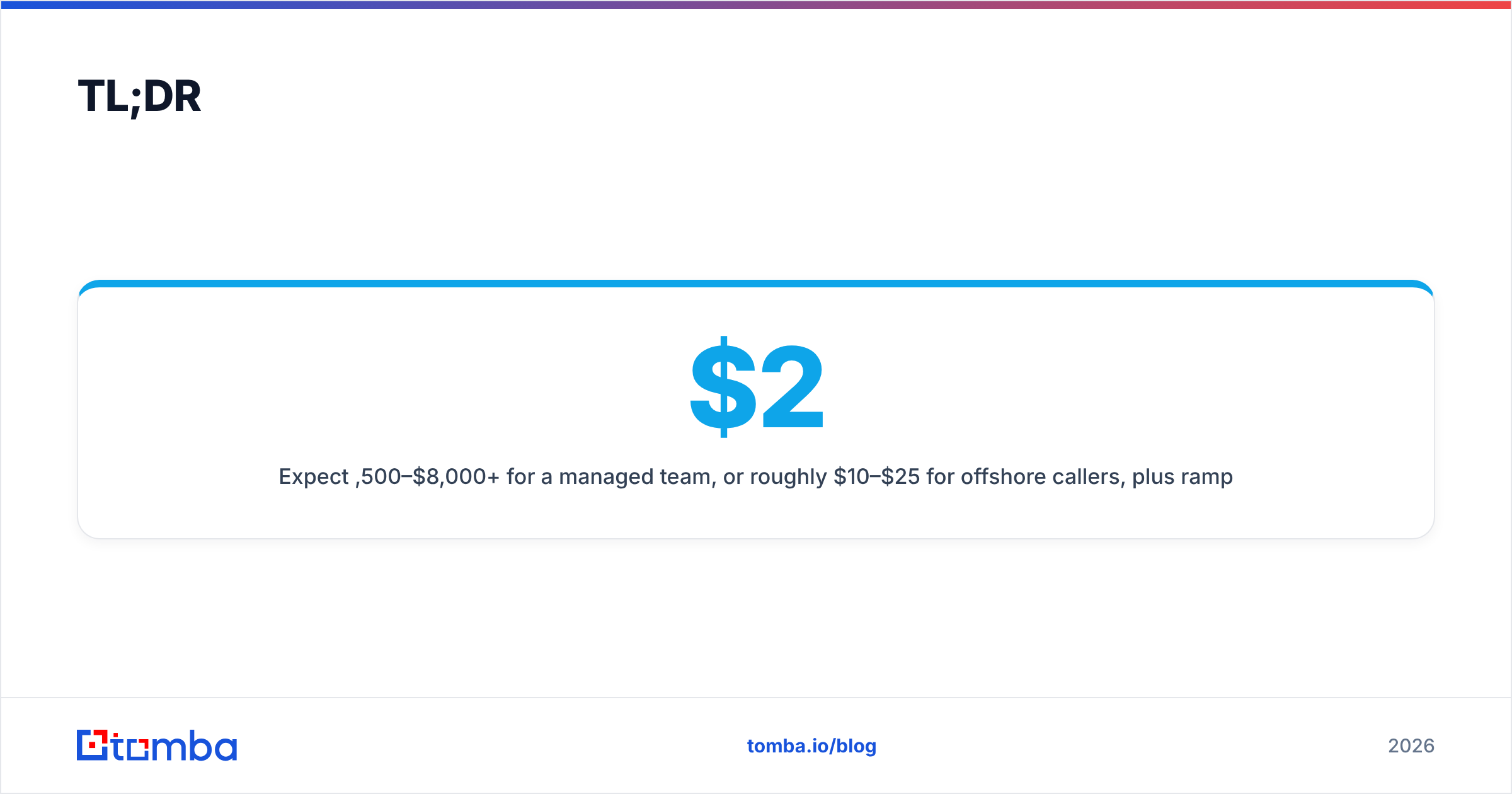
- Expect $2,500–$8,000+ per month for a managed team, or roughly $10–$25 per hour for offshore callers, plus ramp time.
- Data quality beats vendor quality. A great caller working from wrong numbers loses to an average caller with verified, enriched contacts.
- Hybrid models win most often: keep strategy and closing in-house, outsource the top-of-funnel dialing, and feed the whole thing accurate contact data.
What Is Cold Calling Outsourcing?#
Cold calling outsourcing is hiring an external team to make outbound sales calls to prospects who have not opted in. Think of it like hiring a catering company for a party: you still decide the menu and the guest list, but someone else does the cooking and serving at scale. You define the offer, the target market, and the qualification criteria; the vendor supplies trained callers, dialing infrastructure, and daily activity.
The arrangement usually covers one of three outcomes:
- Appointment setting — the vendor books qualified meetings straight into your reps' calendars.
- Lead qualification — callers verify budget, authority, need, and timing, then hand warm leads to your closers.
- Full-cycle SDR-as-a-service — the vendor runs discovery and light nurturing before passing an opportunity.
The vendor rarely closes deals. Outsourced calling is a top-of-funnel engine, not a replacement for your account executives.
Why Do Companies Outsource Cold Calling?#
The honest reasons fall into a few buckets, and not all of them are good ones.
- Speed to volume. Standing up an in-house SDR team takes months of recruiting, onboarding, and management. A vendor can be dialing in two to three weeks.
- Cost predictability. Instead of salaries, benefits, tools, and turnover, you pay a fixed monthly fee or hourly rate.
- Reps hate cold calling. Many closers are far more effective on warm, qualified conversations. Outsourcing the grind can lift morale and focus.
- Geographic or timezone coverage. Vendors with distributed teams can cover markets your team cannot reach.
The bad reason: outsourcing because you cannot make cold calling work yourself. If your message does not convert when your own team dials, a vendor will not magically fix it. They will just burn your list faster. According to HubSpot's sales research, personalization and relevance drive connect and conversion rates — and both depend on inputs only you can define.
In-House vs Outsourced vs Hybrid: Which Model Fits?#
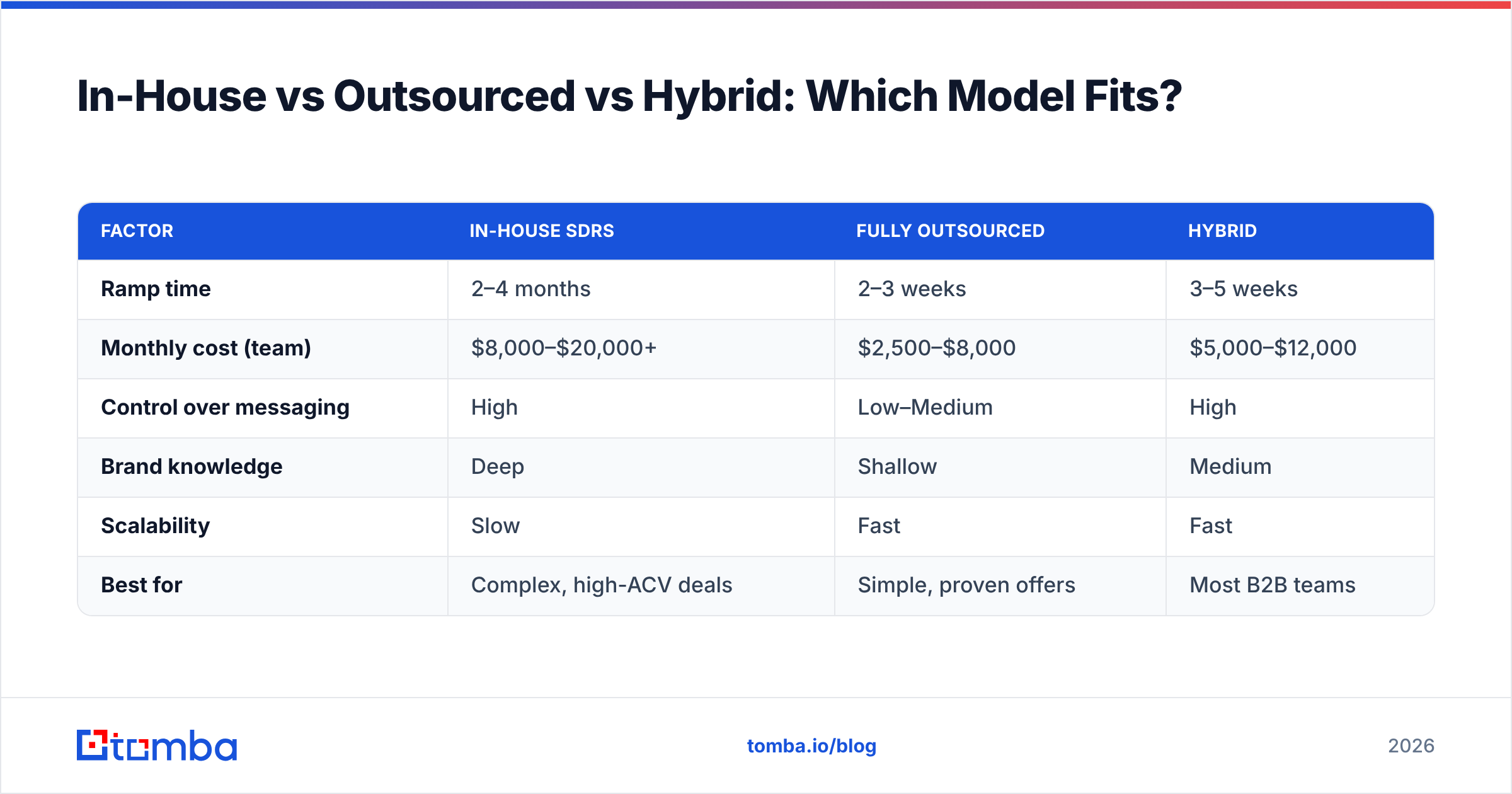
There is no universally correct answer; there is only the right fit for your stage and margins. Here is a direct comparison.
| Factor | In-House SDRs | Fully Outsourced | Hybrid |
|---|---|---|---|
| Ramp time | 2–4 months | 2–3 weeks | 3–5 weeks |
| Monthly cost (team) | $8,000–$20,000+ | $2,500–$8,000 | $5,000–$12,000 |
| Control over messaging | High | Low–Medium | High |
| Brand knowledge | Deep | Shallow | Medium |
| Scalability | Slow | Fast | Fast |
| Best for | Complex, high-ACV deals | Simple, proven offers | Most B2B teams |
In-house wins when your sale is complex, your average contract value is high, and brand nuance matters on every call. Fully outsourced fits simple, transactional offers where the pitch is easy to teach. Hybrid — you own strategy, scripting, and closing while a vendor supplies dialing volume — is where most growing B2B teams land, because it keeps the expensive judgment in-house and rents the repetitive labor.
How Much Does It Cost to Outsource Cold Calling?#
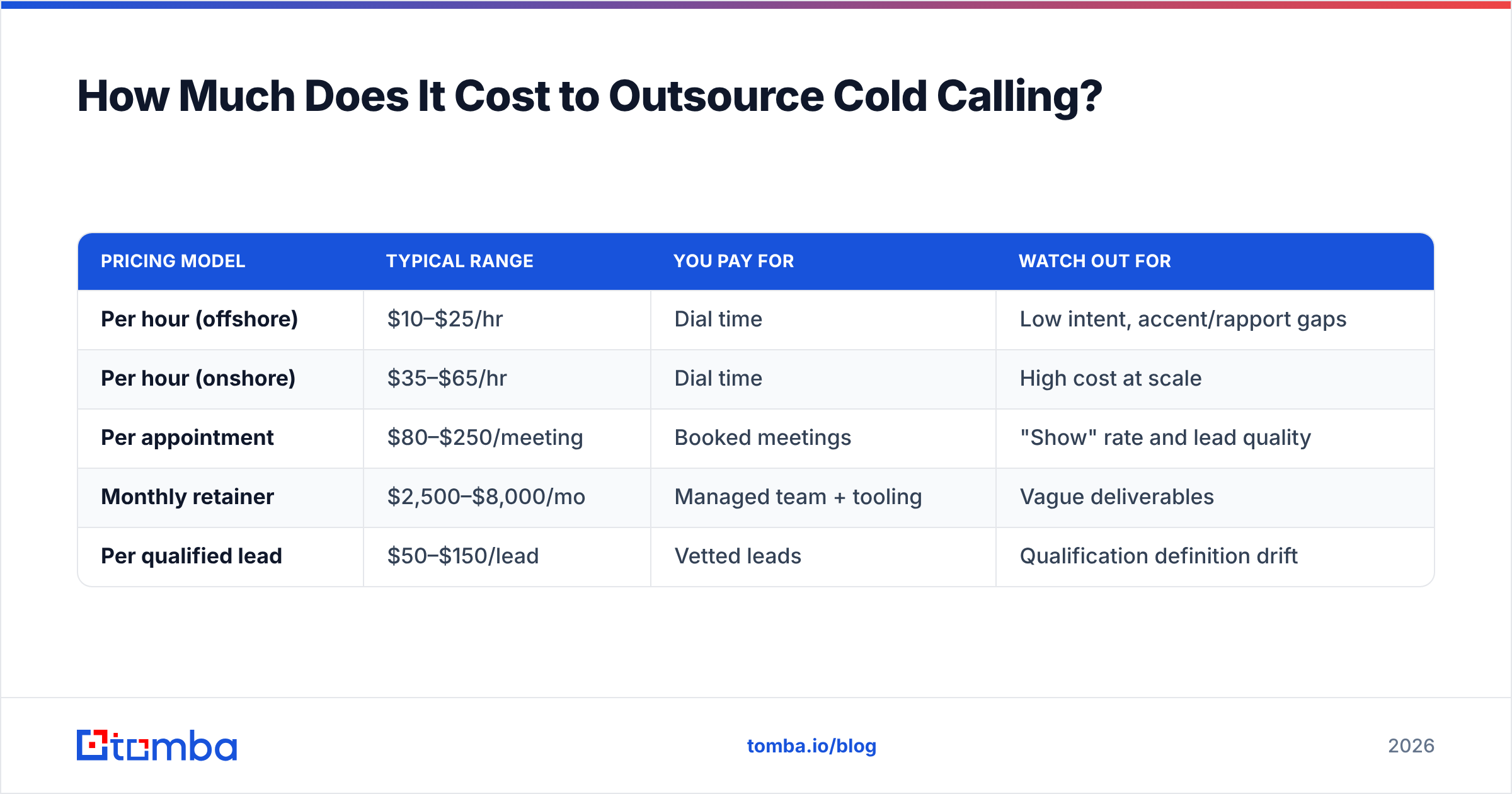
Pricing models vary, and the cheapest option is almost never the cheapest outcome.
| Pricing model | Typical range | You pay for | Watch out for |
|---|---|---|---|
| Per hour (offshore) | $10–$25/hr | Dial time | Low intent, accent/rapport gaps |
| Per hour (onshore) | $35–$65/hr | Dial time | High cost at scale |
| Per appointment | $80–$250/meeting | Booked meetings | "Show" rate and lead quality |
| Monthly retainer | $2,500–$8,000/mo | Managed team + tooling | Vague deliverables |
| Per qualified lead | $50–$150/lead | Vetted leads | Qualification definition drift |
The trap is per-appointment pricing. It sounds risk-free — you only pay for meetings — but it incentivizes the vendor to book anyone, inflating no-show rates and wasting your closers' time. Retainers with clear activity and quality SLAs usually produce healthier pipelines. Whatever the model, budget for a 30–60 day ramp before results stabilize.
What Actually Determines Success? (Hint: It's the Data)#
Here is the part vendors rarely lead with: the biggest predictor of outsourced calling ROI is the accuracy of your contact list. A caller can only be as good as the numbers and names in front of them.
Consider the math. If 30% of your list has wrong or dead phone numbers, then nearly a third of every paid dialing hour is wasted before a word is spoken. Offshore rates look cheap until you realize you are paying people to hear "the number you dialed is not in service."
This is where your prep work — not the vendor — makes or breaks the campaign. Before you hand over a single record, your list should be:
- Verified — dead and disconnected numbers removed so dial time is spent on live prospects.
- Enriched — job title, company, and context attached so the caller can personalize the opener.
- Deduplicated — no prospect gets called twice by different reps in the same week.
- Compliant — scrubbed against do-not-call registries for the regions you target.
Tools like a phone finder and a phone validator exist precisely to close this gap, pairing decision-maker mobile numbers with a live-status check so your outsourced team dials real people. Layering in data enrichment means each caller opens with relevance instead of a generic script. Feed a vendor clean, enriched data and even an average team performs; feed them a scraped, unverified list and the best team on earth will underdeliver.
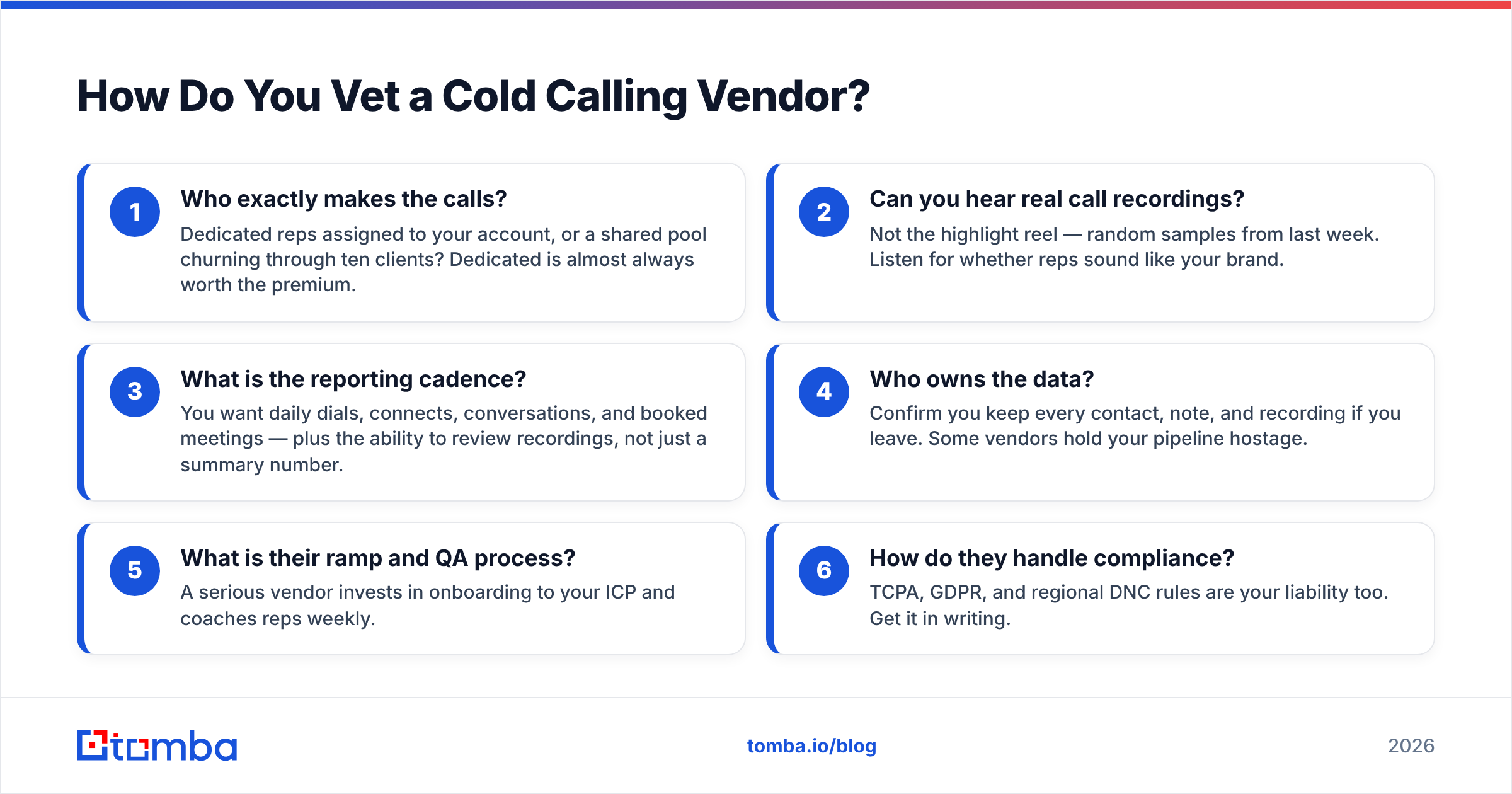
How Do You Vet a Cold Calling Vendor?#
Treat vendor selection like a hire, because functionally it is one. Ask for specifics, not case-study theater.
- Who exactly makes the calls? Dedicated reps assigned to your account, or a shared pool churning through ten clients? Dedicated is almost always worth the premium.
- Can you hear real call recordings? Not the highlight reel — random samples from last week. Listen for whether reps sound like your brand.
- What is the reporting cadence? You want daily dials, connects, conversations, and booked meetings — plus the ability to review recordings, not just a summary number.
- Who owns the data? Confirm you keep every contact, note, and recording if you leave. Some vendors hold your pipeline hostage.
- What is their ramp and QA process? A serious vendor invests in onboarding to your ICP and coaches reps weekly.
- How do they handle compliance? TCPA, GDPR, and regional DNC rules are your liability too. Get it in writing.
Cross-check reviews on independent platforms like G2 before signing, and start with a paid pilot rather than a long contract.
What Are the Risks and Downsides?#
Outsourcing is not free of trade-offs, and pretending otherwise sets you up for disappointment.
- Brand risk. A caller who misrepresents your product or sounds pushy damages your reputation on every dial. You cannot fully control tone at arm's length.
- Shallow product knowledge. Vendors handle objections with scripts, not lived expertise. Technical or nuanced sales suffer.
- Data leakage. Your prospect list and messaging leave your walls. Vet security and contracts carefully.
- Misaligned incentives. Activity-based or per-meeting pricing can reward quantity over quality.
- The handoff cliff. Even great vendors book meetings that go nowhere if your closers are not ready to run them.
These are manageable with tight SLAs, clean data, and a hybrid structure — but they are real, and any vendor who denies them is selling.
Cold Calling Outsourcing vs Multichannel Outbound#
One more honest framing: cold calling in isolation is less effective than it was a decade ago. Connect rates on cold dials have declined, and the strongest outbound programs now blend calling with email and social touches. If you are weighing an outsourced calling contract, ask whether a multichannel motion — calls plus personalized cold email plus LinkedIn — would return more per dollar.
Many teams get better ROI by keeping outbound in-house but arming a lean team with better data and automation, rather than outsourcing the labor wholesale. The right answer depends on your margins, deal complexity, and how proven your messaging already is. If your calls, emails, and social touches all run off the same verified, enriched contact record, every channel compounds instead of competing.
The Bottom Line#
Cold calling outsourcing is a legitimate growth lever when three things are true: your offer already converts, your bottleneck is dialing volume rather than strategy, and you can supply the vendor with accurate, enriched contact data. Skip any one of those and you are renting activity, not buying pipeline.
Start with a paid pilot, insist on dedicated reps and real recordings, price on quality rather than raw appointments, and — above all — clean your list before it ever reaches a dialer. The vendor's script matters. The data behind it matters more.
Before you outsource a single call, make sure every number and contact your team dials is real. Tomba's Email Finder and companion phone finder help you build verified, enriched B2B contact lists — decision-maker emails, direct numbers, and firmographic context — so whichever calling model you choose actually books meetings. Check Tomba pricing to start free with 25 searches a month and scale as your outbound grows.
Related guides#
Ready to find emails that actually work?
Join 150,000+ professionals who stopped guessing and started sending. Free credits on signup — no credit card required.
Get the Tomba newsletter
Practical outbound tactics and product updates — once every two weeks.
About the author