Cold Calling Services in 2026: A Complete Buyer's Guide
Outsourced dialers, in-house SDRs, or a hybrid? Here's how cold calling services actually price out in 2026, what they do well, and the one input that decides whether any of them work.
Cold calling is not dead — but the way most teams buy it is broken. If you're weighing whether to hire a cold calling service, spin up an in-house team, or run a hybrid, this guide breaks down the real costs, the tradeoffs nobody puts on the sales page, and the single input that quietly decides your results.
TL;DR#
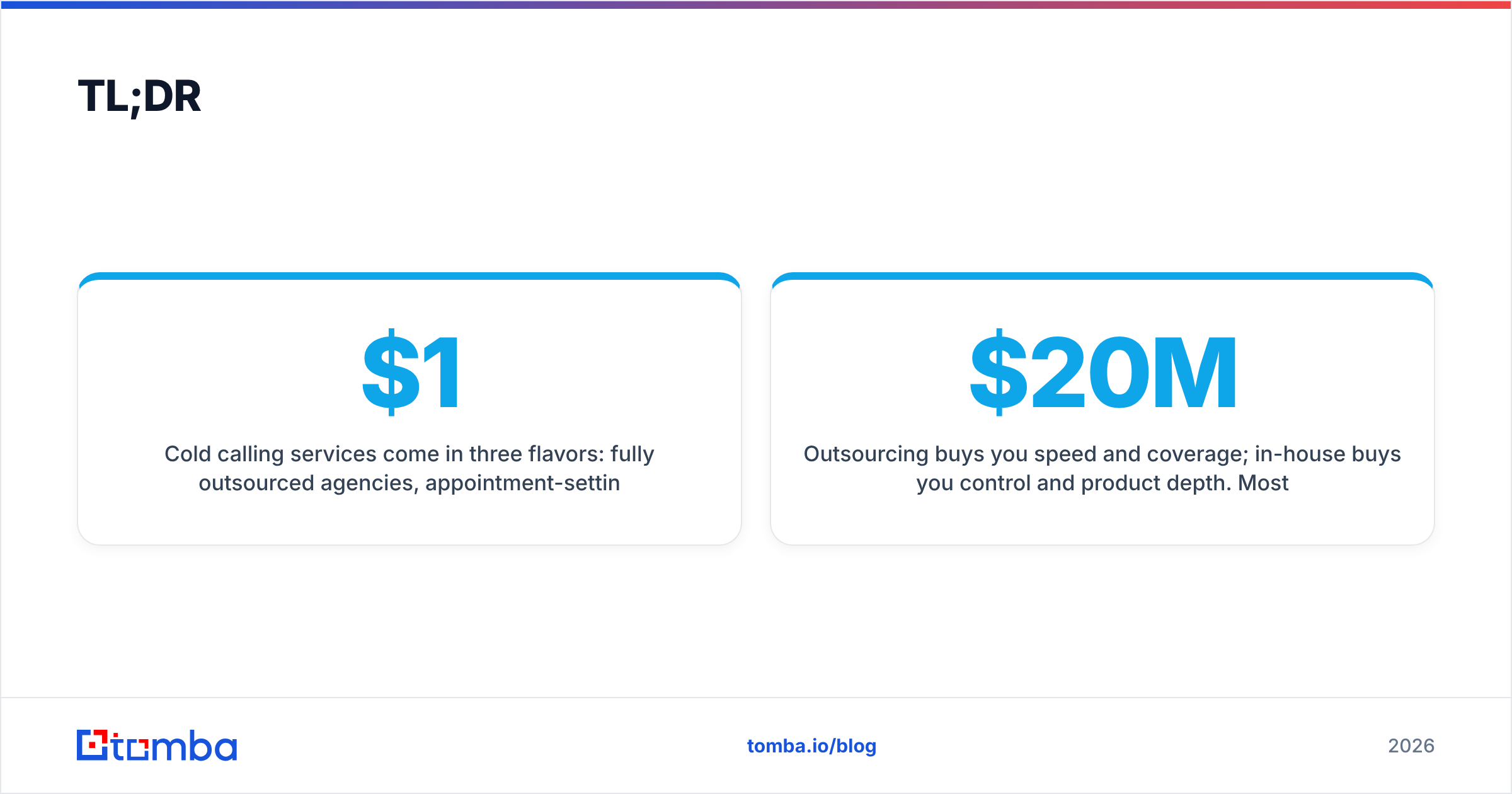
- Cold calling services come in three flavors: fully outsourced agencies, appointment-setting shops, and per-dial "dialer-as-a-service" providers. Pricing ranges from ~$1,500/mo retainers to $8,000+/mo for dedicated SDR pods.
- Outsourcing buys you speed and coverage; in-house buys you control and product depth. Most B2B teams under $20M ARR do better with a hybrid.
- The tool matters less than the list. A great agency dialing bad numbers still fails — connect rate is a data problem before it's a talent problem.
- Expect a 4–8 week ramp before an outsourced team produces qualified meetings. Anyone promising same-week pipeline is selling volume, not quality.
- Feed any service verified, current phone numbers and you can double connect rates without changing a word of the script.
What are cold calling services?#
Cold calling services are companies that make outbound sales calls on your behalf — booking meetings, qualifying leads, or running full top-of-funnel prospecting so your closers only talk to warm-ish buyers.
Think of it like catering versus cooking. You can staff, train, and manage your own kitchen (in-house SDRs), or you can hire a caterer who already has the chefs, the equipment, and the recipes (an outsourced service). Both feed the room. The question is which one fits your budget, your timeline, and how much you care about controlling every dish.
Under that umbrella, providers split into a few distinct models:
- Full-service outbound agencies — they own strategy, list-building, scripting, dialing, and reporting. You hand over an ICP and get booked meetings back.
- Appointment-setting firms — narrower scope: they dial your list and set demos, but leave targeting and messaging to you.
- Per-dial / dialer-as-a-service — you supply reps or scripts, they supply parallel-dialing infrastructure and connect-rate optimization.
- Fractional SDR pods — a dedicated 1–3 person team that acts like your employees without the hiring overhead.
How much do cold calling services cost in 2026?#
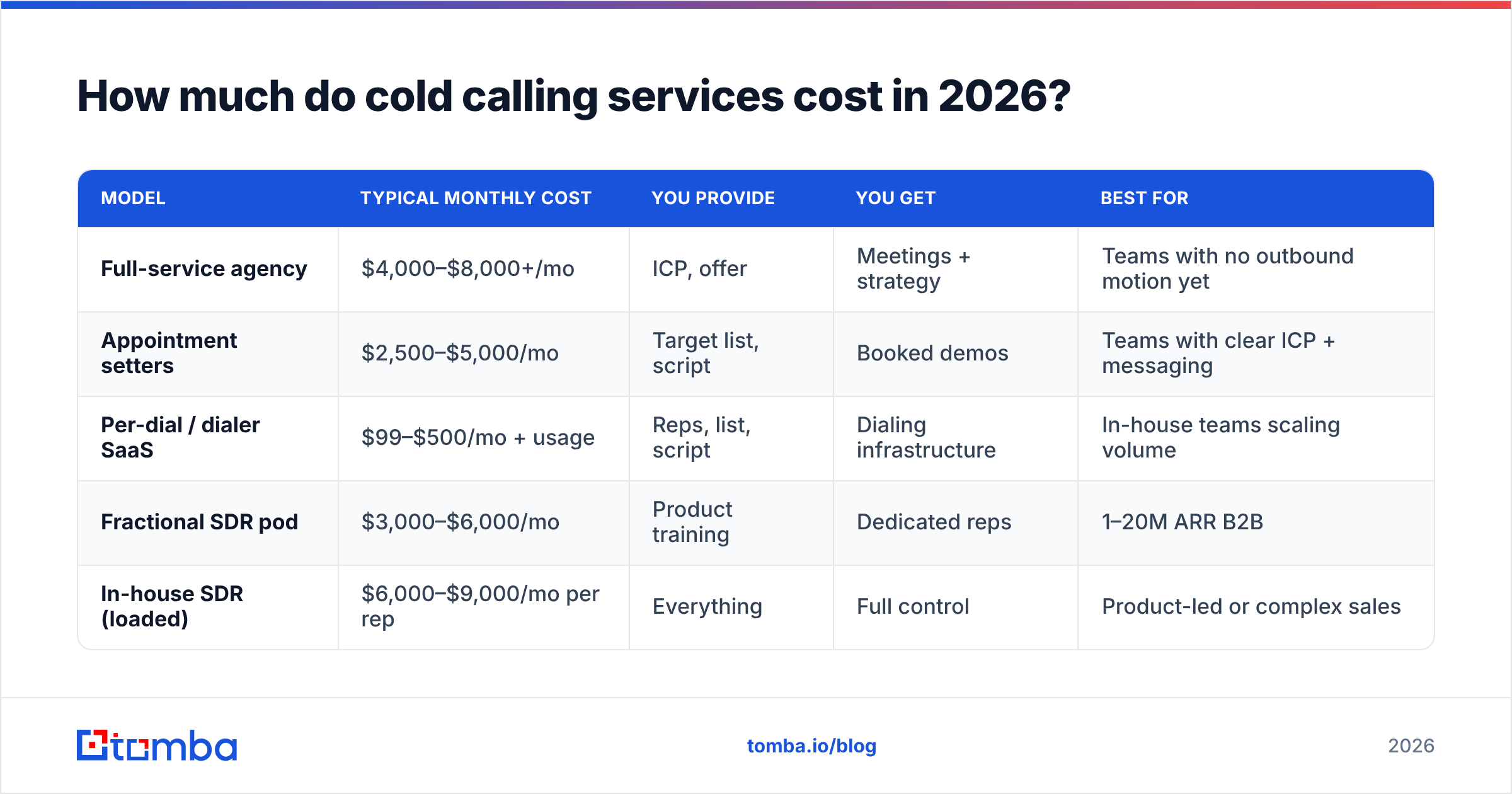
Here's the honest range. Pricing is driven by model, seniority of reps, and whether you're paying for activity (dials, hours) or outcomes (meetings booked).
| Model | Typical monthly cost | You provide | You get | Best for |
|---|---|---|---|---|
| Full-service agency | $4,000–$8,000+/mo | ICP, offer | Meetings + strategy | Teams with no outbound motion yet |
| Appointment setters | $2,500–$5,000/mo | Target list, script | Booked demos | Teams with clear ICP + messaging |
| Per-dial / dialer SaaS | $99–$500/mo + usage | Reps, list, script | Dialing infrastructure | In-house teams scaling volume |
| Fractional SDR pod | $3,000–$6,000/mo | Product training | Dedicated reps | 1–20M ARR B2B |
| In-house SDR (loaded) | $6,000–$9,000/mo per rep | Everything | Full control | Product-led or complex sales |
Two cost traps to watch. First, pay-per-meeting pricing sounds low-risk but pushes agencies to book anyone who says "sure, send an invite" — your no-show and disqualification rates spike. Second, cheap per-dial plans look great until you factor in the list, the CRM, and the rep time you still have to supply. Always compare fully-loaded cost per qualified meeting, not the sticker price.
If you want a baseline for what in-house tooling costs before you add labor, published rates like Tomba pricing (Free tier at 25 searches/mo, Starter at $49/mo, Growth at $99/mo) give you a sense of the data-side line items an agency bakes into its retainer.
Is it better to outsource cold calling or build in-house?#
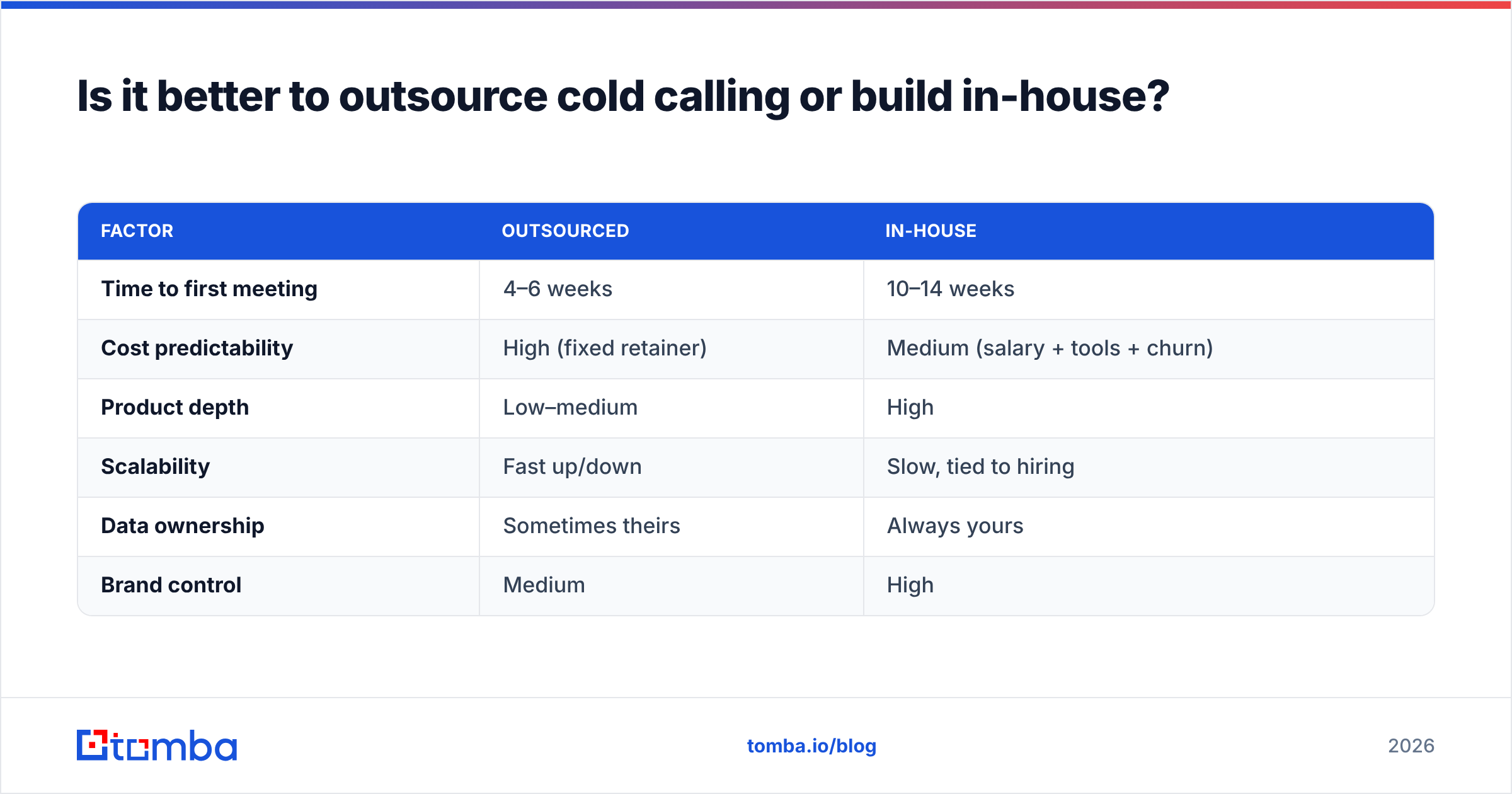
Short answer: outsource for speed and coverage, build in-house for control and complex products. Neither is universally "better" — they optimize for different things.
Outsourcing wins when you need pipeline now, you're testing a new market, or hiring and managing SDRs isn't a core competency. A good agency is already staffed and trained; you skip the 3-month hiring and ramp cycle.
In-house wins when your sale is technical, your product changes fast, or brand voice on the phone matters. Employees absorb product nuance an agency rep juggling five clients never will. According to HubSpot's sales research, reps who deeply understand the buyer's problem consistently outperform on conversion — and depth is hard to rent.
The pattern most successful B2B teams land on: hybrid. Outsource high-volume top-of-funnel prospecting to fill the calendar, keep a small in-house team for high-value accounts and warm follow-up. You get agency reach without surrendering your best opportunities to a rep who churns off your account next quarter.
| Factor | Outsourced | In-house |
|---|---|---|
| Time to first meeting | 4–6 weeks | 10–14 weeks |
| Cost predictability | High (fixed retainer) | Medium (salary + tools + churn) |
| Product depth | Low–medium | High |
| Scalability | Fast up/down | Slow, tied to hiring |
| Data ownership | Sometimes theirs | Always yours |
| Brand control | Medium | High |
That last row — data ownership — is where a lot of outsourcing deals quietly hurt teams. If the agency owns the list and the call outcomes, you're renting pipeline, not building an asset. Insist on getting the enriched, dispositioned data back in your CRM.
Why do most cold calling services underperform?#
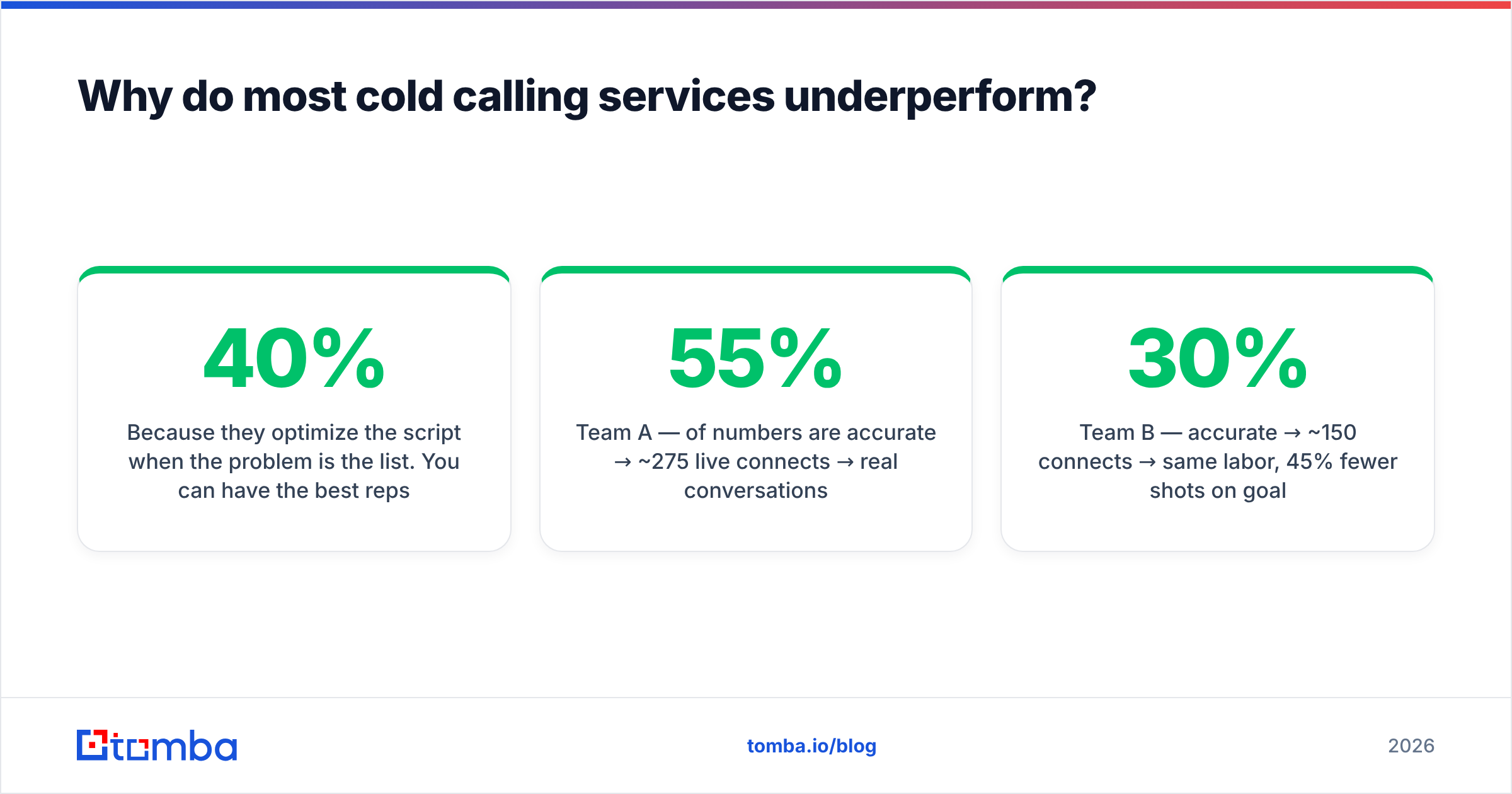
Because they optimize the script when the problem is the list. You can have the best reps in the world, but if 40% of the phone numbers are wrong, disconnected, or point to a gatekeeper's desk, half your paid dialing hours evaporate before anyone says hello.
Connect rate is the hidden multiplier. Consider two teams making the same 500 dials/day:
- Team A — 55% of numbers are accurate → ~275 live connects → real conversations.
- Team B — 30% accurate → ~150 connects → same labor, 45% fewer shots on goal.
Team B will blame the pitch, retrain reps, and rewrite openers. None of it fixes a data problem. This is why the smartest move before signing any cold calling service is auditing the list they'll dial — or better, supplying your own verified one.
Direct dials matter even more in 2026's remote-heavy, mobile-first B2B world, where switchboard numbers route to voicemail purgatory. Sourcing accurate mobile and direct-line numbers with a dedicated phone finder, then confirming they're live with a phone validator before handing them to callers, is the cheapest performance lever you have. Pair that with verified email so your reps can find email addresses for multi-channel follow-up, and every connect turns into a durable contact record instead of a one-shot dial.
What should you look for when choosing a cold calling service?#
Use this checklist to separate operators from order-takers:
- Data source transparency — Ask where their numbers come from and how fresh they are. Vague answers ("proprietary database") usually mean stale, scraped, or unverified. Reputable providers publish their approach to data sources and accuracy.
- Qualification definition — Get a written, mutually-agreed definition of a "qualified meeting." No shared definition means you'll argue about invoices in month two.
- Ramp expectations — Any honest shop tells you 4–8 weeks to steady-state. Same-week promises signal a volume-over-quality operation.
- Reporting cadence — You want dial counts, connect rates, conversations, and dispositions weekly — not just "we booked X meetings."
- Reps per account — Dedicated reps beat shared pools for anything beyond simple appointment-setting.
- Data return policy — Confirm you keep the enriched, dispositioned records in your own CRM.
Cross-check any vendor's claims against third-party review sites like G2 before you commit. Sales pages promise; verified reviews reveal churn, hidden fees, and no-show rates.
How do you get the most out of a cold calling service?#
Treat the vendor as an amplifier, not a magician. Amplifiers make a good signal louder — and a bad signal worse. Your job is to hand them a clean signal.
- Supply the list, or vet theirs. Build a targeted account list from a reliable B2B database and verify every number before the first dial. Garbage in, garbage dialed.
- Give them a real offer, not a feature dump. Reps convert on a crisp reason to take a meeting. Hand them the one-sentence "why now."
- Instrument the funnel. Track dials → connects → conversations → meetings → shows → qualified. When a number drops, you'll know which stage to fix instead of blaming "the leads."
- Route data back. Every dispositioned contact should flow into your CRM enriched, so your closers and marketing team inherit the intelligence.
- Review calls weekly. Listen to 3–5 recordings yourself. You'll catch positioning drift an agency won't self-report.
Do these five things and even a mid-tier service outperforms a premium one you left on autopilot.
Are cold calling services worth it in 2026?#
Yes — if you treat them as a distribution channel for good data and a clear offer, not a substitute for either. The math is simple: an outsourced pod that costs $5,000/mo and books eight qualified meetings, of which two become $30,000 deals, pays for itself many times over. The same pod dialing a stale list books two no-shows and torches your budget.
The differentiator in 2026 isn't which agency has the smoothest reps. It's whether the numbers they dial are real, current, and reachable. That's an input you control regardless of who's holding the phone — and it's the one most teams ignore until they've already burned a quarter's retainer.
So before you shortlist a single vendor, fix your data. Build targeted, accurate contact lists with the Tomba Email Finder and pair them with verified direct-dial numbers, so whether you outsource, staff in-house, or run a hybrid, every dial has a real person on the other end. The service you hire can only be as good as the list you feed it — start with clean data, and the rest of the decision gets a lot easier.
Related guides#
// get started
Find, verify and enrich your first contacts today
Start on the free plan with 25 searches a month, then scale when your team is ready.
Free plan · No credit card required · GDPR & CCPA
// about the author