Cold Calling Stats 2026: The Numbers That Actually Matter
The cold calling stats reps quote are mostly outdated or made up. Here are the 2026 numbers that hold up — connect rates, best call times, and how many dials it really takes.
Cold calling gets buried every year, and every year it keeps booking meetings. The problem isn't the channel — it's the numbers people repeat about it. Half the "cold calling stats" floating around sales LinkedIn are recycled from a 2007 study, misquoted, or invented to sell a course. This guide separates the durable data from the noise and shows you what the 2026 numbers actually mean for your dialing.
TL;DR#
- It takes roughly 6–8 dials to connect with a prospect — most reps quit after two, which is why their pipeline looks empty.
- Connect rates sit around 2–5% per dial for cold lists, so volume and list quality matter more than any single script tweak.
- Wednesday and Thursday, late morning and late afternoon, still outperform Monday mornings and Friday afternoons.
- Bad phone data is the silent killer — a large share of B2B direct dials are wrong, disconnected, or belong to someone who left the company.
- Cold calling works best paired with email and LinkedIn, not as a standalone channel — multi-touch sequences beat single-channel every time.
Are the cold calling stats you've heard even true?#
Short answer: mostly no. The most-quoted cold calling numbers online trace back to a handful of vendor reports and one or two academic studies, then get flattened into scary one-liners. "Only 1% of cold calls convert" and "it takes 8 touches to make a sale" are repeated so often they feel like physics. They aren't. They're context-dependent averages that fall apart the moment you change the industry, the seniority of the prospect, or the quality of the phone number you dialed.
The useful move is to stop treating any single stat as gospel and start treating cold calling as a funnel with measurable stages: dials → connects → conversations → meetings booked → opportunities. Each stage has its own conversion rate, and the leverage is different at each one. Improving your list quality fixes the dial-to-connect stage. Improving your opener fixes the connect-to-conversation stage. Confusing the two is how reps waste months optimizing the wrong thing.
How many cold calls does it actually take to reach someone?#
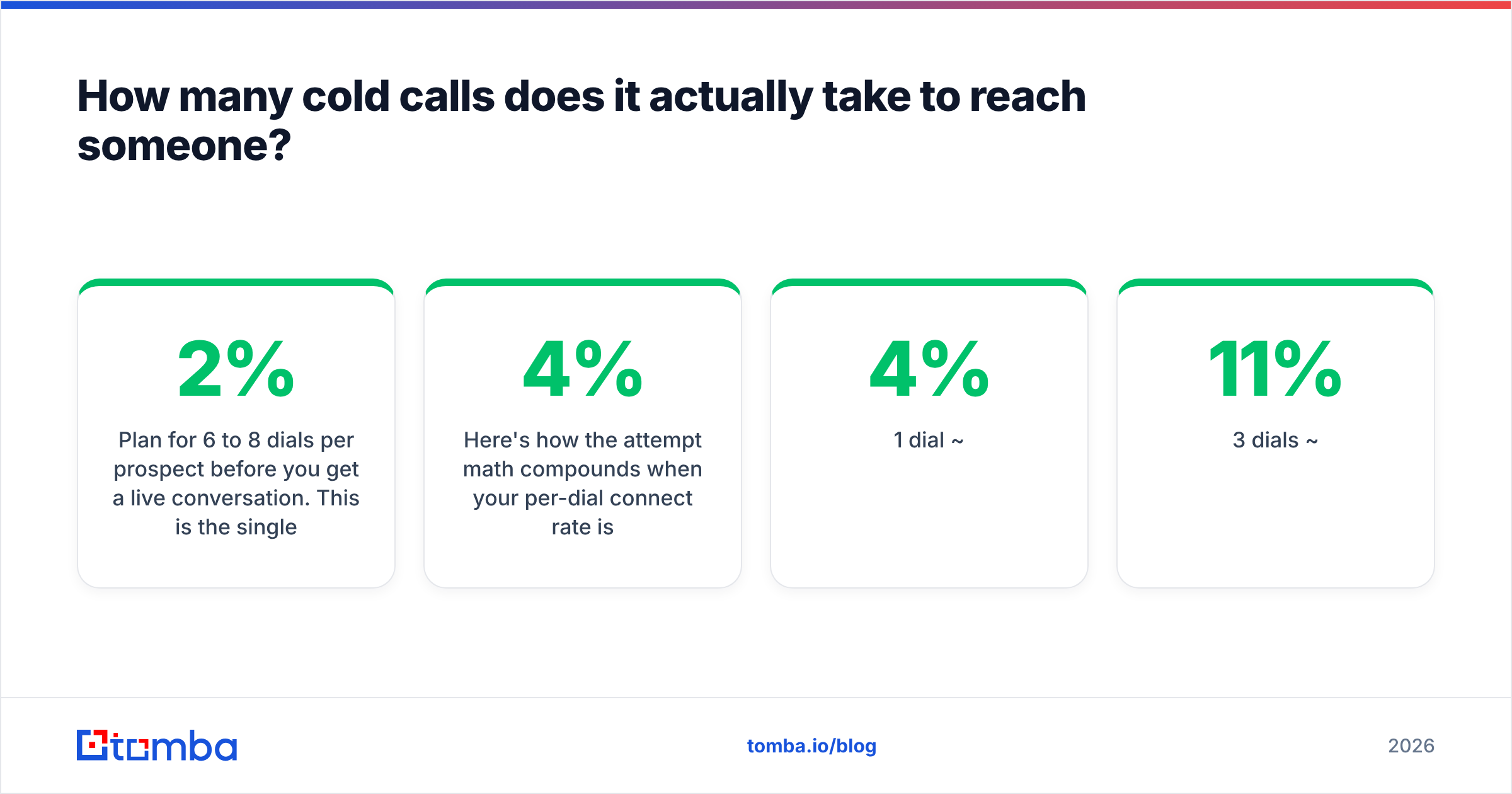
Plan for 6 to 8 dials per prospect before you get a live conversation. This is the single most actionable cold calling stat, because it directly contradicts how most reps behave. Analysis of large outbound datasets consistently shows connect rates per individual dial hovering in the low single digits for cold lists — often 2% to 5%. That means the "one dial and move on" approach mathematically guarantees you'll miss the majority of reachable prospects.
The reps who book the most meetings aren't better talkers. They're more persistent within a disciplined cadence: several attempts spread across different days and times, not eight calls in one afternoon. Spacing matters because you're trying to catch a busy human in a rare open moment.
Here's how the attempt math compounds when your per-dial connect rate is 4%:
| Dial attempt | Cumulative chance of connecting |
|---|---|
| 1 dial | ~4% |
| 3 dials | ~11% |
| 6 dials | ~22% |
| 8 dials | ~28% |
The curve is why persistence pays. Each additional attempt is cheap, and the cumulative probability keeps climbing. If you stop at two dials you're capturing maybe a third of the connects you'd get by attempt six.
What are realistic cold calling connect and conversion rates in 2026?#
Benchmarks vary by segment, but these ranges hold up across most B2B outbound teams:
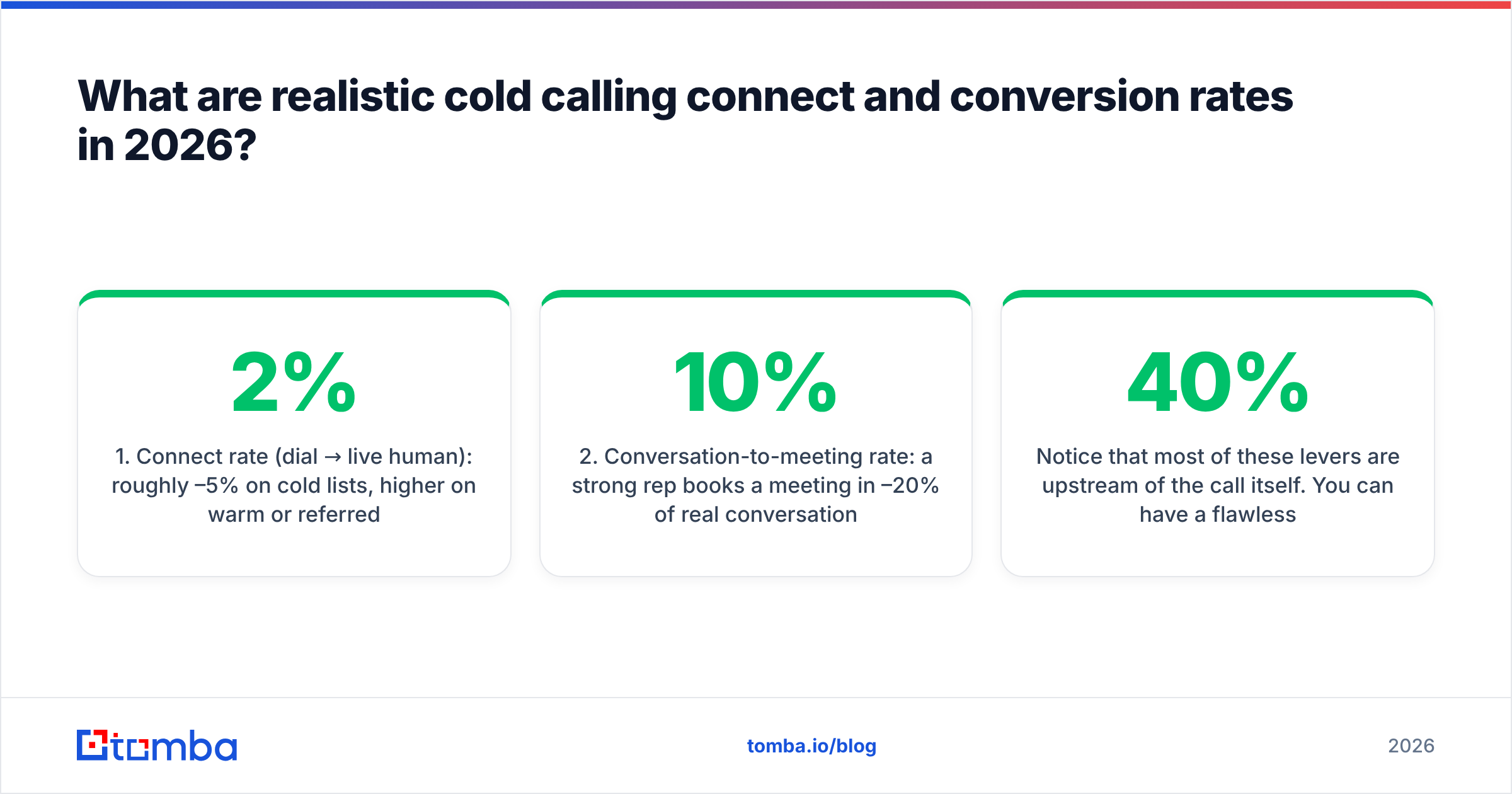
- Connect rate (dial → live human): roughly 2%–5% on cold lists, higher on warm or referred contacts. Direct dials outperform switchboard numbers dramatically.
- Conversation-to-meeting rate: a strong rep books a meeting in 10%–20% of real conversations. Below 10% usually signals a targeting or opener problem, not a closing problem.
- Dials per meeting booked: commonly 50–100+ dials per meeting for fully cold outbound. This is the number that shocks new reps and explains why activity volume is tracked so closely.
- Voicemail-to-callback: low single digits, which is why voicemails work best as part of a sequence rather than a standalone play.
- Best-case senior-decision-maker connect rates: lower than average — the more senior the title, the harder the direct dial, which raises the value of accurate mobile numbers.
Notice that most of these levers are upstream of the call itself. You can have a flawless script and still lose if 40% of your numbers are wrong. That's the part most "cold calling tips" articles skip.
When is the best time to cold call?#
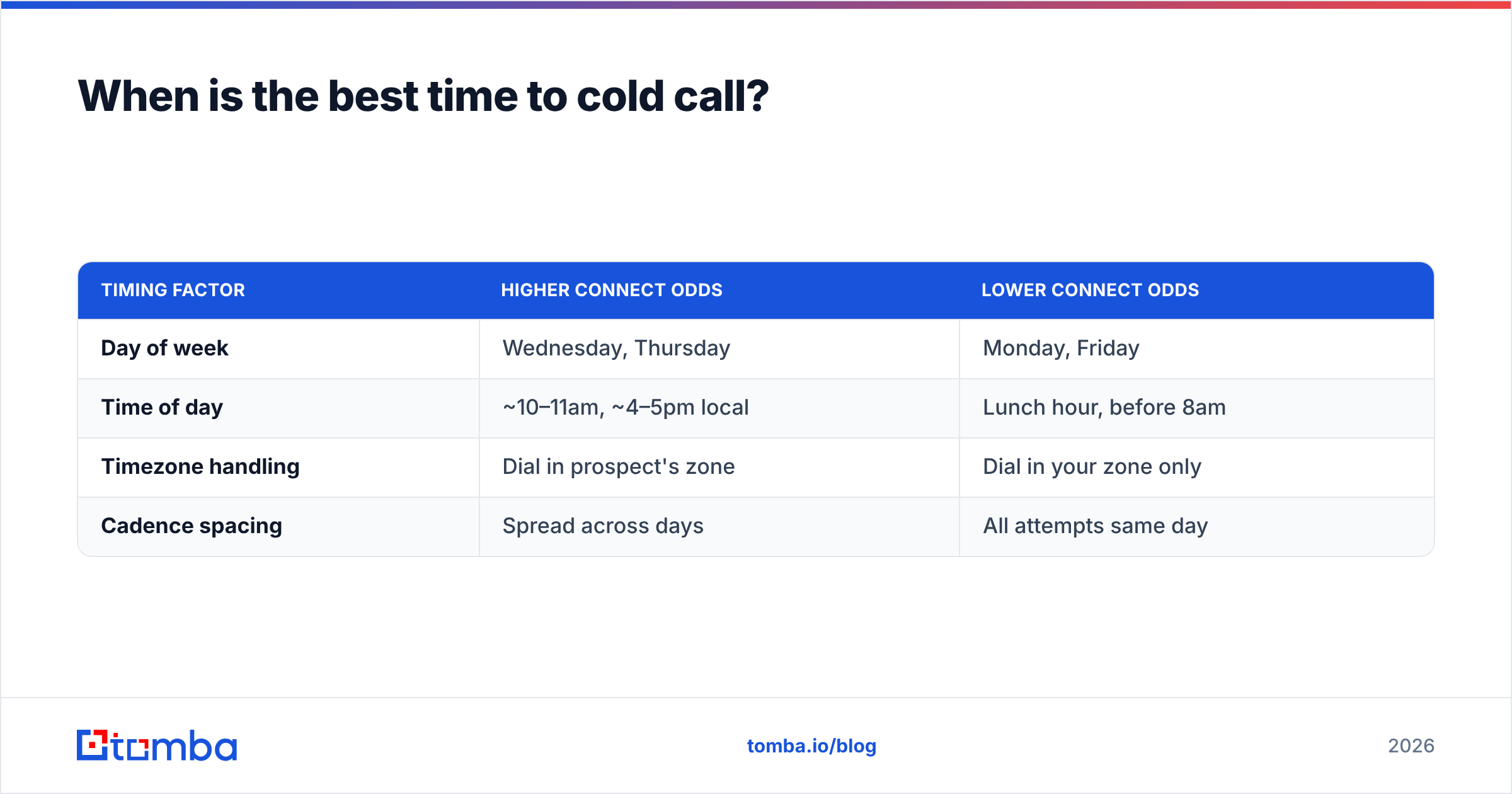
Midweek, late morning and late afternoon, remains the reliable window. Across multiple outbound studies the pattern is stubborn: Wednesday and Thursday beat Monday and Friday, and the two sweet spots tend to be roughly 10–11 a.m. and 4–5 p.m. in the prospect's local time zone. Early morning (before people are heads-down) and end of day (as they wrap up) catch prospects between meetings.
| Timing factor | Higher connect odds | Lower connect odds |
|---|---|---|
| Day of week | Wednesday, Thursday | Monday, Friday |
| Time of day | ~10–11am, ~4–5pm local | Lunch hour, before 8am |
| Timezone handling | Dial in prospect's zone | Dial in your zone only |
| Cadence spacing | Spread across days | All attempts same day |
Two caveats. First, "best time" is a tiebreaker, not a strategy — a great list dialed at an average time beats a bad list dialed at the perfect time. Second, these windows shift by industry. Founders and salespeople answer early; operations and finance roles are easier late. Track your own connect data by hour and let it override any generic benchmark after a few hundred dials.
Is cold calling dead in 2026?#
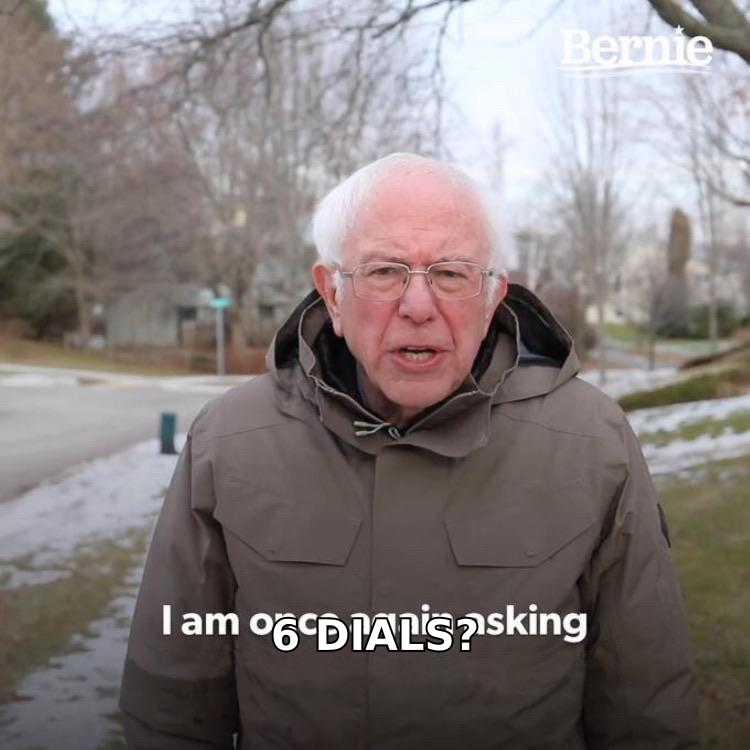
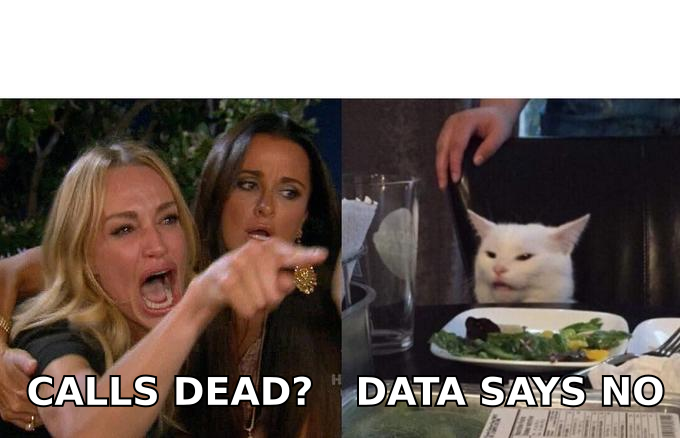
No — but single-channel cold calling is fading fast. The "cold calling is dead" crowd and the "just dial more" crowd are both wrong, and the meme above captures the argument perfectly. The data says cold calling still books meetings, especially for high-value B2B deals where a human conversation shortcuts weeks of email tag. What's actually dead is calling a stranger with zero context, from a bad number, with no other touches around it.
The teams winning in 2026 wrap calls into multi-touch sequences: a relevant email, a LinkedIn touch, then a call that references it. This is where social selling and phone outreach reinforce each other instead of competing. According to research aggregated by outbound platforms and echoed by analysts at firms like Gartner, buyers respond to coordinated, relevant outreach far more than to any single channel hammered in isolation. The phone isn't the problem. Random, uninformed dialing is.
Why does bad phone data wreck your cold calling stats?#
Every wrong number silently taxes every other metric you track. If a meaningful chunk of your dials go to disconnected lines, wrong people, or numbers for someone who left the company two years ago, your connect rate collapses — and no script, cadence, or coaching fixes it. This is the least-discussed and highest-leverage cold calling stat: data decay in B2B contact databases runs high every year as people change jobs, companies restructure, and direct dials get reassigned.
The fix is unglamorous but decisive: verify and enrich your list before you dial. That means confirming the person still works there, getting a current direct dial or mobile, and matching the number to the right individual. A clean list of 200 verified contacts routinely outperforms a raw list of 2,000, because your reps spend their finite calling hours talking to real prospects instead of listening to dial tones.
This is where tooling earns its keep. A phone finder surfaces current B2B direct dials tied to a verified person, and a phone validator checks whether those numbers are live before a rep ever wastes a dial. Pairing that with data enrichment so the rep knows the prospect's role, company, and email before calling turns a cold dial into a semi-warm one. If you're building sequences that combine calls with email, an accurate email finder closes the loop so no channel is running on stale contacts.
How do the top cold calling metrics compare across list quality?#
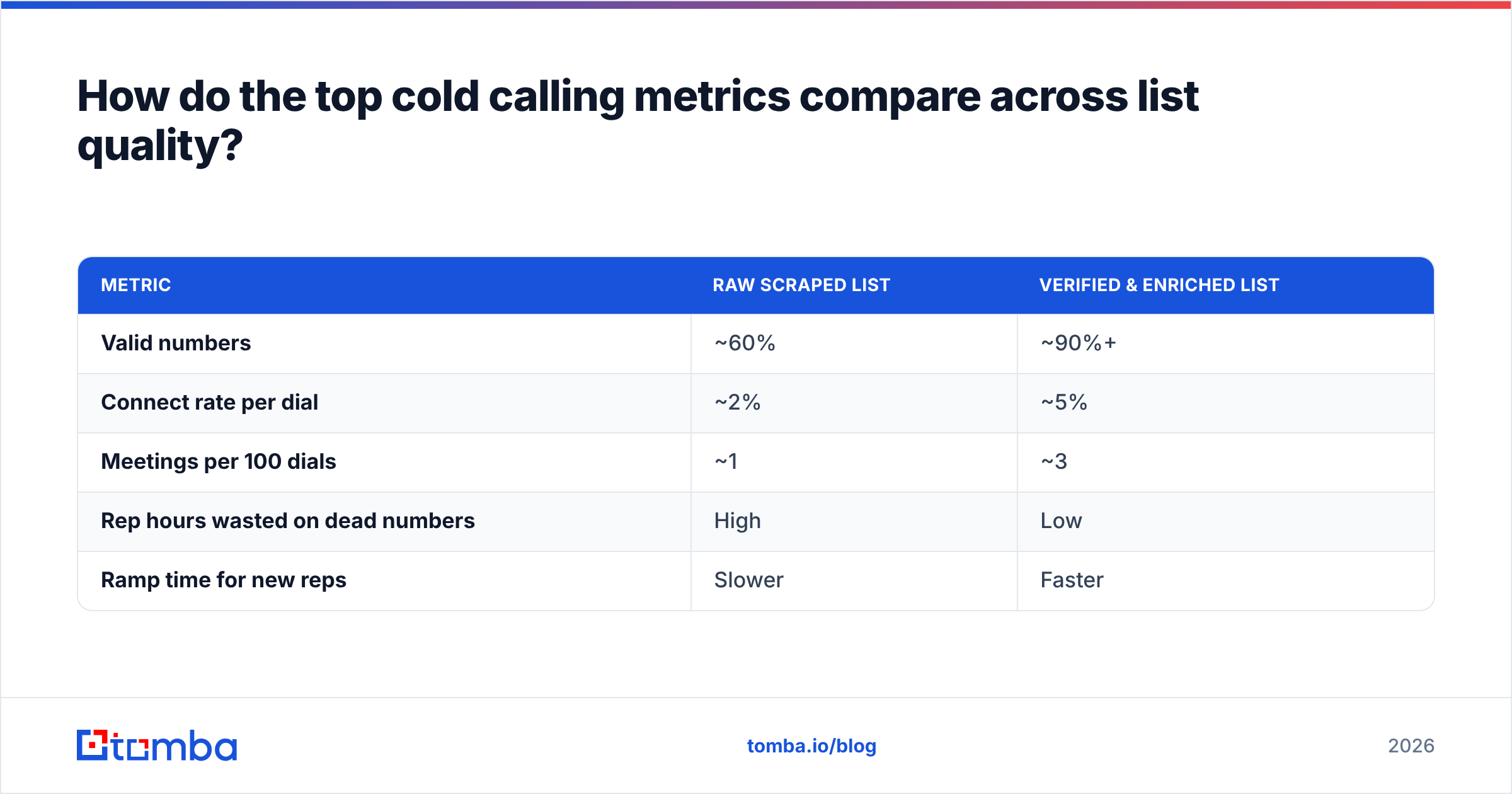
Here's the same rep, same script, same hours — the only variable is data quality. It illustrates why list hygiene is the highest-ROI change most teams can make.
| Metric | Raw scraped list | Verified & enriched list |
|---|---|---|
| Valid numbers | ~60% | ~90%+ |
| Connect rate per dial | ~2% | ~5% |
| Meetings per 100 dials | ~1 | ~3 |
| Rep hours wasted on dead numbers | High | Low |
| Ramp time for new reps | Slower | Faster |
The right-hand column isn't magic — it's just what happens when reps stop dialing garbage. Verification and enrichment don't change human nature or scripts; they change the denominator, and the whole funnel improves downstream.
What should you actually do with these cold calling stats?#
Turn the numbers into a short operating checklist:
- Commit to a real cadence. Six to eight dials per prospect, spread across days and the midweek time windows. Track attempts, not just connects.
- Fix the list before the script. Verify numbers and enrich context first — it's the cheapest points on the board. Check your Tomba pricing options if you're evaluating how verification and enrichment scale to your list size.
- Measure by stage. Separate dial→connect from connect→meeting so you optimize the right bottleneck.
- Go multi-channel. Surround calls with relevant email and LinkedIn touches; single-channel cold calling underperforms.
- Let your own data override benchmarks. Generic stats get you started; your dialer's hourly connect report is the real map after a few hundred calls.
The reps who hit quota aren't the ones with the slickest openers. They're the ones dialing accurate numbers, at sensible times, enough times, inside a coordinated sequence. Every stat in this guide points back to that.
Start with better numbers, not more numbers#
If your connect rate is stuck, the odds are your list — not your rep — is the problem. Feed your dialer verified contacts and current direct dials instead of scraped guesses, and every downstream metric climbs. Tomba's Email Finder and phone tools let you build clean, enriched call lists tied to real people, so your reps spend their calling hours in conversations instead of dial tones. Start on the free tier (25 searches a month), then scale up to Starter at $49/mo when the pipeline proves itself. Better data is the cold calling stat you can actually control.
Related guides#
Ready to find emails that actually work?
Join 150,000+ professionals who stopped guessing and started sending. Free credits on signup — no credit card required.
Get the Tomba newsletter
Practical outbound tactics and product updates — once every two weeks.
About the author