Cold Calling Sucks: Why It Fails and What Beats It in 2026
Cold calling sucks for most reps in 2026 - low connect rates, brutal rejection, and shrinking ROI. Here's the data, plus the multichannel playbook that actually books meetings.
Cold calling sucks. Not as a hot take - as a measurable fact about how buyers behave in 2026. If you have ever burned a morning dialing 80 numbers to book zero meetings, you already know the feeling in your gut. This guide explains why it feels that way, what the numbers actually say, and how top teams keep the useful parts of phone outreach while dropping the soul-crushing rest.
TL;DR#
- Connect rates are the real problem. Most cold dials never reach a human - single-digit connect rates are normal, so reps spend hours listening to voicemail.
- It "sucks" for structural reasons, not because you are bad at it: spam-labeled numbers, remote buyers, and gatekeeping software all work against you.
- Cold calling is not dead - it still closes deals when the list is accurate and the timing is warm. Bad data is what kills it.
- Multichannel beats mono-channel. Pairing calls with targeted email and LinkedIn lifts reply rates far more than dialing harder.
- The fix starts with data. A verified number and email for the right person turns "cold" into "warm-ish," which is where phones still win.
Why does cold calling suck so much in 2026?#
The short answer: you are playing a game where the deck was reshuffled against you, and nobody told the quota.
Three structural shifts stacked up over the last few years:
- Carriers label unknown numbers as "Spam Likely." Buyers see the flag and never pick up. Your dial connects to a decision made before the phone even rang.
- Buyers moved async. Hybrid and remote work means desk phones are dead and mobiles are screened. People answer texts and emails on their schedule, not yours.
- Gatekeeping got automated. Voicemail transcription, silence-detection, and "who's calling?" screening apps intercept reps before a conversation can start.
Add the emotional tax - rejection every few minutes, hours of no-answers - and you get an activity that feels like punishment. That is the honest reason cold calling sucks: the effort-to-outcome ratio collapsed, and the human cost stayed high.
But "feels awful" and "never works" are different claims. Let's separate them.
Is cold calling actually dead, or does it just feel dead?#
Cold calling is not dead - unqualified, bad-data cold calling is dead. That distinction is the whole ballgame.
When a call connects to the right person at a company with a real trigger event (new funding, a new hire in the buying role, a tech-stack change), phones still convert better than almost any channel because they are synchronous and personal. The problem is that most "cold call lists" are stale spreadsheets full of wrong numbers, departed employees, and generic switchboard lines. You are not testing whether calling works; you are testing whether calling a dead number works. It doesn't.
Industry research from sales orgs like HubSpot and analyst coverage from Gartner both point the same way: buyers are self-educating longer before they talk to a rep, so the first touch is rarely a cold call that closes. It's a warm-up. The call earns its keep later in the sequence, once the prospect already half-recognizes your name.
So the useful reframe is not "should I stop calling?" It's "how do I stop making calls that were doomed before I dialed?"
What do the numbers say about cold calling ROI?#
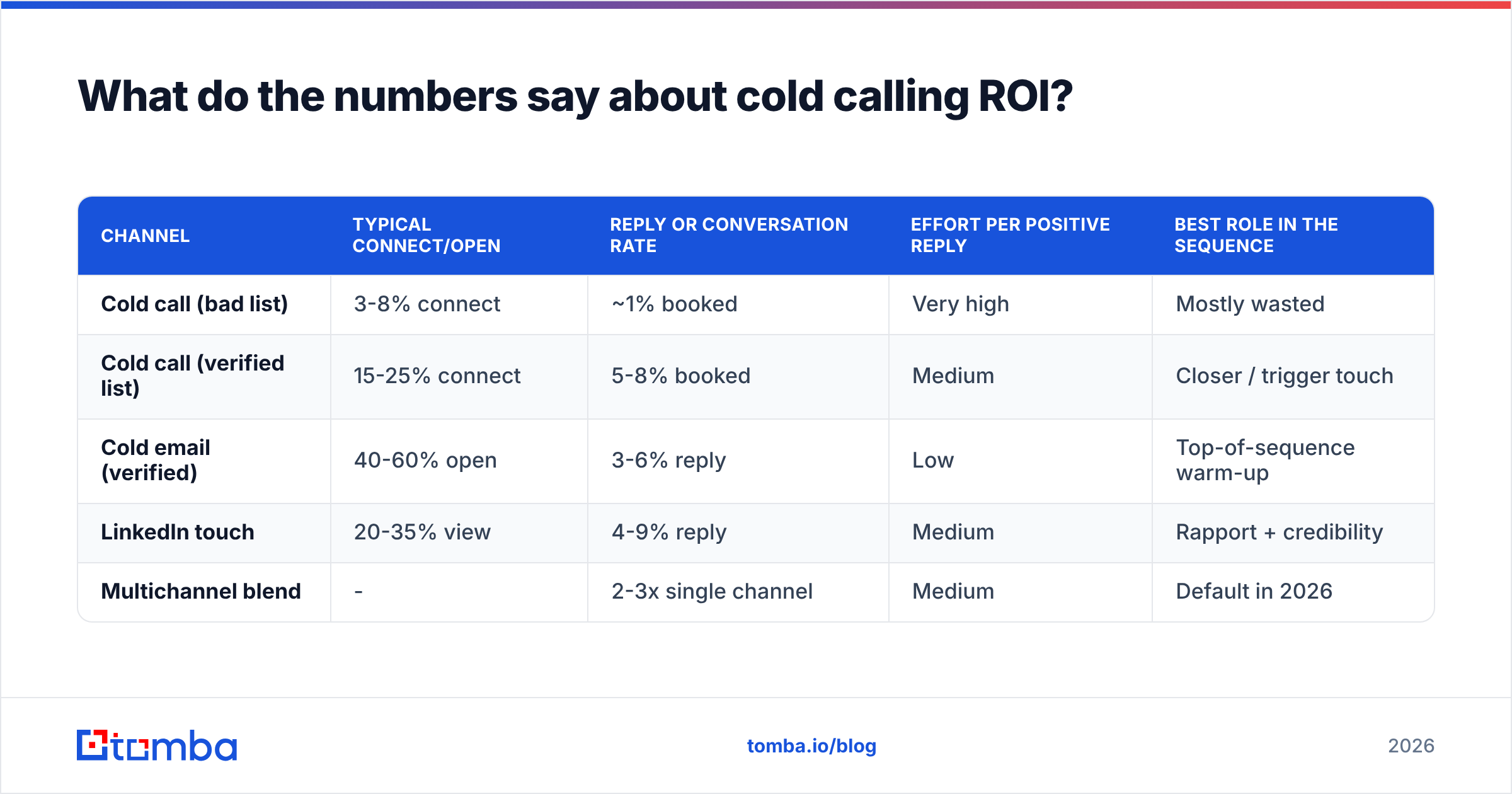
Here is a realistic comparison of outbound channels for a mid-market B2B motion. Numbers vary by industry, but the shape is consistent across teams that measure honestly.
| Channel | Typical connect/open | Reply or conversation rate | Effort per positive reply | Best role in the sequence |
|---|---|---|---|---|
| Cold call (bad list) | 3-8% connect | ~1% booked | Very high | Mostly wasted |
| Cold call (verified list) | 15-25% connect | 5-8% booked | Medium | Closer / trigger touch |
| Cold email (verified) | 40-60% open | 3-6% reply | Low | Top-of-sequence warm-up |
| LinkedIn touch | 20-35% view | 4-9% reply | Medium | Rapport + credibility |
| Multichannel blend | - | 2-3x single channel | Medium | Default in 2026 |
Two things jump out. First, the same activity - a cold call - can be nearly worthless or genuinely productive depending entirely on list quality. Second, no single channel wins alone. The blend beats the best individual channel because different buyers respond on different surfaces.
This is why "dial harder" is the wrong prescription. More volume on a bad list just multiplies the misery. Better inputs beat more attempts.
If cold calling sucks, what actually works better?#
The teams booking meetings in 2026 don't abandon the phone - they demote it from "the whole strategy" to "one instrument in the sequence." The winning pattern looks like this:
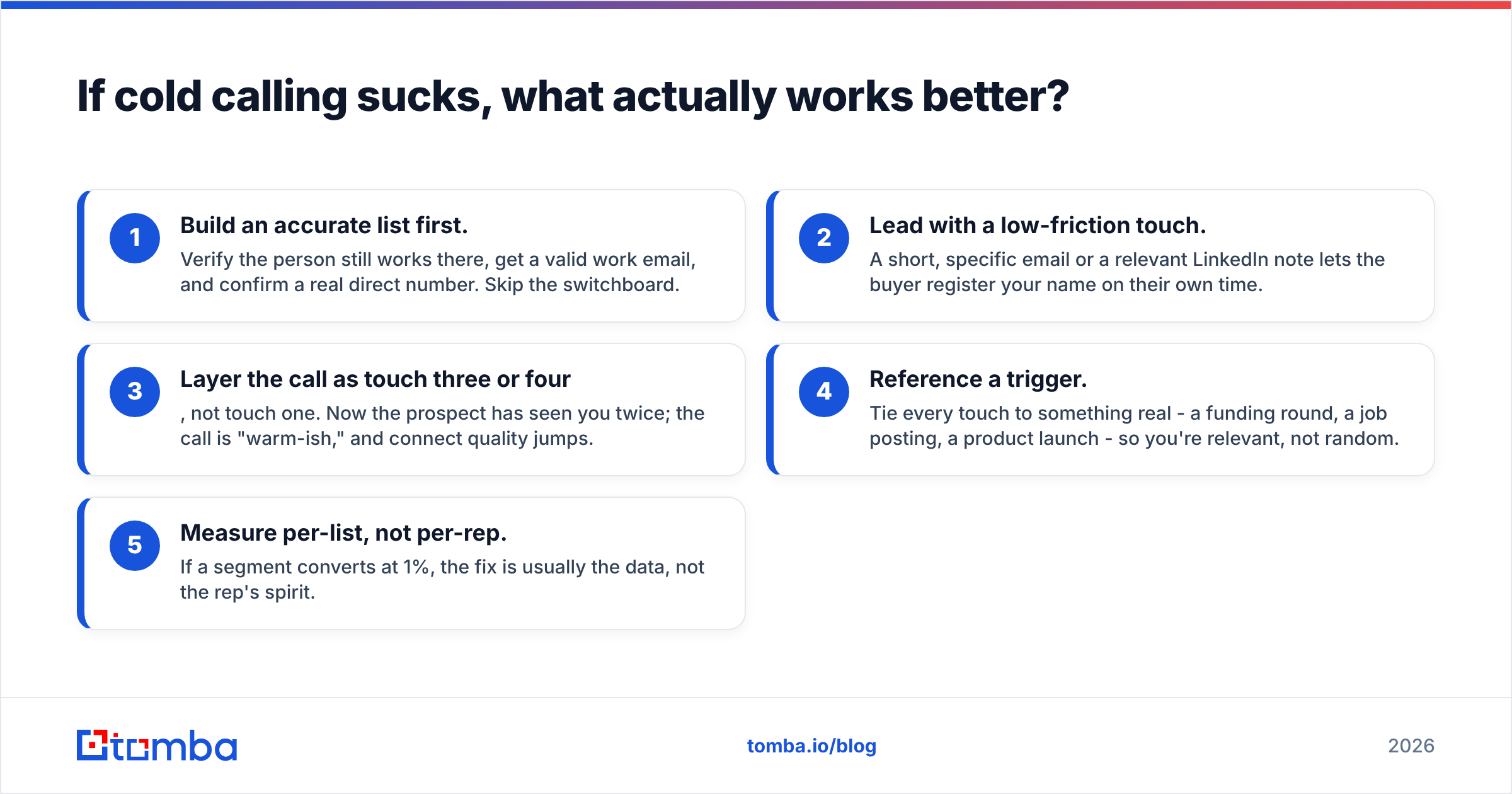
- Build an accurate list first. Verify the person still works there, get a valid work email, and confirm a real direct number. Skip the switchboard.
- Lead with a low-friction touch. A short, specific email or a relevant LinkedIn note lets the buyer register your name on their own time.
- Layer the call as touch three or four, not touch one. Now the prospect has seen you twice; the call is "warm-ish," and connect quality jumps.
- Reference a trigger. Tie every touch to something real - a funding round, a job posting, a product launch - so you're relevant, not random.
- Measure per-list, not per-rep. If a segment converts at 1%, the fix is usually the data, not the rep's spirit.
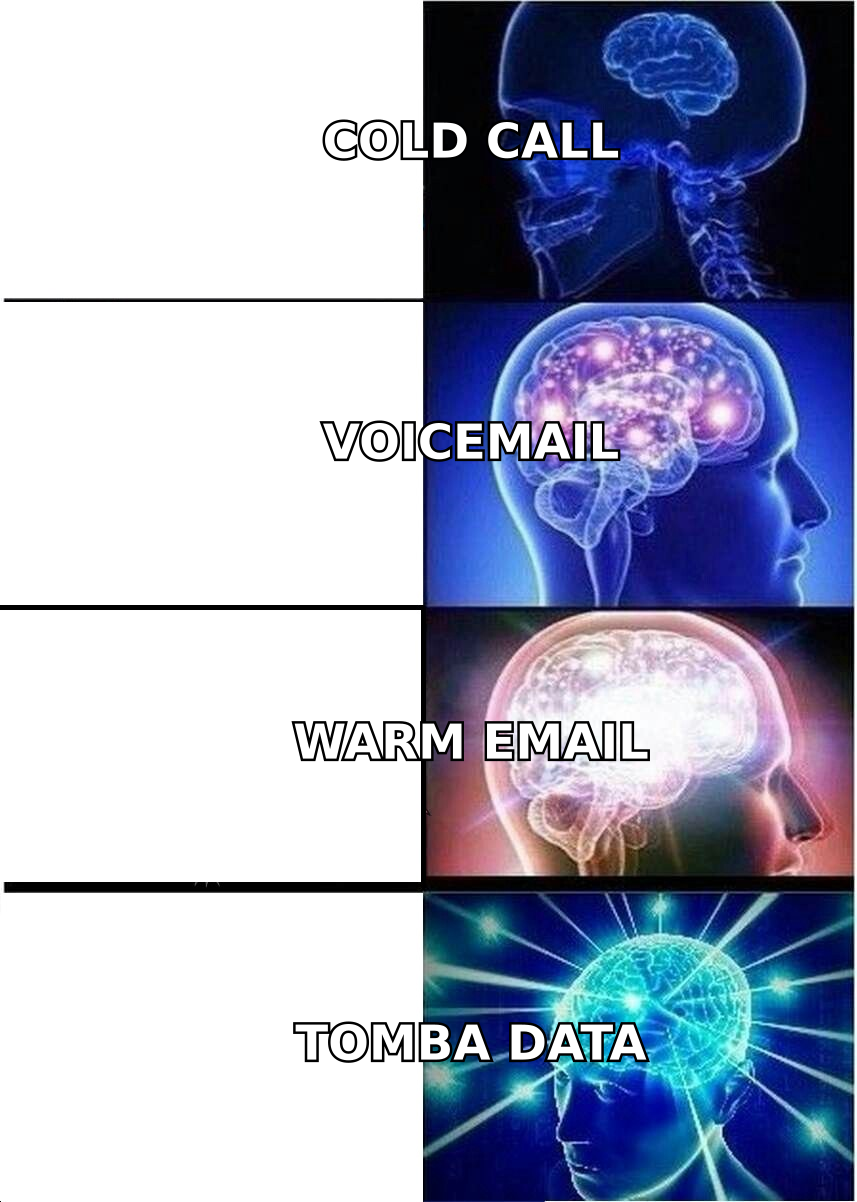
Notice that four of those five steps are upstream of the actual call. That's the point. The call stops sucking when everything feeding it improves. A rep with a clean list of the right people, reachable by phone and email, has a completely different day than one dialing a decade-old CSV.
How does better data fix the "cold calling sucks" problem?#
Data quality is the single biggest lever, and it's the one most teams ignore because it's less visible than a new script.
Think of it like fishing. You can buy a better rod, practice your cast for a year, and read every technique guide - but if you're casting into an empty pond, you catch nothing. Prospect data is the pond. Stock it with real fish (reachable, right-role, right-timing contacts) and average technique starts working. That's the unglamorous truth behind every "our new script tripled meetings" story: usually the list quietly got better too.
Concretely, better data means:
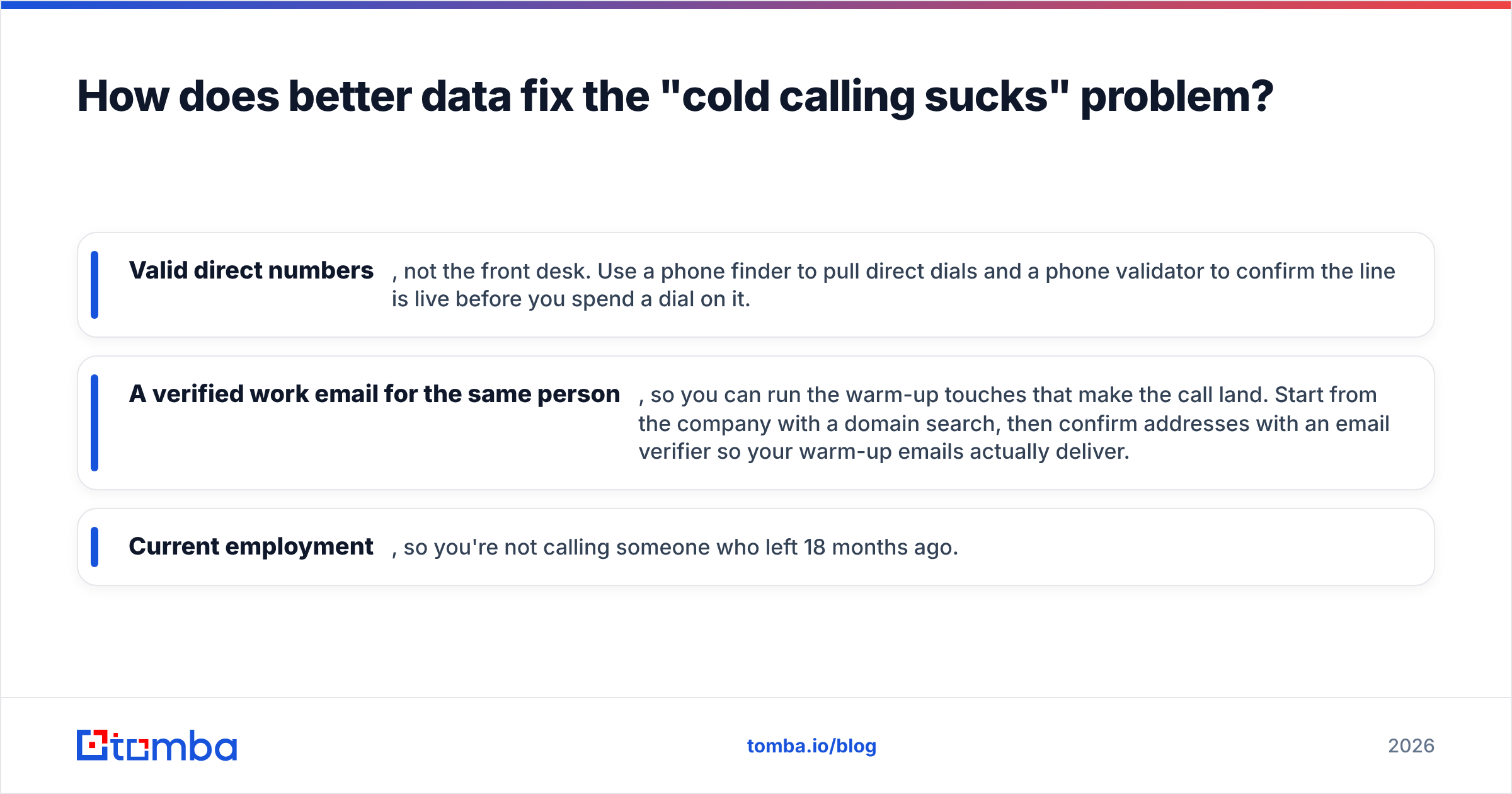
- Valid direct numbers, not the front desk. Use a phone finder to pull direct dials and a phone validator to confirm the line is live before you spend a dial on it.
- A verified work email for the same person, so you can run the warm-up touches that make the call land. Start from the company with a domain search, then confirm addresses with an email verifier so your warm-up emails actually deliver.
- Current employment, so you're not calling someone who left 18 months ago.
When those three are true, the "cold" call is barely cold. The prospect has a real problem you referenced, saw your name in their inbox, and picks up a validated direct line. That is a fundamentally different conversation than a spam-flagged switchboard cold-dial.
Cold calling vs. multichannel outreach: a straight comparison#
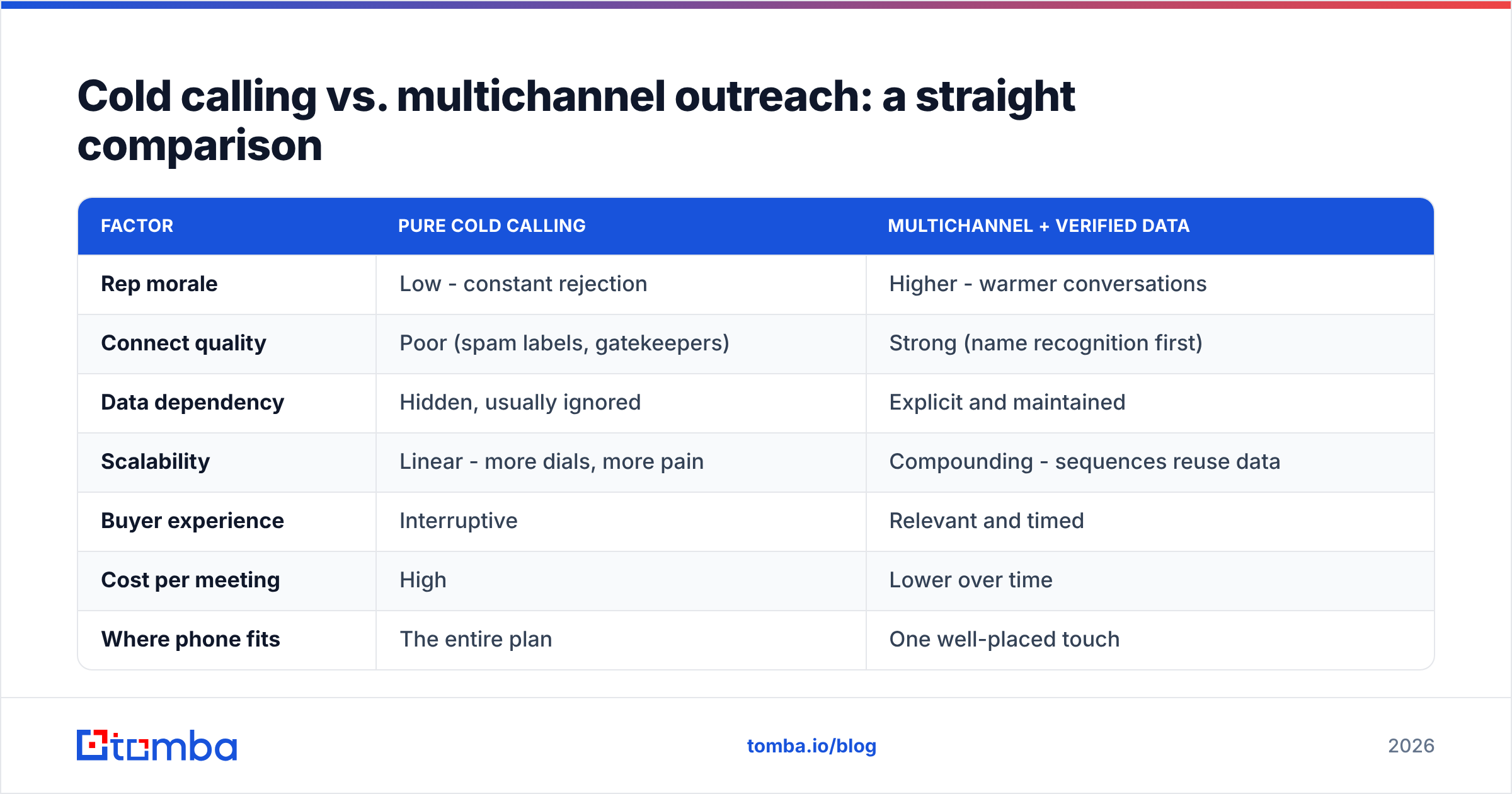
To make the trade-off explicit, here's how a pure cold-call motion stacks up against a multichannel motion built on verified data.
| Factor | Pure cold calling | Multichannel + verified data |
|---|---|---|
| Rep morale | Low - constant rejection | Higher - warmer conversations |
| Connect quality | Poor (spam labels, gatekeepers) | Strong (name recognition first) |
| Data dependency | Hidden, usually ignored | Explicit and maintained |
| Scalability | Linear - more dials, more pain | Compounding - sequences reuse data |
| Buyer experience | Interruptive | Relevant and timed |
| Cost per meeting | High | Lower over time |
| Where phone fits | The entire plan | One well-placed touch |
The right-hand column isn't anti-phone. It's pro-sequenced phone. You keep the channel's real strength - a live, human conversation - and stop paying its worst tax, the doomed first-touch cold dial.
If your team is stuck in the left column, that's not a discipline problem. It's a systems problem, and systems are fixable.
What should you do this week if your dials aren't converting?#
You don't need a six-month transformation. Try this sequence on your next segment:
- Audit one list. Pull 100 records you were about to call and check how many have a verified direct number and a valid email. If it's under half, your problem is data, full stop.
- Enrich the gaps. Fill missing numbers and emails, and drop anyone who has changed jobs. A quick pass with data enrichment or a bulk email finder turns a thin list into a workable one.
- Add two warm-up touches before any call: one email, one LinkedIn note, both referencing a real trigger.
- Call touch three, not touch one. Track connect rate and booked rate against your old cold-first numbers.
- Compare honestly. Most teams see connect quality rise immediately, because the person is now expecting - or at least recognizing - the outreach.
Do this once and you'll feel the difference in your own morale before it even shows up in the pipeline report. Fewer dials, warmer conversations, more meetings. That's the version of phone outreach that doesn't suck.
The bottom line#
Cold calling sucks when it's asked to do everything on top of broken data. It stops sucking when you shrink its job to what phones are genuinely great at - a real conversation with a real person at the right moment - and let verified email and social touches do the warming up. The channel isn't the enemy. Random, unverified, first-touch dialing is.
Fix the pond before you blame the rod.
Ready to make your dials warmer? Start with the people and the numbers that are actually real. Use the Tomba Email Finder to find verified work emails for the exact decision-makers you want, pair them with direct phone data, and run calls as the closing touch in a multichannel sequence instead of a cold-open you dread. Check Tomba pricing - the free tier gives you 25 searches a month to test whether better data changes your connect rate. It will.
Related guides#
Ready to find emails that actually work?
Join 150,000+ professionals who stopped guessing and started sending. Free credits on signup — no credit card required.
Get the Tomba newsletter
Practical outbound tactics and product updates — once every two weeks.
About the author