The Cold Calling System That Books More Meetings in 2026
Random dialing is dead. A repeatable cold calling system — clean data, a tested script, a real cadence, and the right metrics — is what turns dials into booked meetings. Here's how to build one.
Cold calling still works in 2026 — but only when it stops being an activity and becomes a system. Reps who "just dial" burn through lists, sound desperate, and blame the channel. Reps who run a system dial fewer numbers, connect with the right people, and book meetings on repeat. This guide breaks down exactly what that system looks like and how to build one.
TL;DR#
- A cold calling system is a repeatable process: clean data → segmented list → tested opener → structured call flow → multi-touch cadence → tracked metrics. Skip any layer and the whole thing leaks.
- Data quality beats dial volume. A verified, well-researched list of 200 contacts outperforms 2,000 scraped, half-wrong numbers.
- Your opener buys 30 seconds, your discovery earns the meeting, and your cadence does most of the work — most connects happen after multiple attempts.
- Track connect rate, conversation rate, and meetings booked per 100 dials — not just total calls made.
- The fastest lever for most teams isn't a better script; it's a cleaner list and correct phone numbers.
What is a cold calling system?#
A cold calling system is the repeatable machine that turns a list of strangers into booked meetings — the same way a factory line turns raw parts into a finished product, station by station, instead of one person improvising at a bench.
Think of it like a restaurant kitchen. A single talented cook can plate a great dish once. But a kitchen with stations, tickets, and a prep list serves 300 covers a night without chaos. Cold calling is identical: talent gets you one good call; a system gets you a predictable number of meetings every week.
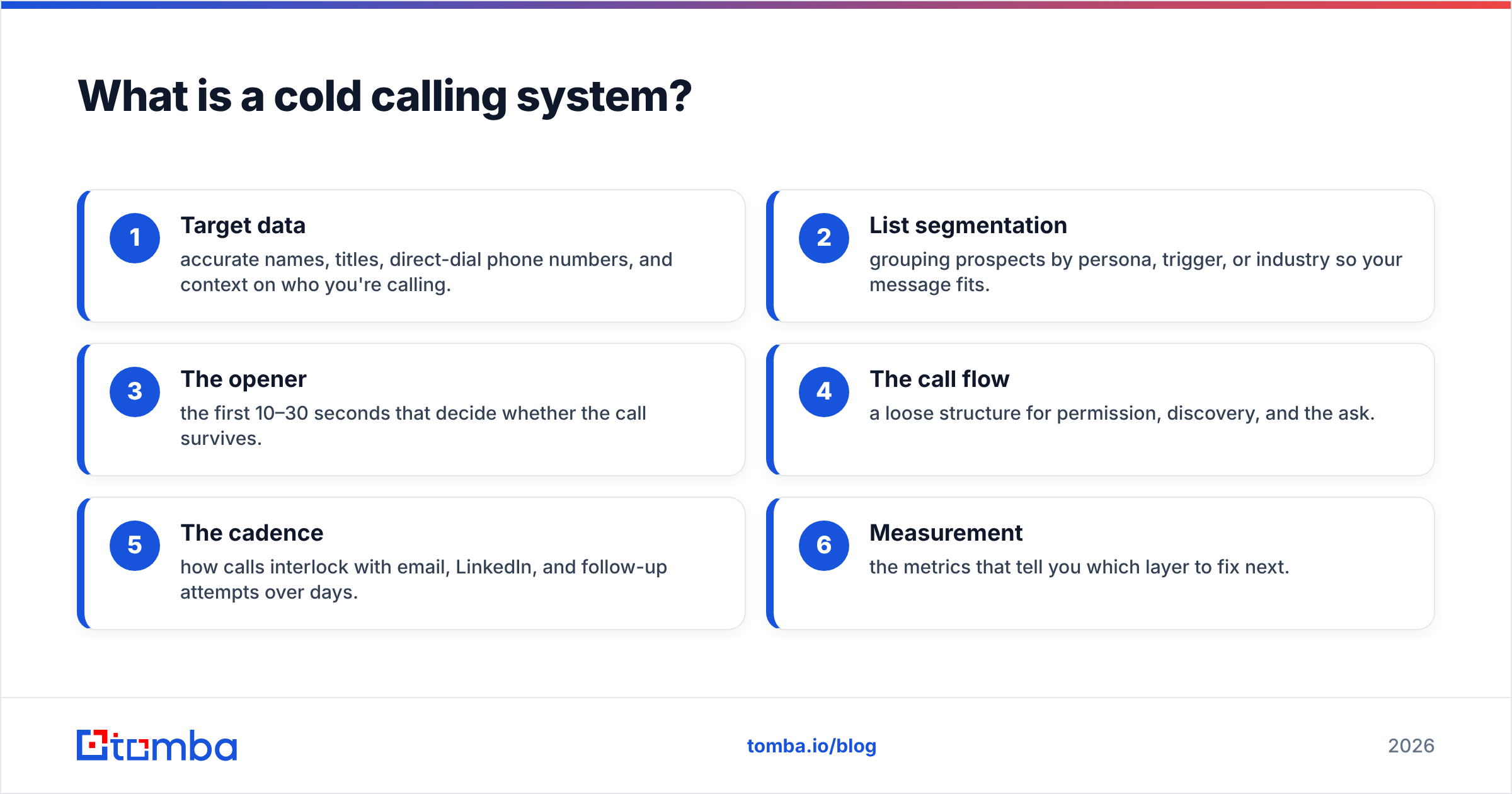
Concretely, a cold calling system has six moving parts working together:
- Target data — accurate names, titles, direct-dial phone numbers, and context on who you're calling.
- List segmentation — grouping prospects by persona, trigger, or industry so your message fits.
- The opener — the first 10–30 seconds that decide whether the call survives.
- The call flow — a loose structure for permission, discovery, and the ask.
- The cadence — how calls interlock with email, LinkedIn, and follow-up attempts over days.
- Measurement — the metrics that tell you which layer to fix next.
Miss the data layer and every downstream step is wasted on wrong numbers. Miss the cadence and you quit right before the connect. The system is only as strong as its weakest station.
Why do most cold calling systems fail?#
Most "systems" fail because they optimize the loudest layer — the script — while ignoring the two layers that actually move the number: data and cadence.
Here's the pattern that plays out on most teams:
- Reps get a list dumped from a scraper or an old export. Numbers are stale, titles are wrong, and 30% of dials hit dead lines.
- Leadership responds by pushing more dials — a volume mandate — which just accelerates burnout on a broken list.
- Reps rewrite the script for the tenth time, chasing a wording fix for what is actually a targeting and data problem.
- Nobody tracks connect rate separately from dial count, so the real bottleneck stays invisible.
Bad data is the silent killer. According to HubSpot's sales research, reps spend a large share of their day on non-selling admin — and chasing wrong contact information is a big part of that drain. If half your dials never reach a human, no script on earth saves the day.
The fix is boring but decisive: verify your list before you dial, enrich it with correct direct numbers, and only then worry about wording. A cold calling system that starts with clean contact enrichment is playing a fundamentally different game than one that starts with a wording tweak.
What are the components of a high-performing cold calling system?#
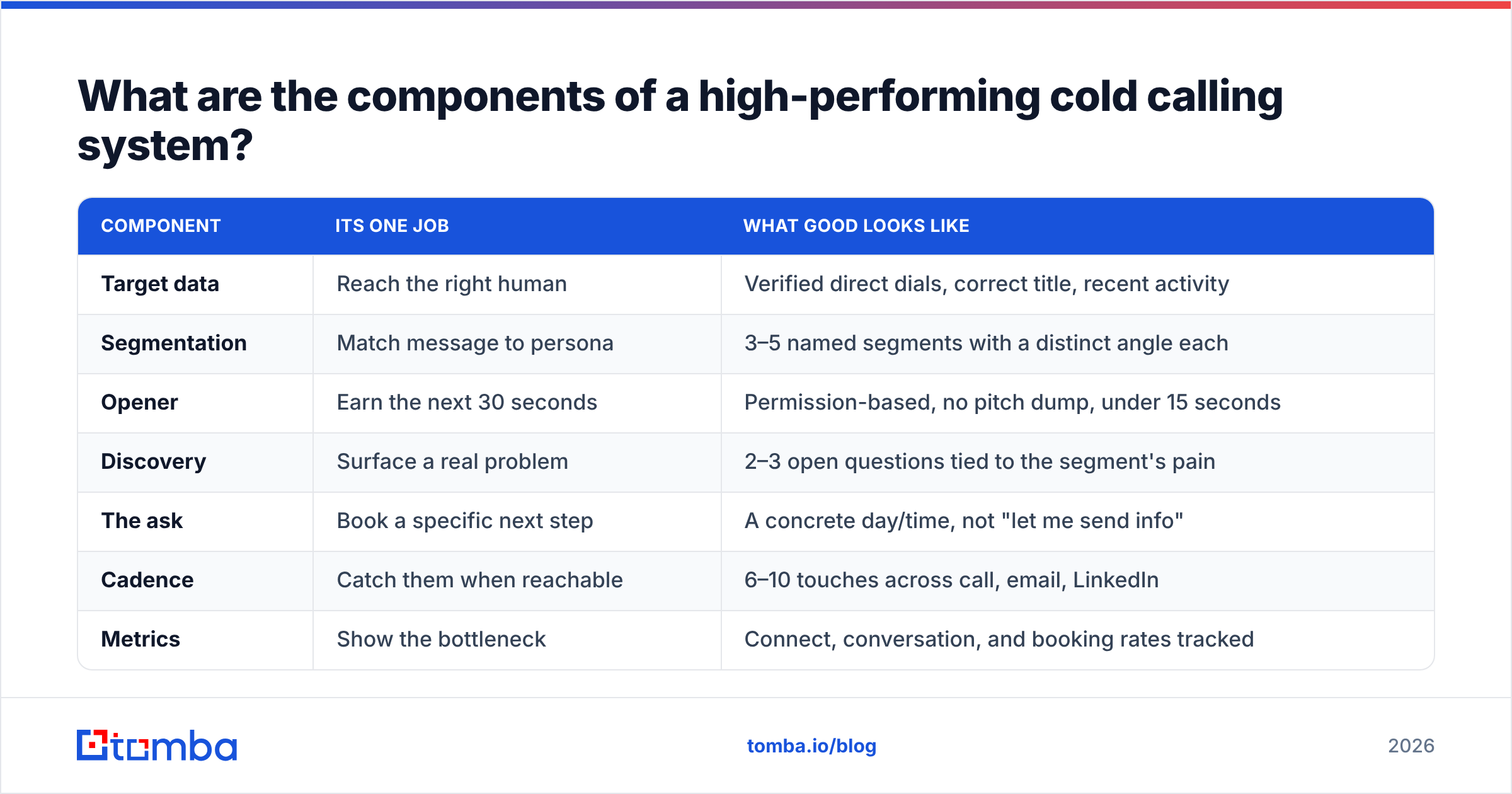
A high-performing system assigns a clear job to each layer, and each layer has a measurable output. Here's how the pieces map:
| Component | Its one job | What good looks like |
|---|---|---|
| Target data | Reach the right human | Verified direct dials, correct title, recent activity |
| Segmentation | Match message to persona | 3–5 named segments with a distinct angle each |
| Opener | Earn the next 30 seconds | Permission-based, no pitch dump, under 15 seconds |
| Discovery | Surface a real problem | 2–3 open questions tied to the segment's pain |
| The ask | Book a specific next step | A concrete day/time, not "let me send info" |
| Cadence | Catch them when reachable | 6–10 touches across call, email, LinkedIn |
| Metrics | Show the bottleneck | Connect, conversation, and booking rates tracked |
Notice that "great talker" is nowhere on that list. The best systems make an average rep effective because the process — not raw charisma — carries the load. That's what makes it a system: it survives when your best rep is out sick.
The two components teams most often skip are the first and the last. They over-invest in the middle (the script) and under-invest in the bookends (data and measurement). Flip that priority and results follow. If you want a shared vocabulary for the middle layers, a quick pass through a B2B glossary keeps the whole team calling the same play the same name.
How do you build a cold calling script that works?#
Build the script as a flexible flow, not a word-for-word monologue — a map, not a train track. A rigid script makes reps sound like a hostage reading a note; a flow lets them adapt while hitting the same checkpoints every time.
A proven four-part structure:
- The pattern interrupt (0–10 sec). Use the prospect's name, then ask permission: "Hey Sarah, I know I'm an interruption — can I take 30 seconds and then you can tell me to buzz off?" Honesty disarms the reflexive brush-off.
- The reason (10–30 sec). One sentence tying a specific trigger to a specific problem for their segment: "We work with RevOps leads at Series B SaaS who are watching outbound reply rates slide." No feature dump.
- Discovery (30 sec–3 min). Two or three open questions. Shut up and listen. This is where the meeting is actually earned — the prospect talks themselves into needing a conversation.
- The ask (final 30 sec). Propose a concrete next step with a real time: "Does Thursday at 10 work for a 20-minute look?" Never end on "I'll send some info."
Two rules keep the flow honest. First, write it, then read it out loud — anything that feels unnatural in your mouth sounds worse in the prospect's ear. Second, tie the language to your segment. A generic script that fits everyone connects with no one. And no script rescues a call that reached the wrong person, which loops back to the data layer every time.
What cadence and call volume should your system target?#
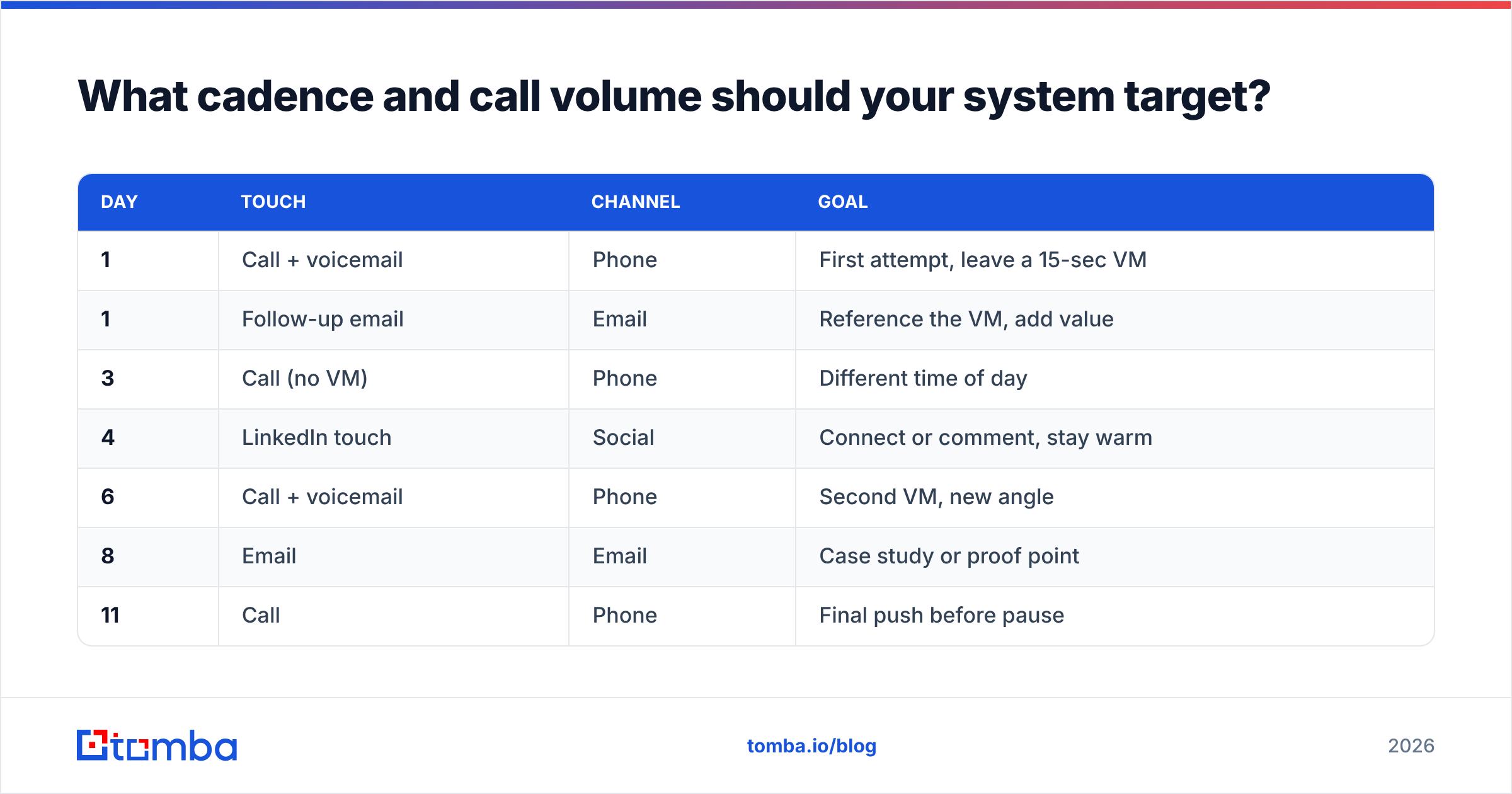
Your cadence — the sequence of touches over time — does more heavy lifting than any single call, because most prospects connect only after several attempts and across more than one channel. A one-and-done "I called them once" approach leaves the majority of your pipeline untouched.
A workable default cadence over about two weeks:
| Day | Touch | Channel | Goal |
|---|---|---|---|
| 1 | Call + voicemail | Phone | First attempt, leave a 15-sec VM |
| 1 | Follow-up email | Reference the VM, add value | |
| 3 | Call (no VM) | Phone | Different time of day |
| 4 | LinkedIn touch | Social | Connect or comment, stay warm |
| 6 | Call + voicemail | Phone | Second VM, new angle |
| 8 | Case study or proof point | ||
| 11 | Call | Phone | Final push before pause |
The key tactics inside that cadence:
- Vary the time of day. Someone unreachable at 9 a.m. may pick up at 4:45 p.m. Rotate windows across attempts.
- Blend channels. A LinkedIn view before a call warms the name; an email after a voicemail reinforces it. Research on multi-touch outbound from teams like Gong consistently shows blended sequences beat single-channel spray.
- Cap the volume that matters. Chasing a raw dial number rewards fast dialing on a bad list. Instead, target quality connects — conversations with the right person — and let dial count be a byproduct.
If your CRM supports it, automate the reminders so no touch slips. Understanding how your CRM sequences tasks is often the difference between a cadence that runs and one that lives in a rep's memory.
Which tools power a modern cold calling system?#
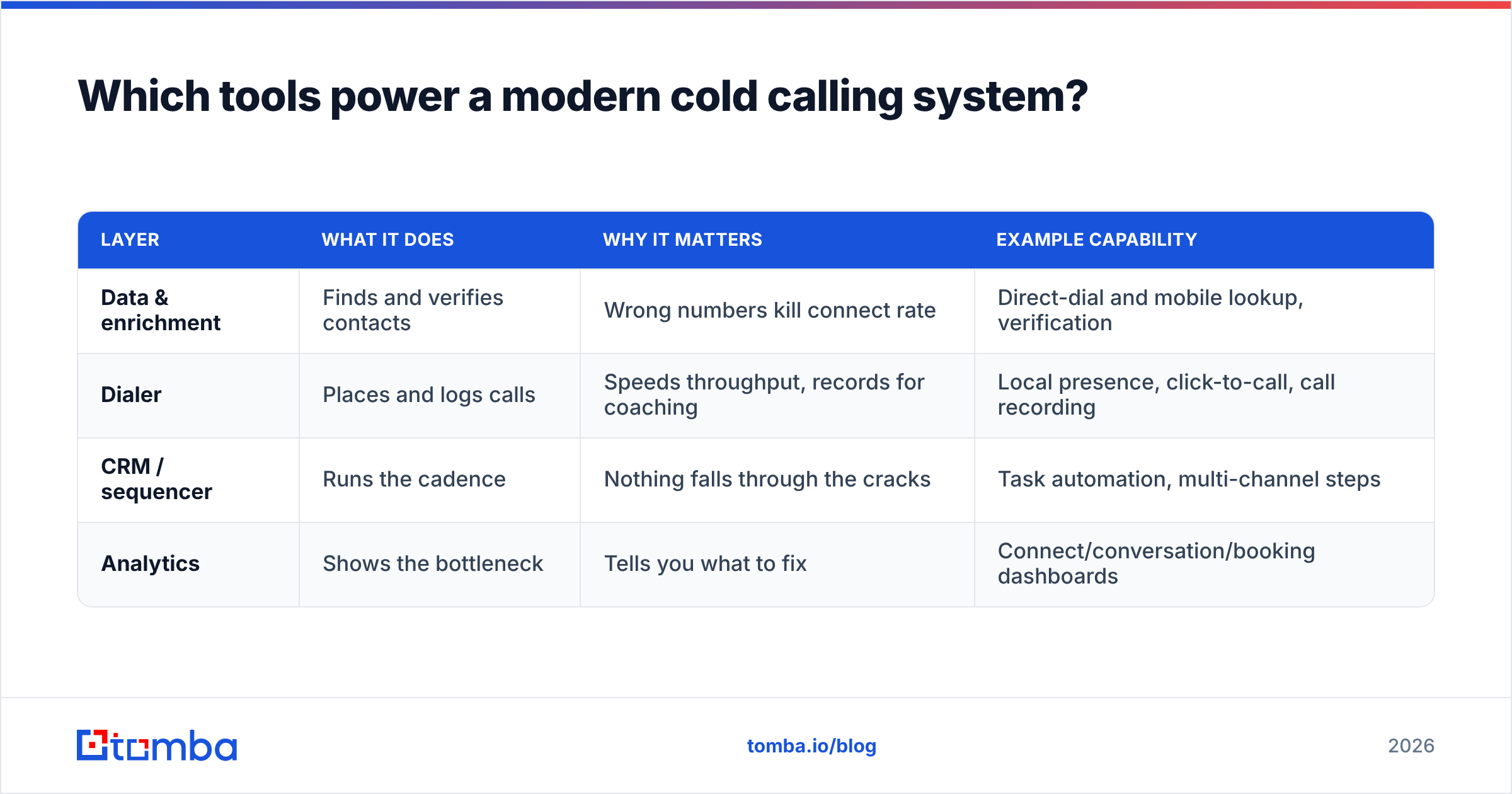
A modern system runs on three tool categories: data, dialing, and tracking. You don't need a bloated stack — you need one reliable tool per job. Here's how the layers compare:
| Layer | What it does | Why it matters | Example capability |
|---|---|---|---|
| Data & enrichment | Finds and verifies contacts | Wrong numbers kill connect rate | Direct-dial and mobile lookup, verification |
| Dialer | Places and logs calls | Speeds throughput, records for coaching | Local presence, click-to-call, call recording |
| CRM / sequencer | Runs the cadence | Nothing falls through the cracks | Task automation, multi-channel steps |
| Analytics | Shows the bottleneck | Tells you what to fix | Connect/conversation/booking dashboards |
The data layer is where most systems win or lose, so it deserves the most scrutiny. Before a single dial, you want verified direct numbers — not the main switchboard. A dedicated phone finder surfaces B2B direct dials and mobiles, and pairing it with a phone validator strips the dead lines before they waste a rep's afternoon. For teams that also run email as part of the cadence, verifying addresses with an email verifier keeps the whole sequence landing.
For dialers and CRMs, the market leaders are well documented on review sites like G2 and platforms such as Salesforce — pick based on your team size and existing stack, not on feature-count bragging. The point isn't the fanciest dialer; it's a clean list feeding a reliable cadence into a system that logs everything.
How do you measure a cold calling system?#
Measure the funnel, not the effort — track the rates that reveal where calls die, not just how many you made. "We made 400 dials" tells you nothing; "our connect rate dropped to 4%" tells you your list went stale.
The three metrics that run a healthy system:
- Connect rate = conversations with the target ÷ dials. If this is low, your data layer is broken. Fix numbers before anything else.
- Conversation-to-meeting rate = meetings booked ÷ conversations. If this is low but connect rate is fine, your opener or discovery needs work.
- Meetings per 100 dials = the north-star efficiency number. It ties data quality and skill into one figure you can trend weekly.
Watch leading indicators too: voicemail-to-callback, best-performing time windows, and which segments convert. When one metric sags, you know exactly which station on the line to inspect — that's the entire payoff of running a system instead of freelancing every call. If your response-heavy channels lag, benchmarking against typical response rate norms tells you whether the problem is your list or your message.
One discipline separates good teams: review the metrics weekly and change exactly one variable. Swap the list source one week, the opener the next. Change five things at once and you'll never know what worked.
What's the fastest way to improve a cold calling system today?#
Fix the data first — it's the highest-leverage change and the one most teams skip. A better script improves a fraction of your reachable calls; correct phone numbers increase the number of reachable calls, which multiplies everything downstream.
Run this order of operations:
- Audit your current list. What percentage of last week's dials hit a dead or wrong number? If it's above 15%, stop and fix data before touching the script.
- Enrich and verify. Append direct dials, confirm titles, and remove the dead lines.
- Segment into 3–5 buckets with a distinct angle each.
- Deploy the four-part flow and a two-week cadence.
- Track connect, conversation, and booking rates — and iterate one variable at a time.
Do those five in order and you've built an actual system: repeatable, measurable, and resilient when your star rep is out. Do them out of order — script first, data last — and you've built the thing most teams mistake for a system.
Build your call list on verified data#
Every layer of a cold calling system sits on top of one foundation: reaching the right person. If your list is wrong, the best script and cadence in the world just get you rejected faster. That's the layer to fix first — and the layer Tomba is built for.
Use the Tomba Email Finder to pull accurate, verified professional contacts by name, company, or domain — then enrich them with direct dials and clean context so every dial has a real human on the other end. Start on the free tier (25 searches/month) to test your list quality, and check Tomba pricing when you're ready to scale from Starter at $49/mo up to team plans. Build the list right, and the rest of your system finally has something solid to run on.
Related guides#
Ready to find emails that actually work?
Join 150,000+ professionals who stopped guessing and started sending. Free credits on signup — no credit card required.
Get the Tomba newsletter
Practical outbound tactics and product updates — once every two weeks.
About the author