Cold Calling Times Allowed in 2026: Legal Hours and Best Times to Call
Call at the wrong hour and you're either breaking the rules or hitting voicemail. Here's when you're legally allowed to dial B2B prospects in 2026 — and the slots when they actually pick up.
TL;DR
- In the U.S., cold calling times allowed are generally 8:00 a.m. to 9:00 p.m. in the called party's local time zone — a federal TCPA rule that also governs most B2B dialing in practice.
- Legal and effective are two different questions. You can dial at 8:03 a.m., but your connect rate will be poor. The best windows are mid-to-late morning (10–11:30 a.m.) and late afternoon (4–5 p.m.).
- Time zone is the variable most reps get wrong. A 5 p.m. call from New York lands at 2 p.m. in California — legal, but off-peak for that prospect.
- Wednesday and Thursday consistently outperform Monday and Friday for B2B connect rates.
- Accurate contact data — correct number, correct time zone, correct person — matters more than any single "magic hour." Bad data breaks the schedule before it starts.
Cold calling still works in 2026, but only if you dial inside two boxes at once: the hours the law allows, and the hours humans answer. Miss the first and you risk fines. Miss the second and you waste a dialer session on voicemail. This guide covers both, with the rules, the data, and a repeatable schedule you can hand to a team.
What are the cold calling times allowed by law?#
In the United States, you may place telemarketing and most cold sales calls between 8:00 a.m. and 9:00 p.m. in the time zone of the person you are calling. That 13-hour window comes from the Telephone Consumer Protection Act (TCPA) and the FTC's Telemarketing Sales Rule.
The critical detail: the clock runs on the recipient's local time, not yours. If your SDR team sits in Austin and calls a prospect in Los Angeles at 7:30 a.m. Central, that's 5:30 a.m. Pacific — well before the legal window opens. The call is non-compliant regardless of your intent.
A few more rules that shape when you can dial:
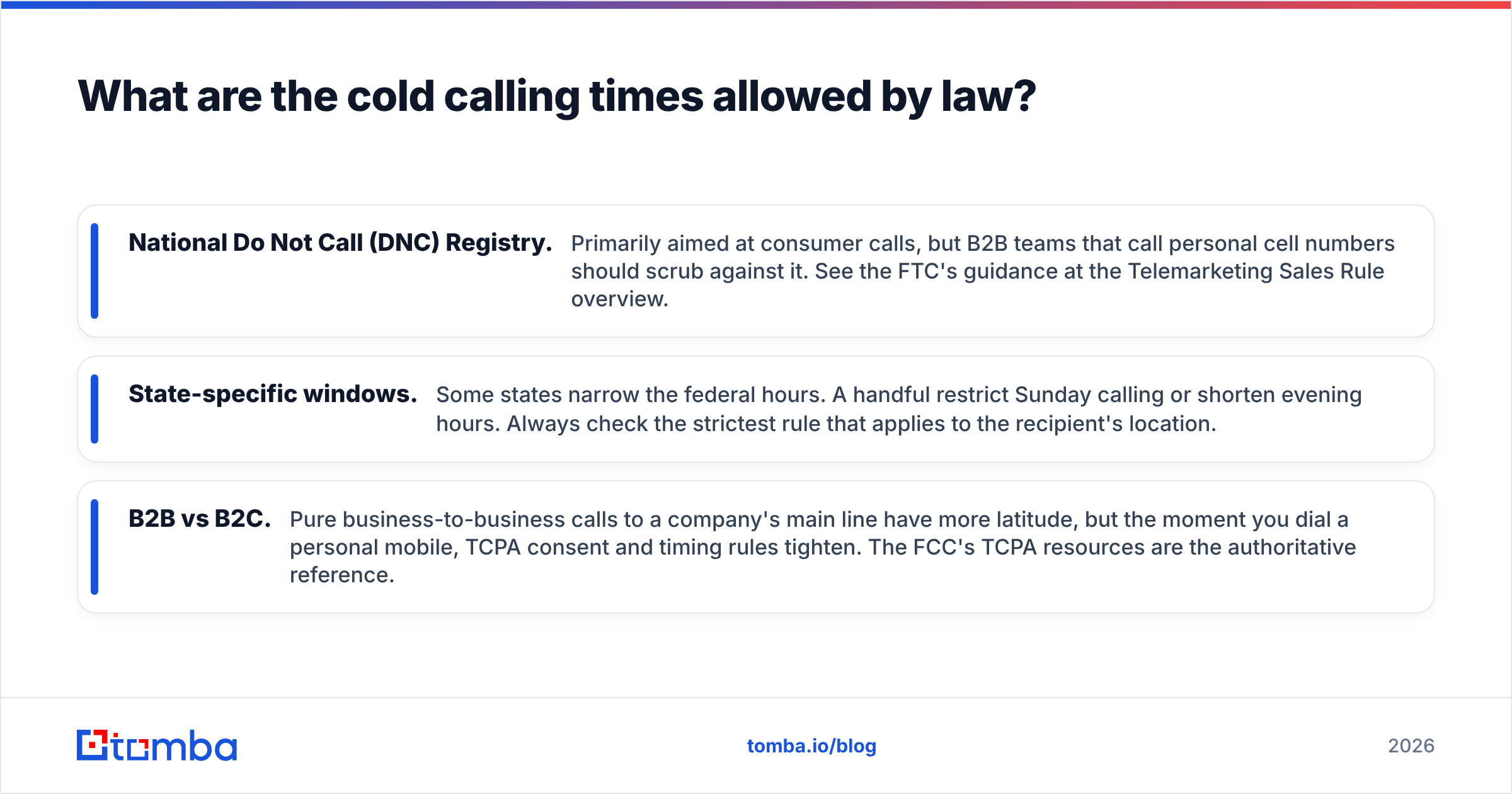
- National Do Not Call (DNC) Registry. Primarily aimed at consumer calls, but B2B teams that call personal cell numbers should scrub against it. See the FTC's guidance at the Telemarketing Sales Rule overview.
- State-specific windows. Some states narrow the federal hours. A handful restrict Sunday calling or shorten evening hours. Always check the strictest rule that applies to the recipient's location.
- B2B vs B2C. Pure business-to-business calls to a company's main line have more latitude, but the moment you dial a personal mobile, TCPA consent and timing rules tighten. The FCC's TCPA resources are the authoritative reference.
When in doubt, treat 8 a.m.–9 p.m. local to the prospect as your hard boundary, and log the time zone for every record you dial.
Is calling early morning or evening actually legal — and smart?#
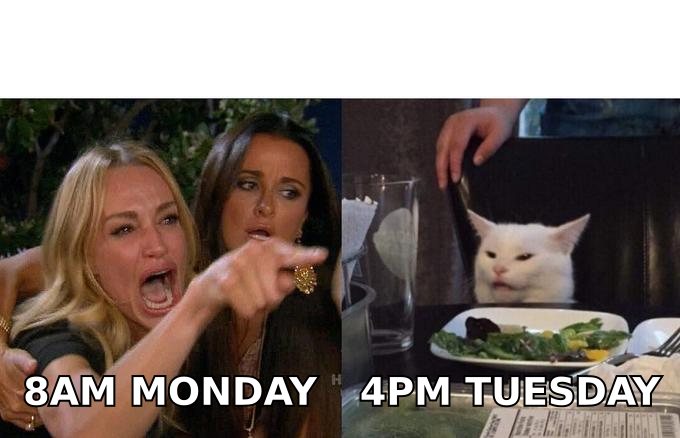
Legal, mostly. Smart, rarely. Just because the window opens at 8 a.m. doesn't mean 8 a.m. is a good idea.
Early-morning calls (8–9 a.m.) catch decision-makers still triaging their inbox, in stand-ups, or not yet at their desk. Late-evening calls (after 6 p.m.) reach people who have mentally clocked out. Both are inside the cold calling times allowed by law, but both sit at the bottom of every connect-rate study.
There's also a reputational cost. Dialing at the very edges of the legal window reads as aggressive. Prospects who feel ambushed at 8:01 a.m. remember the brand — and not the way you want. Compliance is the floor, not the strategy.
What is the best time of day to cold call?#
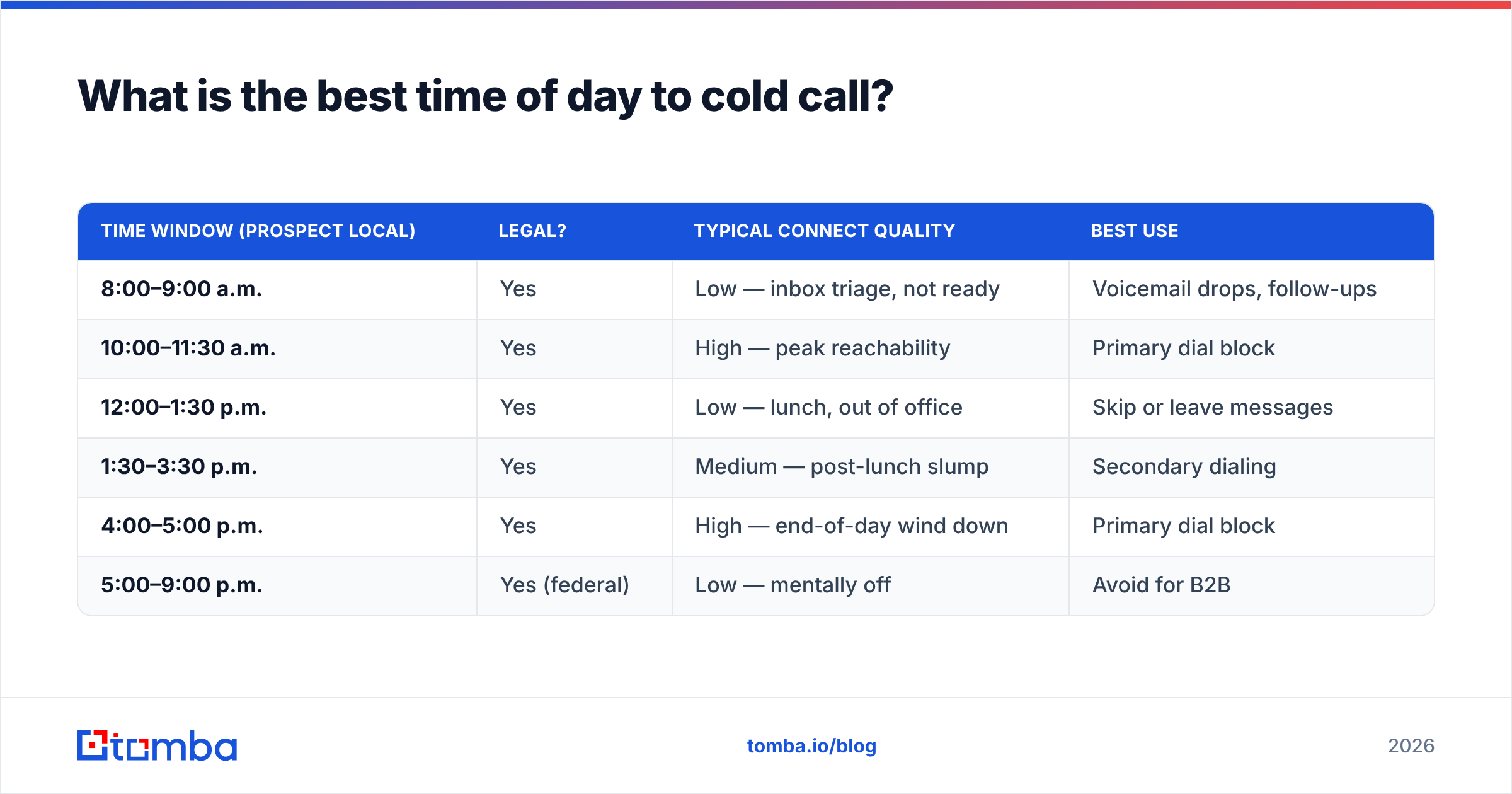
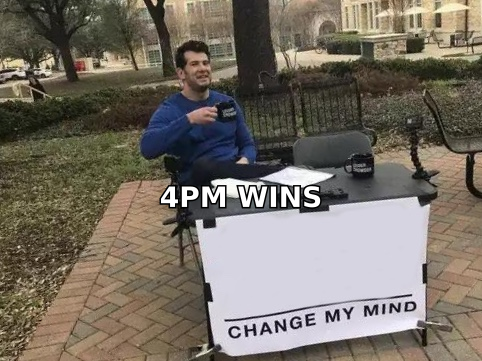
Two windows win repeatedly: 10:00–11:30 a.m. and 4:00–5:00 p.m., prospect local time. Late morning catches people after the first-meeting rush but before lunch. Late afternoon catches them winding down, more willing to take a quick call before the day ends.
Here's how the common windows compare for B2B outbound:
| Time window (prospect local) | Legal? | Typical connect quality | Best use |
|---|---|---|---|
| 8:00–9:00 a.m. | Yes | Low — inbox triage, not ready | Voicemail drops, follow-ups |
| 10:00–11:30 a.m. | Yes | High — peak reachability | Primary dial block |
| 12:00–1:30 p.m. | Yes | Low — lunch, out of office | Skip or leave messages |
| 1:30–3:30 p.m. | Yes | Medium — post-lunch slump | Secondary dialing |
| 4:00–5:00 p.m. | Yes | High — end-of-day wind down | Primary dial block |
| 5:00–9:00 p.m. | Yes (federal) | Low — mentally off | Avoid for B2B |
Treat this as a starting template, not gospel. Founders answer at 7 a.m. Nurses and shift-based buyers flip the whole schedule. The point is to build blocks around your audience's rhythm, then measure and adjust using your own response rate data.
What is the best day of the week to cold call?#
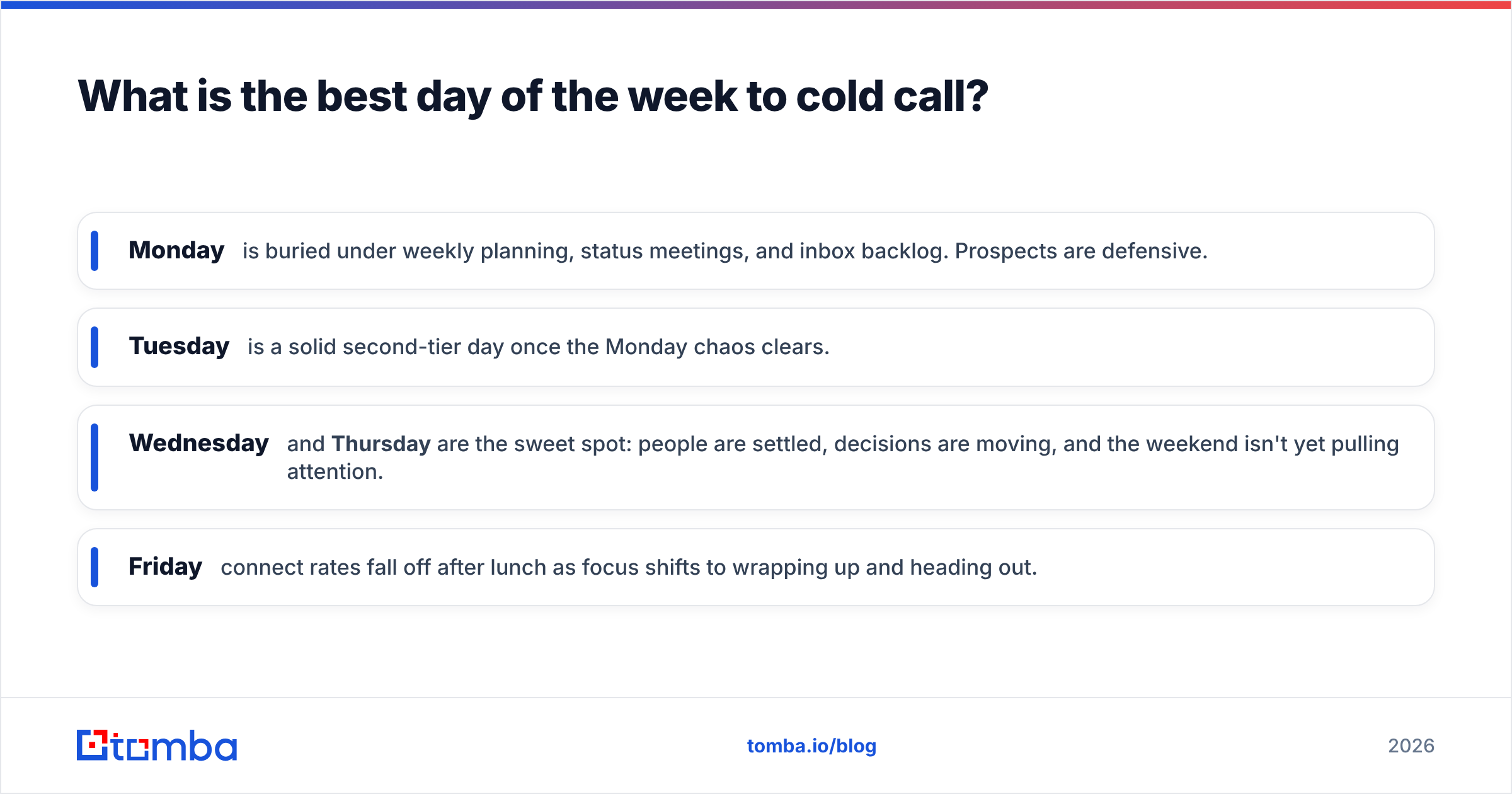
Wednesday and Thursday. Across most B2B connect-rate studies — including HubSpot's sales benchmarks — midweek days beat the bookends.
- Monday is buried under weekly planning, status meetings, and inbox backlog. Prospects are defensive.
- Tuesday is a solid second-tier day once the Monday chaos clears.
- Wednesday and Thursday are the sweet spot: people are settled, decisions are moving, and the weekend isn't yet pulling attention.
- Friday connect rates fall off after lunch as focus shifts to wrapping up and heading out.
Stack your highest-value accounts into Wednesday and Thursday's late-morning and late-afternoon blocks. Use Monday and Friday for admin, list-building, and pre-call research so your prime hours are pure dialing.
How do time zones change the rules?#
Time zones are where good schedules quietly break. A rep working 9 a.m.–5 p.m. Eastern can only legally reach Pacific-time prospects starting at 11 a.m. Eastern (8 a.m. Pacific) — and the Pacific prospect's prime late-afternoon window (4–5 p.m. Pacific) is 7–8 p.m. Eastern, after the rep has gone home.
Practical ways to handle it:
- Segment your call lists by time zone, not alphabetically or by account size. Build a "Pacific block" your reps hit in their afternoon.
- Stamp every record with the prospect's time zone during enrichment, so the dialer never guesses.
- Route accounts to reps in compatible zones if your team is distributed. A West Coast rep covering West Coast accounts keeps everyone inside the good window.
None of this works without an accurate phone number tied to the right location. If half your numbers are wrong or the area code doesn't match where the person actually sits, your carefully planned schedule dials into the void. This is where clean data and a reliable phone finder do more for your connect rate than any timing tweak — and a quick pass through a phone validator removes dead and disconnected numbers before they burn a slot.
How do you build a compliant, high-connect calling schedule?#
Put the two boxes together — legal window and peak reachability — into a schedule your whole team can run without thinking about it.
A repeatable weekly template:
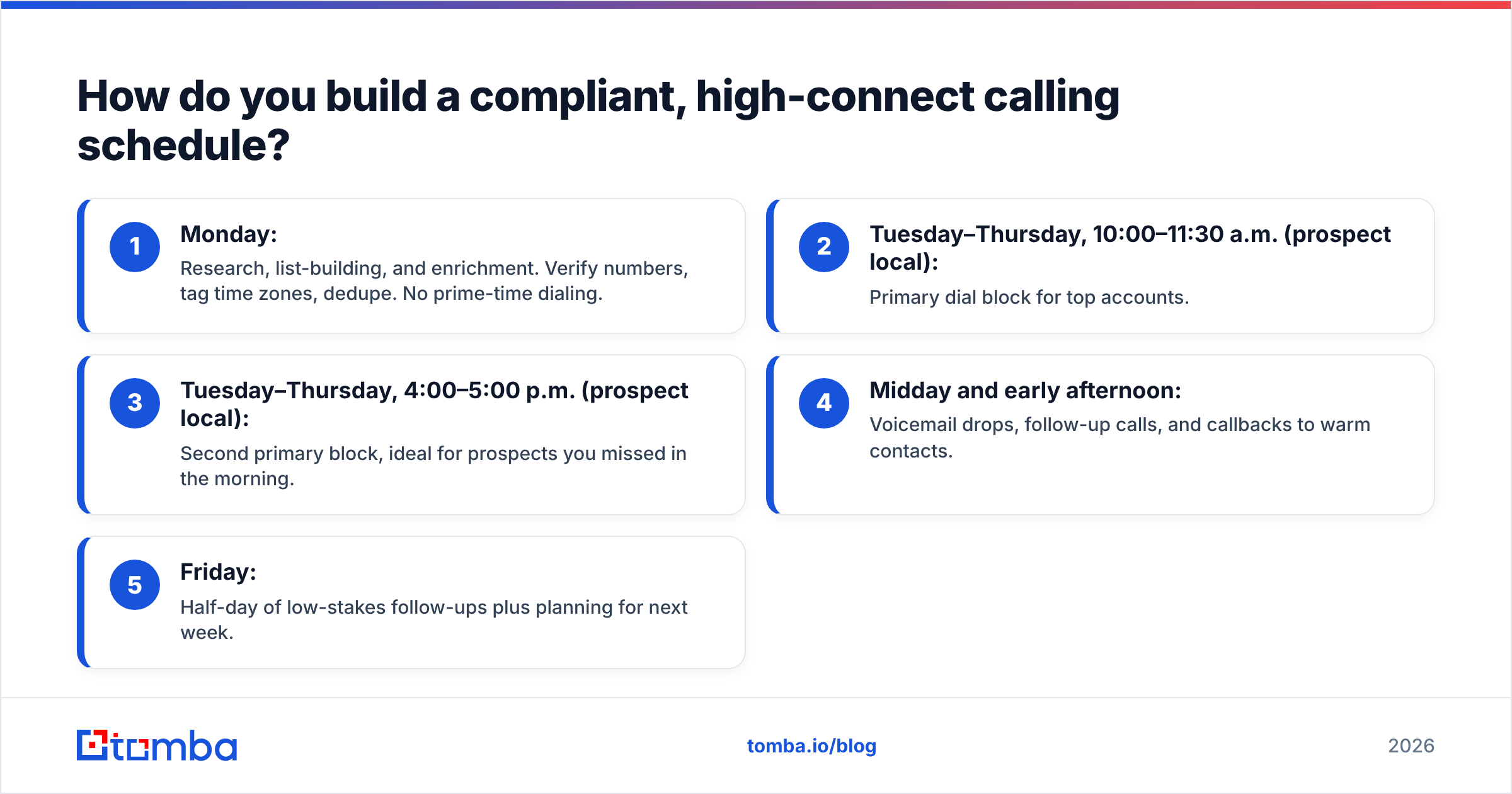
- Monday: Research, list-building, and enrichment. Verify numbers, tag time zones, dedupe. No prime-time dialing.
- Tuesday–Thursday, 10:00–11:30 a.m. (prospect local): Primary dial block for top accounts.
- Tuesday–Thursday, 4:00–5:00 p.m. (prospect local): Second primary block, ideal for prospects you missed in the morning.
- Midday and early afternoon: Voicemail drops, follow-up calls, and callbacks to warm contacts.
- Friday: Half-day of low-stakes follow-ups plus planning for next week.
Layer compliance checks on top: confirm the recipient's local time before dialing, honor DNC and internal opt-outs, and log every attempt with a timestamp. If you're running a distributed team, keep a shared clock reference so nobody accidentally calls a prospect at 6 a.m. their time.
Feed the whole system with reliable contact data. Building call lists from a maintained B2B database and running fields through data enrichment means your reps open each block with correct names, direct numbers, and accurate time zones — instead of spending the good hours cleaning bad rows.
Cold calling times: quick answers#
Q: What time can telemarketers legally call in the US? Between 8:00 a.m. and 9:00 p.m. in the called person's time zone, under the TCPA and the FTC Telemarketing Sales Rule. State laws may narrow this.
Q: Is it illegal to cold call before 8 a.m.? For telemarketing and most consumer-facing sales calls, yes — dialing before 8 a.m. local to the recipient violates federal timing rules. Pure B2B main-line calls have more latitude, but 8 a.m.–9 p.m. is the safe standard.
Q: What's the single best time to cold call? Late morning (10–11:30 a.m.) and late afternoon (4–5 p.m.), prospect local time, on Wednesday or Thursday.
Q: Can I cold call on weekends? Federally you may call Saturdays within the 8 a.m.–9 p.m. window, but B2B connect rates are poor and some states restrict Sunday calling. Most B2B teams skip weekends entirely.
Q: Does the time zone follow me or the prospect? The prospect. Always calculate the legal window and the ideal window in their local time.
The bottom line#
The cold calling times allowed by law give you a 13-hour window, but only a few of those hours actually connect — and only if you're dialing the right number in the right time zone. Compliance keeps you out of trouble; timing plus clean data is what fills your pipeline.
Get the data layer right first. Tomba's phone finder surfaces verified B2B direct numbers, and pairing it with enrichment lets you tag every prospect's time zone before a rep ever picks up the phone. Start free — Tomba's plans run from a free tier up to Growth at $99/mo, with full Tomba pricing laid out per credit tier — so you can build a compliant, high-connect call list today and spend your prime hours talking to people instead of chasing bad numbers.
Related guides#
Ready to find emails that actually work?
Join 150,000+ professionals who stopped guessing and started sending. Free credits on signup — no credit card required.
Get the Tomba newsletter
Practical outbound tactics and product updates — once every two weeks.
About the author