Cold Calling Via Email: The 2026 Playbook That Books Meetings
Cold calling via email takes the persistence and personalization of a phone call and gives it inbox-scale reach. Here's the exact 2026 framework, templates, and metrics.
Cold calling never died — it just moved into the inbox. "Cold calling via email" is what happens when you take the discipline of phone prospecting (a tight list, a sharp opener, a clear ask, relentless follow-up) and run it at the scale and asynchronicity email allows. Done right, it books meetings without the rejection-per-minute grind of the phone. Done wrong, it's spam.
This guide breaks down exactly how to run cold calling via email in 2026: the mindset shift, the message structure, the sequence cadence, the metrics that matter, and the tooling that keeps you out of spam folders.
TL;DR#
- Cold calling via email = phone-prospecting discipline, applied to the inbox. Same targeting rigor, same crisp ask — just async and scalable.
- One clear ask per email. A cold email is a 15-second "call," not a brochure. Get to the point in the first two sentences.
- The sequence does the work. 90% of replies come from follow-ups 2–5, not the first send. Plan 4–7 touches over 2–3 weeks.
- Deliverability is the whole game. Verified data, warmed domains, and authentication (SPF/DKIM/DMARC) decide whether your "calls" ever ring.
- Accurate contact data beats clever copy. A perfect pitch to a dead address books zero meetings. Start with a clean, verified list.
What is cold calling via email?#
Cold calling via email is outbound prospecting that borrows the mechanics of a cold call and delivers them through email instead of the phone. Think of it like leaving a series of short, well-crafted voicemails — except the prospect can respond on their own schedule, you can reach 200 people in the time one call takes, and nobody hangs up on you mid-sentence.
The "cold" part is identical to phone: the recipient didn't ask to hear from you. The "call" part is the intent — you want a specific next action (a reply, a booked slot, a referral), not just brand awareness. That distinguishes it from newsletter marketing or nurture email, which optimize for long-term engagement rather than an immediate conversation.
Here's the mindset that separates operators from spammers:
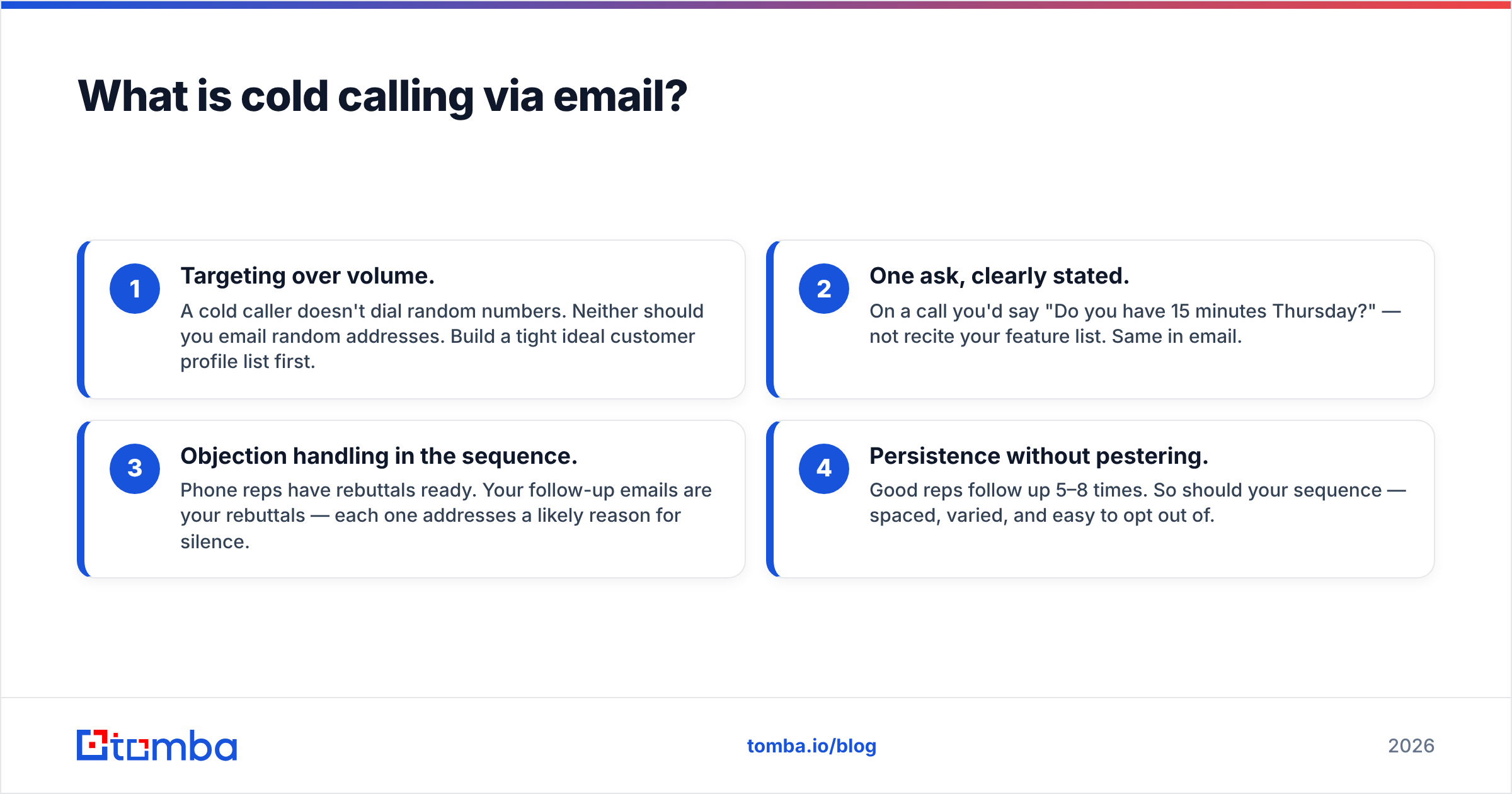
- Targeting over volume. A cold caller doesn't dial random numbers. Neither should you email random addresses. Build a tight ideal customer profile list first.
- One ask, clearly stated. On a call you'd say "Do you have 15 minutes Thursday?" — not recite your feature list. Same in email.
- Objection handling in the sequence. Phone reps have rebuttals ready. Your follow-up emails are your rebuttals — each one addresses a likely reason for silence.
- Persistence without pestering. Good reps follow up 5–8 times. So should your sequence — spaced, varied, and easy to opt out of.
Is cold calling via email better than the phone?#
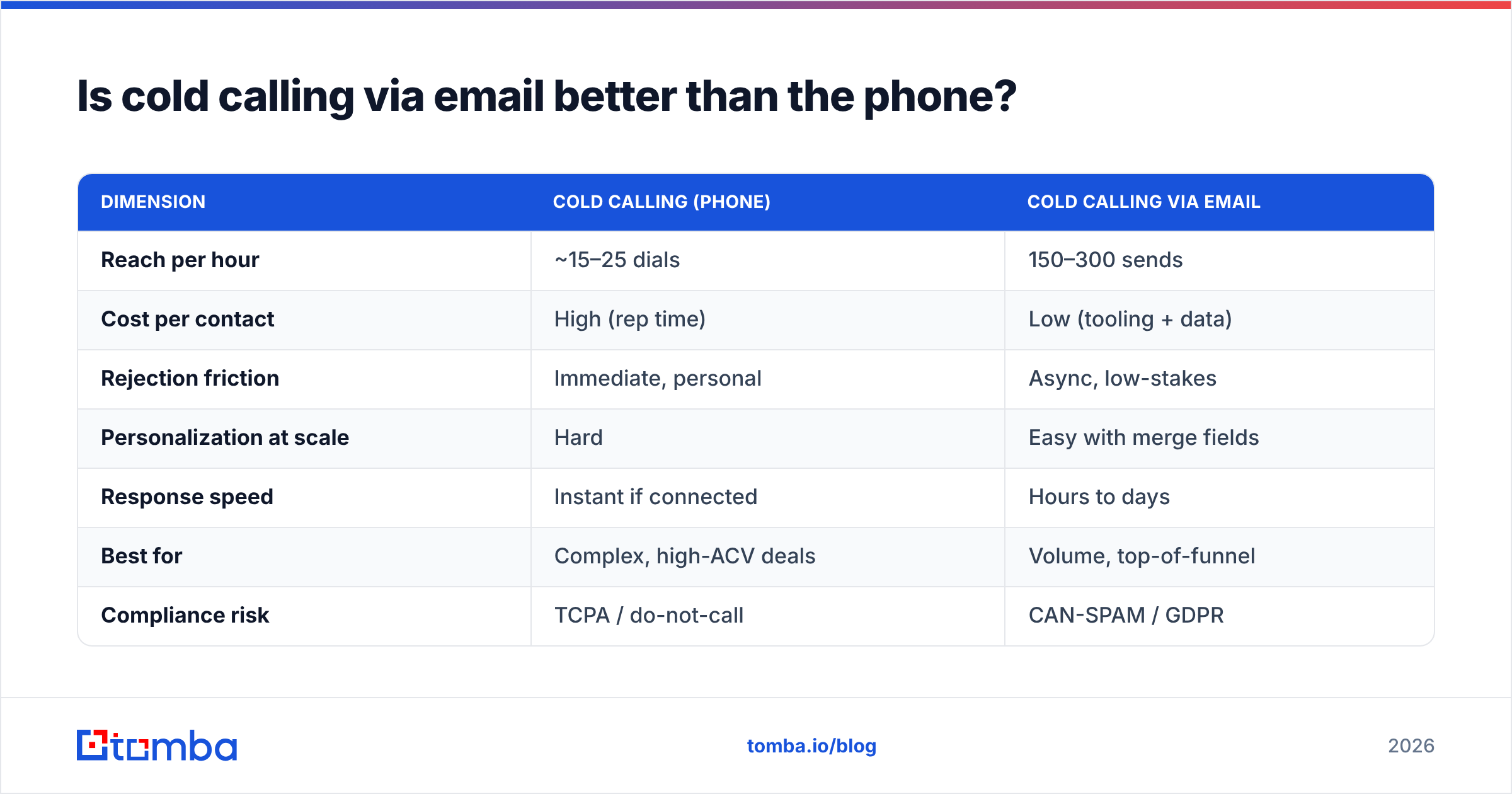
Neither wins outright — they win in combination. But for most B2B teams in 2026, email is the more efficient first touch, with the phone reserved for warm or high-value follow-up. Here's the honest trade-off.
| Dimension | Cold calling (phone) | Cold calling via email |
|---|---|---|
| Reach per hour | ~15–25 dials | 150–300 sends |
| Cost per contact | High (rep time) | Low (tooling + data) |
| Rejection friction | Immediate, personal | Async, low-stakes |
| Personalization at scale | Hard | Easy with merge fields |
| Response speed | Instant if connected | Hours to days |
| Best for | Complex, high-ACV deals | Volume, top-of-funnel |
| Compliance risk | TCPA / do-not-call | CAN-SPAM / GDPR |
| Books meetings via | Live conversation | Sequence + clear CTA |
The pragmatic 2026 stack is "email-first, phone-assist": email opens the relationship and surfaces interest signals (opens, clicks, replies), then a rep calls the accounts showing intent. That way you spend expensive phone minutes only on prospects who've already raised a hand. It's the same logic as social selling layering on top of outbound — meet buyers where the friction is lowest, then escalate.
How do you structure a cold email that lands like a call?#
Keep it to the length of a voicemail: 50–125 words, one idea, one ask. The structure below maps directly onto how a good cold caller opens.
- Subject line (the "hello"). 2–5 words, lowercase, specific. "quick question, {{first_name}}" or "{{company}} + outbound". Avoid anything that reads like a promotion. Test variants with a subject line tester before you scale.
- Opening line (the pattern interrupt). Reference something true and specific about them — a role change, a job posting, a recent announcement. Never "I hope this email finds you well."
- The reason (the pitch). One sentence on why you're reaching out, framed around their problem, not your product.
- The ask (the CTA). A single, low-friction question. "Worth a 15-minute look?" beats "Can we schedule a comprehensive demo of our platform?"
- Signature (the credibility). Real name, real company, a link they can verify. Use a clean email signature generator so you look like a person, not a bot.
A working example:
Subject: outbound at {{company}}
Hi {{first_name}} — saw you're hiring two SDRs this quarter. Usually that means the current team is buried in list-building instead of selling.
We help RevOps teams cut prospecting research time by ~60% with verified contact data. Worth a quick look, or should I send a 2-line summary instead?
— Sara, Tomba
That last line — offering a smaller yes ("a 2-line summary") — is a classic phone tactic: never let the only options be "full demo" or "no."
What does a winning email sequence cadence look like?#
The single email is a myth. Just as a cold caller expects to dial someone 6–8 times, your results come from the sequence. Data from outbound teams consistently shows the majority of positive replies arrive on the third touch or later. Plan for it.
A reliable 2026 cadence:
- Day 1 — Opener. The email above. Problem + soft ask.
- Day 3 — Value add. No pitch. Share a relevant stat, teardown, or resource. "Made this before I forget."
- Day 6 — Social proof. A one-line customer result in their industry.
- Day 10 — The nudge. "Bad timing, or not a fit?" — the permission-to-close email that reliably pulls replies.
- Day 14 — Breakup. "I'll stop here — want me to circle back next quarter?"
Vary the angle each touch, never just "bumping this to the top of your inbox." And keep every send verifiable and opt-out-friendly — that's not just courtesy, it's what keeps your domain healthy. For the copy itself, a cold email AI writer can draft variants fast, but always edit for a human voice before sending.
Why does deliverability decide everything?#
Because a cold email that lands in spam is a call that never rings. You can have flawless copy and a perfect list, but if your domain isn't trusted, nobody hears you. Deliverability is the unglamorous 80% of cold calling via email.
The non-negotiable checklist:
- Authenticate your domain. Set up SPF, DKIM, and DMARC before you send a single cold email. Verify your SPF record with a checker, and confirm alignment. Google and Yahoo now effectively require this for bulk senders — see Google's sender guidelines.
- Warm the domain and inbox. New or cold domains need 2–4 weeks of gradual volume ramp before real campaigns. Use a warmup schedule; don't go 0 to 500 overnight.
- Verify every address. Sending to invalid or catch-all addresses spikes your bounce rate and torches sender reputation. Run your list through an email verifier first — this is the single highest-ROI habit in cold outreach.
- Keep volume human. 20–50 cold sends per inbox per day, spread out. Scale with more inboxes, not more sends per inbox.
- Watch the leading indicators. Rising bounces, falling open rates, or spam complaints mean stop and fix — not push harder.
Deliverability and email deliverability hygiene compound: every clean send builds reputation, every bad one erodes it. Tools like G2's email deliverability category list dozens of warmup and monitoring options, but the foundation is always the same three pillars — authenticate, warm, verify.
What metrics actually tell you it's working?#
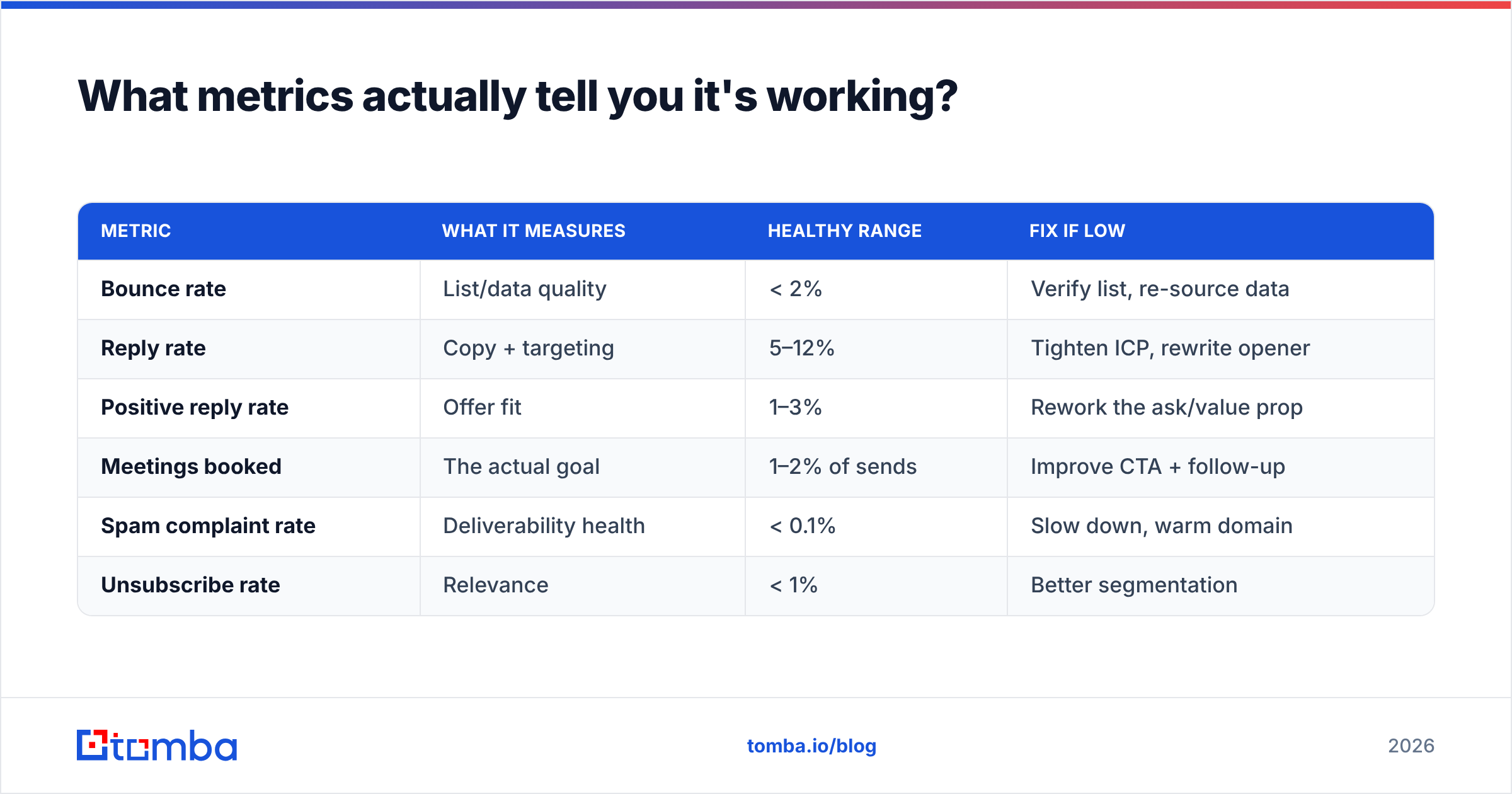
Track reply rate and meetings booked — not opens. Open tracking is increasingly unreliable (Apple Mail Privacy Protection inflates it), and opens don't pay. Here's what to watch and what "good" looks like for cold calling via email in 2026.
| Metric | What it measures | Healthy range | Fix if low |
|---|---|---|---|
| Bounce rate | List/data quality | < 2% | Verify list, re-source data |
| Reply rate | Copy + targeting | 5–12% | Tighten ICP, rewrite opener |
| Positive reply rate | Offer fit | 1–3% | Rework the ask/value prop |
| Meetings booked | The actual goal | 1–2% of sends | Improve CTA + follow-up |
| Spam complaint rate | Deliverability health | < 0.1% | Slow down, warm domain |
| Unsubscribe rate | Relevance | < 1% | Better segmentation |
If bounce rate is your problem, no amount of copywriting fixes it — that's a data problem. Which brings us to the part everyone underinvests in.
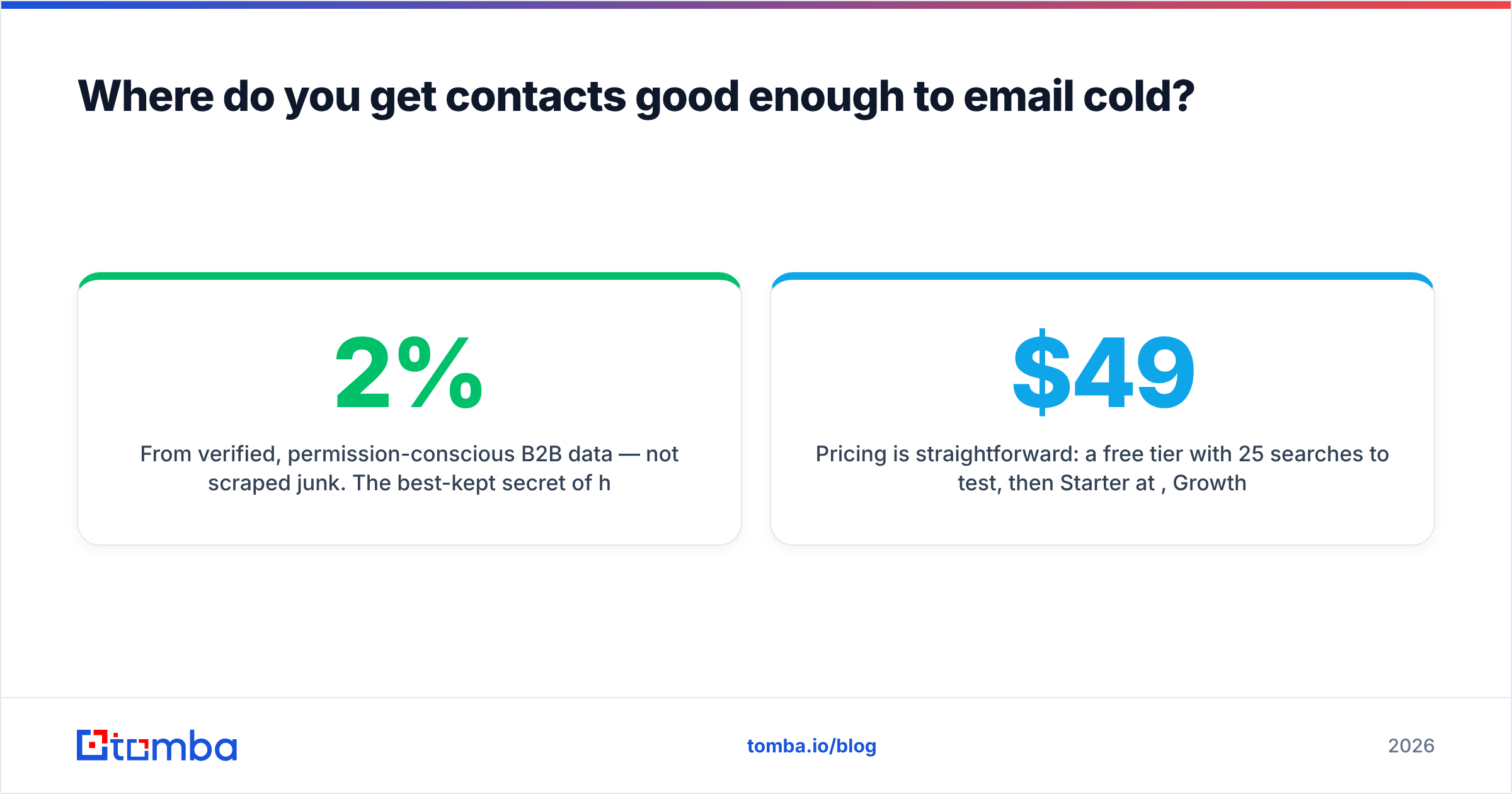
Where do you get contacts good enough to email cold?#
From verified, permission-conscious B2B data — not scraped junk. The best-kept secret of high-performing outbound teams is boring: their lists are clean. When your bounce rate sits under 2% and every address is a real, current person, average copy still books meetings. When your list is 30% dead, even genius copy fails.
That's the layer Tomba is built for. Instead of buying stale lists, you find and verify contacts on demand:
- Find the person. Use the Tomba Email Finder to get a professional address from a name and company, or run a full domain search to map every reachable contact at a target account.
- Verify before you send. Every address runs through verification, including catch-all verification, so you're not gambling on risky domains.
- Build lists at scale. The bulk email finder turns a company list into a verified contact list, and data enrichment fills in titles, seniority, and firmographics for real segmentation.
- Work where you already are. Native integrations push contacts straight into your CRM or sequencer.
Pricing is straightforward: a free tier with 25 searches/month to test, then Starter at $49/mo, Growth at $99/mo, and Pro at $249/mo as you scale — full details on the Tomba pricing page. Compared with all-in-one platforms, the value is focus: accurate, verified contact data is the one input your whole cold-email engine depends on.
How is cold calling via email different from spam?#
Intent, targeting, and consent hygiene. Spam is untargeted, deceptive, and impossible to opt out of. Legitimate cold outreach is relevant, honest about who you are, and easy to unsubscribe from. The legal and practical lines:
- Be truthful. Real sender name, real company, no misleading subject lines. This is a CAN-SPAM requirement in the US, not a nicety.
- Offer an opt-out. Every email needs a clear way to say "stop." Honor it fast.
- Have a lawful basis in the EU/UK. GDPR requires legitimate interest or consent for B2B outreach — document your reasoning and segment tightly.
- Target for relevance. If a reasonable recipient would think "why is this person emailing me?", you've mis-targeted. Fix the list, not the disclaimer.
The paradox: the same practices that keep you legal also make you effective. Tight targeting and clean data lower complaint rates, protect deliverability, and raise reply rates. Compliance and performance point the same direction.
Cold calling via email: the operator's summary#
Treat it exactly like a phone campaign with better economics. Build a tight list of the right people, verify every address, write short messages with one clear ask, run a patient multi-touch sequence, and protect your domain like it's your phone number — because it is. The teams that win at cold calling via email in 2026 aren't the ones with the cleverest copy. They're the ones whose "calls" actually connect, because the data behind them is accurate and the domain behind them is trusted.
Get the data layer right first, and everything downstream gets easier.
Ready to make every cold email connect? Start with the input that decides your bounce rate and reply rate: verified contact data. Spin up a free Tomba Email Finder account — 25 searches a month, no card — build a clean, verified list, and give your cold-calling-via-email engine the fuel it needs to book real meetings.
Related guides#
Ready to find emails that actually work?
Join 150,000+ professionals who stopped guessing and started sending. Free credits on signup — no credit card required.
Get the Tomba newsletter
Practical outbound tactics and product updates — once every two weeks.
About the author