Cold Email Benchmarks 2026: Open, Reply & Bounce Rates
What actually counts as a good open, reply, bounce, and positive-reply rate in 2026? Real cold email benchmarks by industry, plus how to beat them.
You send 1,000 cold emails, get 4 replies, and have no idea whether that's a disaster or just Tuesday. The problem isn't your effort — it's that you have nothing to measure against. This guide gives you the cold email benchmarks that actually matter in 2026, what "good" looks like by metric and industry, and the concrete levers that move each number.
TL;DR — Cold Email Benchmarks at a Glance#
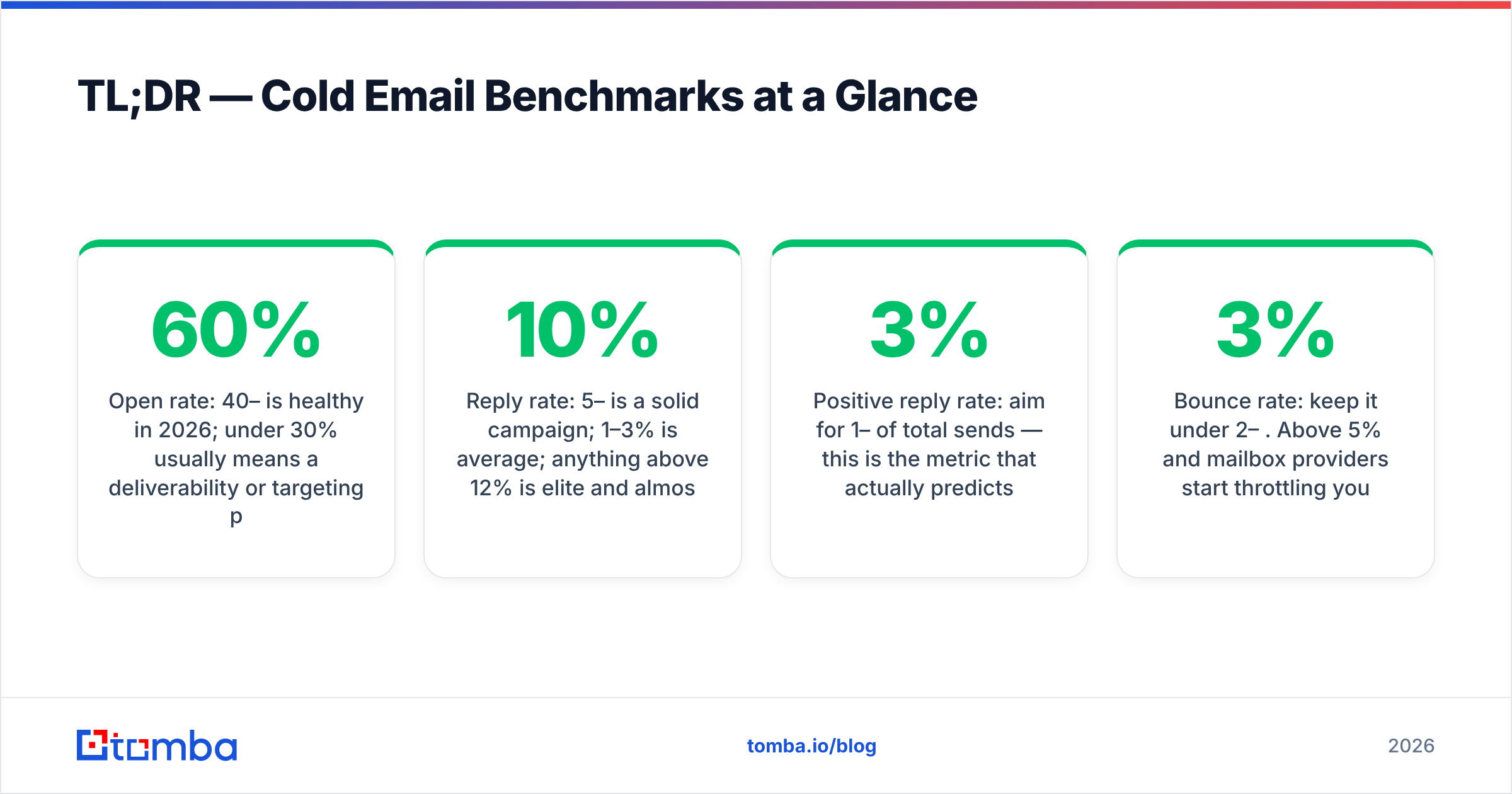
- Open rate: 40–60% is healthy in 2026; under 30% usually means a deliverability or targeting problem, not a subject-line one.
- Reply rate: 5–10% is a solid campaign; 1–3% is average; anything above 12% is elite and almost always driven by list quality plus personalization.
- Positive reply rate: aim for 1–3% of total sends — this is the metric that actually predicts pipeline.
- Bounce rate: keep it under 2–3%. Above 5% and mailbox providers start throttling you.
- Biggest single lever: a verified, well-targeted list beats clever copy every time. Garbage in, throttled out.
What Counts as a Good Cold Email Benchmark in 2026?#
Short answer: it depends on the metric, and the goalposts have moved. Apple Mail Privacy Protection and image pre-fetching have inflated open rates for years, so a 60% "open rate" no longer means 60% of humans read your email. That's why smart teams in 2026 anchor on reply rate and positive reply rate instead of opens.
Think of your funnel like a physical mailroom. Opens tell you the envelope got opened. Replies tell you someone read the letter and cared enough to write back. Positive replies tell you a real opportunity walked in the door. Only the last one pays rent.
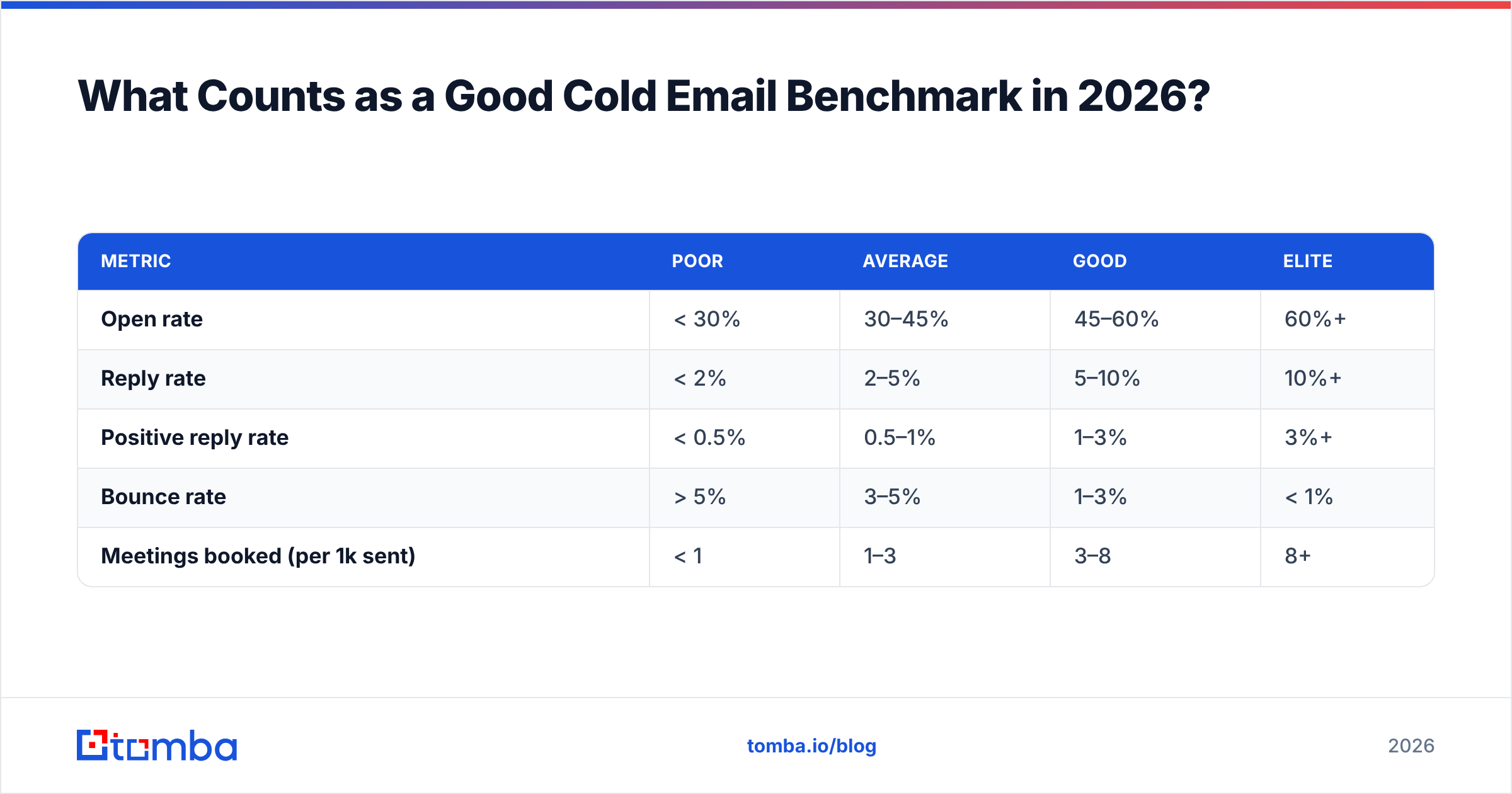
Here's the current landscape across the metrics that matter:
| Metric | Poor | Average | Good | Elite |
|---|---|---|---|---|
| Open rate | < 30% | 30–45% | 45–60% | 60%+ |
| Reply rate | < 2% | 2–5% | 5–10% | 10%+ |
| Positive reply rate | < 0.5% | 0.5–1% | 1–3% | 3%+ |
| Bounce rate | > 5% | 3–5% | 1–3% | < 1% |
| Meetings booked (per 1k sent) | < 1 | 1–3 | 3–8 | 8+ |
These are cross-industry medians pulled from aggregated 2025–2026 outbound reporting. Your mileage varies by vertical, deal size, and how cold the list actually is — but if you're consistently in the "poor" column on two or more rows, the campaign has a structural problem, not a copy problem.
Which Metrics Should You Actually Track?#
Track fewer things, but track the right ones. Here's the priority order most outbound teams should use in 2026:
- Positive reply rate — the percentage of sends that produce genuine interest (a meeting, a "tell me more," a referral). This is your north star because it filters out "unsubscribe" and "wrong person" noise.
- Reply rate — total replies over total delivered. A useful health check, but inflated by negative replies, so never read it alone.
- Bounce rate — the fastest way to torch your sender reputation. Watch it before every send, not after.
- Delivered rate — sends that actually landed (not bounced, not blocked). If this dips, nothing downstream matters.
- Meetings booked — the only metric your revenue team cares about. Everything else is a leading indicator of this.
- Open rate — still worth watching for trend breaks, but treat it as directional, not gospel, thanks to privacy pre-fetching.
Notice what's low on the list: open rate. In 2026 it's a smoke detector, not a scoreboard. A sudden open-rate collapse can flag a deliverability issue, but a high open rate proves almost nothing about pipeline.
How Do Cold Email Benchmarks Vary by Industry?#
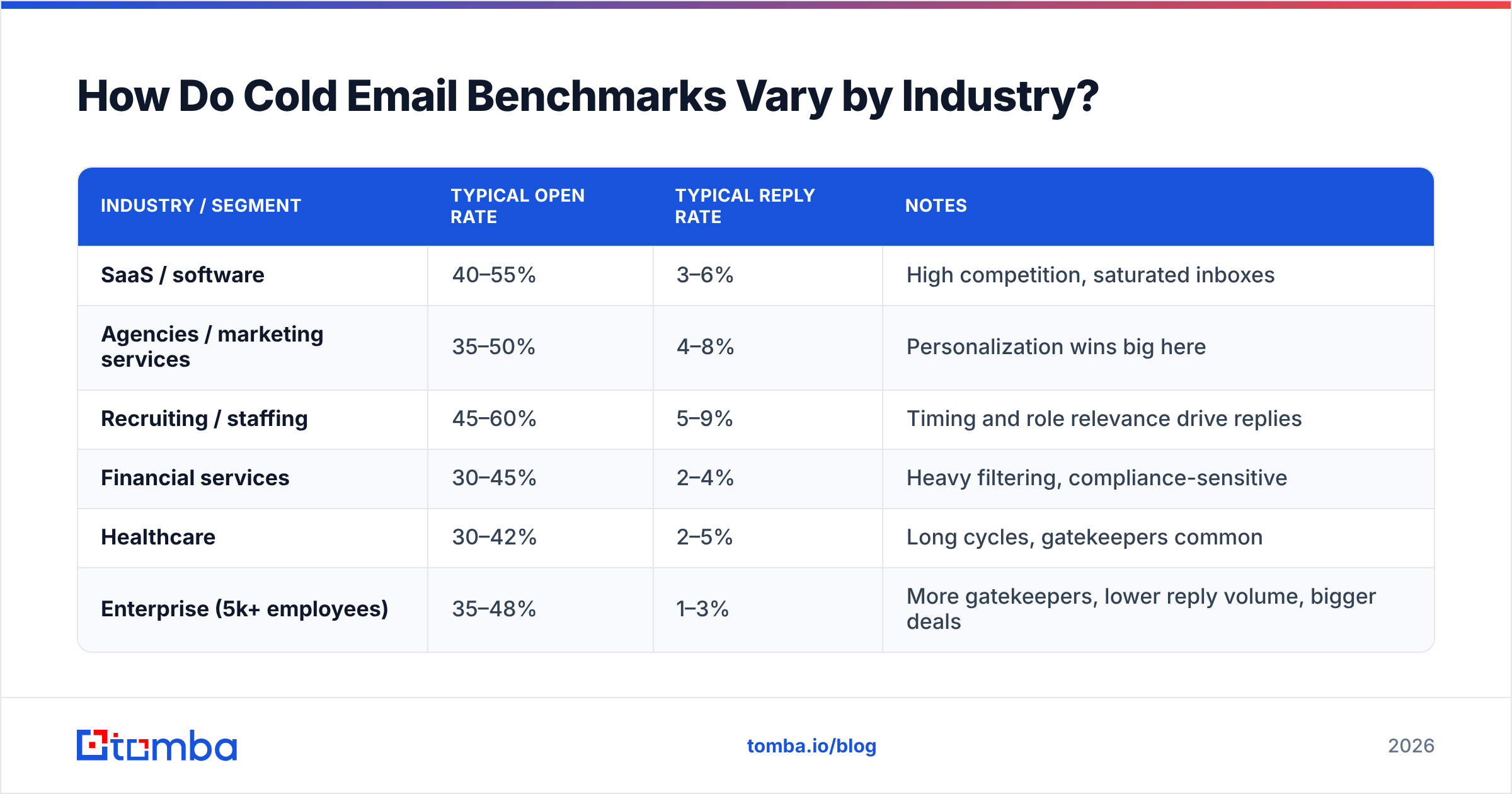
A lot. Selling a $500/month SaaS tool to marketers is a different physics problem than selling a seven-figure services contract to a hospital CIO. Reply rates generally rise as the audience narrows and the offer gets more relevant, and fall as the market gets more saturated with outreach.
| Industry / segment | Typical open rate | Typical reply rate | Notes |
|---|---|---|---|
| SaaS / software | 40–55% | 3–6% | High competition, saturated inboxes |
| Agencies / marketing services | 35–50% | 4–8% | Personalization wins big here |
| Recruiting / staffing | 45–60% | 5–9% | Timing and role relevance drive replies |
| Financial services | 30–45% | 2–4% | Heavy filtering, compliance-sensitive |
| Healthcare | 30–42% | 2–5% | Long cycles, gatekeepers common |
| Enterprise (5k+ employees) | 35–48% | 1–3% | More gatekeepers, lower reply volume, bigger deals |
Two takeaways. First, don't compare your healthcare campaign to someone's agency case study on LinkedIn — the baselines are different. Second, a lower reply rate in enterprise isn't failure; a 2% reply rate on 200 named accounts with $250k ACV crushes a 9% reply rate on 5,000 tiny prospects.
Why Is Your Reply Rate Below Benchmark?#
Ninety percent of the time it's one of four things, in this order of impact:
1. Your list is wrong or dirty. If you're emailing people who don't fit the problem you solve, no subject line saves you. And if a chunk of those addresses bounce, you're not even reaching the ones who do fit. This is why list quality is the highest-leverage fix — clean, targeted data lifts every downstream number at once. Start by pulling contacts with a real email finder rather than scraping guesses, then run the whole list through an email verifier before your first send.
2. You're landing in spam. If your email deliverability is broken — missing authentication, cold domain, spammy content — your "open rate" tanks because nobody sees the message. Check your SPF, DKIM, and DMARC records, and confirm your sender reputation is intact before blaming copy. Google's own sender guidelines are the baseline every serious sender should meet.
3. Your offer isn't relevant enough. Personalization at scale isn't "Hi {{first_name}}." It's a first line that proves you understand their specific situation. Relevance is the multiplier on top of a clean list.
4. Your ask is too big. "Got 30 minutes Thursday?" from a stranger is a big commitment. Soft asks ("worth a quick look?") consistently outperform calendar-grab CTAs in cold outreach.
How Do You Get Above These Benchmarks?#
Beating benchmarks is boring and repeatable. Here's the stack that works in 2026:
Fix the foundation first (weeks, not days):
- Warm up new sending domains and mailboxes gradually — ramp volume over 3–4 weeks.
- Authenticate everything: SPF, DKIM, DMARC. No exceptions.
- Use a separate domain for cold outreach so a reputation hit never touches your primary domain.
Then fix the list (this is where the gains are):
- Verify every address before sending. A bounce rate under 2% is table stakes, and a good email verification pass gets you there.
- Handle catch-all domains deliberately instead of blasting them — they're a common hidden source of bounces and soft blocks.
- Segment by fit, not just by firmographics, so your copy can actually be relevant.
Then optimize the message:
- Write like a human. Short, specific, one idea, one ask.
- A/B test one variable at a time — subject line, first line, or CTA — never all three at once.
- Follow up 2–4 times with new angles, not "just bumping this."
The order matters. Optimizing copy on top of a broken list is like repainting a car with no engine. Get the deliverability and data right, and average copy will already beat most competitors' clever copy on dirty lists. For the whole pipeline — sourcing, verifying, and enriching contacts — running your outreach on top of a quality B2B database removes most of the "why is my reply rate 1%" mystery before it starts.
How Should You Benchmark Your Own Campaigns Over Time?#
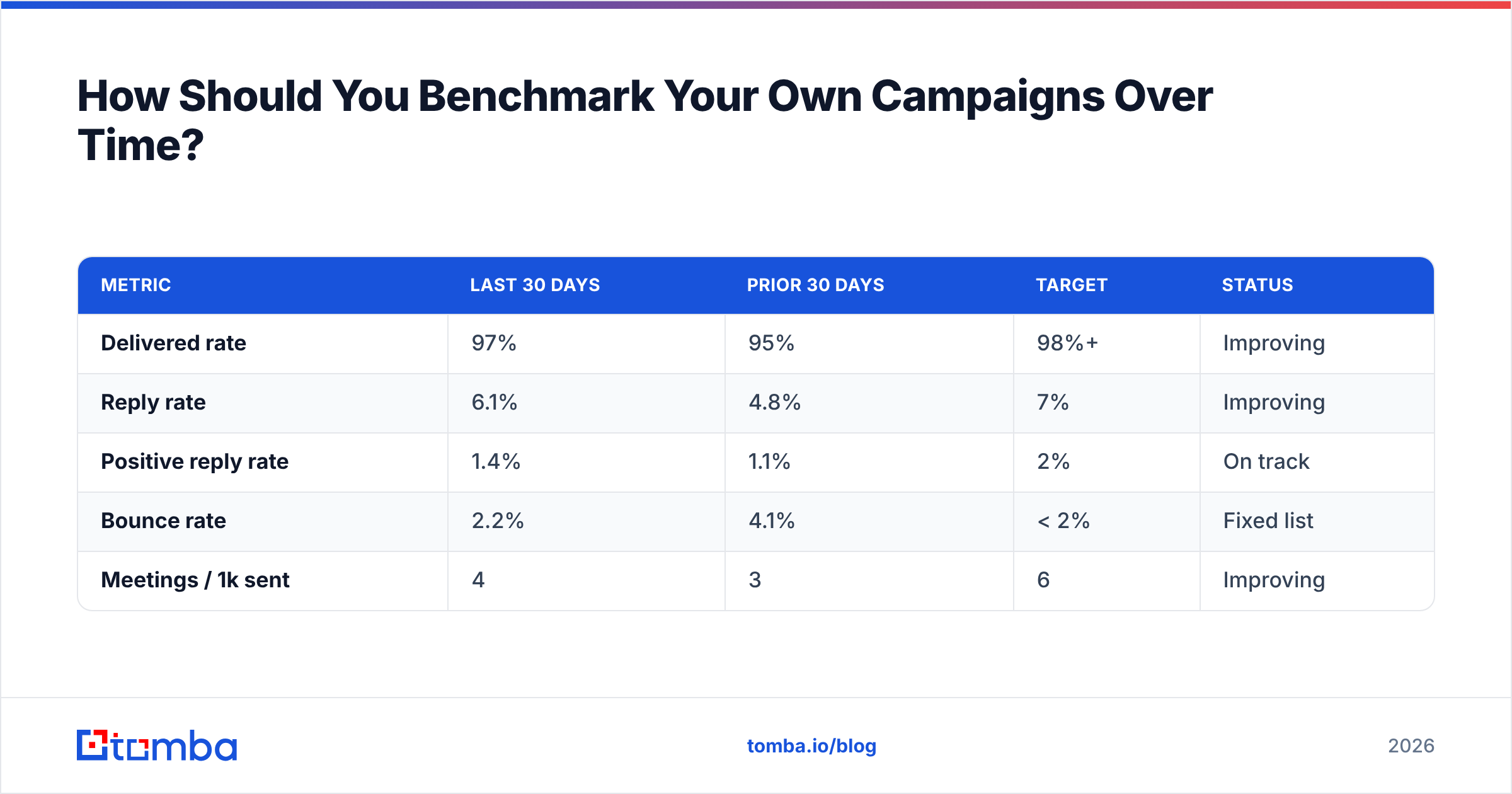
Stop comparing yourself to strangers' screenshots and start comparing yourself to your own trailing average. Set a rolling 30-day baseline for each core metric, then treat any 20%+ swing as a signal worth investigating.
A simple monthly scorecard beats any industry report:
| Metric | Last 30 days | Prior 30 days | Target | Status |
|---|---|---|---|---|
| Delivered rate | 97% | 95% | 98%+ | Improving |
| Reply rate | 6.1% | 4.8% | 7% | Improving |
| Positive reply rate | 1.4% | 1.1% | 2% | On track |
| Bounce rate | 2.2% | 4.1% | < 2% | Fixed list |
| Meetings / 1k sent | 4 | 3 | 6 | Improving |
The magic isn't in any single row — it's in the trend. When bounce rate drops from 4.1% to 2.2% and reply rate climbs the same month, you've just proven that list hygiene, not copy, was your bottleneck. That's the kind of insight that reshapes where you spend the next quarter.
Tools like G2 and vendor deliverability reports are useful for a sanity check on the wider market, but your own scorecard is the only benchmark that reflects your list, your offer, and your sending setup.
Common Cold Email Benchmark Mistakes to Avoid#
- Chasing open rate. It's inflated and increasingly meaningless. Optimize for replies.
- Ignoring bounce rate until it's too late. By the time your reputation drops, recovery takes weeks. Verify before every send.
- Comparing across industries. A 3% reply rate in enterprise can outperform a 9% rate in SMB on revenue.
- Testing everything at once. You'll never know which change moved the needle.
- Treating positive replies and total replies as the same thing. "Stop emailing me" is a reply too — don't let it flatter your dashboard.
The Bottom Line#
Good cold email benchmarks in 2026 aren't a single magic number — they're a range that shifts with your industry, offer, and list quality. Anchor on positive reply rate, keep bounce rate under 2%, and measure yourself against your own trailing average instead of someone's cherry-picked case study. Above all, remember the order of operations: fix deliverability, then fix your data, then polish the copy.
If your reply rate is stuck below benchmark, start where the leverage is highest — the list. Use the Tomba Email Finder to source accurate, targeted contacts by domain, name, or company, then verify them before your first send so your bounce rate stays low and every downstream metric has a fair shot. Cheaper leads that never convert aren't cheaper — they're the reason your benchmarks are red. Check the Tomba pricing tiers, including the free plan, and put clean data under your next campaign.
Related guides#
Ready to find emails that actually work?
Join 150,000+ professionals who stopped guessing and started sending. Free credits on signup — no credit card required.
Get the Tomba newsletter
Practical outbound tactics and product updates — once every two weeks.
About the author