Cold Email Cadence: How to Build a Sequence That Gets Replies
Most cold emails fail on timing, not copy. Here's how to build a cold email cadence—step count, spacing, and channels—that books meetings instead of burning your domain.
Cold Email Cadence: How to Build a Sequence That Gets Replies
Most reps blame their copy when a campaign flops. The real culprit is usually the cadence — how many emails you send, how far apart, and what happens between them. A great message sent once and abandoned will always lose to an average message delivered on a disciplined schedule.
This guide breaks down what a cold email cadence actually is, how long it should run, the exact spacing that works in 2026, and how to layer in other channels without tripping spam filters or annoying prospects.
TL;DR#
- A cold email cadence is a timed sequence of touches — typically 4 to 7 emails over 2 to 4 weeks — designed to reach a prospect who ignored the first message.
- Spacing matters more than volume. Front-load value, widen the gaps as you go, and stop before you become noise.
- Multichannel beats email-only. Blending email with LinkedIn and a call can lift reply rates 2–3x versus email alone.
- Deliverability is the silent killer. Clean, verified lists and warmed domains determine whether your cadence even reaches the inbox.
- Start with accurate data. A perfect cadence sent to bounced or guessed addresses is wasted effort — verified emails come first.
What is a cold email cadence?#
A cold email cadence is a predefined series of outbound touches sent to a prospect over a fixed window, with each message spaced deliberately and often escalating in urgency or angle. Think of it like watering a plant: one soak does nothing if the soil is dry, but a little water on a consistent schedule is what makes something grow. One email is a coin flip. A cadence is a system.
The average buyer needs multiple exposures before they respond — not because your first email was bad, but because they were in a meeting, triaging their inbox, or simply not ready. Cadence gives you more at-bats without you having to remember to follow up manually.
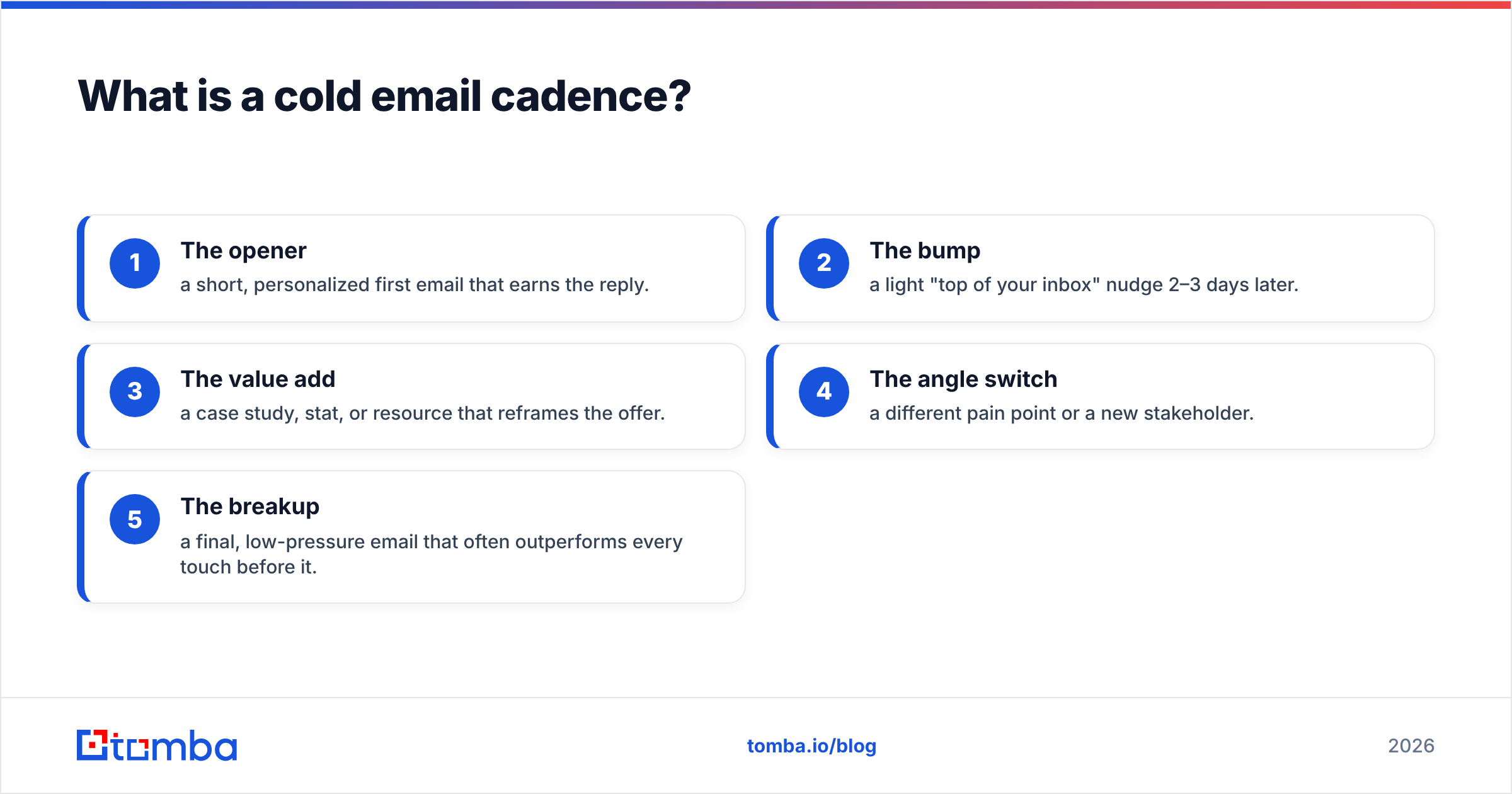
A modern cadence usually includes:
- The opener — a short, personalized first email that earns the reply.
- The bump — a light "top of your inbox" nudge 2–3 days later.
- The value add — a case study, stat, or resource that reframes the offer.
- The angle switch — a different pain point or a new stakeholder.
- The breakup — a final, low-pressure email that often outperforms every touch before it.
How many emails should a cold email cadence have?#
Four to seven emails is the sweet spot for most B2B cold outreach. Fewer than four and you quit before the prospect has warmed up; more than seven and you cross into pestering, which hurts your sender reputation and your brand.
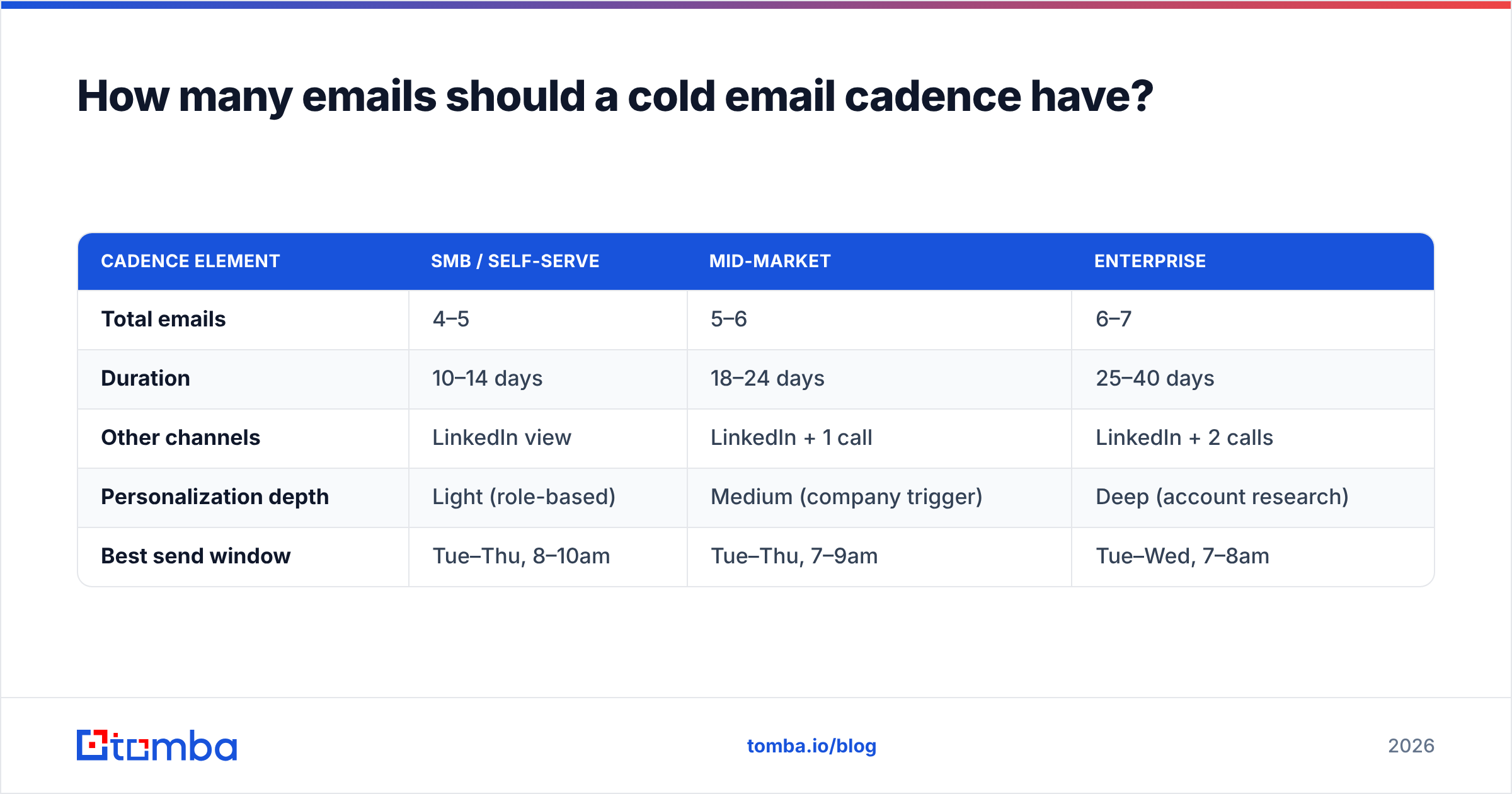
The right number depends on deal size and audience. A high-ticket enterprise motion justifies a longer, slower cadence with more channels. A self-serve or SMB play can run shorter and tighter. Here's a practical baseline:
| Cadence element | SMB / self-serve | Mid-market | Enterprise |
|---|---|---|---|
| Total emails | 4–5 | 5–6 | 6–7 |
| Duration | 10–14 days | 18–24 days | 25–40 days |
| Other channels | LinkedIn view | LinkedIn + 1 call | LinkedIn + 2 calls |
| Personalization depth | Light (role-based) | Medium (company trigger) | Deep (account research) |
| Best send window | Tue–Thu, 8–10am | Tue–Thu, 7–9am | Tue–Wed, 7–8am |
Notice that duration stretches as deal complexity rises. Enterprise buyers have more stakeholders and slower cycles, so a cadence that feels patient reads as professional rather than desperate.
What is the best spacing between cold emails?#
Widen the gaps as the cadence progresses. Early touches can be close together because the prospect hasn't formed an opinion yet; later touches need breathing room so you don't look automated. A reliable pattern:
- Email 1 → Email 2: 2 days
- Email 2 → Email 3: 3 days
- Email 3 → Email 4: 4 days
- Email 4 → Email 5: 6 days
- Email 5 → breakup: 7 days
That progression keeps you present without carpet-bombing an inbox in a single week. Avoid sending two emails on back-to-back days — it's the fastest way to get marked as spam and it signals you're running a machine, not a conversation.
Timing within the day matters too. Tuesday through Thursday, early morning in the prospect's timezone, consistently outperforms Monday floods and Friday dead zones. If you're sending across regions, segment by timezone rather than blasting everyone at 9am your time. For subject lines that survive the morning triage, a quick pass through a subject line generator can save you from the "just checking in" trap.
Should a cold email cadence be multichannel?#
Yes — email alone leaves replies on the table. Layering complementary channels around your email cadence is one of the highest-leverage changes you can make. According to HubSpot's sales research, multi-touch, multi-channel outreach consistently outperforms single-channel sequences because it meets buyers where they actually pay attention.
A blended cadence might look like this:
- Day 1: Email 1 (opener)
- Day 2: LinkedIn profile view + connection request
- Day 4: Email 2 (bump)
- Day 6: Phone call or voicemail
- Day 8: Email 3 (value add)
- Day 12: LinkedIn message referencing the emails
- Day 16: Email 4 (breakup)
The channels reinforce each other. A prospect who saw your LinkedIn request is far more likely to open the email that follows. To add the phone leg, you'll need direct dials — a phone finder pulls B2B numbers so your call step isn't a dead end. And to make the LinkedIn leg work at scale, connect the dots with a LinkedIn finder that maps profiles to verified work emails.
Why does deliverability make or break your cadence?#
Your cadence is only as good as the inboxes it reaches. You can engineer perfect timing and copy, but if half your list bounces, your domain reputation tanks and even the good addresses stop seeing you. This is the part most teams ignore until their open rates quietly collapse.
Three fundamentals protect your cadence:
- Verified lists. Every invalid address you email chips away at your sender reputation. Scrub your list with an email verifier before the first send, and re-check periodically.
- Authenticated domain. Set up SPF, DKIM, and DMARC. Skipping this is like mailing a letter with no return address — mailbox providers won't trust it. Check your records with a free SPF checker.
- Warmed sending domain. Ramp volume gradually on a domain that isn't your primary company domain, so a burned reputation never touches your real email.
Bounce rate is the metric to watch obsessively. Keep it under 2–3% and most providers keep you in the inbox; cross 5% and you're fighting the spam folder on every send. High email deliverability isn't a nice-to-have — it's the foundation the entire cadence stands on.
Cold email cadence vs. a single follow-up: which wins?#
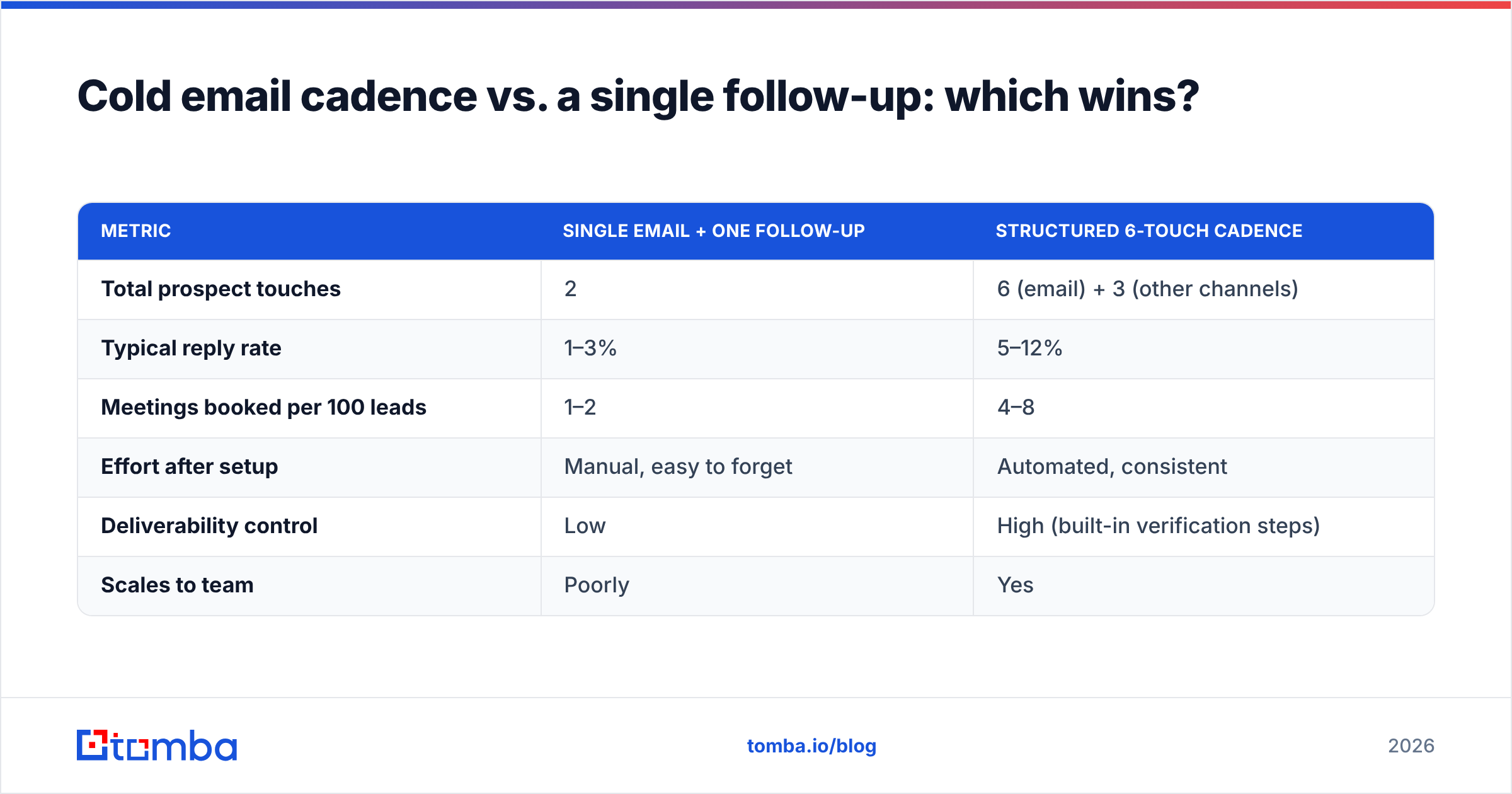
A structured cadence wins decisively, and the gap is bigger than most people expect. Here's how the two approaches compare across the metrics that matter:
| Metric | Single email + one follow-up | Structured 6-touch cadence |
|---|---|---|
| Total prospect touches | 2 | 6 (email) + 3 (other channels) |
| Typical reply rate | 1–3% | 5–12% |
| Meetings booked per 100 leads | 1–2 | 4–8 |
| Effort after setup | Manual, easy to forget | Automated, consistent |
| Deliverability control | Low | High (built-in verification steps) |
| Scales to team | Poorly | Yes |
The single-follow-up approach isn't just less effective — it's fragile, because it depends on a human remembering to send touch two. A cadence removes that dependency. Once it's built, it runs whether or not the rep is having a good week.
What does a strong cold email cadence look like end to end?#
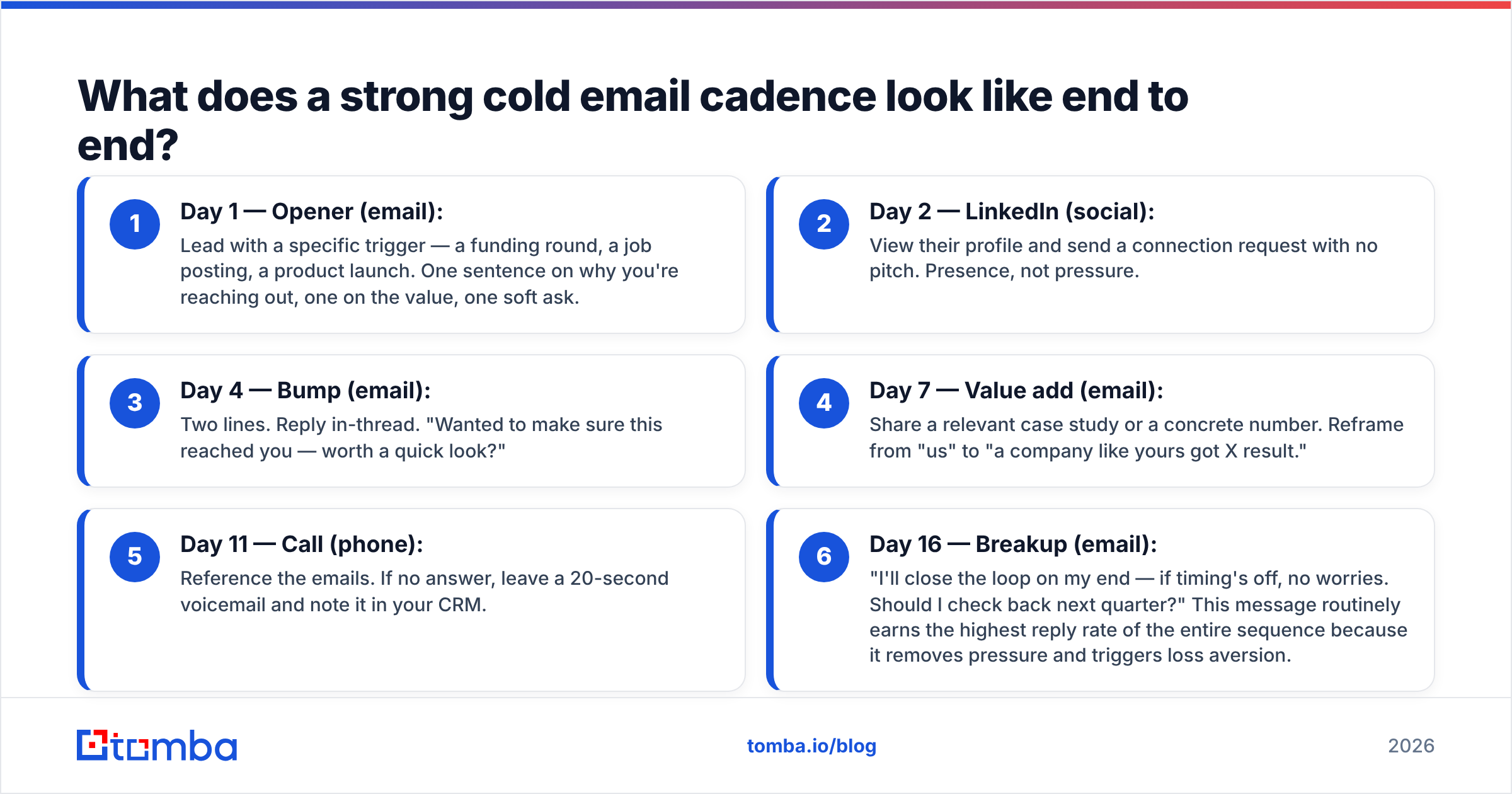
Here's a complete 6-touch, multichannel cadence you can adapt. Keep each email under 120 words, one clear call to action, and no attachments in the first three touches.
- Day 1 — Opener (email): Lead with a specific trigger — a funding round, a job posting, a product launch. One sentence on why you're reaching out, one on the value, one soft ask.
- Day 2 — LinkedIn (social): View their profile and send a connection request with no pitch. Presence, not pressure.
- Day 4 — Bump (email): Two lines. Reply in-thread. "Wanted to make sure this reached you — worth a quick look?"
- Day 7 — Value add (email): Share a relevant case study or a concrete number. Reframe from "us" to "a company like yours got X result."
- Day 11 — Call (phone): Reference the emails. If no answer, leave a 20-second voicemail and note it in your CRM.
- Day 16 — Breakup (email): "I'll close the loop on my end — if timing's off, no worries. Should I check back next quarter?" This message routinely earns the highest reply rate of the entire sequence because it removes pressure and triggers loss aversion.
If you want proven copy to slot into each step, a library of cold email templates gives you tested structures to personalize rather than starting from a blank page.
How do you keep a cadence from feeling automated?#
Personalization is what separates a cadence from a spam cannon. The mechanics can be automated; the words should not feel like they were. A few rules keep it human:
- Reference something only you would know — a recent post, a company milestone, a mutual connection. Generic "I came across your company" openers get deleted.
- Vary sentence length and structure across touches so the sequence doesn't read like one template with the name swapped.
- Never send an email that assumes they read the last one. Each touch should stand on its own for the prospect seeing it fresh.
- Match the ask to the touch. Early emails ask for interest; later ones can ask for a specific 15-minute slot.
The bottleneck is rarely writing — it's having accurate contact data to personalize against. That's where sourcing quality contacts up front pays off across every touch in the cadence.
Common cold email cadence mistakes to avoid#
- Sending on consecutive days. It reads as automated and torches deliverability.
- Copy-pasting the same message with a new subject line. Prospects notice, and filters do too.
- No breakup email. You're leaving your best-performing touch unsent.
- Ignoring bounce data. A rising bounce rate is an early warning that your list — and your reputation — are decaying.
- One channel only. Email-only cadences cap out fast; add LinkedIn and phone.
- Guessing email addresses. Pattern-guessing inflates bounces. Confirm every address before it enters the cadence.
Build your cadence on a foundation of verified data#
The best cadence in the world fails if it's built on bad addresses. Before you obsess over spacing and copy, make sure every contact is real and reachable — because bounces, not bad timing, are what quietly kill most campaigns.
Tomba's Email Finder lets you find and verify professional email addresses by name, domain, or company, so your cadence starts with contacts that actually land in the inbox. Pair it with the email verifier to keep bounce rates low as your list scales, and check the Tomba pricing to see which plan fits your volume — the Free tier includes 25 searches to test the workflow, with paid plans from $49/mo. Nail the data first, and every email in your cadence works harder.
Related guides#
Ready to find emails that actually work?
Join 150,000+ professionals who stopped guessing and started sending. Free credits on signup — no credit card required.
Get the Tomba newsletter
Practical outbound tactics and product updates — once every two weeks.
About the author