Cold Email Call to Action: 12 CTAs That Actually Get Replies
The call to action is the single line that makes or breaks your cold email. Here's how to write CTAs that lower friction, earn replies, and book meetings—with real examples and a copy-paste swipe file.
Your subject line earns the open. Your body earns the read. But your cold email call to action is the only line that decides whether a prospect actually does something. Get it wrong and everything above it was wasted effort.
Most reps obsess over personalization and ignore the CTA, then wonder why a well-written email gets zero replies. This guide fixes that. You'll get the psychology behind high-converting asks, a comparison of soft vs. hard CTAs, 12 copy-paste examples, and the mistakes quietly killing your reply rate in 2026.
TL;DR#
- A cold email call to action is the specific next step you ask a prospect to take—reply, book, click, or answer a question. One email, one CTA.
- Soft, low-friction CTAs (interest-based questions) consistently beat hard "book a 30-minute demo" asks for first-touch cold outreach.
- The best CTAs are specific, singular, easy to say yes to, and framed around the prospect's outcome—not your calendar.
- Adding a second CTA, using vague timing ("sometime next week?"), or asking for too much too early are the three most common reply-killers.
- Your CTA is only as good as your targeting: a perfect ask sent to the wrong inbox still fails, so verified contact data matters as much as copy.
What is a cold email call to action?#
A cold email call to action is the sentence—usually the last one—that tells the recipient exactly what to do next. It's the hinge the entire message swings on.
Think of it like the end of a first date. You can have a great conversation, but if you never suggest a clear next step, nothing happens. The CTA is you saying "want to grab coffee Thursday?" instead of a vague "we should do this again sometime." Specific beats open-ended every time.
In practice, a cold email CTA does three jobs at once:
- Signals the desired action — reply, click, book, or forward.
- Sets the friction level — a one-word reply is easy; a 30-minute call is heavy.
- Frames the value — why saying yes benefits them, not you.
The mistake is treating the CTA as an afterthought you paste on. It's the part you should write first, because everything else in the email exists to make that single ask feel reasonable.
Soft CTA vs. hard CTA: which one wins?#
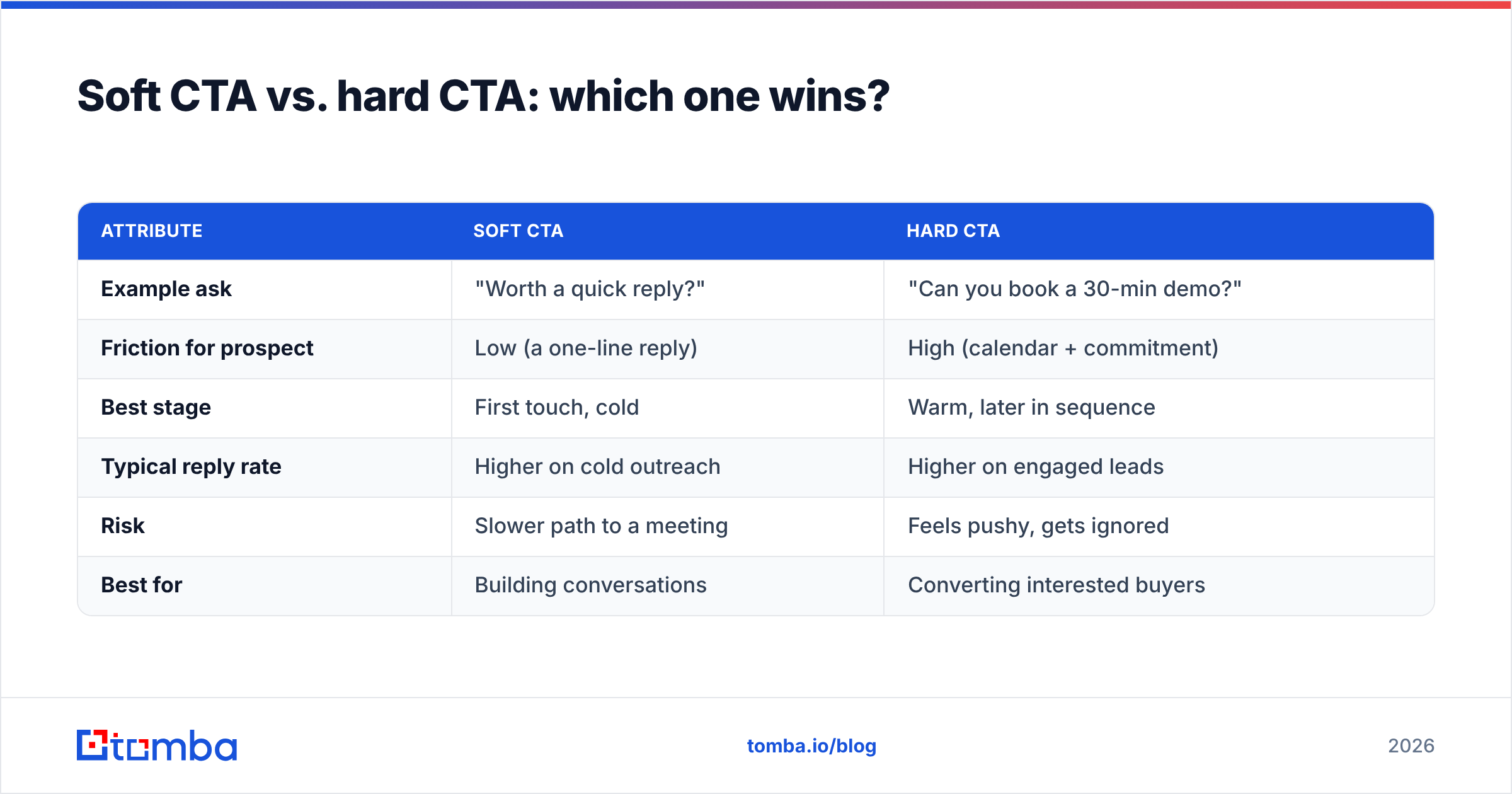
The core decision in every cold email is how much you ask for. A soft CTA requests low-commitment engagement—an opinion, a yes/no, a pointer to the right person. A hard CTA asks for time or money up front—a demo, a call, a signup.
For cold, first-touch outreach, soft CTAs almost always win. You haven't earned the right to 30 minutes yet. Asking for a quick reply lowers the psychological cost of saying yes, and once someone replies, you're in a conversation instead of a pitch. Research summarized by teams at HubSpot and revenue-intelligence platforms like Gong repeatedly points to interest-based, curiosity-driven asks outperforming aggressive meeting requests on cold sends.
Here's how the two approaches compare across what actually matters:
| Attribute | Soft CTA | Hard CTA |
|---|---|---|
| Example ask | "Worth a quick reply?" | "Can you book a 30-min demo?" |
| Friction for prospect | Low (a one-line reply) | High (calendar + commitment) |
| Best stage | First touch, cold | Warm, later in sequence |
| Typical reply rate | Higher on cold outreach | Higher on engaged leads |
| Risk | Slower path to a meeting | Feels pushy, gets ignored |
| Best for | Building conversations | Converting interested buyers |
The nuance: hard CTAs aren't bad—they're just mistimed on a first email. Save "grab 20 minutes Tuesday" for follow-up #2 or #3, once the prospect has shown a flicker of interest. Match the ask to the temperature of the relationship.
What makes a cold email call to action convert?#
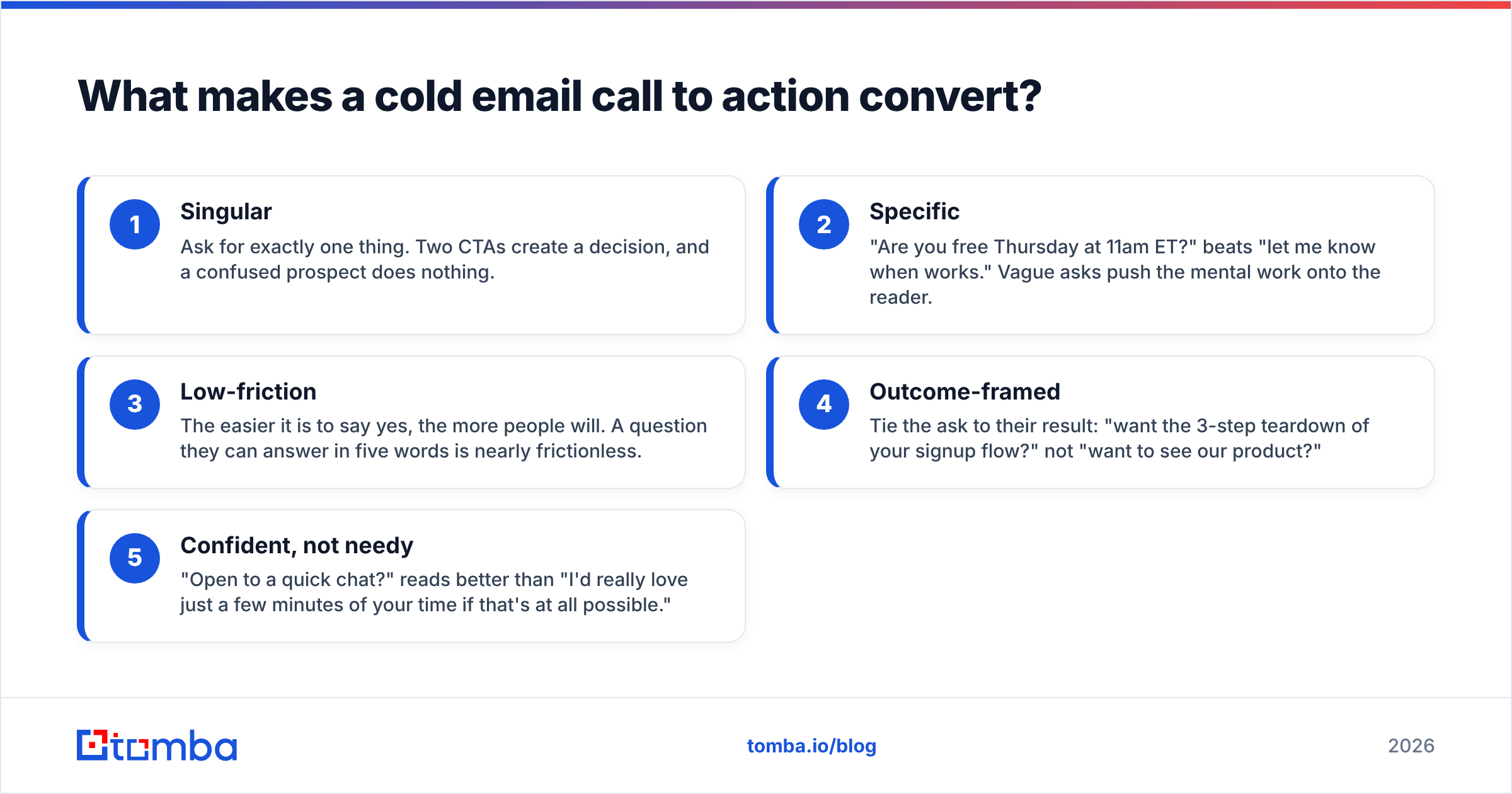
Five traits separate CTAs that get replies from CTAs that get archived. Use them as a checklist before you hit send.
- Singular — Ask for exactly one thing. Two CTAs create a decision, and a confused prospect does nothing.
- Specific — "Are you free Thursday at 11am ET?" beats "let me know when works." Vague asks push the mental work onto the reader.
- Low-friction — The easier it is to say yes, the more people will. A question they can answer in five words is nearly frictionless.
- Outcome-framed — Tie the ask to their result: "want the 3-step teardown of your signup flow?" not "want to see our product?"
- Confident, not needy — "Open to a quick chat?" reads better than "I'd really love just a few minutes of your time if that's at all possible."
Notice that none of these require clever wording. They require restraint. The strongest CTAs are short, plain, and easy—the copywriting equivalent of holding the door open rather than shoving someone through it.
If you want a faster starting point, tools like Tomba's cold email templates and subject line generator give you framing you can adapt instead of writing from scratch. Just remember to rewrite the CTA to fit your specific offer.
What are the best cold email CTA examples?#
Below are 12 CTAs grouped by intent. Steal them, swap in your specifics, and test. Each is written to be low-friction and reply-first.
Interest-check CTAs (best for first touch)
- "Worth a quick look, or not a priority right now?"
- "Is improving [metric] on your radar this quarter?"
- "Should I send over the 2-minute breakdown?"
- "Open to me sharing how [similar company] handled this?"
Reply-generating CTAs
- "Are you the right person for this, or should I reach out to someone else?"
- "What's your current approach to [problem]?"
- "Reply with a '1' and I'll send the details."
Soft-meeting CTAs (for warmer follow-ups)
- "Got 15 minutes Thursday to walk through it?"
- "Free for a quick call Tuesday or Wednesday afternoon?"
Resource / value CTAs
- "Want the teardown I made of your [page/process]?"
- "Should I send the case study—takes 90 seconds to skim?"
- "Happy to share the template we used. Want it?"
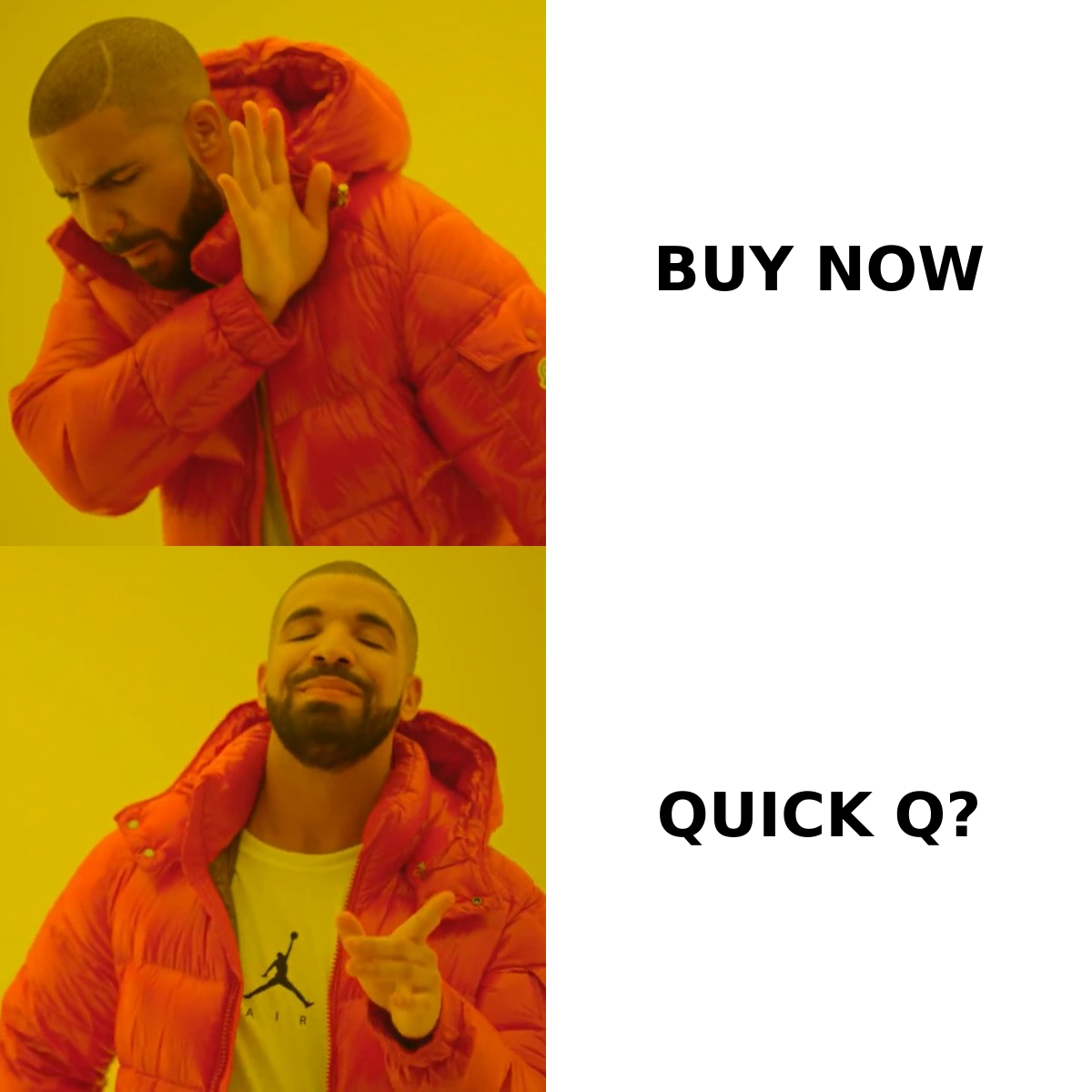
The "right person?" CTA deserves a special mention. It's disarming because it gives the prospect an easy out while often prompting them to either self-identify or forward you internally. Either outcome moves you forward.
What are the biggest cold email CTA mistakes?#
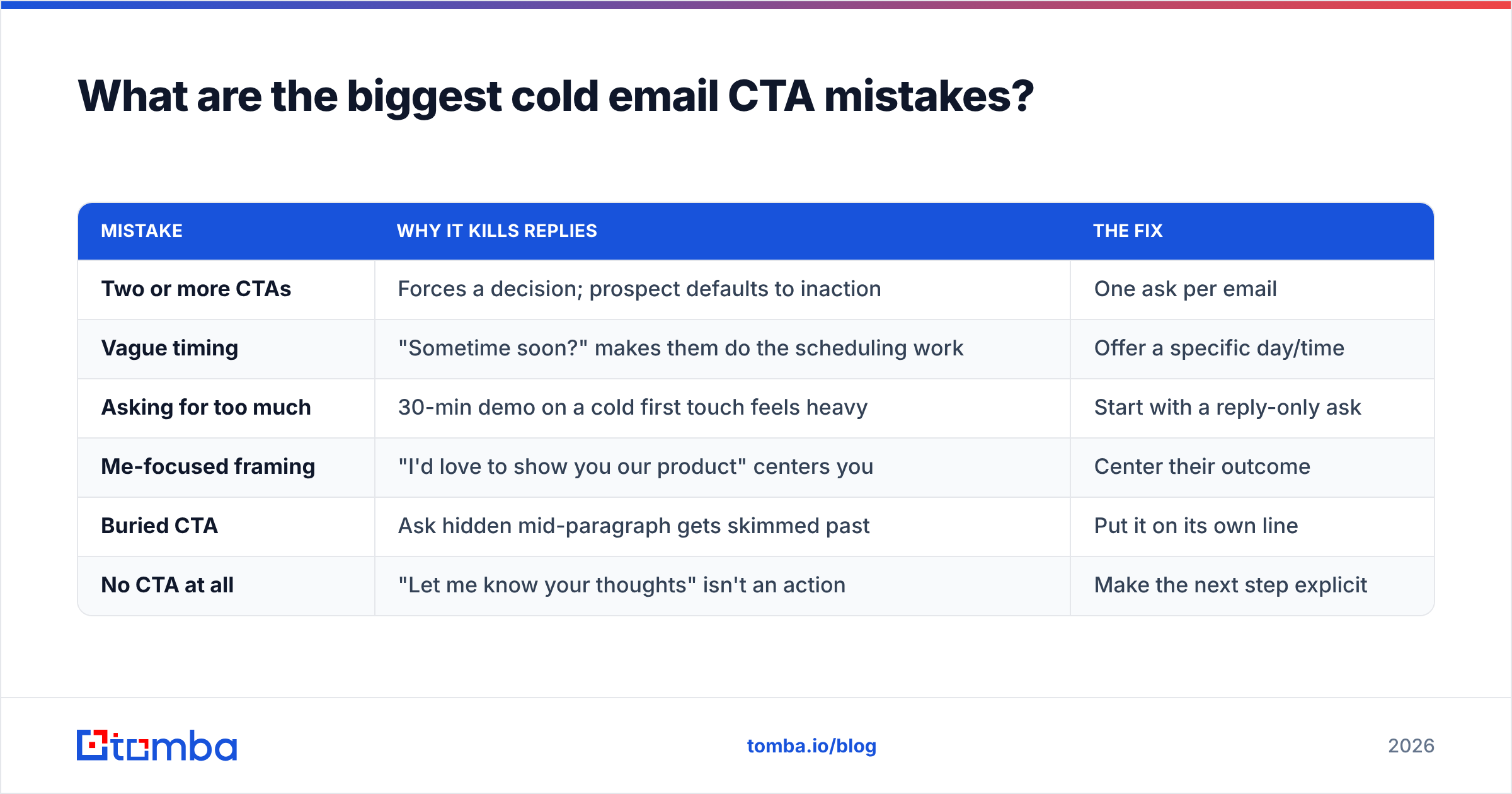
Even experienced reps sabotage strong emails with weak asks. These are the patterns to eliminate first.
| Mistake | Why it kills replies | The fix |
|---|---|---|
| Two or more CTAs | Forces a decision; prospect defaults to inaction | One ask per email |
| Vague timing | "Sometime soon?" makes them do the scheduling work | Offer a specific day/time |
| Asking for too much | 30-min demo on a cold first touch feels heavy | Start with a reply-only ask |
| Me-focused framing | "I'd love to show you our product" centers you | Center their outcome |
| Buried CTA | Ask hidden mid-paragraph gets skimmed past | Put it on its own line |
| No CTA at all | "Let me know your thoughts" isn't an action | Make the next step explicit |
The single most common error is the double ask: "Can you reply, and also here's my Calendly if you'd rather just book?" You've now given the prospect two roads, and split attention almost always results in no action. Pick the one step you most want and cut the rest.
The second most common is the fake CTA. "Looking forward to hearing your thoughts" feels like an ask but requires no defined action. It's a closing line masquerading as a CTA. Replace it with something the reader can actually do in one motion.
How does your CTA fit into the whole cold email?#
A great CTA can't rescue a bad email, and it can't rescue a message that landed in the wrong inbox. The call to action is the last link in a chain, and the chain is only as strong as its weakest part.
Work backward from the ask. If your CTA is "want the teardown of your signup flow?", the body needs to establish that you actually looked at their signup flow. If the CTA is "are you the right person for lead gen?", the opening needs relevance to their role. Alignment between the promise up top and the ask at the bottom is what makes a cold email feel coherent instead of templated.
Timing and deliverability matter too. The most elegant CTA earns nothing if the email hits spam or reaches a stale address. That's why strong response rates depend on more than copy—they depend on reaching real, verified people at the right cadence. Sending to bounced or role-based addresses drags down your sender reputation and buries even your best-written asks.
This is where your data foundation quietly decides your results. You can A/B test CTAs for weeks, but if 20% of your list is invalid, you're optimizing copy for an audience that never sees it. Clean, verified contacts let your CTA testing actually mean something.
How do you test and improve your cold email CTAs?#
Treat your CTA as the highest-leverage variable in your outreach, because it is. Small wording changes here move reply rates more than almost anything else in the email.
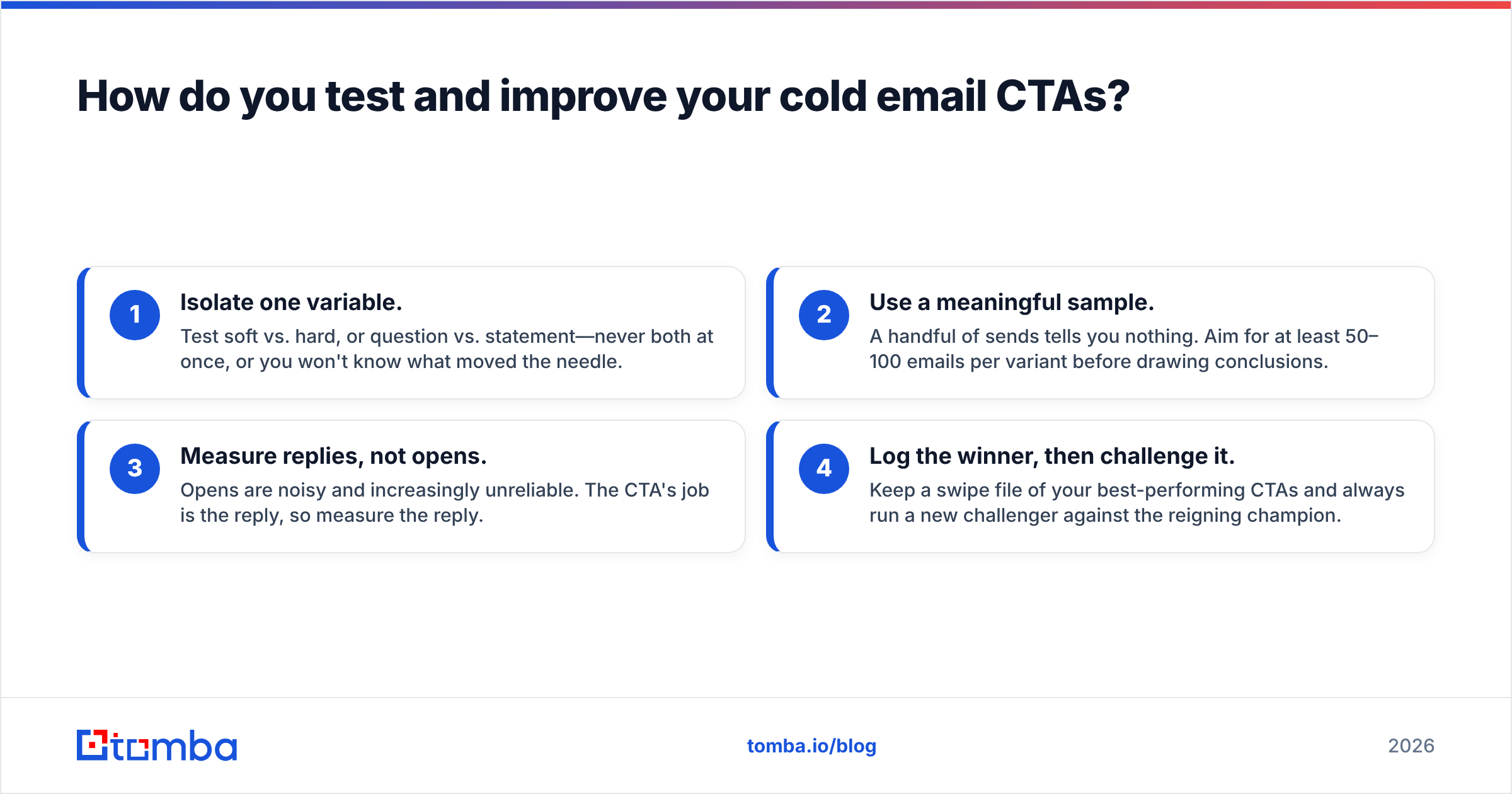
A simple, disciplined testing loop:
- Isolate one variable. Test soft vs. hard, or question vs. statement—never both at once, or you won't know what moved the needle.
- Use a meaningful sample. A handful of sends tells you nothing. Aim for at least 50–100 emails per variant before drawing conclusions.
- Measure replies, not opens. Opens are noisy and increasingly unreliable. The CTA's job is the reply, so measure the reply.
- Log the winner, then challenge it. Keep a swipe file of your best-performing CTAs and always run a new challenger against the reigning champion.
If you run outreach at volume, an AI cold email writer can generate CTA variations for you to test rather than guessing. Just apply human judgment—AI drafts tend to default to hard, generic asks that need softening. You can also cross-reference broader best practices on peer-review sites like G2 to sanity-check what's working across the industry.
Over a few weeks of disciplined testing, you'll converge on two or three CTAs that consistently outperform for your audience. That's your money set. Protect it, keep challenging it, and rebuild it whenever your offer or ICP shifts.
Frequently asked questions#
Where should the CTA go in a cold email? On its own line, near the end, after you've established relevance. Isolating it visually stops it from being skimmed past and signals "this is the thing to respond to."
Should a cold email have more than one CTA? No. One email, one ask. Multiple CTAs split attention and reduce the odds of any action. If you have a second thing to ask, save it for a follow-up.
Is a question a good cold email CTA? Usually the best kind. A yes/no or short-answer question is low-friction, invites a reply, and starts a conversation instead of demanding a commitment.
Should I put a Calendly link in my first cold email? Rarely. A booking link on a cold first touch asks for too much before you've earned interest. Lead with a reply-based CTA, then share scheduling once they engage.
Turn better CTAs into booked meetings#
The best call to action in the world still needs to land in a real inbox. Before you optimize a single word, make sure you're reaching verified, deliverable contacts—because reply-rate gains from great copy evaporate if a chunk of your list bounces.
Tomba's Email Finder helps you build clean, targeted prospect lists from a name and domain, so your carefully crafted CTAs actually reach the people who can say yes. Pair it with the email verifier to keep bounce rates low and your sender reputation intact, and start on the free tier (25 searches/month) before scaling up on a paid plan. Write the sharper CTA—then make sure it gets delivered.
Related guides#
Ready to find emails that actually work?
Join 150,000+ professionals who stopped guessing and started sending. Free credits on signup — no credit card required.
Get the Tomba newsletter
Practical outbound tactics and product updates — once every two weeks.
About the author