Cold Email Click Through Rate: Benchmarks and Fixes for 2026
Most cold emails get opened and ignored. Here's what a good cold email click-through rate actually looks like in 2026 — and the levers that move it.
TL;DR
- A "good" cold email click through rate (CTR) sits around 2–5% of delivered emails in 2026. Anything above 5% is strong, and single-link, plain-text emails consistently beat busy HTML.
- CTR is a downstream metric. If your list is unverified or your domain reputation is weak, no subject line will rescue the click.
- One clear call to action beats five. Every extra link splits attention and raises spam risk.
- Track CTR as clicks ÷ delivered, not clicks ÷ opens. Apple Mail Privacy Protection has made open rates nearly useless.
- The fastest CTR gains come from list quality, relevance, and a low-friction ask — not from adding more buttons.
What counts as a good cold email click through rate in 2026?#
A good cold email click through rate in 2026 is roughly 2% to 5% of delivered messages. The top decile of senders push past 6%. That's the short answer. The longer answer is that "good" depends on how you count and what you ask the reader to do.
Cold email behaves nothing like a newsletter. Your recipients never opted in, they don't recognize your name, and their guard is up. So the benchmarks marketers quote for opt-in campaigns don't map cleanly. Those numbers are often 2–3% CTR on huge warm lists. In cold outreach, a tightly targeted 200-person campaign to the right buyers can hit 8% CTR. A 10,000-person blast to a scraped list might scrape together 0.4%.
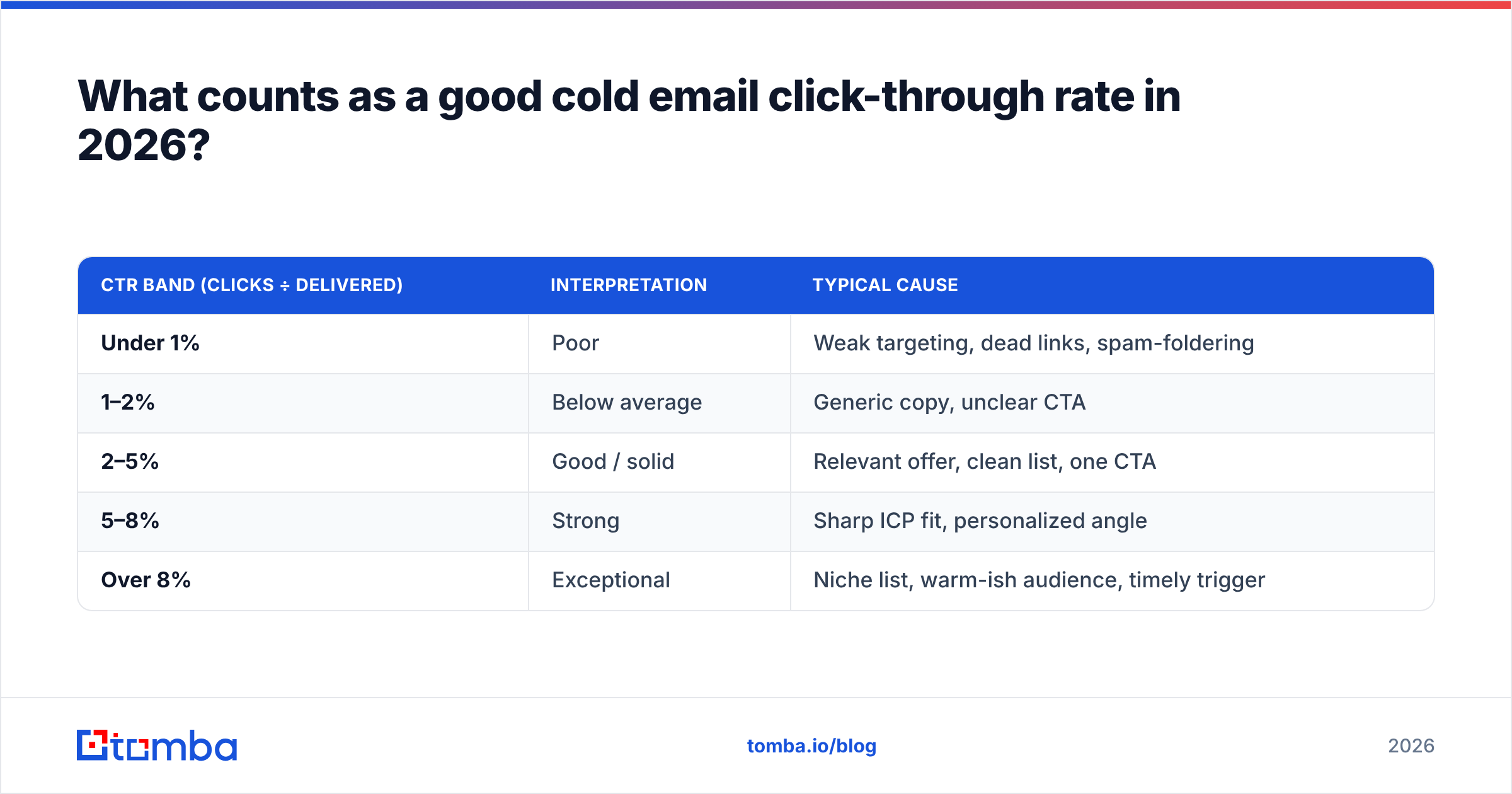
Here's the distribution most B2B senders should measure themselves against:
| CTR band (clicks ÷ delivered) | Interpretation | Typical cause |
|---|---|---|
| Under 1% | Poor | Weak targeting, dead links, spam-foldering |
| 1–2% | Below average | Generic copy, unclear CTA |
| 2–5% | Good / solid | Relevant offer, clean list, one CTA |
| 5–8% | Strong | Sharp ICP fit, personalized angle |
| Over 8% | Exceptional | Niche list, warm-ish audience, timely trigger |
Two caveats before you benchmark yourself. First, a link click is not a reply. Plenty of great cold campaigns are reply-driven and deliberately carry no link at all. Second, adding links inflates CTR but can wreck deliverability, so a higher number isn't automatically a better outcome.
How do you calculate cold email click through rate correctly?#
Calculate CTR as unique clicks divided by delivered emails, then multiply by 100. Use delivered, not sent and not opened.
- Delivered = sent minus bounces. This is your true denominator.
- Unique clicks = distinct recipients who clicked at least once (not total clicks, which double-counts the curious).
- Avoid clicks ÷ opens. Apple's Mail Privacy Protection auto-loads tracking pixels, so a large share of "opens" are bots. Any CTR built on that denominator is fiction.
So if you delivered 1,000 emails and 34 unique people clicked, your CTR is 3.4%. That's simple. But it is only trustworthy if the 1,000 were real, reachable inboxes in the first place. That's why measurement starts upstream, at the list. Sending to invalid addresses doesn't just waste credits. The resulting bounces drag your sender reputation down and quietly route future sends to spam, where nobody clicks anything.
Run your list through an email verifier before every campaign. A clean list of 800 verified contacts will out-click a bloated list of 2,000 unverified ones every time. Your denominator is honest and your reputation stays intact.
Why is your cold email click through rate so low?#
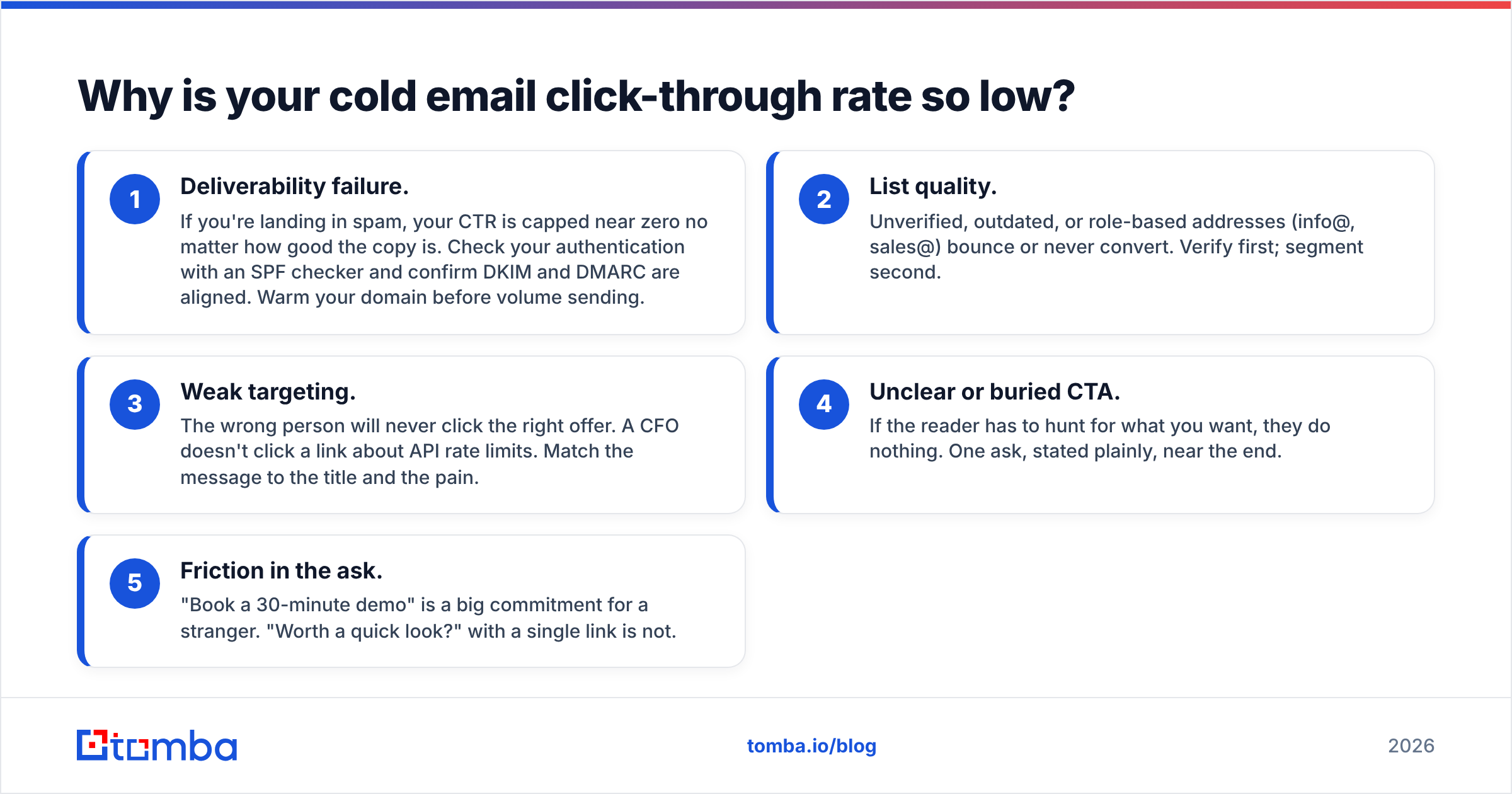
Low CTR almost always traces back to one of five root causes. Work them in this order, because the earlier ones cap the later ones.
- Deliverability failure. If you're landing in spam, your CTR is capped near zero no matter how good the copy is. Check your authentication with an SPF checker and confirm DKIM and DMARC are aligned. Warm your domain before volume sending.
- List quality. Unverified, outdated, or role-based addresses (info@, sales@) bounce or never convert. Verify first; segment second.
- Weak targeting. The wrong person will never click the right offer. A CFO doesn't click a link about API rate limits. Match the message to the title and the pain.
- Unclear or buried CTA. If the reader has to hunt for what you want, they do nothing. One ask, stated plainly, near the end.
- Friction in the ask. "Book a 30-minute demo" is a big commitment for a stranger. "Worth a quick look?" with a single link is not.
Notice that only two of the five are about copy. The cold-email industry over-indexes on subject lines and clever hooks. But the structural issues — deliverability and list quality — are what actually keep CTR in the basement. Fix the pipes before you repaint the walls. For a deeper primer on inbox placement, the concept of email deliverability is worth understanding end to end, because CTR is downstream of every decision it covers.
Does adding more links increase clicks?#
No — more links usually decreases meaningful clicks and increases spam risk. This is the counterintuitive part.
Every link you add does three unhelpful things. It splits the reader's attention across competing actions. It raises the link-to-text ratio that spam filters scrutinize. And it dilutes the one action you actually care about. A cold email with a single, purposeful link almost always beats one with a signature link, a calendar link, an unsubscribe link, and a "check out our case study" link all fighting for the same click.
The discipline is subtraction. Decide the one thing you want this email to accomplish, and remove every link that doesn't serve it. If the goal is a reply, consider dropping the link entirely and asking a question. Reply-driven cold email sidesteps link-based spam signals completely. It often produces higher-quality conversations than a click ever would.
What actually moves cold email click through rate?#
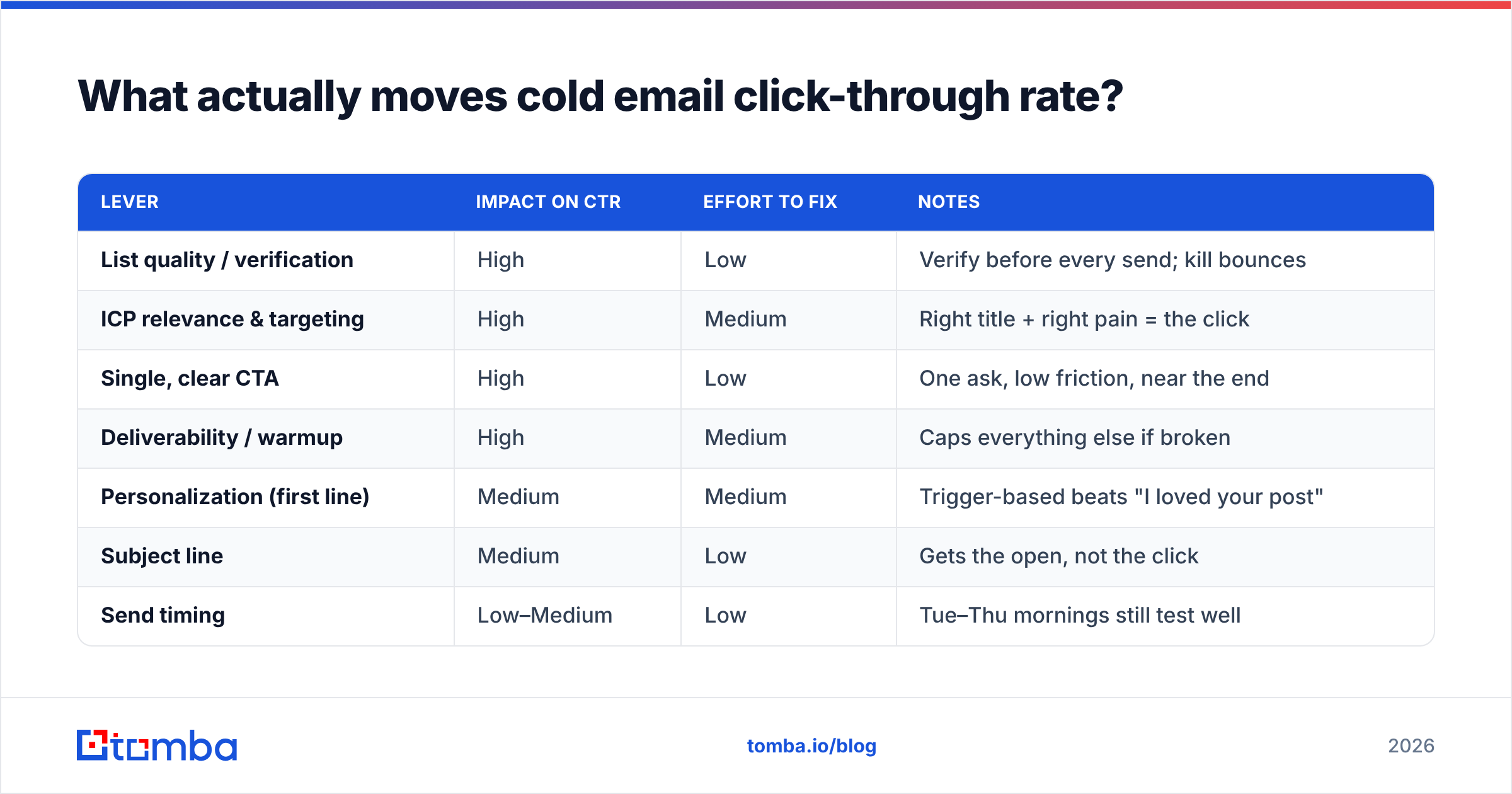
The levers that move CTR, ranked by impact, are relevance, list quality, CTA clarity, timing, and copy — roughly in that order. Here's how they stack up against effort.
| Lever | Impact on CTR | Effort to fix | Notes |
|---|---|---|---|
| List quality / verification | High | Low | Verify before every send; kill bounces |
| ICP relevance & targeting | High | Medium | Right title + right pain = the click |
| Single, clear CTA | High | Low | One ask, low friction, near the end |
| Deliverability / warmup | High | Medium | Caps everything else if broken |
| Personalization (first line) | Medium | Medium | Trigger-based beats "I loved your post" |
| Subject line | Medium | Low | Gets the open, not the click |
| Send timing | Low–Medium | Low | Tue–Thu mornings still test well |
The pattern is clear. The highest-leverage, lowest-effort wins are list verification and a single clear CTA. Both are things you control completely, today, without a copywriter.
Relevance beats cleverness. A plainly written email to exactly the right person beats a beautifully crafted one to a near-miss prospect. This is why sourcing accurate, well-targeted contact data matters more than most senders admit. Build your list with a precise email finder and filter by role, company size, and tech stack. That does more for your CTR than any subject-line A/B test, because it fixes the denominator and the relevance problem at once.
Personalize the trigger, not the flattery. "Saw you're hiring three SDRs this quarter" earns a click. "I really admire your work" does not. Tie your first line to an observable event — a job posting, a funding round, a product launch — and the link that follows feels earned rather than intrusive.
How does CTR fit with the rest of your cold email funnel?#
CTR is one gauge on a dashboard, not the whole engine. Read it alongside deliverability, reply rate, and positive-reply rate. Optimizing CTR in isolation can quietly sabotage the metrics that pay the bills.
Think of your funnel like a series of doors: delivered → opened → clicked (or replied) → booked → closed. A high CTR with a low reply rate often means your link is attracting curiosity but not intent. People click, look, and leave. A campaign with modest CTR but a strong positive-reply rate is usually healthier, because replies signal genuine interest and keep your domain reputation clean.
For teams running multi-touch sequences, CTR also tells you which touch is doing the work. If touch one carries all your clicks and touch four carries none, trim the sequence. If a follow-up beats the opener, lead with that angle next time. Pair this with a healthy sender reputation practice — consistent volume, low complaints, verified recipients — and your click numbers stay durable instead of decaying after week two.
A quick sanity framework for reading the funnel together:
- High deliverability, low CTR → copy or targeting problem. Fix the offer and the ask.
- Low deliverability, any CTR → infrastructure problem. Fix auth, warmup, and list hygiene first.
- High CTR, low replies → wrong-fit clickers. Tighten your ICP.
- Low CTR, high replies → you're winning; consider dropping links entirely.
What benchmarks should each team actually target?#
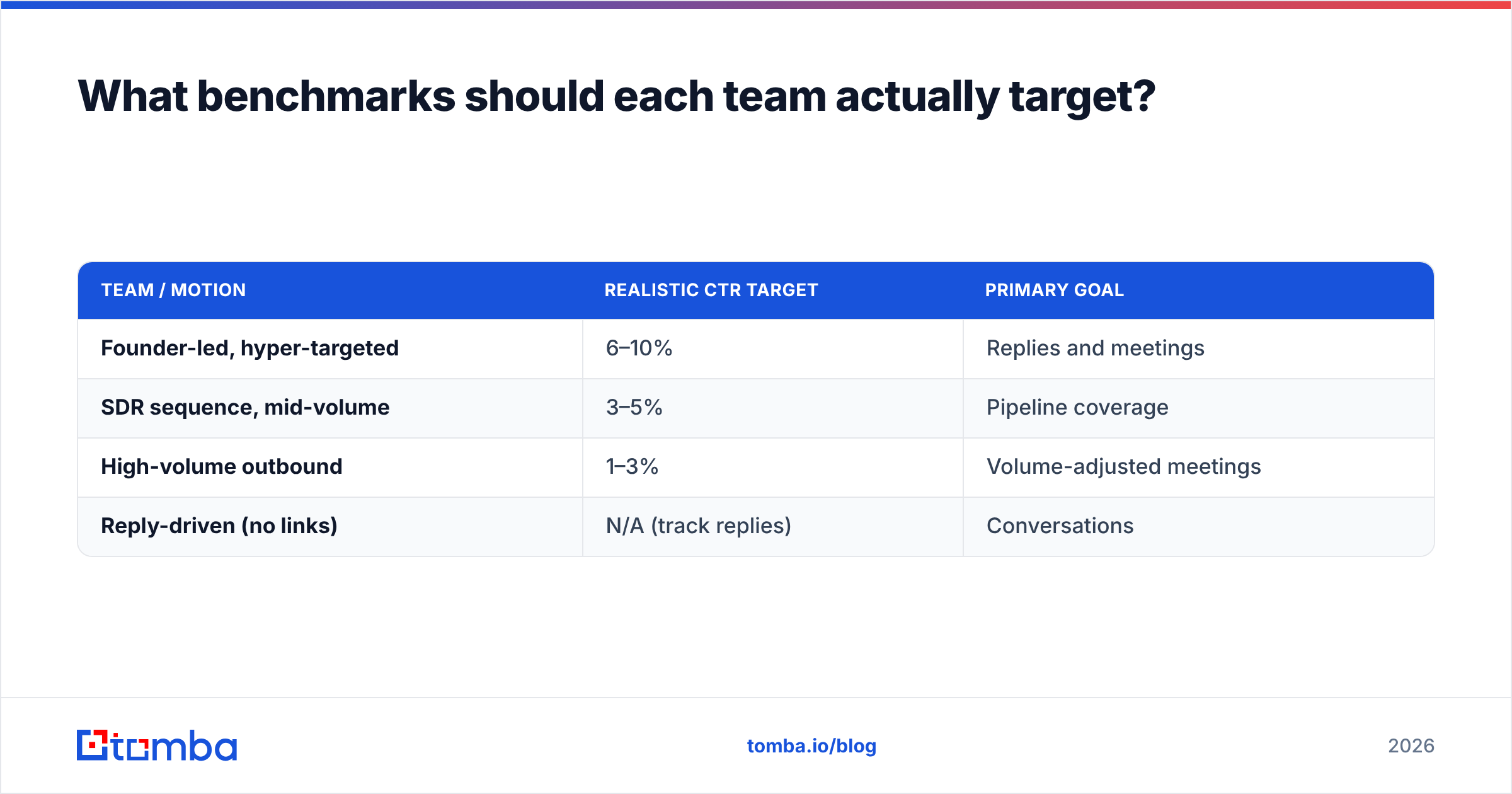
Set your target by motion, not by a universal number. A high-volume SDR team and a founder doing 20 hand-written emails a day should not chase the same CTR.
| Team / motion | Realistic CTR target | Primary goal |
|---|---|---|
| Founder-led, hyper-targeted | 6–10% | Replies and meetings |
| SDR sequence, mid-volume | 3–5% | Pipeline coverage |
| High-volume outbound | 1–3% | Volume-adjusted meetings |
| Reply-driven (no links) | N/A (track replies) | Conversations |
If you're below your band, don't reach for a new template first. Pull your bounce rate and spam-placement data, verify your list, and confirm you're emailing the right titles. Nine times out of ten the fix lives upstream of the words.
The bottom line on cold email click through rate#
A good cold email click through rate in 2026 is 2–5% of delivered emails. But the number is only as trustworthy as the list behind it. Verify your contacts, authenticate your domain, send to the right people, and give them exactly one clear thing to do. Do those four things and your CTR takes care of itself. Chase clever copy while ignoring them and you'll optimize a metric that was broken before the reader ever saw it.
Start where the leverage is highest: your data. Build tightly targeted, verified prospect lists with the Tomba Email Finder, find professional emails by domain, name, or company, and confirm every address is real before you hit send. Cleaner lists mean honest metrics, better deliverability, and clicks that actually turn into pipeline. See the full Tomba pricing — including a free tier of 25 searches a month — and give your next campaign a denominator you can trust.
Sources & further reading:
- HubSpot email marketing benchmarks
- G2 sales engagement software reviews
- Wikipedia: Email deliverability
Related guides#
// get started
Find, verify and enrich your first contacts today
Start on the free plan with 25 searches a month, then scale when your team is ready.
Free plan · No credit card required · GDPR & CCPA
// about the author