Cold Email Conversion Rate: Benchmarks and How to Improve It
Most cold email conversion rates die at the reply stage, not the open. Here are 2026 benchmarks for every step of the funnel — and the concrete fixes that actually move the number.
Your cold email conversion rate is the single number that tells you whether outbound is a growth channel or a money pit. Yet most teams track the wrong version of it — they celebrate a 60% open rate while three meetings trickle in from 2,000 sends. This guide fixes that. You'll get real 2026 benchmarks for every stage of the funnel, the math that connects them, and the specific levers that move the number that actually pays your salary: booked meetings.
TL;DR#
- A "good" cold email conversion rate depends on the stage. Target ~40–60% open, 5–10% reply, 1–3% positive reply, and 0.5–2% meeting-booked from cold, verified lists.
- Replies — not opens — are where most campaigns quietly die. Opens became unreliable after Apple Mail Privacy Protection; optimize for reply and meeting rates instead.
- Deliverability is a conversion lever, not a technical footnote. A dirty list caps your ceiling before a single word of copy matters.
- The fastest lift is list quality. Verifying emails and tightening targeting typically beats rewriting copy for the third time.
- Track the full funnel. Sent → delivered → opened → replied → positive → meeting. Optimize the weakest link, not the vanity metric.
What is a cold email conversion rate?#
Your cold email conversion rate is the percentage of prospects who take a desired action after receiving a cold email. Think of it like a retail store: foot traffic (opens) means nothing if nobody reaches the register (books a meeting). The "conversion" is whichever step you've defined as success.
The problem is that "conversion" hides at least six different rates, and mixing them up is how teams fool themselves. Here's the funnel, stage by stage:
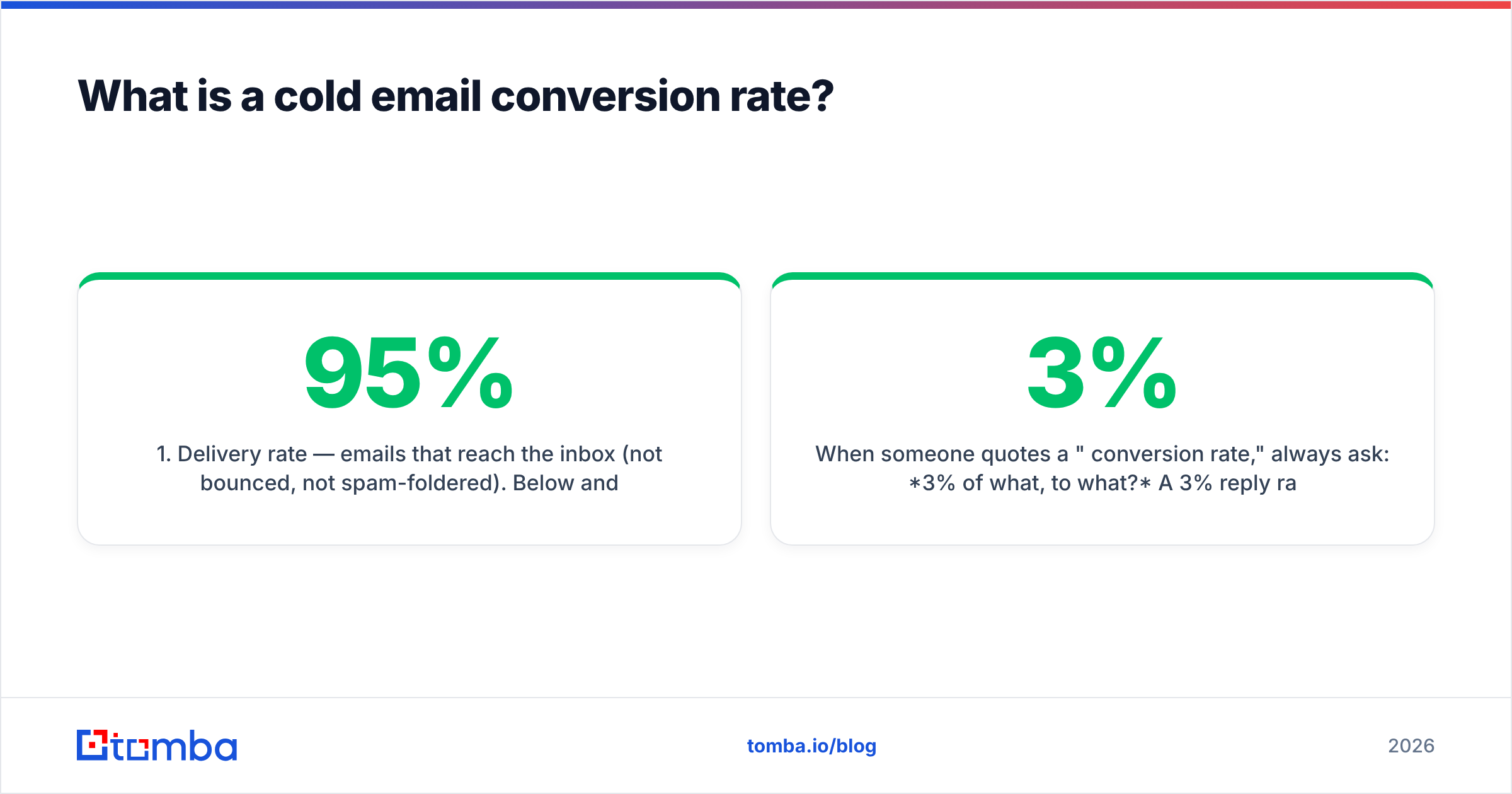
- Delivery rate — emails that reach the inbox (not bounced, not spam-foldered). Below 95% and you have a deliverability problem, not a copy problem.
- Open rate — recipients who open. Directionally useful, but unreliable since Apple and Google began pre-fetching and masking opens.
- Reply rate — recipients who respond at all, including "no."
- Positive reply rate — replies that show genuine interest.
- Meeting-booked rate — the percentage who schedule a call. For most B2B teams, this is the real conversion rate.
- Closed-won rate — meetings that become revenue. This belongs to sales, but outbound should still watch it.
When someone quotes a "3% conversion rate," always ask: 3% of what, to what? A 3% reply rate and a 3% meeting rate are wildly different businesses.
)
What is a good cold email conversion rate in 2026?#
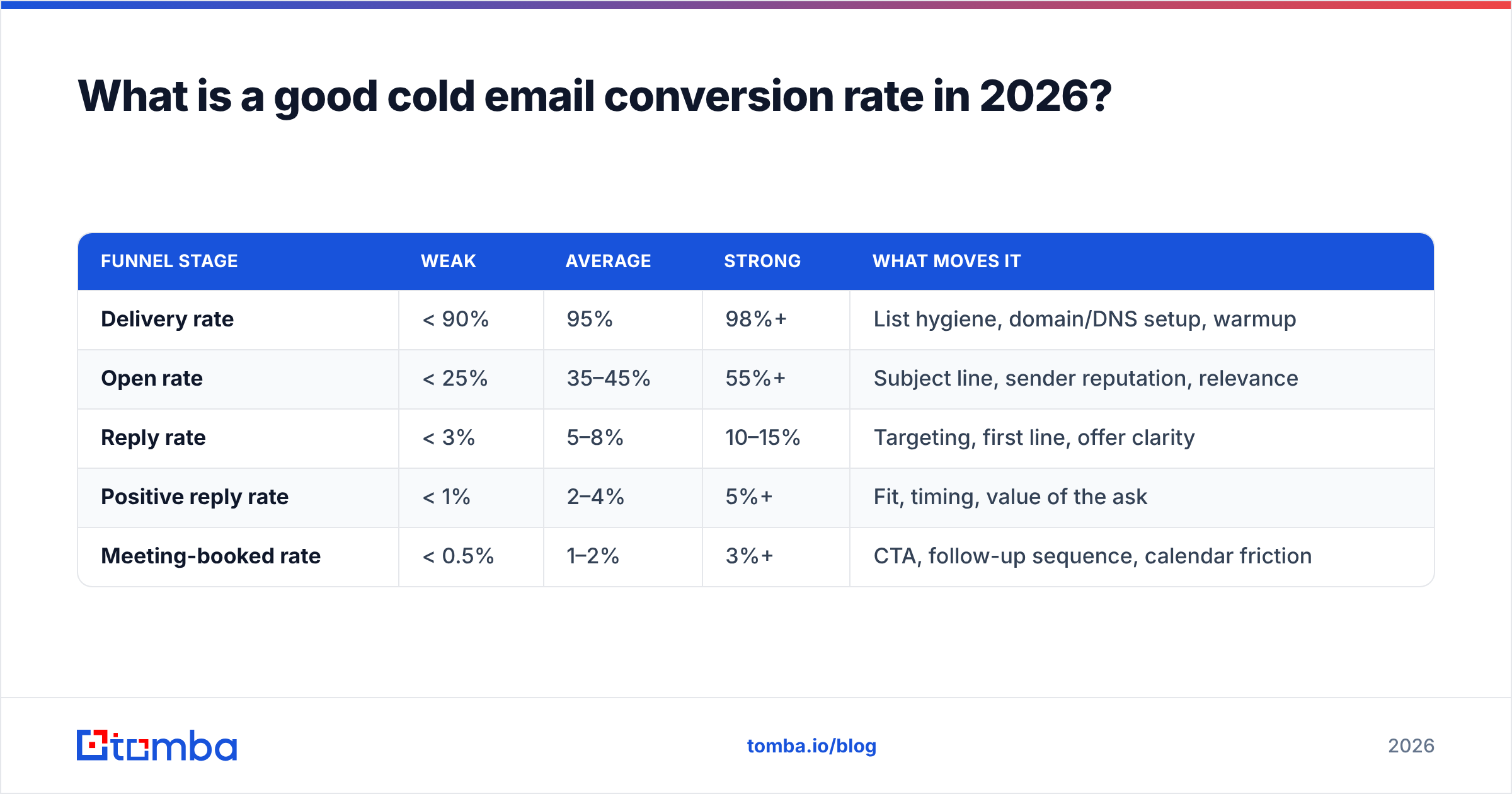
A good cold email conversion rate in 2026 lands roughly at 40–60% open, 5–10% reply, and 1–3% meetings booked — but only on tightly targeted, verified lists. Broad, unverified blasts routinely come in at a fraction of that.
Benchmarks vary by industry, seniority, and offer, so treat these as goalposts rather than guarantees. The single biggest variable is list quality: the same copy sent to a verified, well-matched list versus a scraped one can differ by 5–10x on reply rate.
| Funnel stage | Weak | Average | Strong | What moves it |
|---|---|---|---|---|
| Delivery rate | < 90% | 95% | 98%+ | List hygiene, domain/DNS setup, warmup |
| Open rate | < 25% | 35–45% | 55%+ | Subject line, sender reputation, relevance |
| Reply rate | < 3% | 5–8% | 10–15% | Targeting, first line, offer clarity |
| Positive reply rate | < 1% | 2–4% | 5%+ | Fit, timing, value of the ask |
| Meeting-booked rate | < 0.5% | 1–2% | 3%+ | CTA, follow-up sequence, calendar friction |
Two honest caveats. First, "strong" numbers usually come from small, hand-built lists — they rarely survive scaling to 10,000 sends without dropping. Second, industries differ: a niche vertical with 200 perfect-fit accounts can crush these figures, while a horizontal SaaS blasting SMBs will sit at the low end. Chasing a benchmark you copied from a Twitter screenshot is a fast way to optimize for the wrong thing.
Why do cold email conversion rates die at the reply stage?#
Most campaigns bleed conversion between "opened" and "replied," and it's almost always a relevance problem, not a persuasion problem. A prospect opens out of curiosity; they reply only when the message is clearly for them. Generic templates get opened and ignored at scale.
There's also a measurement trap. After Apple's Mail Privacy Protection and similar changes, open tracking inflates your open rate with machine-generated pixel loads. You can see a 70% "open rate" that's mostly bots pre-fetching images, then wonder why replies don't follow. Google's own guidance on bulk sender requirements makes it clear that engagement — not open pixels — is what protects your sender reputation. Optimize for the metric that can't be faked: a human writing back.
The fix is to invert your priorities:
- Stop grading subject lines by open rate alone. Grade them by reply rate downstream.
- Write the first line for one person. If your opener could be pasted into any prospect's inbox unchanged, it's too generic to earn a reply.
- Make the ask small. "Worth a quick look?" converts better than "Can we schedule a 30-minute demo next week?"
- Follow up. The majority of replies land on emails two through four, not the first touch.
How do you calculate cold email conversion rate correctly?#
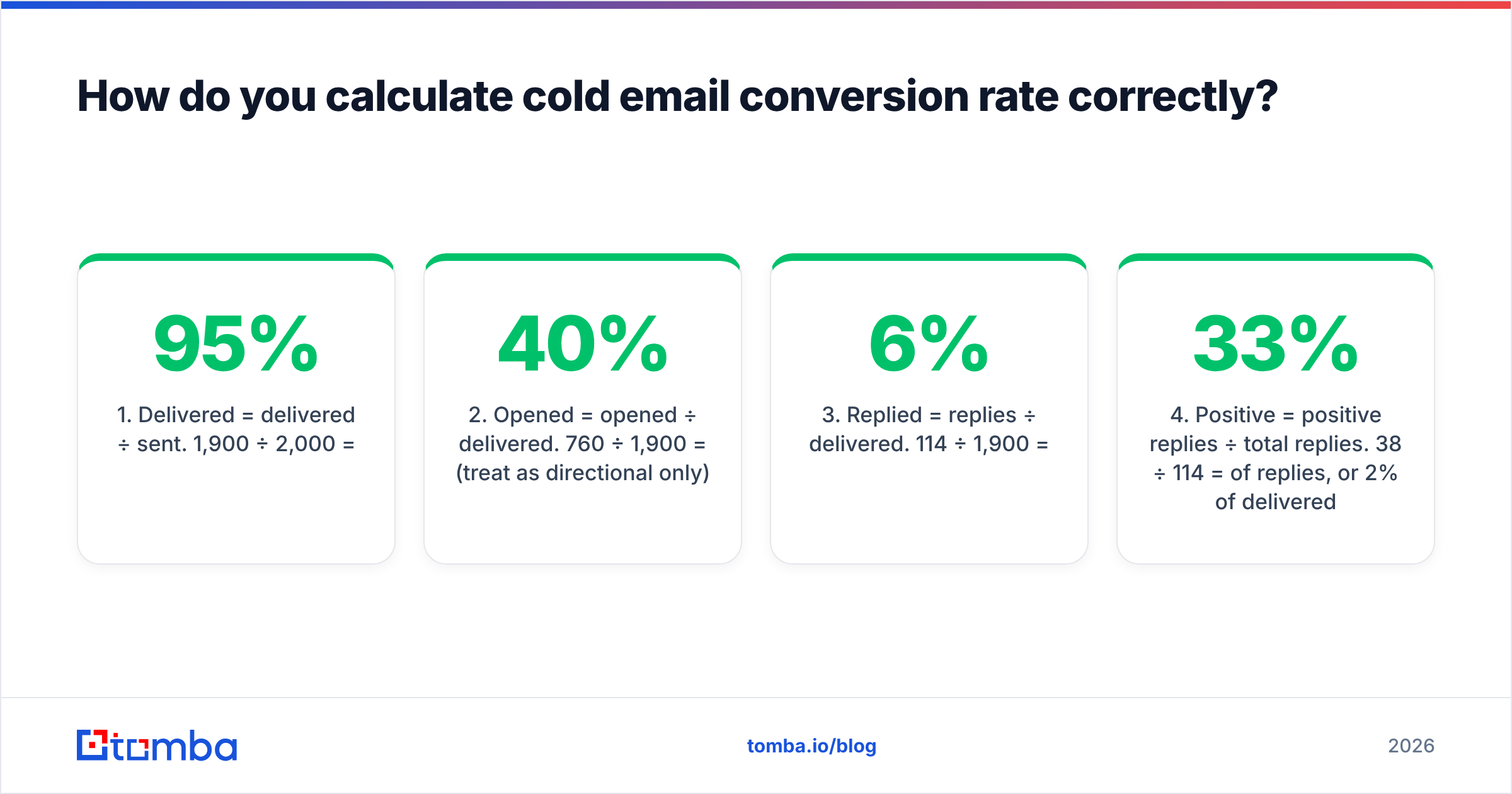
Calculate each stage as a percentage of the stage before it, not of total sends — otherwise you can't tell which link is broken. Dividing everything by "sent" flattens the funnel and hides the actual leak.
Here's the correct method with a worked example on 2,000 sends:
- Delivered = delivered ÷ sent.
1,900 ÷ 2,000 = 95%. - Opened = opened ÷ delivered.
760 ÷ 1,900 = 40%(treat as directional only). - Replied = replies ÷ delivered.
114 ÷ 1,900 = 6%. - Positive = positive replies ÷ total replies.
38 ÷ 114 = 33%of replies, or 2% of delivered. - Meetings = meetings ÷ delivered.
28 ÷ 1,900 = 1.5%.
Notice that computing meetings against delivered (1.5%) versus sent (1.4%) barely differs here — but if your bounce rate were 20% instead of 5%, using "sent" would badly overstate your real inbox performance. Always separate deliverability from persuasion. A high bounce rate is a data problem you solve with an email verifier, not a copywriting problem you solve with a thesaurus.
One more discipline: segment before you average. A blended 6% reply rate might be 12% for your best-fit segment and 1% for a mismatched one you should stop emailing entirely. Averages hide the accounts worth doubling down on.
Which levers actually improve cold email conversion rate?#
The highest-ROI levers, in order, are list quality, deliverability, targeting, then copy — most teams work that list backwards. They rewrite subject lines for a week while sending to a list that's 20% invalid and landing half their volume in spam.
Lever 1: Clean, verified data#
Every invalid address does double damage: it wastes a send and it drags your bounce rate toward the threshold that gets your domain flagged. Verifying your list before a campaign is the cheapest conversion lift available. Pair a good source of contacts with verification so you're only mailing addresses that actually exist. Tomba's email finder and bulk email verification are built for exactly this pre-send hygiene step, and a catch-all verifier helps with the tricky domains that accept everything.
Lever 2: Deliverability foundations#
Get the technical basics right or nothing else matters. Authenticate with SPF, DKIM, and DMARC; warm up new sending domains; keep volume per inbox modest; and monitor your sender reputation. These aren't optional in 2026 — mailbox providers enforce them.
Lever 3: Precise targeting#
A perfect message to the wrong person converts at zero. Narrow your ICP until every line of copy can be specific. Fewer, better-matched prospects almost always beat a bigger, looser list on total meetings booked.
Lever 4: Copy that earns a reply#
Only after the first three levers are handled does copy become the bottleneck. Keep it short, lead with a relevant observation, make one clear ask, and write like a human — not a press release.
)
How does deliverability change your conversion math?#
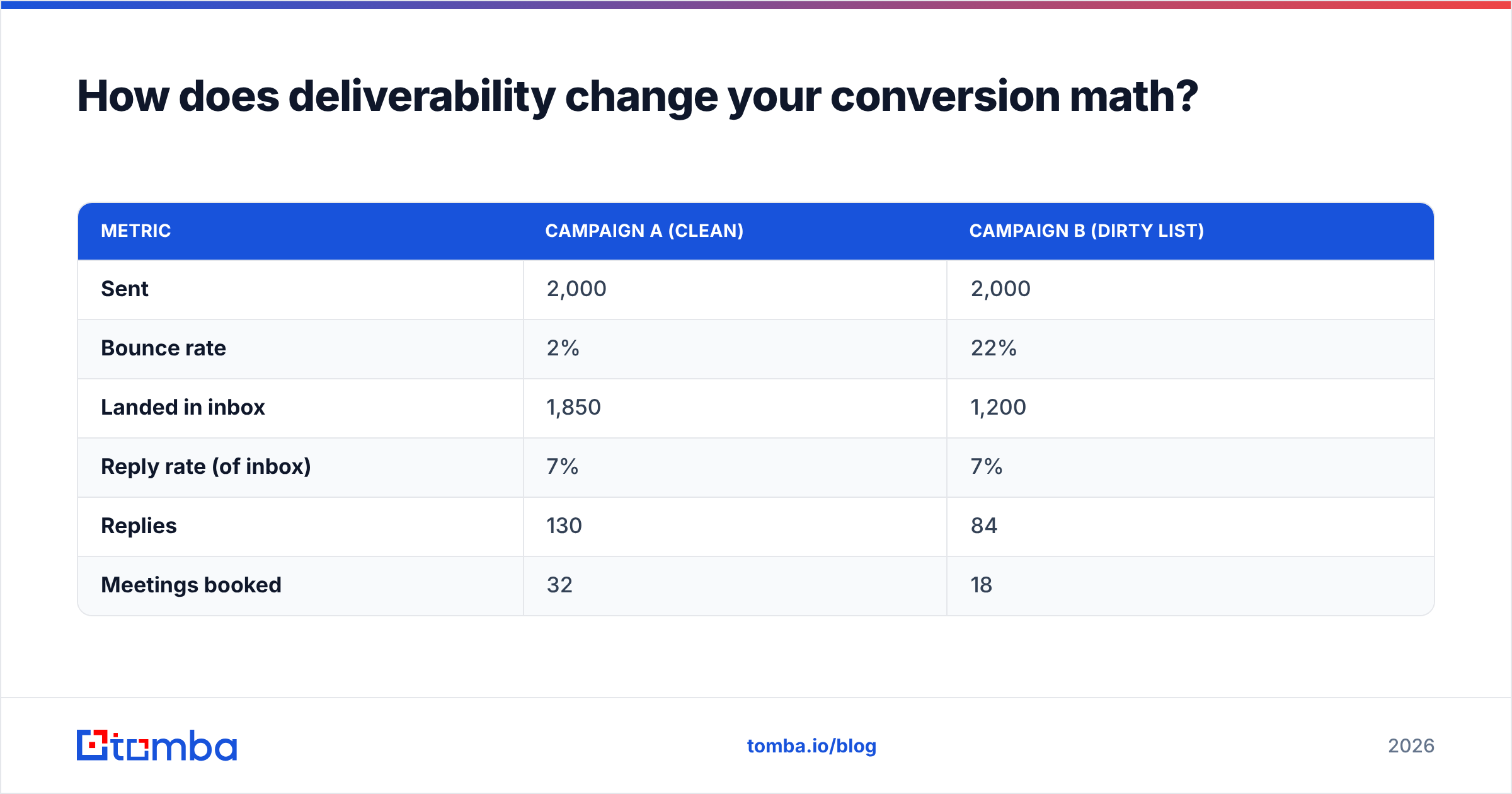
Deliverability sets the ceiling on every downstream rate, because an email in the spam folder converts at zero no matter how good it is. If 30% of your volume never reaches the inbox, you've capped your best possible conversion rate at 70% of its potential before copy even enters the picture.
Here's how two identical campaigns diverge purely on deliverability:
| Metric | Campaign A (clean) | Campaign B (dirty list) |
|---|---|---|
| Sent | 2,000 | 2,000 |
| Bounce rate | 2% | 22% |
| Landed in inbox | 1,850 | 1,200 |
| Reply rate (of inbox) | 7% | 7% |
| Replies | 130 | 84 |
| Meetings booked | 32 | 18 |
Same copy, same reply rate on delivered mail — nearly double the meetings, entirely because Campaign A protected its deliverability. That gap compounds over time: high bounce rates and spam complaints degrade your domain reputation, so Campaign B's next send performs even worse. Deliverability isn't a one-time setup; it's a flywheel you either build up or grind down.
To keep the flywheel spinning: verify before every send, rotate sending inboxes, throttle volume, remove non-responders after a few touches, and watch complaint rates like a hawk. Tools like HubSpot's email deliverability resources and third-party reviews on G2 are useful for benchmarking your stack against what actually works.
What conversion benchmarks should each team track?#
Track the stage that matches your goal, and hold every campaign to it — SDR teams optimizing for meetings should not grade themselves on open rate. Different roles own different links in the funnel, and mismatched metrics create false wins.
- Founders and early GTM: meeting-booked rate. You need pipeline, not vanity opens. Aim for 1–2% of delivered as a floor.
- SDR/BDR teams: positive reply rate and meetings. These predict quota attainment better than raw reply volume.
- Demand gen at scale: delivery rate and reply rate. At high volume, protecting the domain and keeping replies honest is the job.
- RevOps: the full funnel end to end, so you can attribute revenue back to the leakiest stage and fix it systematically.
A practical cadence: review conversion by segment weekly, kill the bottom-decile segments, and reinvest that send volume into the segments already converting above benchmark. Outbound compounds when you feed the winners and starve the losers — most teams do the opposite by keeping every list "just in case."
Frequently asked questions#
What is the average cold email conversion rate? For tightly targeted, verified lists, expect roughly 5–10% reply and 1–3% meetings booked. Broad, unverified sends often come in far lower. The "average" you should care about is your own, tracked by segment.
Is open rate still worth tracking in 2026? Directionally, yes — but never as your primary metric. Privacy features inflate opens with machine loads. Use it to compare subject lines relatively, then judge success by reply and meeting rates.
How many follow-ups improve conversion? Most positive replies land on the second through fourth email. A three-to-four touch sequence spaced a few days apart typically captures far more meetings than a single send, without becoming spammy.
Does list verification really change conversion that much? Yes. Verification cuts bounces, which protects deliverability, which raises the ceiling on every downstream rate. It's usually the single cheapest lift available before you touch copy.
Improve your cold email conversion rate at the source#
Every conversion metric downstream depends on one upstream fact: whether your emails are real, deliverable, and matched to the right person. That's the leak worth fixing first. Tomba's Email Finder helps you build accurate, verified prospect lists by domain, name, or company — so your reply and meeting rates start from a clean foundation instead of a scraped one. Pair it with bulk verification before every campaign, and you'll spend your energy improving copy that actually reaches humans. Start free with 25 searches a month, and see full Tomba pricing when you're ready to scale outbound that converts.
Related guides#
Ready to find emails that actually work?
Join 150,000+ professionals who stopped guessing and started sending. Free credits on signup — no credit card required.
Get the Tomba newsletter
Practical outbound tactics and product updates — once every two weeks.
About the author