Cold Email Copywriting: The 2026 Guide That Gets Replies
Most cold emails die in the inbox because the copy is about you, not them. Here's a concrete, no-fluff framework for cold email copywriting that actually earns replies in 2026.
Cold email copywriting is the difference between a 1% reply rate and a 15% one — same list, same product, completely different words. If your outbound is quiet, the problem is almost never the offer. It's the copy.
This guide breaks down what actually moves reply rates in 2026: how to write subject lines that survive the preview pane, openers that don't get you deleted, bodies that respect a busy person's time, and calls to action that are easy to say yes to. No filler, no "personalization at scale" hand-waving — just the moves that work.
TL;DR#
- Relevance beats cleverness. A boring email to the right person outperforms a witty email to the wrong one every time.
- The first line is your real subject line. Preview text decides whether the email gets opened, so never waste it on "I hope this email finds you well."
- One idea, one ask. The best cold emails are 50–125 words with a single, low-friction call to action.
- Deliverability is copywriting's silent partner. Spammy words, image-heavy layouts, and unverified lists sink great copy before anyone reads it.
- Templates are starting points, not scripts. Use a proven structure, then earn the reply with one specific, researched detail.
What is cold email copywriting?#
Cold email copywriting is the craft of writing a short, unsolicited message to someone who doesn't know you — and getting them to reply. Think of it like knocking on a stranger's door: you have about four seconds before they decide whether to listen or shut it. Every word has to earn the next one.
Technically, it combines three disciplines: persuasion (why should they care), brevity (respecting attention), and deliverability (making sure the message lands in the primary inbox at all). Most people obsess over the first and ignore the other two, which is why most cold email fails.
The goal of a cold email is not to close a deal. It's to start a conversation. Once you internalize that, your copy gets shorter, humbler, and far more effective.
What makes a cold email actually get replies?#
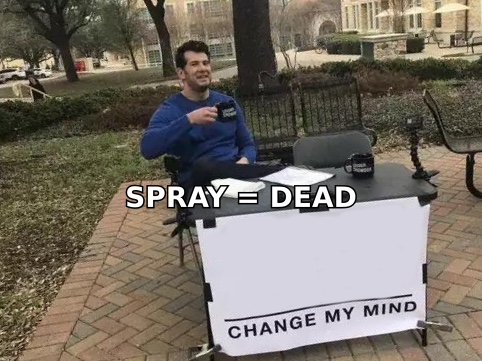
Every high-performing cold email has the same anatomy. Miss one part and the whole thing wobbles.
- A subject line that earns the open — short, specific, lowercase-friendly, no hype.
- An opener about them, not you — a researched observation that proves this isn't a blast.
- A one-sentence value proposition — the outcome you deliver, framed around their world.
- Proof or relevance — a quick, credible reason to believe you.
- A single low-friction CTA — an easy yes, not "book a 30-minute demo."
- A signature that builds trust — real name, company, and a way to verify you're a human.
Here's the mistake almost everyone makes: they lead with their company, their features, and their calendar link. That order is exactly backwards. Lead with the prospect. The moment your reader senses the email is about your quota, they're gone.
What is the best cold email structure?#
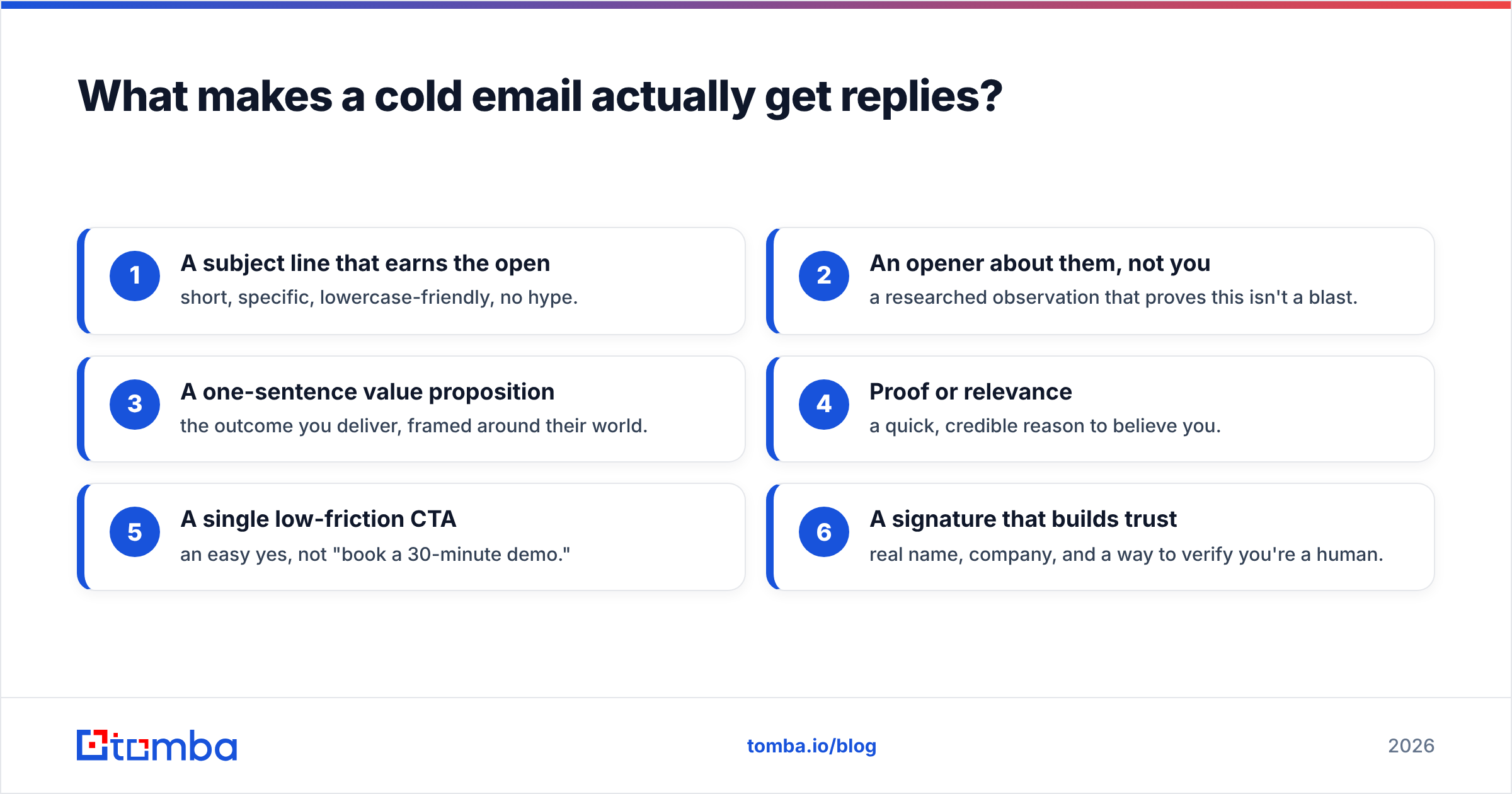
The most reliable structure in 2026 is still the classic Problem → Value → Proof → Ask, kept ruthlessly short. Below is how the same message looks written badly versus well.
| Element | Weak version | Strong version |
|---|---|---|
| Subject line | "Revolutionary AI Sales Platform — Limited Offer!" | "question about your Q3 hiring" |
| Opener | "I hope this email finds you well. My name is..." | "Saw you just opened a second SDR role in Austin." |
| Value prop | "We offer a best-in-class end-to-end solution." | "We help SDR teams book meetings without buying more seats." |
| Proof | "Trusted by thousands of companies worldwide." | "Similar team at [peer company] added 9 meetings/mo." |
| CTA | "Book a 30-minute demo here: [link]" | "Worth a quick reply — should I send the 2-line breakdown?" |
| Length | 240 words | 78 words |
Notice the strong column is specific, humble, and easy to answer. The weak column is generic, self-centered, and asks for a big commitment from someone who owes you nothing.
For a deeper library of frameworks you can adapt, our cold email templates cover intro, follow-up, and re-engagement patterns you can lift directly.
How do you write cold email subject lines?#
Your subject line has one job: get the email opened without lying. In 2026, inboxes are more crowded and AI filters are more suspicious than ever, so restraint wins.
- Keep it under 45 characters. Mobile clients truncate anything longer, and most of your prospects read on their phones first.
- Write it like a coworker would. "quick question re: onboarding" outperforms "Transform Your Onboarding Today."
- Avoid trigger words. "Free," "guarantee," "act now," and excessive punctuation raise your spam score. Run drafts through a spam checker before you send.
- Never use fake personalization tokens. "Re:" on a first-touch email or "{{FirstName}}, are you free?" that failed to render screams automation.
- Test two variants per campaign. Small, honest differences ("a question" vs. "quick question") reveal what your specific audience responds to.
If you're stuck, a subject line generator can break the blank-page freeze — but always rewrite the output in your own plain voice before sending.
Why does personalization matter so much?#
Personalization matters because it's the only signal that separates you from a bot. When a prospect sees a detail that could only apply to them, they subconsciously grant you a few more seconds of attention — the door stays open.
But there's a catch: shallow personalization is worse than none. "I loved your recent LinkedIn post!" with no specifics reads as a merge field, and experienced buyers spot it instantly. Real personalization references something concrete — a job posting, a product launch, a specific line from a talk they gave.
The catch behind the catch is scale. You can't hand-research 500 prospects a day. The teams winning at outbound in 2026 do research at the account level (one insight per company) and personalize the first line at the person level. That's the balance that keeps volume high and copy human.
How do cold email copy and deliverability work together?#
Great copy is invisible if it lands in spam. Deliverability and copywriting are two sides of the same coin, and in 2026 you cannot separate them.
Here's the chain of dependencies most writers overlook:
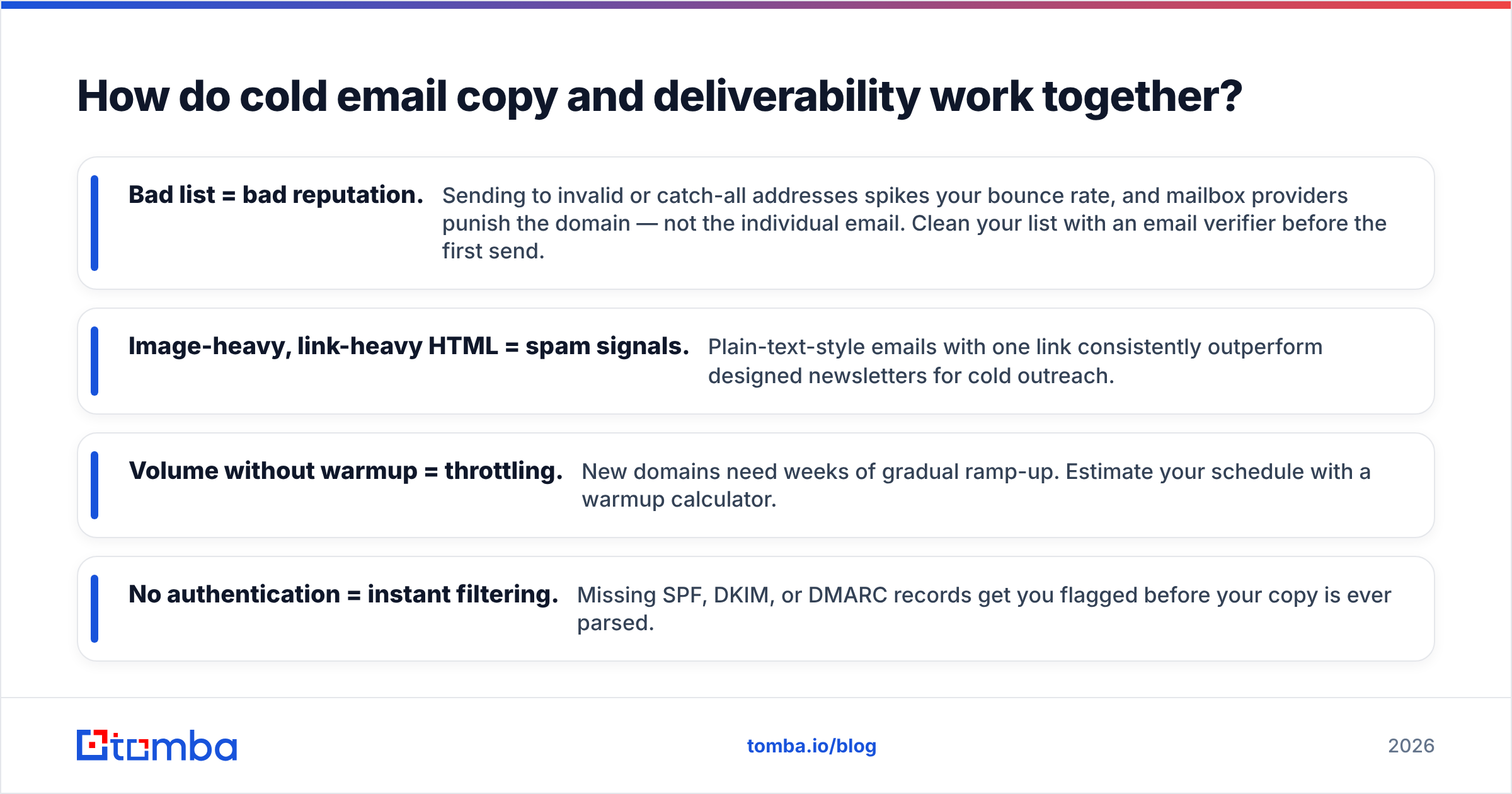
- Bad list = bad reputation. Sending to invalid or catch-all addresses spikes your bounce rate, and mailbox providers punish the domain — not the individual email. Clean your list with an email verifier before the first send.
- Image-heavy, link-heavy HTML = spam signals. Plain-text-style emails with one link consistently outperform designed newsletters for cold outreach.
- Volume without warmup = throttling. New domains need weeks of gradual ramp-up. Estimate your schedule with a warmup calculator.
- No authentication = instant filtering. Missing SPF, DKIM, or DMARC records get you flagged before your copy is ever parsed.
If you want the technical grounding, Google's own Postmaster guidelines and the concept of email deliverability explain why sender reputation gates everything. The takeaway for a copywriter: your words don't matter if the envelope never reaches the desk.
What are the biggest cold email copywriting mistakes?#
Most failing campaigns share the same handful of errors. Fix these before you touch anything advanced.
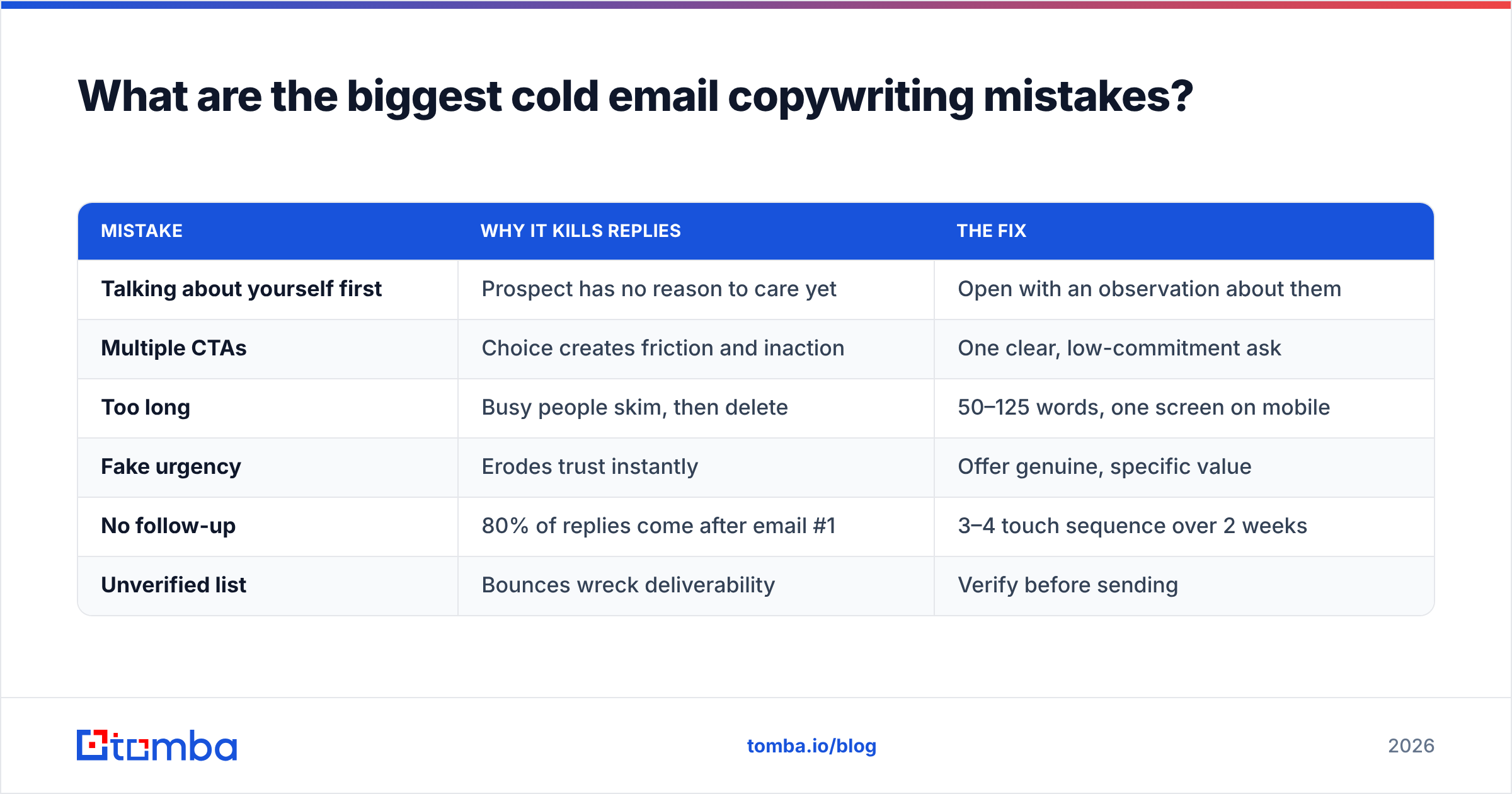
| Mistake | Why it kills replies | The fix |
|---|---|---|
| Talking about yourself first | Prospect has no reason to care yet | Open with an observation about them |
| Multiple CTAs | Choice creates friction and inaction | One clear, low-commitment ask |
| Too long | Busy people skim, then delete | 50–125 words, one screen on mobile |
| Fake urgency | Erodes trust instantly | Offer genuine, specific value |
| No follow-up | 80% of replies come after email #1 | 3–4 touch sequence over 2 weeks |
| Unverified list | Bounces wreck deliverability | Verify before sending |
The follow-up point deserves emphasis. A single cold email is a coin flip; a thoughtful four-touch sequence is a strategy. Each follow-up should add a new angle — a different pain point, a case study, a lighter ask — never just "bumping this to the top of your inbox."
How do you find the right people to email?#
The best copy in the world sent to the wrong inbox is wasted effort. Targeting is upstream of writing, and it's where reply rates are quietly won or lost.
Start by defining the exact role and company profile that has the problem you solve. Then build the list with accurate, verified contact data rather than scraped guesses. A tool like Tomba's domain search lets you pull every professional email at a target company, while the email finder locates a specific decision-maker by name and domain. Both feed verified addresses straight into your sequence, so your carefully written copy actually reaches a human.
For teams comparing data vendors, neutral marketplaces like G2 are worth a scan — accuracy and coverage vary widely, and the right source depends on your target market. Partners such as BookYourData also serve teams that prefer buying pre-built lists over building their own; the right choice comes down to how much control you want over targeting.
What does a strong cold email look like end to end?#
Here's a complete example that applies every principle above. It's 74 words.
Subject: question about your new Austin SDR role
Hi Jordan,
Saw you just posted a second SDR opening — usually that means the current team is at capacity on pipeline.
We help SDR teams book more meetings from the same headcount by tightening list accuracy before outreach. A team like [peer] added 9 meetings a month without new hires.
Worth a quick reply — should I send the two-line breakdown of how?
— Sam, Tomba
Why it works: the subject is specific and lowercase, the opener proves research, the value prop is framed around their constraint (headcount), the proof is concrete, and the CTA asks for a reply — not 30 minutes of calendar time. Nothing here is clever. It's just relevant, short, and human.
How do you scale cold email copywriting without sounding like a robot?#
Scale is the eternal tension: volume pulls toward generic, and relevance pulls toward slow. You resolve it by systematizing the parts that don't need a human and protecting the parts that do.
- Templatize the structure, personalize the first line. The Problem → Value → Proof → Ask skeleton stays constant; only the opening observation changes per prospect.
- Segment tightly. Ten messages tuned to ten roles beat one message blasted to a thousand. Same wording works within a segment because the pain really is shared.
- Automate data, not empathy. Use data enrichment to pull the firmographic details that inform your angle, then write the human line yourself.
- Measure the right metric. Track reply rate and positive-reply rate, not open rate — open rate is increasingly unreliable in 2026 thanks to privacy proxies.
An AI assist can help draft variants — a cold email AI writer is genuinely useful for beating the blank page — but treat its output as a rough draft. Every send should still pass the "would a real coworker write this?" test.
Cold email copywriting checklist#
Before any campaign goes live, run this list:
- Is the list verified? Bounces under 3%.
- Is the subject under 45 characters and honest?
- Does the first line prove I researched them?
- Is there exactly one CTA, and is it easy to say yes to?
- Is the email under 125 words?
- Are SPF, DKIM, and DMARC configured on the sending domain?
- Is there a 3–4 touch follow-up sequence queued?
If you can't tick all seven, you're leaving replies on the table.
Start with accurate data, then write the copy#
The best cold email copywriting in the world only pays off when it reaches a real, reachable person — which is why targeting and data quality come first, and clever words come second. Get the list right, keep the message short and human, and let a proven structure carry the weight.
If you're ready to build a clean, verified prospect list to write to, start with the Tomba Email Finder. Find decision-makers by name or domain, verify every address before you send, and give your copy the one thing it can't do for itself: a real inbox to land in. The free tier gives you 25 searches a month to test it, and you can see full Tomba pricing when you're ready to scale.
Related guides#
Ready to find emails that actually work?
Join 150,000+ professionals who stopped guessing and started sending. Free credits on signup — no credit card required.
Get the Tomba newsletter
Practical outbound tactics and product updates — once every two weeks.
About the author