Cold Email Follow Up: The 2026 Sequence That Gets Replies
Most cold email replies come from the follow up, not the first send. Here is the exact sequence, timing, and templates that get answers in 2026.
Most of your replies are hiding in emails you never sent. The first cold email gets opened, glanced at, and forgotten. The reply usually comes from message two, three, or four — the follow ups you skipped because they felt pushy. This guide fixes that.
TL;DR#
- The follow up is where the money is. In most cold outbound data, 40–60% of replies land after the first email, not on it.
- Send 3–5 follow ups, spaced across 2–3 weeks, each adding a new angle — never a bare "just bumping this."
- Timing matters less than relevance. A useful reason to write beats a perfectly timed nudge every time.
- Deliverability decides everything. Verified addresses, a warmed domain, and short plain-text emails keep you out of spam.
- Automate the send, personalize the open and the ask. Sequences scale; generic copy doesn't.
Why does a cold email follow up matter so much?#
Because buyers don't reply on your schedule — they reply when your message happens to catch them at a moment that matters. Think of a follow up like knocking on a neighbor's door: the first knock rarely lands when they're free, but the third one catches them between tasks. You're not being annoying; you're increasing the number of moments where "yes, let's talk" is possible.
Concretely, a single cold email is a coin flip on timing. Your prospect might be in a meeting, buried in their inbox, or out that week. Each additional touch is another chance to arrive when they can actually act. Sales teams that stop after one email are leaving the majority of their pipeline on the table — the response rate on a well-built multi-step sequence routinely doubles or triples a one-and-done send.
The catch: follow ups only work if the first email reached a real inbox. If you're emailing dead addresses or landing in spam, more messages just multiply the failure. That's why the sequence starts before you write a word — with clean data and a healthy sending domain.
How many follow ups should you send?#
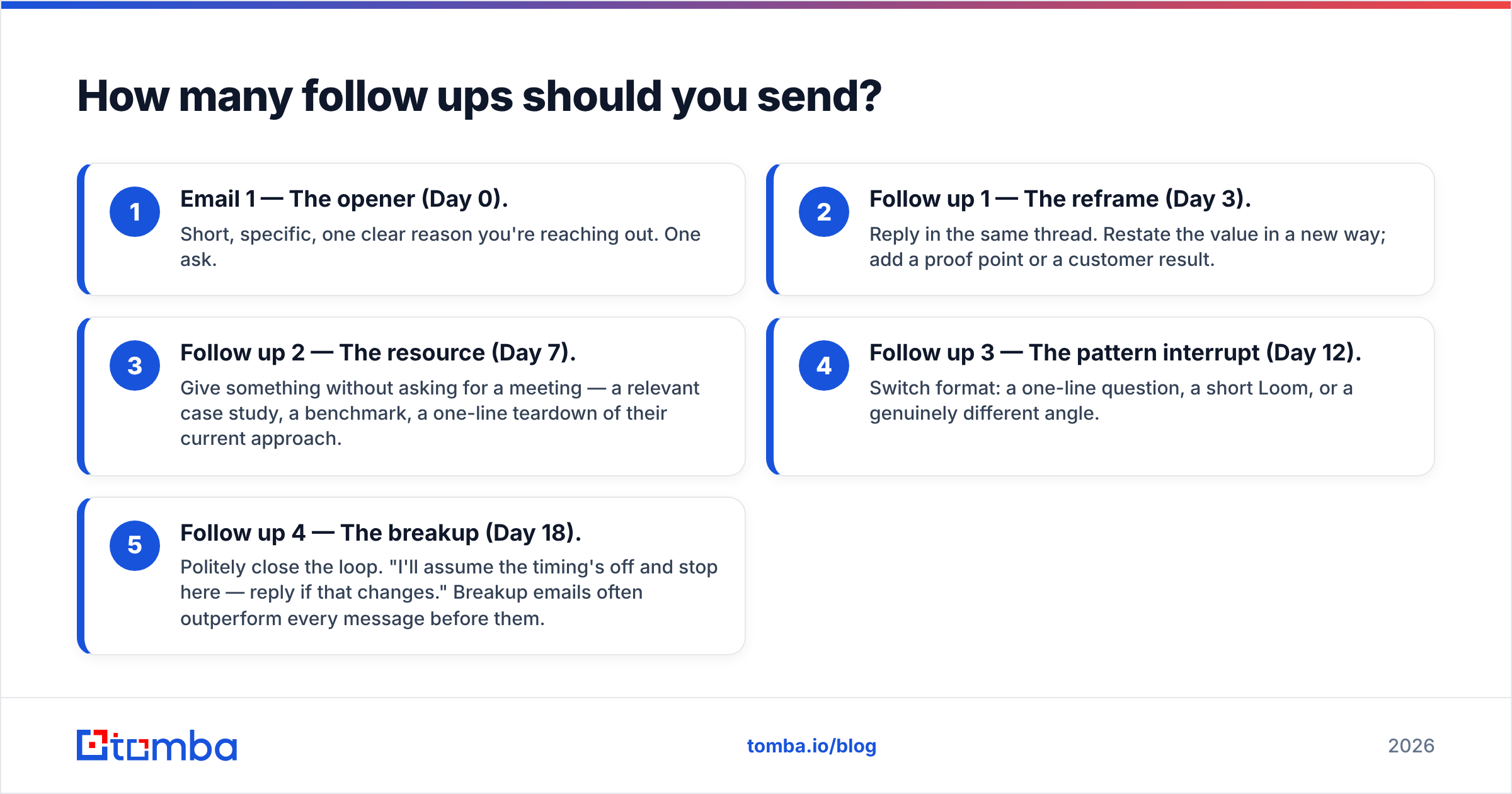
Send three to five follow ups after the initial email. Fewer than three and you quit before most replies arrive; more than six and you're mostly annoying people who were never going to buy.
Here's a sequence that holds up across industries:
- Email 1 — The opener (Day 0). Short, specific, one clear reason you're reaching out. One ask.
- Follow up 1 — The reframe (Day 3). Reply in the same thread. Restate the value in a new way; add a proof point or a customer result.
- Follow up 2 — The resource (Day 7). Give something without asking for a meeting — a relevant case study, a benchmark, a one-line teardown of their current approach.
- Follow up 3 — The pattern interrupt (Day 12). Switch format: a one-line question, a short Loom, or a genuinely different angle.
- Follow up 4 — The breakup (Day 18). Politely close the loop. "I'll assume the timing's off and stop here — reply if that changes." Breakup emails often outperform every message before them.
The rule underneath all of this: every follow up must add something new. A message that only says "circling back" or "just bumping this to the top of your inbox" trains the reader to ignore you. Give them a reason to re-engage each time.
What does the follow up timing look like?#
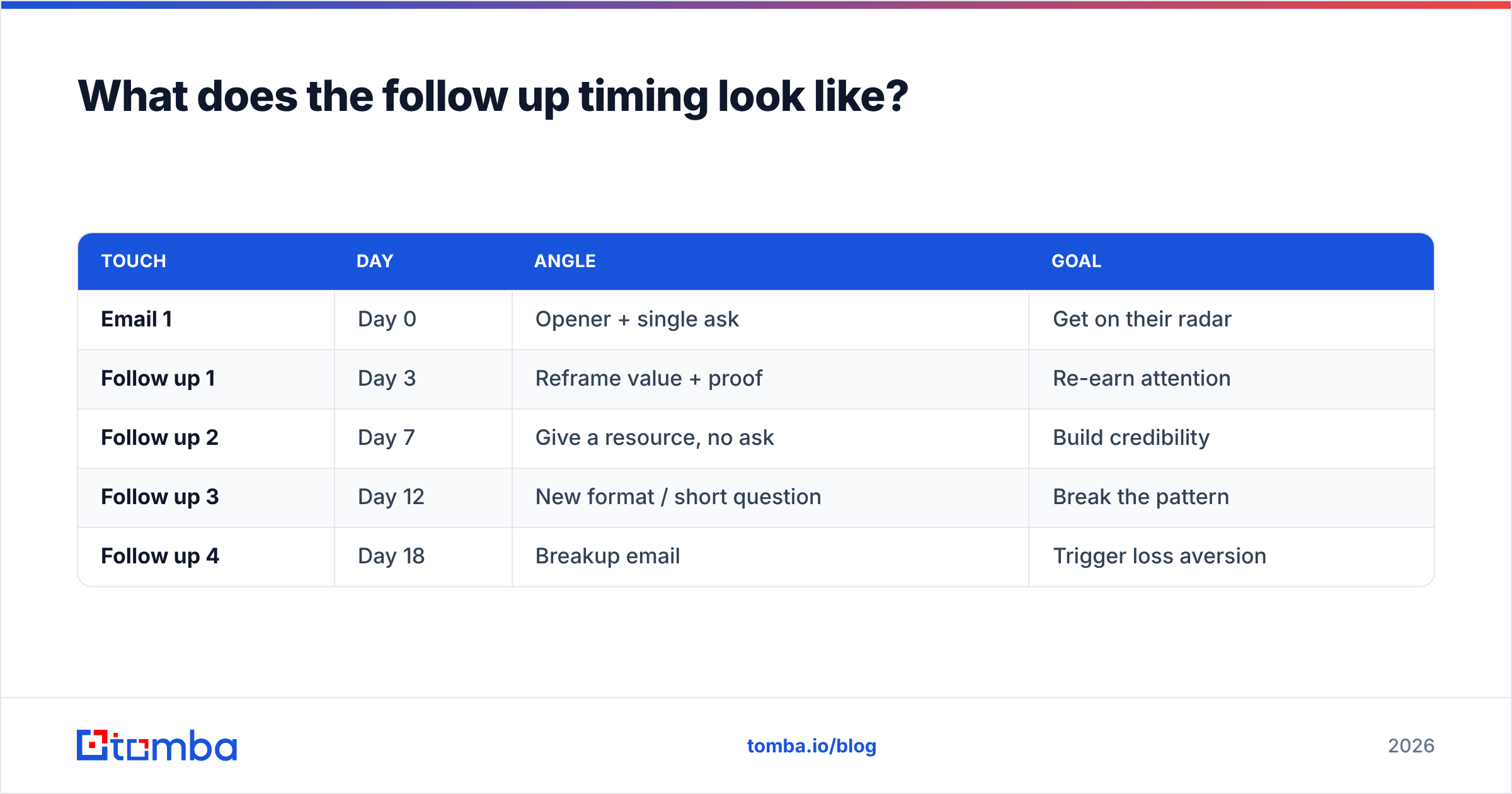
Front-load the early touches, then stretch the gaps. People decide fast when they decide at all, so your first two follow ups should arrive while the opener is still fresh. After that, widen the spacing so you stay present without crowding.
| Touch | Day | Angle | Goal |
|---|---|---|---|
| Email 1 | Day 0 | Opener + single ask | Get on their radar |
| Follow up 1 | Day 3 | Reframe value + proof | Re-earn attention |
| Follow up 2 | Day 7 | Give a resource, no ask | Build credibility |
| Follow up 3 | Day 12 | New format / short question | Break the pattern |
| Follow up 4 | Day 18 | Breakup email | Trigger loss aversion |
Two timing rules that matter more than the exact days:
- Keep the same thread. Replying to your own email preserves context and signals persistence, not spam.
- Match their timezone and workday. Sending at 7 a.m. their local time often beats mid-afternoon, because you sit at the top of the inbox when they start. Tools like HubSpot's sales research show send-time effects are real but modest — don't over-optimize timing at the expense of the message.
What should each cold email follow up actually say?#
Lead with them, not you. Every message should pass a simple test: could a prospect read the first sentence and immediately know why it's worth 20 seconds? If the opening line is about your company, rewrite it.
Here are three follow up patterns you can adapt today. Keep them under 90 words.
The reframe (Follow up 1):
Hi {First name} — following up on my note about {problem}. One thing I should've led with: {Customer} cut {metric} by {number}% in {timeframe} using the same approach. Worth a 15-minute look at whether it maps to {their company}?
The resource (Follow up 2):
{First name}, no ask here — just thought this was relevant. We put together a short breakdown of how teams in {industry} handle {problem}: {link}. Curious whether #2 matches what you're seeing.
The breakup (Follow up 4):
{First name}, I've reached out a few times and haven't heard back, so I'll assume {problem} isn't a priority right now. No worries at all — if that changes, just reply here and I'll pick it up. Wishing you a strong quarter.
If writing five distinct angles per prospect sounds slow, it is — until you templatize it. A library of proven cold email templates plus a strong subject line generator lets you keep the structure fixed and swap only the personalized details. And keep subject lines short: on follow ups inside the same thread, "Re:" plus a two-word hook beats a fresh clever line.
Manual follow ups vs. automated sequences: which wins?#
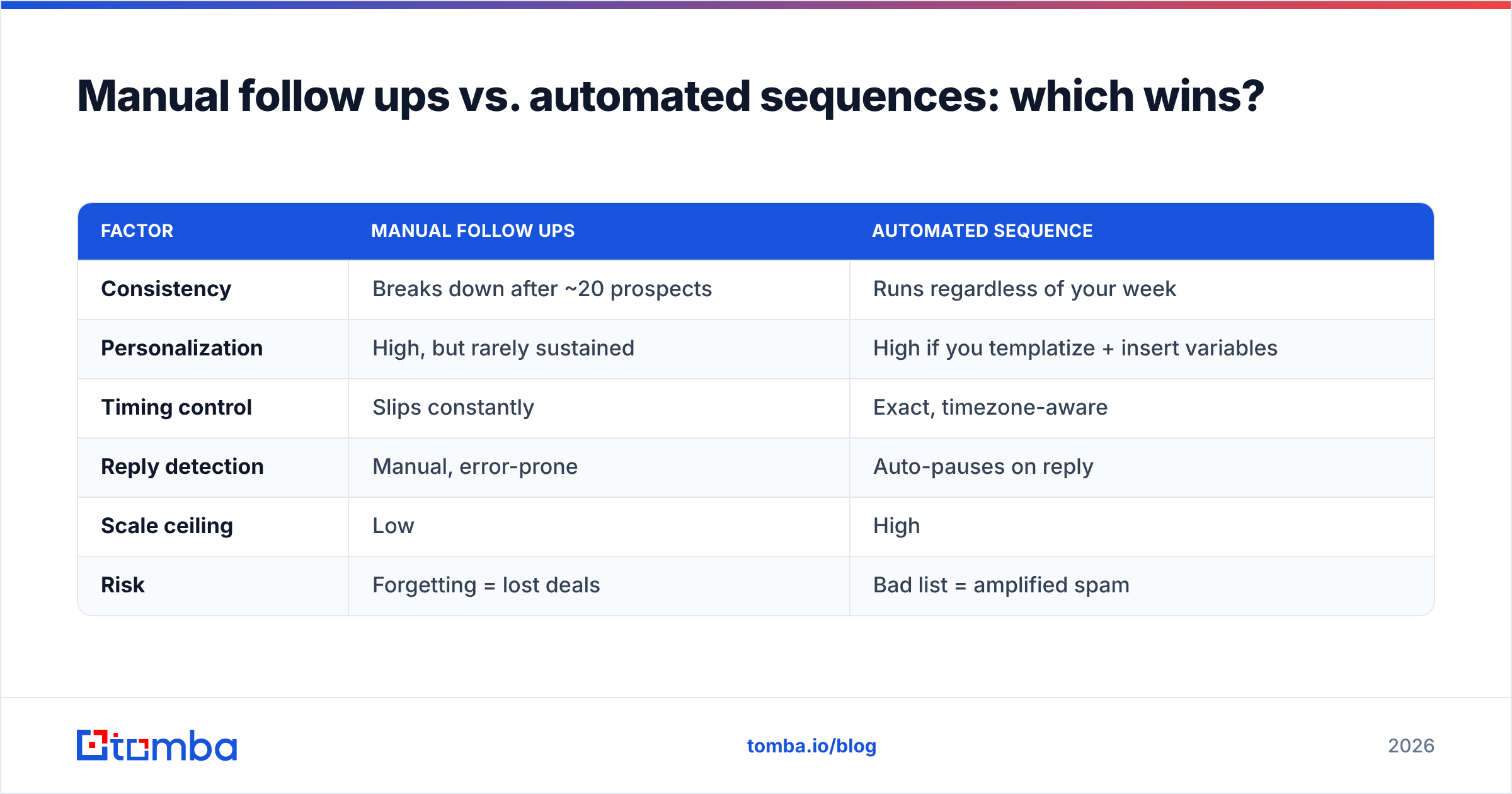
Automate the sending and tracking; keep the thinking human. The point of automation is not to remove personalization — it's to guarantee that follow up number four actually goes out on Day 18 when you're slammed with everything else.
| Factor | Manual follow ups | Automated sequence |
|---|---|---|
| Consistency | Breaks down after ~20 prospects | Runs regardless of your week |
| Personalization | High, but rarely sustained | High if you templatize + insert variables |
| Timing control | Slips constantly | Exact, timezone-aware |
| Reply detection | Manual, error-prone | Auto-pauses on reply |
| Scale ceiling | Low | High |
| Risk | Forgetting = lost deals | Bad list = amplified spam |
The honest trade-off: automation multiplies whatever you feed it. Feed it a clean, verified list and sharp copy, and it compounds your results. Feed it a scraped list full of guesses, and it compounds your bounce rate and torches your domain. That's why the data layer isn't optional.
How do you keep follow ups out of spam?#
Protect the domain before you protect the copy. You can write the best sequence in the world, but if half your sends bounce or land in spam, the follow up never happens. Deliverability is a prerequisite, not a nice-to-have.
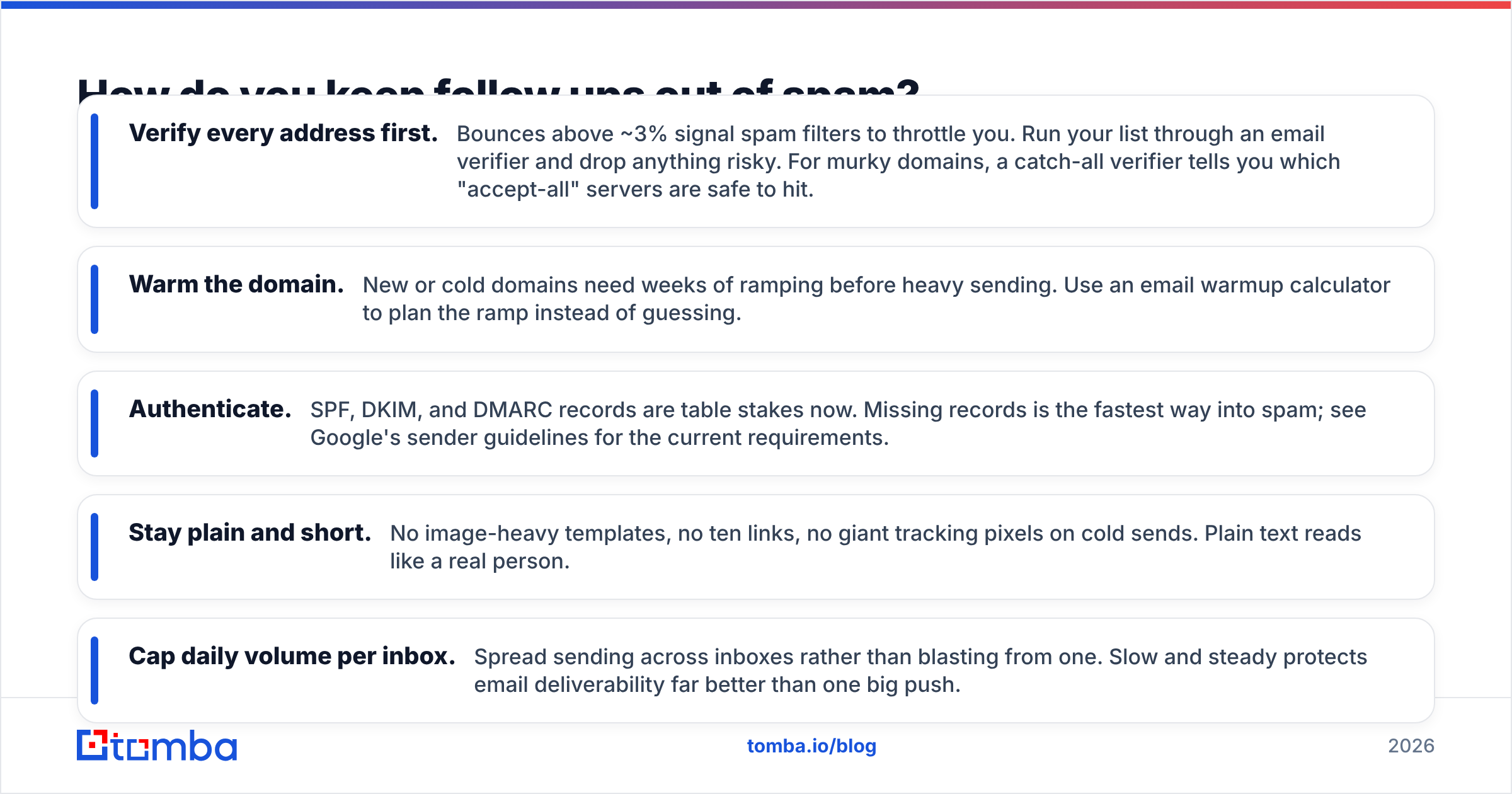
Work through this checklist before you scale any sequence:
- Verify every address first. Bounces above ~3% signal spam filters to throttle you. Run your list through an email verifier and drop anything risky. For murky domains, a catch-all verifier tells you which "accept-all" servers are safe to hit.
- Warm the domain. New or cold domains need weeks of ramping before heavy sending. Use an email warmup calculator to plan the ramp instead of guessing.
- Authenticate. SPF, DKIM, and DMARC records are table stakes now. Missing records is the fastest way into spam; see Google's sender guidelines for the current requirements.
- Stay plain and short. No image-heavy templates, no ten links, no giant tracking pixels on cold sends. Plain text reads like a real person.
- Cap daily volume per inbox. Spread sending across inboxes rather than blasting from one. Slow and steady protects email deliverability far better than one big push.
Deliverability and data quality are the same problem wearing two hats. Both come back to sending real messages to real people at a sustainable pace.
What's the biggest cold email follow up mistake?#
Quitting too early — closely followed by following up with nothing to say. Most reps send one email, hear silence, and move on. The ones who win send five relevant touches and detect the reply automatically so they never double-message someone who already answered.
A few other mistakes worth naming:
- Guilt-tripping. "I've emailed three times and heard nothing" makes it about you. Stay warm and neutral.
- Breaking the thread. Starting a new subject line each time erases context and looks like a fresh blast.
- Ignoring the data. No amount of clever copy saves a list of unverified guesses. Start from accurate contacts — that's the whole game. You can compare accuracy claims across vendors on independent review sites like G2 before you trust a source.
- Over-automating the human parts. Merge tags are fine; a fully robotic email that name-drops the wrong company is worse than no email.
How does better data make follow ups work?#
Accurate contacts turn a sequence from spray-and-pray into a system. When you know the email is real, the name is right, and the person actually works there, every follow up compounds instead of leaking. That's the difference between a 2% reply rate and a 15% one.
This is where the tooling around your sequence earns its keep. A reliable email finder gets you verified, deliverable addresses instead of pattern guesses, and a domain search surfaces the right contacts at a target account so you're following up with the decision-maker, not the general inbox. Clean inputs mean your carefully written Day 18 breakup email lands in a real inbox — which is the only place a reply can come from.
Build the sequence, warm the domain, and personalize the open. But start with data you can trust, because every follow up you send is only as good as the address it's sent to.
Start with contacts that actually convert#
Your follow up sequence is only as strong as your list. Before you write a single "circling back," make sure every address is a real, verified inbox — because five perfect follow ups to a dead email get you nothing. Tomba's Email Finder gives you accurate, deliverable B2B emails so your sequence lands where it counts, and its built-in verification keeps your bounce rate low and your sender reputation intact. Start free with 25 searches, then scale on the Starter plan at $49/mo when your outreach takes off. Find the right people first — the replies follow.
Related guides#
Ready to find emails that actually work?
Join 150,000+ professionals who stopped guessing and started sending. Free credits on signup — no credit card required.
Get the Tomba newsletter
Practical outbound tactics and product updates — once every two weeks.
About the author