Cold Email Follow Up Template: 7 Proven Examples for 2026
Most replies come from the follow-up, not the first email. Steal 7 cold email follow up templates, a cadence that works, and the mistakes that kill deliverability.
Roughly 8 out of 10 replies to a cold sequence never come from the first email. They come from touch two, three, or four — the ones most reps never send. If you stop after a single message, you are leaving the majority of your pipeline on the table.
This guide gives you seven copy-paste cold email follow up templates, the cadence and timing that actually books meetings, and the mistakes that quietly tank your reply rate and your sender reputation.
TL;DR#
- Follow-ups win the game. The bulk of positive replies land on the second through fifth touch, not the first. One-and-done outreach wastes your list.
- Space touches out. A 5-email sequence over 14–18 business days beats hammering someone daily. Vary the angle each time.
- Every follow-up needs a new reason to reply — a fresh insight, a case study, a different CTA — never just "bumping this up."
- Deliverability is the multiplier. Clean lists and verified addresses keep you out of spam; broken addresses spike bounces and burn your domain.
- Seven templates below cover the gentle nudge, the value-add, the social-proof, the objection-handler, and the breakup — steal them today.
Why do cold email follow ups matter more than the first email?#
Think of cold outreach like knocking on a door. The first knock is easy to ignore — the person is busy, distracted, or your timing was simply bad. The second and third knock signal that you are serious and not going away. That persistence, done politely, is what earns the conversation.
The data backs the analogy. Reply rates climb sharply as you add touches, then plateau. Prospects who ignored your opener often reply to touch three because that email happened to hit their inbox on a calmer morning, or because the new angle finally connected. A single email gives every prospect exactly one chance to be in the right mood. A sequence gives them four or five.
There is also a compounding trust effect. Repeated, respectful contact builds familiarity, and familiarity lowers the perceived risk of replying to a stranger. According to HubSpot's sales research, persistence across multiple touches is one of the clearest separators between reps who hit quota and reps who don't.
The catch: persistence only works if each message earns its place. Five copies of "just following up" is spam, not a sequence. That is where templates with distinct angles come in.
What does a good cold email follow up sequence look like?#
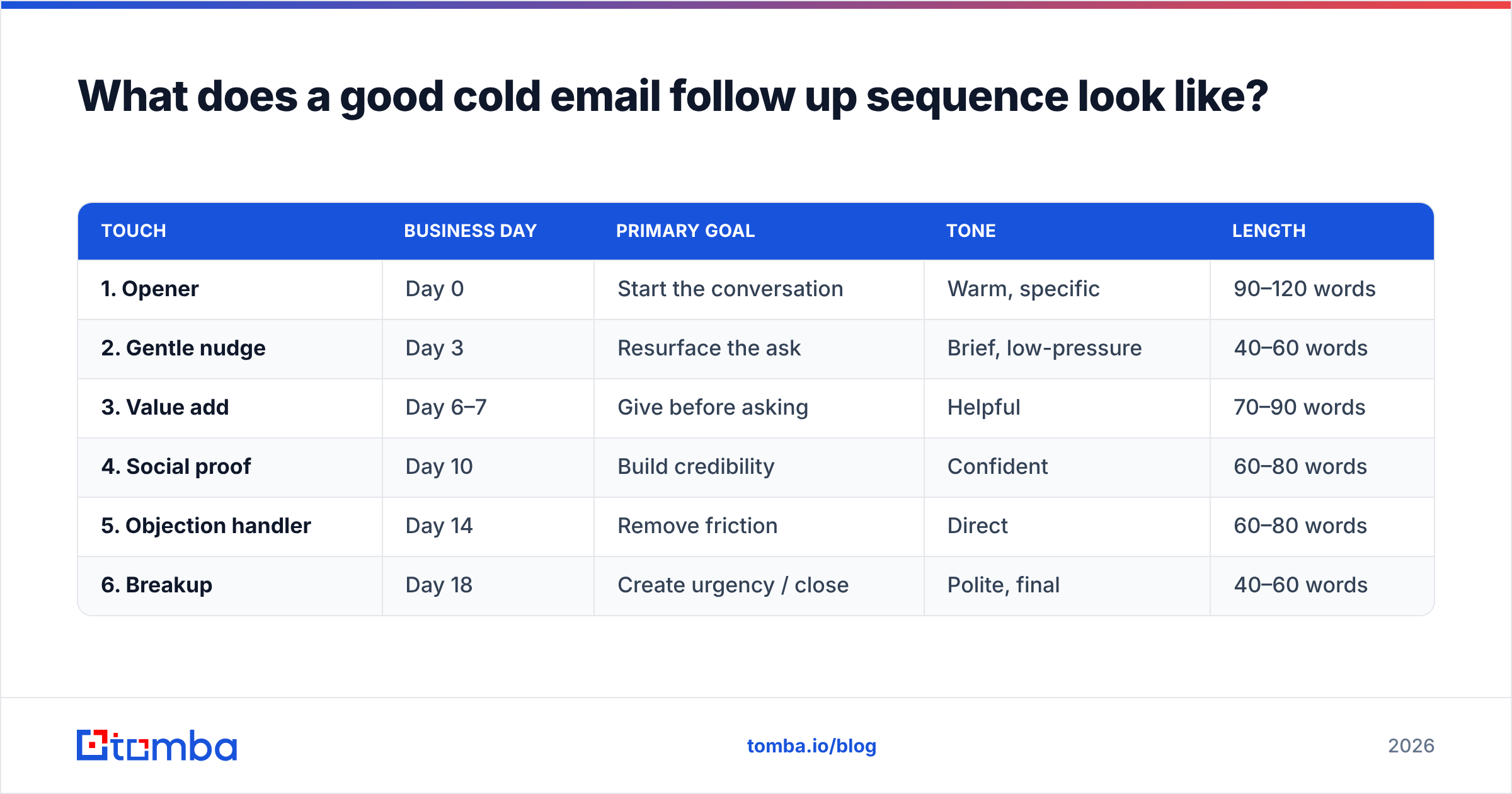
A strong sequence is a planned series of 4–6 emails, each with a different job, spaced across roughly two to three weeks. Here is the structure that consistently performs:
- Touch 1 — The opener. Your original cold email. Personalized hook, one clear value proposition, single soft CTA.
- Touch 2 — The gentle nudge (Day 3). Short reply-in-thread bump that resurfaces the ask without repeating it.
- Touch 3 — The value add (Day 6–7). Bring something new: a relevant stat, resource, or mini case study. No ask fatigue.
- Touch 4 — The social proof (Day 10). Show a comparable company's result to trigger "that could be us."
- Touch 5 — The objection handler (Day 14). Preempt the silent "no" — price, timing, or relevance.
- Touch 6 — The breakup (Day 18). Signal you're closing the loop. Breakup emails often produce the highest single-touch reply rate because they create urgency and remove pressure at once.
Here is how those touches map to timing, goal, and tone:
| Touch | Business day | Primary goal | Tone | Length |
|---|---|---|---|---|
| 1. Opener | Day 0 | Start the conversation | Warm, specific | 90–120 words |
| 2. Gentle nudge | Day 3 | Resurface the ask | Brief, low-pressure | 40–60 words |
| 3. Value add | Day 6–7 | Give before asking | Helpful | 70–90 words |
| 4. Social proof | Day 10 | Build credibility | Confident | 60–80 words |
| 5. Objection handler | Day 14 | Remove friction | Direct | 60–80 words |
| 6. Breakup | Day 18 | Create urgency / close | Polite, final | 40–60 words |
Keep every follow-up in the same email thread as the original. Threading gives the prospect instant context and keeps your name stacked in one place instead of scattered across their inbox.
What are the 7 best cold email follow up templates?#
Copy these, swap the brackets, and match them to the touch structure above. Keep personalization tokens accurate — a wrong first name or company is worse than no personalization at all.
Template 1 — The gentle nudge (Touch 2)#
Subject: Re: [original subject]
Hi [First name],
Floating this back to the top of your inbox in case it slipped. My question was whether [specific outcome] is a priority for [Company] this quarter.
Worth a quick 15 minutes to find out?
[Your name]
Template 2 — The value add (Touch 3)#
Hi [First name],
Thought this might be useful regardless of whether we talk: [link to a relevant resource, benchmark, or teardown]. Companies like [peer] used the same approach to cut [metric] by [number].
Happy to walk you through how it maps to [Company] if helpful.
[Your name]
Template 3 — The social proof (Touch 4)#
Hi [First name],
[Comparable company] had the same [challenge] you're likely seeing. After [what changed], they hit [specific result] in [timeframe].
I'd love to show you the exact play. Does Thursday or Friday work better?
[Your name]
Template 4 — The objection handler (Touch 5)#
Hi [First name],
If I had to guess, the silence means one of three things: timing's off, budget's tight, or this isn't a fit right now. All fair.
If it's timing, tell me when to circle back. If it's fit, a one-line "not for us" saves us both time — no hard feelings.
[Your name]
Template 5 — The breakup (Touch 6)#
Subject: Closing the loop
Hi [First name],
I don't want to keep landing in your inbox uninvited, so this is my last note. If [outcome] moves up your list later, just reply here and I'll pick it right back up.
Wishing you a strong quarter either way.
[Your name]
Template 6 — The trigger-event follow up#
Hi [First name],
Saw [Company] just [funding round / new hire / product launch / expansion]. Congrats. Moments like this usually put [relevant priority] front and center — which is exactly where we help.
Open to a short call this week?
[Your name]
Template 7 — The referral pivot#
Hi [First name],
I may have aimed this at the wrong person — apologies if so. Who on your team owns [function]? Happy to take it off your plate and reach out to them directly.
Thanks either way,
[Your name]
Want more starting points before you write from scratch? Browse Tomba's cold email templates and run subject lines through the subject line tester so your follow-up actually gets opened.
How often should you send cold email follow ups?#
Send 4–6 touches over 14–20 business days, with widening gaps between each. Front-load slightly (Day 0, 3, 7) then stretch (Day 10, 14, 18). Daily follow-ups read as desperate and get you marked as spam; monthly gaps let the thread go cold.
The spacing matters as much as the count. Early touches ride the momentum of the first email while your name is still faintly familiar. Later touches give busy prospects room to breathe so your persistence reads as professional rather than pushy.
A few timing rules that consistently help:
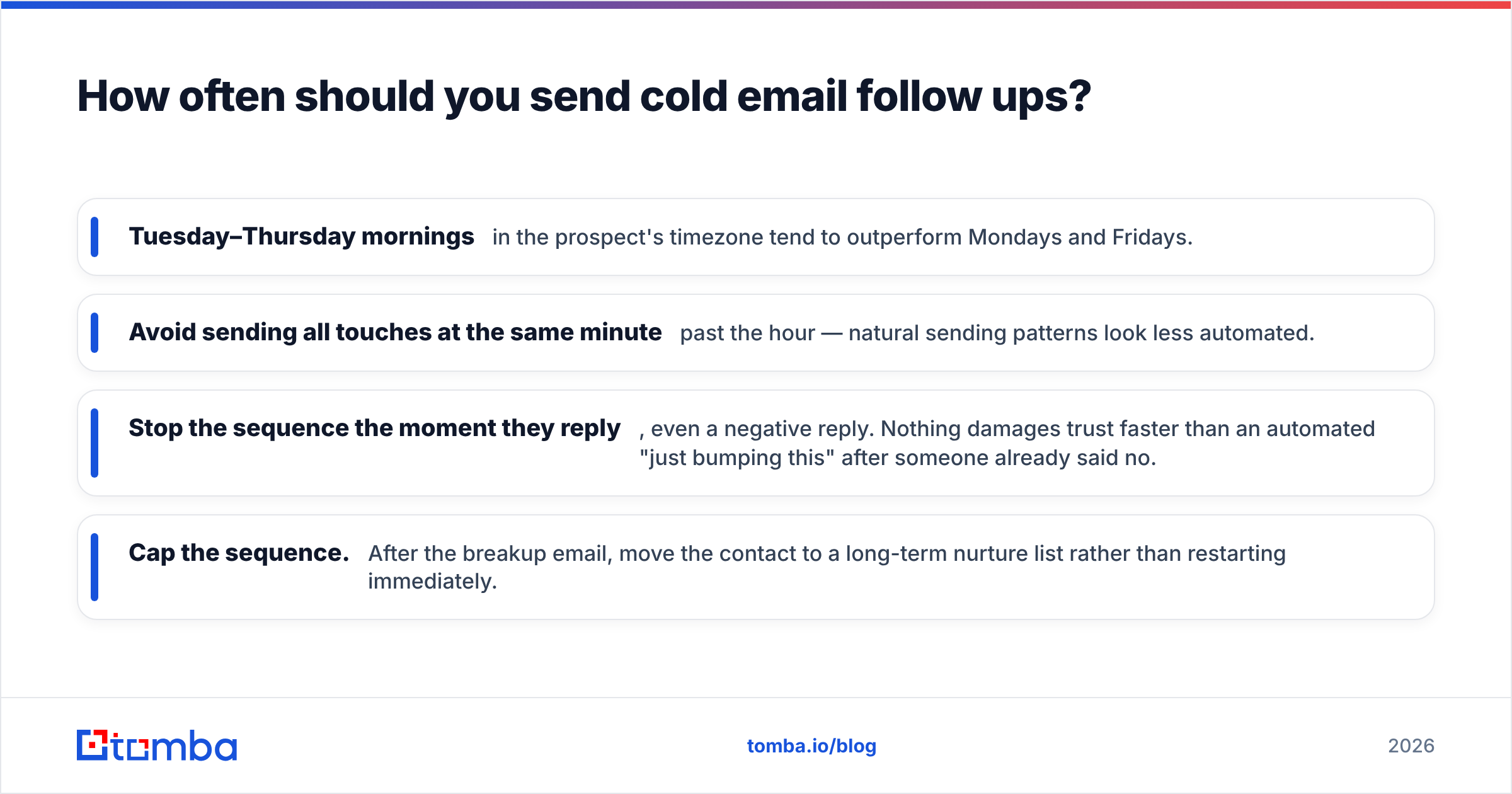
- Tuesday–Thursday mornings in the prospect's timezone tend to outperform Mondays and Fridays.
- Avoid sending all touches at the same minute past the hour — natural sending patterns look less automated.
- Stop the sequence the moment they reply, even a negative reply. Nothing damages trust faster than an automated "just bumping this" after someone already said no.
- Cap the sequence. After the breakup email, move the contact to a long-term nurture list rather than restarting immediately.
What kills cold email follow up performance?#
Two things silently destroy otherwise good sequences: bad copy habits and bad deliverability. The copy problems are visible; the deliverability problems are invisible until your open rates quietly collapse.
Copy mistakes to avoid:
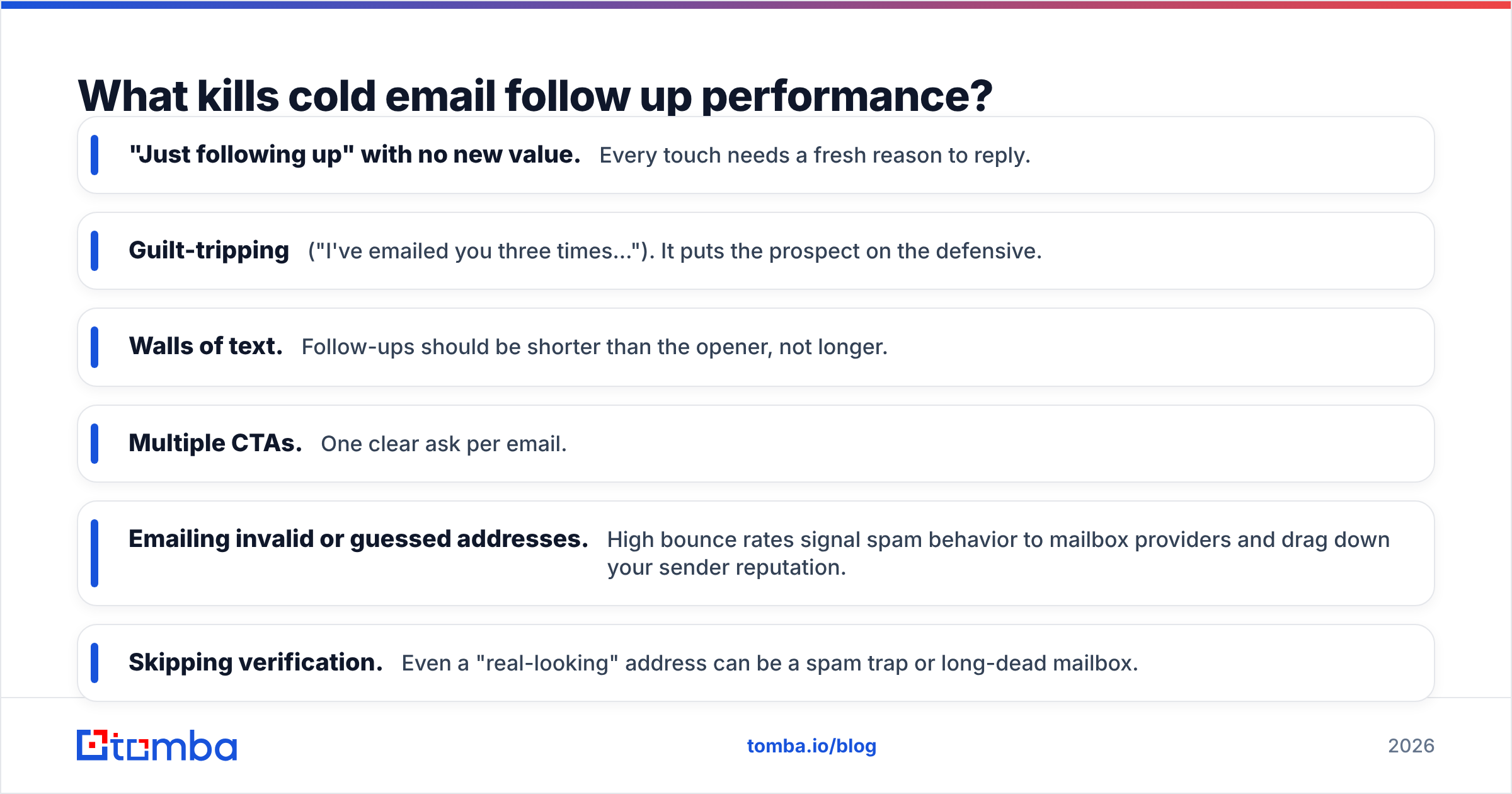
- "Just following up" with no new value. Every touch needs a fresh reason to reply.
- Guilt-tripping ("I've emailed you three times…"). It puts the prospect on the defensive.
- Walls of text. Follow-ups should be shorter than the opener, not longer.
- Multiple CTAs. One clear ask per email.
Deliverability mistakes to avoid:
- Emailing invalid or guessed addresses. High bounce rates signal spam behavior to mailbox providers and drag down your sender reputation.
- Skipping verification. Even a "real-looking" address can be a spam trap or long-dead mailbox.
- Ignoring authentication. Missing SPF or DKIM records land you in spam before anyone reads word one.
This is where your list quality becomes the multiplier on everything above. The best follow-up template in the world can't reach an inbox that never existed. Before a sequence goes out, confirm the addresses are deliverable with an email verifier, and when you're building the list itself, pull accurate contacts with a reliable email finder instead of guessing formats. Clean inputs keep your bounce rate low, your domain healthy, and your carefully-written follow-ups in the primary inbox.
For a deeper checklist on staying out of spam, the email deliverability fundamentals — warmup, authentication, and list hygiene — are worth reviewing before you scale volume. You can also sanity-check your domain records with a free SPF checker.
How do you personalize follow ups at scale?#
Personalization at scale is about templated structure with variable substance — the frame stays the same, the proof changes per prospect. You don't rewrite each email; you swap in one genuinely specific detail: a recent trigger event, a shared connection, an industry-specific metric.
The workflow that makes this manageable:
- Segment your list by industry, role, or trigger event so one template variant fits a whole segment.
- Enrich each contact with firmographic and role data so your "specific detail" is accurate — data enrichment fills the gaps LinkedIn leaves.
- Verify before send to protect deliverability across the whole segment at once.
- Map one template variant per segment, then let a merge field handle the single personalized line.
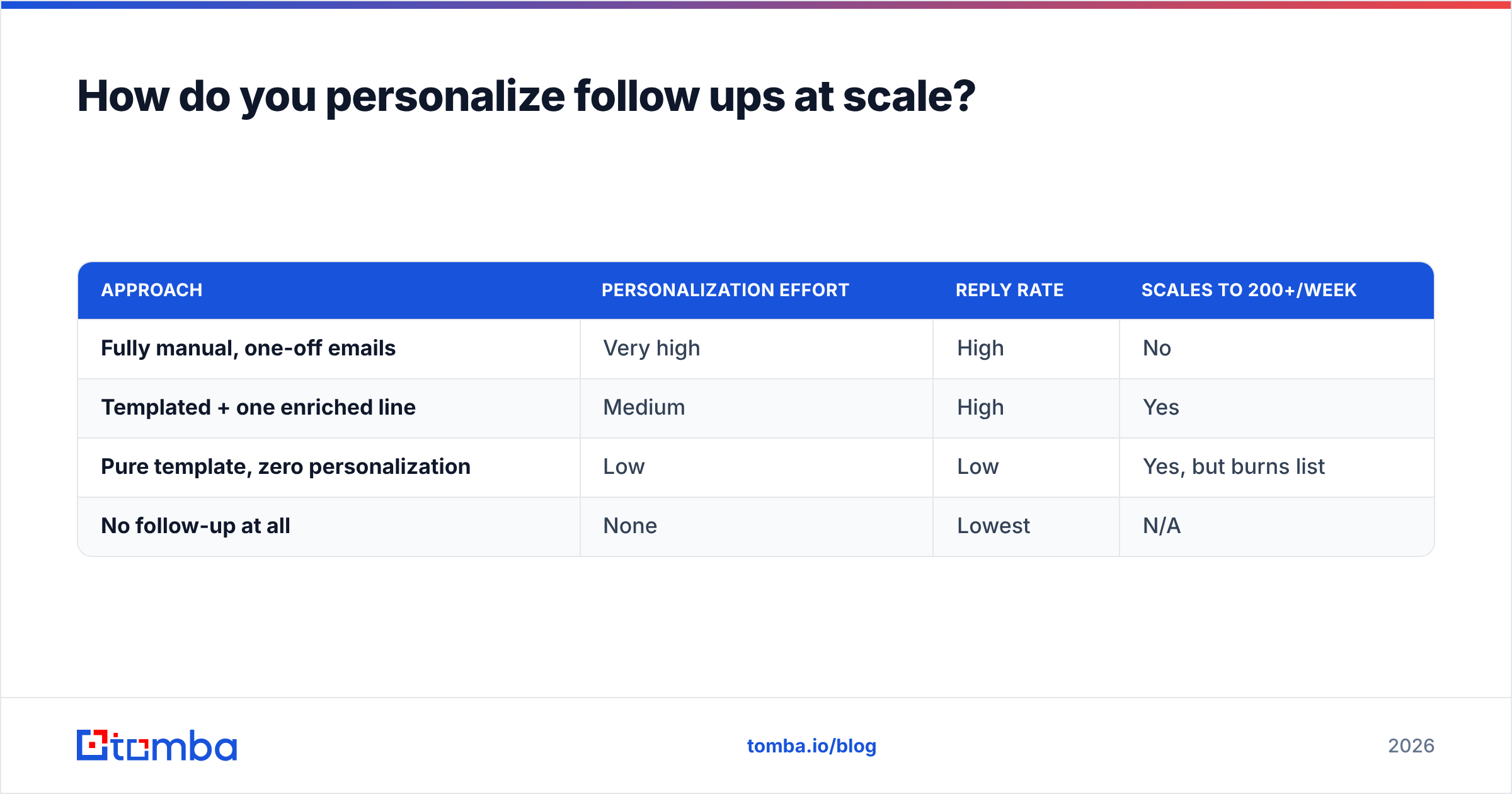
That way a rep sending 200 follow-ups a week still sounds like they wrote each one — because the one line that matters actually is unique. Compare the effort-to-reply ratio across approaches:
| Approach | Personalization effort | Reply rate | Scales to 200+/week |
|---|---|---|---|
| Fully manual, one-off emails | Very high | High | No |
| Templated + one enriched line | Medium | High | Yes |
| Pure template, zero personalization | Low | Low | Yes, but burns list |
| No follow-up at all | None | Lowest | N/A |
The middle row is the sweet spot: near-manual reply rates at automated volume. It only works when your underlying contact data is accurate — which loops back to enrichment and verification doing the heavy lifting.
Frequently asked questions#
How many follow-ups is too many? Beyond six touches on a single cold thread, reply rates flatten and complaint rates rise. Send 4–6, then move non-responders to a longer-term nurture track and re-engage weeks later with a new angle.
Should follow-ups be in the same thread or a new email? Same thread. Threading gives the prospect instant context and keeps your outreach consolidated. Start a new thread only when the original subject line has clearly gone stale or you're re-engaging months later.
What's the best time to send a follow-up? Tuesday through Thursday mornings in the prospect's local timezone generally win. Avoid Monday inbox-clearing and Friday wind-down. Test two windows against your own list rather than trusting a universal "best time."
Do breakup emails really work? Yes — they often generate the single highest reply rate in a sequence. Removing pressure ("this is my last note") plus mild urgency triggers responses from people who kept meaning to reply but never did.
Start sending follow-ups that actually land#
Great follow-up copy is worth nothing if it bounces. Before your next sequence goes out, build your list with the Tomba Email Finder to pull verified, professional email addresses by name, company, or domain — then send your seven templates knowing they'll reach a real inbox instead of a spam folder. Start free with 25 searches a month, and check the Tomba pricing plans when you're ready to scale from a handful of prospects to a full pipeline.
Write the templates once. Verify the list every time. That's the difference between a sequence that fills your calendar and one that fills a spam trap.
Related guides#
Ready to find emails that actually work?
Join 150,000+ professionals who stopped guessing and started sending. Free credits on signup — no credit card required.
Get the Tomba newsletter
Practical outbound tactics and product updates — once every two weeks.
About the author