Cold Email Follow Up Templates That Actually Get Replies
Most replies come from follow-ups, not the first email. Here are 9 cold email follow up templates, the timing behind them, and how to sequence them without sounding needy.
TL;DR
- Most cold email replies never come from the first message — they come from follow-ups two through five, so a single send is leaving the majority of your pipeline on the table.
- The best cold email follow up templates add a new reason to reply each time: a fresh angle, a resource, a proof point — never a guilt-tripping "just bumping this."
- Send 4–6 touches spaced 2–4 business days apart, then close the loop with a clean breakup email.
- Personalization and deliverability matter more than clever copy. A perfect template sent to a bad address or from a cold domain still fails.
- Below: 9 copy-paste templates, a cadence table, and the mistakes that get your whole domain filtered.
Why do cold email follow-ups matter more than the first email?#
Because the reply is usually hiding in message three, not message one. Prospects are busy, your first email lands during a meeting, it slides down the inbox, and it is gone. That is not rejection — it is physics. A follow-up simply resurfaces you when the timing is better.
Think of it like knocking on a neighbor's door to return a package. Nobody answers the first knock because they are in the backyard. You do not conclude they hate you and walk away forever — you knock again a bit later. Cold email is the same: persistence is not annoyance, it is coverage of the moments you cannot see.
Vendor and industry data consistently show that multi-touch sequences outperform one-and-done sends by a wide margin, and reply rates keep climbing through the fourth and fifth touch before tapering. The practical takeaway is blunt: if you stop after one email, you are voluntarily capping your results.
What makes a cold email follow-up template actually work?#
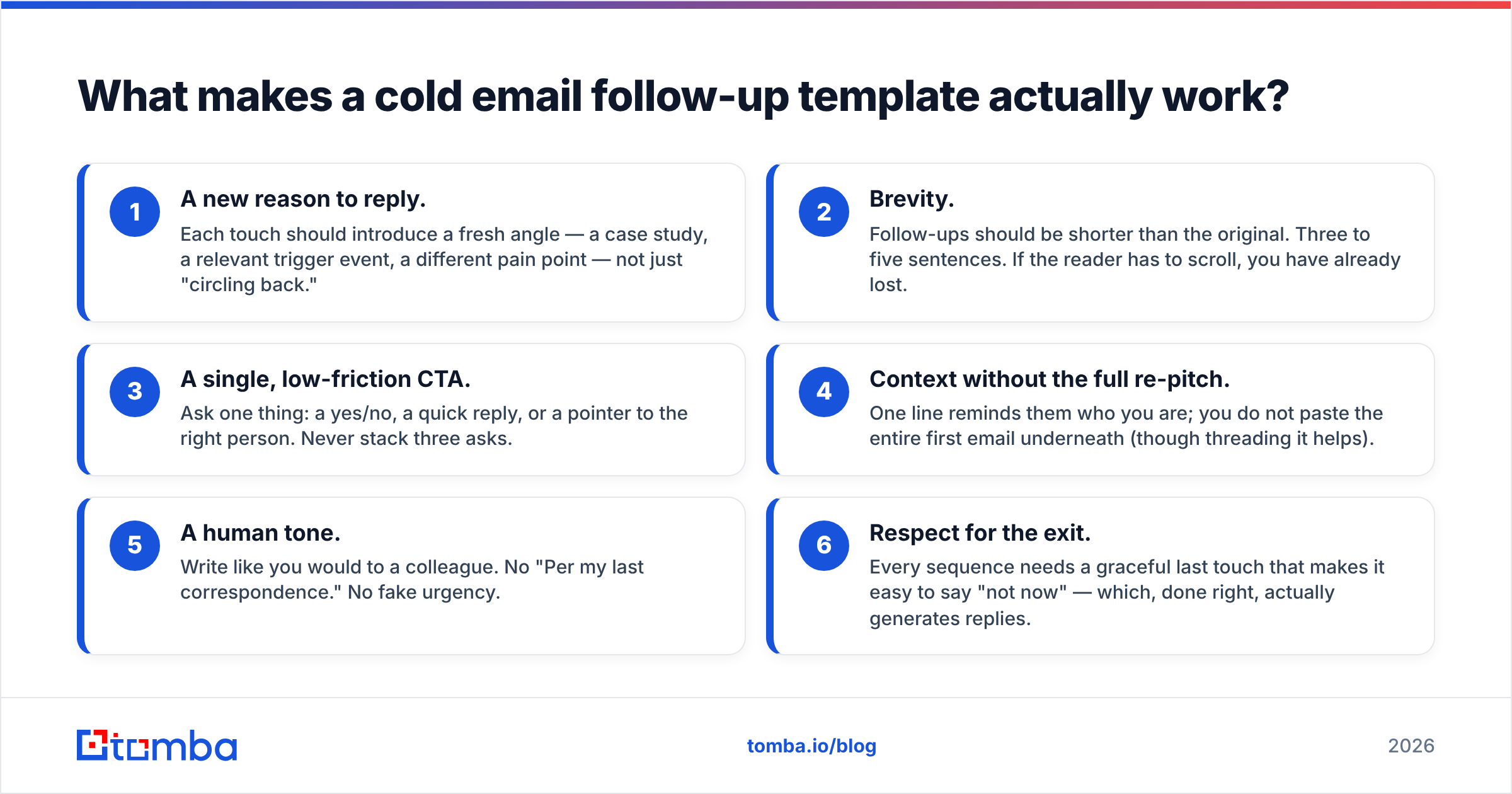
A good follow-up earns its place in the inbox by giving the reader something new. Weak follow-ups repeat the ask; strong ones change the offer.
- A new reason to reply. Each touch should introduce a fresh angle — a case study, a relevant trigger event, a different pain point — not just "circling back."
- Brevity. Follow-ups should be shorter than the original. Three to five sentences. If the reader has to scroll, you have already lost.
- A single, low-friction CTA. Ask one thing: a yes/no, a quick reply, or a pointer to the right person. Never stack three asks.
- Context without the full re-pitch. One line reminds them who you are; you do not paste the entire first email underneath (though threading it helps).
- A human tone. Write like you would to a colleague. No "Per my last correspondence." No fake urgency.
- Respect for the exit. Every sequence needs a graceful last touch that makes it easy to say "not now" — which, done right, actually generates replies.
Before any of that copy matters, the mechanics have to be right. Sending to a verified address protects your sender reputation, and running your list through an email verifier first keeps bounces low enough that inbox providers keep trusting you.
What is the right cold email follow-up cadence and timing?#
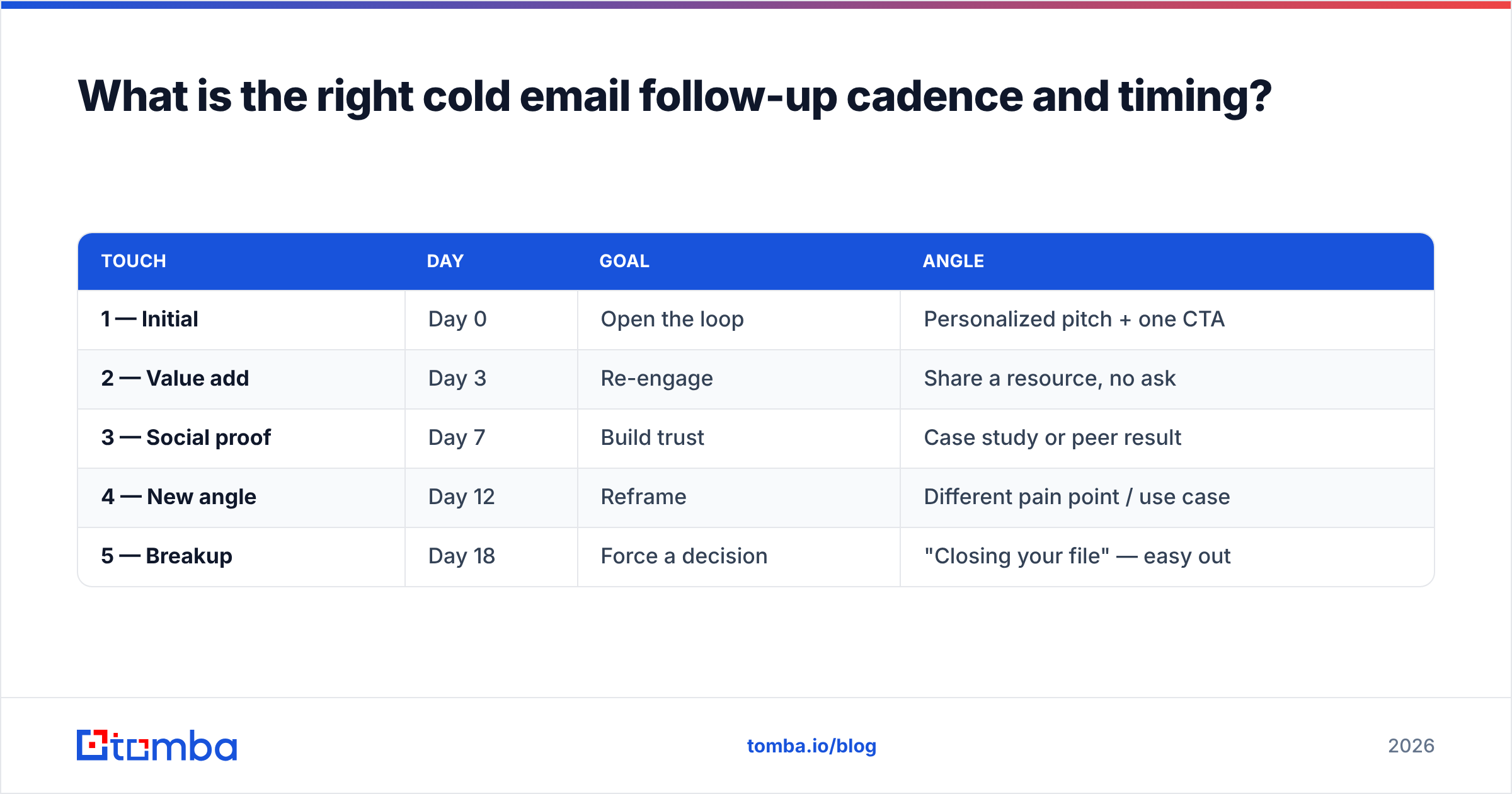
Space touches 2–4 business days apart and cap the sequence at 4–6 emails over roughly three weeks. Close too fast and you look aggressive; drag it out over months and the context evaporates.
Here is a cadence that balances persistence with restraint:
| Touch | Day | Goal | Angle |
|---|---|---|---|
| 1 — Initial | Day 0 | Open the loop | Personalized pitch + one CTA |
| 2 — Value add | Day 3 | Re-engage | Share a resource, no ask |
| 3 — Social proof | Day 7 | Build trust | Case study or peer result |
| 4 — New angle | Day 12 | Reframe | Different pain point / use case |
| 5 — Breakup | Day 18 | Force a decision | "Closing your file" — easy out |
Two rules that override the table:
- Match the buyer's clock. Send during their business hours in their timezone. A phone finder or enrichment step that tells you the prospect's region is worth more than any "best time to send" study.
- Stop when they say stop. A soft "not interested" ends the sequence. Ignoring it is how you earn spam complaints, and complaints damage email deliverability for every future campaign.
The 9 cold email follow-up templates#
Copy these, then swap the brackets for real details. The personalization is what turns a template into a message.
Template 1 — The gentle nudge (Day 3)#
Subject: (reply in-thread)
Hi [First name],
Quick one — did my note below reach the right person? If [Company] handles [problem] differently, point me to whoever owns it and I'll get out of your inbox.
Thanks,
[You]
Why it works: it offers an exit and asks for a referral, which is easier to grant than a meeting.
Template 2 — The value add (Day 3–5)#
Hi [First name],
No response needed — I just thought this was relevant. We put together [guide/benchmark] on how [peer companies] cut [metric] by [X]%. Here's the link: [URL].
If it's useful, happy to walk you through how it maps to [Company].
[You]
Why it works: it gives before it asks. You show up as a resource, not a rep.
Template 3 — The social proof (Day 7)#
Hi [First name],
[Competitor or peer] was wrestling with [problem] too. After [solution], they hit [result] in [timeframe].
Worth a 15-minute look at whether the same applies to [Company]?
[You]
Why it works: buyers trust outcomes from companies that look like theirs more than they trust your pitch.
Template 4 — The new angle (Day 12)#
Hi [First name],
I may have led with the wrong thing. Teams like yours usually care less about [old angle] and more about [new pain point].
Is that closer to what's on your plate this quarter?
[You]
Why it works: it admits you might have missed and re-opens the conversation on their terms.
Template 5 — The trigger event (any day)#
Hi [First name],
Saw that [Company] just [funding / hire / launch / expansion]. Congrats. That usually means [relevant challenge] gets loud fast — which is exactly where we help.
Open to comparing notes?
[You]
Why it works: relevance beats frequency. A timely trigger makes the email feel researched, not blasted.
Template 6 — The question follow-up (Day 5–7)#
Hi [First name],
One question and I'll leave it there: is [problem] something you're actively trying to fix in 2026, or is it parked for now?
Either answer helps me know whether to stay in touch.
[You]
Why it works: a binary question is nearly frictionless, and "parked for now" is still a reply you can nurture.
Template 7 — The resource stack (Day 10)#
Hi [First name],
In case timing's the issue, here are the two things people ask me for most:
- [Template / calculator]
- [Short case study]
Grab whichever's useful. When [problem] moves up the list, you know where I am.
[You]
Why it works: it stays helpful even if they never buy, which keeps the door open for months.
Template 8 — The breakup (Day 18)#
Hi [First name],
I don't want to clutter your inbox, so this is my last note. I'll assume [problem] isn't a priority right now and close your file.
If that changes, just reply and I'll pick it right back up.
All the best,
[You]
Why it works: the breakup email is famous for a reason — loss aversion pulls replies from people who never meant to lose you. Keep it warm, not passive-aggressive.
Template 9 — The re-engage (30–90 days later)#
Hi [First name],
It's been a bit. Since we last spoke, [new feature / result / change]. Given [Company]'s focus on [goal], felt worth one more hello.
Bad timing again, or worth a quick chat?
[You]
Why it works: quarters change, budgets open, champions get promoted. A polite re-engage catches the version of them that is finally ready.
How do you personalize these templates at scale?#
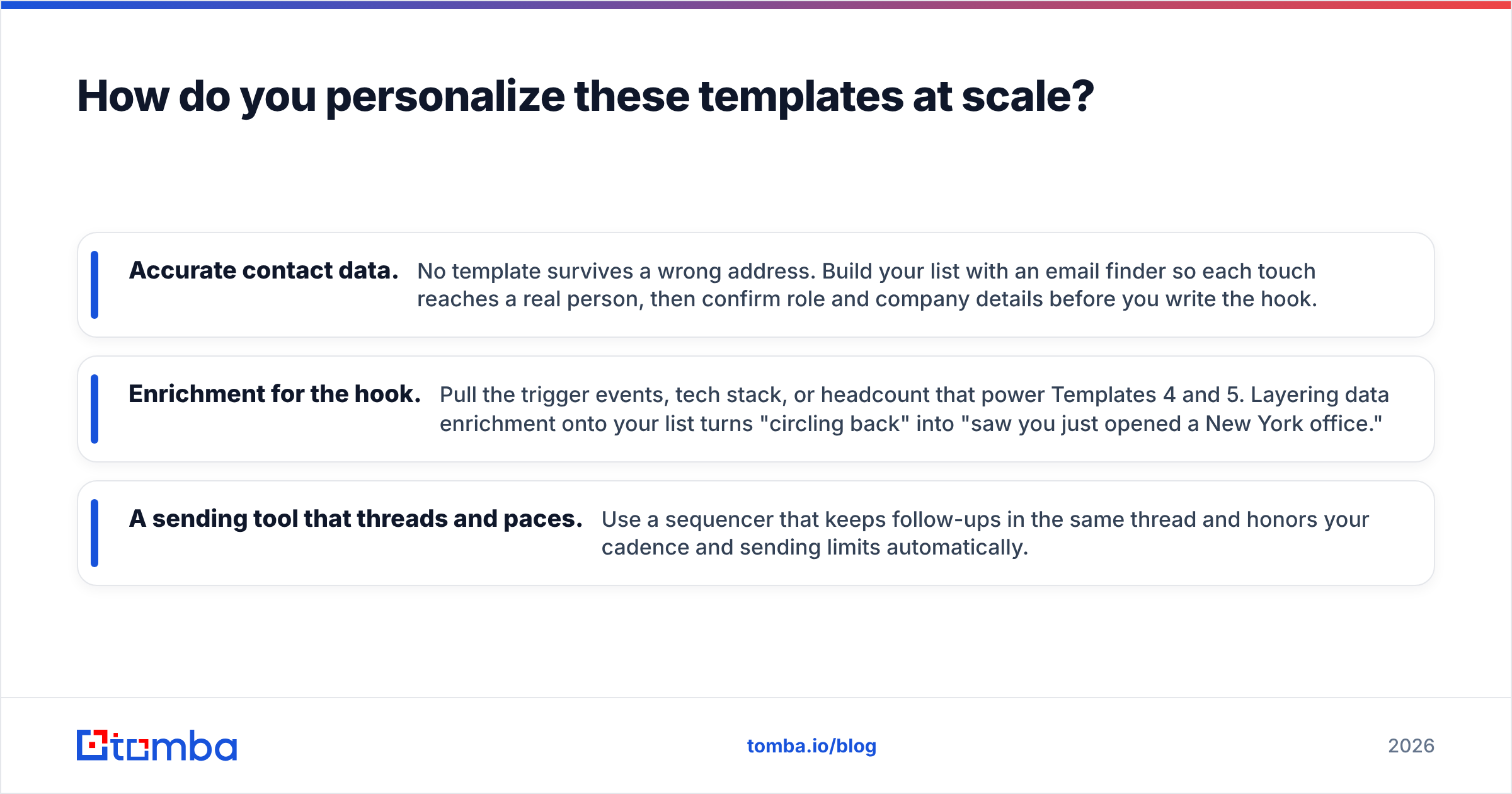
Personalize the first line and the CTA; templatize everything else. The trap teams fall into is either sending robotic mail-merge blasts or hand-writing every email until they burn out. The middle path is to standardize structure and vary the two spots that matter — the opening hook and the relevance line.
To do that at volume you need three ingredients:
- Accurate contact data. No template survives a wrong address. Build your list with an email finder so each touch reaches a real person, then confirm role and company details before you write the hook.
- Enrichment for the hook. Pull the trigger events, tech stack, or headcount that power Templates 4 and 5. Layering data enrichment onto your list turns "circling back" into "saw you just opened a New York office."
- A sending tool that threads and paces. Use a sequencer that keeps follow-ups in the same thread and honors your cadence and sending limits automatically.
For heavier campaigns, a bulk email finder lets you build and verify hundreds of contacts at once so your sequencing tool never fires at a dead inbox.
What cold email follow-up mistakes kill reply rates?#
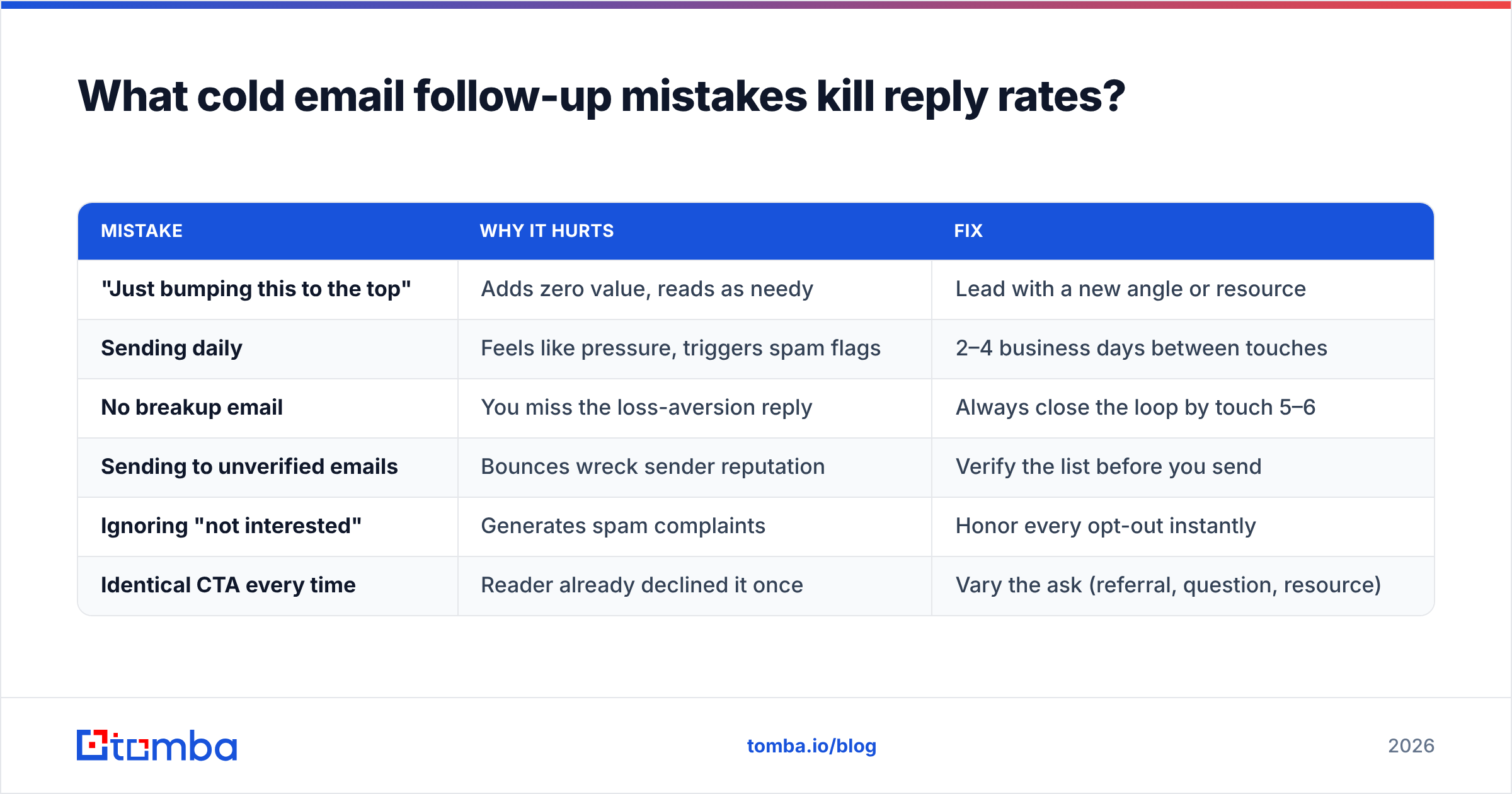
The fastest way to tank a sequence is to treat follow-ups as reminders instead of new value. Here are the ones that do the most damage:
| Mistake | Why it hurts | Fix |
|---|---|---|
| "Just bumping this to the top" | Adds zero value, reads as needy | Lead with a new angle or resource |
| Sending daily | Feels like pressure, triggers spam flags | 2–4 business days between touches |
| No breakup email | You miss the loss-aversion reply | Always close the loop by touch 5–6 |
| Sending to unverified emails | Bounces wreck sender reputation | Verify the list before you send |
| Ignoring "not interested" | Generates spam complaints | Honor every opt-out instantly |
| Identical CTA every time | Reader already declined it once | Vary the ask (referral, question, resource) |
Two of these are deliverability landmines, not just copy problems. High bounce rates and spam complaints tell inbox providers your domain is risky, and once you are filtered, even a flawless template lands in the junk folder. This is why data hygiene sits upstream of copywriting: authoritative guides from teams like HubSpot and independent reviews on G2 both put list quality and cadence discipline ahead of clever subject lines.
If you want to sanity-check your setup before a big send, run your domain through an SPF checker and confirm your list is clean. It is far cheaper to fix deliverability before a campaign than to rebuild a burned domain after one.
How many follow-ups is too many?#
Stop at 5–6 touches per sequence, then move the contact to a longer-term nurture rather than hammering the same inbox. Past six emails in three weeks, reply rates fall and complaint rates climb — you are no longer persistent, you are noise.
A cleaner mental model: each sequence is one conversation. When the conversation clearly ends (a firm no, or silence through the breakup email), let it rest. The re-engage template (number 9) exists precisely so you can return months later with fresh context instead of grinding the same thread into the ground.
If you are measuring, watch response rate per touch and per sequence, not just opens. Opens are noisy and increasingly unreliable; replies are the metric that pays.
Start sending follow-ups that actually land#
Great follow-up copy is only half the equation — the other half is reaching a real, verified person from a domain inbox providers trust. Before you load these templates into your sequencer, build your list with the Tomba Email Finder: find professional email addresses by name, company, or domain, verify them in the same workflow, and enrich each contact with the details that make your hooks land. The free plan covers 25 searches a month to test it, and paid plans start at $49/mo when you are ready to scale your outreach. Get the data right, send the follow-ups above, and let the sequence do the work your first email never could.
Related guides#
// get started
Find, verify and enrich your first contacts today
Start on the free plan with 25 searches a month, then scale when your team is ready.
Free plan · No credit card required · GDPR & CCPA
// about the author