Cold Email for Founders: The 2026 Playbook That Books Meetings
A no-fluff cold email system built for founders who have no SDR team, no big budget, and no time to waste. Templates, targeting, and deliverability included.
Cold email is still the cheapest way for a founder to create pipeline from nothing. No ad budget, no inbound engine, no SDR headcount — just you, a list, and an inbox. The problem is that most founder cold email reads like a pitch deck fired into the void, and it converts about as well.
This guide is the version I wish I'd had when I sent my first 500 emails and got two replies (both were "unsubscribe"). It's written for founders doing outbound themselves, with limited time and no dedicated sales team.
TL;DR: Cold Email for Founders in 5 Bullets#
- Founder status is your unfair advantage. "I'm the founder of X" gets opened and answered far more than "Account Executive." Use it in the from-name and the first line.
- Targeting beats volume. 40 hyper-relevant emails a day from a warmed inbox will out-book 4,000 sprayed ones. Narrow the list before you write a word.
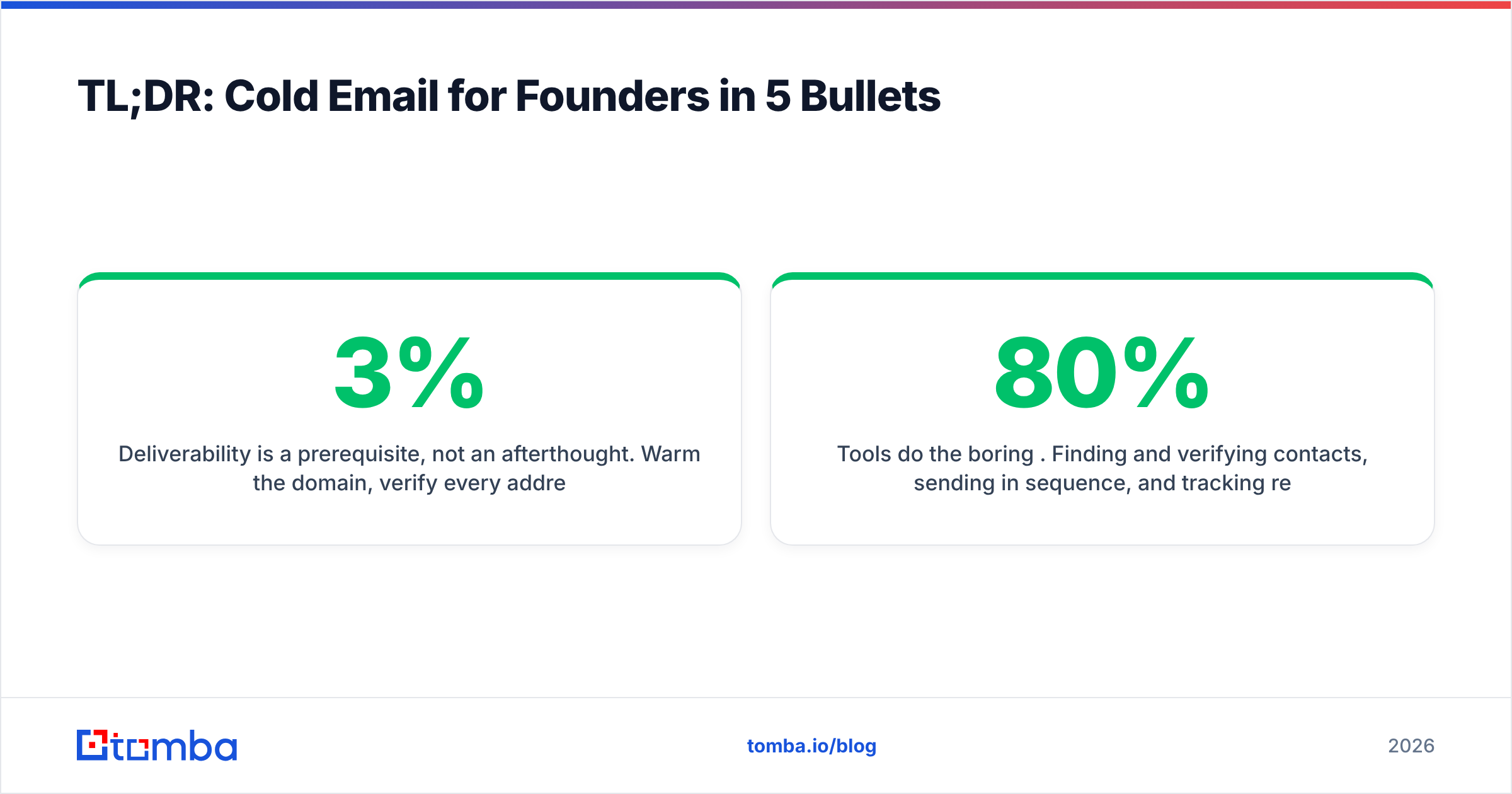
- Deliverability is a prerequisite, not an afterthought. Warm the domain, verify every address, and keep bounce rates under 3% or nothing else matters.
- One idea per email. A clear, specific, personalized reason you're reaching out. No feature dumps, no calendar link in email one.
- Tools do the boring 80%. Finding and verifying contacts, sending in sequence, and tracking replies should be automated so you spend your time on the 20% that needs a human.
Why is cold email still worth it for founders in 2026?#
Because it's the only channel where a founder with zero budget can reach a specific decision-maker directly and start a conversation the same week. Paid ads need spend and time to optimize. SEO takes months. Referrals depend on a network you may not have yet. Cold email needs a list and a keyboard.
It also compounds. Every reply teaches you how your market actually talks about the problem you solve — language you'll reuse in your landing page, your ads, and your pitch. Early-stage founders are often doing customer discovery and pipeline generation at the same time, and cold outbound serves both.
The catch: the bar has risen. Inboxes are crowded, spam filters are smarter, and buyers have seen every "quick question" subject line a hundred times. Getting it right in 2026 means treating email deliverability and targeting as seriously as the copy.

What makes founder cold email different from SDR outreach?#
You have three advantages a sales rep doesn't, and one big constraint.
Your advantages:
- Credibility. "I built this because I hit the problem myself" is a story only a founder can tell. It lowers the buyer's guard.
- Authority to make decisions. You can offer a custom pilot, a discount, or a product change in the same thread. Reps have to check with someone.
- Genuine curiosity. You actually want to learn whether the problem is real for them. That reads as human, not scripted.
Your constraint: time. You can't spend four hours a day in an inbox. So the goal isn't to do more outreach than a sales team — it's to do smarter, tighter outreach and automate everything that doesn't need your judgment.
That framing changes every decision below. When in doubt, choose the option that saves your time without hurting relevance.
How do you build a cold email list that actually converts?#
Start with the tightest possible definition of who buys, then find those exact people. Founders lose months emailing "potential" customers who were never going to buy. Precision first, scale later.
A workable process:
- Write your ICP in one sentence. "Heads of RevOps at 50–200 person B2B SaaS companies in North America." If you can't fill in the specifics, you're not ready to send.
- Find the companies. Use LinkedIn Sales Navigator filters, funding databases, or a B2B database to build a company list that matches the ICP.
- Find the people and their emails. Use a domain search to pull the right contacts at each company, then an email finder to get verified addresses by name and domain.
- Verify before you send. Run the list through an email verifier so invalid and risky addresses never touch your sending domain.
That last step is non-negotiable. A single spike in bounces can tank your sender reputation and route future emails straight to spam — including the ones that would have converted.
Which cold email tools do founders actually need?#
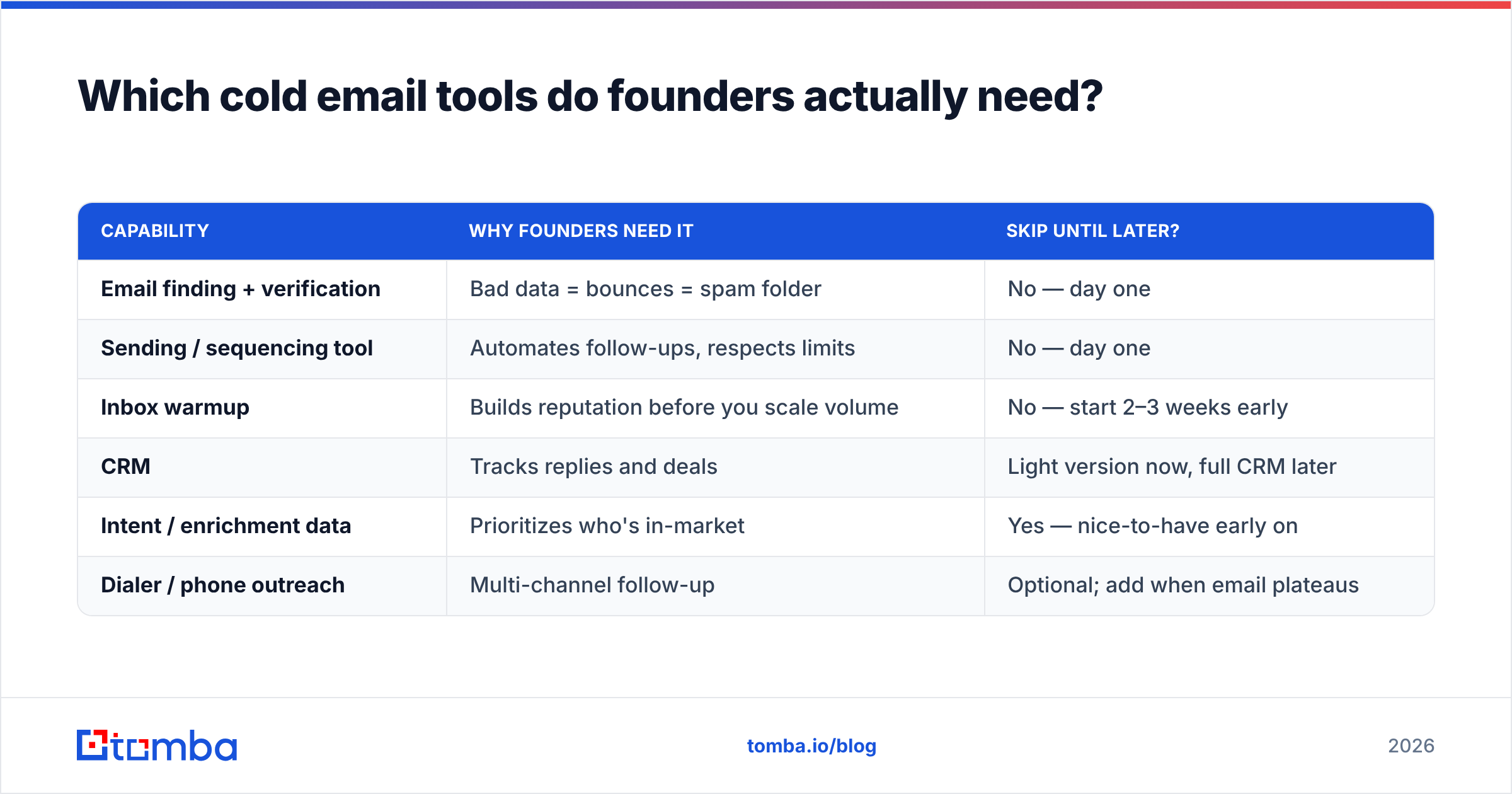
You don't need the enterprise sales stack. You need four capabilities, and several can be one tool. Here's the honest breakdown of what matters at the founder stage versus what you can skip until you hire a sales team.
| Capability | Why founders need it | Skip until later? |
|---|---|---|
| Email finding + verification | Bad data = bounces = spam folder | No — day one |
| Sending / sequencing tool | Automates follow-ups, respects limits | No — day one |
| Inbox warmup | Builds reputation before you scale volume | No — start 2–3 weeks early |
| CRM | Tracks replies and deals | Light version now, full CRM later |
| Intent / enrichment data | Prioritizes who's in-market | Yes — nice-to-have early on |
| Dialer / phone outreach | Multi-channel follow-up | Optional; add when email plateaus |
For the data layer, compare tools on accuracy and price rather than logo count. Founder budgets are real. Tomba's pricing starts with a free tier (25 searches/month) and a Starter plan at $49/month, which is enough to test outbound before you commit to a Growth ($99/month) or Pro ($249/month) plan. Whatever you choose, the rule holds: verify before you send.
What's the cold email structure that gets replies?#
Five parts, each doing one job. If a line isn't earning its place, cut it.
- From name: Your real name. "Sara Chen" opens better than "Sara @ Acme." Founders can add credibility with "Sara Chen, Founder at Acme."
- Subject line: 2–5 words, lowercase, specific, no clickbait. "quick question about {{company}} onboarding" beats "Revolutionize Your Workflow!" Test variants with a subject line generator if you're stuck.
- Opening line: About them, not you. A specific observation — a recent hire, a product launch, a job posting — proves you did homework.
- The ask / value: One sentence on why you're reaching out and what's in it for them. No feature list.
- CTA: Low-friction. "Worth a quick look?" or "Open to a 10-minute call next week?" Save the calendar link for after they say yes.
Keep the whole thing under 90 words. Founders write too much because they're excited about the product. The buyer isn't — yet.

Cold email templates founders can steal#
Two templates that consistently pull replies for early-stage founders. Personalize the bracketed parts — don't send them raw.
Template 1 — The founder problem story
Subject: how {{company}} handles {{problem}}
Hi {{first_name}},
I'm the founder of {{your_company}}. We built it after spending two years fighting {{specific_problem}} at my last company.
Noticed {{company}} is {{specific_observation}} — usually the point where {{problem}} starts to bite. Curious how you're handling it today.
If it's a headache, happy to share how {{similar_company}} cut it by {{result}}. Worth a quick reply?
{{your_name}}
Template 2 — The direct offer
Subject: {{first_name}}, idea for {{company}}
Hi {{first_name}},
Quick one. We help {{ICP}} do {{outcome}} without {{pain}}. {{Customer}} got {{result}} in {{timeframe}}.
Not sure it's a fit for {{company}}, but if {{problem}} is on your list this quarter, I'd love to show you in 10 minutes.
Open to it?
{{your_name}}
Grab more field-tested structures from Tomba's cold email templates library, and always send one idea per email. If you're following up (you should — most replies come after email two or three), change the angle, don't just "bump" the thread.
How do founders avoid the spam folder?#
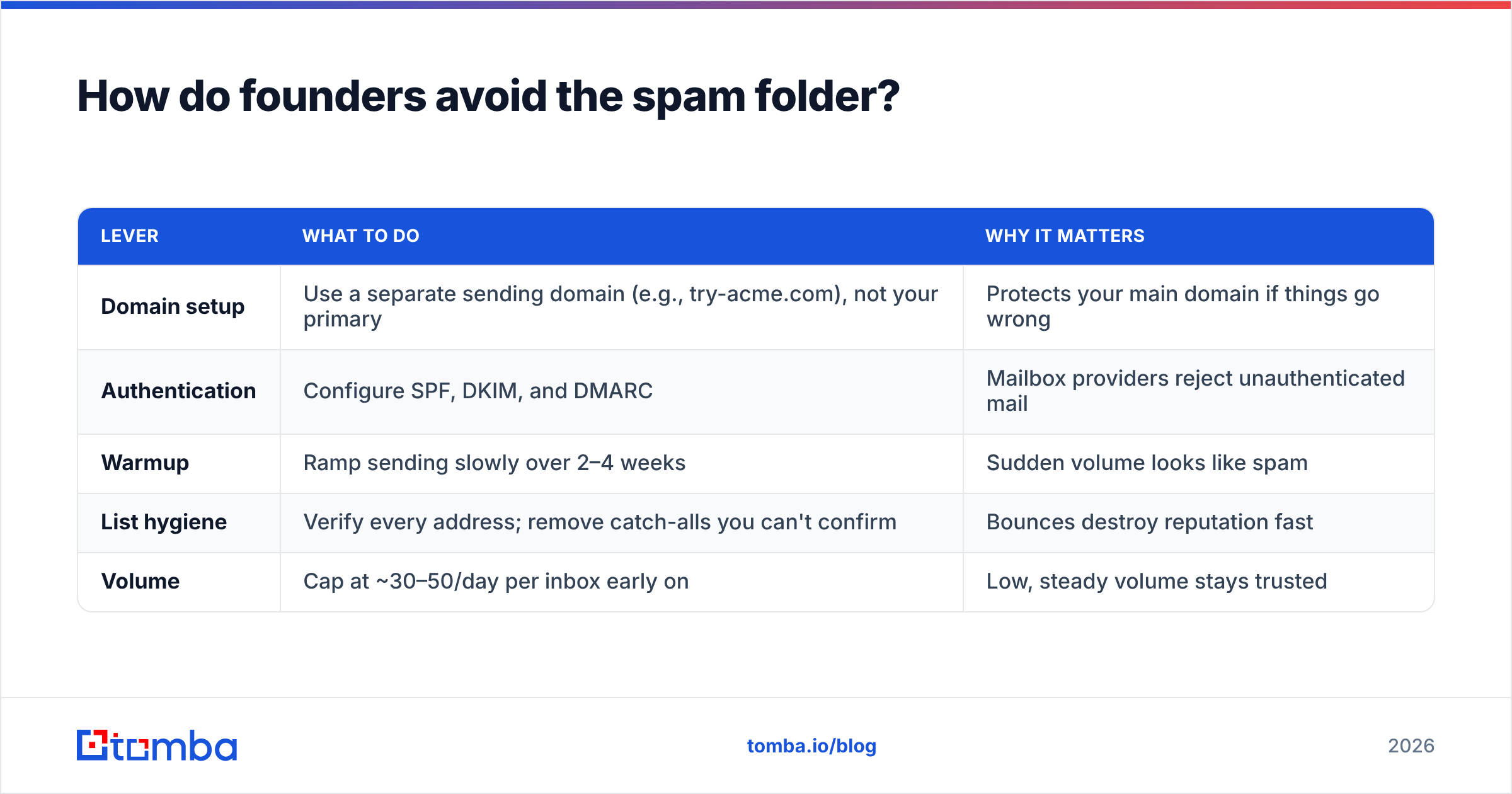
Deliverability is where most founder campaigns quietly die. You never see the emails that landed in spam, so you assume the market doesn't care. Often the market never got the email.
Protect your inbox with these fundamentals:
| Lever | What to do | Why it matters |
|---|---|---|
| Domain setup | Use a separate sending domain (e.g., try-acme.com), not your primary | Protects your main domain if things go wrong |
| Authentication | Configure SPF, DKIM, and DMARC | Mailbox providers reject unauthenticated mail |
| Warmup | Ramp sending slowly over 2–4 weeks | Sudden volume looks like spam |
| List hygiene | Verify every address; remove catch-alls you can't confirm | Bounces destroy reputation fast |
| Volume | Cap at ~30–50/day per inbox early on | Low, steady volume stays trusted |
Check your SPF record and run a quick spam check on your copy before launching. If you send to a lot of catch-all domains, use a catch-all verifier so you're not gambling on addresses that may not exist. Google publishes clear sender requirements in Gmail's bulk sender guidelines — read them once and set up accordingly.
How much cold email should a founder send per week?#
Enough to learn, not so much that you burn your domain or your calendar. For a solo founder, 150–250 verified, personalized emails per week across one or two warmed inboxes is a healthy range. That's ~30–50 a day, which you can genuinely personalize in an hour.
The math that matters: if you're sending relevant, verified emails to a tight ICP, expect a 30–50% open rate and a 3–8% reply rate once your copy is dialed in. From 200 emails a week at a 5% reply rate, that's 10 conversations — plenty for an early-stage founder to work while still building the product.
Track your numbers weekly and improve one variable at a time: subject line, opening line, CTA, or list quality. Changing everything at once tells you nothing. Watch response rate as your north-star metric, not vanity opens.
What mistakes kill founder cold email campaigns?#
- Buying a cheap list and blasting it. Unverified lists bounce, spam-flag your domain, and waste weeks. Build a targeted list and verify it.
- Talking about your product instead of their problem. Nobody replies to a feature list. They reply to "I understand your problem."
- No follow-up. The majority of positive replies come after the first email. Sequence 3–4 touches with different angles.
- Skipping warmup. Sending 500 emails from a fresh domain on day one is the fastest way to spam purgatory.
- Pitching the meeting too hard. Ask for interest first, the calendar second. A soft CTA gets more yeses.
- Not tracking anything. If you can't see opens, replies, and bounces, you can't improve. Even a simple spreadsheet beats guessing.
Fix these five and you'll be ahead of most funded sales teams, let alone other founders.
When should a founder hand cold email off to a team?#
When outbound is working and it's eating the time you should spend on product or fundraising. If you're consistently booking meetings and the process is documented — ICP, list-building steps, templates, sequences, tools — that's a system you can hand to your first sales hire or an SDR. Founders who try to hand off a process that doesn't work yet just teach someone else to fail.
Until then, keep it lean. The whole point of founder cold email is that one person with the right tools can create real pipeline. Get the data, deliverability, and copy right, and you don't need a team to get started.
Start sending smarter cold email today#
Founder cold email lives or dies on data quality. The best copy in the world won't help if half your addresses bounce and your domain lands in spam. Start by building a verified, targeted list: use the Tomba Email Finder to get accurate professional emails by name and domain, verify them in the same workflow, and send with confidence. The free tier gives you 25 searches to test it against your real ICP before you spend a dollar. Nail the data, keep the copy human, and let the founder advantage do the rest.
Related guides#
Ready to find emails that actually work?
Join 150,000+ professionals who stopped guessing and started sending. Free credits on signup — no credit card required.
Get the Tomba newsletter
Practical outbound tactics and product updates — once every two weeks.
About the author