How to Cold Email Influencers in 2026 (Templates + Steps)
Most influencer pitches die in the spam folder. Here's how to cold email influencers who actually reply—with verified addresses, tested subject lines, and templates that book real brand deals.
Cold emailing influencers looks easy until you send 200 pitches and hear back from two. The problem is rarely your product. It's that you emailed the wrong address, opened with "Dear Creator," and asked for a call before you gave a reason to care.
This guide breaks down how to cold email influencers in a way that gets replies in 2026: finding the right inbox, writing a pitch a busy creator will actually read, and following up without becoming a nuisance.
TL;DR#
- Verify the address first. Most influencer outreach fails at the delivery step, not the copy step. A bounced pitch is a wasted pitch.
- Personalize the first two lines or don't send. Creators can smell a template from the preview text.
- Lead with what's in it for them, not your brand story. Money, product, or audience—say it early.
- Keep it under 120 words with one clear ask and one link.
- Follow up two to three times. Most replies come after the first email, not from it.
Why do most cold emails to influencers get ignored?#
Because they read like mass blasts, and creators receive dozens a day. A mid-tier influencer with 50k engaged followers might get 20 to 40 pitches a week. Their filter is brutal and fast: if the first line is generic, they archive it.
Three failure modes account for most silence:
- Wrong or dead address. You scraped a
contact@alias that nobody checks, or guessed a Gmail that bounces. - No personalization. "I love your content" is not personalization. Naming a specific post is.
- Vague ask. "Would love to collaborate" forces the creator to do the work of figuring out what you want.

Fix those three and your reply rate can jump from under 2% to double digits. The rest of this guide is how.
How do you find an influencer's real email address?#
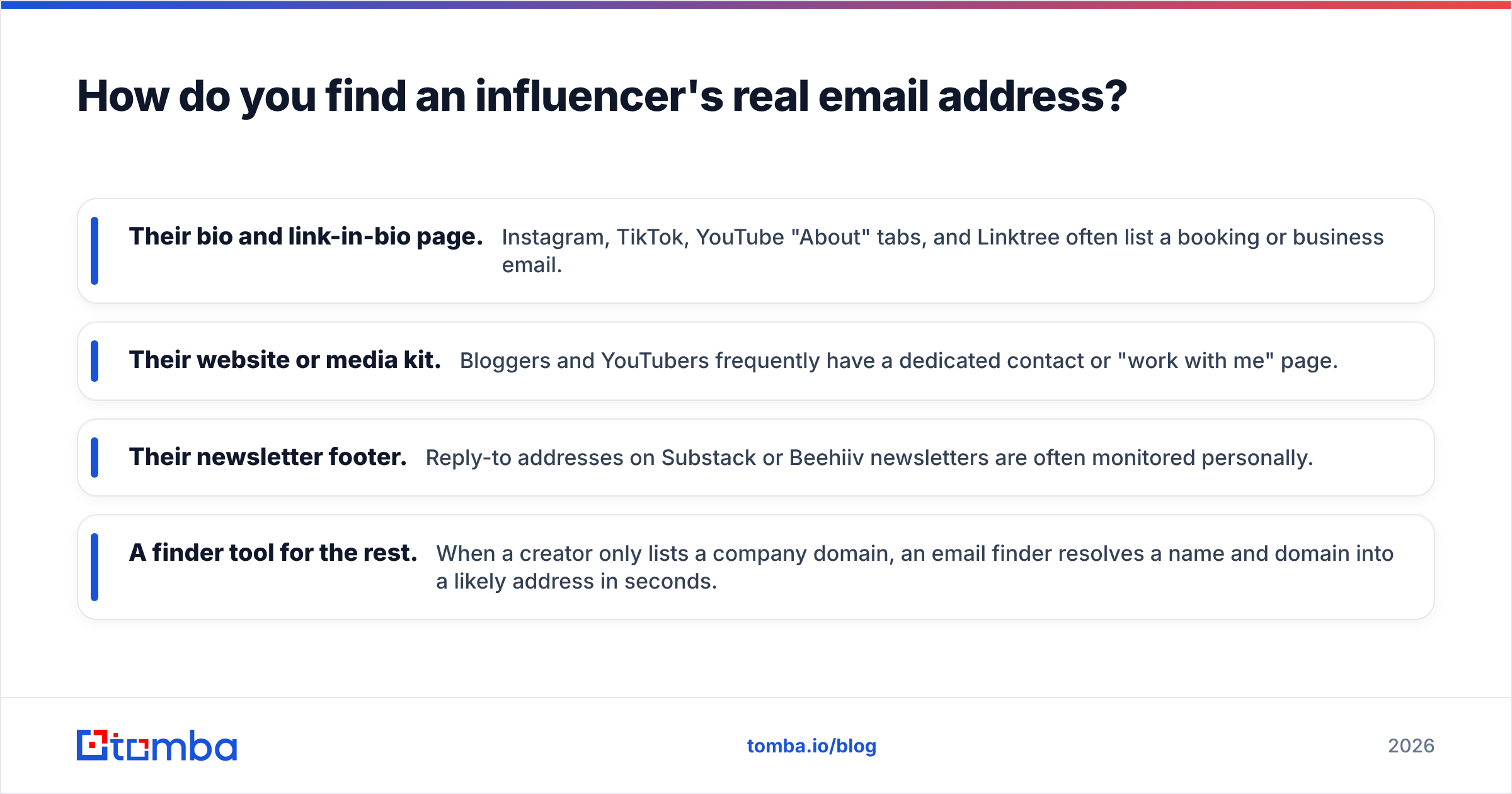
Start with the sources creators actually publish, then fill gaps with a finder tool.
- Their bio and link-in-bio page. Instagram, TikTok, YouTube "About" tabs, and Linktree often list a booking or business email.
- Their website or media kit. Bloggers and YouTubers frequently have a dedicated contact or "work with me" page.
- Their newsletter footer. Reply-to addresses on Substack or Beehiiv newsletters are often monitored personally.
- A finder tool for the rest. When a creator only lists a company domain, an email finder resolves a name and domain into a likely address in seconds.
Whatever you collect, run it through an email verifier before you send. Influencer lists rot fast—people change management, switch platforms, and abandon old inboxes. Verifying protects your sender reputation and keeps your bounce rate low, which is what actually gets you into the primary inbox instead of promotions.
If you're pitching an agency-repped creator, domain search will surface the managers and talent handlers behind a roster domain, so you email the person who signs deals rather than a generic inbox.
What should a cold email to an influencer actually say?#
Four parts, in this order: a specific hook, a one-line reason to care, a single ask, and an easy exit. Here's a template you can adapt.
Subject: quick idea for your [specific series/topic]
Hi [First name],
Your [specific post/video, e.g. "budget camera setup breakdown from last week"] is the reason I'm emailing—my [team/brand] has been recommending it internally.
We're [one line: who you are + the offer]. For creators in your space we typically [pay $X / send product + affiliate / co-produce]. Based on your audience, I think [specific angle] would land well.
Open to a quick look? I can send details or a sample—whatever's easier. No pressure if it's not a fit.
[Your name]
[Link to one-page brief]
Notice what's missing: no company history, no "hop on a 30-minute call," no five links. You earn the call in email two or three, not the first touch.
If writing from scratch stalls you, a subject line generator and a library of cold email templates give you tested starting points you can personalize instead of inventing.
Which outreach approach wins: buying lists or finding and verifying?#
Bought influencer lists feel fast, but they're a trap—stale addresses, no context, and a shared list everyone else is already spamming. Building a small, verified, researched list beats a big bought one every time.
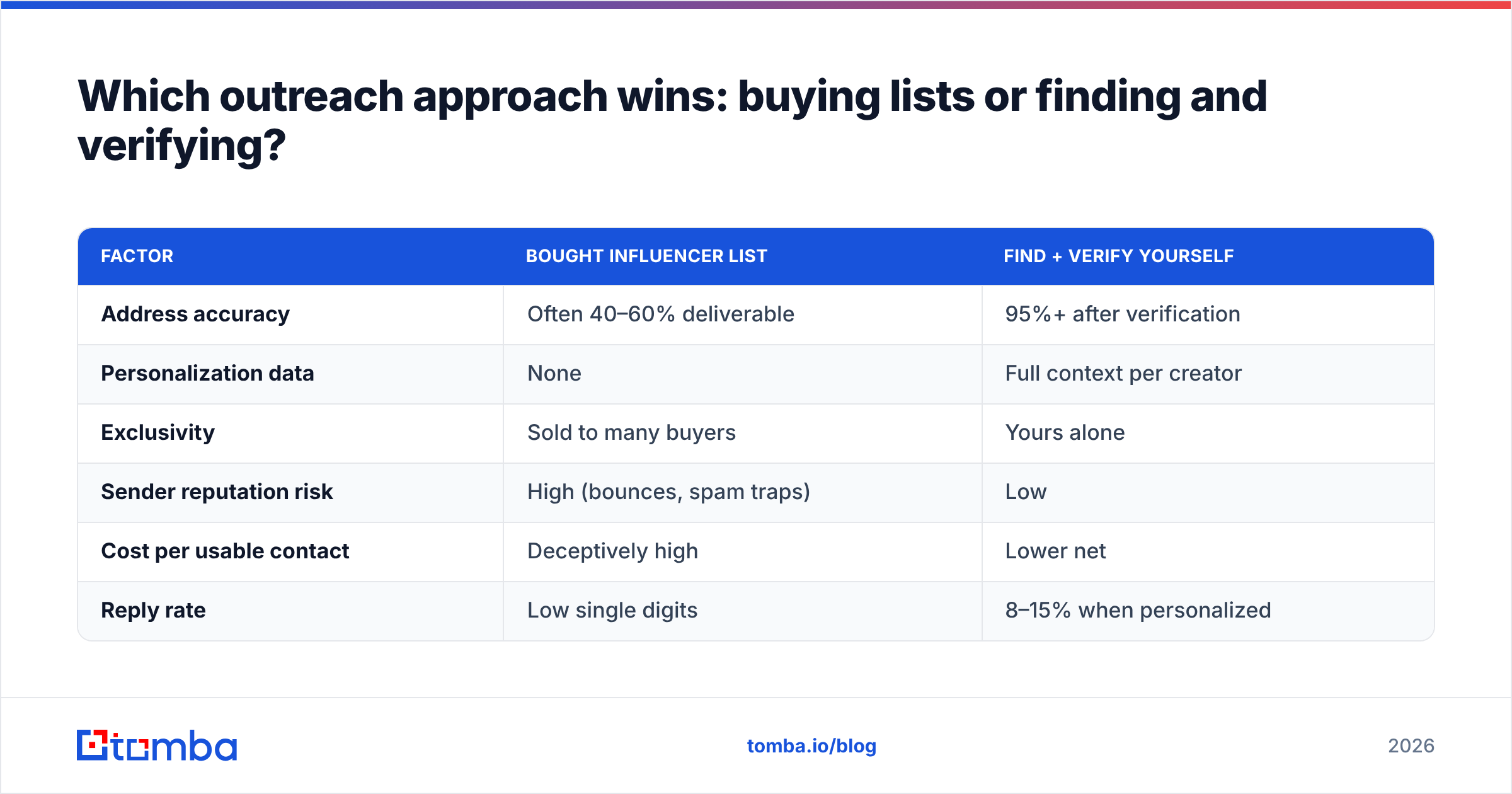
Here's the tradeoff laid out plainly.
| Factor | Bought influencer list | Find + verify yourself |
|---|---|---|
| Address accuracy | Often 40–60% deliverable | 95%+ after verification |
| Personalization data | None | Full context per creator |
| Exclusivity | Sold to many buyers | Yours alone |
| Sender reputation risk | High (bounces, spam traps) | Low |
| Cost per usable contact | Deceptively high | Lower net |
| Reply rate | Low single digits | 8–15% when personalized |
The "cheap" bought list costs more once you count the bounces, the reputation damage, and the creators who ghost because they got the same pitch from ten brands.
What is the right cadence for following up?#
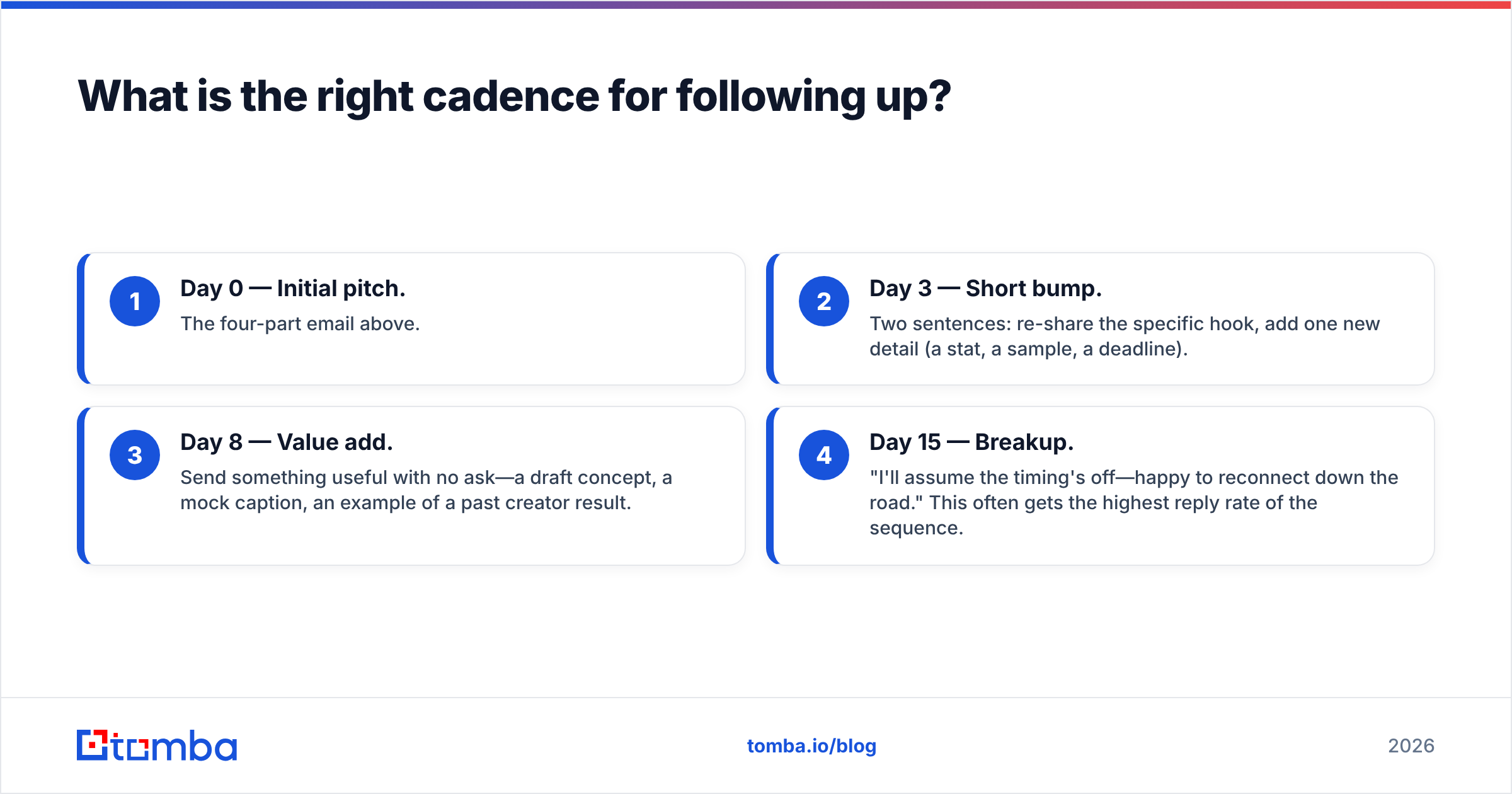
Send three to four touches over two to three weeks, then stop. Most positive replies to cold influencer outreach come from a follow-up, not the first email—creators are busy, and a gentle bump at the right time is what surfaces your pitch.
A cadence that respects the creator's time:
- Day 0 — Initial pitch. The four-part email above.
- Day 3 — Short bump. Two sentences: re-share the specific hook, add one new detail (a stat, a sample, a deadline).
- Day 8 — Value add. Send something useful with no ask—a draft concept, a mock caption, an example of a past creator result.
- Day 15 — Breakup. "I'll assume the timing's off—happy to reconnect down the road." This often gets the highest reply rate of the sequence.
Keep each follow-up shorter than the last, and always reply in the same thread so context travels with the message. If you're running this at scale, load your verified contacts into a sequencing tool and let it handle timing while you keep the copy human. Platforms like HubSpot and dedicated sequencers make cadence management trivial once your list is clean.
How do you personalize at scale without sounding robotic?#
Personalization scales when you templatize the structure and hand-write only the hook. The body of your email can stay 80% consistent; the first two lines and the subject must be unique per creator.
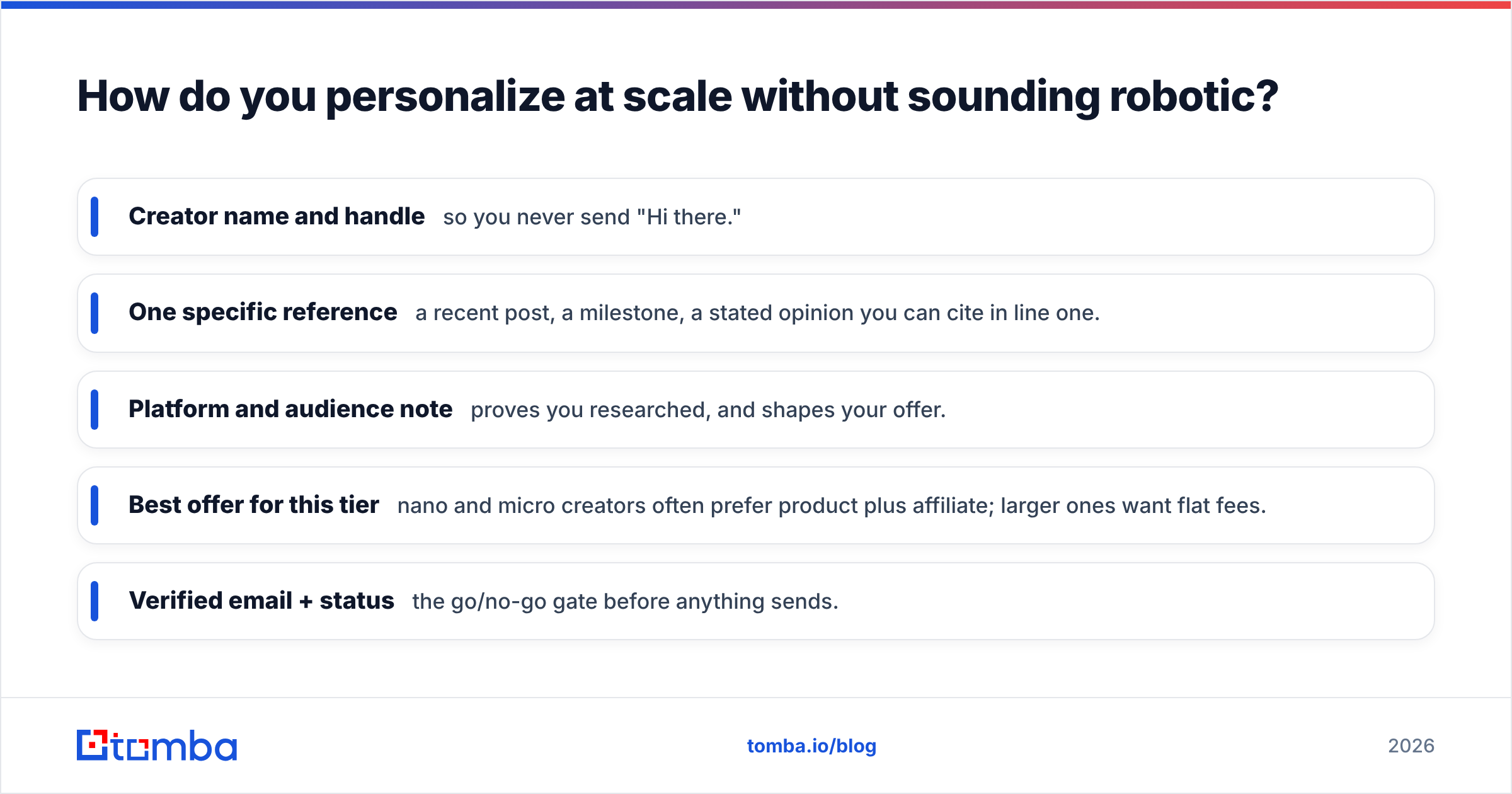
Build a simple research sheet with these columns before you write a single email:
- Creator name and handle — so you never send "Hi there."
- One specific reference — a recent post, a milestone, a stated opinion you can cite in line one.
- Platform and audience note — proves you researched, and shapes your offer.
- Best offer for this tier — nano and micro creators often prefer product plus affiliate; larger ones want flat fees.
- Verified email + status — the go/no-go gate before anything sends.
With that sheet, one writer can personalize 30 to 50 pitches an hour without any of them feeling mass-produced. The research is the moat; the copy is nearly a fill-in-the-blank.
For teams pulling contacts from spreadsheets, connecting a finder directly to your outreach data through the Tomba API removes the copy-paste step entirely—enrich a handle into a verified email inside your existing workflow.
What subject lines get influencers to open?#
Lowercase, specific, and curiosity-driven beats polished and salesy. Creators associate ALL-CAPS "COLLAB OPPORTUNITY!!" subjects with spam. You want the subject to read like a note from a peer.
Patterns that consistently earn opens:
- Reference their work:
loved your [specific] breakdown - Tease a concrete offer:
paid idea for your [topic] audience - Ask a light question:
open to [product] for the next video? - Name the outcome:
[Creator], quick partnership—5 min read
Avoid words that trip spam filters and human skepticism alike: "free," "guaranteed," "urgent," excessive punctuation. If deliverability matters to you—and it should—understanding email deliverability fundamentals will do more for your open rate than any clever subject line. You can also sanity-check patterns against public benchmarks on review sites like G2 before committing to a template.
How many influencers should you email at once?#
Start small—25 to 50 highly researched creators—before scaling. A tight, verified batch teaches you which offer, tier, and angle convert, so you don't burn your reputation (or your best creators) learning on a list of a thousand.
A sensible ramp:
- Week 1: 25 pitches, three subject-line variants, one offer. Measure open and reply rates.
- Week 2: Double down on the winning variant, expand to 50, test a second offer tier.
- Week 3+: Scale to your capacity to reply thoughtfully. Outreach volume should never exceed your ability to hold real conversations.
Sending 500 cold pitches you can't follow up on isn't outreach—it's spam with extra steps. The creators worth landing can tell the difference.
Common mistakes that kill influencer outreach#
- Emailing the wrong contact. A manager's inbox and a creator's personal inbox get very different treatment. Know which you're hitting.
- Skipping verification. One high-bounce send can drop you into spam for the whole batch.
- Over-asking in email one. Save the contract, the call, and the brief attachments for after they say "tell me more."
- No clear offer. "Let's collaborate" makes the creator do your thinking. State the deal.
- Ghosting your own thread. If they reply and you take four days, you've taught them you're not serious.
Get the fundamentals right and cold email stays one of the highest-ROI channels for influencer partnerships—no algorithm between you and the person who can say yes.
Start with contacts that actually deliver#
Great influencer outreach is 20% copywriting and 80% reaching a real, monitored inbox with a reason to care. Nail the address and the personalization, and average copy still converts; miss them, and your best pitch never gets read.
Use the Tomba Email Finder to turn creator names and domains into verified business emails, then run every address through verification before you send. You'll spend less time guessing, protect your sender reputation, and put your pitch in front of the creators most likely to say yes. Check Tomba pricing—including a free tier to test your first batch—and build a list that lands.
Related guides#
Ready to find emails that actually work?
Join 150,000+ professionals who stopped guessing and started sending. Free credits on signup — no credit card required.
Get the Tomba newsletter
Practical outbound tactics and product updates — once every two weeks.
About the author