Cold Email Marketing Services in 2026: A Buyer's Guide
Agencies charge $3,000-$8,000 a month to run cold email for you. Here's exactly what that buys, where the margin hides, and the revenue threshold where doing it in-house wins.
TL;DR
- Cold email marketing services typically run $3,000-$8,000/month on retainer, plus a $1,500-$5,000 setup fee. Roughly 60-70% of that is labor and margin, not tooling.
- The actual tool stack an agency runs on costs $300-$700/month for most SMB senders. The gap is strategy, list building, copy, and someone watching deliverability daily.
- Agencies win when you have no sender infrastructure, no list, and no one to own the channel. In-house wins the moment you have one dedicated SDR or growth hire.
- The single biggest variable in cold email performance is list quality — not copy, not sequence length. Bad data burns domains faster than bad subject lines.
- Ask any vendor these four questions before signing: Who owns the domains? Where does the data come from? What's the bounce-rate SLA? Can I see three anonymized client dashboards?
What are cold email marketing services?#
A cold email marketing service is an agency or managed-service provider that runs outbound email campaigns on your behalf — sourcing the list, buying and warming sending domains, writing the sequences, sending them, and (usually) handing you replies to close.
Think of it like hiring a general contractor instead of building a deck yourself. The contractor doesn't own a secret lumber mill. They own a truck, a crew, and the scar tissue from twenty decks that warped. You're paying for the scar tissue.
What that means in practice: the vendor is not selling you technology. Everything in their stack — the sending platform, the data provider, the verification layer — is something you can buy directly, today, for a fraction of the retainer. What you cannot buy off the shelf is the judgment about which 4,000 of the 40,000 companies in your ICP are actually worth touching this quarter, and the discipline to check bounce rates every single morning.
Most providers fall into one of four buckets:
- Full-service outbound agencies — $4,000-$10,000/mo. They own strategy, data, copy, sending, and often book meetings directly onto your calendar. Contracts are usually 3-6 months minimum.
- Lead-gen-as-a-service / pay-per-meeting — $500-$1,500 per qualified meeting, sometimes with a base retainer. Aligns incentives on volume, misaligns them on fit — you will get meetings that were never going to close.
- Managed sending / deliverability shops — $1,500-$3,000/mo. You bring the list and the copy; they own infrastructure, warmup, inbox rotation, and monitoring. The most honest version of the model.
- Software + light services — $200-$800/mo. A sending platform with an onboarding call and a Slack channel. Closest to DIY with a safety net.
What do you actually get for a $5,000/month retainer?#
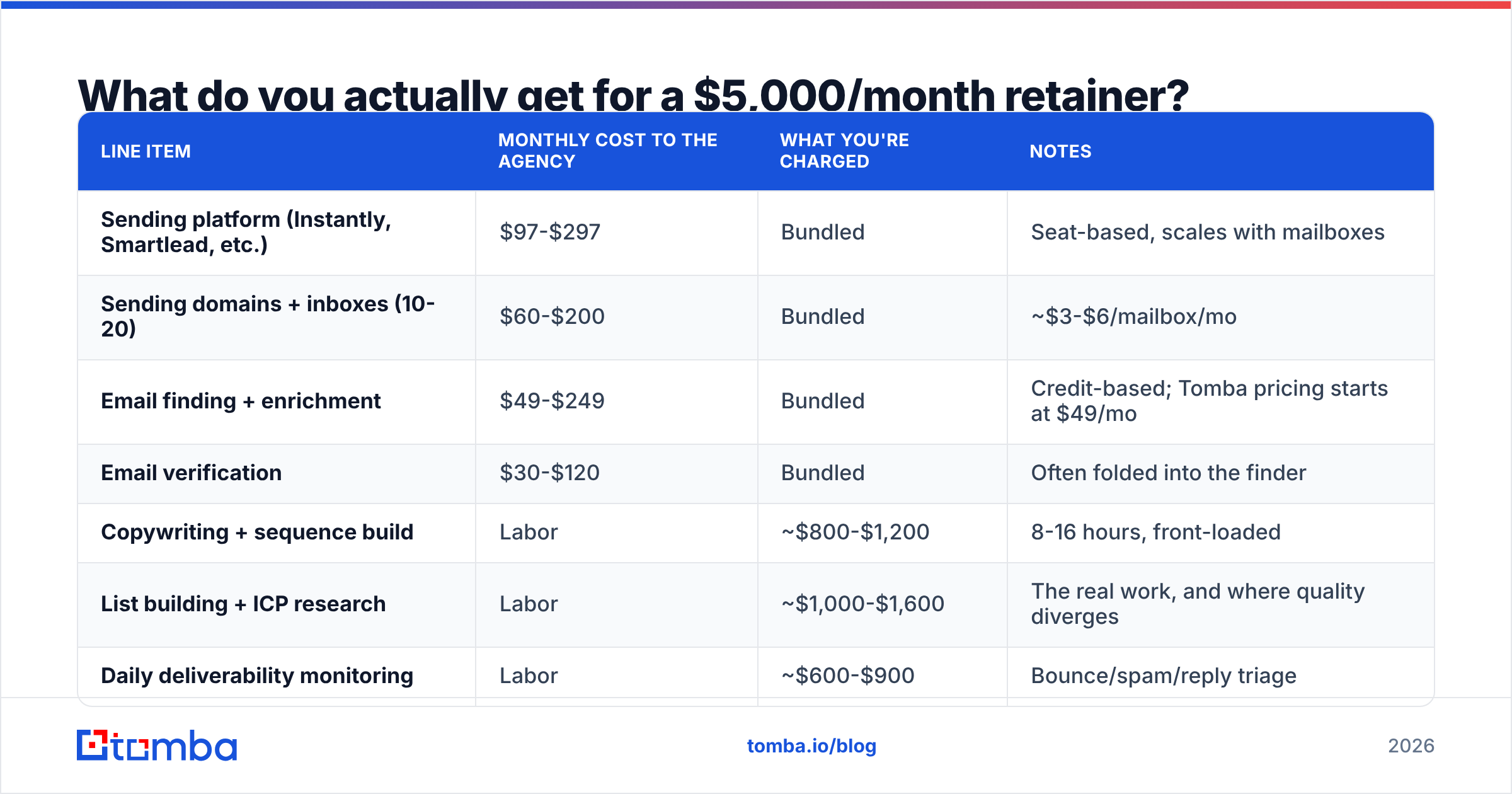
Here is the uncomfortable arithmetic. A typical mid-market cold email retainer breaks down roughly like this:
| Line item | Monthly cost to the agency | What you're charged | Notes |
|---|---|---|---|
| Sending platform (Instantly, Smartlead, etc.) | $97-$297 | Bundled | Seat-based, scales with mailboxes |
| Sending domains + inboxes (10-20) | $60-$200 | Bundled | ~$3-$6/mailbox/mo |
| Email finding + enrichment | $49-$249 | Bundled | Credit-based; Tomba pricing starts at $49/mo |
| Email verification | $30-$120 | Bundled | Often folded into the finder |
| Copywriting + sequence build | Labor | ~$800-$1,200 | 8-16 hours, front-loaded |
| List building + ICP research | Labor | ~$1,000-$1,600 | The real work, and where quality diverges |
| Daily deliverability monitoring | Labor | ~$600-$900 | Bounce/spam/reply triage |
| Reporting + strategy calls | Labor | ~$400-$600 | 2-4 hours/mo |
| Agency margin | — | ~$1,000-$1,800 | Typically 25-35% |
Tooling is roughly $300-$700. Everything above that line is people and profit. That is not a scam — labor is the product. But it changes the question from "is this expensive?" to "do I have someone who can do this work, and is their time worth more elsewhere?"
The single most common failure mode is paying for a full-service retainer and then discovering the agency's "list building" was a CSV export from a shared database that four of their other clients already emailed last month. Ask directly. Get the answer in writing.
Is a cold email agency better than doing it in-house?#
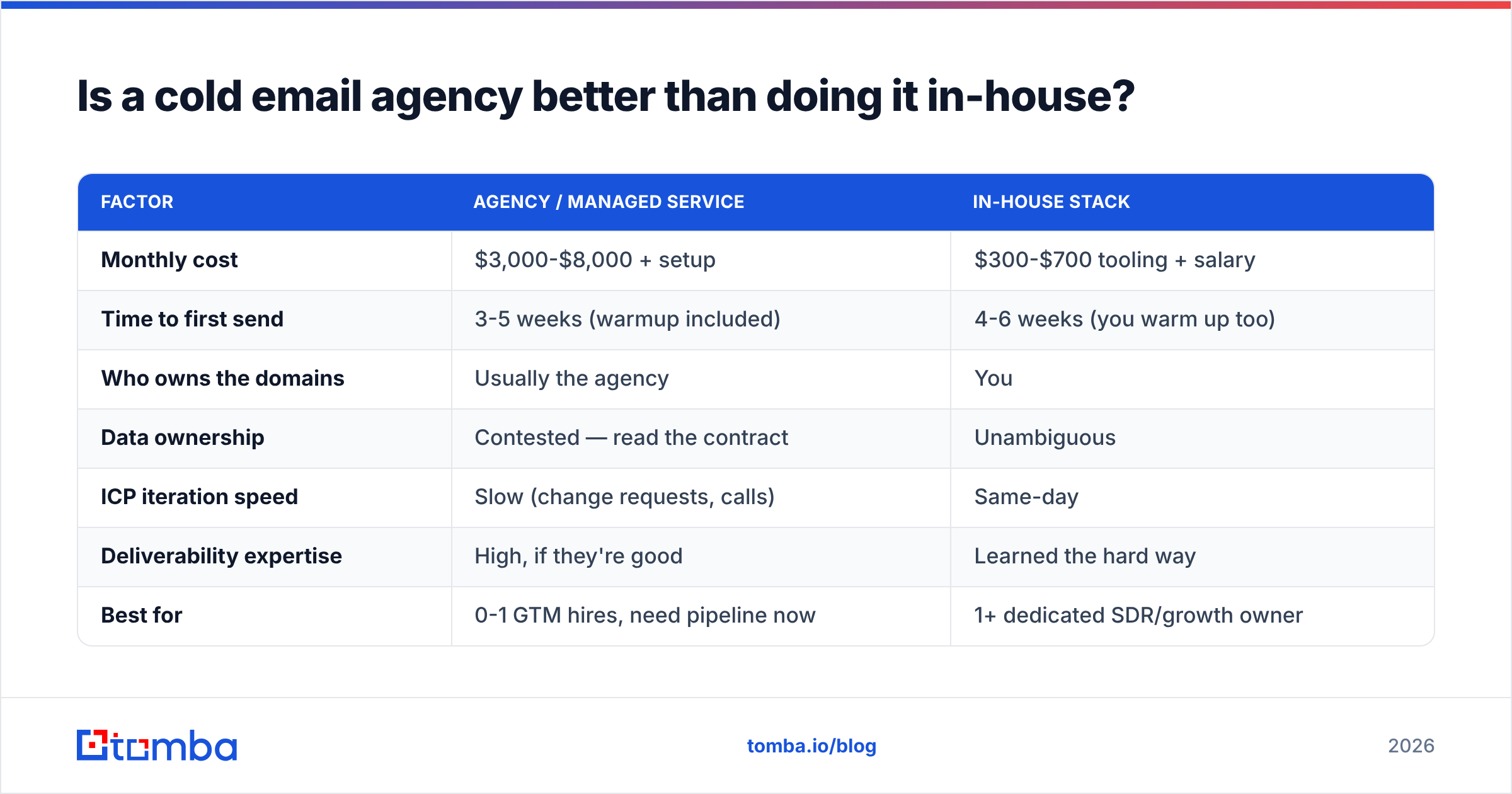
Neither is categorically better. The decision hinges on three inputs: how many people you can dedicate, how fast you need pipeline, and how specific your ICP is.
| Factor | Agency / managed service | In-house stack |
|---|---|---|
| Monthly cost | $3,000-$8,000 + setup | $300-$700 tooling + salary |
| Time to first send | 3-5 weeks (warmup included) | 4-6 weeks (you warm up too) |
| Who owns the domains | Usually the agency | You |
| Data ownership | Contested — read the contract | Unambiguous |
| ICP iteration speed | Slow (change requests, calls) | Same-day |
| Deliverability expertise | High, if they're good | Learned the hard way |
| Best for | 0-1 GTM hires, need pipeline now | 1+ dedicated SDR/growth owner |
| Worst for | Highly technical or niche ICPs | Teams with zero email ops literacy |
The domain-ownership line matters more than anything else in that table. If the agency registers getyourcompany.com and yourcompany-hq.com under their account, those reputations — good and bad — leave with them when you churn. Insist on registering sending domains under your own registrar account and granting the agency delegated access. Any vendor who resists is telling you something.
When an agency genuinely wins:
- You have no sender infrastructure. Warming 15 mailboxes from zero is 4-6 weeks of nothing happening. An agency has a warm bench.
- You need pipeline inside a quarter. Hiring, onboarding, and ramping an SDR takes 90+ days before the first meeting.
- Your ICP is broad and well-documented. "Series A-C SaaS companies with 50-200 employees in North America" is a list any competent shop can build.
- You've never sent cold email and don't know what SPF, DKIM, and DMARC do. Learning that on your production domain is expensive.
When in-house wins:
- Your ICP is weird. If qualification requires reading a company's engineering blog or checking whether they use a specific ERP, no agency researcher will do it as well as your own team.
- You already have one growth or sales ops person with spare cycles. Their $8K/mo salary already covers the labor line.
- You want compounding assets. In-house builds a data moat: verified contacts, tested subject lines, a warm domain portfolio. Agency work rents all three.
- Deal sizes are large and the touch is consultative. Fewer, better emails written by the person who will actually take the call beat 3,000 templated sends.
What should a cold email marketing service cost in 2026?#
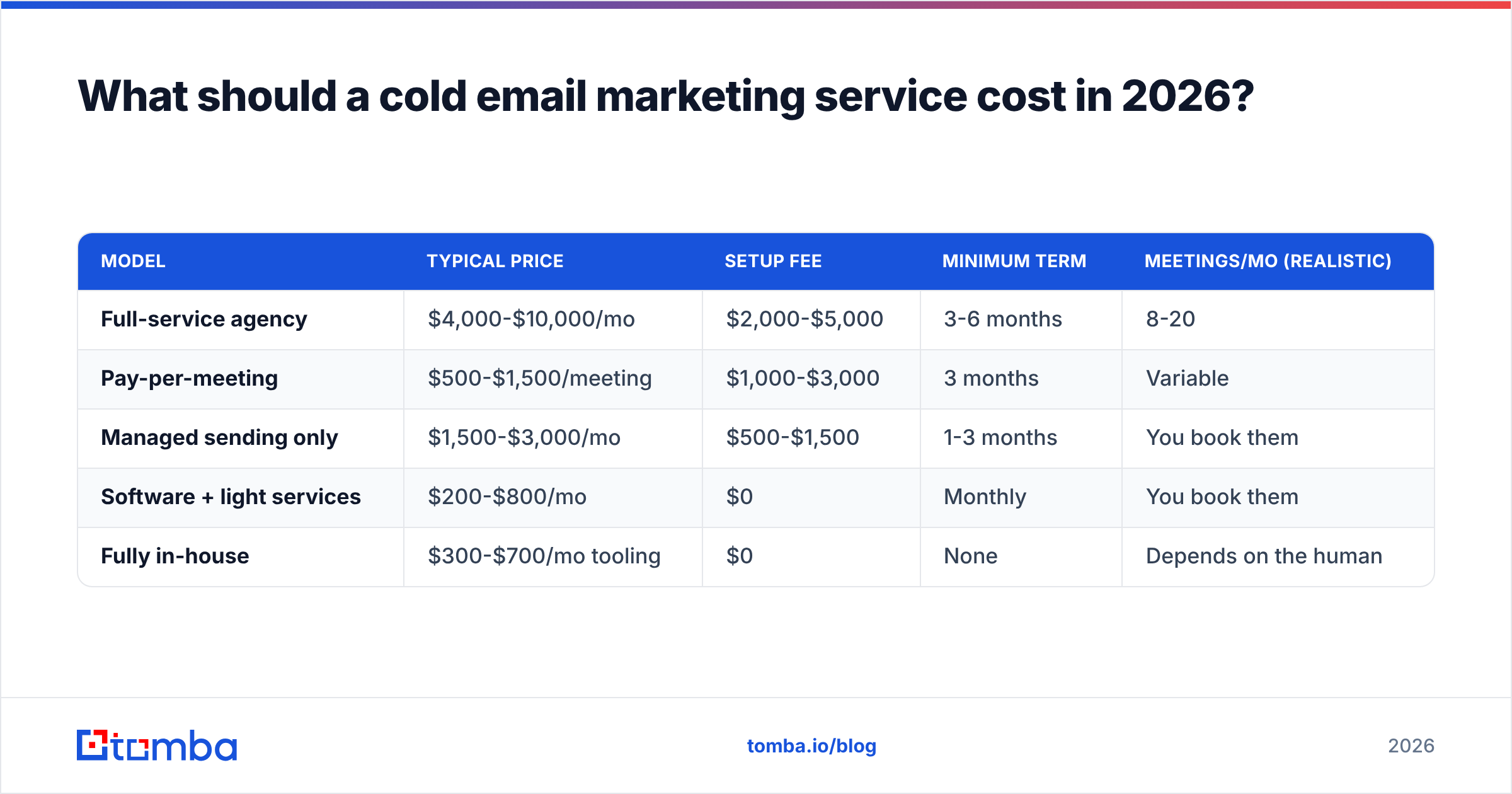
Benchmark ranges, based on public pricing pages and G2 reviews across the category:
| Model | Typical price | Setup fee | Minimum term | Meetings/mo (realistic) |
|---|---|---|---|---|
| Full-service agency | $4,000-$10,000/mo | $2,000-$5,000 | 3-6 months | 8-20 |
| Pay-per-meeting | $500-$1,500/meeting | $1,000-$3,000 | 3 months | Variable |
| Managed sending only | $1,500-$3,000/mo | $500-$1,500 | 1-3 months | You book them |
| Software + light services | $200-$800/mo | $0 | Monthly | You book them |
| Fully in-house | $300-$700/mo tooling | $0 | None | Depends on the human |
A note on pay-per-meeting: it looks like the safest model and is often the worst. The vendor's incentive is to fill your calendar, not your pipeline. Unless you define "qualified" with painful specificity — budget confirmed, title matched, timeline stated — you will pay $1,200 a head for coffee chats with interns. If you do use this model, write the qualification criteria into the SOW and add a clawback clause for no-shows.
Setup fees are usually legitimate. Registering domains, configuring DNS records, and warming inboxes for a month is real work with real elapsed time. What's not legitimate is a setup fee for domains you don't own at the end.
How do you evaluate a cold email vendor?#
Run every prospective vendor through this checklist. The order matters — the first two disqualify most of the field.
- "Where does your contact data come from?" The answer should name specific sources or providers. Vendors who resell a single stale database will hedge. Good answers reference multiple layers: a licensed B2B database, real-time verification, and manual enrichment for tier-1 accounts. Reputable data vendors like BookYourData publish their sourcing and accuracy methodology openly — that transparency is the baseline, not a bonus. If your vendor won't discuss data sources, assume the worst.
- "What's your bounce-rate SLA, and what happens if you breach it?" Anything above 3% is a deliverability emergency. Above 5% and Google will start filtering you. A serious vendor commits to under 2% and offers remediation — free re-verification, paused sends, domain rotation. A vendor who has never thought about this will say "we aim for low bounces."
- "Who owns the sending domains, and what happens on churn?" Covered above. Get it in writing.
- "Show me three anonymized client dashboards, including one that underperformed." Anyone can screenshot a 12% reply rate. The tell is whether they can explain a campaign that failed and what they changed. Vendors who claim they've never had a losing campaign are lying or new.
- "Who writes the copy, and can I see their last three sequences?" If the answer is "our AI," ask to see the prompt and the output. AI-drafted first passes are fine. AI-drafted-and-never-edited sequences are why your prospects' inboxes look like a template graveyard.
- "What's your process when a domain gets blacklisted?" The correct answer includes: pause immediately, check a blacklist checker, delist, rotate to backup domains, re-verify the list segment that caused it. "That doesn't happen to us" is disqualifying.
What does the in-house stack actually look like?#
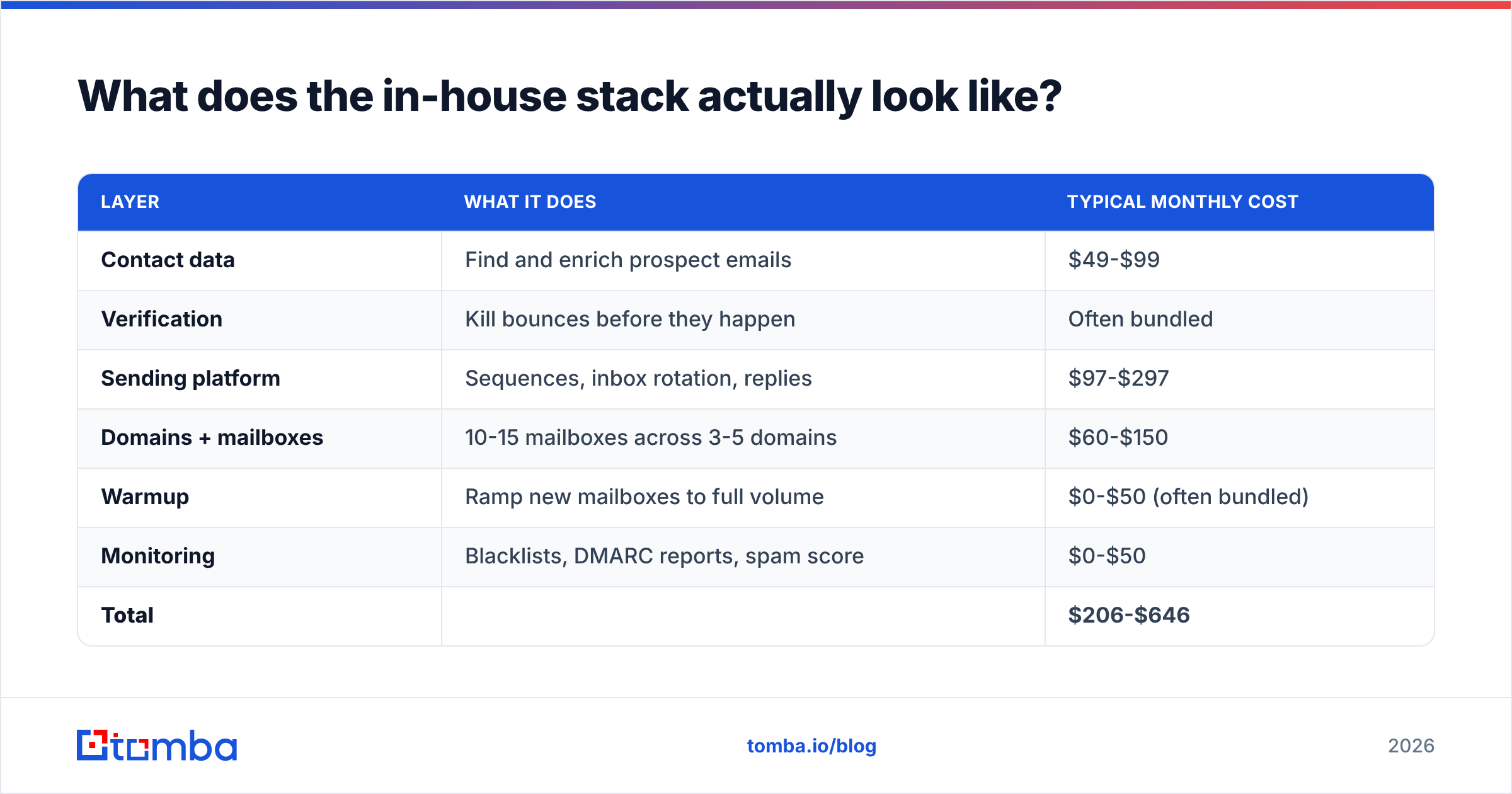
If the checklist above made you think "I could just do this," here is the honest bill of materials for running cold email yourself at 2,000-5,000 sends/month.
| Layer | What it does | Typical monthly cost |
|---|---|---|
| Contact data | Find and enrich prospect emails | $49-$99 |
| Verification | Kill bounces before they happen | Often bundled |
| Sending platform | Sequences, inbox rotation, replies | $97-$297 |
| Domains + mailboxes | 10-15 mailboxes across 3-5 domains | $60-$150 |
| Warmup | Ramp new mailboxes to full volume | $0-$50 (often bundled) |
| Monitoring | Blacklists, DMARC reports, spam score | $0-$50 |
| Total | $206-$646 |
The data layer is where you should spend attention, not money. A bulk email finder that returns verified addresses at 95%+ accuracy costs about the same as one that returns 70% — but the 70% tool will bounce 300 of your first 1,000 sends and torch a domain you spent five weeks warming. Verification isn't a nice-to-have; run every list through an email verifier before it touches a sequence, and use a catch-all verifier for the domains that come back ambiguous.
For infrastructure, follow the actual specification rather than blog folklore. Google's bulk sender requirements spell out SPF, DKIM, DMARC, one-click unsubscribe, and the 0.3% spam-complaint ceiling. Meeting those four requirements puts you ahead of most agencies. HubSpot's cold email guide is a reasonable free primer on sequence structure if you're writing copy for the first time.
The labor is the part nobody can sell you. Budget 6-10 hours a week: two hours building and verifying the list, three hours on copy and reply handling, one hour on deliverability checks, and the rest on iteration. That's a meaningful chunk of one person. If you don't have that person, hire the agency. If you do, the retainer is buying you a truck you already own.
How do you measure whether it's working?#
Vanity metrics kill cold email programs because they let a bad vendor look good for two months.
- Bounce rate (target: under 2%). The leading indicator. Rising bounces mean your data is decaying or your source is stale. Fix this before touching anything else.
- Spam complaint rate (target: under 0.1%, hard ceiling 0.3%). Watch it in Google Postmaster Tools. One bad segment can put you over.
- Reply rate (target: 4-8% for a well-targeted list). Below 2% usually means targeting, not copy. Above 15% usually means your list is warm, not cold.
- Positive reply rate (target: 30-50% of replies). The number that separates a real program from a spray operation.
- Meetings booked per 1,000 sends (target: 2-5). The only number your CFO cares about.
- Cost per booked meeting. Retainer ÷ meetings. Compare it honestly against your in-house alternative, salary included.
Track response rate weekly, not monthly. Cold email degrades fast, and a monthly cadence means you find out about a dead domain three weeks too late.
The bottom line#
Cold email marketing services are worth it when you're buying time and expertise you genuinely don't have — a warm sending bench, a deliverability operator, and someone who has already made the mistakes. They stop being worth it the moment you employ a single person who can own the channel, because at that point you're paying a 30% margin on your own labor plus tooling you could buy for $500.
Whichever way you go, the data layer decides the outcome. An agency with a stale list will fail more expensively than a solo founder with a clean one. Start there.
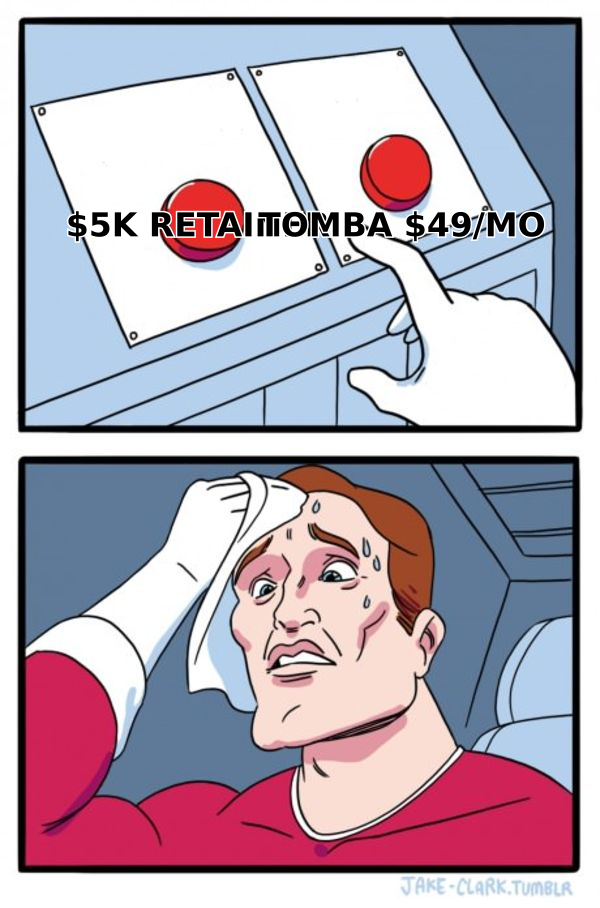
If you're building the in-house version, Tomba Email Finder is where the stack starts: find verified professional emails by domain, name, or company, with verification built into the same credit pool. The free tier gives you 25 searches a month to test accuracy against your own ICP before you commit a dollar — and Starter runs $49/mo, roughly one percent of the retainer you were about to sign.
Related guides#
// get started
Find, verify and enrich your first contacts today
Start on the free plan with 25 searches a month, then scale when your team is ready.
Free plan · No credit card required · GDPR & CCPA
// about the author