Cold Email Reply Rate Benchmarks and How to Improve Yours
Most cold email reply rate benchmarks are inflated by cherry-picked campaigns. Here is the real math, the 2026 numbers by list type, and the four levers that actually move replies.
TL;DR
- A healthy cold email reply rate in 2026 sits between 3% and 8% for a well-targeted list. Anything above 10% usually means a tiny, hand-picked list — not a repeatable system.
- Reply rate is a ratio, not a score. Cutting your list from 2,000 to 400 people can double the percentage while halving the meetings. Track replies and positive replies and absolute meeting count.
- Deliverability failures masquerade as copy failures. If 18% of your sends bounce or land in spam, no subject line rewrite will save the campaign.
- The four levers that actually move the number, in order of impact: list precision → deliverability → relevance of the first line → ask size.
- Verified data comes first. A list with 4% bounces and correct job titles will outperform a "perfect" sequence sent to stale contacts every single time.
What is a cold email reply rate, exactly?#
Your cold email reply rate is the percentage of delivered emails that produce any human response — positive, negative, or "unsubscribe me."
Reply rate = (total unique replies ÷ emails delivered) × 100Three details in that formula cause most of the confusion you see in benchmark posts:
- Delivered, not sent. If you send 1,000 emails and 120 bounce, your denominator is 880. Tools that divide by sent quietly deflate your number; tools that divide by delivered quietly inflate it. Know which one you're reading.
- Unique replies, not total replies. A four-message thread with one prospect is one reply. Sequencers that count every inbound message will hand you a beautiful, meaningless chart.
- Any reply, not good replies. "Take me off this list" counts. This is why positive reply rate — replies that indicate interest — is the metric your pipeline actually depends on.
Think of it like a restaurant's foot traffic versus its covers. Plenty of people walk past the door (sends). Some walk in (delivered). Some sit down (replies). Some order (positive replies). Only the last group pays for the kitchen. Optimizing for foot traffic while the dining room stays empty is the most common mistake in outbound.
What is a good cold email reply rate in 2026?#
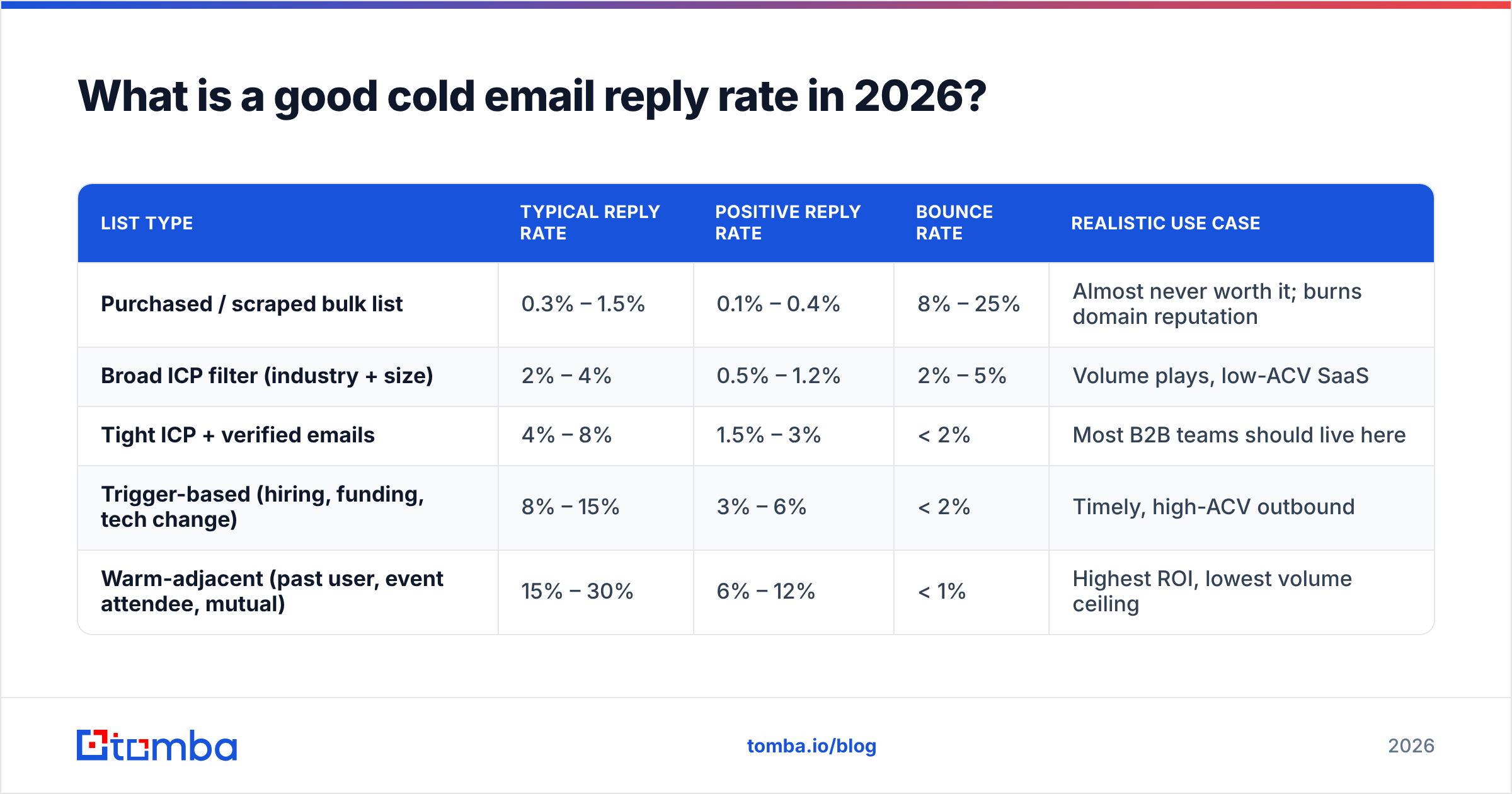
There is no single number, because reply rate is almost entirely a function of list quality and offer fit. What follows is what teams running clean, verified, sub-2%-bounce campaigns typically see. Treat it as a range, not a target.
| List type | Typical reply rate | Positive reply rate | Bounce rate | Realistic use case |
|---|---|---|---|---|
| Purchased / scraped bulk list | 0.3% – 1.5% | 0.1% – 0.4% | 8% – 25% | Almost never worth it; burns domain reputation |
| Broad ICP filter (industry + size) | 2% – 4% | 0.5% – 1.2% | 2% – 5% | Volume plays, low-ACV SaaS |
| Tight ICP + verified emails | 4% – 8% | 1.5% – 3% | < 2% | Most B2B teams should live here |
| Trigger-based (hiring, funding, tech change) | 8% – 15% | 3% – 6% | < 2% | Timely, high-ACV outbound |
| Warm-adjacent (past user, event attendee, mutual) | 15% – 30% | 6% – 12% | < 1% | Highest ROI, lowest volume ceiling |
Two honest caveats. First, industry matters: security and finance buyers reply less than agency owners and e-commerce operators, and enterprise IT replies least of all. Second, seniority matters in a non-linear way — VPs reply less often than directors, but the replies they send are worth more.
If you are averaging under 1% on a list you believe is well-targeted, the problem is almost never your copy. It's the plumbing.
Why is your cold email reply rate low?#
Work through these in order. The list is deliberately ordered by how much of the variance each factor explains, based on what breaks most often in practice.
- Your list is wrong, not your copy. The single largest driver of reply rate is whether the person receiving the email has the problem you solve and the authority to act. No amount of personalization rescues a message sent to a Marketing Coordinator when you sell to a CRO.
- You never confirmed the emails exist. Every hard bounce is a direct signal to Google and Microsoft that you don't know who you're mailing. Above roughly 3% bounce, inbox placement degrades across the whole domain — including the emails to people who would have replied.
- You skipped authentication. Missing or misconfigured SPF, DKIM, and DMARC records mean bulk senders get filtered before a human sees anything. Run an SPF checker before you blame the subject line.
- Your first line is about you. "I'm reaching out because we help companies like yours…" is a reply-rate tax. The first sentence should demonstrate you know something specific and non-public-feeling about their situation.
- Your ask is too big. "Do you have 30 minutes Thursday?" asks a stranger to give you something scarce. "Is this on your roadmap for Q4, or is it a next-year problem?" asks for a two-word answer.
- You stopped at message two. Roughly half of all replies to a well-run sequence arrive after the first email. Cutting a sequence short is voluntarily halving your own number.
How does deliverability limit your reply rate?#
Deliverability is the ceiling. Everything else is the room underneath it.
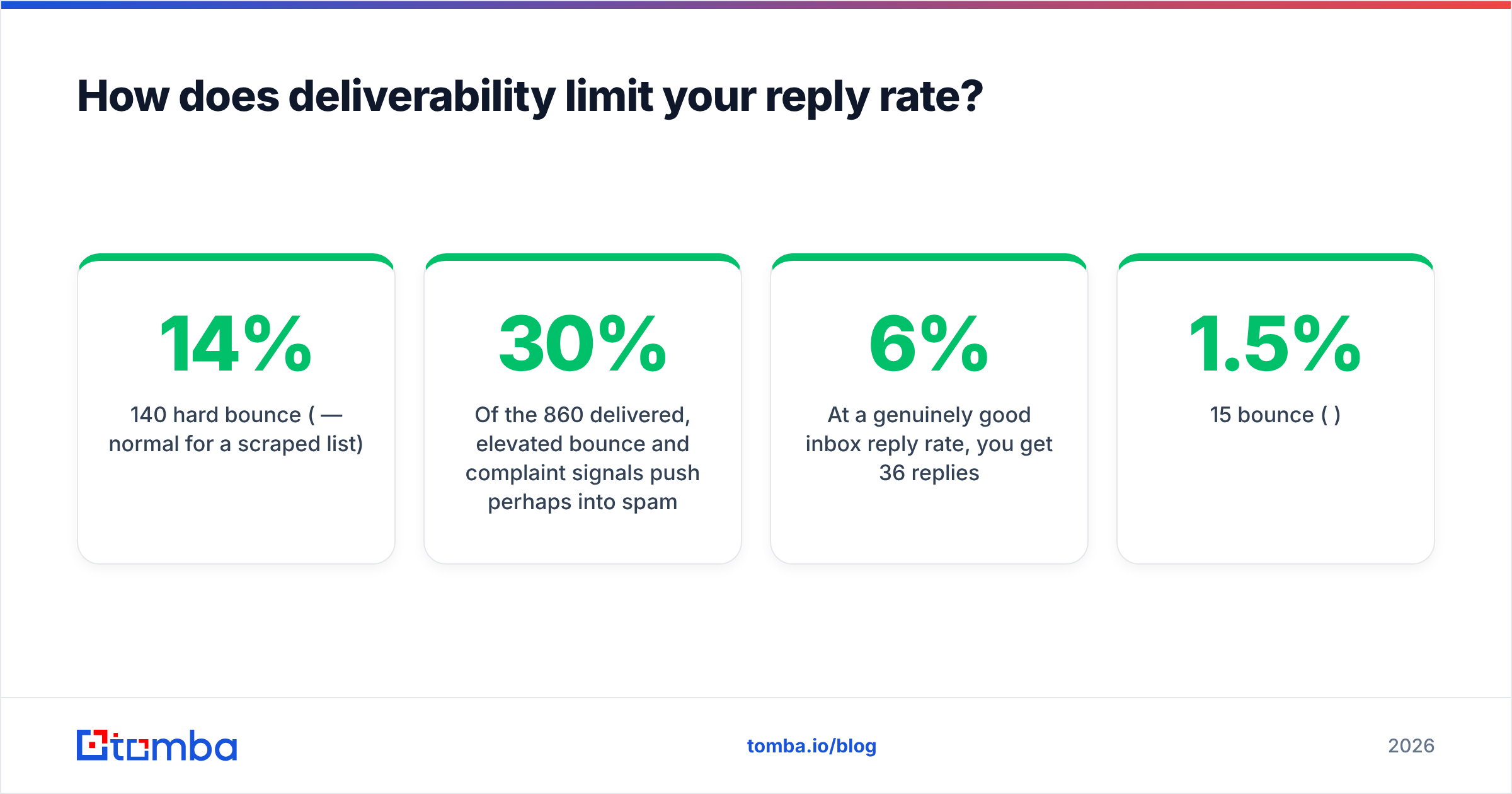
Here's the arithmetic nobody enjoys. Suppose you send 1,000 emails to an unverified list:
- 140 hard bounce (14% — normal for a scraped list)
- Of the 860 delivered, elevated bounce and complaint signals push perhaps 30% into spam
- 602 emails reach an inbox
- At a genuinely good 6% inbox reply rate, you get 36 replies
Now send 1,000 emails to a verified list:
- 15 bounce (1.5%)
- Reputation stays intact; 5% go to spam
- 936 emails reach an inbox
- At the same 6%, you get 56 replies
Same copy. Same offer. Same people, roughly. A 56% lift in replies purely from data hygiene and the sender reputation it protects. This is why "improve deliverability" outranks "rewrite the email" in every prioritized list I'd give a team.
Google and Yahoo formalized much of this in their bulk sender requirements — authentication, a one-click unsubscribe, and a spam complaint rate held under 0.3%. Google's own sender guidelines are the primary source; read them rather than a summary. Then check your own domain in Google Postmaster Tools, which shows the reputation grade Gmail actually assigns you rather than the one you hope you have.
Before a campaign, three checks take ten minutes and prevent a month of confusion:
- Verify every address. Use an email verifier to remove hard bounces and identify risky catch-all domains before they hit your sequencer.
- Check your records. SPF, DKIM, DMARC. All three, on the sending domain, not the root domain if they differ.
- Warm the domain. A brand-new domain sending 400 emails on day one is a spam filter's easiest decision of the week.
Which levers actually move the number?#
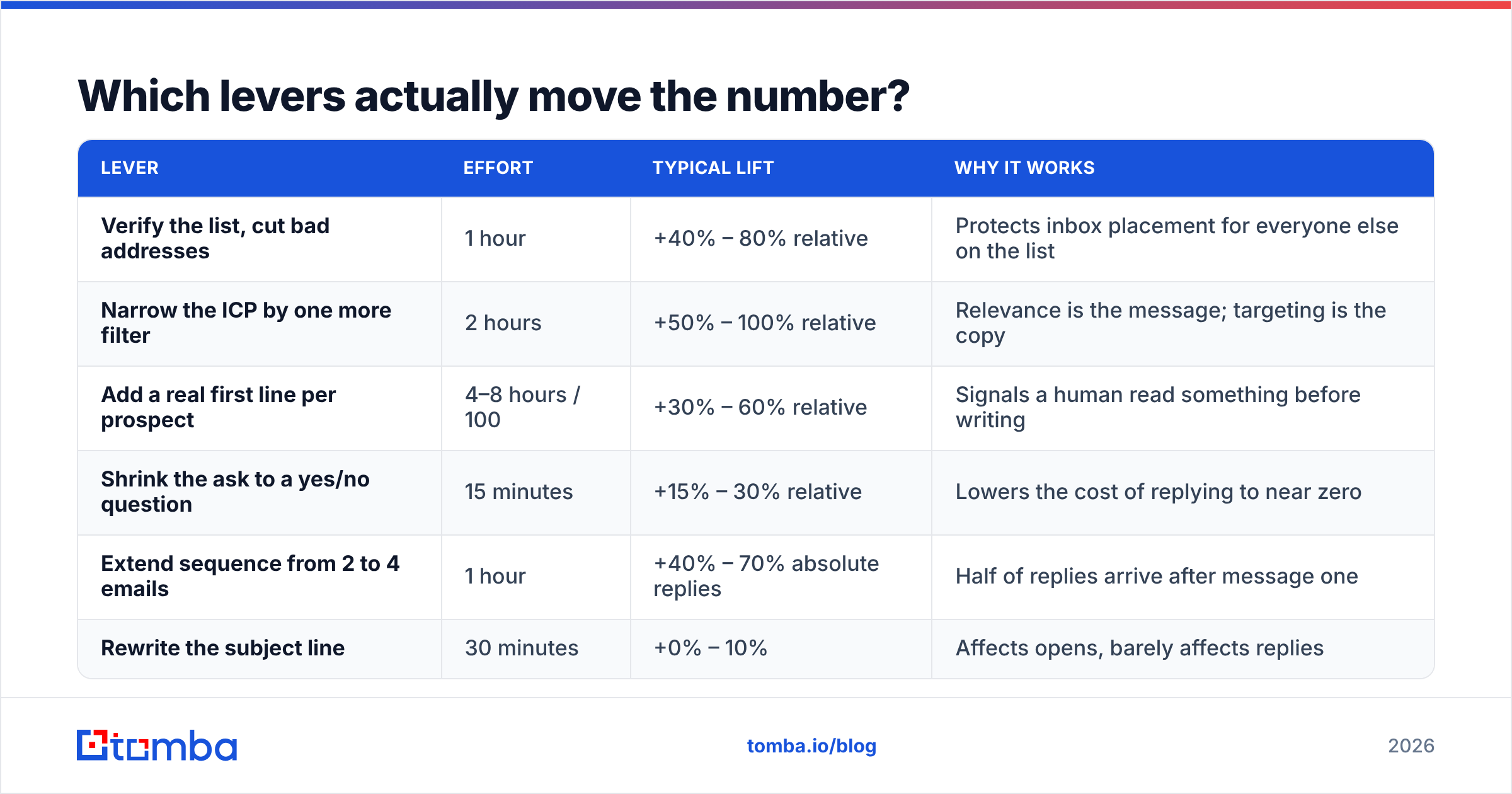
Ranked by expected lift per hour of effort, for a team currently sitting at 1–2%.
| Lever | Effort | Typical lift | Why it works |
|---|---|---|---|
| Verify the list, cut bad addresses | 1 hour | +40% – 80% relative | Protects inbox placement for everyone else on the list |
| Narrow the ICP by one more filter | 2 hours | +50% – 100% relative | Relevance is the message; targeting is the copy |
| Add a real first line per prospect | 4–8 hours / 100 | +30% – 60% relative | Signals a human read something before writing |
| Shrink the ask to a yes/no question | 15 minutes | +15% – 30% relative | Lowers the cost of replying to near zero |
| Extend sequence from 2 to 4 emails | 1 hour | +40% – 70% absolute replies | Half of replies arrive after message one |
| Rewrite the subject line | 30 minutes | +0% – 10% | Affects opens, barely affects replies |
Notice where subject lines land. They matter for opens, and opens are now an unreliable metric anyway thanks to Apple Mail Privacy Protection inflating them. If you are A/B testing subject lines while your bounce rate is 9%, you are rearranging deck chairs. If you want to test them anyway, do it with a subject line tester rather than burning live sends on the experiment.
How do you build a list that replies?#
The workflow that produces 4–8% reply rates is boring and repeatable. It looks like this.
Step 1 — Define the trigger, not just the profile. "Series B SaaS companies, 50–200 employees" is a profile. "Series B SaaS companies that posted a Head of RevOps role in the last 30 days" is a trigger. Triggers roughly double reply rates because they answer why now, which is the question every cold email implicitly has to survive.
Step 2 — Find the actual humans. Pull the companies that match, then find the specific person who owns the problem. A domain search returns the email patterns and named contacts at a company, which is faster than guessing at first.last@ and hoping. For named prospects you already have from LinkedIn or a conference list, an email finder resolves name plus domain into a deliverable address.
Step 3 — Verify before you enrich. Verification is cheaper than enrichment and removes the rows that would poison the campaign. Do it first. Catch-all domains — where the server accepts everything and confirms nothing — need a catch-all verifier rather than a standard SMTP check, or you'll either drop good contacts or keep bad ones.
Step 4 — Enrich only what survives. Now add the company context, headcount, funding, and tech stack you'll use in the first line. Data enrichment on a 400-row verified list costs a fraction of enriching 2,000 rows where 600 addresses don't exist.
Step 5 — Segment before you write. Ten segments of 40 people, each with a genuinely different first line, beat one segment of 400 with a merge tag. This is the entire trick. It is not glamorous.
Step 6 — Measure positive replies per 100 delivered. Not opens. Not raw reply rate. Positive replies per 100 delivered is the only number that survives contact with a CFO.
Should you optimize for reply rate or for meetings?#
Meetings. Always meetings.
Reply rate is a ratio, and ratios are trivially gamed by shrinking the denominator. A rep who emails 30 perfectly researched prospects and gets 9 replies posts a 30% reply rate and books two meetings. A rep who emails 600 verified, well-targeted prospects and gets 36 replies posts a 6% reply rate and books eleven meetings. The second rep is more valuable and looks worse on the dashboard.
The honest framing: reply rate is a diagnostic, not an objective. Use it to detect problems — a sudden drop means deliverability broke, a chronically low number means targeting is off — and use absolute positive replies and booked meetings to judge whether the channel is working. Sales leaders at HubSpot and elsewhere have made this point repeatedly in their sales research, and reviews across G2 reflect the same pattern: teams that chase percentage move upmarket in personalization until volume collapses.
The practical rule: set a reply-rate floor, then maximize volume within it. If 4% is your floor, add prospects until the rate starts sliding below 4%, then stop and fix targeting. That keeps quality honest and volume growing at the same time.
What reply rate can you realistically expect by month?#
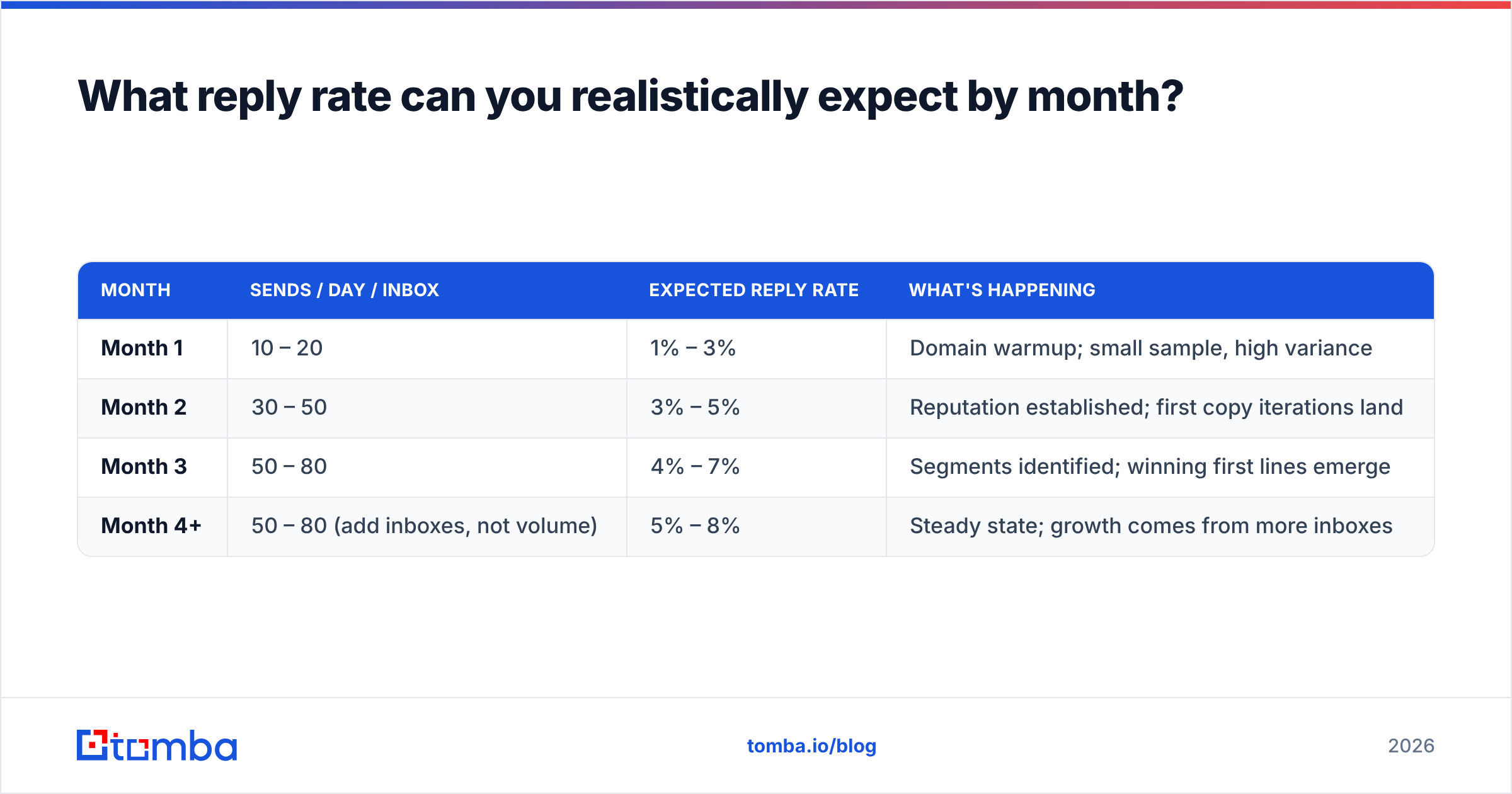
A team starting from a cold domain and a verified list should expect a curve, not a step change.
| Month | Sends / day / inbox | Expected reply rate | What's happening |
|---|---|---|---|
| Month 1 | 10 – 20 | 1% – 3% | Domain warmup; small sample, high variance |
| Month 2 | 30 – 50 | 3% – 5% | Reputation established; first copy iterations land |
| Month 3 | 50 – 80 | 4% – 7% | Segments identified; winning first lines emerge |
| Month 4+ | 50 – 80 (add inboxes, not volume) | 5% – 8% | Steady state; growth comes from more inboxes |
The most common failure in month one is impatience: pushing volume before reputation exists, which caps the account permanently. The most common failure in month four is complacency: leaving winning segments un-scaled because the aggregate reply rate looks fine.
The bottom line#
Your cold email reply rate is downstream of three things, in this order: whether the address exists, whether the message reaches the inbox, and whether the person on the other end has the problem you described. Copy is fourth. Subject lines are a rounding error.
Fix the data first. Verify every address before it enters a sequencer, resolve catch-all domains properly, and keep your bounce rate under 2% so the emails that should land actually do.
Start with the list. Tomba's Email Finder resolves names and domains into verified, deliverable addresses with source attribution, so you know where each contact came from. The free tier gives you 25 searches a month to test the workflow on a real segment; paid plans start at $49/mo on Starter, with Growth at $99/mo and Pro at $249/mo — see Tomba pricing for the full breakdown. Build a 200-person verified list this week, send four messages over ten days, and measure positive replies per 100 delivered. That single number will tell you more about your outbound than any benchmark post, including this one.
Related guides#
// get started
Find, verify and enrich your first contacts today
Start on the free plan with 25 searches a month, then scale when your team is ready.
Free plan · No credit card required · GDPR & CCPA
// about the author