Cold Email Results in 2026: Benchmarks, Math, and Fixes
Most teams have no idea whether their cold email results are good or terrible. Here are the real 2026 benchmarks for reply rates, meeting rates, and bounces — plus the arithmetic that turns sends into pipeline.
TL;DR
- A healthy cold email campaign in 2026 lands at 2–5% positive reply rate, 8–15% total reply rate, and under 2% bounce. Anything above 8% positive reply means you found a very sharp segment — not that you're a genius copywriter.
- Open rate is no longer a metric. Apple MPP, Gmail image proxying, and security scanners inflate it. Track replies, meetings, and pipeline instead.
- Cold email results are mostly a list problem. Roughly 60% of outcome variance traces back to targeting and data quality; copy accounts for far less than people assume.
- Run the reverse math before you send: meetings needed → replies needed → prospects needed. Most teams are 4–6x short on volume, not short on cleverness.
- Bounce above 3% is a deliverability emergency, not a data hiccup. Verify before you send, always.
What counts as good cold email results in 2026?#
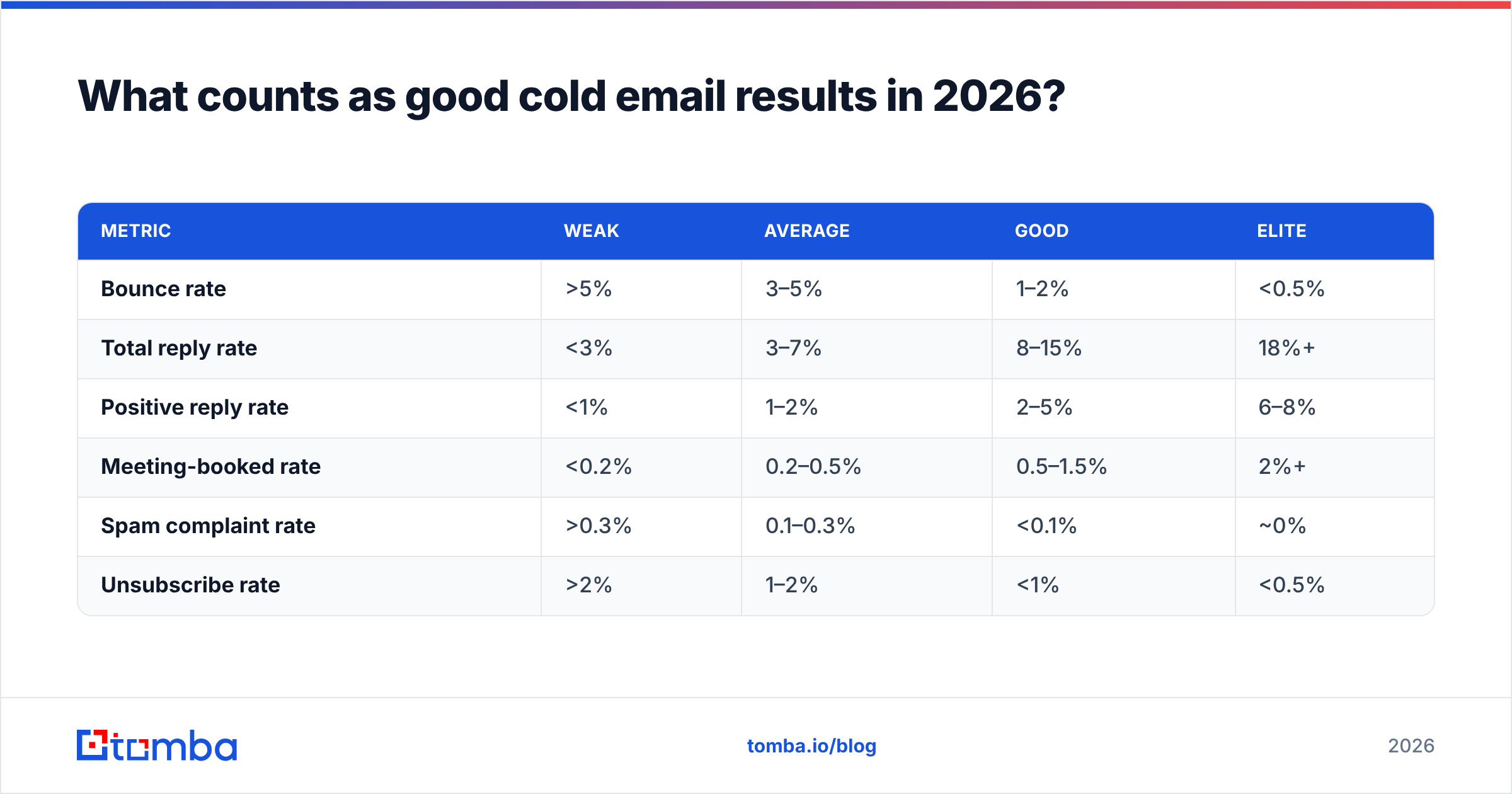
Short answer: 2–5% positive reply rate, 8–15% total reply rate, 0.5–1.5% meeting-booked rate, and bounce under 2%.
That's the honest band across mid-market B2B outbound. It is dramatically lower than the numbers in most vendor case studies, and dramatically higher than what the average team actually gets, because the average team sends unverified lists to unsegmented personas with a template they copied off LinkedIn.
Two things have changed since 2023 and both compress results:
- Inbox providers tightened enforcement. Google and Yahoo's bulk sender requirements made SPF, DKIM, and DMARC non-optional, and both now enforce a spam-complaint threshold at 0.3%. Cross it and your domain gets throttled regardless of copy quality. Google's email sender guidelines spell out the rules — read them before you touch a sequence builder.
- Prospect volume exploded. AI made writing 200 "personalized" first lines free. Everyone did it. The marginal value of a mediocre personalized opener is now approximately zero, and buyers pattern-match it in half a second.
The result: results didn't die, they concentrated. Narrow, well-researched, well-verified campaigns still print. Broad ones now underperform their 2021 selves by 40–60%.
The benchmark table#
| Metric | Weak | Average | Good | Elite |
|---|---|---|---|---|
| Bounce rate | >5% | 3–5% | 1–2% | <0.5% |
| Total reply rate | <3% | 3–7% | 8–15% | 18%+ |
| Positive reply rate | <1% | 1–2% | 2–5% | 6–8% |
| Meeting-booked rate | <0.2% | 0.2–0.5% | 0.5–1.5% | 2%+ |
| Spam complaint rate | >0.3% | 0.1–0.3% | <0.1% | ~0% |
| Unsubscribe rate | >2% | 1–2% | <1% | <0.5% |
Read this table with one caveat: elite numbers almost always come from small lists. A 20% reply rate on 50 hand-picked accounts is real and repeatable. A 20% reply rate on 5,000 contacts has never happened and never will. Whenever a vendor shows you a screenshot, ask for the denominator first.
Why is open rate a broken metric now?#
Because you cannot measure it anymore.
Apple's Mail Privacy Protection pre-fetches tracking pixels for every message regardless of whether the human opened it. Gmail proxies images. Corporate security appliances — Proofpoint, Mimecast, Microsoft Defender — click links and load images to sandbox them before delivery. Every one of those events registers as an "open," and several register as a "click."
The practical damage: teams see 60% open rates, conclude their subject lines work, and never investigate the 0.4% reply rate underneath. Inflated opens hide dead lists. They also hide deliverability collapse, because a list that's 40% invalid still shows opens from the 60% that landed.
What to track instead, in order of signal quality:
- Meetings booked — the only number your CRO cares about, and the only one that can't be faked by a scanner.
- Positive replies — human intent, human effort, no bot can generate it.
- Total replies (including "no thanks") — measures whether you reached a human at all.
- Bounce rate — the cleanest proxy for list quality you have.
- Spam complaints — a lagging indicator that you've already gone too far.
Delete open rate from your dashboard. Keep click rate only if your emails contain a link and you've excluded the first 20 seconds after delivery (that's the scanner window).

How do you calculate the cold email results you actually need?#
Work backwards from the number your board sees. This is fifth-grade arithmetic and almost nobody does it before launching a campaign.
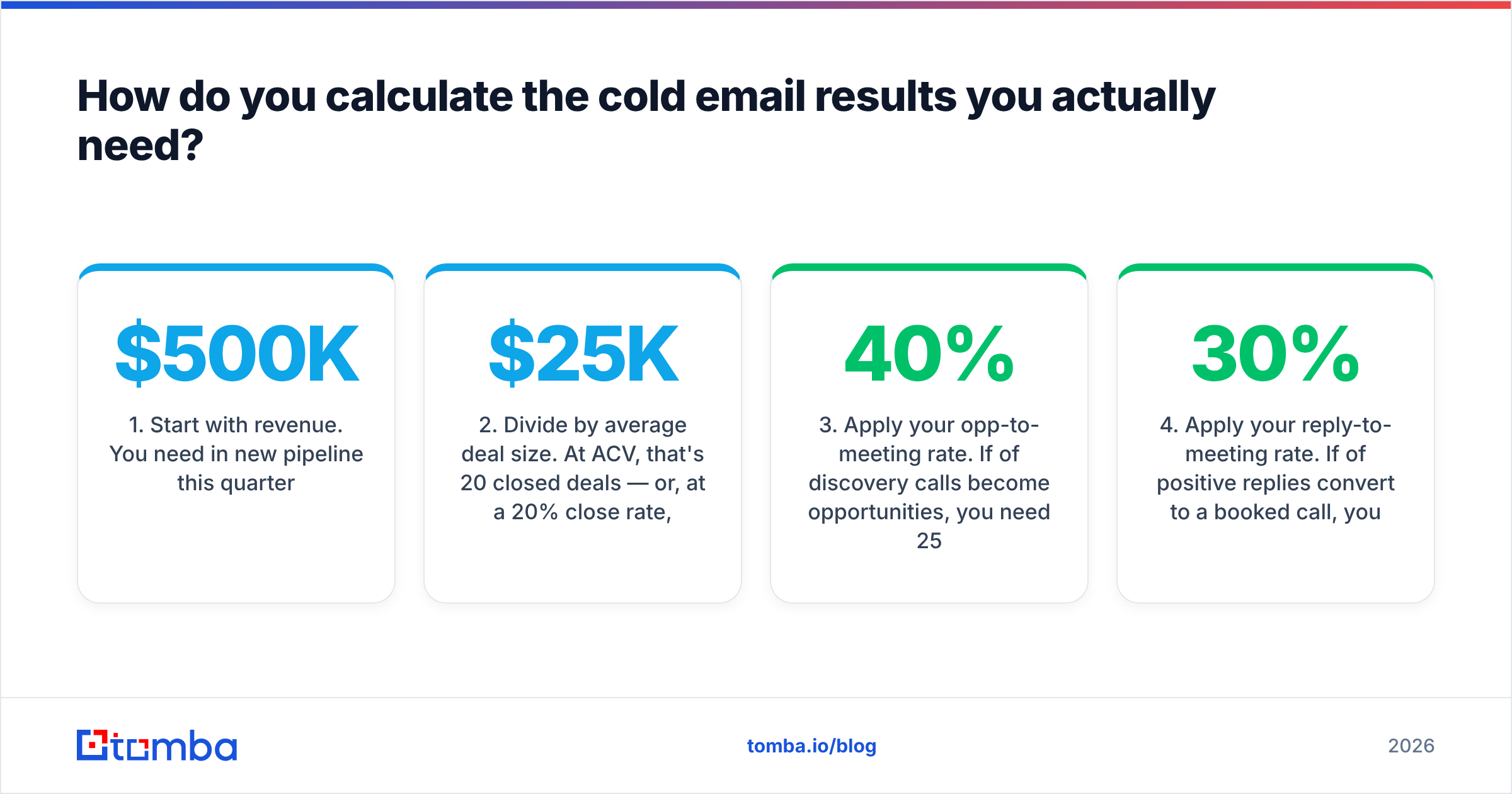
The reverse-math chain:
- Start with revenue. You need $500K in new pipeline this quarter.
- Divide by average deal size. At $25K ACV, that's 20 closed deals — or, at a 20% close rate, 100 opportunities.
- Apply your opp-to-meeting rate. If 40% of discovery calls become opportunities, you need 250 meetings.
- Apply your reply-to-meeting rate. If 30% of positive replies convert to a booked call, you need ~833 positive replies.
- Apply your positive reply rate. At a healthy 3%, you need ~27,800 deliverable contacts.
- Add for bounce and dedupe. At 2% bounce plus 10% overlap with existing CRM records, source roughly 31,500 raw contacts.
Now look at that number and be honest about whether you have it. Most teams discover at this step that their addressable list is 4,000 people, not 31,500. Which means the answer isn't a better subject line — it's either a broader ICP definition, a different channel, or a fundamentally different motion (events, partnerships, paid).
That realization is worth more than any copywriting tip in this post.
The five inputs that move cold email results, ranked#
- List precision (~40% of variance). Is this person genuinely in-market for what you sell, at a company that plausibly buys it? Nothing else matters if the answer is no.
- Data accuracy (~20%). Valid, deliverable, currently-employed. An invalid address earns you a bounce and a reputation hit, not a zero.
- Deliverability infrastructure (~15%). Authenticated domain, warmed inbox, sane volume, low complaint rate. This is a gate, not a lever — you either pass or nothing else counts.
- Offer clarity (~15%). Not "we do AI-powered sales enablement." Something a stranger can evaluate in seven seconds.
- Copy and personalization (~10%). Real, but wildly overweighted in every blog post you've read. Great copy on a bad list is a rounding error.
If you're spending 80% of your outbound effort on step 5, you've inverted the priority stack.
What does a bad bounce rate actually cost you?#
More than the wasted sends. A lot more.
Bounces are a direct reputation signal. Mailbox providers treat a high hard-bounce rate as evidence you're either scraping indiscriminately or buying a stale list — both are spammer behaviors. Cross 3% and you'll see delivery to the primary inbox degrade for the entire domain, including the emails your AEs send to live opportunities.
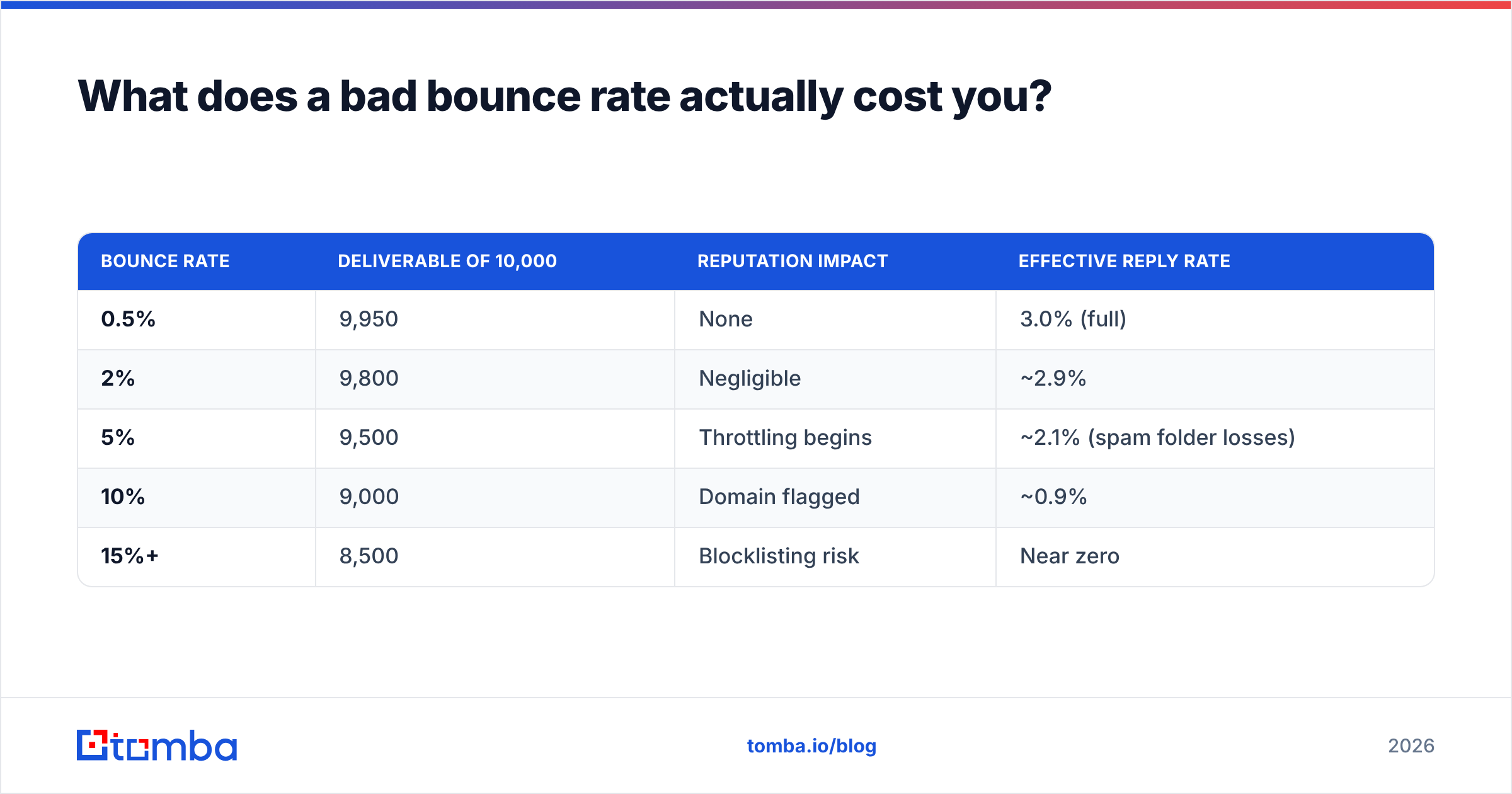
The compounding math is ugly:
| Bounce rate | Deliverable of 10,000 | Reputation impact | Effective reply rate |
|---|---|---|---|
| 0.5% | 9,950 | None | 3.0% (full) |
| 2% | 9,800 | Negligible | ~2.9% |
| 5% | 9,500 | Throttling begins | ~2.1% (spam folder losses) |
| 10% | 9,000 | Domain flagged | ~0.9% |
| 15%+ | 8,500 | Blocklisting risk | Near zero |
Notice that at 10% bounce you lose 10% of your list but roughly 70% of your results, because the surviving sends increasingly land in spam. Bounce doesn't subtract linearly — it multiplies against everything downstream.
The fix is boring and total: run every address through an email verifier before it enters a sequence, and re-verify anything older than 90 days. B2B contact data decays at roughly 2–2.5% per month as people change jobs, which means a list you built in January is meaningfully broken by July. For large lists, a bulk email finder run beats manual cleanup by an order of magnitude on time.
Catch-all domains deserve special mention. They accept everything at the SMTP layer, so a naive verifier marks them "unknown" and you either send blind or drop them. Since a large share of enterprise domains are catch-all, dropping them means dropping your best accounts. A dedicated catch-all verifier resolves most of that ambiguity instead of punting it to your bounce rate.
Is copy or targeting responsible for weak cold email results?#
Targeting. Almost always targeting.
Here's the diagnostic that settles the argument in ten minutes. Take a campaign with poor results and split it:
- Segment A: the 50 contacts closest to your best existing customer — same industry, same size, same trigger event.
- Segment B: everyone else in the campaign.
Send the identical email to both. If Segment A replies at 10% and Segment B replies at 1%, your copy is fine and your list is the problem. If both segments reply at 1%, your offer or your deliverability is broken.
In practice, Segment A almost always outperforms by 5–10x with zero copy changes. That's the whole story of cold email in 2026: the message that fails on a stranger succeeds on someone with the problem you solve, right now.

Signals that predict a reply better than any first line#
- Recent funding round (30–90 days out — they have budget and mandate)
- Relevant new hire (a new VP of Demand Gen rebuilds the stack in month two)
- Job postings that describe the pain you solve
- Technology adoption or removal on their site
- Competitor churn signals — G2 review activity, support-forum complaints
Layering two of these on a list cuts volume by 90% and typically lifts reply rate by 3–4x. Fewer sends, better response rate, lower complaint risk, healthier domain. Every part of the system improves at once.
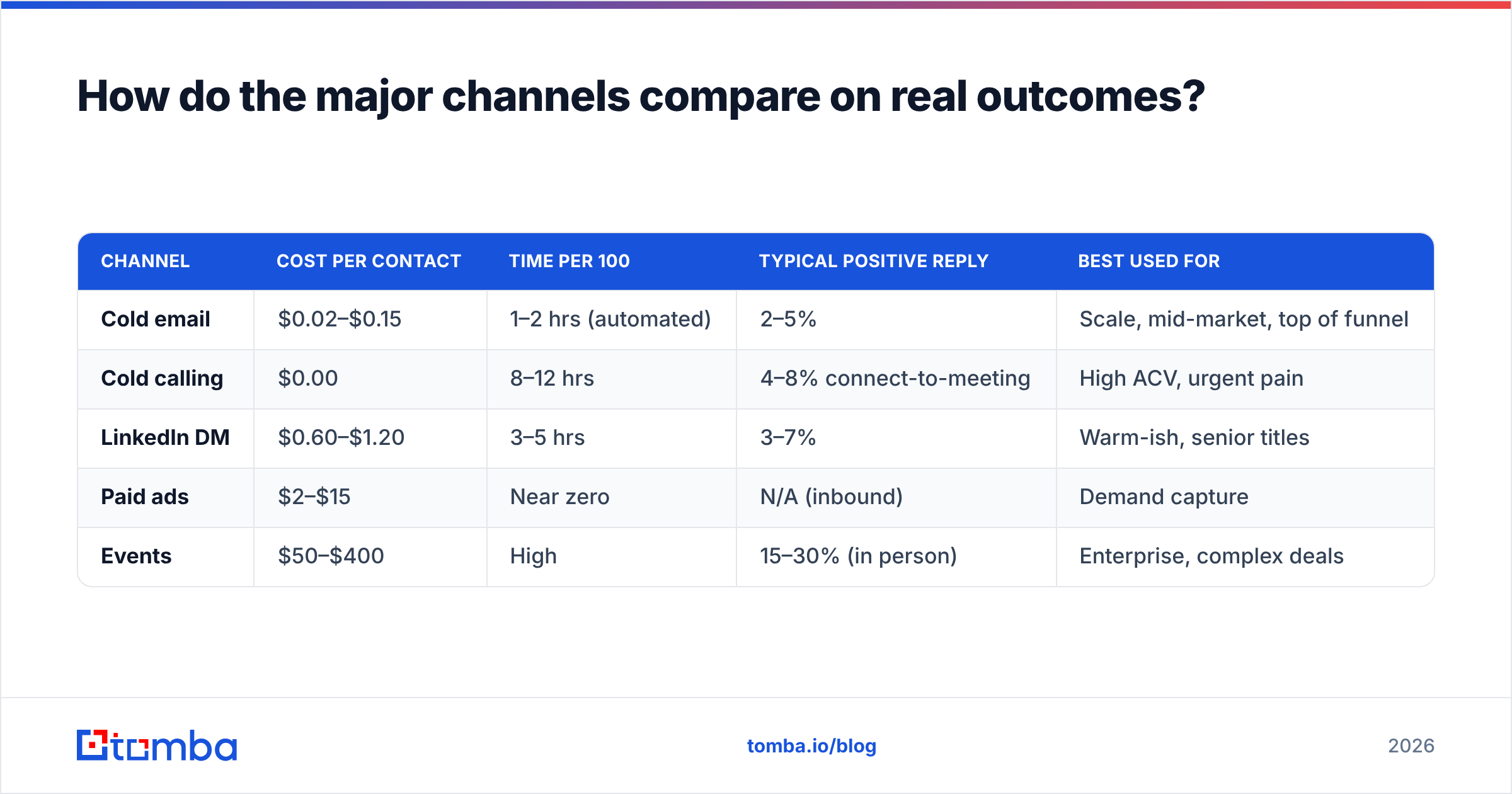
How do the major channels compare on real outcomes?#
Cold email doesn't exist in isolation. Judge it against what else your rep could be doing with the same hour.
| Channel | Cost per contact | Time per 100 | Typical positive reply | Best used for |
|---|---|---|---|---|
| Cold email | $0.02–$0.15 | 1–2 hrs (automated) | 2–5% | Scale, mid-market, top of funnel |
| Cold calling | $0.00 | 8–12 hrs | 4–8% connect-to-meeting | High ACV, urgent pain |
| LinkedIn DM | $0.60–$1.20 | 3–5 hrs | 3–7% | Warm-ish, senior titles |
| Paid ads | $2–$15 | Near zero | N/A (inbound) | Demand capture |
| Events | $50–$400 | High | 15–30% (in person) | Enterprise, complex deals |
Cold email wins on cost per contact by two orders of magnitude and loses on reply rate to every human-touch channel. That's the trade. The teams that get outsized results run email as the coverage layer and calls or DMs as the conversion layer on accounts that showed any signal at all.
Peer discussion on channel mix is worth reading before you commit budget — the sales engagement category on G2 surfaces unfiltered practitioner reviews, and HubSpot's marketing statistics roundup aggregates survey data across thousands of teams.
What should you fix first when results are bad?#
Triage in this exact order. Do not skip ahead; each step invalidates the measurement of the ones below it.
- Check bounce rate. Above 3%? Stop everything, verify the list, resume in a week. No other diagnosis is valid until this is clean.
- Check authentication. SPF, DKIM, DMARC all passing? Run a spam-score test on a live send. A spam checker catches the obvious triggers — link shorteners, spammy phrases, image-heavy HTML — in seconds.
- Check inbox placement. Send to seed accounts across Gmail, Outlook, and one corporate domain. If you're in Promotions or Junk, copy is irrelevant.
- Check segment fit. Run the A/B split from the previous section. Fix targeting before touching a single word.
- Check offer. Would a stranger understand what you're offering and why it's worth 30 minutes? Read your email aloud. If you need a second sentence to explain the first, cut both.
- Then, finally, check copy. Shorter. One ask. No calendar link in email one. No "hope this finds you well."
Teams that follow this order fix their results in two weeks. Teams that start at step 6 iterate on subject lines for six months while their domain reputation quietly rots.
What does a realistic 90-day trajectory look like?#
Set expectations before you start, because outbound has a slow-burn shape that punishes impatience.
- Days 1–14: Domain warmup, list build, verification. Results: zero. This is normal. Sending at volume now is the single most common way to destroy a campaign before it launches.
- Days 15–30: First sends at 20–40/day per inbox. Expect a 1–2% reply rate. You're gathering data, not booking meetings.
- Days 31–60: Segment on what replied. Kill the dead cohorts. Reply rate climbs to 3–5% on the survivors. First meetings land.
- Days 61–90: Scale the winning segment, add a second. Meeting-booked rate stabilizes around 0.5–1%. Now — and only now — is your cost-per-meeting number meaningful.
If someone promises you 30 meetings in month one, they are either lying or planning to burn a domain you'll have to replace.
Get the list right, and the results follow#
Every benchmark in this post collapses back to one input: are you emailing the right people at valid addresses? Copy, cadence, and tooling are downstream. A verified, tightly-segmented list of 500 will out-produce an unverified list of 50,000 on every metric that reaches your pipeline report — and it won't cost you your domain.
That's where Tomba's Email Finder fits. Build the list from domain, company, or name, get verified deliverable addresses with confidence scoring, and push clean records straight into your sequencer or CRM. The free tier covers 25 searches a month if you want to test the accuracy on accounts you already know; Starter runs $49/mo, Growth $99/mo, and Pro $249/mo when you're ready to scale — full details on the Tomba pricing page.
Start with 100 perfectly-targeted, fully-verified contacts. Measure the reply rate. Then decide what to scale.
Related guides#
Ready to find emails that actually work?
Join 150,000+ professionals who stopped guessing and started sending. Free credits on signup — no credit card required.
Get the Tomba newsletter
Practical outbound tactics and product updates — once every two weeks.
About the author