Cold Email Scripts: 12 Templates That Book Meetings in 2026
Most cold email scripts don't fail on the copy — they fail on the list, the ask, and the follow-up. Here are 12 scripts that still work in 2026, plus the benchmarks to judge them against.
TL;DR
- A cold email script is a reusable skeleton — trigger, relevance line, one ask — not a fill-in-the-blank template you blast to 5,000 people.
- Reply rates in 2026 cluster around 1–5% for generic sends and 8–15% for tightly-targeted, verified lists. The script is maybe 30% of that outcome.
- Short beats long. Scripts under 90 words consistently out-reply 150+ word scripts in the same sequence.
- Every script below assumes a verified, deduplicated list. Sending a great script to a 22% bounce list will land you in spam before anyone reads it.
- The 12 scripts here are grouped by trigger type: role-based, event-based, competitor-based, and re-engagement.
What is a cold email script, exactly?#
A cold email script is a reusable structure for a first-touch email to someone who has never heard of you. That's it. It is not a template in the mail-merge sense — the moment you treat it as Hi {{first_name}}, I saw {{company}} is doing great things, you've built a spam signature that thousands of other senders are also using.
Think of a script the way a stand-up comic thinks about a bit. The beats are fixed: setup, turn, punchline. The specific words change every night depending on the room. Your beats are:
- The trigger — the observable, dated reason you're emailing this person this week. A funding round, a job posting, a new integration, a competitor switch. Not "I saw your website."
- The relevance bridge — one sentence connecting that trigger to a problem you fix. This is where most scripts collapse into a pitch.
- The proof — one concrete number or named customer. Never a paragraph. Never an adjective.
- The ask — exactly one, and it should be smaller than "book a 30-minute call."
- The exit — permission to say no, in plain language.
Five beats. Under 90 words. That's the whole discipline.

Why do most cold email scripts fail?#
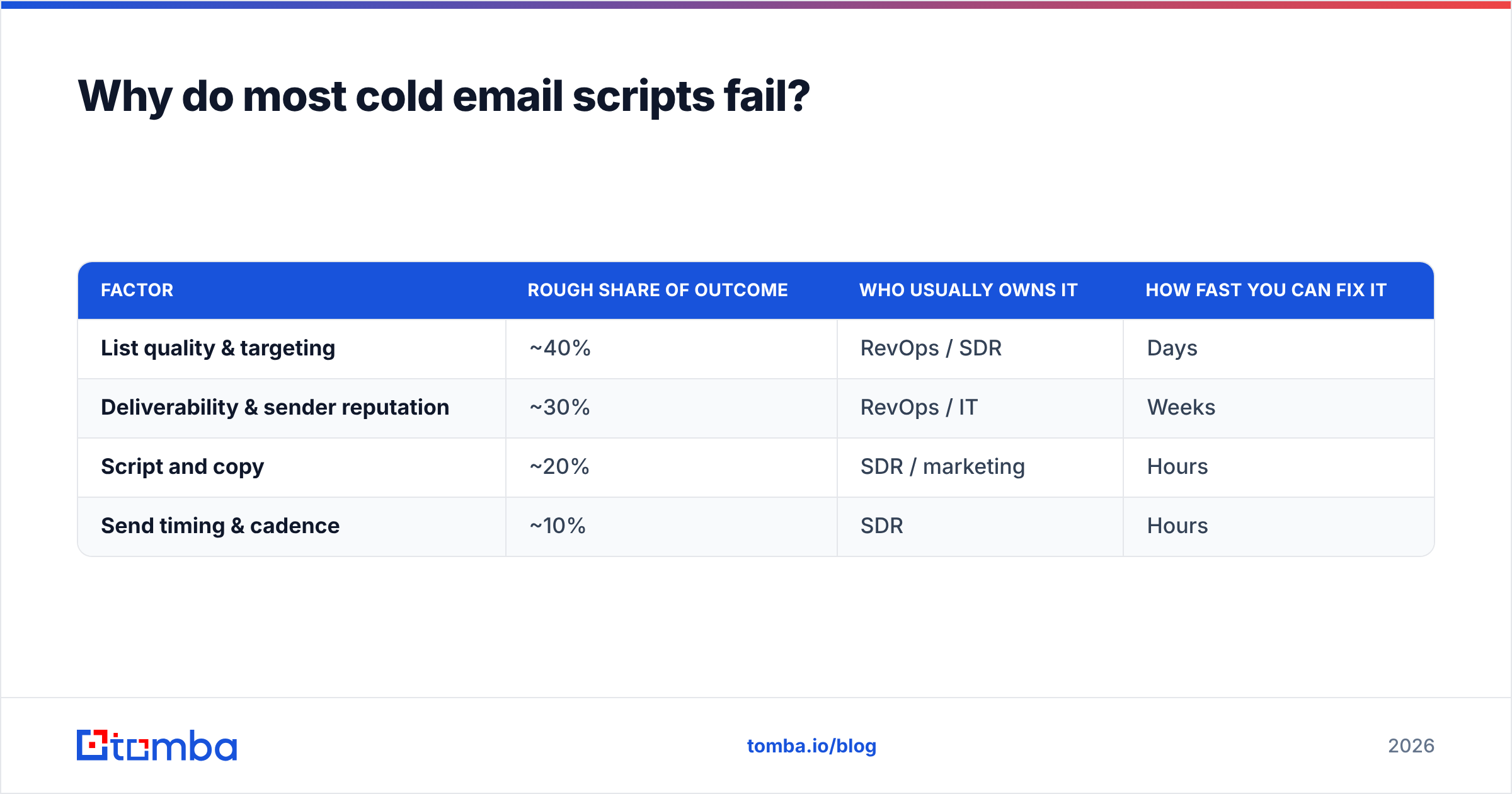
Because people debug the copy when the problem is upstream. Here's the honest breakdown of what determines whether a cold email gets a reply:
| Factor | Rough share of outcome | Who usually owns it | How fast you can fix it |
|---|---|---|---|
| List quality & targeting | ~40% | RevOps / SDR | Days |
| Deliverability & sender reputation | ~30% | RevOps / IT | Weeks |
| Script and copy | ~20% | SDR / marketing | Hours |
| Send timing & cadence | ~10% | SDR | Hours |
Read that table again. If your emails are landing in spam because your domain has no SPF alignment and your list has a 20% bounce rate, no cold email script on the internet will save you. Google and Yahoo's bulk sender requirements made this non-negotiable — sustained spam complaint rates above 0.3% will get you filtered regardless of how clever your first line is.
So before you touch a single word of copy, do these four things:
- Verify the list. Run every address through an email verifier and drop anything that isn't
valid. Target a bounce rate under 2%. - Handle catch-all domains separately. Roughly a third of B2B domains accept everything at the MX layer. A catch-all verifier tells you whether a mailbox is real behind the accept-all wall — otherwise you're guessing.
- Check your SPF, DKIM, and DMARC records. A free SPF checker takes thirty seconds.
- Cap sends per mailbox. 30–50/day per inbox on a warmed domain. More than that and providers start treating you like a list-blaster, because you are one.
Only then does the script matter.
What does a good cold email script look like structurally?#
Here's the skeleton every script below follows, annotated:
Subject: [3–5 words, lowercase, no pitch]

[Trigger — dated, specific, verifiable]
[Bridge — one sentence, their problem not your product]
[Proof — one number or one named logo]
[Ask — one question, low commitment]

[Name]
Two rules people break constantly:
- The subject line is not a headline. "quick question about your Q3 hiring" beats "Transform Your Sales Pipeline with AI." Lowercase, short, and boring wins because it looks like an internal email. If you want to pressure-test one, a subject line tester will flag the spam-triggering phrases you've gone blind to.
- The ask must be answerable in one word. "Worth a look?" "Are you the right person?" "Should I send it?" The moment your CTA requires opening a calendar, you've added friction to an email from a stranger.
Which cold email scripts actually work in 2026?#
Twelve scripts, grouped by trigger. Adapt the specifics — the beats stay fixed.
Role-based triggers#
1. The new-hire script
Subject: your first 90 days
Congrats on the VP Ops role at Northwind — saw the announcement last Tuesday.
New ops leaders usually inherit a reporting stack nobody documented.
We rebuilt that for Acme's ops team in 11 days; their weekly close went from 6 hours to 40 minutes.
Want the 11-day breakdown? One reply and I'll send it.
2. The job-posting script
Subject: your SDR req
You're hiring three SDRs in Austin — I read the req this morning.
Most teams that scale SDR headcount hit a data problem before a talent problem.
Ramp time at Brightline dropped from 90 days to 52 once their reps stopped hand-building lists.
Is list-building the bottleneck for you, or is it something else?
3. The "wrong person" script
Subject: right person?
Ellen — I'm trying to reach whoever owns outbound data quality at Kestrel.
If that's you, I have a two-minute thing. If not, who should I ask?
No pitch either way.
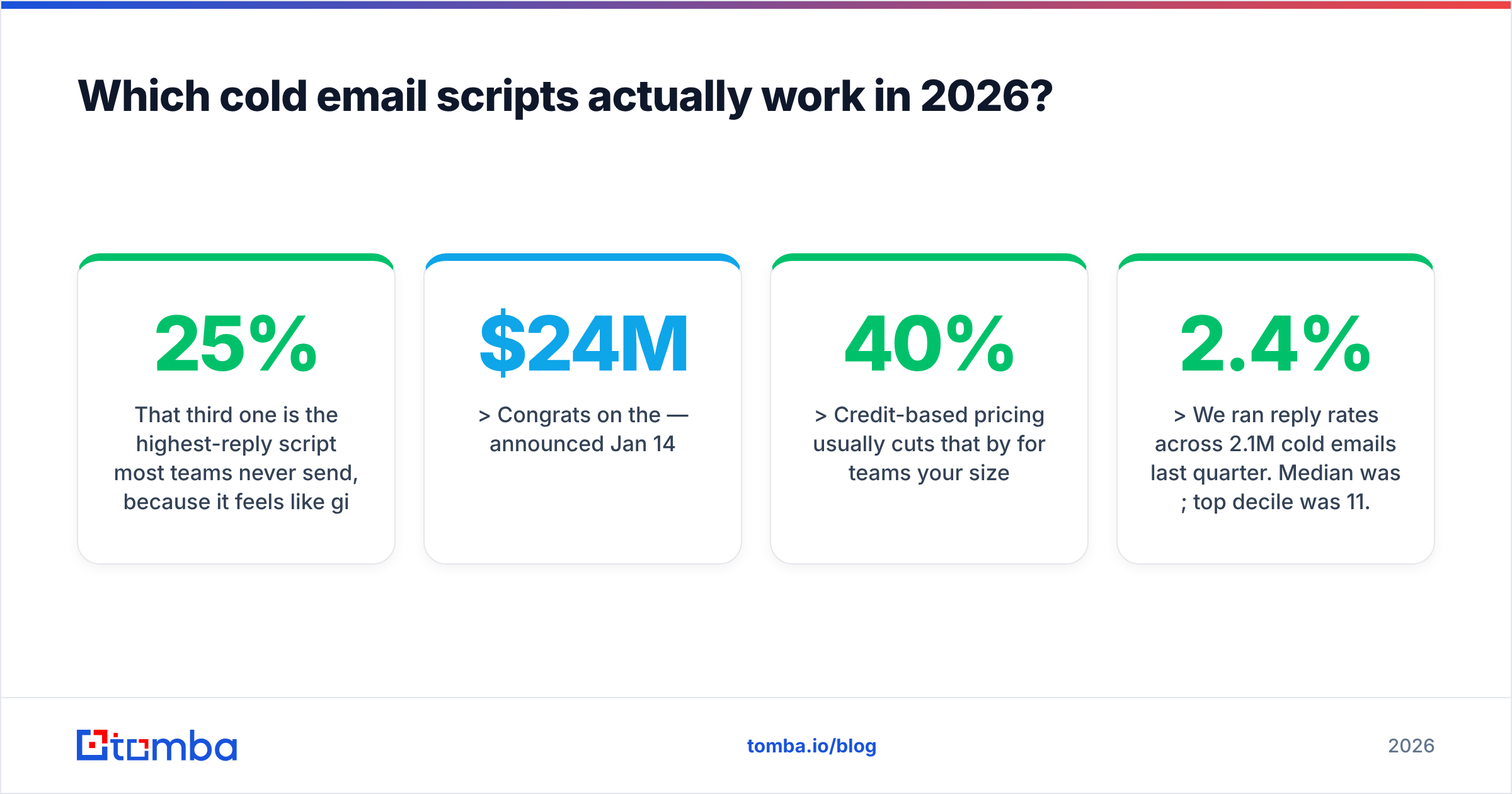
That third one is the highest-reply script most teams never send, because it feels like giving up. It isn't. It converts at 15–25% because it costs the recipient almost nothing to answer.
Event-based triggers#
4. The funding script
Subject: post-Series B
Congrats on the $24M — announced Jan 14.
The quarter after a B round is when outbound targets get set by people who weren't in the room for them.
Two of our customers doubled pipeline coverage in the first quarter post-raise without adding reps.
Worth 10 minutes before your Q2 planning locks?
5. The product-launch script
Subject: the new API tier
You shipped the public API last week — the changelog entry was clear, which is rare.
Developer-facing launches usually create a support-volume spike nobody staffed for.
Want to see how Loop handled theirs?
6. The conference script
Subject: SaaStr booth
You're speaking at SaaStr on pipeline forecasting — Thursday, 2pm track.
I'm not going, but I'd steal fifteen minutes of the same conversation.
Free next week?
Competitor-based triggers#
7. The switcher script
Subject: moving off Clearbit
Noticed Kestrel's careers page still runs the old enrichment snippet.
Teams migrating enrichment usually eat two weeks of broken CRM fields.
We've done 40+ of those migrations without a field breaking.
Want the migration checklist? Free, no call needed.
8. The pricing-shock script
Subject: seat-based pricing
If your data tool bills per seat, you're paying for the ops person who logs in twice a month.
Credit-based pricing usually cuts that by 40% for teams your size.
Should I send the math?
9. The tech-stack script
Subject: HubSpot + your enrichment
Your site loads HubSpot and a scraper script, but no enrichment vendor I recognize.
That combination usually means someone is pasting LinkedIn URLs into a spreadsheet on Fridays.
Am I close?
That last line — "am I close?" — is the single best CTA in cold email. It invites a correction, and people love correcting strangers.
Re-engagement triggers#
10. The break-up script (that isn't manipulative)
Subject: closing the loop
I've sent three emails and gotten silence, which is a fair answer.
I'll stop here. If outbound data ever becomes a Q3 problem, this thread is easy to find.
11. The value-only follow-up
Subject: the benchmark you asked about
We ran reply rates across 2.1M cold emails last quarter. Median was 2.4%; top decile was 11.8%.
Full breakdown here, no gate.
That's the whole email.
12. The internal-referral script
Subject: Marcus said to email you
Marcus in your RevOps team mentioned you own SDR tooling.
He said list quality is the current fight.
Is that still true?
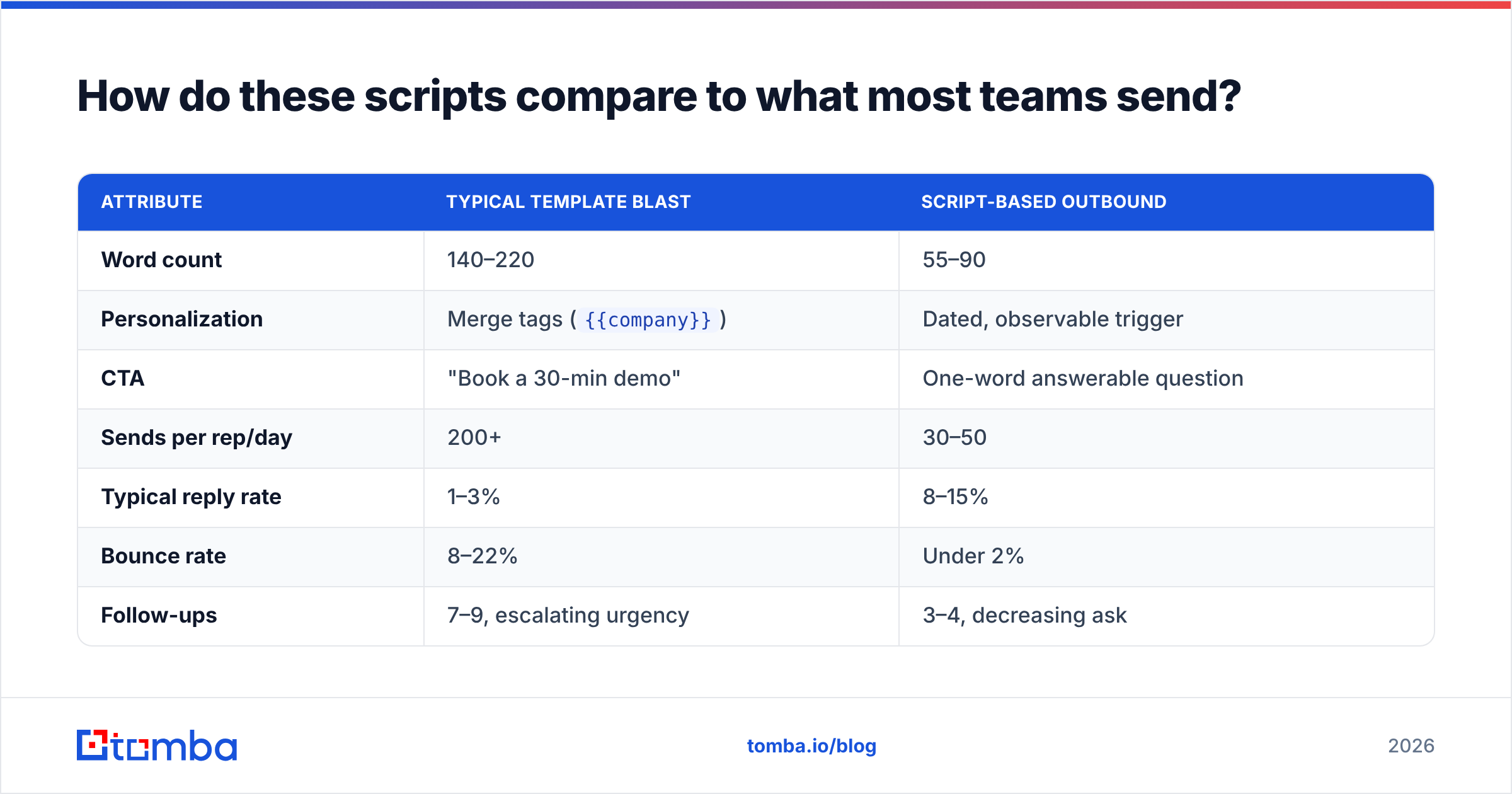
How do these scripts compare to what most teams send?#
| Attribute | Typical template blast | Script-based outbound |
|---|---|---|
| Word count | 140–220 | 55–90 |
| Personalization | Merge tags ({{company}}) |
Dated, observable trigger |
| CTA | "Book a 30-min demo" | One-word answerable question |
| Sends per rep/day | 200+ | 30–50 |
| Typical reply rate | 1–3% | 8–15% |
| Bounce rate | 8–22% | Under 2% |
| Follow-ups | 7–9, escalating urgency | 3–4, decreasing ask |
| Spam complaint rate | 0.3%+ | Under 0.1% |
The trade you're making is volume for reply rate — and the math almost always favors the script. Fifty emails at 12% beats 250 at 2%, and it doesn't burn the domain you'll need next quarter.
How many follow-ups should a cold email sequence have?#
Three to four, and each one should ask for less than the last.
- Email 1 — trigger + one ask ("worth a look?")
- Email 2 (day 3) — one new piece of proof, no re-pitch ("here's the number I mentioned")
- Email 3 (day 8) — the wrong-person check ("should I be talking to someone else?")
- Email 4 (day 15) — the break-up, no guilt
Escalating urgency ("just bumping this to the top of your inbox!!") is the fastest way to train someone to mark you as spam. Gartner's B2B buying research has been consistent for years: buyers spend a fraction of their journey with any vendor, and they resent being chased through it.
What data do you need before any of this works?#
Every script above depends on two things you cannot fake: a real email address and a real trigger.
For the address — build the list from the company outward, not from a bought CSV inward. Run a domain search on the accounts in your ICP, pull the roles that match, then verify. If you're sourcing from LinkedIn, a LinkedIn finder resolves profile URLs to verified work addresses without the copy-paste ritual. For volume, bulk verify before the list ever touches your sending tool.
Purchased databases can work as a starting layer — vendors like BookYourData maintain solid human-verified B2B records, and pairing a static database with live verification at send time is a legitimate pattern. What doesn't work is treating any list, bought or built, as verified because it was verified once, in March, by someone else. B2B data decays around 2.5% per month. A list you scraped in January is a different list in July.
For the trigger — set up alerts. Job boards, funding announcements, changelogs, G2 review pages. If you can't name a dated reason you're emailing someone this week, don't email them this week. That's not a productivity rule, it's a deliverability rule: irrelevant email generates complaints, and sender reputation is the only asset in outbound you can't buy back.
What should you measure?#
Four numbers, in this order:
- Bounce rate — under 2%, or stop sending immediately and re-verify.
- Reply rate — the real metric. Open rates have been noise since Apple Mail Privacy Protection started pre-fetching pixels; treat them as directional at best.
- Positive reply rate — replies that aren't "unsubscribe" or "wrong person." This is what you actually optimize.
- Meetings booked per 100 sent — the only number your CRO cares about. One per 100 is respectable. Three per 100 means your list is excellent.
Test one variable at a time. Change the subject line for two weeks. Then the trigger. Then the CTA. Changing all three at once and celebrating a lift teaches you nothing.
The honest verdict#
Cold email scripts are a solved problem. The five beats have been stable for a decade, and the twelve scripts above are variations on the same skeleton that worked in 2016. What changed is the cost of getting the list wrong. Filtering is stricter, complaint thresholds are enforced, and a burned domain takes months to rehabilitate.
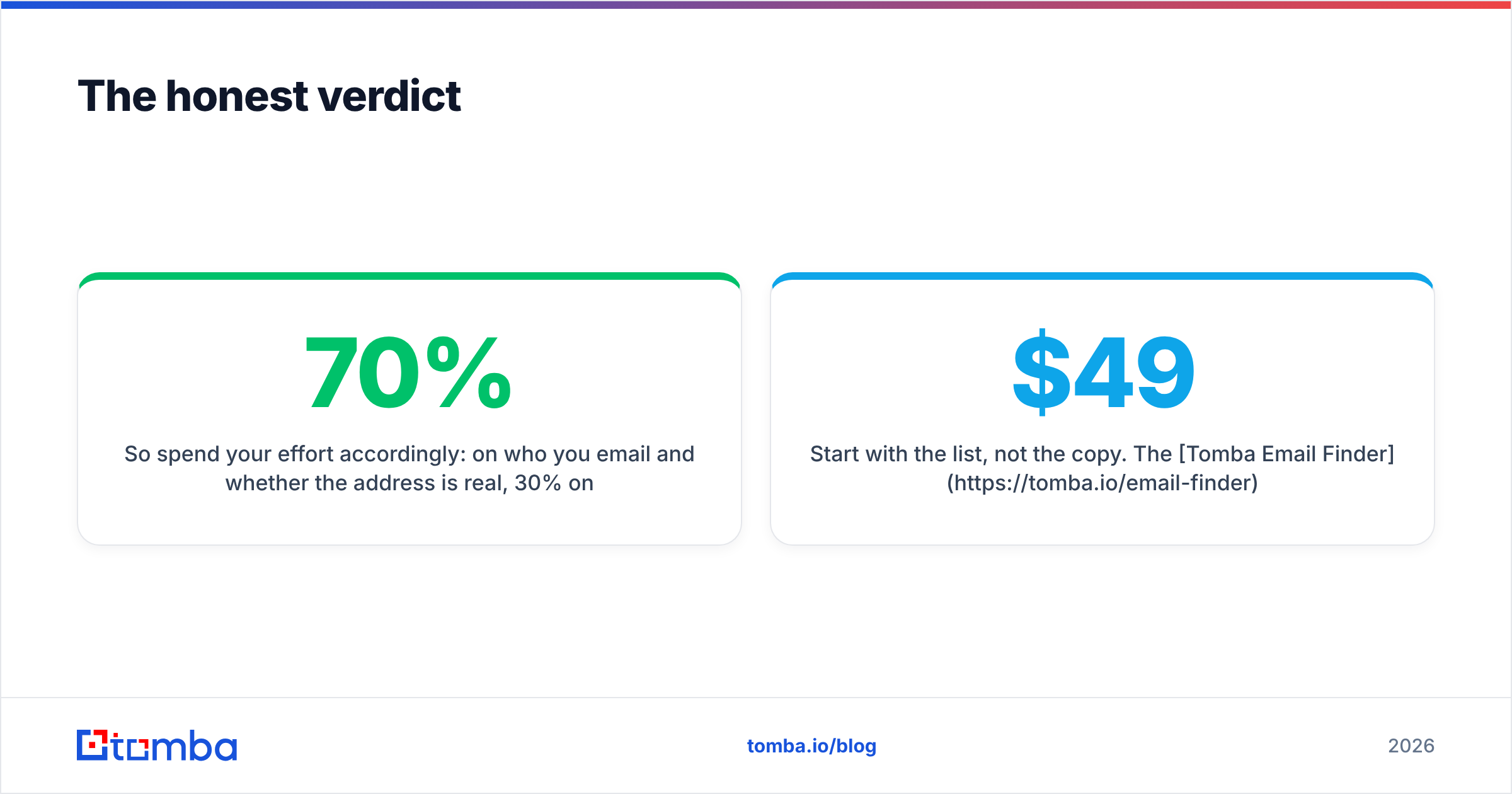
So spend your effort accordingly: 70% on who you email and whether the address is real, 30% on what you say. Teams that get this ratio backwards write beautiful emails into a void.
Start with the list, not the copy. The Tomba Email Finder resolves names and domains into verified work emails with a confidence score attached, so your scripts land in inboxes instead of bouncing. The free tier gives you 25 searches a month to test it against a list you already have; paid plans start at $49/mo. Check the pricing details if you're scaling past that — and verify before you send, every time.
Related guides#
// get started
Find, verify and enrich your first contacts today
Start on the free plan with 25 searches a month, then scale when your team is ready.
Free plan · No credit card required · GDPR & CCPA
// about the author