Cold Email Template for Digital Marketing: 7 That Work in 2026
Most agency cold emails die because they pitch services instead of proving a gap. Here are seven cold email templates for digital marketing teams, the subject lines that carry them, and the data hygiene that keeps them out of spam.
TL;DR
- A cold email template for digital marketing only works when it leads with a specific observed gap — a broken meta description, a competitor outranking them, a paid ad with no landing page match — not with your agency's list of services.
- Seven templates below cover the realistic angles: audit-first, competitor gap, trigger event, case-study proof, referral, low-friction ask, and breakup.
- Subject lines carry 30-40% of the outcome. Keep them under 45 characters, lowercase, and about the prospect.
- Templates fail on bad data before they fail on bad copy. A 12% bounce rate kills the domain that would have delivered your best-performing email.
- Send three touches over eleven days, then stop. Sequences past four emails on cold traffic mostly generate spam complaints.
What makes a cold email template for digital marketing different?#
Digital marketing is the most saturated cold email category on earth. Your prospect — a founder, a CMO, a head of growth — receives somewhere between four and fifteen agency pitches per week. Every one of them says the same three things: we do SEO, we do paid, we do content, and we'd love fifteen minutes.
That's the actual problem. Not deliverability, not the CTA, not the send time. The problem is that a marketing-services email arrives in an inbox that has already been trained, over hundreds of repetitions, to pattern-match "agency pitch" and archive on sight.
So a cold email template for digital marketing has one job that other templates don't: it must prove, in the first two sentences, that you looked at their marketing before you wrote. Not "I checked out your website" — everyone says that. Something only someone who actually looked would know.
The good news is that marketing is unusually observable. You can see their organic rankings, their ad copy, their page speed, their schema markup, their email capture flow, their LinkedIn cadence. Every one of those is a legitimate, verifiable hook. In almost no other industry do you get that much free intelligence before the first email.

What does the anatomy of a high-performing template look like?#
Every template below is built from the same six components. Get these right and the specific wording matters less than you think.
- The observed hook (sentence one). One concrete, checkable fact about their marketing. "Your /pricing page is ranking #14 for 'project management software pricing'" beats "I noticed you're in the SaaS space."
- The implication (sentence two). Translate the fact into money or risk. Rankings become traffic; traffic becomes pipeline. Never leave the prospect to do this math.
- The proof (one line, one number). A comparable client, a comparable result, a timeframe. Skip the logo wall.
- The ask (one sentence, low commitment). "Worth a look?" outperforms "Do you have 15 minutes Tuesday at 2pm?" on cold traffic, because it asks for interest, not calendar space.
- The exit. Make it easy to say no. "If you've already got this handled, just say so and I'll close the loop."
- The signature. Name, one-line role, no banner, no logo image, no legal footer. Every image is a deliverability tax.
Total: 70 to 110 words. If your draft is longer than that, you're pitching, not prospecting.
Which cold email template should you use?#
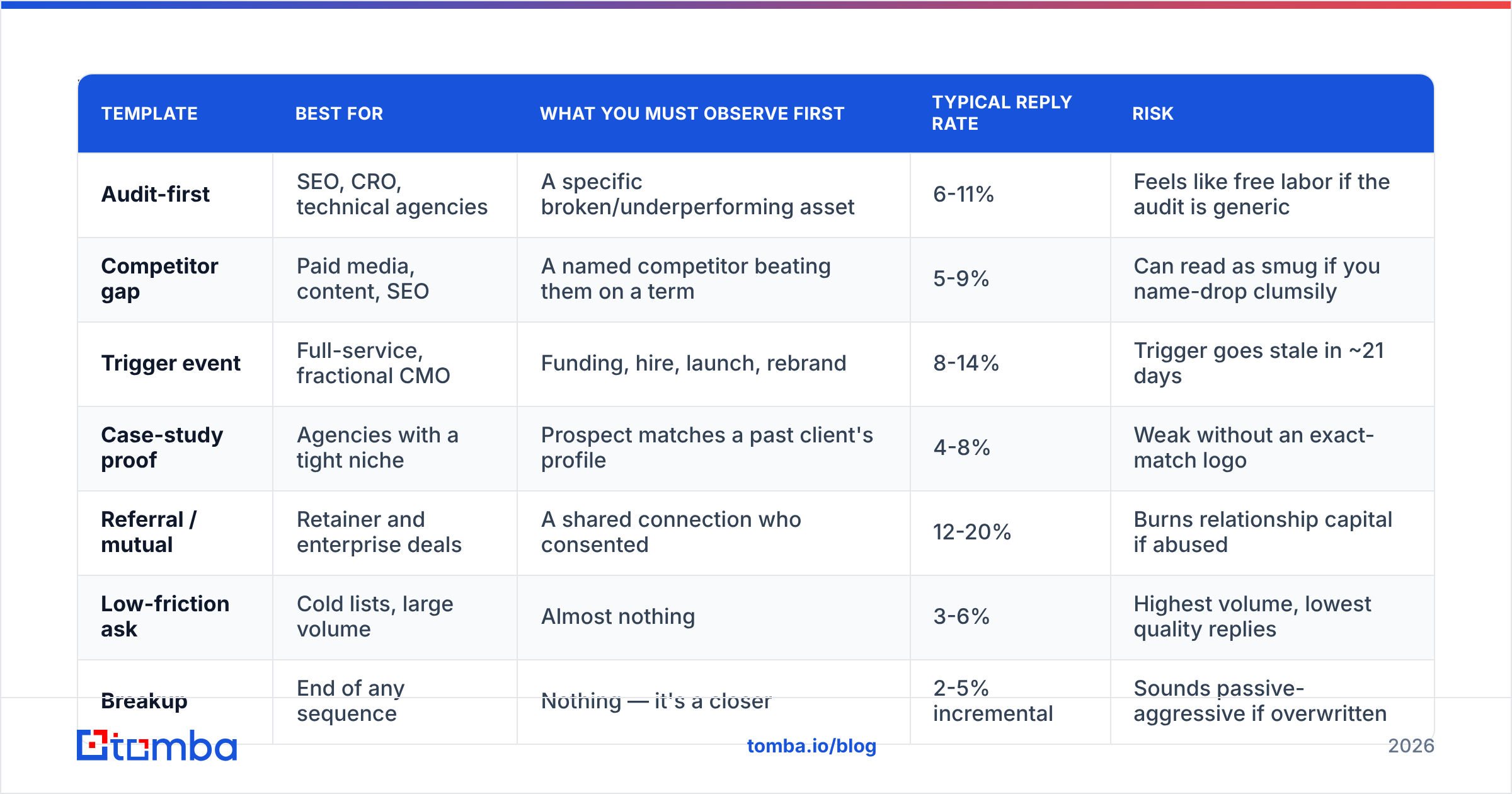
Match the template to what you can actually observe. Here's the decision table.
| Template | Best for | What you must observe first | Typical reply rate | Risk |
|---|---|---|---|---|
| Audit-first | SEO, CRO, technical agencies | A specific broken/underperforming asset | 6-11% | Feels like free labor if the audit is generic |
| Competitor gap | Paid media, content, SEO | A named competitor beating them on a term | 5-9% | Can read as smug if you name-drop clumsily |
| Trigger event | Full-service, fractional CMO | Funding, hire, launch, rebrand | 8-14% | Trigger goes stale in ~21 days |
| Case-study proof | Agencies with a tight niche | Prospect matches a past client's profile | 4-8% | Weak without an exact-match logo |
| Referral / mutual | Retainer and enterprise deals | A shared connection who consented | 12-20% | Burns relationship capital if abused |
| Low-friction ask | Cold lists, large volume | Almost nothing | 3-6% | Highest volume, lowest quality replies |
| Breakup | End of any sequence | Nothing — it's a closer | 2-5% incremental | Sounds passive-aggressive if overwritten |
Reply rates above are directional ranges from agency outbound programs — treat them as a target, not a promise. Your list quality moves them more than your copy does. If you want a formal definition of what you're measuring, Tomba's glossary entry on response rate draws the line between replies, positive replies, and meetings booked, which most agencies conflate.
What are the seven templates?#
Template 1 — The audit-first email (SEO and technical agencies)#
Subject: title tag on /pricing
Hi {{FirstName}},
Your /pricing page has the same title tag as your homepage, so Google's treating them as near-duplicates. It's sitting at #14 for "{{keyword}}" — page one for that term gets roughly {{n}} searches a month in {{country}}.
We fixed the same collision for {{ClientName}} and their pricing page moved to #4 in seven weeks.
Want me to send the two other duplicates I found? No pitch, just the list.
— {{YourName}}, {{Agency}}
Why it works: the hook is falsifiable. If you're wrong, they'll tell you — which is still a reply. The ask is for permission to send more free information, which is the cheapest yes in outbound.
Template 2 — The competitor gap email (paid media and content)#
Subject: {{Competitor}} is outbidding you
Hi {{FirstName}},
{{Competitor}} is running four ads on "{{keyword}}" right now. You're not bidding on it, and it's your own product category.
Their landing page is thin — no pricing, no comparison table. That's a gap, not a moat.
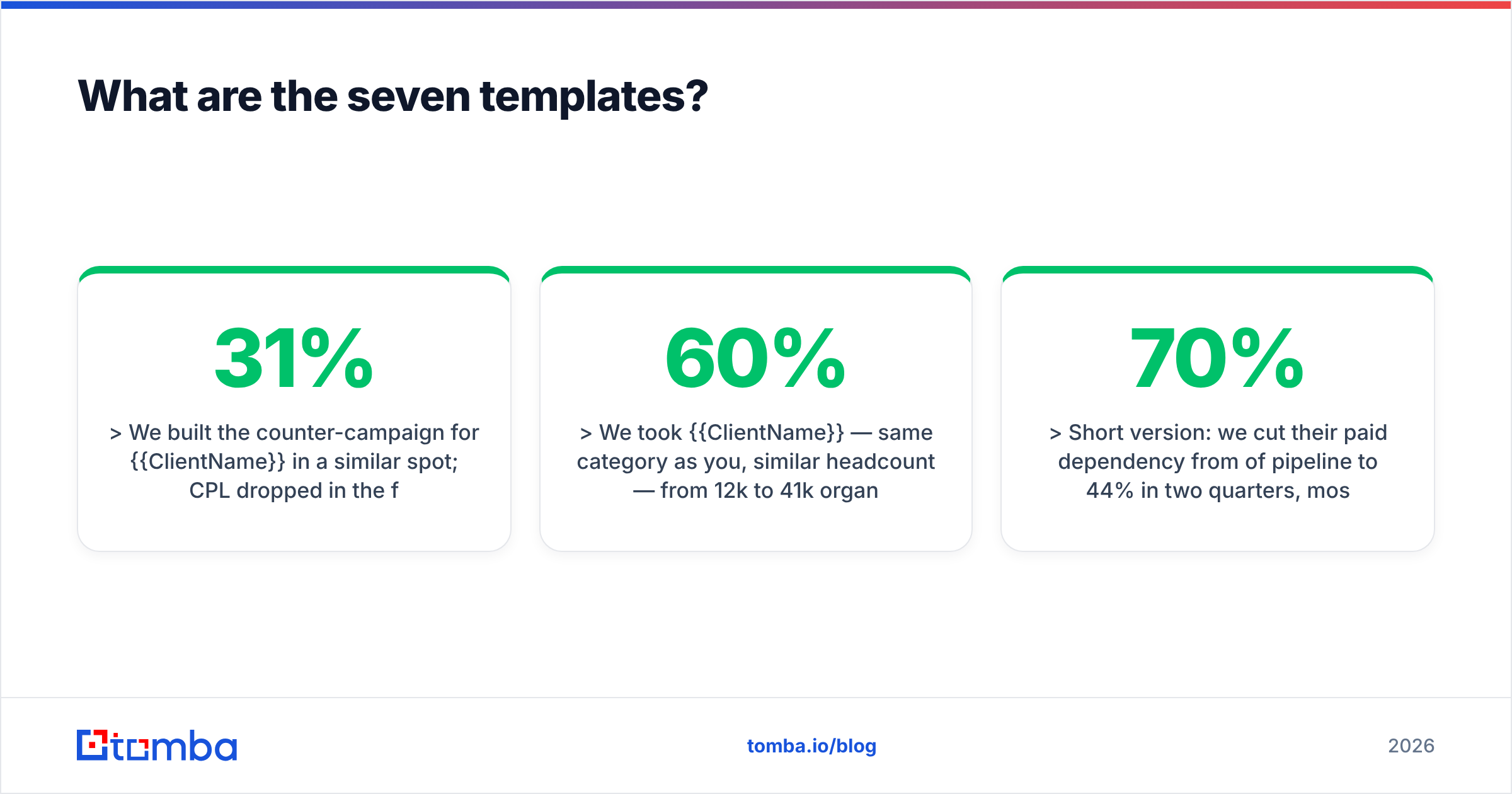
We built the counter-campaign for {{ClientName}} in a similar spot; CPL dropped 31% in the first month because we weren't fighting for brand terms.
Worth a look at the ad copy I pulled?
— {{YourName}}
Rule: name one competitor, never three. Three reads like you ran a report. One reads like you were paying attention.
Template 3 — The trigger event email (highest reply rate)#
Subject: congrats on the Series A — one thing
Hi {{FirstName}},
Saw the {{Round}} announcement. Congrats.
Most teams at your stage double the paid budget before the site can handle it — your product pages are at a 4.1s LCP on mobile, which usually means about a third of that new spend leaks before the form.
We handled exactly this for {{ClientName}} right after their Series A.
Want the page-speed breakdown?
— {{YourName}}
Triggers decay. A funding round is worth emailing about for roughly three weeks; after that you're the fortieth agency to send congratulations, and the congratulations itself becomes the tell.
Template 4 — The case-study proof email#
Subject: {{ClientName}} → {{result}}
Hi {{FirstName}},
We took {{ClientName}} — same category as you, similar headcount — from 12k to 41k organic sessions in nine months. Two things did it: a content model built around bottom-funnel comparison pages, and killing 60% of their old blog.
The second one is the part nobody wants to hear.
If growing organic is on the {{Quarter}} list, I'll send the teardown.
— {{YourName}}
This template only fires when the proof is close enough that the prospect sees themselves in it. A DTC skincare result sent to a B2B fintech CMO is noise.
Template 5 — The referral / mutual connection email#
Subject: {{MutualName}} suggested I reach out
Hi {{FirstName}},
{{MutualName}} mentioned you're rebuilding the demand gen motion this year and thought our lifecycle work at {{ClientName}} might be relevant.
Short version: we cut their paid dependency from 70% of pipeline to 44% in two quarters, mostly by fixing the nurture sequence nobody owned.
Happy to walk through what applied. Or I'll leave it here — your call.
— {{YourName}}
Only send this when the referral is real and the referrer knows. Fabricating a mutual connection is the fastest way to get an agency blacklisted in a tight vertical.
Template 6 — The low-friction ask (volume plays)#
Subject: wrong person?
Hi {{FirstName}},
Quick one — are you the right person for {{Channel}} at {{Company}}, or should I be talking to someone else?
We help {{ICP}} teams with {{one specific outcome}}. Two sentences on that if you're the right door.
— {{YourName}}
Twelve seconds to read, five seconds to answer. It generates a lot of "that's Sarah" replies, which is a routing win rather than a sales win — but a routed name converts far better on the second touch.
Template 7 — The breakup email#
Subject: closing your file
Hi {{FirstName}},
I've sent three notes about {{specific gap}} and haven't heard back, which is a fair answer.
I'll stop here. If it becomes a priority in Q{{n}}, the audit is yours whenever you want it.
— {{YourName}}
No guilt, no "just following up one last time!!", no emoji. The breakup email earns its keep because it's the only email in the sequence that asks for nothing.
Do cold email templates still work in 2026?#
Yes, but the margin is thinner than it was three years ago. Two things changed.
First, Google and Microsoft tightened bulk-sender enforcement. Authentication is no longer optional — SPF, DKIM, and DMARC all have to align, and complaint rates above 0.3% get you throttled quietly rather than bounced loudly. Run an SPF checker before your first send, not after your reply rate tanks.
Second, prospects got better at recognizing merge tags. {{FirstName}}, I loved your post about {{Topic}} is now a tell, not a compliment, because everyone can see the seams of a personalization variable that pulled the wrong noun. The templates above survive because their variables are facts you had to go find — a title tag, an ad, a page-speed score — not fields an LLM guessed from a company description.
The counterintuitive result: templates got better, and personalization-at-scale got worse. A rigid template with one hand-checked observation beats a fluid AI-written email with four shallow ones. HubSpot's sales blog has been making a version of this argument for years, and the volume-first crowd has spent the same years proving them right by accident.
Why does data quality decide the template's fate?#
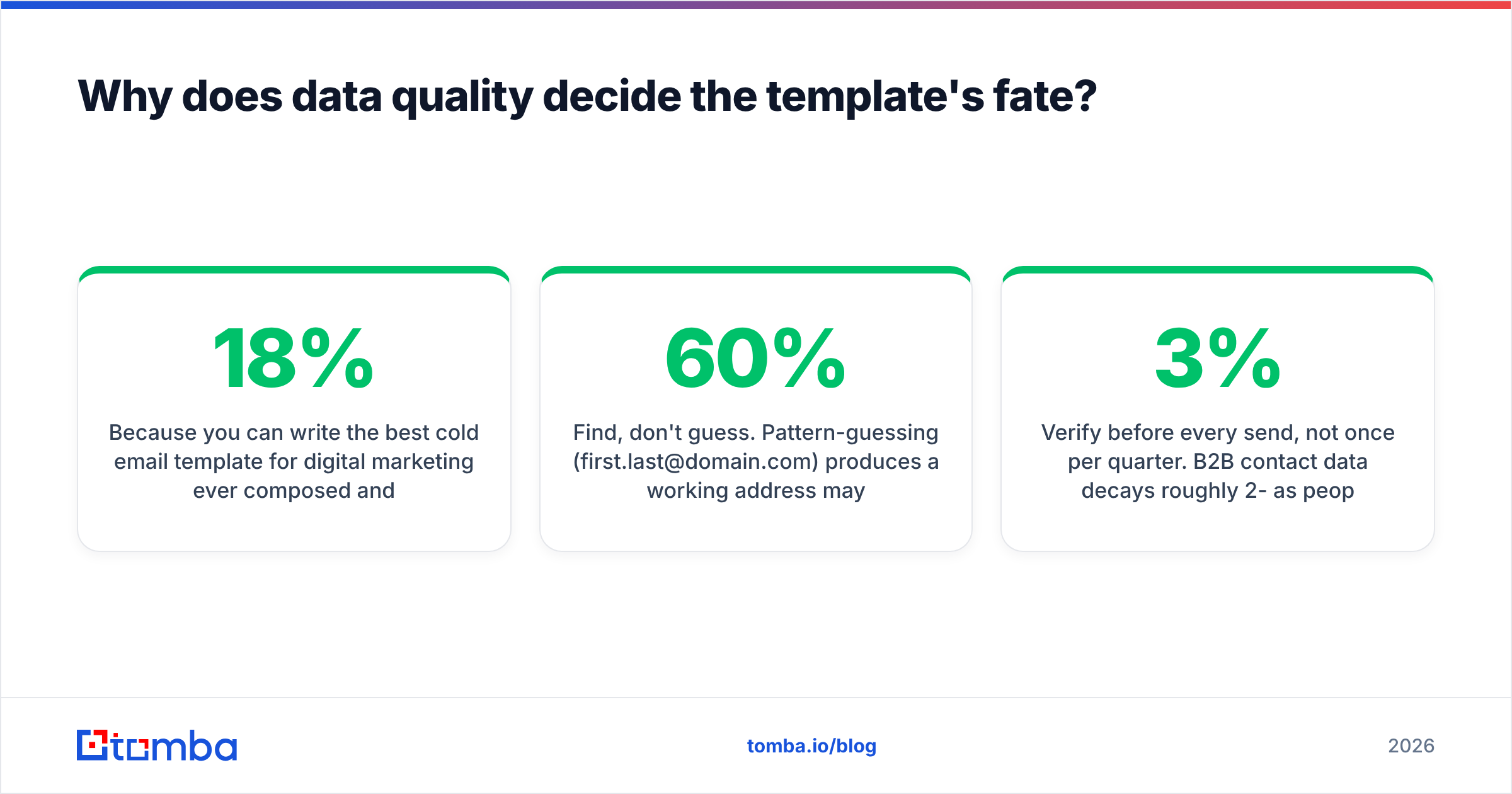
Because you can write the best cold email template for digital marketing ever composed and it will produce zero meetings if 18% of the addresses bounce.
Here's the mechanic most agencies never internalize. Mailbox providers score your domain on a rolling basis. A single send with a high bounce rate depresses that score for weeks. Your best email — the one to the CMO who was genuinely in-market — lands in spam not because of what it said, but because of the twenty dead addresses you emailed the previous Tuesday.

The fix is unglamorous and takes ten minutes:
- Find, don't guess. Pattern-guessing (
first.last@domain.com) produces a working address maybe 60% of the time. An email finder that checks the address against known sources gets you materially higher, and tells you when it doesn't know. - Verify before every send, not once per quarter. B2B contact data decays roughly 2-3% per month as people change roles. A list verified in January is meaningfully rotten by June. Run it through an email verifier at send time.
- Handle catch-all domains separately. Catch-all servers accept everything, so a standard verifier returns "unknown." Segment these into their own send with tighter volume, or resolve them with a dedicated catch-all verifier before they poison an otherwise clean batch.
- Cap daily volume per mailbox. Forty to sixty cold sends per inbox per day. Not two hundred. The template doesn't matter above that ceiling.
If you'd rather buy a list than build one, established providers like BookYourData sell verified B2B contacts with bounce guarantees, which is a legitimate path — particularly for niches where firmographic filtering matters more than headcount. Just verify on arrival regardless of the guarantee, because decay starts the moment the file is exported. The vendor landscape is well documented on G2's sales intelligence category if you want to compare bounce SLAs side by side.
How should you sequence the follow-ups?#
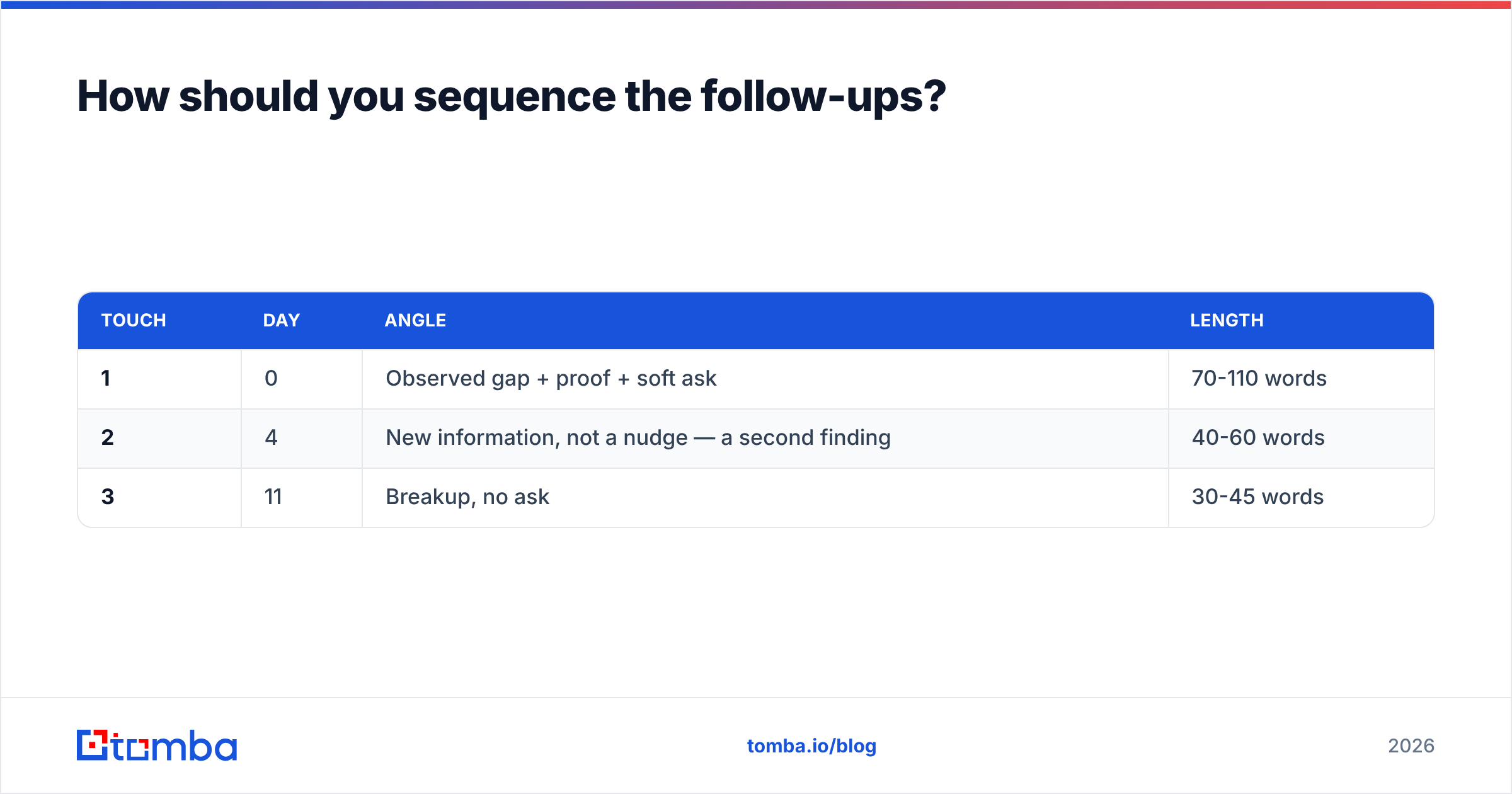
Three touches, eleven days, then stop.
| Touch | Day | Angle | Length |
|---|---|---|---|
| 1 | 0 | Observed gap + proof + soft ask | 70-110 words |
| 2 | 4 | New information, not a nudge — a second finding | 40-60 words |
| 3 | 11 | Breakup, no ask | 30-45 words |
The rule that matters is touch two. "Just bumping this to the top of your inbox" is not a follow-up; it's a confession that you had nothing to add. Every follow-up must carry a new fact. If you ran out of facts, you didn't research enough to send touch one.
Subject lines for the sequence should stay in-thread for touches two and three. New subject lines on follow-ups reset the thread context and make the sequence read as three separate strangers. If you're testing openers, run them through a subject line tester before you commit a whole send to them — spam-trigger words in agency outreach ("free audit," "guaranteed rankings," "10x your traffic") are a well-mapped minefield.
What are the mistakes that kill agency cold emails?#
- Attaching a deck. Attachments on cold email are a spam signal and nobody opens them.
- Three CTAs. "Reply, or book here, or check out our case studies" gives the prospect a decision to make. One ask.
- The word "leverage." Also "synergy," "circle back," "touch base." They mark you as a template user, which is exactly the perception the template exists to avoid.
- Sending Monday 9am. Everyone's automation fires then. Tuesday through Thursday, 7-8am local, clears a lot of competition.
- Personalizing the wrong layer. Referencing their podcast appearance is charming; referencing their broken canonical tag is relevant. Relevance converts.
- Not tracking positive replies separately. Open rates are close to meaningless now that privacy proxies pre-fetch images. Positive reply rate is the only number worth optimizing.
What should you do next?#
Pick one template. Pick fifty prospects. Spend twenty minutes finding one real, checkable observation per prospect — not fifty minutes on copy. Send Tuesday morning, follow up Friday, break up the following week. Measure positive replies, not opens.
Then fix the layer underneath the copy. Templates are the visible part; the list is the part that decides whether anyone sees them. If you're building agency prospecting lists by hand, or worse, guessing email patterns and hoping, start with Tomba's Email Finder — it resolves professional addresses from a name and domain, flags catch-all servers before they bounce, and gives you 25 free searches a month to test whether your template is the problem or your data was. Paid plans start at $49/mo on Tomba's pricing if you scale past that.
Write the observation. Verify the address. Send eleven days of discipline. That's the whole method.
Related guides#
// get started
Find, verify and enrich your first contacts today
Start on the free plan with 25 searches a month, then scale when your team is ready.
Free plan · No credit card required · GDPR & CCPA
// about the author