Cold Email Template for Social Media Marketing That Books Calls
Most agency cold emails die because they lead with services instead of evidence. Here are the templates, sequences, and list-hygiene rules that actually get social media marketers on calls in 2026.
TL;DR
- The best cold email template for social media marketing is not a template at all — it's a three-part structure: a specific observation, one proof point, and a low-friction ask.
- Agency emails fail for two reasons: they pitch services nobody asked for, and they land in a shared inbox nobody reads.
- A verified contact list beats better copy. A 12% bounce rate will cap your reply rate no matter how sharp your first line is.
- Three templates below cover the three situations you actually face: the audit hook, the competitor gap, and the content-signal reply.
- Four touches over 14 days, each shorter than the last, outperforms a single long pitch by a wide margin.
Why do most cold emails from social media marketers get deleted?#
Because they read like a capabilities deck compressed into 200 words.
Here's the archetype, and you've sent it:
"Hi Sarah, I'm the founder of BrightReach, a full-service social media agency specializing in content strategy, community management, and paid social. We've helped brands like X, Y, and Z grow their following by 300%. Would you be open to a quick 15-minute call this week to discuss how we can help?"
Nothing in that email is about Sarah. It's about you. The prospect's brain does a fast cost-benefit check — "does this person know anything about my situation?" — gets a no, and archives.
The second failure is structural. You sent it to info@ or marketing@, or you guessed sarah@company.com when the company uses s.chen@company.com. Guessed addresses either bounce (which hurts your sender reputation) or land in a mailbox monitored by an office manager whose job is to delete things like your email.
Fix the second problem first. It's mechanical. Then fix the copy.
What is a cold email template for social media marketing, structurally?#
A working template is a scaffold with four fixed slots and one variable slot. The variable slot is where the research goes, and it's the only part that changes per prospect.
- The observation (1–2 sentences). Something specific and checkable about their social presence. Not "I love your brand." Something like "your TikTok posts three times a week but the Instagram Reels are reposts of the same cuts, two days later."
- The implication (1 sentence). Why the observation matters in revenue or effort terms. "That's fine for reach, but Reels watch-time drops hard on reposted vertical video, so you're paying twice for one asset."
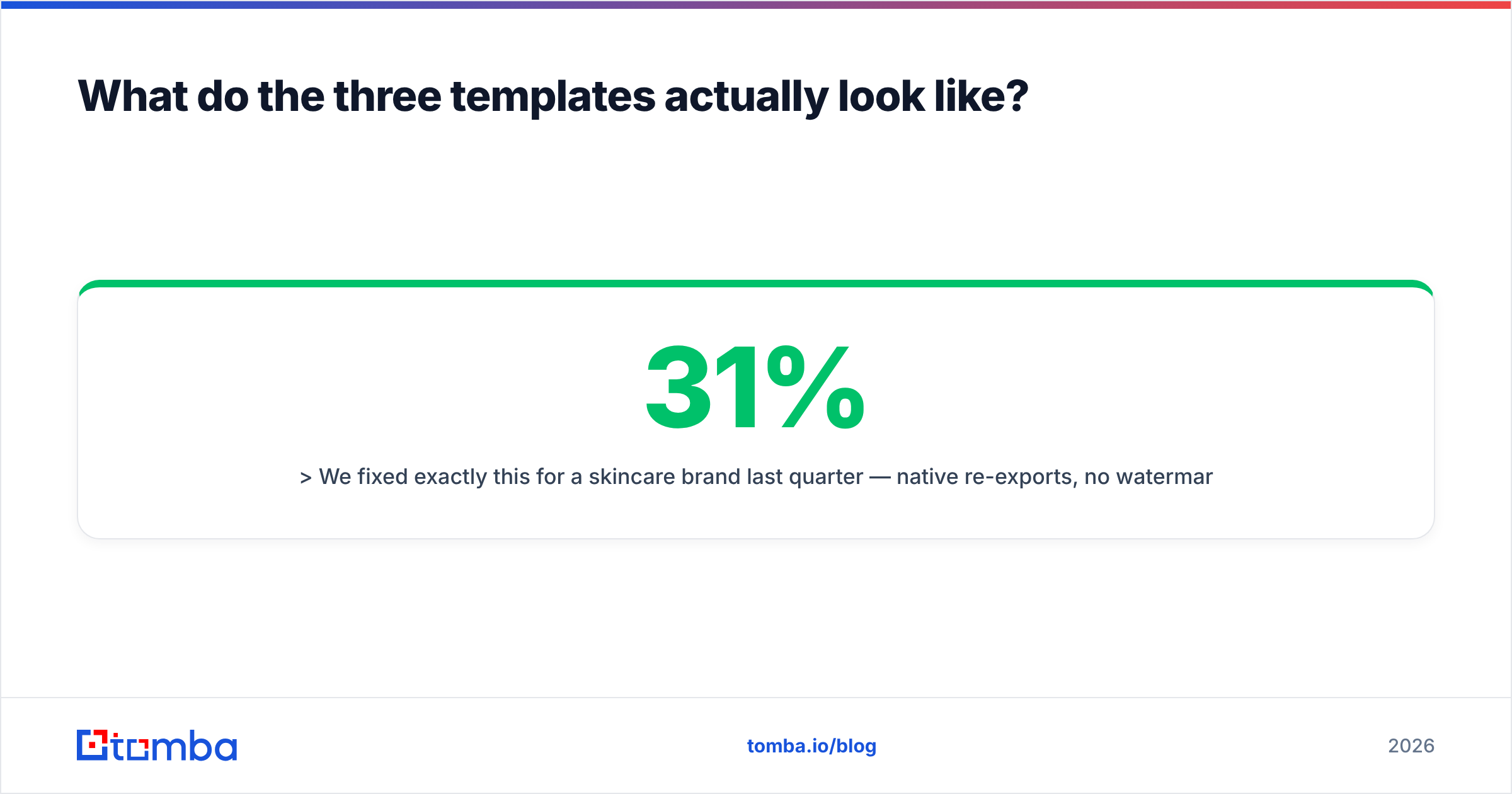
- The proof (1 sentence, max). One number from one comparable client. Not a logo wall. "We rebuilt native Reels for a DTC skincare brand and their 3-second view rate went from 31% to 58% in six weeks."
- The ask (1 sentence). Low friction. Not "a 15-minute call." Something the prospect can say yes to without opening a calendar.
- The signature. No banner image, no legal footer, no "Sent from my iPhone" theater. Name, role, one link.
That's it. The template is 90 words. If yours is 220, you've padded slots 3 and 4.
The reason this shape works is that it inverts the normal cold email: it spends its first and best sentence on the prospect and its last sentence on you. Most agency emails do the reverse. HubSpot's sales research has been saying some version of this for a decade, and it's still ignored, which is good news for you.
What do the three templates actually look like?#
Use whichever matches what you found during research. Don't force a template onto a prospect it doesn't fit.
Template 1 — The audit hook#
Use when you found a concrete, fixable problem.
Subject: your Reels vs your TikToks
Hi Sarah,
Your TikTok cuts are getting 40k+ views, but the same clips reposted to Reels are averaging under 3k. The reposts still have the TikTok watermark, which Instagram down-ranks.
We fixed exactly this for a skincare brand last quarter — native re-exports, no watermark, and their Reels 3-second view rate went from 31% to 58% in six weeks.
Want me to send a two-minute Loom breaking down your last five Reels? No call needed.
— Marcus, BrightReach
The ask is a Loom, not a meeting. You're trading a small piece of free work for permission to continue. Roughly one in four people who accept a Loom will take a call afterward, because now you've done something for them.
Template 2 — The competitor gap#
Use when the prospect is losing ground to a named rival and you can prove it in one line.
Subject: Glossier is posting 4x your cadence on Threads
Hi Dan,
Quick observation: your team posts to Threads about twice a week. Two of your closest competitors are at eight to ten, and both are seeing 3–5x the reply volume you are.
Threads is the only major platform right now where organic reach still rewards raw volume over production quality. That window closes.
I pulled a 90-day Threads cadence plan for a brand in your category. Want it? It's a Google Doc, takes you five minutes to read.
— Marcus
Naming a competitor is the sharpest tool in cold email and the easiest to misuse. Only do it when the comparison is factual and public. Never editorialize about the competitor's quality.
Template 3 — The content-signal reply#
Use when the prospect published something — a podcast, a LinkedIn post, a job listing.
Subject: re: your social media manager posting
Hi Priya,
Saw you're hiring a social media manager. Two months of recruiting, then three months of ramp — that's five months before your first native TikTok ships.
Not saying don't hire. Saying you could run the channel with us for those five months and hand your new manager a working system on day one instead of a blank calendar.
If that's interesting, I'll send our five-month bridge scope. If not, ignore this and good luck with the search.
— Marcus
The "ignore this" line is not humility theater. It measurably increases replies, because it removes the pressure that makes people freeze rather than answer.

Which template fits which prospect?#
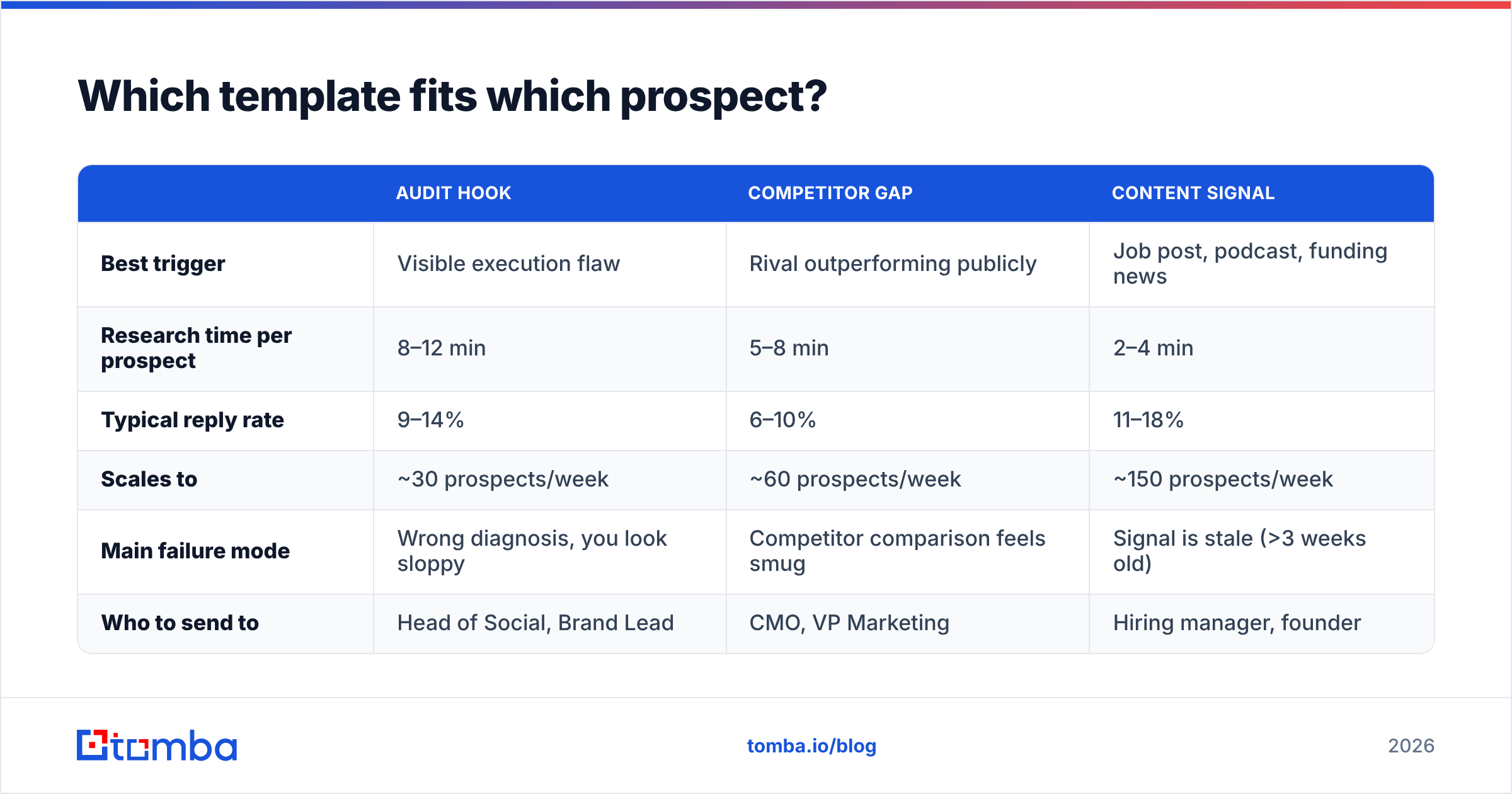
| Audit hook | Competitor gap | Content signal | |
|---|---|---|---|
| Best trigger | Visible execution flaw | Rival outperforming publicly | Job post, podcast, funding news |
| Research time per prospect | 8–12 min | 5–8 min | 2–4 min |
| Typical reply rate | 9–14% | 6–10% | 11–18% |
| Scales to | ~30 prospects/week | ~60 prospects/week | ~150 prospects/week |
| Main failure mode | Wrong diagnosis, you look sloppy | Competitor comparison feels smug | Signal is stale (>3 weeks old) |
| Who to send to | Head of Social, Brand Lead | CMO, VP Marketing | Hiring manager, founder |
Read the last row again. The template and the recipient are coupled. An audit of Reels performance sent to a CFO is noise. The same audit sent to the person whose quarterly review depends on Reels performance is a lifeline.
Which means the whole system rests on getting the right name and the right address — not a role alias.
Does your list matter more than your copy?#
Yes, and it isn't close.
Run the arithmetic. You send 500 emails with a brilliant template. Twelve percent bounce because you guessed the pattern. Another 18% land in info@ and never reach a human. Of the 350 that arrive at a real person, maybe 40% are the wrong person for that message.
You wrote a 14%-reply-rate email and shipped it to 210 correct humans. Your actual outcome is 29 replies, and your domain reputation took a hit from the bounces that will suppress the next campaign too.
Now run it with a clean list. Zero-to-two percent bounce, every address a named individual, every individual role-matched to the template. Same copy, ~68 replies. Nothing about your writing changed.
This is why verification is not a nice-to-have step. Use an email verifier on every list before it touches your sending tool, and use a domain search to pull the actual named contacts at a company rather than scraping whatever alias sits on the contact page. If you're working from a list of target companies, bulk email finder tools turn a spreadsheet of domains and names into verified, role-matched addresses in one pass.
A note on catch-all domains, which are common at agencies and enterprise brands: they accept every address at the SMTP layer, so a naive verifier marks them "valid" and you never learn the truth until the bounce. A dedicated catch-all verifier is the only way to separate real mailboxes from black holes on those domains.
If you'd rather buy a list than build one, BookYourData is a solid, well-regarded option in that space — just verify anything you buy before you send, regardless of vendor guarantees.
How do you personalize at scale without sounding like a robot?#
Personalization has three tiers, and only one of them is worth your time.
- Tier 1 — Merge tags.
{{first_name}},{{company}}. Everyone does this. It buys you nothing. A merge tag is table stakes, not personalization. - Tier 2 — Category personalization. "As a DTC skincare brand…" This is a mail-merge in a trench coat. Prospects recognize it instantly because you're describing a segment, not them.
- Tier 3 — Observation personalization. One sentence that could only have been written about this one company by someone who spent eight minutes looking. This is the entire game.
Tier 3 does not scale infinitely, and pretending otherwise is how agencies burn domains. It scales to about 30–60 well-researched emails a week per SDR. That's fine. Thirty emails at a 12% reply rate produce more pipeline than 3,000 at 0.3% — and one of those two numbers destroys your sender reputation.
Where automation genuinely helps is in the steps around the observation: finding the right person, verifying the address, enriching the record with role and seniority so you know which template to reach for. Data enrichment does that in bulk. Writing the observation is still your job, and AI writing it for you is obvious to everyone who reads it.

How many follow-ups, and what do they say?#
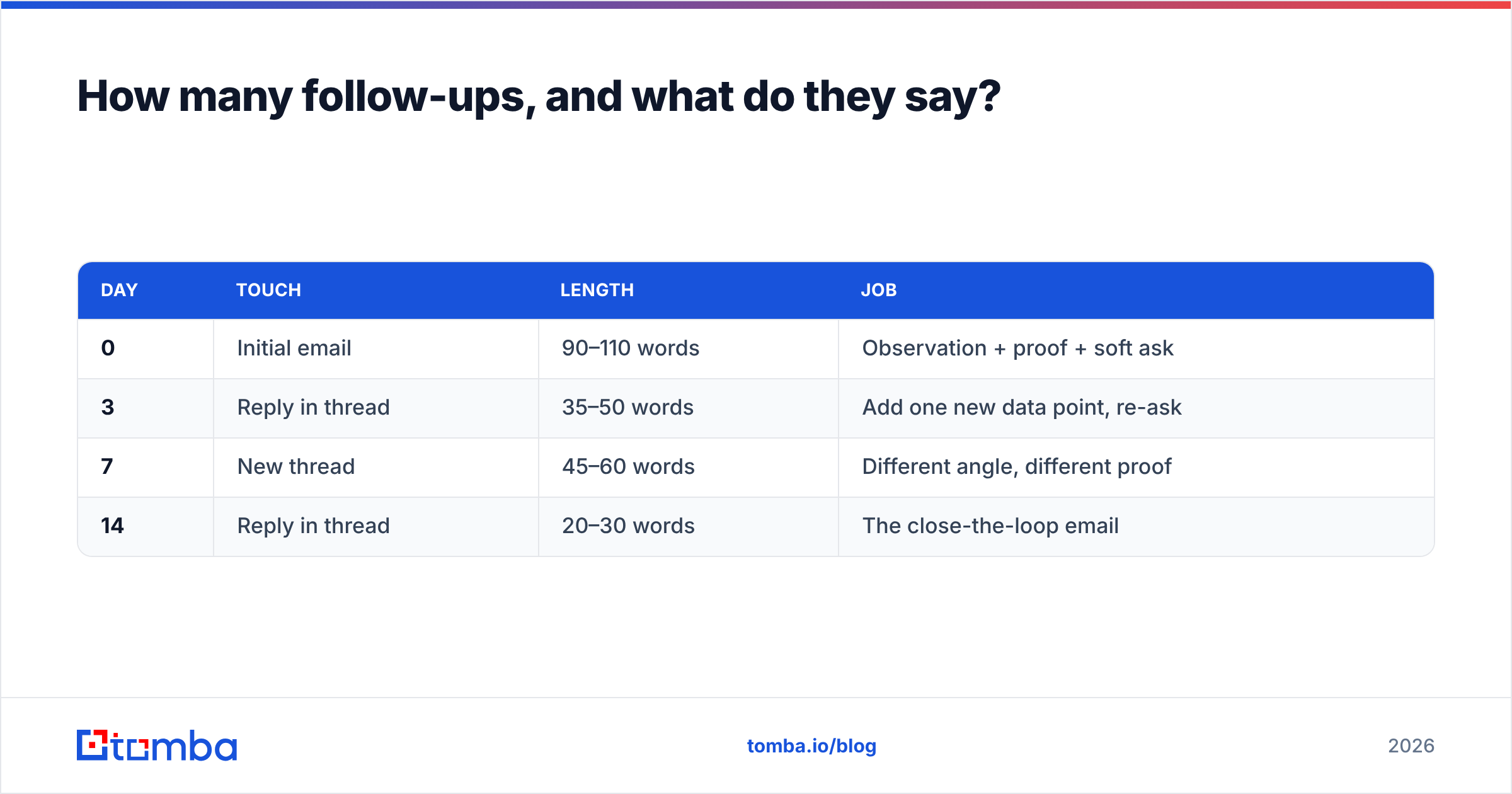
Four touches over 14 days. Each one shorter than the last. Never a new pitch — a new angle on the same ask.
| Day | Touch | Length | Job |
|---|---|---|---|
| 0 | Initial email | 90–110 words | Observation + proof + soft ask |
| 3 | Reply in thread | 35–50 words | Add one new data point, re-ask |
| 7 | New thread | 45–60 words | Different angle, different proof |
| 14 | Reply in thread | 20–30 words | The close-the-loop email |
The day-14 email is the one that works and the one nobody sends:
Hi Sarah — closing the loop on this. If Reels aren't a priority this quarter, totally fair. Should I check back in Q4, or take you off the list?
It gets replies because it offers an easy exit, and people take easy exits by answering. Roughly a third of the replies you'll get from a four-touch sequence arrive on this email. A meaningful share of those are "actually, let's talk."
Do not send touch five. Do not restart the sequence in 30 days with a new subject line. Both behaviors are how you end up on a blocklist. If you're unsure of your domain's standing, run a blacklist checker before scaling any sequence.
What metrics tell you the template is working?#
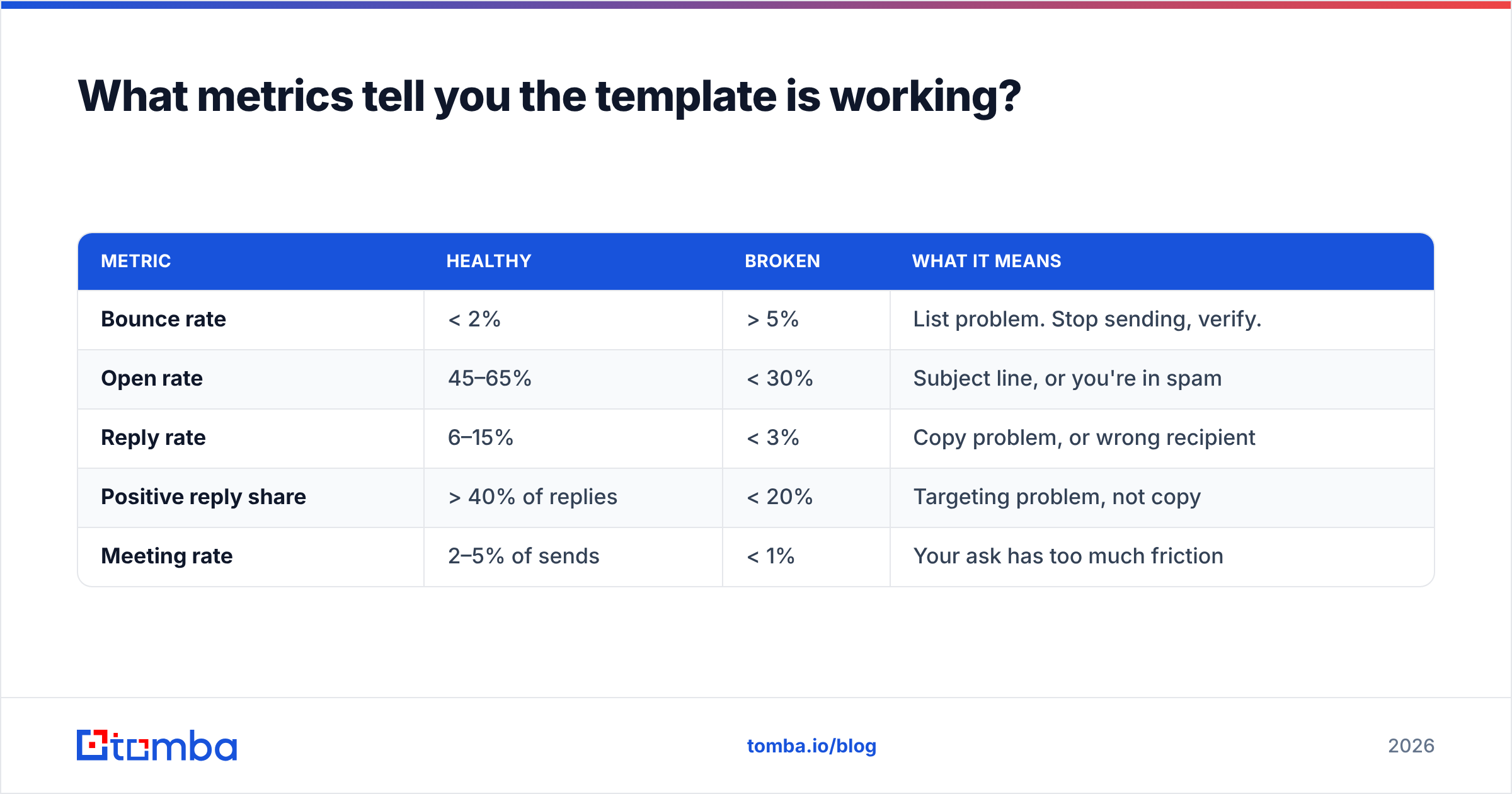
Reply rate is the only number that matters, but it's the last one to move. Diagnose upstream first.
| Metric | Healthy | Broken | What it means |
|---|---|---|---|
| Bounce rate | < 2% | > 5% | List problem. Stop sending, verify. |
| Open rate | 45–65% | < 30% | Subject line, or you're in spam |
| Reply rate | 6–15% | < 3% | Copy problem, or wrong recipient |
| Positive reply share | > 40% of replies | < 20% | Targeting problem, not copy |
| Meeting rate | 2–5% of sends | < 1% | Your ask has too much friction |
Note the fourth row. If you're getting replies but they're all "not interested," your copy is fine and your list is wrong. Most agencies read a low positive-reply share as a copywriting failure and rewrite the email six times. They should have rebuilt the list.
Open rate has gotten noisier since Apple's Mail Privacy Protection began pre-loading images, so treat it as directional. If you want a primer on how these signals fit together, Gartner and the practitioner reviews on G2 are more useful than most agency blogs, and the email marketing fundamentals haven't changed as much as vendors want you to believe.
What are the mistakes that kill an otherwise good template?#
- Subject lines in title case. "Quick Question About Your Social Media Strategy" reads like marketing. "your Reels vs your TikToks" reads like a colleague.
- Attachments in email one. Deliverability penalty, and nobody opens them.
- Three asks in one email. "Book a call, or reply, or check out our case study." Pick one.
- Calendar links in the first touch. You're asking for time before you've earned attention. Link the calendar in touch three.
- Claiming results you can't source. "300% growth" without a name, a timeframe, and a metric definition is noise. One specific number from one named category beats four vague ones.
- Sending from your main domain. Use a separate sending domain for cold outreach. Warm it properly — a warmup calculator will tell you how long, and it's longer than you want it to be.
Where should you start this week?#
Pick 30 target accounts. For each one, spend ten minutes finding the person who owns social — not the CMO, not info@, the person whose name appears when someone tags the brand's account. Verify the address. Write the observation. Send template one.
Thirty emails. Two weeks. Four touches. Then look at your positive-reply share and decide whether the problem was the copy or the list.
It's usually the list.
Get the addresses right before you get the copy right. The Tomba Email Finder resolves named contacts at any company domain, verifies them against live SMTP and catch-all checks, and hands you a list you can actually send to. The free tier gives you 25 searches a month — enough to build your first 30-account list before you spend a dollar. Paid plans start at $49/mo (Starter), $99/mo (Growth), and $249/mo (Pro); the full breakdown is on the Tomba pricing page. Build the list, then write the email that deserves it.
Related guides#
// get started
Find, verify and enrich your first contacts today
Start on the free plan with 25 searches a month, then scale when your team is ready.
Free plan · No credit card required · GDPR & CCPA
// about the author